World Cup 2018: Which Countries Are (and Aren’t) Members of FIFA?

This is an updated edition of our FIFA member countries article. The original version, from 2014, is here.
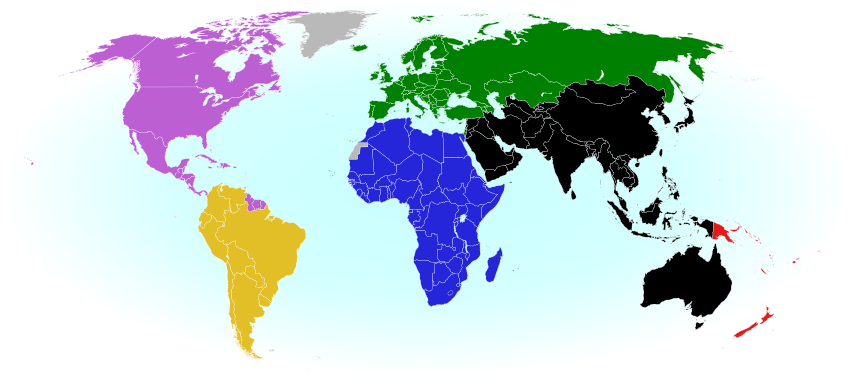
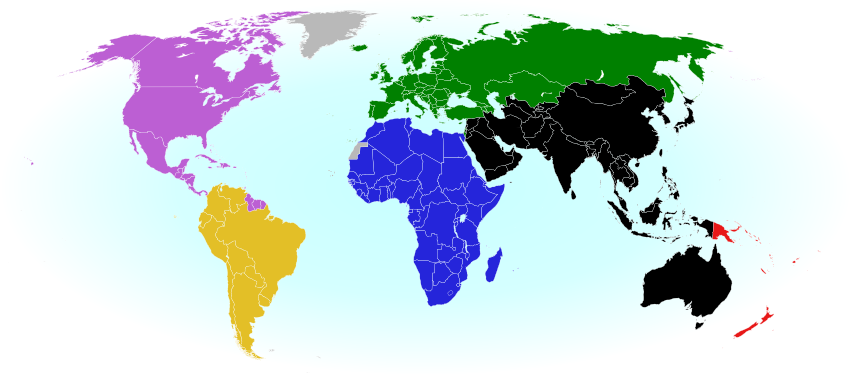
2018 world map showing the six continental confederations of men's national association football (soccer) teams, including all FIFA national teams and World Cup countries. Colorblind accessible.
The six continental confederations of national football teams associated with FIFA. Most, but not all, confederation members are individually members of FIFA as well. Map by Evan Centanni, based on work by EOZyo (source).

Around the world, fans of association football – also known in many countries as “soccer” – are tuning in today for the beginning of the month-long FIFA World Cup in Russia. Not all the world’s countries can advance to the cup, but did they all get a shot at it? Which countries were eligible to enter the tournament, and which are excluded? Read on for our exclusive guide to the roster of FIFA national football teams…

How many FIFA national teams are there?

There are currently 211 national football teams with official FIFA membership, which is required to compete for qualification in the World Cup. FIFA members are divided into six continental confederations that preside over competitions within each region (see map above), though it’s possible to be a member of one of these confederations but not of FIFA.

The confederations are loosely based on the geographical boundaries of the world’s continents, but there are some exceptions: The Asian Football Confederation also includes Australia, Guam, and the Northern Mariana Islands (usually considered part of Oceania), while culturally Caribbean countries, including South America’s Guyana, Suriname, and French Guiana, are grouped with North and Central America. As in the Olympics, Israel is a member of the European confederation despite its location on the Asian continent. Turkey, Kazakhstan, Armenia, Azerbaijan, and Georgia are also grouped with Europe even though each one is technically located mostly in Asia.

FIFA members that aren’t independent countries

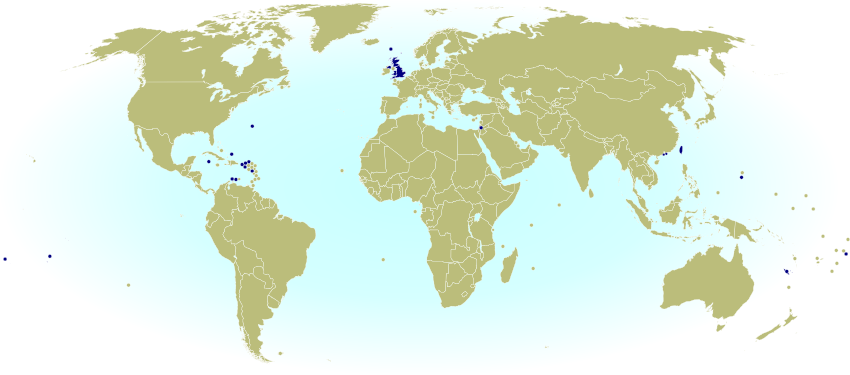
You might have noticed that 211 is more than the number of actual independent countries in the world. After all, the United Nations only recognizes 195. That’s because, much like the Olympics, FIFA used to allow dependent territories to apply for membership. Now it mostly only admits recognized independent countries, but teams that became members in the past are allowed to stay on regardless of their sovereignty status, and exemptions to the rule are possible. Today there are 19 dependent territories with FIFA-eligible national football teams:
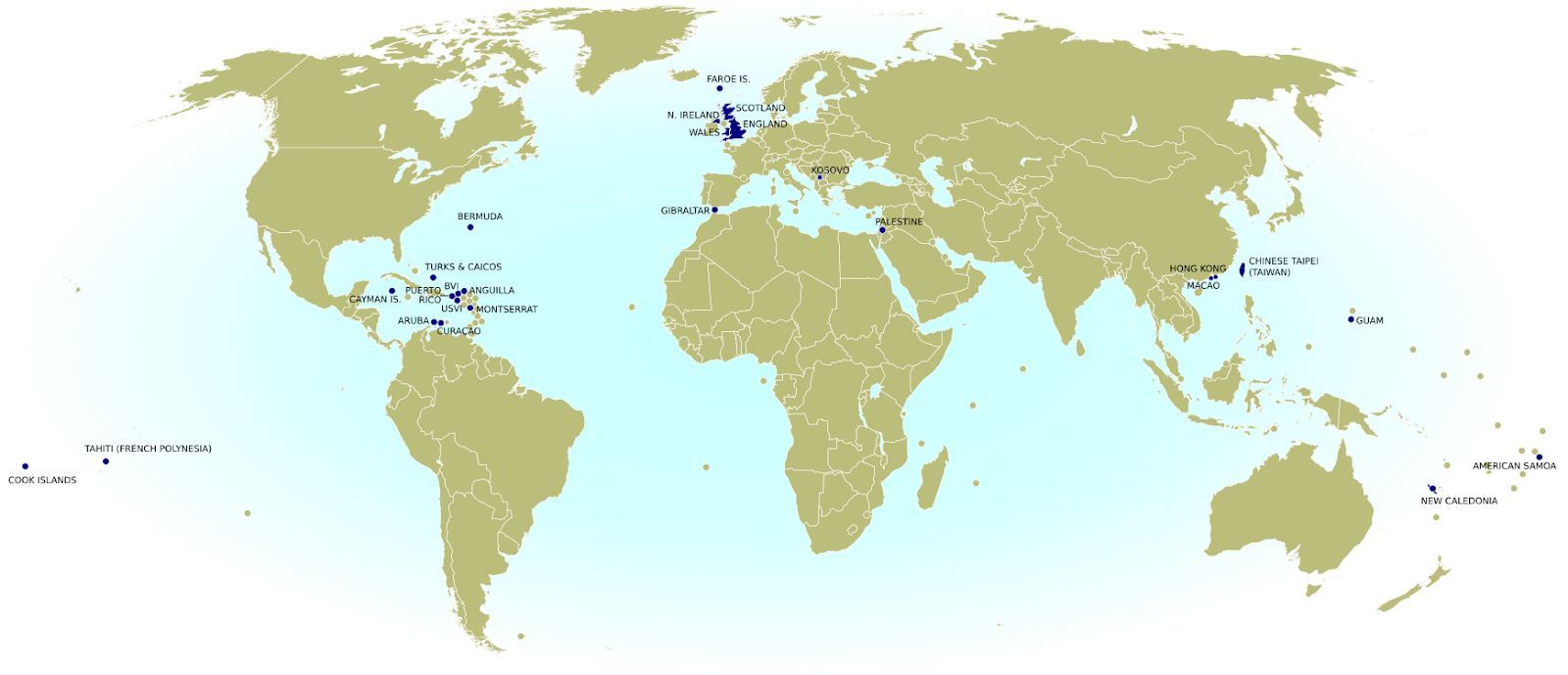
World map showing recognized FIFA national teams that represent dependent territories, partially-recognized or unrecognized countries, and subnational entities. None are independent countries, but all are eligible to qualify for the FIFA World Cup of men's association football/soccer. Map updated to 2018. Colorblind accessible.
Click to enlarge: FIFA members that aren’t UN member countries, including dependent territories, partially recognized states, and national subdivisions. By Evan Centanni, from public domain base map (source).

North America & the Caribbean
 Anguilla (UK)
 Aruba (Netherlands)
 Bermuda (UK)
 British Virgin Islands (UK)
 Cayman Islands (UK)
 Curaçao (Netherlands)
 Montserrat (UK)
 Puerto Rico (US)
 Turks & Caicos Islands (UK)
U.S. Virgin Islands (US)

Asia
 Hong Kong (China)
 Guam (US)
 Macau (China)

Europe
 Faroe Islands (Denmark)
 Gibraltar (UK)

Oceania
 American Samoa (US)
 Cook Islands (New Zealand)
 New Caledonia (France)
 Tahiti (France)

By tradition, each of the four “countries” making up the UK also has a separate team, despite not being independent:

 England
 Northern Ireland
 Scotland
 Wales

Also as in the Olympics, disputed countries Palestine, Kosovo, and Taiwan (known in international sports as “Chinese Taipei“) are included as special cases without the requirement for fully-recognized independence. In fact, Palestine is now treated as an independent country by the UN, but that wasn’t yet the case when it was first admitted to FIFA in 1998.

New FIFA national teams since 2014

No national teams have left FIFA in the four years since the 2014 World Cup in Brazil, but there are two new ones that have been added.

Europe’s disputed, self-declared Republic of Kosovo was accepted in June 2016, after the FIFA congress decided it had gathered enough recognition from the world’s countries to be considered independent – despite opposition from Serbia, which claims Kosovo as a part of it. Kosovo was also accepted into the Olympics in 2014, but still isn’t treated as an independent country by the United Nations (UN).

At the same time, FIFA also accepted Gibraltar, a British territory in southwestern Europe, as a national team. Since Gibraltar isn’t independent, and its status as a British territory is disputed by Spain, it was rejected from FIFA at first. But in early 2016, a world sports court ruled that its application had to be reconsidered, and within a few months, it was approved.

Which countries aren’t members of FIFA?

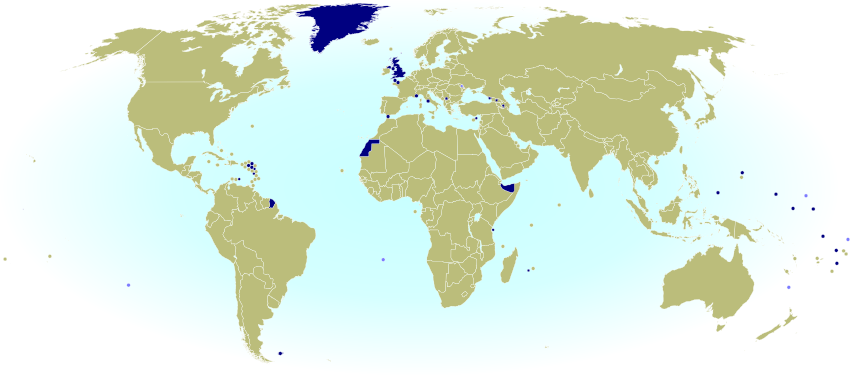
As we’ve seen, even some dependent territories are FIFA members – but there are actually a few independent countries that still aren’t:

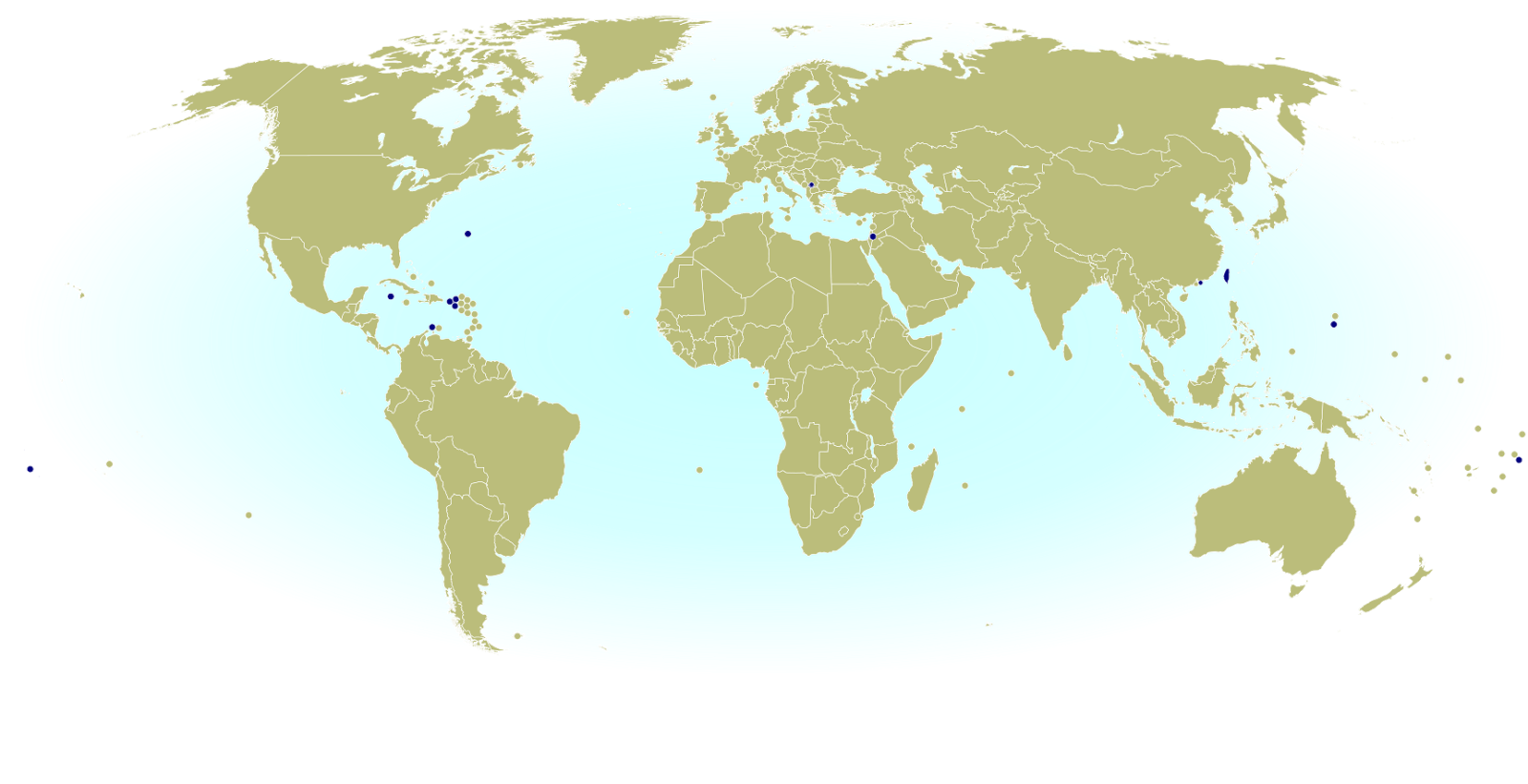
Map of countries and territories with FIFA-unrecognized national football teams, plus those with no national team. Includes recognized countries, breakaway states, and dependent territories. Colorblind accessible.
Click to enlarge: FIFA non-members – countries, claimed countries, dependent territories, and any national subdivisions that participate in continental confederations but are not recognized by FIFA. Map by Evan Centanni, from public domain base map (source).

Europe
  Monaco
 United Kingdom (UK)
   Vatican City

Oceania
 Kiribati
 Marshall Islands
 Micronesia
 Nauru
 Palau
 Tuvalu

The Marshall Islands is the only UN-recognized independent country without a national team at all. All the others do have teams (yes, even Vatican City!), but aren’t members of FIFA. That means they’re not eligible even to enter into qualifying matches for the World Cup – though Kiribati and Tuvalu do participate as associate members in the Oceania Football Confederation (OFC), which is associated with FIFA.

And even though Palestine, Taiwan, and Kosovo have managed to secure membership in FIFA, other partially-unrecognized countries haven’t. There are ten non-FIFA teams belonging to unrecognized but independently-governed countries:

 Abkhazia
 Artsakh (Nagorno-Karabakh)
 Donetsk People’s Republic
 Kosovo
 Luhansk People’s Republic
 Northern Cyprus
 Somaliland
 South Ossetia
 Transnistria
 Western Sahara

Transnistria, a self-declared republic in Eastern Europe that’s not recognized by any UN member country, first formed its own national football team in 2015, so it’s been added to the this list since the last World Cup. The less well-established Donetsk and Luhansk People’s Republics, which declared independence from Ukraine in 2014, apparently have their own national teams now as well.

CONIFA, an organization for non-FIFA football, counts almost another 30 “national” teams among its members, many of them representing separatist states or marginalized ethnic groups within FIFA member countries. You can see the full list of those here.

Several other dependent territories and remote islands have their own national teams as well, even if they’re not members of any major confederation. And ten dependent territories and country subdivisions have full or associate membership in the FIFA-connected continental confederations, even though they haven’t been accepted into FIFA itself:

Africa
 Réunion (France)
 Zanzibar (Tanzania)

North America and the Caribbean
 Bonaire (Netherlands)
 French Guiana (France)
 Guadeloupe (France)
 Martinique (France)
 Saint-Martin (France)
 Sint Maarten (Netherlands)

Asia
 Northern Mariana Islands (US)

Oceania
 Niue (New Zealand)

Which countries qualified for the 2018 FIFA World Cup in Russia?

Even if a country is an eligible FIFA member, it still has to compete in the pre-tournament qualification process before moving on to the actual World Cup. In the 2018 World Cup, for the first time ever, every single national team in FIFA registered to compete in the qualifiers (209 teams that registered on time, plus new members Kosovo and Gibraltar who were allowed to join later). Besides Kosovo and Gibraltar, Bhutan and South Sudan also tried out for the first time.

Out of the 211 eligible countries, only 32 are allowed to continue into the final World Cup tournament in Russia. Iceland and Panama have both qualified for the first time ever, while four-time champion Italy has gotten locked out for the first time since 1958. Other major players that won’t make it this year include the US, the Netherlands, Cameroon, and Chile. England is the only qualifying team not representing an independent, UN-recognized country (remember, England is just one part of the UK).

Here’s a full map of eligible and qualifying national teams in this year’s World Cup – you can find all the details on Wikipedia.

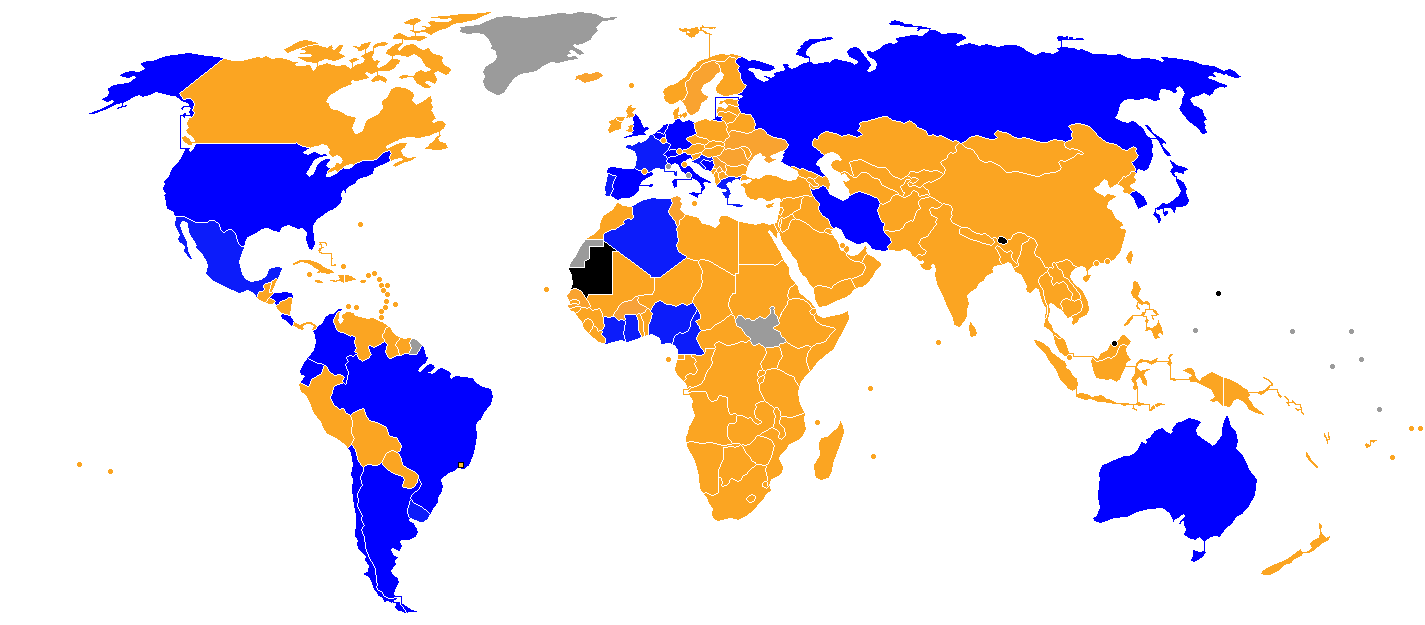
World Cup Countries 2018: Map of FIFA qualifying teams for the 2018 World Cup in Russia. Color-coded for qualified World Cup national teams, countries that were eliminated in the qualifiers, and countries that were expelled from the tournament before playing any matches.
Blue = countries qualifying for the 2018 FIFA World Cup; Orange = countries eliminated in the qualifying rounds; Black = countries expelled before playing any matches; Gray = countries and dependent territories that aren’t FIFA members. Map by 2Nyte and other Wikimedia Commons users (source; CC BY-SA).

Have something to ask or say about FIFA or non-FIFA countries while you’re watching the World Cup? Tweet to us @PolGeoNow!

Parade of Nations: Which Countries Are (and Aren’t) in the Olympics? (PyeongChang 2018)

This is an updated version of an article first published in 2012. You can also read the London 2012, Sochi 2014, and Rio 2016 versions.

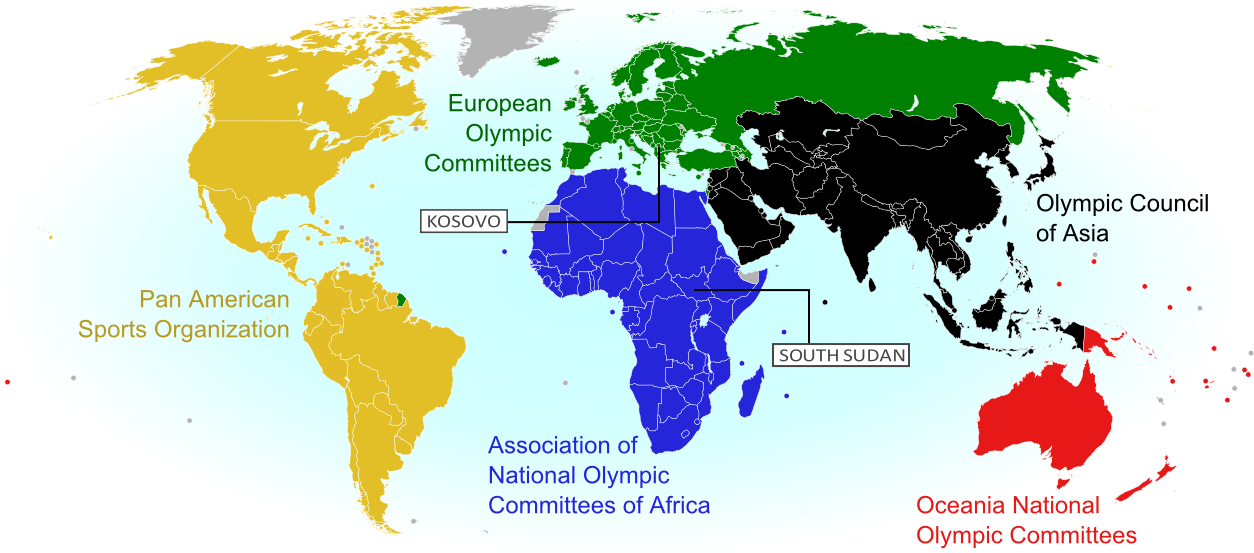
World map showing the five continental associations of National Olympic Committees, including all nations eligible for the PyeongChang 2018 Olympic Games.
Map of all countries in the Olympics and their regional associations. By Evan Centanni, modeled after this map.

The 2018 Winter Olympics in Pyeongchang County, South Korea officially open tomorrow, February 9th! They’ll be the second Olympics to be hosted in South Korea, after the 1988 Summer Games. These are also only the thirdever Winter Olympics to be held outside of Europe and North America, following up the 1972 and 1998 games hosted by Japan.

Of course, it wouldn’t be an Olympic opening ceremony without the Parade of Nations. But how many countries are there in the games, and is everyone included? Read on for PolGeoNow’s updated guide to the roster of Olympic Nations…

How many countries are in the Olympics?

There are currently 206 recognized Olympic Nations, represented by a National Olympic Committee (NOC) in each country. The International Olympic Committee (IOC) presides over the Olympic Games themselves, and the NOCs are divided between five continental associations (see map above).[1]

If 206 countries sounds like too many, don’t worryyou’re not going crazy. The UN only recognizes 195 countries worldwide (See: How Many Countries Are There in the World?). So what gives? Well, it turns out the IOC used to be more relaxed than the UN about requirements for nationhood…

Dependent territories that are Olympic Nations

Before 1995, countries’ overseas territories and other dependencies were allowed to qualify for the Olympics on their own, since many are self-governing and technically not “part of” the countries they belong to. The ones that got approved before the rules changed have been grandfathered in, and today ten of those territories hold Olympic Nation status:

World map marking dependent territories and partially recognized countries (de facto sovereign states) that have recognized National Olympic Committees and are allowed by the IOC to participate in the Olympic Games
Click to enlarge: Dependent territories and partially recognized countries admitted to the Olympics.

Americas
 Aruba (Netherlands)
 Bermuda (UK)
 British Virgin Islands (UK)
 Cayman Islands (UK)
 Puerto Rico (US)
 Virgin Islands (US)

Asia
 Hong Kong (China)

Oceania
 American Samoa (US)
 Guam (US)
 Cook Islands (New Zealand)

Unrecognized countries that are Olympic Nations

These days, to qualify as a new Olympic Nation you have to be an “independent State recognised by the international community“. The usual way to meet that requirement is to become an official member of the United Nations (UN). But there are actually three non-UN countries that also participate:

 Taiwan
 Palestine
 Kosovo

Taiwan– which is claimed by China but ruled as an independent country under a pre-communist version of the Chinese constitution – was allowed to stay after the communist government in Beijing took over UN  representation of Mainland China in 1979. But a compromise deal made at the time says Taiwan has to call itself “Chinese Taipei” in the games.[2]

Disputed Palestine, whose claimed territory is largely controlled by Israel, was admitted in 1995 for the sake of athletes in the Gaza Strip and West Bank, whose residents don’t have Israeli citizenship. Palestine has since been recognized as a UN observer state, but at the time it had no UN status. On the other hand, it had already been recognized individually by about 100 of the world’s countries (more than half of the UN’s members).

The third non-UN country in the Olympics, Kosovo, is a more recent addition. A region that controversially declared independence from Serbia in 2008, Kosovo has been blocked from UN membership by objections from Serbia, Russia, and other countries. Still, the IOC decided to admit Kosovo as an Olympic Nation in 2014 after about 55% of UN member countries had recognized Kosovan independence.

Which countries are new to the Olympics?

Though they’ve participated in the Summer Olympics before, this week there are six countries that will be joining the Winter Olympics for the first time ever:

 Ecuador
 Eritrea
 Kosovo
 Malaysia
 Nigeria
 Singapore

Most of these countries have only one athlete competing in PyeongChang 2018, except for Malaysia, which has two, and Nigeria, which has three. (Click the country names in the list for more information on their 2018 Olympic participants and sports!)

No entirely new Olympic Nations have been approved by the IOC since the Rio 2016 games, though PyeongChang 2018 will feature one very large national-level “team” that technically didn’t participate in previous Olympics. Because Russia has been suspended from the games over an ongoing drug-related cheating scandal, the Russian athletes allowed to individually participate this year can’t use the Russian flag or national anthem. Instead, they’ll be part of a special group called “Olympic Athletes from Russia (OAR)“, which uses the flag and national anthem of the Olympic Games.

And there’s one more technically-new team participating in this month’s Olympics: Korea. As a gesture of peace, North Korea and South Korea will be walking in the Parade of Nations under the Korean Unification Flag. They’ve done that before, at the 2000, 2004, and 2006 Olympics – but this year, for the first time ever, they’ll also compete together as a single team in one sport: ice hockey. In other sports, they’ll be competing separately as usual.

Why would the two Koreas want to make a gesture of unification? Because each country considers itself the rightful government of all Korea, and they agree on the basic principle that the Korean Peninsula should eventually be unified.

Learn More: What is North Korea, and how did it become divided from the South?

At the Rio 2016 games, there were two new Olympic Nations: Kosovo, the disputed breakaway state mentioned above, and South Sudan, which became independent and joined the UN in 2011, then was approved as an Olympic Nation in 2015. Before that, the last Olympics to have new countries were the 2008 Summer Games in Beijing, where the Marshall Islands, Montenegro, and Tuvalu were added to the list.

Which countries aren’t in the Olympics at all?

There’s only one UN-recognized independent country not represented in the Olympics: Vatican City, the independent Catholic Church headquarters in Rome, has never applied. Still, despite the inclusive and worldwide mission of the Olympic Games, not all applicants have been allowed in.

The ten dependent territories allowed to participate in the Olympics are only a select few, leaving most of the world’s overseas dependencies without their own teams (though athletes from the territories are allowed to apply for their patron countries’ teams). Self-proclaimed countries not recognized by the UN aren’t usually admitted either, even if they’re effectively independent. In fact, there are quite a few dependent territories and unrecognized countries that have created National Olympic Committees, or said they plan to, but haven’t been recognized by the IOC:

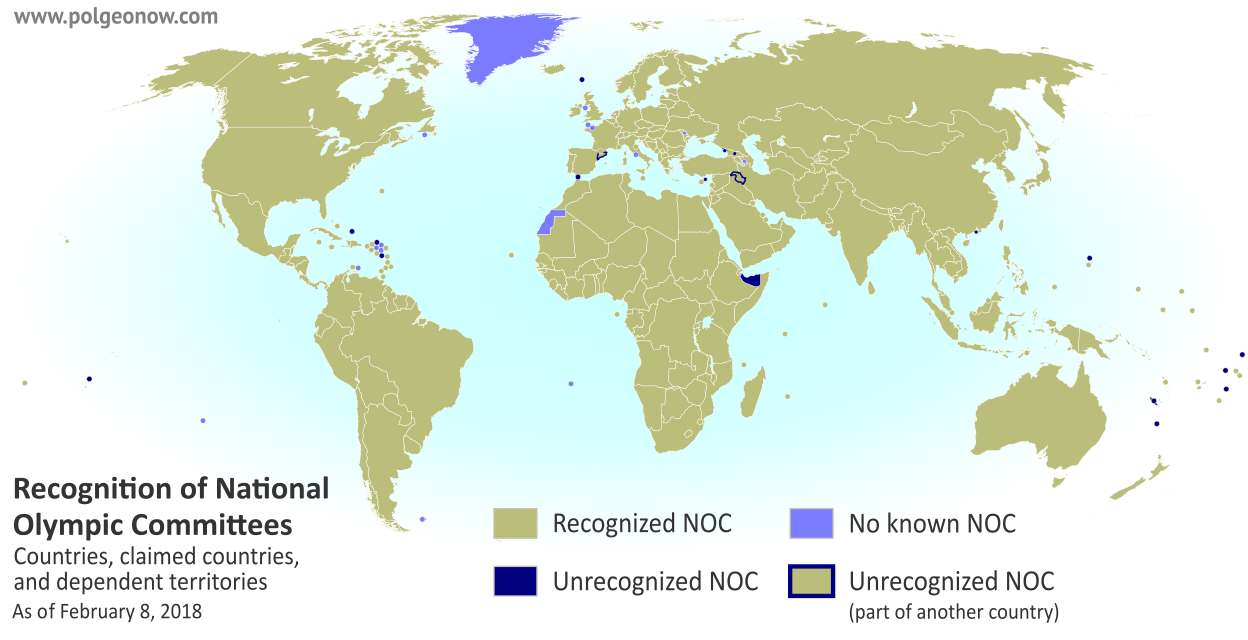
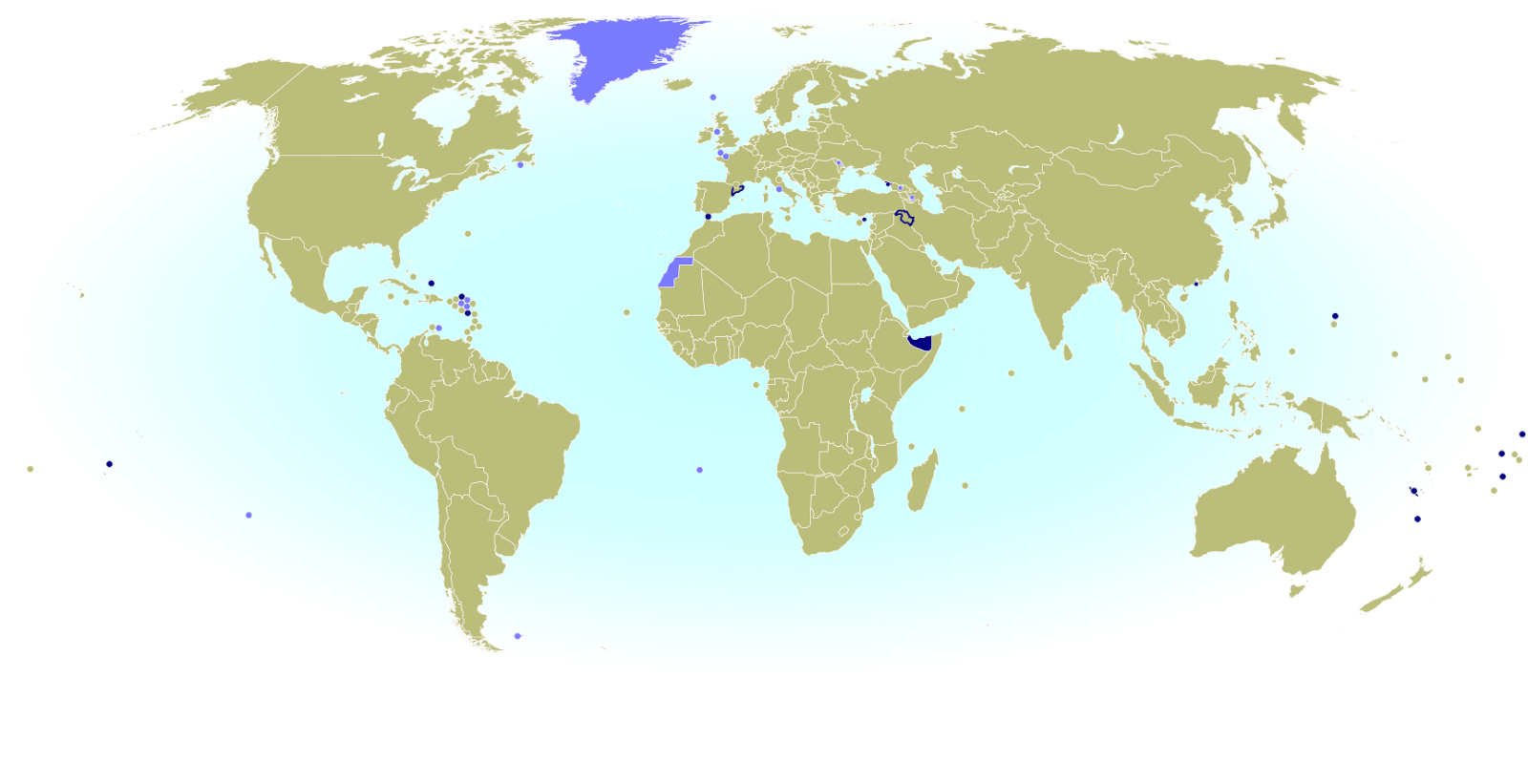
Countries not in the Olympics: World map marking independent countries (de facto sovereign states) and dependent territories that don't have IOC-recognized National Olympic Committees, and are thus not allowed to send their own teams to the Olympic Games
Click to enlarge: Territories and self-proclaimed countries not allowed to send teams to the Olympics.

Africa
 Somaliland (self-proclaimed country)

Americas
 Anguilla (UK territory)
 Montserrat (UK territory)
 Turks & Caicos (UK territory)

Asia
Kurdistan (autonomous region of Iraq)
 Macau (autonomous region of China)[3]

Europe
 Abkhazia (self-proclaimed country)
 Catalonia (region of Spain)
 Faroe Islands (associated state of Denmark)
 Gibraltar (UK territory)
 Northern Cyprus (self-proclaimed country)
 South Ossetia (self-proclaimed country)

Oceania
 New Caledonia (territory of France) [4]
 Niue (associated state of New Zealand) [4]
 Norfolk Island (outlying island of Australia) [4]
 Northern Mariana Islands (US territory) [4]
 Tahiti (territory of France) [4]
 Tokelau (territory of New Zealand) [4]
 Wallis and Futuna (territory of France) [4]

How many countries are attending the PyeongChang 2018 Olympic Games?

Being an Olympic Nation doesn’t mean you have to actually send athletes to every Olympics. And unlike the Summer Games, which sometimes feature every single recognized Olympic nation, it’s normal for a lot of countries to skip the Winter Olympics. Not surprisingly, most of the absentees are tropical countries where there are few chances to practice winter sports – though there are always a few exceptions. 

This year there are 91 nations participating in the games – a record high for the Winter Olympics, beating out the previous record of 89 nations from Sochi 2014. Adding in the special “Olympic Athletes from Russia” group and the joint Korea team (both discussed above under “Which countries are new?”), that leaves a total of 93 different flags athletes will compete under at PyeongChang 2018. Wikipedia has a full list of the participating teams, complete with links to the athlete rosters for each country.

About 20 of the teams are from tropical countries and territories, while the only real cold northern country missing is Russia, due to the ban on its official national team. Still, there are a few countries with snowy mountain ranges – like Nepal, Peru, Afghanistan, and Tajikistan – that are also sitting it out this winter.

Because the separate North Korea and South Korea teams are marching together under “Korea”, there will only be 91 delegations in the Parade of Nations (though North and South Korea will still compete under their separate flags for most sports). There’s a complete, ordered list of the 2018 Parade of Nations countries and flagbearers at Wikipedia.

Are you watching the Parade of Nations? Tweet to us @PolGeoNow with your thoughts or questions!

Footnotes

[1] The five associations are based closely on the world’s continents, but with a few quirks: The southern Caucasus, Israel, and eastern Turkey are part of the European association despite traditionally being considered part of Asia; and the South American territory of French Guiana also falls under European jurisdiction, because it’s considered part of France and doesn’t have a separate team.

[2] “Chinese Taipei” is intended to be ambiguous, since most Taiwanese people consider themselves to be at least culturally Chinese. However, the use of “Taipei” is unfortunate for the two-thirds of Taiwan’s people who don’t live in or near the city of Taipei. This was especially awkward when the 2009 World Games (an Olympics-affiliated event) were held in Kaohsiung, Taiwan – something of a rival city to Taipei. 

[3] Although Macau’s NOC isn’t recognized by the IOC itself, it has been accepted as a member of its continental organization, the Olympic Council of Asia. Macau participates in the Asian Games and Paralympic Games, but not in the regular Olympics.

[4] Seven dependent territories in Oceania are associate members of the Oceania National Olympic Committees. They’re allowed to participate in some regionally-organized sporting events, but not in the Olympics.

Parade of Nations: Which Countries Are (and Aren’t) in the Olympics? (Rio 2016)

This is an older version of our Parade of Nations article. Click here to see the newest edition!

This is an updated version of an article first published in 2012. You can also read the London 2012 and Sochi 2014 versions.

World map showing the five continental associations of National Olympic Committees, including all nations eligible for the Rio 2016 Olympic games. Labels newly recognized nations Kosovo and South Sudan.
Map of all countries in the Olympics and their regional associations. Two newest Olympic Nations labeled.
(By Evan Centanni, starting from public domain blank map and modeled after this Wikipedia map)

The 2016 Summer Olympics in Rio de Janeiro, Brazil officially open tonight, Friday, August 5th! They’ll be the first Olympics ever to be held in South America, and also the first in any Portuguese-speaking country. If that wasn’t enough, they’re also the first Summer Olympics to be held entirely in the winter!

Of course, it wouldn’t be an Olympic opening ceremony without the Parade of Nations. But how many countries are there in the games, and is everyone included? Read on for an exclusive updated guide to the roster of Olympic Nations…

How many countries are in the Olympics?

There are currently 206 recognized Olympic Nations, represented by a National Olympic Committee (NOC) in each country. The International Olympic Committee (IOC) presides over the Olympic Games themselves, and the NOCs are divided between five continental associations (see map above).[1]

If 206 countries sounds like too many, don’t worry, you’re not going crazy. The UN only recognizes 195 countries worldwide (See: How Many Countries Are There in the World?). So what gives? Well, it turns out the IOC has historically been more lax than the UN about requirements for nationhood…

Dependent Territories that are Olympic Nations

Before 1995, some dependent territories were allowed to qualify for the Olympics, and were allowed to stay even after the rules changed. Today, ten of these territories hold Olympic Nation status:

World map marking dependent territories and partially recognized countries (de facto sovereign states) that have recognized National Olympic Committees and are allowed by the IOC to participate in the Olympic Games
Click to enlarge: Dependent territories and partially recognized countries admitted to the Olympics.
(By Evan Centanni, from public domain base map)

Americas
 Aruba (Netherlands)
 Bermuda (UK)
 British Virgin Islands (UK)
 Cayman Islands (UK)
 Puerto Rico (US)
 Virgin Islands (US)

Asia
 Hong Kong (China)

Oceania
 American Samoa (US)
 Guam (US)
 Cook Islands (New Zealand)

Unrecognized countries that are Olympic Nations

These days, to qualify as a new Olympic Nation you have to be an “independent State recognised by the international community“. The most obvious way to meet that is to be an official member or observer state in the United Nations (UN). However, there are three non-UN countries that also participate:

 Taiwan
 Palestine
 Kosovo

Taiwan– which is claimed by China but ruled as an independent country under a pre-Communist version of the Chinese constitution – was allowed to stay after the Communist government in Beijing took over representation of Mainland China in 1979. However, a compromise deal made at the time says Taiwan has to call itself “Chinese Taipei” in the games.[2]

Disputed Palestine, whose claimed territory is largely controlled by the military of Israel, was admitted in 1995 for the sake of athletes in Gaza and the West Bank, whose residents don’t have Israeli citizenship. Palestine has since been recognized as a UN observer state, but at the time it had no UN status. However, it had already been recognized individually by about 100 of the world’s countries (more than half of the UN’s members).

The third non-UN country in the Olympics, Kosovo, is a new addition. A separatist state that controversially declared independence from Serbia eight years ago, Kosovo has never been allowed into the UN due to objections from Serbia, Russia, and others. But the IOC decided to admit Kosovo as an Olympic Nation in 2014, after about 55% of UN member countries had recognized the breakaway state as independent.

Which countries are new to the Olympics?

There are two new Olympic Nations that have been approved since the last games: Kosovo, the disputed breakaway state mentioned above, and South Sudan, which became independent and joined the UN in 2011. At the time of the 2008 and 2014 Olympics, South Sudan’s sports world wasn’t organized enough to even apply to join the IOC, but it finally got things together and was approved as an Olympic Nation in summer of 2015.

Although not an actual “nation”, there will be one other new national-level team attending Rio 2016: the Refugee Olympic Team. This team was put together by the IOC in honor of the record-high number of people in the world who have been forced to leave their home countries to escape wars. Its 10 hand-selected athletes, all of whom are refugees themselves, will have their own place in the Parade of Nations at the opening ceremony.

The last Olympic Games that had new countries were the 2008 Summer Olympics in Beijing, where the Marshall Islands, Montenegro, and Tuvalu were added to the list. There were no new Olympic Nations approved between then and the 2012 Summer Olympics in London, nor in time for the 2014 Winter Games in Sochi, Russia.

Read more:
New Olympic Nation: South Sudan
Kosovo becomes an Olympic Nation

Which countries aren’t included in the Olympics?

Despite the inclusive and worldwide mission of the Olympic Games, not all applicant countries have been allowed in. In fact, one UN-recognized country still hasn’t joined: UN observer Vatican City, the independent Catholic Church headquarters in Rome, has never applied.

The ten dependent territories allowed to participate in the Olympics are only a select few, leaving most of the world’s overseas dependencies without their own teams (though athletes from the territories are allowed to apply for their patron countries’ teams). Meanwhile, partially recognized or unrecognized countries aren’t usually admitted either, even if they’re effectively independent. In fact, there are quite a few National Olympic Committees that have been created locally but not recognized by the IOC. Here’s a partial list:

World map marking independent countries (de facto sovereign states) and dependent territories that don't have IOC-recognized National Olympic Committees, and are thus not allowed to send their own teams to the Olympics
Click to enlarge: Territories and sovereign states not represented in the Olympics. Light Blue: No NOC; Dark Blue: NOC not recognized by IOC. Also shown in dark blue outlines: subnational regions with unrecognized NOCs. (By Evan Centanni, from public domain map)

Africa
 Somaliland (unrecognized country)

Americas
 Anguilla (UK territory)
 Montserrat (UK territory)
 Turks & Caicos (UK territory)

Asia
 Iraqi Kurdistan (autonomous region of Iraq)
 Macau (autonomous region of China)[3]

Europe
 Abkhazia (partially recognized country)
 Catalonia (region of Spain)
 Gibraltar (UK territory)
 Northern Cyprus (partially recognized country)

Oceania
 New Caledonia (territory of France) [4]
 Niue (associated state of New Zealand) [4]
 Norfolk Island (outlying island of Australia) [4]
 Northern Mariana Islands (US territory) [4]
 Tahiti (territory of France) [4]
 Tokelau (territory of New Zealand) [4]
 Wallis and Futuna (territory of France) [4]

Which countries are attending the Rio 2016 Olympic Games?

Being an Olympic Nation doesn’t mean you have to actually send athletes to the Olympics every time. For example, many tropical countries choose to just skip the Winter Olympics altogether. But this year, all the Olympic Nations will have athletes participating in Rio…except one.

Kuwait, which is in a drawn out dispute with the IOC over rules about government interference in sports, will not have an official team at the games. However, Kuwaiti athletes are being allowed to participate as “independent Olympic athletes”, using the Olympic flag instead of the flag of Kuwait.

That makes a total of 205 official Olympic Nations participating in the Rio 2016 games – a record high, since in London 2012 there were only 204 recognized Olympic nations in the world (and they all did attend). Add the independent Kuwaiti athletes and the new Refugee Olympic Team, and there will be a total of 207 delegations in the Parade of Nations tonight.

More Details: 2016 Parade of Nations: List of countries and flagbearers in order of entrance

Footnotes

[1] The five associations are based closely on the world’s continents, but with a few quirks: The Caucasus, Israel, and eastern Turkey are part of the European association despite geographers usually putting them in Asia; and the South American territory of French Guiana also falls under European jurisdiction, because it’s considered part of France and doesn’t have a separate team.

[2] “Chinese Taipei” is intended to be ambiguous, since most Taiwanese people consider themselves to be at least culturally Chinese. However, the use of “Taipei” is unfortunate for the two-thirds of Taiwan’s people who don’t live in or near the city of Taipei. This was especially awkward when the 2009 World Games (an Olympics-connected event) were held in Kaohsiung, Taiwan – something of a rival city to Taipei. 

[3] Although Macau’s NOC isn’t recognized by the IOC itself, it has been accepted as a member of its continental organization, the Olympic Council of Asia. Macau participates in the Asian Games and Paralympic Games, but not in the regular Olympics.

[4] Seven dependent territories in Oceania are associate members of the Oceania National Olympic Committees. They’re allowed to participate in some regionally-organized sporting events, but not in the Olympics.

New Olympic Nation: South Sudan (Map)

Paid subscribers click here to view this article in the ad-free members area. Not a member yet? Subscribe now!
World map showing the five continental associations of National Olympic Committees. Shows all Olympic nations, and labels the two newest as of August 2015, Kosovo and South Sudan.
Map of all nations in the Olympics, and their regional associations. Two newest Olympic nations labeled.
Map by Evan Centanni, starting from this blank map and modeled after this map.

By Evan Centanni

In the Olympics at Last
Last weekend, South Sudan was officially recognized by the International Olympic Committee (IOC), the organization in charge of organizing the Olympic Games. The recently independent country, located in east-central Africa, will participate in the 2016 Olympics in Rio de Janeiro, Brazil.

See Also: Which Countries Are (and Aren’t) in the Olympics? (2014)

Flag of South SudanCountry Name:  
• South Sudan
Official Name:  
• Republic of South Sudan
Capital: Juba
(There are about 60 recognized national languages in South Sudan, but English is the country’s only “official working language”.)

South Sudan became independent and joined the UN in 2011, but for the last four years has been left out of the Olympics, apparently because it did not yet have a functioning national Olympic committee (NOC). But even though the country did not have an official team at the 2012 Olympics in London, one South Sudanese runner did attend those games as a specially-approved independent athlete.

The emergence of South Sudan’s NOC has come despite the country being locked in an ongoing civil war since 2013.

Other Newcomers
South Sudan is now one of 206 official Olympic nations, and the first new IOC member since disputed Kosovo was controversially admitted last December. Prior to South Sudan and Kosovo’s admissions, the newest Olympic members were Montenegro and Tuvalu, which both joined in 2007. Like South Sudan now, Montenegro was newly independent at that time.

You may also like: 
Which Countries Are (and Aren’t) in the Olympics?
Is South Sudan a member of FIFA?
All South Sudan articles on PolGeoNow

Graphic of the South Sudanese flag is in the public domain (source).

Kosovo Becomes an Olympic Nation

Premium members click here to view this article in the ad-free members area. Not a member yet? Subscribe now!
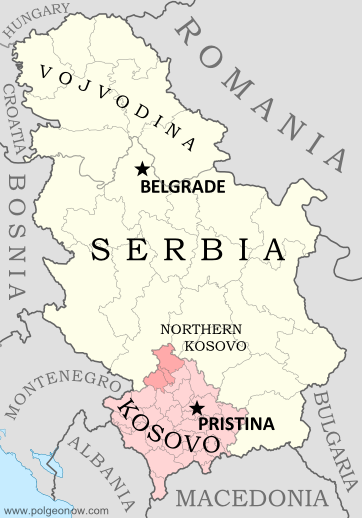
Map of Serbia, Kosovo, and North Kosovo
Kosovo controversially claims independence from Serbia (Northern Kosovo is under partial pro-Serbian control). Map by Evan Centanni, based on these two blank maps by Nord-NordWest. License: CC BY-SA

By Evan Centanni

Next Stop: Rio 2016
Disputed country Kosovo has become the 205th member of the International Olympic Committee (IOC), making it an official Olympic Nation and allowing it to field a team at the 2016 Olympics in Brazil. Its full acceptance came at an IOC meeting in Monaco on December 9, after being granted “provisional recognition” in October.

Kosovo’s admission process has been ongoing for five years, and the self-proclaimed country was denied the chance to participate in the London Olympics of 2012. However, one Kosovan athlete attended the games with the team from Albania, a neighboring country with close cultural ties to Kosovo.

Disputed Status
Located in southeastern Europe, Kosovo controversially declared independence from Serbia in 2008, while under the control of UN peacekeepers. Since then, it has been recognized as independent by over half of the world’s countries, including the US and most of the European Union. However, Russia, China and many other countries still consider it to be rightfully part of Serbia.

Flag of the Republic of KosovoCountry Name:  
• Kosovo (English, Serbian)
• Kosova (Albanian)
Official Name:  
• Republic of Kosovo (English)
Republika e Kosovës (Albanian)
Republika Kosovo (Serbian)
Capital: Pristina/Prishtina

Serbia strongly opposed Kosovo’s admission into the Olympics, arguing that Kosovan athletes had been invited to join the Serbian team. However, in the name of good sportsmanship, Serbia’s Olympic committee has declined to file a formal protest.

Rules and Precedents
Kosovo will become one of only three disputed countries allowed to send teams to the Olympics, after Taiwan (participating as “Chinese Taipei“) and Palestine. Other breakaway states, like Western Sahara, Abkhazia, and Northern Cyprus, are still shut out.

Most Olympic Nations are fully-recognized UN member countries, but the rules don’t explicitly require that. Official IOC regulations say only that every new member must be an “independent State recognised by the international community“. This has often been assumed to mean UN membership, but the IOC apparently decided it’s good enough to be recognized individually by 107 out of 193 UN member countries.

The last time the IOC admitted new members was in 2007, when Montenegro and Tuvalu both joined. Both of those countries were members of the UN prior to becoming Olympic Nations.

See Also: 
Which Countries Are (and Aren’t) in the Olympics?
Which Countries Recognized Kosovo as Independent?
 

Flag graphic by Cradel (source). License: CC BY-SA

World Cup 2014: Which Countries Are (and Aren’t) Members of FIFA?

Watching the 2018 World Cup? Check out our updated edition of this article!
 

World map showing the six continental confederations of national association football (soccer) teams, including all teams eligible for the World Cup
The six continental confederations of national football teams associated with FIFA. Not all confederation members are individually members of FIFA. Map by Evan Centanni, based on work by EOZyo (source).

Football/soccer fans around the world are tuning in tonight for the beginning of the month-long FIFA World Cup in Brazil. But how much do you know about which teams can compete? Which countries were eligible to enter the tournament, and which are excluded? Read on for an exclusive guide to the roster of FIFA national football teams…

Premium members click here to view this article in the ad-free members area. Not a member yet? Subscribe now!

How many countries participate in FIFA?
There are currently 209 national football teams with official FIFA membership, which is required to compete for qualification in the World Cup. FIFA members are divided into six continental confederations that preside over competitions within each region (see map above).*

You might have noticed that 209 is more than the number of actual independent countries in the world. After all, the United Nations only recognizes 195. That’s because, much like the Olympics, FIFA used to allow dependent territories to apply for membership. Now they only admit recognized independent countries (with a few exceptions), but teams that became members in the past are allowed to stay on regardless of their sovereignty status.

FIFA members that aren’t independent countries
Today there are 18 dependent territories with FIFA-eligible national football teams:

World map marking dependent territories, partially recognized sovereign states, and subnational entities which have national football (soccer) teams recognized by FIFA, making them eligible for the World Cup.
Click to enlarge: FIFA members that aren’t independent countries. By Evan Centanni, from public domain base map (source).

North America & the Caribbean
 Anguilla (UK)
 Aruba (Netherlands)
 Bermuda (UK)
 British Virgin Islands (UK)
 Cayman Islands (UK)
 Curaçao (Netherlands)
 Montserrat (UK)
 Puerto Rico (US)
 Turks and Caicos Islands (UK)
U.S. Virgin Islands (US)

Asia
 Guam (US)*
 Hong Kong (China)
 Macau (China)

Europe
 Faroe Islands (Denmark)

Oceania
 American Samoa (US)
 Cook Islands (New Zealand)
 New Caledonia (France)
 Tahiti (France)

By tradition, each of the four “countries” making up the UK also has a separate team, despite them not being independent themselves:

 England
 Northern Ireland
 Scotland
 Wales

Also as in the Olympics, disputed states Palestine and Taiwan (known in sports as “Chinese Taipei“) are included as special cases without the requirement for fully-recognized independence. In fact, Palestine is now treated as an independent country by the UN, but that wasn’t yet the case when it was first admitted to FIFA in 1998.

Changes since 2010
Since the last World Cup in 2010, one new country has joined FIFA: South Sudan. This East African nation only became independent in 2011, after the 2010 World Cup in South Africa was already over. It’s now fully eligible, but still wasn’t able to enter in this year’s Cup because qualification matches began just before it joined.

Meanwhile, the Netherlands Antilles were eligible for the last time in 2010, though they didn’t manage to qualify for the World Cup finals. Later that same year, the Dutch dependency was split into several separate territories, and its FIFA membership was inherited only by the largest island, Curaçao, which entered for the 2014 Cup but again didn’t qualify. Two of the other island territories, Bonaire and Sint Maarten, formed their own national teams but have not been accepted as FIFA members. However, they have been allowed to participate in their relevant continental organization, the Confederation of North, Central American and Caribbean Association Football (CONCACAF).

Which countries aren’t members of FIFA?
Even though quite a few dependent territories are FIFA members, there are still a few fully independent countries that aren’t eligible:

World map marking countries and dependent territories that aren't members of FIFA, and are thus ineligible to qualify for the World Cup
Click to enlarge: Countries and territories without FIFA membership. Dark Blue: national team not recognized by FIFA; Light Blue: no known national team. Map by Evan Centanni, from public domain base map (source).

Europe
  Monaco
 United Kingdom (UK)
   Vatican City

Oceania
 Kiribati
 Marshall Islands
 Micronesia
 Nauru
 Palau
 Tuvalu

The Marshall Islands are the only independent, UN-recognized country that don’t have any national team at all. All the others on the list do have teams (yes, even Vatican City!), but are not members of FIFA. This means they’re not eligible even to enter into qualifying matches for the World Cup, though Kiribati and Tuvalu do participate as associate members in the relevant continental organization, the Oceania Football Confederation (OFC).

Even though Palestine and Taiwan managed to secure membership, other partially unrecognized countries haven’t been able to get into FIFA. There are seven non-FIFA teams belonging to de facto independent countries:

 Abkhazia
 Kosovo
 Nagorno-Karabakh
 Northern Cyprus
 Somaliland
 South Ossetia
 Western Sahara

Another unrecognized breakaway state, Transnistria, doesn’t have a national team.

Finally, there are many dependent territories that have never been able to get into FIFA. Of these, eleven territories or country subdivisions have full or associate membership in the continental confederations, but not in FIFA itself:

Africa
 Réunion (France)
 Zanzibar (Tanzania)

North America and the Caribbean
 Bonaire (Netherlands)
 French Guiana (France)*
 Guadeloupe (France)
 Martinique (France)
 Saint-Martin (France)
 Sint Maarten (Netherlands)

Asia
 Northern Mariana Islands (US)*

Europe
 Gibraltar (UK)

Oceania
 Niue (New Zealand)

Which countries qualified for the 2014 FIFA World Cup in Brazil?
Even if a country is an eligible FIFA member, it still has to compete in the pre-tournament qualification process before moving on to the actual World Cup. Out of the 208 countries eligible at the time of qualification (remember, South Sudan missed out), there are just 32 countries qualifying for this year’s World Cup finals in Brazil. One of them, Bosnia and Herzegovina, is in the finals for the first time after gaining independence from Yugoslavia in 1992. See below for a full map of eligible and qualifying national teams in this year’s Cup:

Map of which countries qualified for the 2014 FIFA World Cup in Brazil, as well as which countries were eliminated in the qualifying rounds and which didn't enter at all.
Blue = countries qualifying for the 2014 FIFA World Cup; orange = countries eliminated in the qualifying rounds; black = countries that didn’t enter; gray = countries that weren’t members when qualification began. Map by Jlsa and IgorMagic (source; CC BY-SA).

Enjoy the matches!


Note
*The six continental football confederations are based on the geographical borders of the world’s continents, but there are some exceptions. The Asian Football Confederation also includes Australia, Guam, and the Northern Mariana Islands (usually considered part of Oceania), while Caribbean countries, including South America’s Guyana, Suriname, and French Guiana, are grouped with North and Central America. As in the Olympics, Israel is a member of the European confederation despite its location on the Asian continent. Turkey, Kazakhstan, Armenia, Azerbaijan, and Georgia are also grouped with Europe but located mostly in Asia.

Olympics Map Update: Which Countries Are Attending Sochi 2014?

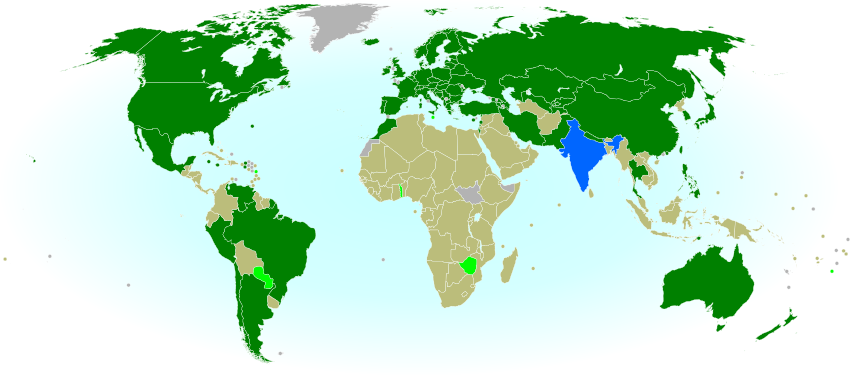
Map of countries with teams attending the 2014 Winter Olympics in Sochi, Russia, including seven countries making their Winter Olympics debut (highlighted), and one that was suspended but reinstated during the games.
Sochi 2014: Nations attending the Winter Olympics for the first time in bright green; suspended nations reinstated during the games in blue; all other nations attending Sochi 2014 in dark green; ineligible countries/territories in gray. By Evan Centanni, from public domain base map.

Premium members click here to view this article in the ad-free members area. Not a member yet? Subscribe now!

By Evan Centanni

India’s Olympics Membership Reinstated
This is a quick update to the map of countries attending the Sochi 2014 Winter Olympics, which originally appeared in Sochi 2014: Which Countries Are (and Aren’t) in the Olympics? That article explained that India was not officially included in this year’s games due its suspension from the International Olympic Committee (IOC) over a voting issue.

However, on Tuesday India’s IOC membership was reinstated, effective immediately. This means that the three Indian athletes at the games, who were allowed to participate independently under the Olympic flag during the opening ceremony and first few days of the event, may now officially represent India again. This is the first time in history that a country has been un-suspended from the the Olympics during the actual games.

Sochi 2014: Which Countries Are (and Aren’t) in the Olympics?

This is an older version of our Parade of Nations article. Click here to see the newest edition!

[This article was first published in July 2012 as “Parade of Nations: Which Countries Are (and Aren’t) in the Olympics?“, in connection with that year’s Summer Olympics in London. The following article is an updated version for the 2014 Sochi Winter games.]

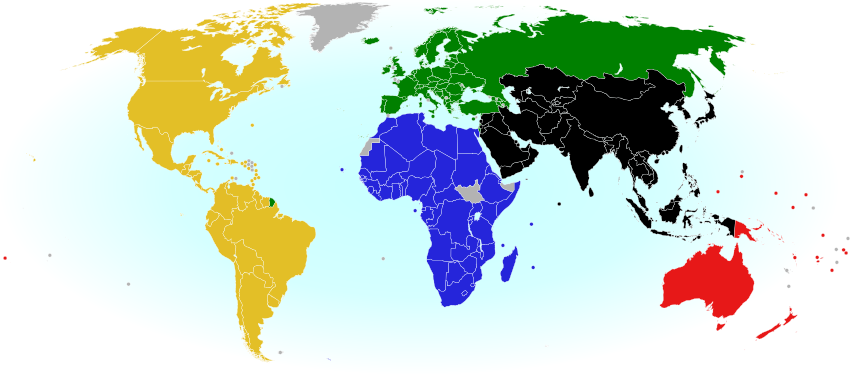
World map showing the five continental associations of National Olympic Committees, including all nations eligible for the Olympic games
The five continental associations representing the world’s Olympic Nations. Gold: Pan-American Sports Organization; Green: European Olympic Committees; Black: Olympic Council of Asia; Red: Oceania National Olympic Committees; Blue: Association of National Olympic Committees of Africa; Gray: non-member country or territory. Map by Evan Centanni, starting from this blank map and modeled after this Wikipedia map.

Premium members click here to view this article in the ad-free members area. Not a member yet? Subscribe now!

The 2014 Winter Olympics in Sochi, Russia officially begin tonight (Feb. 7), and it wouldn’t be an Olympic opening ceremony without the Parade of Nations. But how many countries are there in the games, and is everyone included? Read on for an exclusive guide to the roster of Olympic Nations….

How many countries participate in the Olympics?
There are currently 204 recognized Olympic Nations, represented by a National Olympic Committee (NOC) in each country. The games are presided over by the International Olympic Committee (IOC), and the NOCs are divided among five continental associations (see map above). [1]

If 204 countries sounds like too many, don’t worry, you’re not going crazy. Indeed, the U.N. only recognizes 195 sovereign states in the world (See: How Many Countries Are There in the World?). So what gives? Well, it turns out that the IOC has historically been more lax than the U.N. about the criteria for nationhood. Before 1995, some dependent territories were allowed to qualify for the Olympics, and were allowed to stay even after the rules changed. Today, there are ten such territories with Olympic Nation status:

World map marking dependent territories and partially recognized sovereign states which have recognized National Olympic Committees and are allowed by the IOC to participate in the Olympic Games
Click to enlarge: Dependent territories and partially recognized sovereign states admitted to the Olympics. By Evan Centanni, from public domain base map (source).

Americas
 Aruba (Netherlands)
 Bermuda (U.K.)
 British Virgin Islands (U.K.)
 Cayman Islands (U.K.)
 Puerto Rico (U.S.)
 Virgin Islands (U.S.)

Asia
 Hong Kong (China)

Oceania
 American Samoa (U.S.)
 Guam (U.S.)
 Cook Islands (New Zealand)

Besides those exceptions, qualifying as a nation usually requires recognition as a sovereign state by the U.N. Nevertheless, in 1995 disputed Palestine was admitted for the sake of athletes in Gaza and the West Bank, the two semi-autonomous Palestinian Territories which are largely cut off from the main territory of Israel (this was long before Palestine’s recognition as a U.N. observer state). Meanwhile Taiwan, which is claimed by China but effectively ruled as an independent country, has also been allowed to participate – but only on the condition that it calls itself “Chinese Taipei”. [2]

Changes to the roster
Six years ago at the 2008 Summer Olympics in Beijing, there were three new Olympic Nations: the Marshall Islands, Montenegro, and Tuvalu. But since then, no new countries have joined.

A controversy erupted last year when the Russian Olympic Committee listed unrecognized breakaway states South Ossetia and Abkhazia as nations in its database, but the IOC quickly chimed in to remind everyone that it was irrelevant. Russia recognizes the independence of these two states, which seceded from Georgia decades ago and were contested again in a 2008 war, but neither has an internationally recognized Olympic committee.

India, though a long-time member of the IOC, was suspended in December 2012 over problems with the election process in its national committee. The issue was not quite resolved in time for the 2014 games, so India’s three qualifying winter olympians will be participating independently under the Olympic flag. [Update Feb. 16: India’s membership has now been reinstated, and its athletes may compete and walk in the closing ceremony under the Indian flag.]

Which countries aren’t included in the Olympics?
Despite the inclusive and worldwide mission of the Olympic Games, not all of the world’s states are represented. In fact, two U.N.-recognized countries still haven’t joined: South Sudan apparently still hasn’t formed an NOC since gaining independence in 2011, and U.N. observer state Vatican City, the independent Catholic Church headquarters in Rome, has never applied.

The ten dependent territories allowed to participate in the Olympics are only a select few, leaving most of the world’s overseas dependencies without their own teams (though athletes from the territories may attempt to qualify for their patron countries’ teams). Meanwhile, partially recognized or unrecognized states are not usually admitted either, even if they are effectively independent. In fact, there are a number of National Olympic Committees which have been created locally but not recognized by the IOC. Here’s a partial list:

World map marking sovereign states and dependent territories which do not have IOC-recognized National Olympic Committees, and are thus not allowed to send their own teams to the Olympics
Click to enlarge: Territories and sovereign states not represented in the Olympics. Light Blue: No NOC; Dark Blue: NOC not recognized by IOC. Also shown in dark blue outlines: subnational regions with unrecognized NOCs. By Evan Centanni, from public domain map (source).

Africa
 Somaliland (unrecognized sovereign state)

Americas
 Anguilla (U.K. territory)
 Montserrat (U.K. territory)
 Turks & Caicos (U.K. territory)

Asia
 Iraqi Kurdistan (autonomous region in Iraq)
 Macau (Special Administrative Region of China) [3]

Europe
 Abkhazia (partially recognized sovereign state)
 Catalonia (region of Spain)
 Gibraltar (U.K. territory)
 Kosovo (partially recognized sovereign state)
 Northern Cyprus (partially recognized sovereign state)

Oceania
 French Polynesia (French territory)
 New Caledonia (French territory)
 Niue (free associate state of New Zealand)
 Northern Mariana Islands (U.S. territory)

Which countries are attending the Sochi 2014 Winter Olympics?
Unlike the Summer Olympics, which all qualified countries attended two years ago, it’s normal that a lot of countries skip the Winter Olympics. Not surprisingly, most of the absentees are tropical countries where there are fewer chances to practice winter sports. However, there are some exceptions (see map below).

This year there will be a total of 88 nations participating in the Olympics – a record high for the Winter games. [Update Feb. 16: There are now 89 participating nations – check out the updated map.] Wikipedia has a full list of the participating nations, complete with links to the athlete rosters for each national team. Notably, there are seven nations participating in the Winter Olympics for the first time ever this year:

Map of countries with teams attending the 2014 Winter Olympics in Sochi, Russia, including seven countries making their Winter Olympics debut (highlighted).
Click to enlarge: Nations attending the Sochi 2014 Winter Olympics in green; first time Winter Olympics attendees in bright green; ineligible countries/territories in gray. By Evan Centanni, from public domain base map. [Click here for an updated version of this map.]

Africa
 Togo
 Zimbabwe

Americas
 Dominica
 Paraguay 

Asia
 Timor-Leste (East Timor)

Europe
 Malta

Oceania
 Tonga

More Info: 2014 Parade of Nations – ordered list of countries and flagbearers (Wikipedia)

Footnotes

[1] The five associations correspond closely to conventional definitions of the continents, but with a few quirks: Turkey, the Caucasus, and Israel are part of the European association despite being geographically in Asia; and the South American territory of French Guiana also falls under European jurisdiction, because it is considered an integral part of France and does not have a separate team.

[2] “Chinese Taipei” is intended to be ambiguous, since most Taiwanese people consider themselves to be at least culturally Chinese. However, the use of “Taipei” is somewhat unfortunate for the two-thirds of Taiwan’s people who do not live in or near Taipei City. This was especially awkward when the 2009 World Games (an Olympics-connected event) were held in Kaohsiung, Taiwan – something of a rival city to Taipei. 

[3] Although Macau’s NOC is not recognized by the IOC itself, it has in fact been accepted as a member of the relevant continental organization, the Olympic Council of Asia. Macau has participated in the Paralympic Games but not in the regular Olympics.

London 2012: Which Countries Are (and Aren’t) in the Olympics?

This is an older version of our Parade of Nations article. Click here to see the newest edition!

The 2012 Summer Olympics in London begin tomorrow (July 27), and it wouldn’t be an Olympic opening ceremony without the Parade of Nations. But how many countries are there in the games, and is everyone included? Read on for an exclusive guide to the roster of Olympic Nations….

World map showing the five continental associations of National Olympic Committees, including all nations eligible for the Olympic games
The five continental associations representing the world’s Olympic Nations. Gold: Pan-American Sports Organization; Green: European Olympic Committees; Black: Olympic Council of Asia; Red: Oceania National Olympic Committees; Blue: Association of National Olympic Committees of Africa; Gray: non-member country or territory. Map by Evan Centanni, modified from public domain wiki map (source), and modeled after this Wikipedia map.


How many countries participate in the Olympics?
There are currently 204 recognized Olympic Nations, represented by a National Olympic Committee (NOC) in each country. The games are presided over by the International Olympic Committee (IOC), and the NOCs are divided among five continental associations (see map above). [1]

If 204 countries sounds like too many, don’t worry, you’re not going crazy. Indeed, the U.N. only recognizes 194 sovereign states in the world (see also: How Many Countries Are There in the World?). So what gives? Well, it turns out that the IOC has historically been more lax than the U.N. about the criteria for nationhood. Before 1995, some dependent territories were allowed to qualify for the Olympics, and were allowed to stay even after the rules changed. Today, there are ten such territories with Olympic Nation status:

World map marking dependent territories and partially recognized sovereign states which have recognized National Olympic Committees and are allowed by the IOC to participate in the Olympic Games
Click to enlarge: Dependent territories and partially recognized sovereign states admitted to the Olympics. By Evan Centanni, from public domain base map (source).

Americas
 Aruba (Netherlands)
 Bermuda (U.K.)
 British Virgin Islands (U.K.)
 Cayman Islands (U.K.)
 Puerto Rico (U.S.)
 Virgin Islands (U.S.)

Asia
 Hong Kong (China)

Oceania
 American Samoa (U.S.)
 Guam (U.S.)
 Cook Islands (New Zealand)

Besides those exceptions, qualifying as a nation usually requires recognition as a sovereign state by the U.N. However, in 1995 disputed Palestine was admitted for the sake of athletes in Gaza and the West Bank, the two semi-autonomous Palestinian Territories which are largely cut off from the main territory of Israel. And Taiwan, which is claimed by China but effectively ruled as an independent country by the pre-Communist Republic of China government, has also been allowed to participate – but only as long as it refers to itself as “Chinese Taipei”. [2]

Changes to the roster
In the last Summer Olympics in Beijing (2008), there were three new Olympic Nations: the Marshall Islands, Montenegro, and Tuvalu. But since then, no new countries have joined. In fact, one has been removed: the Netherlands Antilles, a Dutch dependency in the Caribbean, was ruled ineligible by the IOC last year after the territory was officially dissolved.

Map marking the location of the former Netherlands Antilles, just prior to the dissolution of the territory
Location of the former Netherlands Antilles. Public domain map (source).

Two of the five islands of the Netherlands Antilles are now separate Dutch territories, and the other three islands have joined the Netherlands proper. Since the IOC no longer admits dependent territories, none of the islands can rejoin under their new administrations, but the former territory’s team of three athletes will be allowed to participate independently under the Olympic flag for now. After 2012, they will need to qualify for the Netherlands team in order to join future games.

Which countries aren’t included in the Olympics?
Despite the inclusive and worldwide mission of the Olympic Games, not all of the world’s states are represented. In fact, two U.N.-recognized countries still haven’t joined: newly independent South Sudan has not yet formed an NOC, though one of its athletes has been accepted to compete under the Olympic flag this time; and U.N. observer state Vatican City, which perhaps doesn’t consider itself a “nation” (since it serves only as the headquarters of the Catholic Church), has never applied.

The ten dependent territories allowed to participate in the Olympics are only a select few, leaving most of the world’s overseas dependencies without their own teams (though athletes from the territories may attempt to qualify for their patron country’s team). And partially recognized or unrecognized states are not usually admitted, even if they are effectively independent. In fact, there are a number of National Olympic Committees which have been created locally but not recognized by the IOC:

World map marking sovereign states and dependent territories which do not have IOC-recognized National Olympic Committees, and are thus not allowed to send their own teams to the Olympics
Click to enlarge: Territories and sovereign states not represented in the Olympics. Light Blue: No NOC; Dark Blue: NOC not recognized by IOC. Also shown in dark blue outlines: subnational regions with unrecognized NOCs. By Evan Centanni, from public domain map (source).

Africa
 Somaliland (unrecognized sovereign state)

Americas
 Anguilla (U.K. territory)
 Montserrat (U.K. territory)
 Turks & Caicos (U.K. territory)

Asia
 Iraqi Kurdistan (autonomous region in Iraq)
 Macau (Special Administrative Region of China) [3]

Europe
 Abkhazia (partially recognized sovereign state)
 Catalonia (region of Spain)
 Gibraltar (U.K. territory)
 Kosovo (partially recognized sovereign state)
 Northern Cyprus (partially recognized sovereign state)

Oceania
 French Polynesia (French territory)
 New Caledonia (French territory)
 Niue (free associate state of New Zealand)
 Northern Mariana Islands (U.S. territory)

Which countries are attending the London 2012 Olympics?
It’s not uncommon for a few countries to miss the Olympic Games in a given year – a small country fails to field a team, a big country boycotts, or tropical countries skip the Winter Olympics – but the London 2012 games are special. This year, all 204 recognized Olympic Nations will be attending the games, resulting in one of the biggest international sports events in history. Wikipedia has a full list of the participating nations, complete with links to the rosters for each national team.

Number of athletes sent to the London 2012 Olympics by each participating country. Map by Foreston/Wikipedia (source). License: CC BY-SA

Now that you know the background on the Parade of Nations, you can watch the London 2012 opening ceremony and games with a new understanding of the political geography behind the sporting event – if you have any questions, post a comment or shoot me an e-mail!

Further info: 2012 Parade of Nations – ordered list of countries and flagbearers (Wikipedia)

Footnotes

[1] The five associations correspond closely to conventional definitions of the continents, but with a few quirks: Turkey, the Caucasus, and Israel are part of the European association despite being geographically in Asia; and the South American territory of French Guiana also falls under European jurisdiction, because it is considered an integral part of France and does not have a separate team.

[2] “Chinese Taipei” is intended to be ambiguous, since most Taiwanese people consider themselves to be at least culturally Chinese. However, the use of “Taipei” is somewhat unfortunate for the two-thirds of Taiwan’s people who do not live in or near Taipei City. This was especially awkward when the 2009 World Games (an Olympics-related event) were held in Kaohsiung, Taiwan – something of a rival city to Taipei. 

[3] Although Macau’s NOC is not recognized by the IOC itself, it has in fact been accepted as a member of the relevant continental organization, the Olympic Council of Asia. Macau has participated in the Paralympic Games but not in the regular Olympics.