Niger and Burkina Faso Resolve Territorial Dispute

Update: In May 2015, Niger and Burkina Faso formally agreed to implement this ICJ ruling, with the practical aspects of exchanging territories to be completed by the end of the following year.

Map of the disputed territory between Niger and Burkina Faso, which was divided between the two countries in an April 2013 ruling by the International Court of Justice
Map by Evan Centanni. Sources: ICJ, Natural Earth. Africa inset based on this map by TUBS/Wikimedia Commons (CC BY-SA).

By Evan Centanni
 
Border Dispute Settled
Last week, a territorial dispute between the West African countries of Niger and Burkina Faso was resolved peacefully with a ruling from the International Court of Justice (ICJ). Both countries’ governments agreed to respect the court’s ruling on where their border should lie, a question which had persisted ever since they both achieved independence in 1960.

In the ruling, the court drew an official border based on a careful analysis of a 1927 document establishing the pre-independence boundary between the two former French colonies, also turning to a 1960 French map which both countries had agreed to use as a secondary reference. The new border splits the disputed area between Burkina Faso and Niger, and will help put an end to confusion regarding policing and tax collection in the border area.

The ICJ, or World Court, is a part of the U.N., and is tasked mainly with arbitrating disagreements between U.N. member countries. It should not be confused with the International Criminal Court (ICC), which prosecutes individuals for war crimes. Niger and Burkina Faso had agreed by treaty to send the case of their disputed border to the ICJ for settlement, and both have expressed satisfaction with the result.

Further Reading: Full Text of ICJ ruling on Burkina Faso/Niger Frontier Dispute (PDF)

Unclaimed Land
An interesting curiosity noted in this case is that Burkina Faso and Niger’s respective border claims left a small strip of land claimed by neither country. The area, stretching between two locations referred to as the Tong-Tong and Tao astronomic markers, was left unclaimed because Burkina Faso considered the border to be a straight line running between the two markers, while Niger also respected a third marker placed a bit east of the line.

The third marker had originally been intended to lie exactly along the line between Tong-Tong and Tao, but was placed inaccurately. It is not entirely clear why Niger would choose to define its border in a way that would give it less territory than did Burkina Faso’s definition, but in any case the court discounted the third marker, giving the strip of land to Niger in the final ruling. A more famous (and still outstanding) case of a territory not claimed by any country is the Bir Tawil “triangle” between Egypt and Sudan.

Related Articles:

North Kosovo Status Changing after Serbia Deal

North Kosovo Status Changing After Serbia Deal

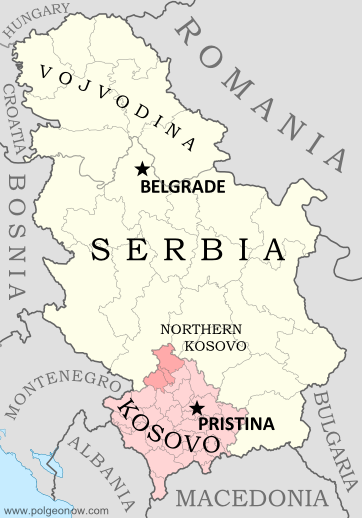
Map of Serbia, Kosovo, and North Kosovo
Map by Evan Centanni, based on these two blank maps by Nord-NordWest. License: CC BY-SA

Kosovo & Serbia in Historic Agreement
Serbia and the breakaway Republic of Kosovo reached a landmark deal on Friday to normalize their relations, partially compromising on several contentious issues between the two governments in southeastern Europe. Kosovo declared its independence from Serbia in 2008, but due to Serbia’s opposition it has still not achieved full international recognition. 

Status Change for North Kosovo
North Kosovo is the largest of several areas within Kosovo where the majority of people are part of the Serb ethnic group, whereas 90% of people in Kosovo as a whole are ethnically Albanian. When Kosovo split from Serbia, many Serbs in the north refused to go, governing themselves separately from Kosovo and choosing instead to continue cooperating with and accepting government funding from Serbia.

Territory Name:  
• North Kosovo (English)
• Severno Kosovo (Serbian)
Kosova Veriore (Albanian)
Claimants: 
• Republic of Kosovo
• Serbia
Actual Control: Local pro-Serbia groups, foreign peacekeepers
Status: No official status
Capital: Kosovska Mitrovica (de facto)

Under the new agreement, Serbia will stop treating North Kosovo as part of its territory, in exchange for the region receiving a degree of autonomy within Kosovo. Notably, Serbs in North Kosovo will now be able to legally manage their own police force. However, there may still be a bumpy road ahead, since Serb leaders in North Kosovo are refusing to accept the compromise.

Flag of the Republic of KosovoCountry Name:  
• Kosovo (English, Serbian)
• Kosova (Albanian)
Official Name:  
Republic of Kosovo (English)
Republika e Kosovës (Albanian)
Republika Kosovo (Serbian)
Status: Partially recognized; claimed by Serbia
Capital: Pristina/Prishtina

Eligibility for EU

The biggest benefit Serbia gets out of this week’s deal is eligibility to apply for membership in the European Union (EU). The EU, which admits new members on a case-by-case basis, had told Serbia it would never be considered unless it first relinquished control of North Kosovo. Serbia has also agreed not to get in the way if Kosovo applies to join the EU too.

Serbia Still Not Recognizing Kosovo
The Holy Grail for Kosovo would have been official diplomatic recognition of its independence from Serbia. However, the agreement stopped short of Serbia calling Kosovo an independent country. Kosovo’s Prime Minister has claimed that the deal counts as recognition anyway, but Serbia has emphatically denied this.

Kosovo is recognized as independent by about half of all the world’s countries, including the majority of the EU and NATO, but opposition from Serbia and Russia has kept it locked out of the UN. For a current map of all of the countries that recognize Kosovo, see Kosovo Recognition Update: April 2103.

Article by Evan Centanni. Kosovo flag graphic by Cradel (source) (CC BY-SA).

What is North Korea?

North Korea’s threats of war have captured the world’s attention in recent weeks, leaving citizens of other East Asian countries anxiously awaiting the latest news. A new war is unlikely, but how much do you know about North Korea, its international status, and its dispute with the south?

Map of North Korea and South Korea
Map by Johannes Barre & Patrick Mannion (CC BY-SA) (source)

What is North Korea?
Located on the northern half of the Korean Peninsula between South Korea and China (and sharing a short border with Russia), North Korea is a medium-sized East Asian country of about 24 million people. Despite its size, it boasts the fourth-largest army in the world, and has remained officially at war with South Korea since 1950.

Sometimes considered one of the world’s last remaining communist states, North Korea actually claims no longer to follow communist ideology. However, it surely does hold the distinction of having the world’s most closed borders, with its totalitarian government tightly controlling the flow of information and people in and out of the country.

What territory does North Korea claim?
North Korea doesn’t actually have “north” in its official name, which is the Democratic People’s Republic of Korea (DPRK). This is because it claims to be the rightful government of all of Korea, including the south. South Korea (officially the Republic of Korea) also maintains the same claim, with both sides seeking eventual unification. Korea hasn’t been a single independent country for over 100 years, since it lost its independence in 1905 and was absorbed into the Japanese Empire in 1910.

How did Korea become divided?

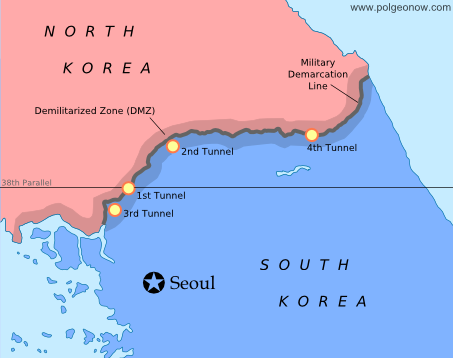
Map of the Military Delimitation Line (armistice line) and Demilitarized Zone (DMZ) separating North and South Korea
Armistice line and DMZ dividing North and South Korea. Modified by Evan Centanni from this map by Rishabh Tatiraju (CC BY-SA).

When Japan lost World War II in 1945, Korea was divided temporarily between U.S. and Russian control, with the boundary placed arbitrarily at the latitude 38° north. However, the Russian-held area in the north and the U.S.-held area in the south ended up forming two rival governments, a political situation that culminated with the north’s 1950 invasion of the south.

In the first large-scale conflict of the Cold War, an American-led U.N. intervention force fought off the Russian- and Chinese-supported north in the three-year-long Korean War. The armistice that brought fighting to an end in 1953 drew a new boundary close to the old one, but not as straight, also establishing a 4 km (2.5 mi) wide Demilitarized Zone (DMZ) around the line. However, because both Koreas seek reunification, neither recognizes the armistice line as an official border.

Map of North and South Korea's differing claims for their maritime boundary in the Yellow Sea
Korean boundary in the Yellow Sea: the U.N.’s Northern Limit Line (A) and North Korea’s claimed line (B). Map modified by Evan Centanni from this one by Amble, 玖巧仔 and Tomchen1989 (CC BY-SA).

Are there any other “disputed territories” between North and South Korea?
Yes – although technically the entire Korean peninsula is disputed between the north and the south, even the unofficial boundary is contested in the Yellow Sea off Korea’s west coast. The armistice agreement didn’t specify a sea boundary, and U.N. forces later drew a simple line running between North Korea and the nearest South Korean islands (the Northern Limit Line). However, North Korea has rejected this boundary, drawing its own line to carefully avoid the South’s islands while claiming the surrounding waters for itself.

What is North Korea’s international status?
Despite North Korea and South Korea claiming to represent the same larger Korea, they are both members of the U.N., after being admitted at the same time as Cold War politics were thawing in 1991. North Korea is now acknowledged around the world as an independent country, with only South Korea and Japan refusing to recognize it. Meanwhile, North Korea maintains active diplomatic relations with most of the world’s countries, with a few major exceptions, such as the U.S. and France.

Flag of North Korea (Democratic People's Republic of KoreaCountry Name:  
• North Korea (English)
• Chosŏn (Korean)
Official Name:  
• Democratic People’s Republic of Korea (English)
• Chosŏn Minjujuŭi Inmin Konghwaguk (Korean)
Capital: Pyongyang

Article by Evan Centanni

Kosovo Recognition Update: April 2013 (99/193)

Map of countries that recognize the Republic of Kosovo as an independent state, updated for April 2013 with most recent additions highlighted
Countries recognizing the Republic of Kosovo in green, with the two most recent additions highlighted. Disputed recognitions in yellow. Kosovo in magenta. Map by Evan Centanni, modified from public domain graphic (source).

Flag of the Republic of KosovoCountry Name:  
• Kosovo (English, Serbian)
• Kosova (Albanian)
Official Name:  
Republic of Kosovo (English)
Republika e Kosovës (Albanian)
Republika Kosovo (Serbian)
Capital: Pristina/Prishtina

By Evan Centanni

New Kosovo Recognitions: Pakistan & Guyana
The self-proclaimed Republic of Kosovo has reportedly been diplomatically recognized by two more U.N. member countries since our last Kosovo report. The government of the small state in southeastern Europe now claims recognition from 99 U.N. member countries, or about 51% of the world body (there are currently 193 sovereign states in the U.N.).

The Islamic Republic of Pakistan in South Asia extended diplomatic recognition to Kosovo on December 24, in a move confirmed by Pakistan’s foreign ministry. Then last month, Kosovo was also recognized by the Caribbean country of Guyana in South America, according to Kosovo’s foreign ministry (though this has not yet been confirmed by independent sources).

The Republic of Kosovo declared independence from Serbia in 2008, but has been blocked from U.N. membership by objections from Serbia, Russia, and other countries which see its secession as invalid. In addition to the 99 U.N. members from whom Kosovo claims recognition, its independence is also acknowledged by one non-U.N. member, Taiwan. For more on Kosovo’s special situation, see our first Kosovo recognition report, which also includes a map of Kosovo’s location relative to Serbia.

Disputed Recognitions
Like Kosovo itself, the list of countries recognizing the Republic of Kosovo is subject to some controversy. Some opponents of independence have cast suspicion on the self-declared republic’s claims of international recognition, which are sometimes not confirmed by sources outside Kosovo’s government. And they may be on to something: recognition by Nigeria, Uganda, and São Tomé and Príncipe, three countries located in Africa, is currently subject to dispute. Political Geography Now will be following this issue closely in future, and keeping our readers as informed as possible.

Stay Up to Date: Check for further updates to this story by viewing all Kosovo articles on Political Geography Now. 

Flag graphic by Cradel (source). License: CC BY-SA