Explainer: Is Jerusalem the Capital of Israel or Not?

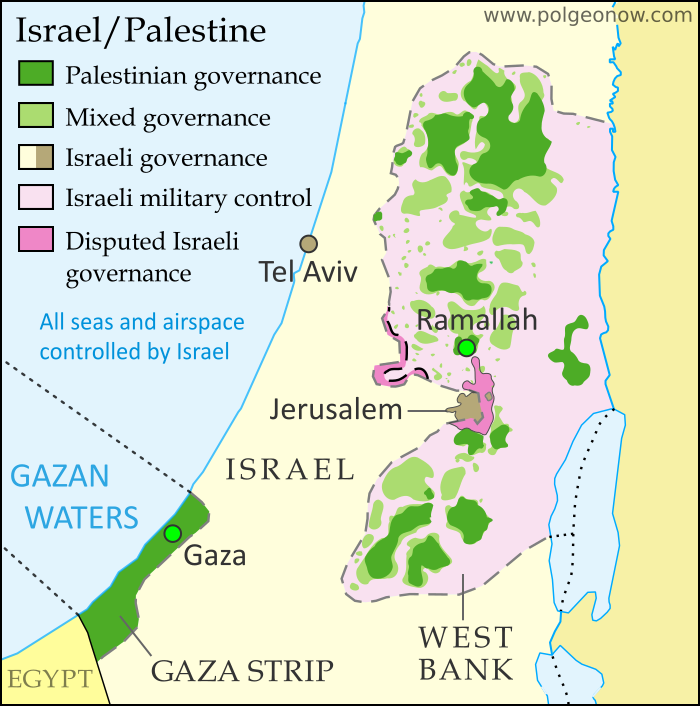
Detailed map of administrative control in Israel and the Palestinian territories (West Bank and Gaza Strip), including official and de facto capitals. Cities: Jerusalem, Ramallah, Gaza, Tel Aviv. Colorblind accessible.
Map by Evan Centanni. All rights reserved.

US recognizes Jerusalem as capital of Israel

This Wednesday, the United States government announced a new policy of recognizing Jerusalem as the capital of Israel. US president Donald Trump said the declaration’s purpose was to “acknowledge the obvious”, while also revealing plans to eventually move the US embassy in Israel to Jerusalem. These decisions were extremely controversial, to say the least. But why? We’ll break it down for you:

So, what’s the big deal?

Israeli law says the city of Jerusalem is the country’s capital. But even Israel’s closest ally, the US, has never officially accepted  the city’s capital status. Almost every other country in the world has done the same: In fact, no country in the world has a proper embassy in Jerusalem. So the new move by the US is a major change of policy, and one that runs contrary to an established world consensus.

But is Jerusalem not the capital of Israel?

A country’s capital is usually, but not always, defined as the city where its government is headquartered. And it’s true that Jerusalem is both the official capital of Israel under the country’s laws, plus the seat of the country’s government, including the legislature, the prime minister, and the Supreme Court. So in that sense Jerusalem is indeed the capital of Israel, for practical purposes at the very least. But that doesn’t mean other countries consider its status legally valid…

So why not recognize Jerusalem as Israel’s capital?

Territory Name:  
• Jerusalem (English)
Yerushalayim (Hebrew)
al-Quds (Arabic)
Claimants: 
• Israel
• Palestine (east Jerusalem only)
Actual Control: Israel
Status: 
• Municipality in Israel (actual governance)
Sub-district in Palestine (claimed; east Jerusalem only)
Part of Jerusalem corpus separatum (claimed by much of international community)

It’s rare for countries to dispute the status of each other’s capitals. The sticking point here is that Arab people in the neighboring West Bank and Gaza Strip territories also claim Jerusalem as the capital of their self-declared State of Palestine.

Just making a competing claim isn’t enough to inspire a worldwide boycott. But the thing is, the United Nations (UN) plan that first endorsed an independent Israel also said Jerusalem should be neutral ground between the Jewish country (now called Israel) and an Arab country (now called Palestine, though “Palestine” was originally a culturally-neutral name for the whole area).

The idea was that Jerusalem and the surrounding area, including the Christian holy city of Bethlehem, would be an internationally-governed neutral zone known as a “corpus separatum” (Latin for “separated body”). But Israel’s 1948-1949 war of independence left western Jerusalem under Israeli control, and since the Six-Day War of 1967, Israel has controlled the whole area. Many think the neutral Jerusalem plan is as good as dead now, but many countries still support it in principile, even treating it as the official legal situation for diplomatic purposes.

Even if they do think neutral Jerusalem is a pipe dream, most countries still support a future where Arabs will get their independent Palestine alongside Israel, and that usually means Jerusalem would at least get divided up between the two countries. In fact, US president Trump made a point of acknowledging that possibility even as he controversially recognized the city as Israel’s capital.
Flag of Israel Country Name:  
• Israel (English)
Yisra’el (Hebrew)
ʼIsrāʼīl (Arabic)
Full Declared Name:  
• State of Israel (English) 
• Medinat Yisra’el (Hebrew)
Dawlat ʼIsrāʼīl (Arabic)
Capital: 
• Jerusalem (functioning but disputed)

Which other countries recognize Jerusalem as Israel’s capital?

It’s difficult to make a full list of countries that recognize Jerusalem’s capital status, because there’s no official register for them to record their positions in. Instead, we’re stuck with looking at what their governments say, and trying to figure out what exactly they mean. 

Maybe the only two countries that seem to unconditionally accept Jerusalem’s role as Israel’s capital are Vanuatu, which reportedly recognized it earlier this year, and disputed Taiwan, which isn’t even recognized as a country itself by most of the world. The Philippines has suggested it might move its embassy to Jerusalem, but doesn’t seem to have made a formal statement of recognition.

Czechia (the Czech Republic) declared the day after Trump’s speech that it recognizes West Jerusalem, but not the whole city, as the capital of Israel. Similarly, Russia’s government has said it thinks East Jerusalem should become Palestine’s capital, and “in this context we view West Jerusalem as the capital of Israel”. This was reported in some media as a recognition, but Russia’s government declared that this week’s US announcement “defies common sense“, so it seems unlikely that’s what they meant.

Other countries have kept their statements vague or neutral, neither recognizing nor rejecting Jerusalem’s claimed capital status.

Then where are all these countries’ embassies, if they’re not in Jerusalem?

Most countries, formerly including the US, don’t recognize any particular city as being the capital of Israel. But all of their embassies are located in the city of Tel Aviv or its suburbs. In the early 1970s, there were 16 countries that did have their embassies in Jerusalem, but most of them left in 1980 after Israel claimed the city’s disputed eastern half as part of its capital. By 2006, there were no more left. 

Even the US embassy is still in Tel Aviv for now, but President Trump says he plans to move it to Jerusalem eventually, maybe after another six months. If he does, it could be the first international embassy to return to Jerusalem, though several more countries might jump on the bandwagon.
Flag of Palestine Claimed Country Name:  
• Palestine (English)
Filasṭīn (Arabic)
Full Declared Name:  
• State of Palestine (English)
• Dawlat Filasṭin (Arabic)
Capital: 
• Jerusalem (claimed; not controlled)
Ramallah (administrative; Fatah faction)
• Gaza City (administrative; Hamas faction)

Most countries’ representative offices to Palestine, on the other hand, are located near the Palestinian government headquarters in the West Bank city of Ramallah, or else in the coastal town of Gaza (ruled by a separate faction of the Palestinian government). In general, these offices aren’t called “embassies” – either because the countries don’t fully recognize Palestine as a country, or because they do recognize it but think the real embassies should be in Jerusalem.

But I thought some countries do have offices in Jerusalem

Yes, they do – ten countries, including the US, have “consulates-general” in Jerusalem. Usually a consulate-general is a regional office that serves under a national embassy, but these are special ones. The consulates-general in Jerusalem are officially representatives to the neutral “corpus separatum” area, not representatives to Israel. 

Because of that, they actually don’t answer to their countries’ embassies in Tel Aviv, instead reporting directly to their national governments. Despite their officially neutral status, most of them also serve as their countries’ representative offices to the Palestinian government in the West Bank.

At least Israel and the Jewish people must be happy about this, right?

Yes and no. Israel’s conservative government enthusiastically supported the US recognition of Jerusalem as its capital, and many Israelis are celebrating. But some think it would have been better to wait until the Israeli-Palestinian conflict is resolved, and others don’t think it should be a big deal. Some of the biggest Jewish groups in the US also approved of the decision, but a big portion also disapproved. Many Palestinians, including Arab Christians, were furious with the symbolic gesture. This may or may not include Arab citizens of Israel, most of whom consider themselves Israelis but disagree with aspects of the country’s governance.

Is Palestine Really a Country?

(Keep up with changes to Palestine’s situation: view all Palestine updates.)

Palestine is now recognized as a country by both the U.N. and a majority of its members, but many  have questioned whether this new-found status reflects the truth on the ground. Is Palestine really an independent country, or is this a political fantasy concocted by supporters in the U.N.?

The Olso Accords divided the Palestinian territories into three areas of control (see article for explanation). Map by Evan Centanni. Sources: Natural Earth, B’Tselem, U.N. OCHA oPt.

What is a “sovereign state”?
By the most common definition, a “state” has to have:

  1. A government
  2. A defined territory
  3. A permanent population
  4. The ability to conduct foreign relations with other states

This definition is called the “declarative theory of statehood“, and was formalized in the Montevideo Convention of 1933. To be a “sovereign” state (i.e. an independent country), it’s also important that the government answers to no other country, and that the territory and population are actually under the government’s control.

A prospective country that fits these criteria is described by geographers as a de facto sovereign state, even if it’s not recognized by the international community (de facto is Latin for “in actual fact”).

Palestine: Sovereign State or Not?
Can Palestine be considered a real, de facto sovereign state based on the declarative theory of statehood? Let’s look at the criteria one by one:

A government that answers to no one
Palestine is represented abroad by the Palestinian Liberation Organization (PLO), and governed within its administrative area by the Palestinian National Authority (PNA), an elected government established by the PLO under the Oslo Accords. Though it faces frequent pressure and demands from Israel, the Palestinian government does not take orders from any country.

Defined territory under its control
The State of Palestine claims two territories: the West Bank and the Gaza Strip. The U.N. considers both of these regions to be occupied by Israel, but the Palestinians do control some parts of them since 1995. The Oslo II Accord temporarily designated three types of control within the West Bank (see map above):

  • Area A – Fully governed by the Palestinians, with no Israeli administration or Israeli military presence (currently 18%)
  • Area B – Shared control; Palestinian civil administration with joint Israeli-Palestinian military control (currently 21%)
  • Area CFull Israeli control, with some exceptions for Palestinian residents (currently 61%)
Flag of Palestine Country Name:  
• Palestine (English)
Filasṭīn (Arabic)
Official Name:  
• State of Palestine (English)
• Dawlat Filasṭin (Arabic)
Capital: 
• Jerusalem (claimed)
Ramallah (administrative)

The Gaza Strip is a special case: Israel withdrew from the territory in 2005, leaving it effectively part of Area A. However, a brief Palestinian civil war in 2007 left Gaza in the hands of extremist group Hamas, which currently doesn’t answer to the PLO (though it did support the campaign for U.N. observer state status). [Update: As of June 2014, Gaza and the West Bank are nominally united under a Palestinian unity government.]

Besides area C, Israel also controls all of the airspace and territorial waters associated with the West Bank and Gaza Strip. Additionally, it has completely annexed (integrated as part of the country) two sections of Area C itself: East Jerusalem, which both sides claim for their capital, and a strip of “no man’s land” which was located between Israel and the West Bank when the latter was still controlled by Jordan.

In other words, Israel controls most of Palestine’s claimed territory, but not all of it. Since many countries don’t control all of their claimed land and waters, that alone doesn’t disqualify Palestine as a state.

A permanent population
There are almost four million Palestinians living within the West Bank and the Gaza Strip, so this requirement is no problem. Even if we only count the West Bank’s Area A, the Palestinian Authority has full control  over close to one million people. By comparison, there about 40 U.N. member states with populations of less than one million.

Ability to conduct foreign relations
This requirement is also clearly fulfilled. Not only is Palestine seated as an observer state in the U.N. General Assembly, but its representatives also maintain direct diplomatic relations with 142 countries (even more than the number who recognize its independence), plus the European Union. It’s also a member or observer in various international organizations.

So what’s the answer?
Palestine has its own government (the PLO/PNA), a defined and controlled territory (Area A in the West Bank), a permanent population (one to four million Palestinians), and the ability to maintain relations with other states. So whatever we think about what should happen in the future, Palestine does seem to qualify as a de facto sovereign state at the present.

Palestine Recognized as a Country by the U.N.

(Keep up with changes to Palestine’s situation: view all Palestine updates.)

This Thursday, the U.N. General Assembly voted to change Palestine’s status in the organization from “observer” to “observer state”. This is the first time the international body has recognized Palestine as a state, giving it the same status enjoyed by U.N. non-member Vatican City. 

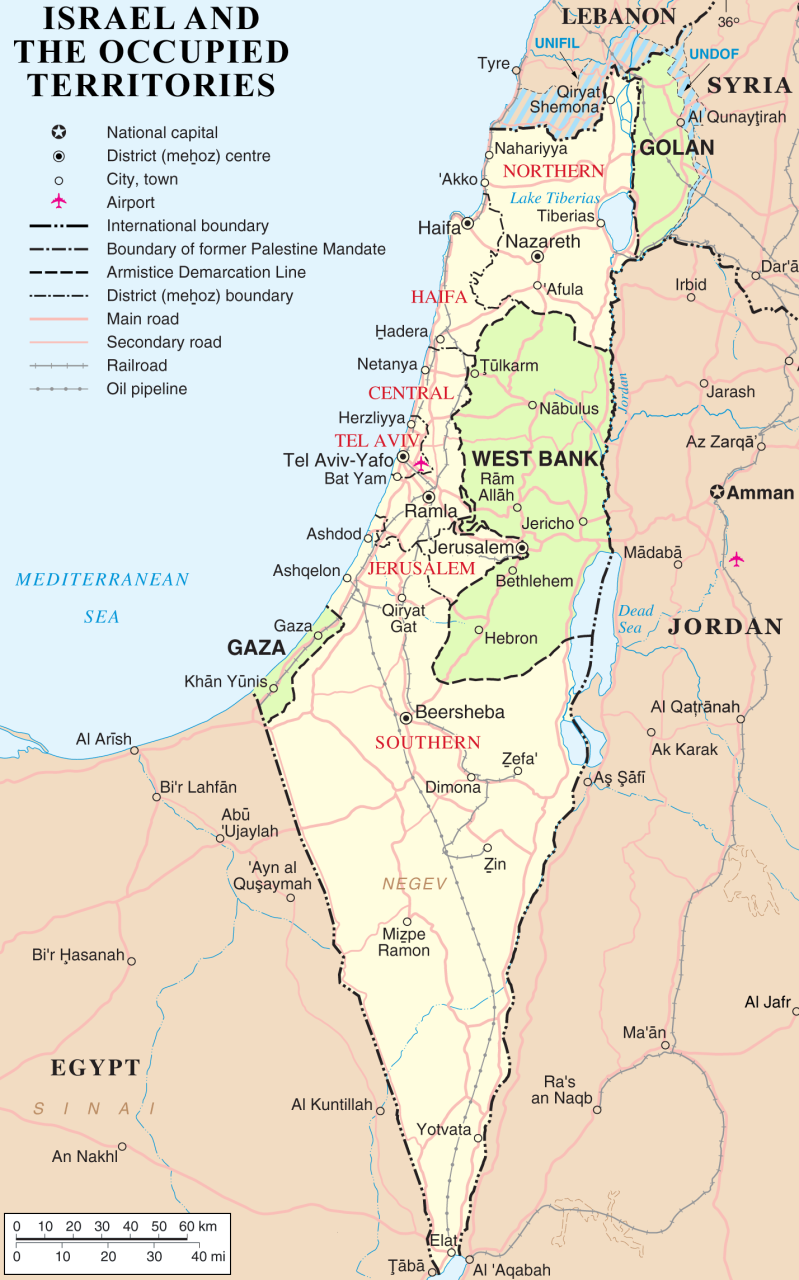
Map of Israel with the occupied territories of the West Bank, Gaza Strip, and Golan Heights highlighted
The State of Palestine claims the West Bank and Gaza, which are largely occupied by Israel. The Golan Heights are not part of the Palestinian Territories. Public domain map (source).

Until this Thursday, Palestine was a partially recognized country, acknowledged by some U.N. member nations, but not by the U.N. itself (See also: How many countries are there in the world?). Although its delegation has had observer status at the U.N. since 1974, it was never classified as a “state”, being treated as something between a country and a non-government organization. Now, the organization has officially voted to change Palestine’s status to “observer state” – effectively a recognition that it’s an independent country, even though it’s still not a U.N. member.

The Palestinian delegation campaigned to join the U.N. as a member last year, but had to give up after the U.S. promised to veto the application in the U.N. Security Council. Observer status, on the other hand, is determined by a majority vote in the U.N. General Assembly, which no single country can veto. That vote happened on November 29th, with members voting 138 to 9 in favor of granting Palestine observer state status (41 members abstained, and 5 were absent from the vote; see the full breakdown of national votes).

The only other U.N. observer state is the Holy See, which represents Vatican City. Many other countries have been observer states in the past, but all of them have since been accepted into the U.N. as full members (the last to join were Switzerland in 2002 and North and South Korea in 1991). While yesterday’s events may help settle Palestine’s legal status, the situation on the ground is more complicated, with most of the country’s claimed territory under the control of Israel. The recognized Palestinian government also does not currently administer the Gaza Strip, one of the Palestinian Territories, which is instead controlled by right-wing opposition party Hamas. But despite their differences, the leadership of Hamas supported the campaign for statehood at the U.N.

Document: Full text of U.N. General Assembly resolution authorizing state observer status for Palestine

Color-coded map showing how each U.N. member voted on the General Assembly resolution recognizing Palestine as an observer state
Results of U.N. General Assembly vote on granting observer state status to Palestine. Green: In favor; Red: Against; Yellow: Abstaining; Blue: Absent; Black: Palestine. Map by B1mbo/Wikimedia (source). License: CC BY-SA

What will change with Palestine’s new status?
Since the change is to Palestine’s political status, the effects will be mostly in the domain of politics. Its actual role within the U.N. General Assembly will change little, because observers’ privileges are mostly assigned on a case-by-case basis anyway. But now other U.N. agencies are more likely to consider Palestine for membership. It already successfully joined UNESCO last year, but was rejected from the U.N.-connected International Criminal Court (ICC) on the basis that members need to be states. Possible Palestinian membership in the ICC has received a lot of political attention, because it would allow Palestine to pursue war crimes charges against the Israeli government.

Flag of Palestine Country Name:  
• Palestine (English)
Filasṭīn (Arabic)
Official Name:  
• State of Palestine (English)
• Dawlat Filasṭin (Arabic)
Capital: 
• Jerusalem (claimed)
Ramallah (administrative)

The current Israeli administration of Prime Minister Benjamin Netanhyahu, supported by the U.S., insists that the statehood bid violated the terms of the Oslo Accords by bypassing the existing peace process between Israel and the Palestinians. And in the weeks leading up to the vote, Netanyahu had threatened to punish the PLO for seeking statehood, possibly by withholding money from taxes that Israel collects on the Palestinian government’s behalf. But his government seemed to back down as the campaign came to an end, downplaying the results of the vote and saying they wouldn’t retaliate unless Palestine tries to take them to court in the ICC. Some Israelis, such as the previous prime minister, Ehud Olmert, actually supported the statehood bid.

Another area to watch will be Palestine’s treatment by geographers: since the most common definition of “independent country” in maps and other publications is “member or observer state of the U.N.”, Palestine may begin showing up on more maps and lists of countries from now on. Although it’s already shown on many maps, it’s usually indicated as special-case disputed territory rather than a country. Alternatively, if Palestine’s nationhood proves too controversial, we could possibly see some change in how independent countries are defined in maps and books. In the U.S., some may choose to follow the lead of the American government, which currently recognizes all U.N. members and observers except Palestine.

Further Reading: Q&A – Palestinian bid for upgraded UN status (BBC), Why Palestine Won Big at the U.N. (TIME)

States Recognize Palestine Ahead of U.N. Bid

Country Name: Palestine (English), Filastin (Arabic)
Official Name: State of Palestine (English), Dawlat Filastin (Arabic)
News Category: Partially Recognized States, Diplomatic Recognition
Summary: The Palestinian Liberation Organization, which claims sovereignty over the disputed territories of the West Bank and Gaza Strip as the State of Palestine, will apply for U.N. membership this week. Meanwhile, the total number of countries recognizing Palestinian independence has grown sharply in the lead-up to the U.N. bid.

The Palestinian Territories. Area A: Full Palestinian Control
(on the ground); Area B: Joint Palestinian-Israeli Control;
Area C: Full Israeli Control. Israeli government considers
the green areas “disputed territory”. Map is my own work.
Sources: Natural Earth, B’Tselem, U.N. OCHA oPt, others.

Full Story
Palestine is a unique case within the nation-state system. It is recognized as an independent state by more than half of the world’s countries, but not by the U.N. itself or by any major Western powers. It indirectly administers much of its claimed territories, yet exercises full sovereign control over none of them. At the heart of one of the world’s most intractable conflicts, it is perhaps the most controversial topic in international politics. The coming weeks could see significant changes to the political status of the Palestinian Territories on the world stage.


The Palestinian Territories are made up of the West Bank and the Gaza Strip, two regions previously controlled by Jordan and Egypt respectively, which were captured by Israel in the Six Day War of 1967. Israel has never fully relinquished control, and Egypt and Jordan eventually gave up their claims to the regions, leaving them in an unusual political situation. Despite widespread calls for independence based on a 1947 U.N. partition plan, Israel refuses to refer to them as anything other than “disputed territories” until negotiations determine their final status. Some of the land within the territories is now administered by the Palestinians, though much of it is still ruled by the Israeli military, which also controls all associated airspace and territorial waters.

Wikipedia: History of the Israeli-Palestinian Conflict 

This week, Mahmoud Abbas, chairman of the Palestinian Liberation Organization (PLO), will formally request full membership for the State of Palestine in the United Nations. The PLO declared independence in 1988, and has enjoyed a degree of support from the U.N. General Assembly, but currently only holds observer status in the organization, which pointedly labels it as a “non-state entity”. Palestinian membership in the U.N. is likely to be vetoed by the U.S., which holds a permanent seat in the U.N. Security Council. However, Palestine may still achieve “state observer” status by a majority vote in the General Assembly, which would elevate it to the same level as the Holy See (Vatican City): a U.N.-recognized state with legal rights.

Countries recognizing the State of Palestine. Recent additions (in the last year) indicated in lighter color.
Modified from this map by Alinor at en.wikipedia (license: CC BY-SA).

Though 90 U.N. members recognized Palestine during the first year after its declaration, the number grew little over the next 15 years. However, since the campaign for U.N. membership began a few years ago, recognition has risen sharply. The State of Palestine is now recognized by 126 U.N. members – nearly two-thirds of the world body – 17 of which have announced their recognition just in the last year. This summer alone has seen six new additions: Syria, Liberia, El Salvador, Honduras, St. Vincent and the Grenadines, and Belize. Palestine’s independence is also endorsed by Western Sahara, a partially-recognized state without U.N. membership.

Chart over time of total U.N. members recognizing the State of Palestine. My own work (source).


Wikipedia:
State of Palestine, Palestinian Territories, International Recognition of the State of Palestine

News Bits: June 2011

“News Bits” posts cover minor political geography events from the previous month. Although the news may be of great political relevance, these events haven’t (yet) affected major changes to the shapes, sovereignty, or international positions of the world’s countries.

Abyei’s location within Sudan
(yellow). The south (blue) gains
independence this July. Based
on this map (license: CC BY-SA).

Sudan Government Forces Overrun Disputed Abyei
The Abyei Area, subject of a territorial dispute between the central Government of Sudan and the autonomous Southern Sudan region, has been invaded by Sudanese government forces. Southern troops, who had shared joint control of the area with the central government, have been driven out, along with many of the area’s inhabitants. Southern Sudan is set to become an independent country this July, based on the 2005 peace agreement that ended Sudan’s second civil war. A referendum was planned for Abyei residents to choose whether they would stay in Sudan or join the new Republic of South Sudan, but it was never held due to disagreements about who was eligible to vote. The Sudan government in Khartoum has asserted that it will not give up Abyei, and southern president Salva Kiir has promised not to go to war again over the territory.

Israel with occupied territories (green).
The PLO claims both the West Bank
and Gaza Strip, but they are currently
ruled by rival factions (map source).

West Bank & Gaza Strip to be Reunited
Rival Palestinian political parties Fatah and Hamas have agreed to form a new unity government in the coming months, which will effectively reunite their respective territories in the West Bank and Gaza Strip. Both groups claimed control of the Palestinian Authority (PA) government after a brief civil war following the 2006 elections, in which Hamas won a majority of seats in the previously Fatah-dominated Palestinian Legislative Council. The armed clash left Hamas in control of the Gaza Strip, while Fatah retained its authority in the Palestinian-controlled areas of the West Bank. Known to the U.N. as the Occupied Palestinian Territories, the West Bank and Gaza Strip are claimed as the State of Palestine by the Palestinian Liberation Organization (PLO), parent organization of the PA. Over half of the U.N.’s member countries have recognized the state’s independence, but the U.N. itself has not. Furthermore, the territories remain under military occupation by Israel, which controls much of the West Bank as well as all air space and territorial waters in the region.

Peruvian and Ecuadorian waters, with the newly agreed
upon boundary marked in yellow. My own work, based
on data sources listed on map (terms of use).

Ecuador & Peru Define Sea Border
The neighboring South American countries of Ecuador and Peru have formally agreed on a boundary between their respective territorial waters in the Pacific Ocean. Although the location of the border was never actively in dispute, its acceptance had been called into question by Peru’s ongoing territorial dispute with Chile, in which Peru claims a 1952 agreement between the three countries did not technically establish the location of their maritime borders. The new agreement is widely seen as a move by Peru to gain Ecuador’s support as the case of the Peru-Chile conflict heads to the International Court of Justice. The agreed upon boundary is located along the parallel of 3° 23′ 33.96″ S, originating at the point where the countries’ land border reaches the ocean.

Libya as of June 1, 2011. Cities controlled by Gaddafi
government in green, rebel-held cities in black, and
areas of ongoing fighting in blue. Public domain map
from Wikipedia (source).

Libyan Rebels Gain Further Recognition
Libya’s rebel National Transitional Council (NTC) over the last month gained diplomatic recognition from five more national governments, bringing to 11 the list of countries recognizing its legitimacy. The NTC forms the political leadership of the rebel forces fighting for control of the North African country against dictator Muammar Gaddafi, in a civil war provoked by Gaddafi’s violent crackdown on popular protests last February. Although Libya’s independence is already recognized by the U.N. and all of it’s members, countries have begun to make the special diplomatic gesture of switching their recognition from Gaddafi’s government to the NTC. Recent additions to the list are Jordan, Russia, and Malta; two other countries, Senegal and Turkey, have acknowledged the NTC’s status as a legitimate opposition group, while still maintaining ties with Gaddafi. Six other countries, starting with France in early March, had all previously recognized the NTC as Libya’s sole representative, some of them expelling Gaddafi’s diplomats and sending ambassadors to the rebel command center in Benghazi. As Gaddafi’s forces continue to face NATO bombing attacks, the war has ground to a near-stalemate, with Gaddafi controlling the capital city of Tripoli and several smaller western cities, while the rebels control the eastern half of the country and some areas of the west.