Yemen Conflict Map: September 2012 (#4)

Since June, the Yemeni government has completed its campaign to free the south from Al Qaeda rule, but multiple rebel movements remain active. Keep reading for a summary of the current situation. (To see other maps in this series, view all Yemen updates.)

Map of current division in Yemen, including Al Qaeda or Ansar al-Sharia activity, Houthi rebel control, and the location of the Southern Movement insurgency. Update for September 2012.
Presence of rebel forces in Yemen as of September 2012. Ansar al-Sharia is part of Al-Qaeda in the Arabian Peninsula (AQAP). Map by Evan Centanni, using this blank map by NordNordWest/Wikipedia (license: CC BY-SA).

In our previous Yemen map update, we reported on the government’s June 2012 capture of most of Abyan province from Ansar al-Sharia, an armed group associated with Al Qaeda in the Arabian Peninsula (AQAP). After the fall of the militants’ two main “Islamic Emirates” in the towns of Jaar and Zinjibar, the U.S.-backed Yemeni army advanced east into neighboring Shabwah province; after about a week, the Islamists had fled Azzan, their primary stronghold in Shabwah.

At the time, Ansar al-Sharia was also known to control the Shabwah towns of Hawta, Rawdah, and Rudum, yet the militants appear to have since gone underground; Yemen’s government declared victory in the entire region, and no word has since filtered through of Islamist-controlled towns. However, what has become clear is that the extremists have not fled altogether, but are only keeping a lower profile. Reports have even emerged of a major Al Qaeda training camp in Abyan’s Mahfad district
Flag of YemenCountry Name:  
• Yemen (English)
• Al-Yaman (Arabic)
Official Name:  
• Republic of Yemen (English)
al-Jumhūriyyah al-Yamaniyyah (Arabic) 
Capital: Sana’a

Meanwhile, a certain amount of chaos continues in the rest of the country despite the political deal that largely calmed last year’s uprising. In the capital city of Sana’a, the transitional government of President Abd Rabbuh Mansur Al-Hadi faces periodic Al Qaeda terrorist attacks as well as insurrection from soldiers loyal to deposed president Ali Abdullah Saleh, the latter of whom have reportedly taken control of some government buildings.

South of the capital, there is still a simmering separatist insurgency in formerly independent southern Yemen, and in the north a large area is still controlled by the Al Houthi rebels. A Zaidi Shiite rebel group, the Houthis currently maintain an informal truce with the transitional government as they await an overdue national dialogue process. However, they sometimes clash with local militias who resent their territorial encroachment, as well as Salafist fighters, extremist Sunnis who consider the Zaidis to be heretics.  

Graphic of Yemeni flag is in the public domain (source).
Malawi’s Flag Change

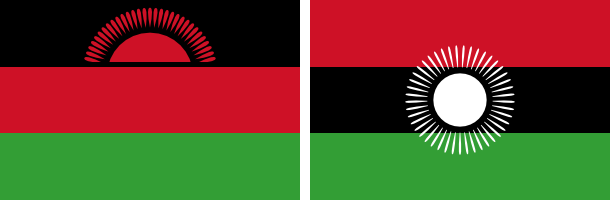
New and old flags of Malawi
Malawi’s original rising-sun flag (left) is being re-adopted, after being controversially replaced two years ago by the full-sun banner (right). Graphics are in the public domain (left source; right source).

Just two years after adopting a new flag, the southeast African country of Malawi is changing back to the old one. The original banner, in place from independence in 1964 until its replacement in 2010, was voted back in by the national parliament on May 28, 2012.

Flag of MalawiCountry Name:  
• Malawi (English)
• Malaŵi (Chichewa)
Official Name:  
• Republic of Malawi (English)
• Dziko la Malaŵi (Chichewa) 
Capital: Lilongwe

The independence flag, which displays a rising sun to represent the dawn of hope for Africa, was controversially replaced by President Bingu wa Mutharika two years ago. The colors were shuffled around to more closely match the Pan-African Flag, and the red rising sun was changed to a full white sun to symbolize the progress made by Malawi since independence.

When President Mutharika died last April, the Malawian government wasted little time in reverting the unpopular flag change. The move was supported by newly sworn-in President Joyce Banda, who had recently experienced a falling-out with Mutharika and started a new political party.

Although the flag change vote passed in parliament, it is still unclear whether it has passed officially into law via the required presidential signature. In any case though, the rising-sun flag appears to be widely in use again, being flown in the Olympics and displayed on many official websites (except for the main government homepage).

Independent Azawad No More: Northern Mali in Islamist Hands

There are newer versions of this map available. To see them, view all Mali maps.   

Since declaring the independence of Azawad in April, control by northern Mali’s MNLA rebels has been usurped by the hardline Islamists of Ansar Dine and MUJAO. The new regime, while still bitter enemies of the Malian government, does not claim independence. Presented here is a map and brief guide explaining the current situation.

Map of Islamist rebel control in northern Mali as of September 2012
Area held by Islamist rebel groups Ansar Dine and MUJWA in northern Mali. Map by Evan Centanni, modified from Wikimedia map by Orionist, using images by Carport and NordNordWest (source). License: CC BY-SA.

Separatists vs. Islamists
Last April, the Tuareg-dominated separatists of the National Movement for the Liberation of Azawad (MNLA) swept into victory in northern Mali, completing their control of the region and declaring independence as the State of Azawad. But their victory was won only with the support of Ansar Dine, an Islamist militia led by veteran Tuareg fighter Iyad Ag Ghaly. The MNLA and Ansar Dine then alternated between cooperation and conflict for months, with the Islamists grabbing ever more control of the region’s cities.

Tensions came to a head on June 26, when a second Islamist group, the Movement for Unity and Jihad in West Africa (MUJWA), violently expelled the MNLA from their capital city of Gao. By month’s end, Ansar Dine had fully pushed the MNLA out of key city Timbuktu, and two weeks later the separatists were driven from their last stronghold in the town of Ansongo. Then just this weekend, MUJWA again made news by seizing the town of Douentza from a formerly cooperative local militia.

Flag of MaliCountry Name:  
• Mali (English, French, Bambara)
Official Name:  
• Republic of Mali (English)
• République du Mali (French) 
• Mali ka Fasojamana (Bambara)
Capital: Bamako

Though northern Mali is still not controlled by the national government in Bamako, the Islamist militias do not seek independence. Instead, they pursue a vision of strict sharia law throughout Mali. Since these new rulers no longer consider Azawad a sovereign nation, its claim to independence has faded away.

Current Rebel Control
Ansar Dine and MUJWA together appear to hold all of the territory originally seized by the MNLA, with the line of control lying between the towns of Douentza and Sévaré. Bandiagara in the nearby Dogon region may have an army presence, but other towns such as Koro do not, and have seen rebel raids.

Administration is divided between the two Islamist militias, with Ansar Dine apparently controlling regional capitals Timbuktu and Kidal, and MUJWA controlling at least Gao (also a regional capital) and Douentza. Al Qaeda in the Islamic Maghreb (AQIM), a branch of the terrorist group, also maintains a strong presence in northern Mali. MUJWA is historically associated with AQIM, though Ansar Dine’s relationship to the organization is more tenuous.

Special thanks to Peter Tinti (@petertinti), who has provided invaluable commentary throughout the Mali conflict, and has repeatedly pointed me in the right direction in my research.

Note on Names:  
The acronym “MNLA” is based on the French, and is sometimes rendered “NMLA” to match the English. 
MUJWA is also known as “MOJWA” (from an alternate translation) or “MOJAO” (from the French). 
Ansar Dine is pronounced “an-SAR (uhd)-DEEN” and sometimes spelled “Ansar Eddine” or “Ansar ud-Dine”. 
AQIM is also known by its French acronym “AQMI”; its Arabic actually means “Al Qaeda in the Islamic West”.

Graphic of Malian flag is in the public domain (source).