Map: Another Country Joins the “Eurasian Union” (May 2015)

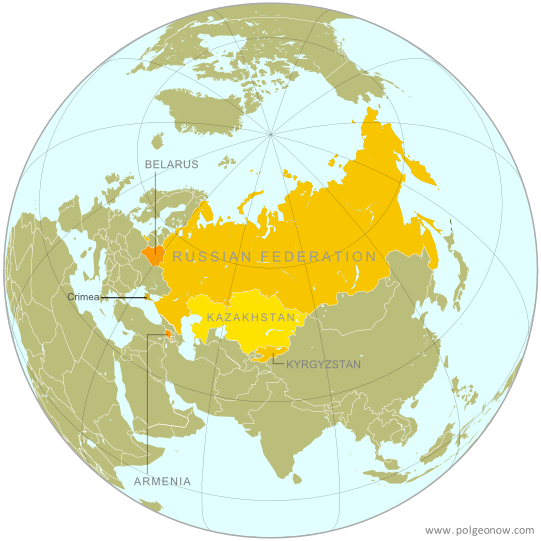
Map of the Eurasian Economic Union (EEU), also known as the Eurasian Union. Includes new member Kyrgyzstan, as well as prior members Russia, Belarus, Kazakhstan, and Armenia, and disputed territory Crimea
The Eurasian Economic Union’s five current member countries, plus disputed Crimea, claimed to be part of Russia. Map by Evan Centanni, starting from this map by Keverich2. License: CC BY-SA

Premium members click here to view this article in the ad-free members area. Not a member yet? Subscribe now!

Article by Evan Centanni

Kyrgyzstan Joins EEU
The Eurasian Economic Union (EEU, EAU, or EAEU), a new Russia-led free trade area, just welcomed Kyrgyzstan as a new member on May 8. The EEU, sometimes known as the “Eurasian Union” for short (or in reference to its possible future direction), officially launched at the beginning of this year, but has been in development since several years ago. The union has four other member countries: Russia, Belarus, Kazakhstan, and Armenia.

More: What is the “Eurasian Union”?

Flag of the Eurasian Economic Union (aka EEU, EAU, or Eurasian Union)
Country Name:
• Kyrgyzstan (English, Kyrgyz)
• Kirgiziya (Russian)
Official Name:
• Kyrgyz Republic (English)
• Kyrgyz Respublikasy (Kyrgyz)
• Kyrgyzskaya Respublika (Russian)
Capital: Bishkek

Kyrgyzstan started the process of joining the EEU last summer, and its entry in the organization has been delayed twice, allegedly due to last-minute hang-ups in the negotiations. The small central Asian country finally signed on as a full member last Friday, at a summit meeting of the leaders from all five member countries.

To ease economically-struggling Kyrgyzstan’s entry into the EEU, Russia has approved hundreds of millions of dollars in aid to the country. Kyrgyz President Almazbek Atambayev, for his part, has been enthusiastic about joining the union, and Russia-bound migrant workers are optimistic about the change. However, many Kyrgyz citizens are concerned that EEU rules favoring trade between the organization’s members could hamper trade and investment from neighboring China.

See Also: Armenia Joins EEU Ahead of Organization’s Official Launch

Graphic of the Kyrgyz flag is in the public domain (source).
What is the “Eurasian Union”? (Map)

The Russia-led Eurasian Economic Union, sometimes simply called the “Eurasian Union”, was officially launched at the beginning of this year. Read on for a brief introduction to this major new regional organization, which you can expect to hear a lot more about in the coming months and years!

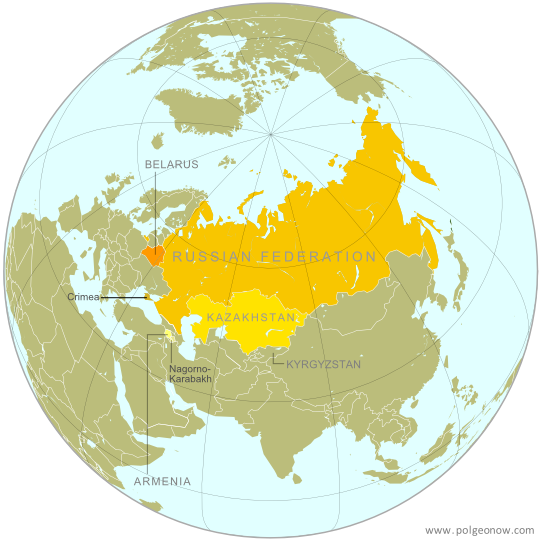
Map of the Eurasian Economic Union (EEU), also known as the Eurasian Union. Includes new member Armenia, as well as prior members Russia, Belarus, and Kazakhstan, and disputed territories Crimea and Nagorno-Karabakh, as well as acceding member Kyrgyzstan.
The Eurasian Economic Union’s four current member countries, plus disputed territories officially or unofficially included in the common market. Map by Evan Centanni, starting from this map by Keverich2. License: CC BY-SA

Premium members click here to view this article in the ad-free members area. Not a member yet? Subscribe now!

Article by Karina Barquet

Eurasian Economic Union
The Eurasian Economic Union (EEU, EAU, or EAEU) was officially launched on the 1st of January, 2015 by member countries Russia, Belarus, Armenia, and Kazakhstan, with Kyrgyzstan awaiting membership next month. The goal of the union is to allow for the free movement of goods, services, capital, and labor among the member countries.

The EEU operates through supranational and intergovernmental institutions including the Eurasian Commission, which serves as the executive body, the Court of the EEU, which acts as the judicial body, and the Eurasian Development Bank. All member states are said to retain full sovereignty and have the same veto power, despite the fact that Russia has financed up to 88% of the organization’s administration.

Flag of the Eurasian Economic Union (aka EEU, EAU, or Eurasian Union)
Organization Name:  
• Eurasian Economic Union (English)
Yevraziyskiy Ekonomicheskiy Soyuz (Russian)
Jeŭrazijski Ekanamičny Sajuz (Belorussian)
Ewrazïyalıq Ékonomïkalıq Odaq (Kazakh)
Yevrasiakan Tntesakan Miut’yun (Armenian)
Launched: Treaty signed My 2014 in Astana, Kazakhstan; effective January 1, 2015
Headquarters:  
Moscow, Russian (Commission)
Minsk, Belarus (Court)
Almaty, Kazakhstan (Development Bank)
Website: eaeunion.org

The EEU is built upon less-extensive cooperation previously established in 2007 through the Customs Union between Russia, Belarus and Kazakhstan, and in 2012 through the Common Economic Space.

Shared Economy
The union has a population of over 170 million people and a GDP of nearly $2.5 trillion, making it the largest common market in the ex-Soviet region. Energy sources constitute the strongest grounds for EEU cooperation. This is no surprise, given that Russia, Belarus, and Kazakhstan share over 20% of the world’s gas resources and 16% of its oil, in addition to being strong producers of electricity and holding large reserves of coal, steel, and iron ore. According to Russian Prime Minister Dmitry Medvedev, over 100 agreements to develop a common oil and gas market are expected to be signed in the EEU during 2015.

Iran, Argentina, Egypt, China and India have reportedly already expressed interest in establishing cooperation and creating a free trade zone with the EEU in the future. Recently, Russia’s ambassador to the European Union (EU) proposed that the EU renounce the Transatlantic Trade and Investment Partnership (TTIP) with the United States to instead enter a partnership and establish a free trade zone with the EEU.

Towards Greater Integration
Although the EEU is currently intended to be a purely economic cooperation block, the union is considered to be Russia’s most ambitious attempt at integrating the region that once formed part of the Soviet Union. Its creation has not been universally welcomed, with some outside obervers seeing the integration process as a symbol of aggressive Russian policy, particularly following Russia’s seizure of Crimea from Ukraine, whose new government chose not to seek EEU membership.

See Also: Armenia Joins EEU Ahead of Organization’s Official Launch

Graphic of the EEU flag is in the public domain (source).