Syrian Civil War Map & Timeline – February 2018

There are newer versions of this map available. To see them, view all Syria updates.
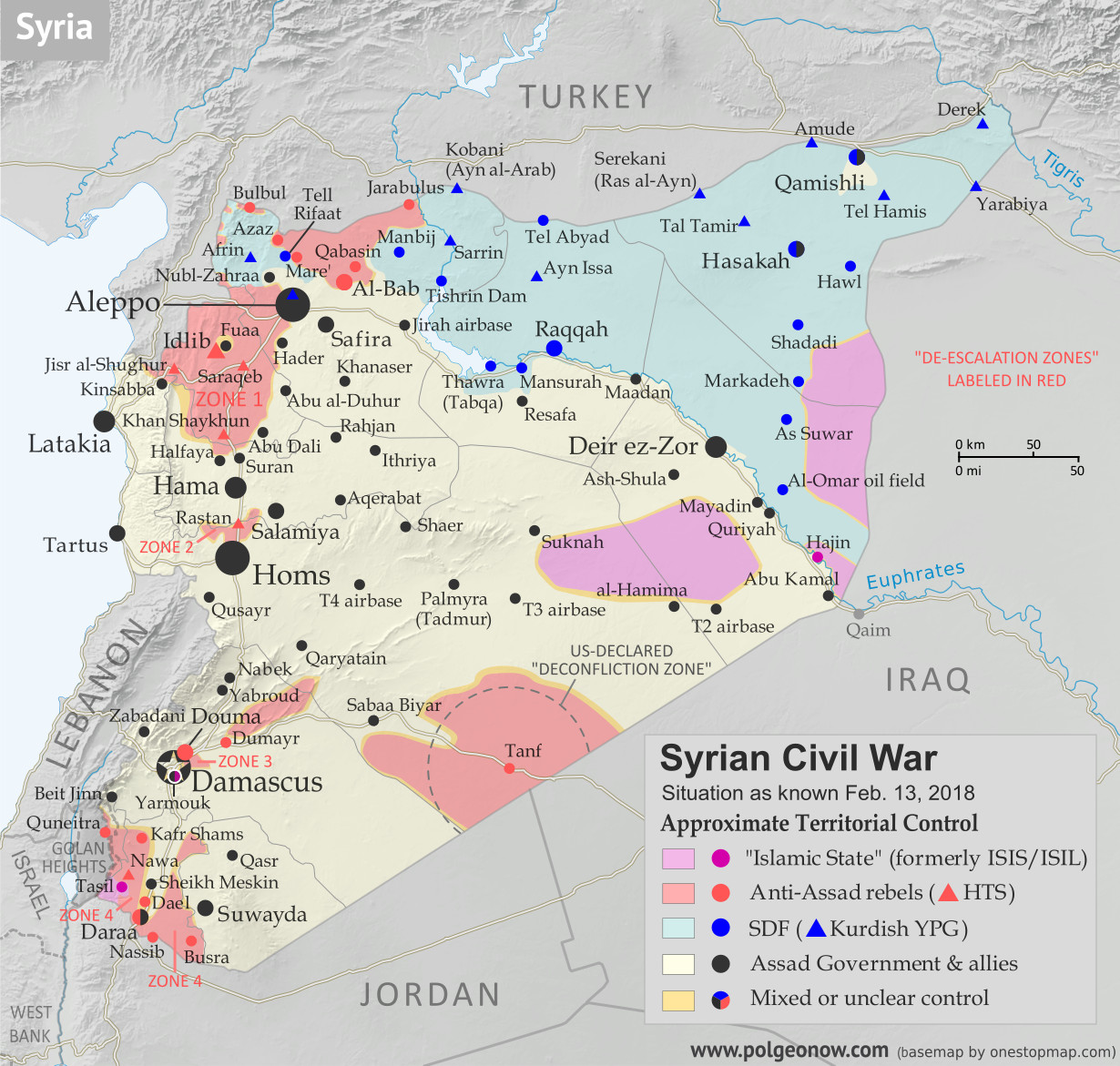
Who controls what in Syria? Rebel and ISIS control map of the Syrian Civil War. Shows territorial control as of February 2018 (Free Syrian Army rebels, Kurdish YPG, Syrian Democratic Forces (SDF), Jabhat Fateh al-Sham / Hayat Tahrir al-Sham (Al-Nusra Front), Islamic State (ISIS/ISIL), and others). Includes Russia-Turkey-Iran agreed de-escalation zones and US deconfliction zone, plus recent locations of conflict and territorial control changes, such as Abu al-Duhur, Bulbul, Saraqeb, and more. Colorblind accessible.
Base map by Koen Adams of onestopmap.com, with territorial control by Evan Centanni and Djordje Djukic.
Contact us for permission to use this map.

(Subscribers click here to view this article on the member site)

Timeline by Djordje Djukic

Situation Summary

The past few weeks since our previous Syria map update have been dominated by news from two main arenas of battle, both in the country’s northwest. In the most politically significant development, the Turkish military has entered the Kurdish-administrated Afrin region (also spelled “Efrin”) as part of a mission, alongside allied rebel fighters, to drive Kurdish militias out of the western border region. Meanwhile, forces loyal to Syria’s Assad government have made major advances in areas south of Aleppo, eliminating an enclave of the so-called “Islamic State” (IS; formerly ISIS/ISIL) and cutting into rebel control around the edges of Idlib province.

The main boundary-related milestones in this update involve the former side-by-side rebel and IS exclaves at the corner of Idlib, Aleppo, and Hama provinces, which were together already encircled by pro-government troops as of our January report. Since that was published, IS forces managed to take over the rebel-held parts of the pocket, simultaneously eliminating the rebel exclave, erasing one of only two IS borders with Syrian rebel territory, and making the IS territory into a proper enclave, fully surrounded by government forces. Not long afterwards, the IS enclave was itself eliminated by government forces, though a smaller, short-lived pocket of IS control briefly sprung up farther to the west.

Turkey’s incursion into the Afrin region has also created three or four new exclaves of rebel control wedged between the Kurdish-administered area and the Turkish border. However, because of the heavy involvement of Turkish troops, some observers might consider these mere extensions of Turkish territory. If the Turkish-led forces are able to continue their advance, we may also soon see the elimination of Kurdish Afrin’s border with Turkey.

See Also: Iraq Control Map for February 2018
Flag of Syria under the current governmentCountry Name:  
• Syria (English)
• Sūriyya/Sūryā (Arabic)
Official Name:  
• Syrian Arab Republic (English)
• al-Jumhūriyyah al-‘Arabīyah  as-Sūriyyah (Arabic)
Capital: Damascus

Note: Red triangles on the map represent towns where rebel group Hayat Tahrir al-Sham (HTS) – formerly known as Al Qaeda affiliate Jabhat al-Nusra (a.k.a. the Nusra Front), and later Jabhat Fateh al-Sham (JFS) – is thought to be in a dominant position among rebel forces, even if it doesn’t exercise exclusive control. This organization has at least some presence in most rebel-held areas of Syria.

Timeline of Events
The following is a timeline of changes to territorial control and other key events in Syria since our previous map update of January 20, 2018. Sources are provided as in-line links.

January 21, 2018
Turkey-supported Free Syrian Army (TFSA) rebels pushed into the Kurdish-administered Afrin region and captured four to nine villages. Later, the Kurdish-led Syrian Democratic Forces (SDF) recaptured two villages. Turkish military forces were fighting alongside the rebels, on a mission to establish a buffer zone between the border and the territory of the SDF, whose dominant Kurdish YPG militia Turkey considers to be terrorists because of links to rebels inside Turkey. (The Turkish government hopes to eventually create a Turkey-friendly buffer zone along Syria’s entire northern border.)

Meanwhile, the Syrian military continued its clean-up operations around the Abu al-Duhur airbase, while also attempting to capture the town of Abu al-Duhur itself, and was also advancing against a besieged rebel-controlled pocket at the intersection of Idlib, Hama and Aleppo provinces. In addition, the army captured two villages from IS in the group’s adjacent enclave. Later, the Syrian Ministry of Defense reported that the airbase had been secured.

January 22, 2018
Government forces seized Abu al-Duhur, and the number of villages captured by the military over the previous 12 hours in the Idlib-Hama-Aleppo pocket reached 30. Meanwhile, the TFSA captured a strategic mountain in the northeast of the Afrin region, as well as a hill to the north. However, the SDF later recaptured the mountain.

January 22-23, 2018
A two-day rebel attack on government positions in Latakia province was repelled, but 16 soldiers were killed during the attack.

January 23, 2018
The TFSA launched a new assault on a strategic mountain in the Afrin region, before Kurdish forces pushed it back. The mountain overlooks the eastern approach to Afrin city. Meanwhile, government forces captured a village west of Abu al-Duhur.

January 24, 2018
IS captured the remaining 17 villages in the government-besieged Idlib-Hama-Aleppo pocket from HTS rebels. Government forces also seized several villages in the enclave from HTS.

January 25, 2018
IS forces launched an assault across the Euphrates River, attacking the government-held western bank. The attack was eventually repelled. Between 18 and 25 IS fighters, as well as between a dozen and 26 pro-government fighters, were killed during the attack along a 32 kilometer front.

January 26, 2018
The town of Abu al-Duhur was reported to once again be contested between government and HTS forces. Meanwhile, the SDF recaptured a village in the Afrin region from pro-Turkish forces.

January 28, 2018
Pro-Turkish forces captured the strategic mountain in the Afrin region that they had been targeting for the past several days.

January 29, 2018
The army captured Abu al-Duhur, thus securing the western flank of the nearby airbase. Three other nearby villages were also captured. Meanwhile, the SDF captured an IS stronghold on the eastern bank of the Euphrates, about 15 km northwest of Hajin, for the fourth time following five weeks of back-and-forth fighting.

January 30, 2018
A civilian was killed when a Turkish military convoy was attacked by a car bomb in the Idlib countryside. A soldier and another civilian were wounded. The Turkish military stated that the convoy had been traveling as part of its mission to enforce a “de-escalation” zone in the province. According to pro-government sources, the convoy was attempting to block further Syrian Army advances in the Aleppo countryside, but that after the attack it had quickly returned to the border.

January 31-February 1, 2018
Government forces seized 100 square kilometers of territory, including 20 villages, in the eastern countryside of Idlib and the southern countryside of Aleppo, coming within 14 kilometers of Saraqeb, a major town at the junction of two key highways.

February 1, 2018
It was reported that since the start of the offensive against Afrin, pro-Turkish forces had advanced only seven kilometers and seized between 15 and 20 villages, about 4 percent of the total number in the region. Meanwhile, Syrian government troops launched an assault against the IS enclave in the northeastern countryside of Hama, capturing three villages and a hill.

February 1-3, 2018
On February 1, the TFSA reached Bulbul, 30 kilometers north of Afrin, and soon afterwards Turkish media claimed the pro-Turkish forces had captured the town. However, pro-opposition and Kurdish sources said the town was still contested. Two days later, the TFSA capture of Bulbul was confirmed.

February 2-3, 2018
Government forces advanced farther toward Saraqeb after capturing four more villages. The next day, the army reportedly seized one more village on the provincial border of of Idlib and Aleppo, as well as one in the southwestern countryside of Aleppo.

February 3, 2018
HTS rebel fighters shot down a Russian Sukhoi 25SM fighter jet over Idlib province with a shoulder-launched anti-aircraft MANPAD missile. It was the first case of a Russian jet being brought down by the rebels since the start of the Russian intervention in the civil war in 2015. The pilot ejected and was immediately fired upon by HTS fighters. He managed to land on the ground and returned fire, shooting two rebels, before he killed himself by detonating a grenade to avoid capture.

February 3-7, 2018
The army continued with an armored assault from multiple directions against the IS pocket in northeastern Hama province, taking control of up to 30 villages, reportedly representing 80 percent of the pocket.

February 5-7, 2018
The rebels launched a counterattack against government forces in the eastern countryside of Idlib, recapturing one village and advancing into a second. Two days later, two more villages were recaptured by the rebels, though it was later reported that one of them had once again come under army control.

February 8, 2018
The US reported that a force of about 500 pro-Syrian government soldiers, supported by artillery, tanks, multiple-launch rocket systems, and mortars, attacked the SDF and American military advisors east of the Euphrates River in Deir ez-Zor province. Coalition airstrikes were then launched against the pro-government forces, with the US claiming more than 100 pro-government fighters were killed, while only one SDF combatant was wounded during the fighting. In contrast, pro-opposition activists reported that 45 pro-government fighters were killed in the airstrikes, while Syrian military sources stated that 45 Syrian soldiers were killed.

Days later, reports emerged that Russian private military contractors (PMCs) supporting the pro-government forces had also died in coalition counterattack, with between 5 and 10 PMC deaths confirmed.

Meanwhile, the Syrian army renewed its attack against the encircled IS pocket in the northeast of Hama, reducing it to about a dozen towns and villages, while the majority of IS forces withdrew to just one town.

February 9, 2018
After one week of fighting, government forces cleared the whole IS enclave in the northeastern countryside of Hama, taking control of 80 villages and fully securing a key highway linking Hama and Aleppo. Opposition activists said that a corridor was opened by the government for the remaining 200 IS fighters to retreat towards rebel-held territory in Idlib province, with IS subsequently capturing three villages from the rebels. According to pro-government sources, the IS forces had instead conducted a surprise break-out towards rebel territory, advancing through over a dozen government-held villages before reaching it.

Meanwhile, the strip of territory that Turkey-backed forces had seized from the SDF along the border was estimated to have reached 15 kilometers in width.

February 10, 2018
An Israeli F-16 fighter jet crashed after coming under fire from Syrian anti-aircraft missiles during a raid against Iranian facilities in eastern Homs province that had earlier launched a drone into Israel. The drone had been intercepted and shot down by Israel. The F-16 crashed in northern Israel, with both pilots ejecting and then being evacuated to a hospital. Subsequently, Israel conducted a second raid against 12 Syrian and Iranian military targets southwest of Damascus. Later in the day, Israel also conducted a third raid near Damascus. Overall, six pro-government fighters, including non-Syrians, were reported killed in the airstrikes.

Meanwhile, a Turkish military attack helicopter was shot down by Kurdish forces in the Afrin region, with both crew members killed. During the day’s fighting in Afrin, the TFSA managed to make advances, linking up with rebel forces in Idlib province.

February 11, 2018
The TFSA advanced to within three kilometers of a strategic town in the Afrin region.

February 12, 2018
IS captured two villages from rebels in the southeastern Idlib countryside and was fighting for control of a third village. Elsewhere, the SDF captured one village from IS on the eastern bank of the Euphrates River, after which IS launched a counterattack in an attempt to retake it. Meanwhile, the TFSA managed to establish a buffer zone around its recent gains in the southern part of Afrin, while in the northern part a new TFSA attack was repelled by the YPG.

February 13, 2018
Four hundred IS fighters and their family members surrendered to rebels in the area they had captured the previous day in Idlib province. The IS fighters also gave up all of their positions in the area. Meanwhile, more advances by the TFSA brought a total of 8 percent of the Afrin region under its control. Overall, since the start of the Turkish-led operation in the area, between 453 and 456 people had been confirmed killed, including 177 TFSA and 163 SDF fighters, 75 civilians in Syria, 7 civilians in Turkey, and 31-34 Turkish soldiers.

Graphic of the Syrian flag is in the public domain (source).
Syria Control Map & Timeline – April 2017 (Subscription)

SUBSCRIBERS CLICK HERE TO PROCEED TO ARTICLE AND MAP

There are newer versions of this map available. To see them, view all Syria updates.

Research by Djordje Djukic. Map by onestopmap.com, Evan Centanni, and Djordje Djukic

Subscribe for full access to all conflict map reports!


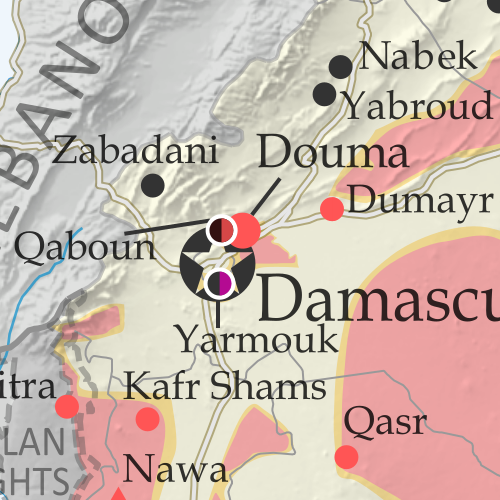
Map of fighting and territorial control in Syria's Civil War (Free Syrian Army rebels, Kurdish YPG, Syrian Democratic Forces (SDF), Jabhat Fateh al-Sham / Hayat Tahrir al-Sham (Al-Nusra Front), Islamic State (ISIS/ISIL), and others), updated to April 26, 2017. Now includes terrain and major roads (highways). Includes recent locations of conflict and territorial control changes, such as Thawra, Halfaya, Suran, Qaboun, and more. Colorblind accessible. The so-called “Islamic State” (ISIS/ISIL) has continued to lose ground in Syria to the Kurdish-led, US-backed Syrian Democratic Forces (SDF) in the north, and to rebel groups in the southern desert. Meanwhile, the Assad government has made some gains against rebels in Hama province, the Damascus area, and elsewhere.
 
See all this and more on the latest update to PolGeoNow’s concise, professional Syrian Civil War control map, which includes a timeline of changes since our previous Syria map report in March, with sources cited.

This map and report are premium professional content, available to paid subscribers of the PolGeoNow Conflict Mapping Service.

Want to see before you subscribe? Check out our most recent FREE SAMPLE Syria map!

Exclusive report includes:

  • Up-to-date map of current territorial control in Syria, color-coded for the Assad government, rebel groups, “Islamic State” (ISIS/ISIL) fighters, and Kurdish/SDF forces. Colorblind accessible.
  • Special symbols indicating towns dominated by rebels of the former Nusra Front (now Hayat Tahrir al-Sham) and US-backed Syrian Democratic Forces (SDF).
  • Detailed indication of city-by-city control, including key towns and other locations important to current events.
  • Locations of recent fighting and other important events, including Thawra, Halfaya, Suran, Qaboun, and more.
  • Detailed timeline of important events and changes to territorial control since March 29, 2017, compiled by our Syria-Iraq expert, with links to sources.

SUBSCRIBERS CLICK HERE TO PROCEED TO ARTICLE AND MAP

Not signed up yet? Click here to learn more about our professional subscription service!

Can I purchase just this map?
This map and report are not available for automated purchase to non-subscribers. If you need access or republication rights for only this map report, contact service@polgeonow.com for options.

Interactive Maps: Which Places Switched Time Zones in 2016?

This article is a spin-off from our popular yearly review of political geography events. For more on changes to countries and borders in 2016, check out our main 2016 year in review article

A time zone map of the world, showing all the world's standard time zones as of the beginning of 2017, with UTC offsets.
Free map of world time zones from Wikimedia Commons, up-to-date for the beginning of 2017. See the close-ups below for interactive, before-and-after illustrations of time zone changes during 2016.

Article and additional graphics work by Evan Centanni
 

Who Controls Time Zones?

The system of dividing the world into time zones is accepted all around the world, in principle. It’s an organized way of letting clocks in each part of the world hit noon around the middle of daylight hours, even if it’s midnight on the other side of the world. But surprisingly, there’s actually no international organization that determines time zones. Except for in the open ocean, where time zones are standardized by a loose agreement between fleets and ship operators, the dividing lines are set independently by each country’s government, or even by local governments below the national level.

Many governments choose one time for the whole country, putting themselves unofficially inside a bigger time zone with other countries that set their clocks to the same time. Others, especially if their territory is very wide from west to east, divide the country up into several time zones. And while most time zones are defined as being a whole number of hours different from Coordinated Universal Time (UTC; a modern version of the outdated “Greenwich Mean Time”), some choose to align their clocks more precisely with the cycles of the sun by shifting them a half hour or even a quarter hour forward or back.

Who Changed Their Time Zones in 2016?

Depending on a country’s laws, redrawing the boundaries between time zones can be as simple as a local assembly voting to reset the area’s clocks, or a president signing an order to modify the nation’s time zones. Last year, there were quite a few of these changes, which you can see by tapping on the maps below (if you’re using a touchscreen) or hovering your cursor over the maps (if you’re using a mouse).

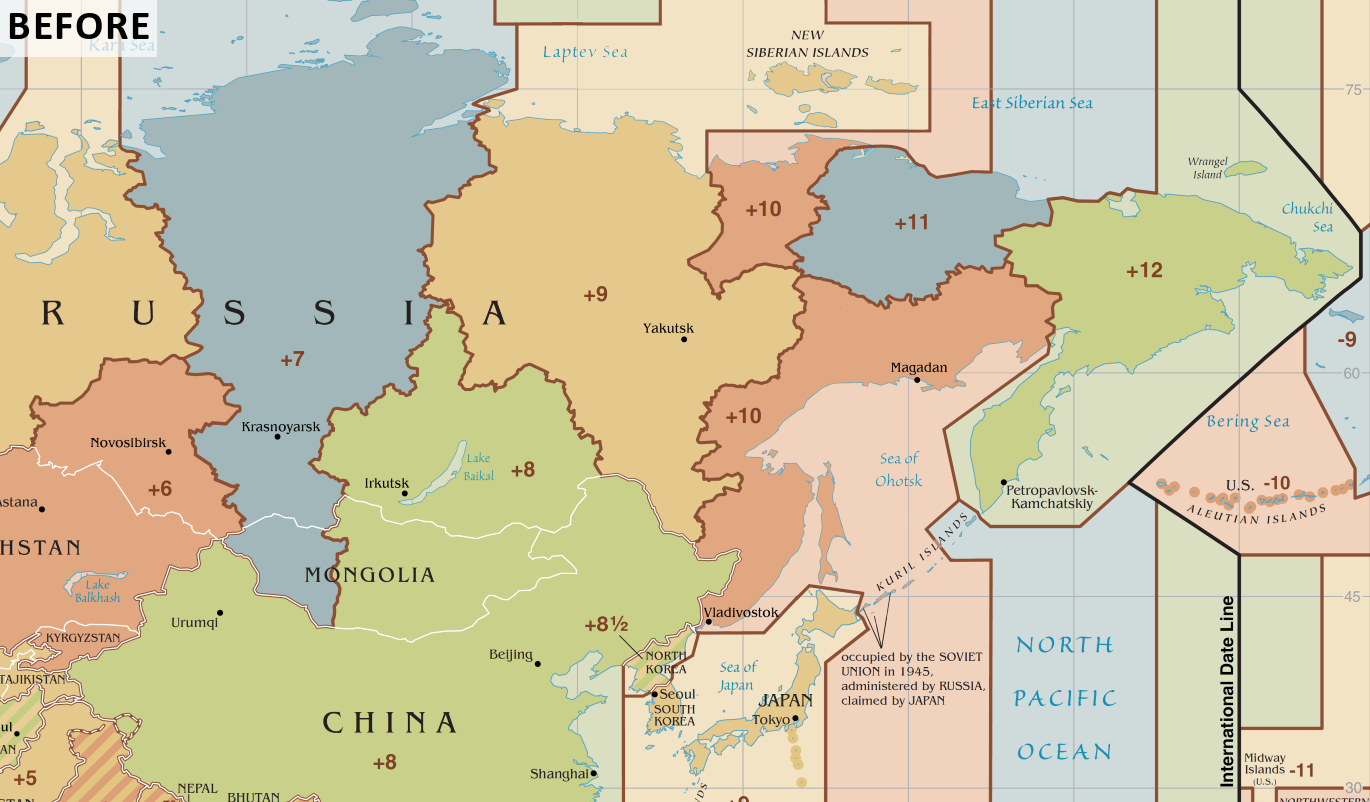
Before and after: Interactive map of time zones that changed during 2016 in Siberia and the Russian Far East
Before and After: Tap or hover your mouse over the map to see which time zones changed shape during 2016 in eastern Russia (see next map below for changes in western Russia)

Russia’s Year of Time Changes

Russia dominated the time zone news in 2016, with ten different regions of the country all moving their clocks forward an hour at different times during the year. The end result was a major redrawing of four different time zone boundaries. Russia has a history of time zone changes, with tweaks or major shifts happening every few years since the 1980s, so this wasn’t a huge surprise.

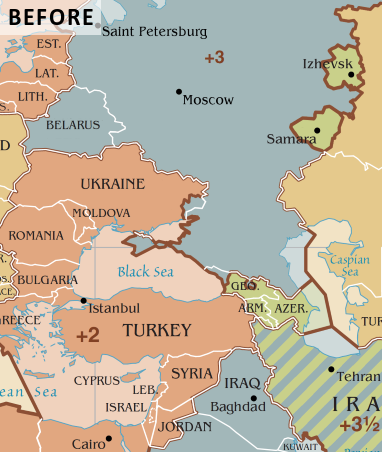
The 2016 changes started off in January, with the announcement that President Vladimir Putin had signed off on a time change for the Zabaykalsk territory of Siberia. The region would set its clocks one hour forward on March 27, moving from Irkutsk Time (UTC +8) to Yakutsk Time (UTC +9). Not long afterwards, he approved a second time change, this one for Astrakhan province in Russia’s southwest. Astrakhan would also set clocks one hour forward, on the same day as Zabaykalsk, leaving Moscow Standard Time (UTC +3) to join Samara Time (UTC +4).

Within weeks, several more changes had been announced for Russia’s March 27 time zone shift:

  • Sakhalin province in Russia’s Far East would set clocks an hour forward, switching from Vladivostok Time (UTC +10) to Srednekolymsk Time (UTC +11)
  • Western Siberia’s Altai Republic and Altai territory would both set clocks an hour forward, switching from Omsk Time (UTC +6) to Krasnoyarsk Time (UTC +7)
  • Ulyanovsk province in Western Russia would join Astrakhan in setting clocks an hour forward from Moscow Time (UTC +3) to Samara Time (UTC +4)

But that wasn’t the end of it. On April 24, less than a month after the big March changes, the far eastern Magadan province also moved an hour forward, leaving Vladivostok Time (UTC +10) to join Sakhalin and Srednekolymsk in the UTC +11 time zone, which was then renamed Magadan Time.

Before and after: Interactive map of time zones that changed during 2016 in west Asia and southeastern Europe
Before and After: Tap or hover to see which time zones changed shape in 2016

The next month, on May 29, yet another Russian region set its clocks forward an hour, with western Siberia’s Tomsk province joining the Altai Republic and Altai territory in moving from Omsk Time (UTC +6) to Krasnoyarsk Time (UTC +7). Then, on July 24, Siberia’s biggest city jumped on the bandwagon, with Novosibirsk province joining the neighboring Tomsk and Altai regions in setting clocks an hour forward (the previous changes had left it an hour behind most of the surrounding areas).

Before the year was done, one more Russian region had switched time zones. On December 4, Saratov province joined Astrakhan and Ulyanosk in setting its clocks forward an hour from Moscow Time (UTC +3) to Samara Time (UTC +4).

Other Countries That Changed Their Time Zones in 2016

Besides Russia, there were a few other countries that carried out time zone changes last year. Not far away from some of the changing Russian time zones, Turkey made a shift of its own. Until late 2016, Turkey’s standard time zone was UTC +2, just like every other country on the eastern Mediterranean, such as Greece, Syria, Israel, and Egypt. During the summer, Turkey would set clocks temporarily forward an hour, a common practice that’s known as daylight saving time (DST). 

But in September, Turkey’s government decided not to set clocks back to the normal time for winter anymore, leaving the country permanently in UTC +3, alongside Moscow, Saudi Arabia, and East Africa. Not to be left-behind, the self-declared Turkish Republic of Northern Cyprus quickly decided to join its sponsor country in the time zone change, leaving the island of Cyprus split awkwardly between different time zones for its northern and southern areas.

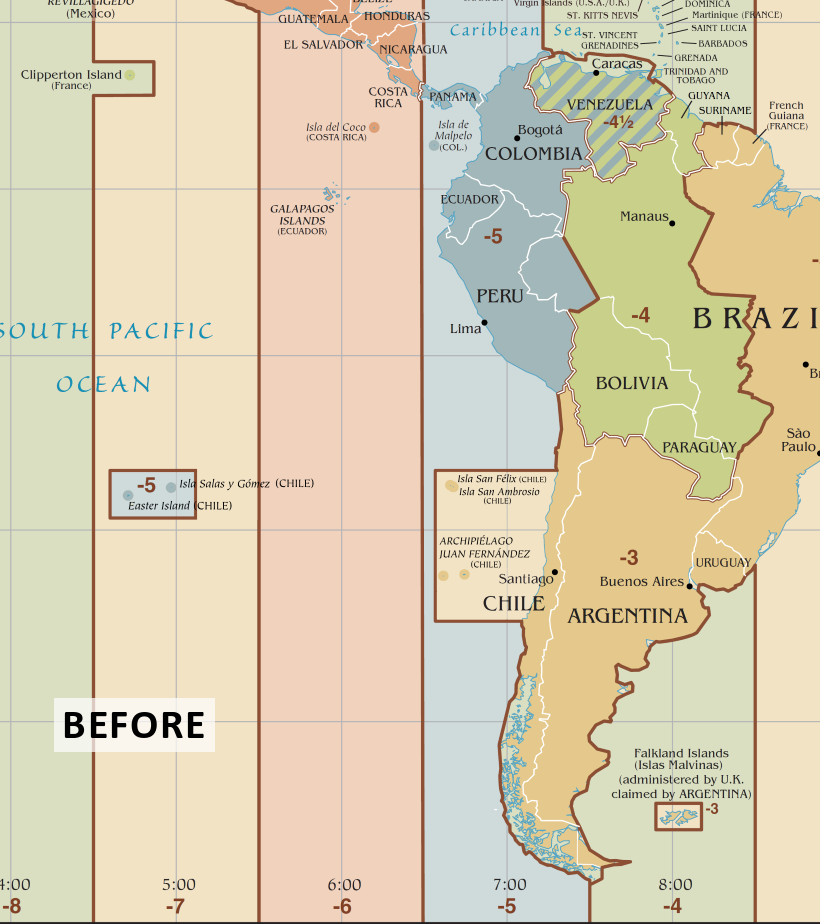
Back in 2015, Chile had done the same thing as Turkey, shifting forward an hour from UTC -4 to UTC -3 by canceling the end of daylight saving time. But in 2016 the country reversed course, reintroducing DST changes so the country’s mainland would return to UTC -4 in the winter. 

The remote Chilean territory of Easter Island, known locally as Rapa Nui, is two hours behind the rest of the country, but follows the same DST rules. So after the 2015 change, Easter Island was permanently in the UTC -5 zone, even though the seas surrounding it are loosely considered to be in UTC -7. But with Chile’s 2016 policy reversal, the island returned to UTC -6 for the winter. Meanwhile, not long after the country set clocks back an hour for the winter, southern Chile’s Magallanes region decided it didn’t like returning to the old time zone, and in December 2016 a law was passed to let it stay in UTC -3 year-round again. The law also affected Chile’s claimed territory in Antarctica, which includes a US research station.

Before and after: Interactive map of time zones that changed during 2016 in South America
Before and After: Tap or hover to see which time zones changed shape in 2016

Finally, Venezuela also changed its clocks in 2016, completely erasing one of the world’s time zones off the map. Since 2007, Venezuela had been the only place in the world using a time zone of UTC -4:30 (which it also used from 1912 to 1965). 

But last April, President Nicolas Maduro announced that the country would set clocks ahead half an hour, returning to the more conventional UTC -4 time zone. The stated purpose was to counter a severe energy shortage. By lengthening evening sunlight hours, it was hoped that the country would save electricity, because people would wait an extra half hour before turning their lights on in the evening. 

Since no other place currently uses the UTC -4:30 zone, Venezuela’s change entirely deleted it from the world time zone map.

Changes to Daylight Saving Time

What the maps in this article don’t show is that many places move temporarily forward an hour in the summer for daylight saving time (DST) – and these policies change just as often as permanent time zones.

In 2016, Tonga reintroduced DST after a period without it, moving its actual time in the summer from UTC +13 temporarily to UTC +14. The UTC +14 time zone, used permanently by parts of the country of Kiribati, is the farthest-forward time zone in the world. Since Tonga is in the southern hemisphere, where summer runs from December to March, this means Tonga and Kiribati together became the first countries to enter the year 2017 on January 1. Curiously, clocks in the UTC +14 time zone show the exact same time as clocks in the UTC -10 time zone (used by Hawaii and French Polynesia), but the date is exactly one day later.

Egypt’s government also planned to reintroduce DST in 2016, after abolishing it twice in the past. But the time changes are so unpopular in Egypt that the government was pressured into canceling the move just a day before some said it would have gone into effect. Meanwhile, Azerbaijan also continued a series of flip-flops on whether to use DST, canceling it in 2016 just 10 days before clocks were set to change. Haiti did the same.

The British Caribbean territory of the Cayman Islands also canceled plans to start using DST in 2016, and the government of the disputed Palestinian territories delayed DST by a week, bringing it closer in line with the dates used by Israel.

What Time Zones Will Change in 2017?

Although an academic proposal to abolish all the world’s time zones is unlikely to happen anytime soon, there are plenty of proposed time zone changes that might come about in 2017. Countries like Namibia, Jordan, Spain, and Hungary are considering changing their time zones, while the European Union, several US states, and at least one Canadian province might abolish daylight saving time (Mongolia has already decided to get rid of DST in 2017, while Haiti has already reversed its 2016 DST cancellation).

Several US states are also debating proposals to switch time zones, either by making DST permanent or by just moving both standard time and DST. One of them, the far northwestern state of Alaska, could merge both its UTC -9 and UTC -10 time zones into the UTC -8 Pacific Time. The change would effectively shift the remote Aleutian Islands two hours forward.

Stay tuned to PolGeoNow’s Twitter feed for updates as we learn about them!

Learn More!
Country and Border Changes in 2016
Rebel Control Around the World in 2016
All PolGeoNow Articles About Time Zones

Iraq Control Map & Timeline: The Siege of Mosul – November 2016 (Subscription)

SUBSCRIBERS CLICK HERE TO PROCEED TO ARTICLE AND MAP

There are newer versions of this map available. To see them, view all Iraq updates.

Research by Djordje Djukic. Map by onestopmap.com, Evan Centanni, and Djordje Djukic

Subscribe for full access to all conflict map reports!


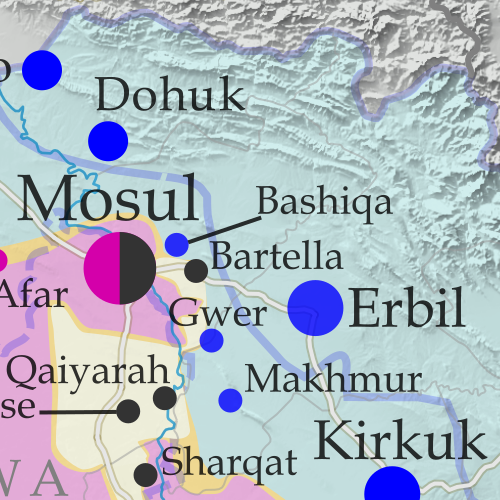
Detailed map of territorial control in Iraq as of November 4, 2016, including territory held by the so-called Islamic State (ISIS, ISIL), the Baghdad government, and the Kurdistan Peshmerga. Shows developments in the ongoing coalition battle to recapture the city of Mosul. Includes key locations from recent events, such as Bashiqa, Sharqat, and Bartella. Colorblind accessible. The battle is now on for Mosul, the so-called Islamic State’s (ISIS/ISIL) biggest city. A grand coalition of Iraqi military, Shiite and Sunni militias, and Kurdistan’s Peshmerga forces – with controversial help from the Turkish military – have now entered and mostly surrounded the city.
 
See all this and more on the latest update to PolGeoNow’s concise, professional map of control in Iraq’s civil war, including a timeline of changes since our previous Iraq map report of September 2016.

This map and report are premium professional content, available to paid subscribers of the PolGeoNow Conflict Mapping Service.

Want to see before you subscribe? Check out our most recent FREE SAMPLE Iraq map report!

Exclusive report includes:

  • Up-to-date map of current territorial control in Iraq, color-coded for the Iraqi government, “Islamic State” (ISIS/ISIL) extremists, and Kurdistan’s Peshmerga forces. Colorblind accessible.
  • Detailed indication of town-by-town control, including provincial boundaries, all major cities, and many smaller ones
  • Markers for key areas of recent fighting such as Mosul, Bashiqa, Sharqat, and Bartella
  • Timeline of changes to the situation since early September, compiled by our Iraq specialist, with links to sources

SUBSCRIBERS CLICK HERE TO PROCEED TO ARTICLE AND MAP

Not signed up yet? Click here to learn more about our professional subscription service!

Can I purchase just this map?
This map and report are not available for automated purchase to non-subscribers. If you need access or republication rights for only this map report, contact service@polgeonow.com for options.

Syrian Civil War Control Map & Report: October 2, 2016 (Subscription)

SUBSCRIBERS CLICK HERE TO PROCEED TO ARTICLE AND MAP

There are newer versions of this map available. To see them, view all Syria updates.

Research by Djordje Djukic. Map by onestopmap.com, Evan Centanni, and Djordje Djukic

Subscribe for full access to all conflict map reports!


Map of fighting and territorial control in Syria's Civil War (Free Syrian Army rebels, Kurdish YPG, Syrian Democratic Forces (SDF), Jabhat Fateh al-Sham (Al-Nusra Front), Islamic State (ISIS/ISIL), and others), updated for October 2016. Now includes terrain and major roads (highways). Includes recent locations of conflict and territorial control changes, such as Dabiq, Halfaya, Suran, Jarabulus, and more (colorblind accessible). During the past month, a continued Turkish military incursion into Syria completely cut off the so-called “Islamic State” from the self-proclaimed caliphate’s last international border in the region (other than its boundaries with Syrian and Iraqi territory).

Meanwhile, the Assad government and rebel groups have continued to take territory from each other despite a brief attempt at a country-wide ceasefire.
 
See all this and more on the latest update to PolGeoNow’s concise, professional Syrian Civil War control map, which includes a timeline of changes since our previous Syria map report in late August, with sources cited.

This map and report are premium professional content, available to paid subscribers of the PolGeoNow Conflict Mapping Service.

Want to see before you subscribe? Check out our most recent FREE SAMPLE Syria map!

Exclusive report includes:

  • Up-to-date map of current territorial control in Syria, color-coded for the Assad government, rebel groups, “Islamic State” (ISIS/ISIL) fighters, and Kurdish/SDF forces. Colorblind accessible.
  • Special symbols indicating towns dominated by rebels of the former Nusra Front (now Jabhat Fateh al-Sham) and US-backed Syrian Democratic Forces (SDF).
  • Detailed indication of city-by-city control, including key towns and other locations important to current events.
  • Locations of recent fighting and military operations, including Dabiq, Halfaya, Suran, Jarabulus, and more.
  • Detailed timeline of important events and changes to territorial control since August 27, 2016, compiled by our Syria-Iraq expert, with links to sources.

SUBSCRIBERS CLICK HERE TO PROCEED TO ARTICLE AND MAP

Not signed up yet? Click here to learn more about our professional subscription service!

Can I purchase just this map?
This map and report are not available for automated purchase to non-subscribers. If you need access or republication rights for only this map report, contact service@polgeonow.com for options.

Syrian Civil War Control Map & Report: August 2016 (Subscription)

SUBSCRIBERS CLICK HERE TO PROCEED TO ARTICLE AND MAP

There are newer versions of this map available. To see them, view all Syria updates.

Research by Djordje Djukic. Map by onestopmap.com, Evan Centanni, and Djordje Djukic

Subscribe for full access to all conflict map reports!


Map of fighting and territorial control in Syria's Civil War (Free Syrian Army rebels, Kurdish YPG, Syrian Democratic Forces (SDF), Al-Nusra Front, Islamic State (ISIS/ISIL), and others), updated for August 2016. Now includes terrain and major roads (highways). Includes recent locations of conflict and territorial control changes, such as Jarabulus, Manbij, Daraya, Hasakah, and more (color blind accessible). Syria’s war has seen several major territorial changes in the past month, with a Turkish military intervention bringing IS defeats even as the rival, Kurdish-led Syrian Democratic Forces have captured key territory from both IS and the Assad government. Meanwhile, the government has scored some major victories of its own against rebel forces.
 
See all this and more on the latest update to PolGeoNow’s concise, professional Syrian Civil War control map, which includes a timeline of changes since our previous Syria map report in late July, with sources cited.

This map and report are premium professional content, available to paid subscribers of the PolGeoNow Conflict Mapping Service.

Want to see before you subscribe? Check out our most recent FREE SAMPLE Syria map!

Exclusive report includes:

  • Up-to-date map of current territorial control in Syria, color-coded for the Assad government, rebel groups, “Islamic State” (ISIS/ISIL) fighters, and Kurdish/SDF forces. Color blind accessible.
  • Special symbols indicating towns dominated by rebels of the Nusra Front (now Jabhat Fateh al-Sham) and US-backed Syrian Democratic Forces (SDF).
  • Detailed indication of city-by-city control, including key towns and other locations important to current events.
  • Locations of recent fighting and military operations, including Jarabulus, Manbij, Daraya, Hasakah, and more.
  • Detailed timeline of important events and changes to territorial control since July 25, 2016, compiled by our Syria-Iraq expert, with links to sources.

SUBSCRIBERS CLICK HERE TO PROCEED TO ARTICLE AND MAP

Not signed up yet? Click here to learn more about our professional subscription service!

Can I purchase just this map?
This map and report are not available for automated purchase to non-subscribers. If you need access or republication rights for only this map report, contact service@polgeonow.com for options.

Syria Civil War Control Map: April 2015 (Subscription)

There are newer versions of this map available. To see them, view all Syria updates.

Map of fighting and territorial control in Syria's Civil War (Free Syrian Army rebels, Kurdish groups, Al-Nusra Front, Islamic State (ISIS/ISIL) and others), updated for April 2015. Highlights recent locations of conflict and territorial control changes, such as Yarmouk, Idlib, Nassib border crossing, Busra, and Tel Hamis.

Download PDF:
Buy now

(Subscribe via Paypal to view all premium content online)

Research by T.H., with additional reporting by Evan Centanni

Since January, the Islamic State has captured part of Syria’s capital city, while rebels have gained important ground in both the north and the south. Meanwhile, Kurdish militias have scored victories against the Islamic State on the northeastern front. 

See all this and more on the newest update to PolGeoNow’s popular Syria control map, and read a timeline of changes since our previous Syria map report at the end of January.

This map and report are exclusive premium content, available to paid subscribers or for separate purchase.
Download PDF (US$19.99)

Exclusive map report includes:

  • Up-to-date map of current territorial control in Syria, color-coded for the Assad government, rebel groups, Islamic State (ISIS/ISIL) extremists, and Kurdish self-protection forces
  • Detailed indication of city-by-city control, highlighting key towns and other locations relevant to current events
  • Locations of recent fighting and military operations, including Yarmouk, Idlib, Nassib border crossing, Busra, and the Tomb of Suleyman Shah (site of Turkey’s brief military incursion in February).
  • Timeline of changes to important events since the end of January, plus summary of important territorial changes in recent months.

MEMBERS CLICK HERE TO PROCEED TO ARTICLE AND MAP

NOT A MEMBER YET? SUBSCRIBE NOW!

Portuguese Community Admits New Member & Observer Countries (Map)

Map of the Community of Portuguese Language Countries (CPLP), including both member states and associated observers. Updated for the July 2014 summit, which admitted new member Equatorial Guinea and new associate observers Georgia, Japan, Namibia, and Turkey (colorblind accessible).
Map by Evan Centanni, starting from public domain blank map (license: CC BY-NC-SA).

Premium members click here to view this article in the ad-free members area. Not a member yet? Subscribe now!

Article by Karina Barquet

Flag of the Community of Portuguese Language Countries (aka Community of Portuguese-speaking Countries, CPLP)Organization Name:  
• Community of Portuguese Language Countries (English)
• Community of Portuguese-Speaking Countries (English – alternative name)
• Comunidade dos Países de Língua Portuguesa (Portuguese)
Founded: 1996 in Lisbon, Portugal
Headquarters: Lisbon, Portugal
Website: www.cplp.org

New Member Country for CPLP
The Community of Portuguese Language Countries (known by the Portuguese acronym CPLP) welcomed a new member this year. Equatorial Guinea joined the organization following its approval at the 10th CPLP Heads of State Summit in Dili, East Timor on July 23, 2014.

The CPLP is an intergovernmental organization for cooperation amongst countries where Portuguese is an official language. It was  founded in 1996 with seven member countries: Portugal, Brazil, Angola, Cape Verde, Guinea-Bissau, Mozambique, and São Tomé and Príncipe. East Timor joined the community in 2002 after gaining independence.

New Observer Countries
In addition to new member Equatorial Guinea, the CPLP’s July 2014 summit also admitted four new Associate Observer countries: Georgia, Japan, Namibia, and Turkey. These joined the two previously-admitted Associate Observers, Mauritius and Senegal.

Equatorial Guinea is a small country located in Central Africa. Its name reflects the country’s location near both the equator and the Gulf of Guinea. Equatorial Guinea is a former Spanish colony, and Spanish is the first official language, followed by French. A new law drafted in 2011 declared Portuguese the third official language in the country, though it is unclear whether that law ever went into effect.

The push to adopt Portuguese as an official language was a result of President Obiang’s efforts in 2007 to improve communications, trade, and bilateral relations with Portuguese-speaking countries, and to meet an important requirement to become a full member of the CPLP. Other requirements for joining CPLP included political reforms to give room for effective democracy and respect for human rights.

The 10th Summit also saw the reincorporation of Guinea-Bissau as a full member of the CPLP, after its suspension following a coup d’etat in April 2012. Guinea-Bissau was readmitted in the wake of the country’s recent presidential and legislative elections, and the transition of the CPLP’s presidency from President of Mozambique, Armando Guebuza, to the President of East Timor, Matan Ruak, who will be in office for the next two years.

Low-resolution graphic of the CPLP flag is displayed under fair use principles (source).