States Recognize Palestine Ahead of U.N. Bid

Country Name: Palestine (English), Filastin (Arabic)
Official Name: State of Palestine (English), Dawlat Filastin (Arabic)
News Category: Partially Recognized States, Diplomatic Recognition
Summary: The Palestinian Liberation Organization, which claims sovereignty over the disputed territories of the West Bank and Gaza Strip as the State of Palestine, will apply for U.N. membership this week. Meanwhile, the total number of countries recognizing Palestinian independence has grown sharply in the lead-up to the U.N. bid.

The Palestinian Territories. Area A: Full Palestinian Control
(on the ground); Area B: Joint Palestinian-Israeli Control;
Area C: Full Israeli Control. Israeli government considers
the green areas “disputed territory”. Map is my own work.
Sources: Natural Earth, B’Tselem, U.N. OCHA oPt, others.

Full Story
Palestine is a unique case within the nation-state system. It is recognized as an independent state by more than half of the world’s countries, but not by the U.N. itself or by any major Western powers. It indirectly administers much of its claimed territories, yet exercises full sovereign control over none of them. At the heart of one of the world’s most intractable conflicts, it is perhaps the most controversial topic in international politics. The coming weeks could see significant changes to the political status of the Palestinian Territories on the world stage.


The Palestinian Territories are made up of the West Bank and the Gaza Strip, two regions previously controlled by Jordan and Egypt respectively, which were captured by Israel in the Six Day War of 1967. Israel has never fully relinquished control, and Egypt and Jordan eventually gave up their claims to the regions, leaving them in an unusual political situation. Despite widespread calls for independence based on a 1947 U.N. partition plan, Israel refuses to refer to them as anything other than “disputed territories” until negotiations determine their final status. Some of the land within the territories is now administered by the Palestinians, though much of it is still ruled by the Israeli military, which also controls all associated airspace and territorial waters.

Wikipedia: History of the Israeli-Palestinian Conflict 

This week, Mahmoud Abbas, chairman of the Palestinian Liberation Organization (PLO), will formally request full membership for the State of Palestine in the United Nations. The PLO declared independence in 1988, and has enjoyed a degree of support from the U.N. General Assembly, but currently only holds observer status in the organization, which pointedly labels it as a “non-state entity”. Palestinian membership in the U.N. is likely to be vetoed by the U.S., which holds a permanent seat in the U.N. Security Council. However, Palestine may still achieve “state observer” status by a majority vote in the General Assembly, which would elevate it to the same level as the Holy See (Vatican City): a U.N.-recognized state with legal rights.

Countries recognizing the State of Palestine. Recent additions (in the last year) indicated in lighter color.
Modified from this map by Alinor at en.wikipedia (license: CC BY-SA).

Though 90 U.N. members recognized Palestine during the first year after its declaration, the number grew little over the next 15 years. However, since the campaign for U.N. membership began a few years ago, recognition has risen sharply. The State of Palestine is now recognized by 126 U.N. members – nearly two-thirds of the world body – 17 of which have announced their recognition just in the last year. This summer alone has seen six new additions: Syria, Liberia, El Salvador, Honduras, St. Vincent and the Grenadines, and Belize. Palestine’s independence is also endorsed by Western Sahara, a partially-recognized state without U.N. membership.

Chart over time of total U.N. members recognizing the State of Palestine. My own work (source).


Wikipedia:
State of Palestine, Palestinian Territories, International Recognition of the State of Palestine
Libyan Rebels Take Capital

Country Name: Libya (English), Lībyā (Arabic)
Official Name (National Transitional Council): Libya, Libyan Republic
Official Name (Gaddafi Regime): Great Socialist People’s Libyan Arab Jamahariya (English), al-Jamāhīriyyah al-‘Arabiyyah al-Lībiyyah ash-Sha‘biyyah al-Ishtirākiyyah al-‘Uẓmá (Arabic)
News Category: Divided Countries
Summary: Libyan rebels last month took sudden control of the national capital of Tripoli and other cities, ending months of stalemate in the North African country’s civil war. Although the old government of Muammar Gaddafi maintains control of a few holdout cities, the rebel National Transitional Council is gaining increasing recognition internationally. The power transition is bringing with it changes to the country’s flag and official name.

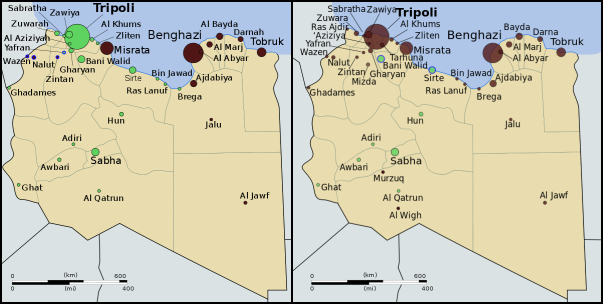
Control of Libya on June 1 (left) and September 2 (right). Gaddafi-held cities in green, rebel-held cities in
black. Blue represents ongoing struggle for control. Public domain maps from Wikimedia (source).


Full Story
Libya’s division between warring factions began in mid-February of this year, during the height of the “Arab Spring” protests happening across the Middle East and North Africa. Dictatorships in Tunisia and Egypt had recently fallen to popular protest movements, and many Libyans were fed up with their country’s erratic and sometimes brutal leader, Muammar Gaddafi. Protesters hit the streets, and when the government answered with violent crackdowns, the protesters fought back. Within days, several cities in eastern Libya had fallen to the rebels, who by the end of the month controlled most of the country’s east and some parts of the west. A government counteroffensive stalled after intervention by NATO, and the country was effectively divided in two, with rebel-held territories governed by the National Transitional Council (NTC) and the remainder under Gaddafi’s control.

Link: Interactive map of the Libyan uprising (February-April) – The New York Times

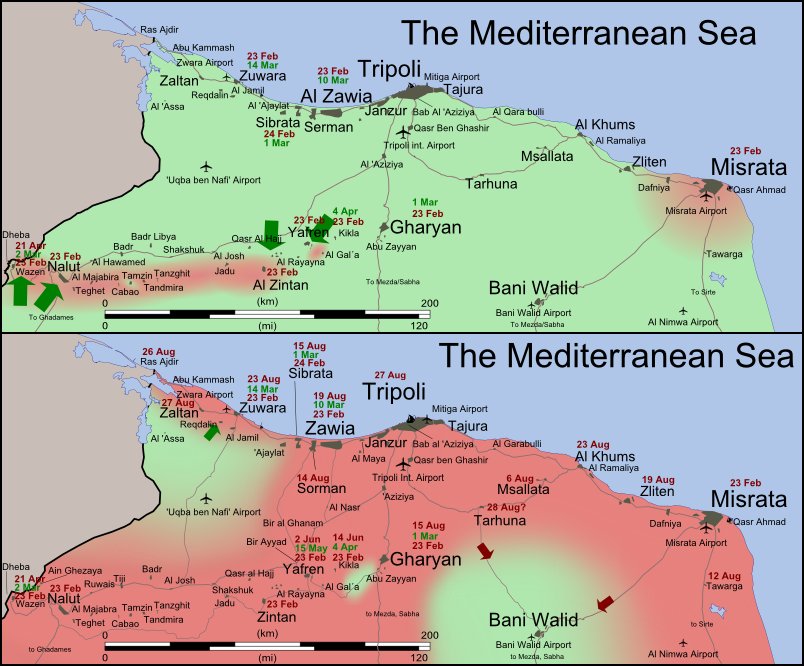
Control of northwestern Libya on June 1 (top) and September 2 (bottom).
Gaddafi-held territory is shown in light green; rebel-held territory is
shown in dark pink. Map by Wikimedia user Rafy (source; CC BY-SA).

The civil war in Libya remained in apparent stalemate for the next five months, with the two sides trading small amounts of territory but not making any major gains. All that changed in late August, when rebel forces suddenly began taking more western towns, then quickly stormed into the capital city of Tripoli, taking control and securing Gaddafi’s headquarters. More rebel gains followed on the eastern front. Gaddafi himself, along with much of his family, escaped from Tripoli and has not yet been located. Forces loyal to him remain in control of the cities of Sabha, Bani Walid, and Sirte – the last of which is Gaddafi’s hometown. Meanwhile, the NTC is in the process of moving its headquarters from its unnofficial capital in Benghazi to the official capital in Tripoli, and many Libyan embassies around the world have switched their allegiance from Gaddafi to the NTC. With international recognition for the NTC growing, the new government seems likely to soon fully replace Gaddafi as representative of the Libyan people on the international stage.

Wikipedia: 2011 Libyan Civil War

The flag of Libya under the Gaddafi regime (top) and under
the NTC (bottom). Public domain, from this Wikipedia page.

Changing Flag and Country Name
As with most revolutions, the rebellion in Libya has brought with it a changing identity. The rebel National Transitional Council, and the movement that spawned it, have been quick to discard any symbols of the Gaddafi regime. One of the most prominent of these symbols is the national flag. For decades, Gaddafi’s Libya has been known by it’s unique flag design: a plain, unmarked green rectangle. The rebel movement, on the other hand, has mostly used the flag of the Kingdom of Libya which Gaddafi overthrew, composed of red, black, and green stripes, with the crescent and star of the Ottoman Empire in white at the center. This was declared the official flag by the NTC, and is now flown at the United Nations and most of Libya’s embassies abroad.

Wikipedia: Flag of Libya

Another eccentricity of Gaddafi’s Libya was the country’s full official name, translated into English as the Great Socialist People’s Libyan Arab Jamahiriya. “Jamahiriya” is a word invented by Gaddafi for what he believed to be a unique and superior form of government, supposedly based on direct rule by the people. The word is a combination of the Arabic words jumhūriyya (“republic”) and jamāhīr (“the masses”). The NTC, again making a point of disassociating itself from Gaddafi, has preferred to simply refer to the country as “Libya”, occasionally using the term “Libyan Republic”.

International Recognition of the NTC
As the rebels and the National Transitional Council consolidate their control of the country, more and more countries are recognizing the NTC as the legitimate government of Libya. For most countries, which already recognize Libya as an independent country, this is a special diplomatic gesture of support for the rebels; or now that the NTC controls most of the country, a gesture of acceptance of the current state of affairs. The number of states recognizing the NTC has risen drastically, from only 11 when I reported on the situation two months ago, to a current total of 78 U.N. member states and two non-U.N. members (Palestine and Kosovo). Several more U.N. members have established diplomatic relations with the new Libyan government without making formal declarations of recognition. However, at least four countries – Venezuela, Zimbabwe, Ecuador, and Nicaragua – have stated their refusal to recognize the change in government.

Countries officially recognizing the National Transitional Council in dark blue; countries maintaining diplomatic relations with the NTC without official recognition in light blue; countries refusing to recognize the NTC in red;
Libya in yellow. Slightly modified from public domain Wikimedia map (source).