Taiwan Loses “Recognition” from El Salvador (Map)

You can always find the latest version of this map, and a list of all related articles, on our Which Countries Recognize Taiwan? page.
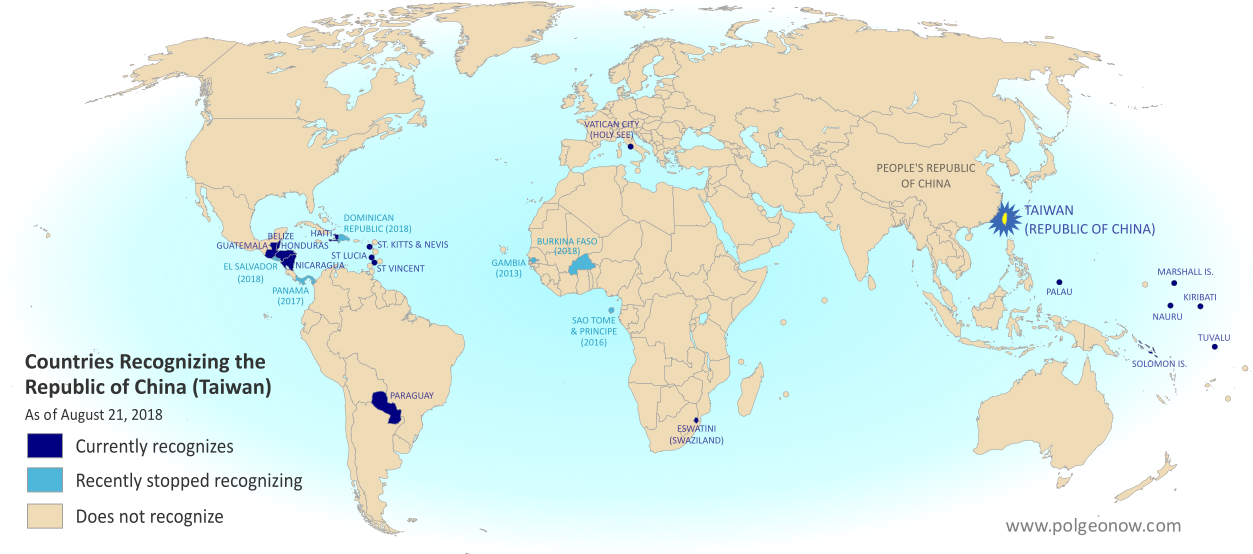
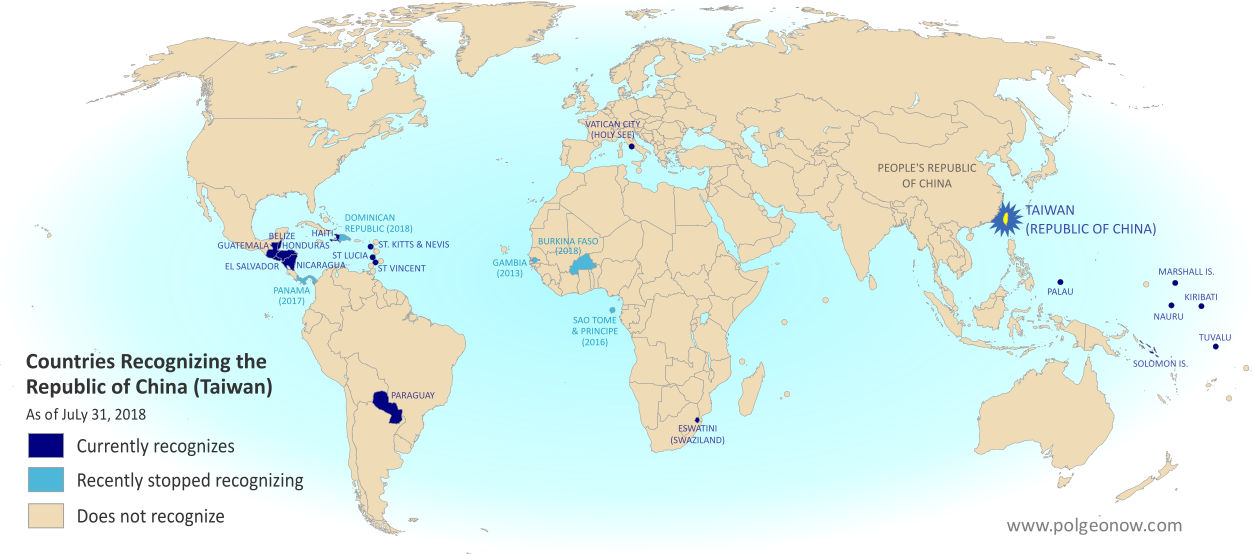
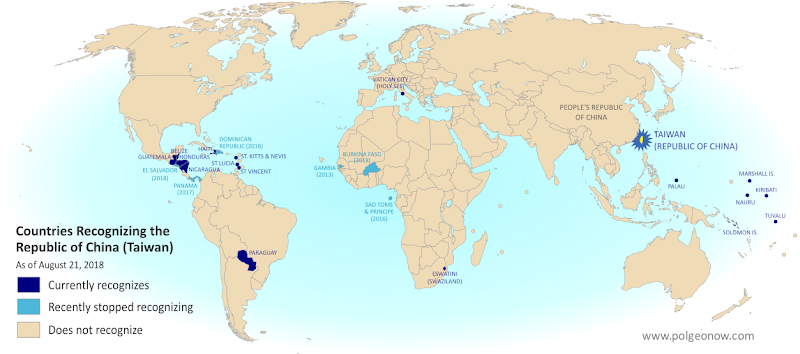
Map of who recognizes Taiwan (what countries recognize the Republic of China) in August 2018. Marks countries that have cut diplomatic ties with Taiwan (withdrawn recognition) in the last ten years: El Salvador, Burkina Faso, the Dominican Republic, Panama, Sao Tome and Principe, and the Gambia. Also answers question: Where is Republic of China located? (Colorblind accessible)
Click to enlarge. By Evan Centanni, modified from public domain blank world map.
Contact us for permission to use this map.

Article by Evan Centanni

El Salvador Drops Taiwan

Flag of the Republic of China (Taiwan) Short Name (informal):  
• Taiwan (English)
• ROC (English)
• Táiwān (Chinese)
Official Name (in constitution):  
• Republic of China (English)
• Zhōnghuá Mínguó (Chinese)
Other names used officially:  
• “Republic of China (Taiwan)” (government offices)
• Chinese Taipei (international sports)
• Taiwan, Province of China (used by UN without Taiwan’s input)   
Capital: 
Taipei (de facto)
Claimed by: People’s Republic of China 

Disputed Taiwan lost its official endorsement from the Republic of El Salvador today. The small but densely-populated Central American country is cutting ties with Taiwan’s government in favor of setting up relations with Mainland China, becoming the latest to endorse the Mainland’s claim that Taiwan is part of China.

In a novel twist, reports said Taiwan’s government “pre-emptively” cut ties with El Salvador just hours before the Salvadoran government publicly announced the switch. But the move was still based on a decision by El Salvador, which Taiwan officials said had been holding talks on the possibility since June.

Is Taiwan a Country?

The islands of Taiwan operate like an independent country today, but are governed under the constitution of the “Republic of China” (ROC), the government that ruled Mainland China before the country’s communist revolution (the administration that now rules the Mainland is called the People’s Republic of China, or PRC).

Since 1991, Taiwan’s government has sought recognition separate from Mainland China in the UN, without challenging the PRC’s right to the Mainland. But because the Mainland government insists Taiwan can’t be separate, it cuts ties with any countries that set up relations with Taiwan, even if they want to stay friends with China too.

“Economic Reasons”

El Salvador’s government is calling its shift away from Taiwan the only reasonable choice in a world where China is one of the most powerful economies, saying that it will bring more opportunities in the future. El Salvador has never before had diplomatic relations with the PRC. Alluding to the fact that the ROC no longer governs most of China, a Salvadoran spokesman was quoted as saying, “El Salvador can’t turn its back on international reality.”

Taiwan’s government, on the other hand, described more specific motivations. The disputed country’s foreign minister accused El Salvador’s president of asking Taiwan to fund his re-election campaign, and said the Salvadoran government had also backing for an expensive port construction project that would have left both countries in debt. (Some speculate that if China steps in to fund the port, it could eventually host the first Chinese military base in the Americas.)

Though Taiwan’s dwindling list of diplomatic contacts may not be a critical threat to its self-governing status, these changes are not merely symbolic. Even aside form the economic ramifications for El Salvador, many average people on both sides may be affected. For example, Salvadoran students in Taiwan are about to see their studies cut short, being forced to either transfer to Mainland China or return home.

Learn More: What Exactly is Taiwan, and Do Countries Really “Recognize” It?

Republic of China: Shrinking Recognition

Today, only 17 countries in the world (about 9%) still have formal diplomatic relations with the Taiwan-based “Republic of China” government – the closest equivalent to officially “recognizing” Taiwan as a country. That includes 16 United Nations (UN) member countries plus UN observer state Vatican City.

El Salvador is the fifth country to drop Taiwan since the current ROC president, whose platform involves resisting Mainland Chinese influence, took office in 2016. Before El Salvador, the last four countries to switch to China were the Dominican Republic and Burkina Faso this May, Panama in June 2017, and São Tomé and Príncipe in December 2016.

Only one country, the Gambia, abandoned Taiwan between 2008 and 2016, during a “diplomatic truce” initiated by Taiwan’s most Mainland-friendly president (even then, the PRC waited until Taiwan elected its current president before restoring its own relations with the Gambia).

Graphic of the Republic of China (Taiwan) flag is in the public domain (source).

Map: Which Countries “Recognize” Taiwan?

This map and explainer will be updated whenever there’s a change to the list of Taiwan’s “diplomatic allies”. You can find articles on each change by scrolling to the bottom of this page, or by viewing all Taiwan articles on PolGeoNow.

Map of who recognizes Taiwan (what countries recognize the Republic of China) in August 2018. Marks countries that have cut diplomatic ties with Taiwan (withdrawn recognition) in the last ten years: El Salvador, Burkina Faso, the Dominican Republic, Panama, Sao Tome and Principe, and the Gambia. Also answers question: Where is Republic of China located? (Colorblind accessible)
Click to enlarge. By Evan Centanni, modified from public domain blank world map.
Contact us for permission to use this map.

Is Taiwan a Country?

At PolGeoNow we frequently report on self-proclaimed, unrecognized or partially-recognized countries – but Taiwan is a special case. It operates like an independent country today, but has never formally declared independence. Instead, Taiwan and its surrounding islands govern themselves as the “Republic of China” (ROC), under a constitution brought there by a former government of the Chinese mainland.

Flag of the Republic of China (Taiwan) Short Name (informal):  
• Taiwan (English)
• ROC (English)
• Táiwān (Chinese)
Official Name (in constitution):  
• Republic of China (English)
• Zhōnghuá Mínguó (Chinese)
Other names used officially:  
• “Republic of China (Taiwan)” (government offices)
• Chinese Taipei (international sports)
• Taiwan, Province of China (used by UN without Taiwan’s input)   
Capital: 
Taipei (de facto)
Claimed by: People’s Republic of China

Taiwan (ROC) vs. Mainland China (PRC)

Taiwan’s ROC government stands in contrast to the People’s Republic of China (PRC), which took the Mainland from the ROC in the Chinese Communist Revolution of the 1940s. The PRC government in Bejing never managed to take over Taiwan, but still insists that it will someday, saying the island is an inseparable part of China. It maintains delicate, semi-official relations with the ROC government in Taipei, but fiercely opposes any move toward formal Taiwanese independence.

Taiwan’s ROC government also claimed ownership of all China at one time, when it was ruled under martial law by Chiang Kai-shek‘s Chinese Nationalist Party (Kuomintang, or KMT). But with democracy now in place, and fewer and fewer Taiwanese people thinking of themselves as Chinese, recent administrations have backed off from those claims.

In fact, many of Taiwan’s politicians support increased acknowledgement of independence, but so far no administration has been willing to risk war with Mainland China by issuing a full-on independence declaration.

Who “Recognizes” Taiwan?

Until the 1970s, the Taiwan’s ROC government held onto China’s seat in the United Nations (UN), and was considered China’s rightful government by the majority of the world’s countries. But after the UN General Assembly deposed it and replaced it with the PRC in 1971, the tables turned quickly.

Today, only 17 countries in the world (about 9%) still have formal diplomatic relations with the Taiwan-based ROC government, including 16 UN member countries plus UN observer state Vatican City. All of them are marked on the map above, along with all countries that have cut diplomatic ties with the ROC within the last ten years.
 
Now, recognizing a government doesn’t technically have the same legal meaning as recognizing a country. Officially, everyone recognizes China as a country, but they disagree over whether the ROC or PRC administration is China’s government. That means that when we talk about countries “recognizing” Taiwan, it’s not technically the same thing as when countries recognize Kosovo or Palestine.

To illustrate that point: A country that recognizes Kosovo as a country independent from Serbia normally continues to recognize Serbia as a country too. But in the case of China and Taiwan, countries are forced to pick one or the other. Because the Mainland government insists Taiwan can’t be separate, it cuts ties with any countries that set up relations with Taiwan, even if they want to stay friends with China too.

Still, saying that a country with diplomatic ties to the ROC “recognizes Taiwan” is a useful practical analogy, since Taiwan now strives to be something more like a self-declared country than a rival government of China. In fact, after 1991 Taiwan’s government requested a seat separate from Mainland China in the UN, accepting the PRC’s right to rule the Mainland even while making sure not to declare outright independence.

North and South Korea have an arrangement just like that, both technically claiming to be governments of Korea while still allowing each other to have separate recognition and UN seats. But because the PRC sees Taiwan its subordinate, not its equal, it has blocked any similar deal from happening.

Taiwan Recognition News on PolGeoNow

Since 2017, PolGeoNow has been bringing you ongoing coverage of all events effecting the recognition of Taiwan. News articles about these changes are listed here:

Map of who recognizes Taiwan (what countries recognize the Republic of China) in August 2018. Marks countries that have cut diplomatic ties with Taiwan (withdrawn recognition) in the last ten years: El Salvador, Burkina Faso, the Dominican Republic, Panama, Sao Tome and Principe, and the Gambia. Also answers question: Where is Republic of China located? (Colorblind accessible)El Salvador Switches Recognition from Taiwan to China
Taiwan and El Salvador cut ties in August 2018, amid accusations of unreasonable Salvadoran financial demands.

Full map and article

Map of who recognizes Taiwan (what countries recognize the Republic of China) in June 2018. Marks countries that have cut diplomatic ties with Taiwan (withdrawn recognition) in the last ten years: Burkina Faso, the Dominican Republic, Panama, Sao Tome and Principe, and the Gambia. Also answers question: Where is Republic of China located? (Colorblind accessible)Taiwan Loses Dominican Republic, Burkina Faso Recognition
In May 2018, two more countries cut ties with Taiwan in favor of relations with Mainland China, both under financial pressure.

Full map and article

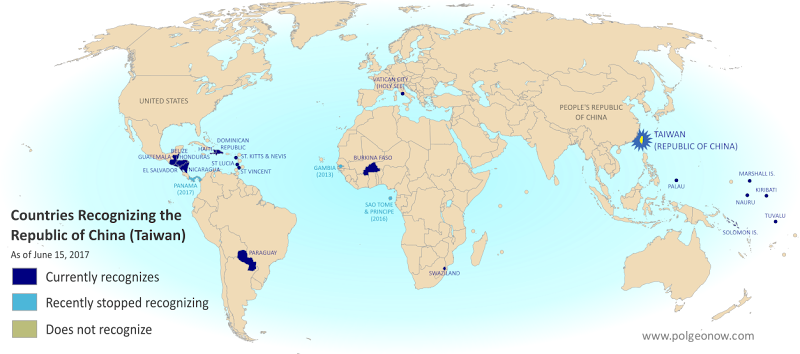
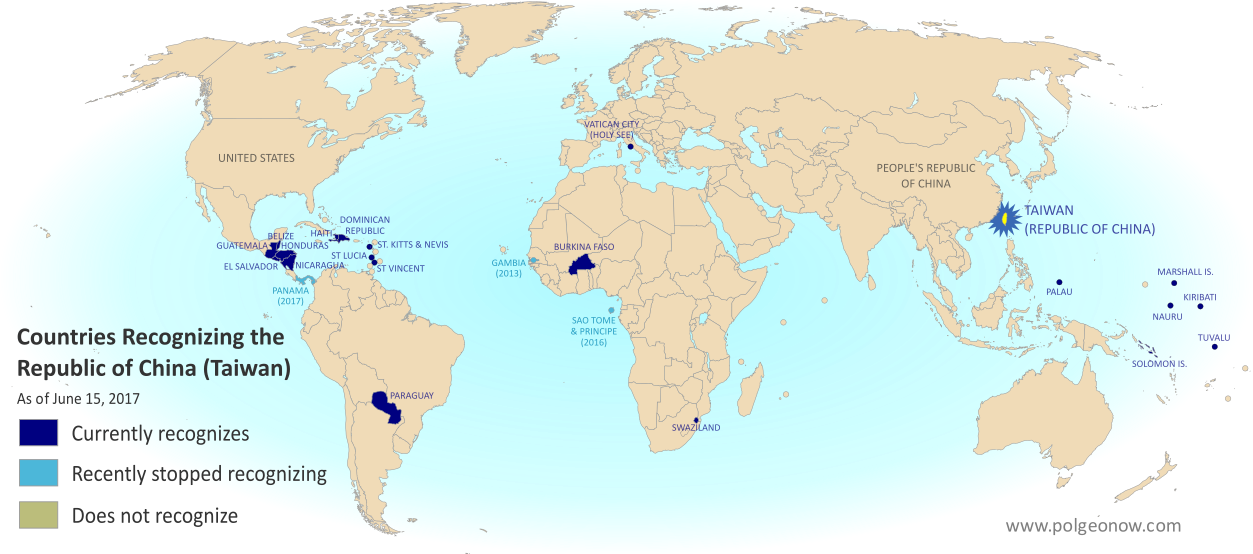
Map of who recognizes Taiwan (what countries recognize the Republic of China) in June 2017. Marks countries that have cut diplomatic ties with Taiwan (withdrawn recognition) in the last ten years: Panama, Sao Tome and Principe, and the Gambia. Also answers question: Where is Republic of China located? (Colorblind accessible)Panama Recognizes China, Stops Recognizing Taiwan
In 2017, the Central American republic of Panama became the second country to cut ties with Taiwan since an eight-year “diplomatic truce” between the ROC and PRC ended in 2016.

Full map and article


Graphic of the Commonwealth flag is displayed under fair use principles (source).

Taiwan Loses Recognition from Dominican Republic, Burkina Faso (Map)

You can always find the latest version of this map, and a list of all related articles, on our Which Countries Recognize Taiwan? page.

Map of who recognizes Taiwan (what countries recognize the Republic of China) in July 2018. Marks countries that have cut diplomatic ties with Taiwan (withdrawn recognition) in the last ten years: Burkina Faso, the Dominican Republic, Panama, Sao Tome and Principe, and the Gambia. Also answers question: Where is Republic of China located? (Colorblind accessible)
Click to enlarge. By Evan Centanni, modified from public domain blank world map.

Article by Evan Centanni

Dominican Republic, Burkina Faso Drop Taiwan

Flag of the Republic of China (Taiwan) Short Name (informal):  
• Taiwan (English)
• ROC (English)
• Táiwān (Chinese)
Official Name (in constitution):  
• Republic of China (English)
• Zhōnghuá Mínguó (Chinese)
Other names used officially:  
• “Republic of China (Taiwan)” (government offices)
• Chinese Taipei (international sports)
• Taiwan, Province of China (used by UN without Taiwan’s input)   
Capital: 
Taipei (de facto)
Claimed by: People’s Republic of China 

This past May, disputed Taiwan lost its official endorsements from both the Dominican Republic in the Caribbean, and Burkina Faso in West Africa. The two countries have cut ties with Taiwan in favor of setting up official relations with Mainland China, endorsing the Mainland’s claim that Taiwan is part of China.

The islands of Taiwan operate like an independent country today, but are governed under the constitution of the “Republic of China” (ROC), the government that ruled Mainland China before the country’s communist revolution (the administration that now rules the Mainland is called the People’s Republic of China, or PRC).

Since 1991, Taiwan’s government has sought recognition separate from Mainland China in the UN, without challenging the PRC’s right to the Mainland. But because the Mainland government insists Taiwan can’t be separate, it cuts ties with any countries that set up relations with Taiwan, even if they want to stay friends with China too.

The Dominican Republic announced it was cutting ties with Taiwan on May 1, 2018, saying the reason was “history and socioeconomic reality”. This reality allegedly includes the equivalent of $3.1 billion US dollars in investments and loans from China, though the Dominican government only mentioned future tourism opportunities as an example.

Burkina Faso followed on May 24, even though it had just co-sponsored Taiwan’s bid to become an observer at World Health Organization (WHO) meetings. The Burkinabe government also cited “socio-economic challenges” and the “evolution of the world” as the reasons for its switch.

Learn More: What Exactly is Taiwan, and Do Countries Really “Recognize” It?

Republic of China: Shrinking Recognition

Today, only 18 countries in the world (about 9%) still have formal diplomatic relations with the Taiwan-based “Republic of China” government – the closest equivalent to officially “recognizing” Taiwan as a country. Before the Dominican Republic and Burkina Faso cut ties in May, the last two countries to drop Taiwan in favor of the PRC were Panama in June 2017 and São Tomé and Príncipe in December 2016.

Only one country, the Gambia, abandoned Taiwan between 2008 and 2016, during a “diplomatic truce” initiated by Taiwan’s most Mainland-friendly president (even then, the PRC waited until Taiwan elected a more independence-leaning president before restoring its own relations with the Gambia).

Taiwan’s last remaining “diplomatic ally” in Africa is tiny Eswatini (Swaziland), whose king recently promised not to follow Burkina Faso in switching to the PRC. Supporters of a separate Taiwan worry their next loss might be the Holy See, government of the Catholic Church’s independent Vatican City in Rome. The Vatican has recently been working to patch up its bad relationship with the Mainland Chinese government.

Learn More: What’s the difference between Vatican City and the Holy See?

Graphic of the Republic of China (Taiwan) flag is in the public domain (source).

Panama Recognizes China, Stops Recognizing Taiwan (Map)

There are newer versions of this map available. You can always find the latest version, and a list of all related articles, on our Which Countries Recognize Taiwan? page.

Map of who recognizes Taiwan (what countries recognize the Republic of China) in June 2017. Marks countries that have cut diplomatic ties with Taiwan (withdrawn recognition) in the last ten years: Panama, Sao Tome and Principe, and the Gambia. Also answers question: Where is Republic of China located? (Colorblind accessible)
Click to enlarge. By Evan Centanni, modified from public domain blank world map.

Article by Evan Centanni

Taiwan Loses Recognition from Panama

Flag of the Republic of China (Taiwan) Short Name (informal):  
• Taiwan (English)
• ROC (English)
• Táiwān (Chinese)
Official Name (in constitution):  
• Republic of China (English)
• Zhōnghuá Mínguó (Chinese)
Other names used officially:  
• “Republic of China (Taiwan)” (government offices)
• Chinese Taipei (international sports)
• Taiwan, Province of China (used by UN without Taiwan’s permission)   
Capital: 
Taipei (de facto)

The Central American country of Panama announced this Tuesday that it’s cutting diplomatic relations with Taiwan. Instead, it’s setting up official ties with Mainland China, endorsing the Chinese claim that Taiwan is part of China.

The island of Taiwan operates like an independent country today, but is governed under the constitution of the “Republic of China” (ROC), the government that ruled Mainland China before the communist revolution (the government that now rules the Mainland is called the People’s Republic of China).

Because the China-Taiwan dispute was originally over which side was the rightful government of China, and because the now-powerful Mainland government insists Taiwan can’t be a separate country, other countries have to choose to recognize just one or the other.

This is the first time Panama has ever recognized the People’s Republic of China, having maintained relations with the Republic of China ever since it was founded in 1912 (long before the ROC government moved to Taiwan).

Republic of China: Shrinking Recognition

Today, only 20 countries (about 10%) still have formal diplomatic relations with the Taiwan-based Republic of China government – the closest equivalent to “recognizing” Taiwan as a country. Before Panama cut ties this week, the last country to switch from Taiwan to China was São Tomé and Príncipe last December.

Only one country, the Gambia, abandoned Taiwan between 2008 and 2016, during a “diplomatic truce” initiated by Taiwan’s most Mainland-friendly president (even then, China waited until Taiwan elected a more independence-leaning president before restoring its own relations with the Gambia).

Graphic of the Republic of China (Taiwan) flag is in the public domain (source).
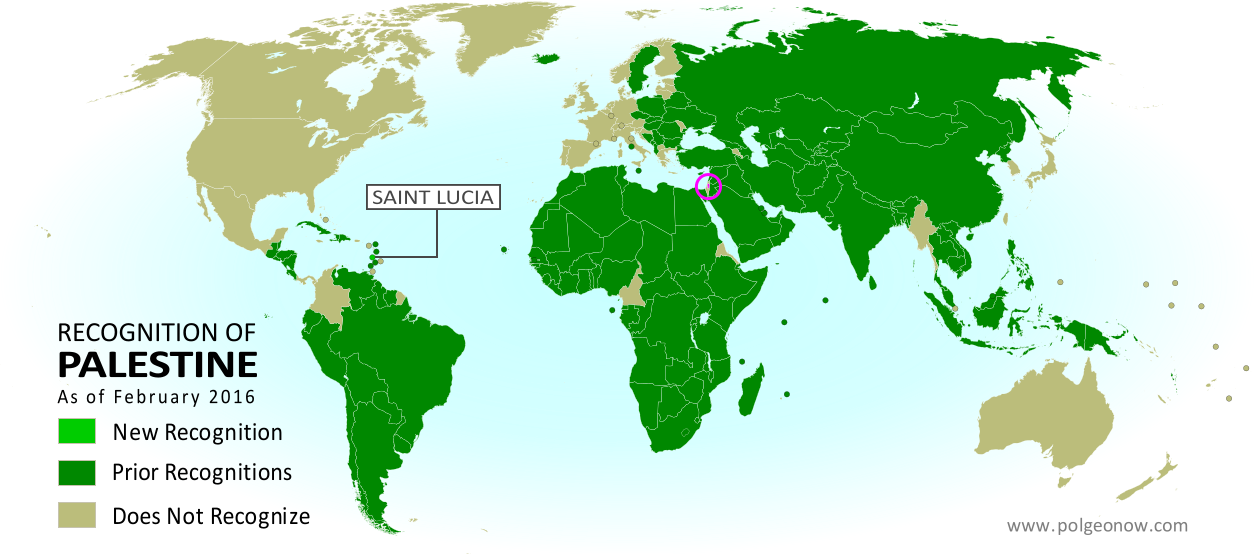
Map: Which Countries Recognize Palestine as Independent in 2016?

(Keep up with changes to Palestine’s situation: view all Palestine updates.)

Map of countries that recognize the State of Palestine as an independent country, updated for February 2016 with recent addition Saint Lucia highlighted
Click to enlarge. Palestine in magenta (circled). Map by Evan Centanni, modified from public domain graphic (source).

Subscribers click here to view this article in the ad-free members area. Not a member yet? Learn about PolGeoNow subscriptions!

Article by Evan Centanni

Disputed Country

The Palestinian Liberation Organization (PLO) declared an independent State of Palestine in 1988, and continues to pursue its recognition as a country today. Though Palestine’s claimed territories are disputed and largely occupied by Israel, it has gathered recognition from more than two-thirds of the world’s countries, and is also treated as a country by the UN General Assembly, where it’s an “Observer State” but not a member.

Flag of Palestine Country Name:  
• Palestine (English)
Filasṭīn (Arabic)
Official Name:  
• State of Palestine (English)
• Dawlat Filasṭin (Arabic)
Capital: 
• Jerusalem (claimed)
Ramallah (administrative)

The number of individual countries recognizing Palestine has grown gradually over the past decades. Last June we reported that 135 U.N. member states (and one observer state) officially recognized Palestine, and since September the number is now 136 (about 70% of all UN members). Palestine is also recognized by the proclaimed government of Western Sahara, another disputed country that’s not formally recognized by the UN.

Saint Lucia Recognizes Palestine

Last September, the small Caribbean island country of Saint Lucia became the latest national government to recognize Palestine as independent. The formal acknowledgement came on September 14, 2015, when the two countries’ UN representatives signed an agreement in New York to establish diplomatic relations.

Saint Lucia is now one of about half the world’s countries whose government recognizes both Palestine and Israel as independent countries. All of the independent Caribbean countries except Cuba recognize Israel, and most also recognize Palestine, with the exception of Jamaica, the Bahamas, Saint Kitts and Nevis, Barbados, and Trinidad and Tobago.

Read More:
Is Palestine Really a Country?
Palestine Recognized as a Country by the UN
Map of Countries Recognizing Kosovo

Map Update: Kosovo Recognized by 3 More Countries in 2015 (108/193 UN members)

Premium members click here to view this article in the ad-free members area. Not a member yet? Subscribe now!

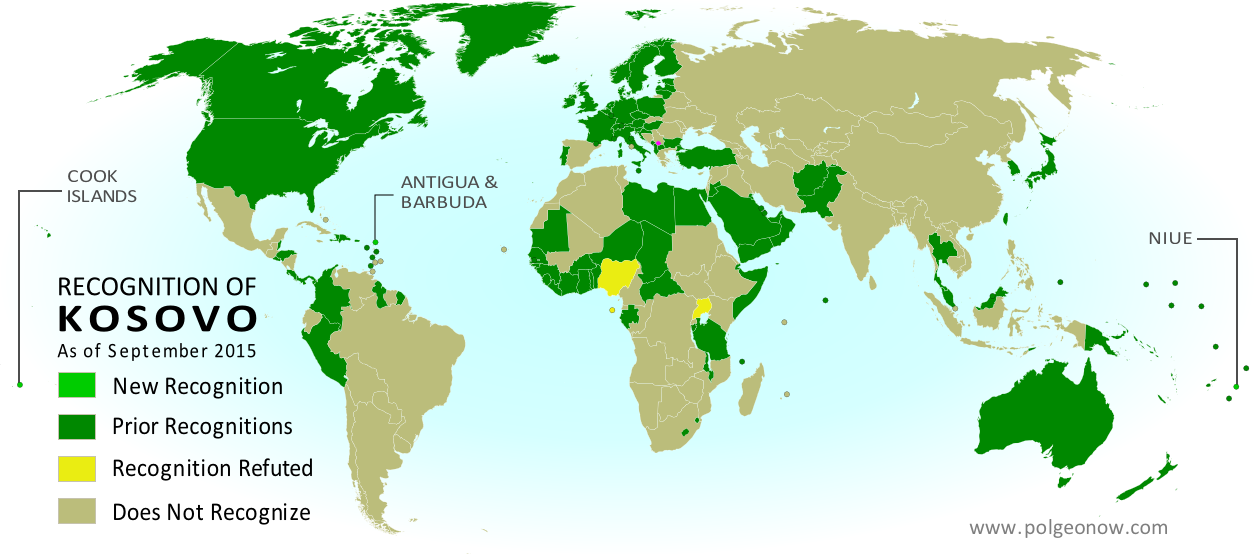
Map of countries that recognize the Republic of Kosovo as an independent state, updated to September 2015, with the most recent additions (Antigua and Barbuda, Cook Islands, and Niue) highlighted. Also shows countries that have refuted claims that they recognized Kosovo: Sao Tome and Principe, Nigeria, and Uganda.
Map by Evan Centanni, modified from public domain graphic (source).

Flag of the Republic of KosovoCountry Name:  
• Kosovo (English, Serbian)
• Kosova (Albanian)
Official Name:  
Republic of Kosovo (English)
Republika e Kosovës (Albanian)
Republika Kosovo (Serbian)
Capital: Pristina/Prishtina

Article by Evan Centanni, with additional reporting by Caleb Centanni

New Recognitions for Kosovo
Since our last Kosovo recognition map report nearly a year ago, the breakaway republic’s independence has been endorsed by three more countries. However, only one of these three new recognizers, Antigua and Barbuda, is a fully independent country and UN member. The other two, the Cook Islands and Niue, are semi-independent states often considered to be overseas territories of New Zealand.

Antigua and Barbuda, a small two-island country in the Caribbean, reportedly recognized Kosovo as independent on May 20, 2015, after several years of talks between the two states’ foreign ministers. Kosovo is now recognized by about half of the island countries in the Caribbean.

Also in May, the Cook Islands recognized Kosovo, with nearby Niue joining a month later. The Cook Islands and Niue are two nearly independent Pacific island countries in “free association” with New Zealand. They are often considered dependent territories rather than independent countries; their people retain New Zealand citizenship, and they have never declared independence or tried to join the UN. However, they are self-governed, with the choice to become independent at any time, and there’s no rule against them diplomatically recognizing other countries or being recognized in return.

Before this year, the last country to recognize Kosovo was Solomon Islands in August 2014. With the addition of Antigua and Barbuda, Kosovo is now considered independent by 108 of the 193 UN member countries (about 56 percent).

What is Kosovo?
The Republic of Kosovo, located in southeastern Europe, controversially declared independence from Serbia in 2008. It has been blocked from UN membership by objections from Serbia, Russia, and other countries who see its secession as invalid. In addition to the 108 UN members recognizing Kosovo, its independence is also acknowledged by non-UN member Taiwan. For more on Kosovo’s special situation, see our first Kosovo recognition report, which also includes a map of Kosovo’s location relative to Serbia.

Refuted Recognitions
In the past, the government of the Republic of Kosovo has been accused of exaggerating its numbers by claiming recognition from countries that didn’t really intend to recognize it. Three African countries – São Tomé and Príncipe, Uganda, and Nigeria – have denied recognizing Kosovo, and are not included in our numbers. However, they are often included in lists compiled by pro-Kosovo sources, so we have illustrated them in yellow on the above map.

And what about the most recent additions to the list? Antigua and Barbuda’s recognition of Kosovo has not been confirmed by sources outside Kosovo’s government, but because it has not been denied either, we are presuming its truth for now. The Cook Islands and Niue, on the other hand, both have online documents confirming that they’ve established diplomatic relations with Kosovo. Diplomatic relations aren’t always the same thing as recognition, but the documents make it fairly clear that the two states indeed consider Kosovo to be an independent country.

Stay Up to Date: Check for further news and map updates related to Kosovo’s recognition by viewing all Kosovo articles on Political Geography Now.
 
Flag graphic by Cradel (source). License: CC BY-SA

Vatican City Administration Recognizes Palestine as a Country (map)

(Keep up with changes to Palestine’s situation: view all Palestine updates.)

Map of countries that recognize the State of Palestine as an independent country, updated for June 2015 with recent addition Vatican City (Holy See) highlighted
Click to enlarge: Countries recognizing the State of Palestine in green, with most recent addition highlighted. Palestine in magenta (circled). Map by Evan Centanni, modified from public domain graphic (source).

Subscribers click here to view this article in the ad-free members area. Not a member yet? Subscribe now!

Article by Evan Centanni

Vatican Recognizes Palestine
Last month the Holy See – the official administration of the Roman Catholic Church and government of Vatican City – became the latest national government to recognize Palestine as an independent country. The explicit acknowledgement of Palestine’s statehood came with a treaty signed May 13, 2015, regarding the activities of the Catholic Church within Palestine’s territory. 

In the face of criticism from Israel’s government and other groups, the Vatican played down the significance of the treaty, saying that the Holy See had really recognized Palestine ever since supporting the UN vote on Palestinian’s statehood in 2012. However, official diplomatic recognition usually requires an explicit statement by the country’s government, so the Holy See was presumed not to formally recognize Palestine until now.

Learn More: What’s the difference between Vatican City and the Holy See?

Vatican City is now one of about half the world’s countries whose government recognizes both Palestine and Israel as independent countries. But Palestine is recognized by only a few countries in Europe, and the Holy See is only the fifth European government to recognize since the end of the Cold War. The last was Sweden in October 2014, preceded by Iceland in 2011, Montenegro in 2006, and Bosnia in 1992.

Flag of Palestine Country Name:  
• Palestine (English)
Filasṭīn (Arabic)
Official Name:  
• State of Palestine (English)
• Dawlat Filasṭin (Arabic)
Capital: 
• Jerusalem (claimed)
Ramallah (administrative)

Palestine: Disputed Country
The Palestinian Liberation Organization (PLO) declared independence for Palestine in 1988, and has been seeking international acceptance for the proclaimed country ever since. Though its claimed territories are disputed and largely occupied by Israel, the “State of Palestine” is recognized by more than two-thirds of the world’s countries, and is also treated as a country by the UN General Assembly, where it is an “Observer State” but not a member.

The Holy See also has Observer State status in the UN, making Vatican City and Palestine the only two countries that are acknowledged as independent by the UN, but do not have votes in the General Assembly.

The number of individual countries recognizing Palestine as independent has grown gradually over the past decades. Last year we reported that 135 UN member states officially recognized Palestine (70% of all UN members), and this is still the case today, since Vatican City is not a full UN member. Palestine is also recognized by the proclaimed government of Western Sahara, a fellow disputed country whose independence is not formally recognized by the UN at all.

Related:
Is Palestine Really a Country?
Palestine Recognized as a Country by the U.N.
Map of Countries Recognizing Kosovo

Map: Which Countries Recognize Palestine in 2014?

(Keep up with changes to Palestine’s situation: view all Palestine updates.)

Map of countries that recognize the State of Palestine as an independent country, updated for December 2014 with recent addition Sweden highlighted
Countries recognizing the State of Palestine in green, with most recent addition highlighted. Palestine in magenta (circled). Click to enlarge. Map by Evan Centanni, modified from public domain graphic (source).

Premium members click here to view this article in the ad-free members area. Not a member yet? Subscribe now!

Article by Evan Centanni

Disputed Country
Palestine declared independence in 1988, and its government continues to pursue recognition as a country today. Though its claimed territories are disputed and largely occupied by Israel, the “State of Palestine” has gathered recognition from more than two-thirds of the world’s countries, and is also treated as a country by the U.N. General Assembly, where it is an “Observer State” but not a member.

The number of individual countries recognizing Palestine as independent has grown gradually over the past decades. A year ago we reported that 134 U.N. member states officially recognized Palestine, and as of December 2014 the number is now 135 (70% of all U.N. members). Palestine is also recognized by the proclaimed government of Western Sahara, another disputed country that’s not formally recognized by the U.N.

Flag of Palestine Country Name:  
• Palestine (English)
Filasṭīn (Arabic)
Official Name:  
• State of Palestine (English)
• Dawlat Filasṭin (Arabic)
Capital: 
• Jerusalem (claimed)
Ramallah (administrative)

Sweden’s Recognition of Palestine
Only one new country has endorsed Palestine’s independence in 2014, but it’s a big one. On October 30, Palestine was officially recognized by Sweden, a major European country and and member of the European Union (EU). This is a big deal because most of Western Europe does not recognize Palestine, and of the 50-60 total countries worldwide that don’t recognize, about half are in Europe.

Palestinian Recognition in Europe
Sweden is the first country to begin recognizing Palestine after becoming a member of of the EU, an organization that tends to take a centrist stance on the Israeli-Palestinian conflict. In recent months, legislatures in France, Spain, Ireland, and the UK have also voted in support of recognizing Palestine, but so far none of their governments has followed through with official recognition.

However, Sweden isn’t the only EU country that endorses Palestine’s claimed independence: Malta, Czechoslovakia, Cyprus, Hungary, Romania, Bulgaria, and Poland all recognized it in 1988, before they became EU members.* Russia, Belarus, Ukraine, Serbia, and Albania also retain recognition from 1988, but are not members of the EU. And yet, neither is Sweden the only European country to recognize Palestine since the end of the Cold War. Bosnia recognized in 1992, Montenegro in 2006, and Iceland in 2011. 

*After the breakup of Czechoslovakia, the Czech Republic and Slovakia inherited their recognition of Palestine, though the current Czech government does its best to ignore that fact, having become a very close ally of Israel. Cyprus, on the other hand, has recently reaffirmed its original position on Palestinian independence. 

Related Articles:
Is Palestine Really a Country?
Palestine Recognized as a Country by the U.N.
Map of Countries Recognizing Kosovo

Map Update: Kosovo Now Recognized by Every Country in Oceania (107/193 UN members)

Premium members click here to view this article in the ad-free members area. Not a member yet? Subscribe now!

Map of countries that recognize the Republic of Kosovo as an independent state, updated for October 2014, with the most recent addition (Solomon Islands) and disputed recognitions highlighted
Countries recognizing the Republic of Kosovo in green, highlighting recent additions. Disputed recognitions in yellow. Kosovo in magenta. Map by Evan Centanni, modified from public domain graphic (source).

Flag of the Republic of KosovoCountry Name:  
• Kosovo (English, Serbian)
• Kosova (Albanian)
Official Name:  
Republic of Kosovo (English)
Republika e Kosovës (Albanian)
Republika Kosovo (Serbian)
Capital: Pristina/Prishtina

By Caleb Centanni

Solomon Islands Recognizes Kosovo
Kosovo, a small breakaway state in the Balkan Region of Southeastern Europe, was recently recognized as an independent country by Solomon Islands (the country’s name is officially singular, with no “the”). This completes Kosovo’s recognition by every UN member country in the Oceania region, which includes Australia, New Zealand, and the islands of the South Pacific.

Solomon Islands, a former British protectorate in Melanesian cultural region of the South Pacific, recognized Kosovo on August 13, 2014. The foreign minister of the island country indicated that a decision was made based on “the improvement of relations between Serbia and Kosovo.” Kosovo’s foreign ministry announced the recognition on the same day.

In the past, many recognitions have been announced only by the Kosovan government, sometimes calling their validity into question (See also “Disputed Recognitions” below). In this case, however, the comments of the Solomon Islands foreign minister leave little doubt.

Solomon Islands’ recognition is Kosovo’s fourth this year, and the twelfth since the beginning of 2013. Prior to this, the most recent recognition was by Togo this past July. Kosovo is now considered a sovereign state by 107 of the 193 UN member countries (just over 55 percent).

Disputed Country
The Republic of Kosovo declared independence from Serbia in 2008, but has been blocked from UN membership by objections from Serbia, Russia, and other countries who see its secession as invalid. In addition to the 107 UN members recognizing Kosovo, its independence is also acknowledged by non-UN member Taiwan. For more on Kosovo’s special situation, see our first Kosovo recognition report, which also includes a map of Kosovo’s location relative to Serbia.

Disputed Recognitions
There are a few countries that appear on lists of UN members recognizing Kosovo, but whose actual recognitions have been called into question. The most contentious case is the African island nation of São Tomé and Príncipe, which announced its recognition of Kosovo on March 13, 2012. However, on January 7, 2013, the country’s president declared the recognition invalid on the grounds that he had not been informed of the decision. Despite this, Kosovo’s government still claims recognition from São Tomé and Príncipe. Political Geography Now has chosen not to include São Tomé and Príncipe in its tallies of recognition until the dispute has been resolved.

The Kosovan foreign ministry also still includes Uganda and Nigeria in its list of “Countries that have recognized the Republic of Kosova”, despite these two recognitions having been strongly refuted. However, as discussed in our previous Kosovo article, even the Kosovan government seems not to actively claim recognition from Uganda and Nigeria anymore.

After Solomon Islands’ recognition took effect in August, the South Pacific country’s foreign minister stated that 109 nations had recognized Kosovo (two more than our tally of 107). This likely indicates that the Solomon Islands was including São Tomé and Principe, bringing the total up from 107 to 108. The figure of 109 could be a reference to the recognition of Kosovo by Taiwan, another disputed non-UN member state that Solomon Islands considers to be an independent country.

Stay Up to Date: Check for further news and map updates related to Kosovo’s recognition by viewing all Kosovo articles on Political Geography Now.

Related Articles:
Kosovo Recognition Map Update: July 2014
North Kosovo Status Changing After Serbia Deal
Which Countries Recognize Palestine as Independent?
 
Flag graphic by Cradel (source). License: CC BY-SA

Map Update: Kosovo Recognized by 3 More Countries in 2014 (106/193)

Premium members click here to view this article in the ad-free members area. Not a member yet? Subscribe now!

Map of countries that recognize the Republic of Kosovo as an independent state, updated for July 2014, with most recent additions (Togo, Tonga, Lesotho) and disputed recognitions highlighted
Countries recognizing the Republic of Kosovo in green, highlighting recent additions. Disputed recognitions in yellow. Kosovo in magenta. Map by Evan Centanni, modified from public domain graphic (source).

Flag of the Republic of KosovoCountry Name:  
• Kosovo (English, Serbian)
• Kosova (Albanian)
Official Name:  
Republic of Kosovo (English)
Republika e Kosovës (Albanian)
Republika Kosovo (Serbian)
Capital: Pristina/Prishtina

By Caleb Centanni

Kosovo Recognition Continues Growing
Over the last six months, three new countries have extended diplomatic recognition to the self-proclaimed Republic of Kosovo. The breakaway state, located in the Balkan Region of Southeastern Europe, is now recognized by at least 106 U.N. member nations (about 55%). Kosovo’s government claims recognition from 107 U.N. members, but one of these has been called into question (see “Disputed Recognitions” below).

The three new states which have recognized Kosovo are Tonga, in January; Lesotho, in February; and Togo, on July 2nd. Tonga is a Pacific Island state, Togo is a small country located in West Africa, and Lesotho is an enclave surrounded by South Africa. None of these countries’ governments appear to have confirmed their recognitions, with the information coming only from Kosovo’s foreign ministry. However, so far none of them has disputed Kosovo’s claims.

The Republic of Kosovo declared independence from Serbia in 2008, but has been blocked from U.N. membership by objections from Serbia, Russia, and other countries who see its secession as invalid. In addition to the 106 U.N. members recognizing Kosovo, its independence is also acknowledged by non-U.N. member Taiwan. For more on Kosovo’s special situation, see our first Kosovo recognition report, which also includes a map of Kosovo’s location relative to Serbia.

Disputed Recognitions
The African Island nation of São Tomé and Príncipe announced its recognition of Kosovo on March 13, 2012. However, on January 7, 2013, the President of the small country declared the recognition invalid on the grounds that he had not been informed of the decision. Despite this, Kosovo still maintains that the recognition is valid. Political Geography Now has chosen not to include São Tomé and Príncipe in its tallies of recognition until the dispute has been resolved.

In addition to this, Kosovo has previously claimed that two other African countries, Nigeria and Uganda, recognized its independence. However, Nigeria clearly stated in March that it did not recognize the breakaway state, and Kosovo’s foreign ministry recently included Uganda in a discussion of nations that “have not yet recognized Kosovo”, also indicating that there are only 107 U.N. members currently recognizing the country. Despite this, the ministry’s website has still not dropped Nigeria and Uganda from its list of “Countries that have recognized the Republic of Kosova”.

Stay Up to Date: Check for further news and map updates related to Kosovo’s recognition by viewing all Kosovo articles on Political Geography Now.

Related Articles:
Kosovo Recognition Map Update: October 2013
North Kosovo Status Changing After Serbia Deal
Who Recognizes Palestine in 2013?
 
Flag graphic by Cradel (source). License: CC BY-SA