Gambia Rejoins the Commonwealth (Map)

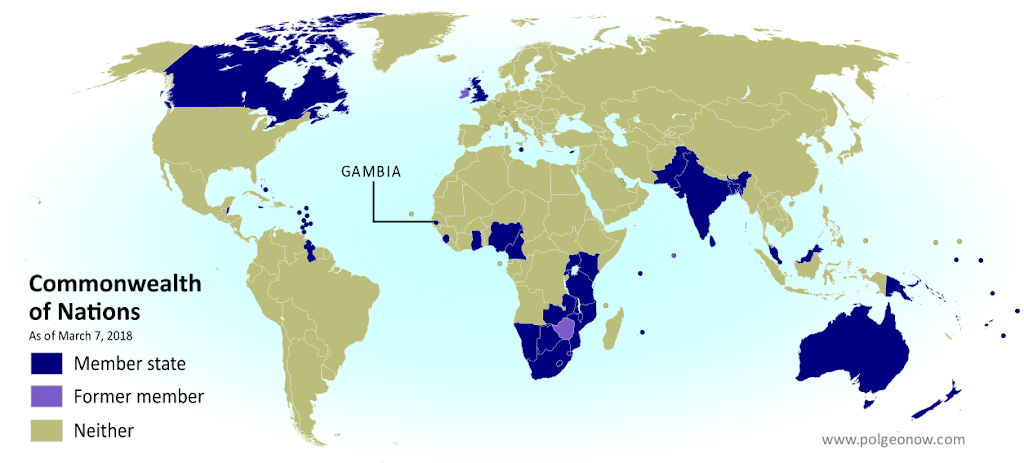
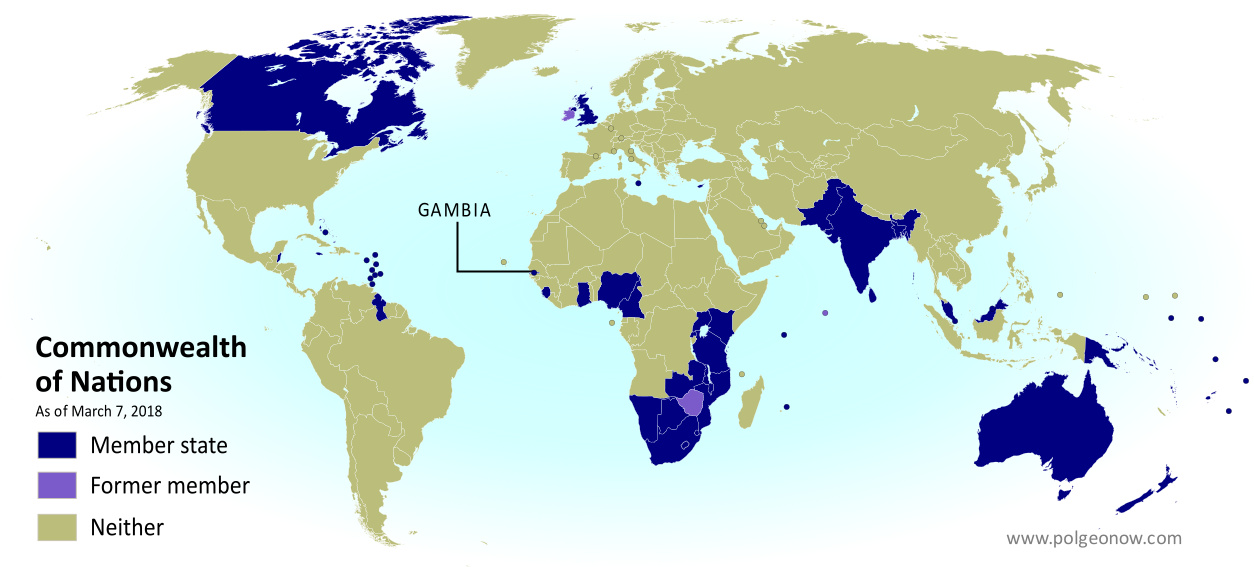
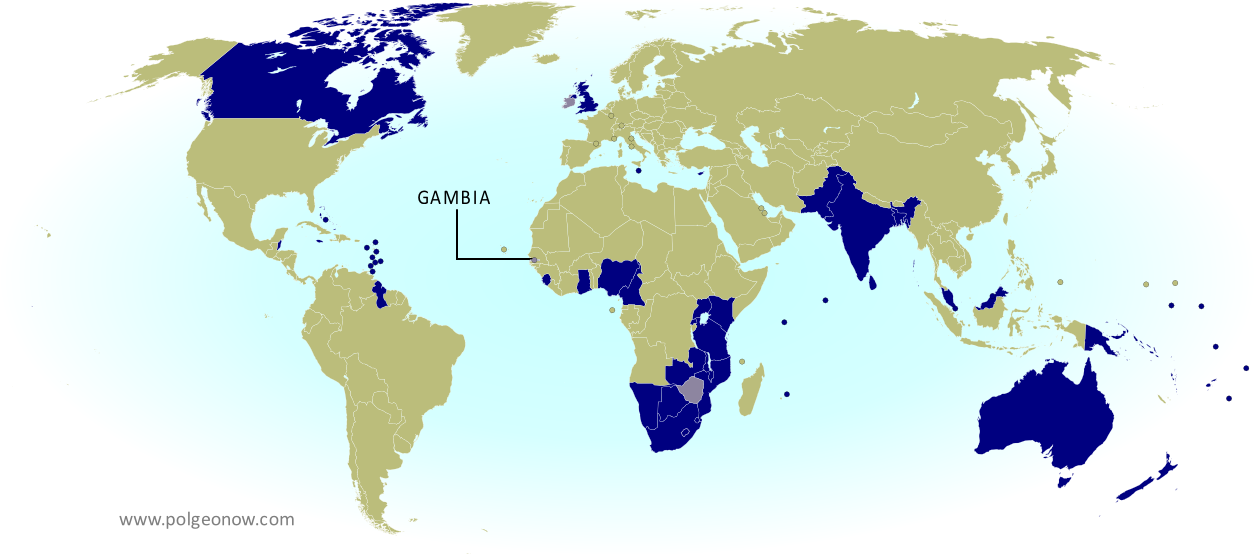
Map of the Gambia in the Commonwealth of Nations (British Commonwealth) as of 2018, color coded for former and current member countries (colorblind accessible).
Map by Evan Centanni, modified from public domain graphic. Visit our Commonwealth of Nations page to check for newer versions, or contact us for permission to use this map.

Commonwealth Readmits Gambia as Member

Last month the Republic of the Gambia was accepted back into the Commonwealth of Nations, a club of countries that were formerly part of the British Empire. The tiny West African country left the organization in 2013 under pressure from other members to improve its democracy and human rights record.
Flag of the Gambia Country Name:  
• The Gambia
Official Name:  
• Republic of the Gambia
Capital: Banjul

See Also: Gambia Withdraws from the Commonwealth (2014 article)

But since eccentric leader Yahyeh Jammeh was forced to step down last year after losing an election, new Gambian president Adama Barrow has made a point of reversing his predecessor’s more controversial policies. This has included undoing the country’s 2015 name change, canceling its withdrawal from the International Criminal Court, and now rejoining the Commonwealth.

Unanimous Decision

The Gambia’s readmission into the Commonwealth took effect on February 8, 2018, after its application was approved unanimously by the leaders of the other member countries. The move to re-apply had likewise been approved unanimously by the country’s own National Assembly.

Sometimes called the “British Commonwealth”, the Commonwealth of Nations is mainly a forum for cooperation between countries that were once parts of the British Empire (though it has also admitted other countries in the past). But any association it has with British colonialism is mostly symbolic –  Queen Elizabeth II is the formal “Head of the Commonwealth”, but within the organization itself, all members are equal and decisions are made by consensus.

Learn More: What is the Commonwealth of Nations, and what does it do?

Why Did Gambia Rejoin the Commonwealth?

In contrast to the country’s unceremonious departure in 2013, the Gambia’s reasons for rejoining the Commonwealth are pretty clear.

In a press release, the Gambian government explained that it feels exclusion from the Commonwealth was a loss for the country, shutting it out from cooperation on things like health and education while denying it the opportunity to punch above its weight on the international stage. The statement specifically mentioned the need for the tiny coastal country to have a voice on climate change issues, and also on how richer countries try to help poorer countries.

In a separate interview, Gambia’s foreign minister mentioned that membership will also help Gambia build its judicial system, allow it to participate in the Commonwealth Games (a major world sporting event), and make it easier for its citizens to live in other Commonwealth countries. When “Commonwealth citizenship” was stripped from the Gambia in 2015, Gambians living abroad lost the right to vote in the UK and some other Commonwealth countries, among many other privileges.
Flag of the Commonwealth of NationsOrganization Name:  
• Commonwealth of Nations
Founded: 1931 and 1949 in London, UK
Headquarters: London, UK
Website: thecommonwealth.org/

Commonwealth Members

The Commonwealth of Nations now has 53 members, making up about a quarter of all the world’s countries. The number today is the same as after the Gambia first left, since the Gambia’s readmission is offset by the Maldives quitting the group in 2016. Participation in the Commonwealth is completely voluntary, and any member country can leave or reapply at will.

With the Gambia back in, there are now just three ex-Commonwealth countries in the world: Ireland left when it broke ties with the UK in 1949, and Zimbabwe exited in 2003 after a year of suspension over democracy issues.

It’s a common misconception that all the Commonwealth countries recognize the queen of England as their monarch. The countries that do share Queen Elizabeth II are called the “Commonwealth Realms“, but most Commonwealth countries don’t have a king or queen at all, and a few have their own separate monarchs. Elizabeth II’s current position as Head of the Commonwealth is separate from her role as the queen of the Realms, gives her no authority over member countries, and won’t be automatically inherited by her successor.

See Also: Queen Elizabeth’s 16 Countries: The Commonwealth Realms

Interested in the Commonwealth? You can always find the latest map and related articles on our Commonwealth of Nations page.


Low-resolution graphic of the Commonwealth flag is displayed under fair use principles (source). Flag of the Gambia is in the public domain (source).
The Gambia Changes Its Name Back

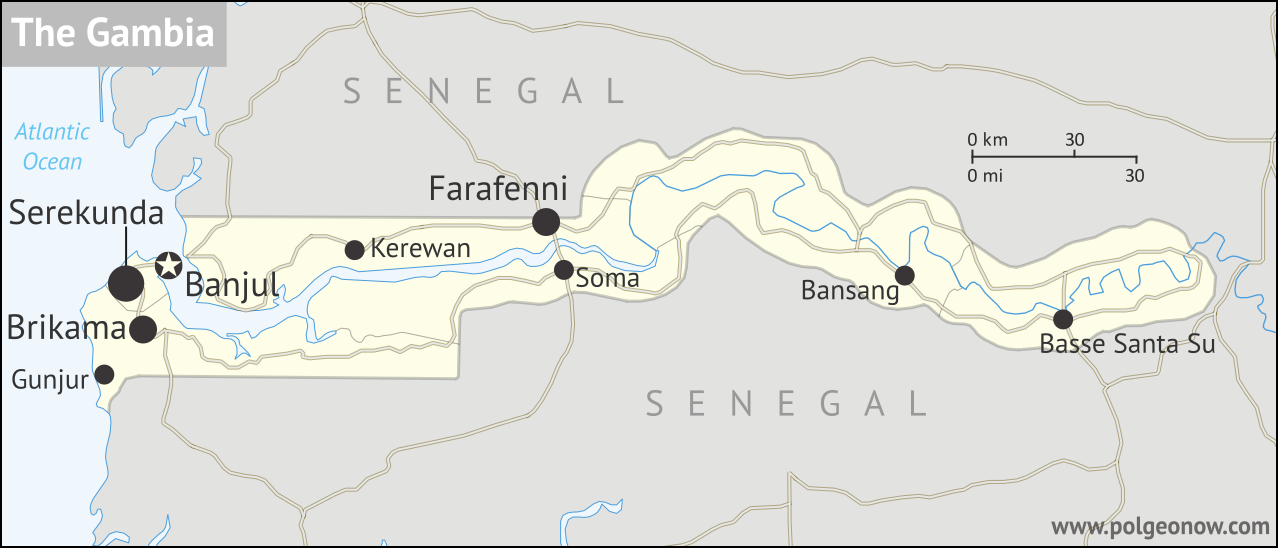
Map of the Gambia: towns, roads, borders, and rivers, with scale shown.
Map by Evan Centanni. Contact for usage rights.

Gambia Name Change Reversal

Last year we reported on how the Gambia, a tiny country located along the banks of a river in West Africa, had changed its official name at the UN. The country’s maverick dictator had decided in 2015 to switch from “Republic of The Gambia” to “Islamic Republic of The Gambia”.

Learn More: The Gambia’s 2015-2016 Name Change

Then, this January, the country’s longtime president stepped down. He had unexpectedly conceded defeat in a late-2016 election, though in the end it still took the threat of an invasion by neighboring countries to force him out. Within 10 days, the new president had already declared a reversal of the name change.

Flag of the Gambia Country Short Name:  
• The Gambia
Official Name:  
• Republic of the Gambia
Capital: Banjul

Name Change Registered with UN and ISO

Since most of the world’s countries, including the Gambia, are part of the United Nations (UN), it’s expected that if a country’s name changes, the change will be filed with the administrative offices of the UN. This lets world organizations and other countries know they should start using the new name.

Unlike the Gambia’s first name change, which was declared in 2015 but not formally registered until months into 2016, this year’s reversal all happened pretty fast. About a month and a half after the president’s announcement about the rollback, the change was already being distributed to users of ISO 3166, the international standard list of countries and country codes used by organizations and companies all around the world.

That meant the name had already been changed in the UN’s official name database too – ISO bases its country names on official UN usage – though PolGeoNow hasn’t been able to determine exactly when the UN change was made.

Name Changed in Other Languages

Unlike some countries that have only changed their name for foreign language speakers, English is actually the official language of the Gambia. The UN, on the other hand, has six official languages, so the name change reversal also took effect in each of those:

Language Before After
English the Islamic Republic of the Gambia the Republic of the Gambia
French la République islamique de Gambie la République de Gambie
Spanish la República Islámica de Gambia la República de Gambia
Russian Исламская Республика Гамбия Республика Гамбия
Chinese 冈比亚伊斯兰共和国 冈比亚共和国
Arabic  جمهورية غامبيا الإسلامية جمهورية غامبيا

Islam in the Gambia

Even though the country’s earlier name change made it sound like the Islamic religion would be playing a larger role in the government, that didn’t ever really happen. Ninety percent of Gambians are Muslims, and there’s not complete separation between church and state in the country, but the Gambian constitution does protect freedom of religion. In the year and a half since the country was first declared an “Islamic republic” and when the name was changed back, there wasn’t much indication that anything had actually changed.

How Often Do Countries Change Their Names?

Out of the world’s nearly 200 countries, there’s an average of about one official country name change each year, most of them involving adjustments to the country’s full name or preferred English name. The Gambia is the first UN-recognized country to change its name in 2017, while 2016 also saw a slightly different kind of name change for the Czech Republic. (Editor’s Note: As we reported later, the unrecognized, self-proclaimed Nagorno-Karabakh Republic also changed its name, in February 2017.)

Before the Gambia’s original “Islamic Republic” announcement in 2015, no countries had changed their names since Cape Verde in 2013. That African island country changed its preferred English name at the UN to Cabo Verde, the same as its native Portuguese-language name; the same year, war-torn Libya had clarified its new long-form name as “State of Libya”. The year before, Somalia’s 2012 constitution changed the country’s full name to the Federal Republic of Somalia, and a new Hungarian constitution traded “Republic of Hungary” for just “Hungary”.

More substantial changes to countries’ names, not just involving translation decisions or adjustments to full names, are much less common. The best recent examples are Yugoslavia’s name change to “Serbia and Montenegro” in 2003, Western Samoa’s change to just “Samoa” in 1997, and Zaire’s reversion to its previous name of “Democratic Republic of the Congo”, also in 1997.

Click here to see all articles on country name changes!

Graphic of the flag of the Gambia is in the public domain (source).
The Gambia’s Name Change

(Subscribers click here to view this article in the members area.)

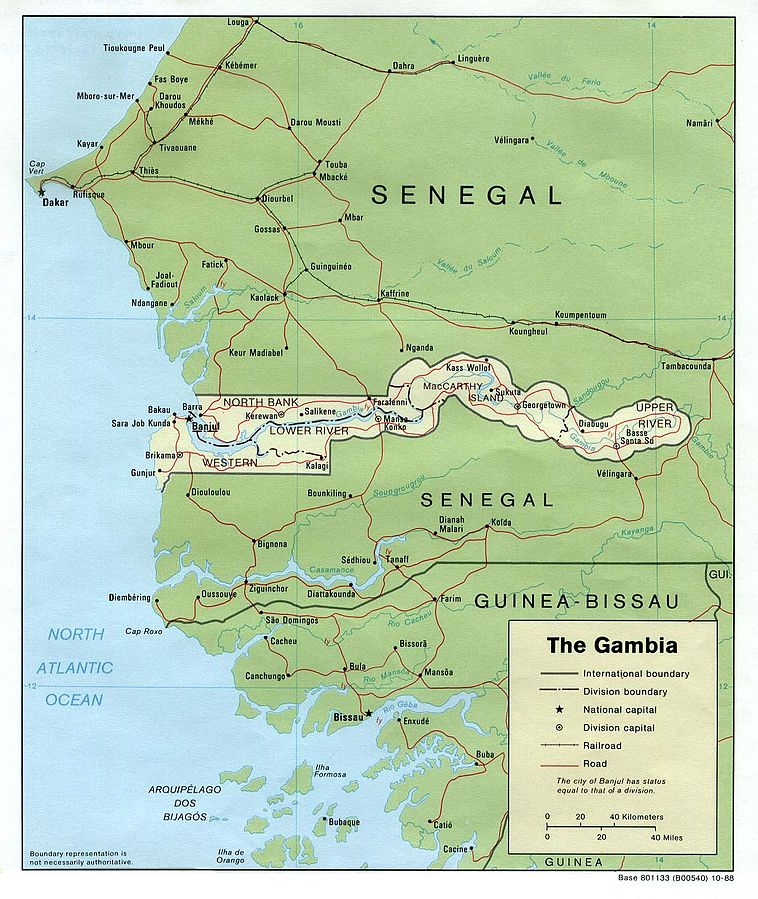
US government map of the Gambia (source)

The Gambia Changes Official Name
If you read our review of world political geography changes in 2015, you might remember a brief note on the official name of the Gambia, a tiny country located along the banks of a river in West Africa. Last December, the Gambia’s maverick dictator decided to declare the country an “Islamic republic”, a designation that can have various meanings and is used by four other countries in the world.

At the time, at least one regional news source claimed that the country’s official name had indeed been changed from “Republic of The Gambia” to “Islamic Republic of The Gambia”. But for a country’s name to be formally changed, its government normally has to pass a law or at least issue some kind of proclamation, and at the time it wasn’t clear whether that had actually  happened.

Flag of the Gambia Country Name:  
• The Gambia
Official Name:  
• Islamic Republic of the Gambia
Capital: Banjul

New Name Registered with UN and ISO
Since most of the world’s countries, including the Gambia, are part of the United Nations (UN), it’s expected that if the country’s name changes, the change will be filed with the administrative offices of the UN so world organizations and other countries will know to start using the new one.

And earlier this year, that finally happened, with the UN updating its terminology database to show that the Gambia’s official long-form English name had been changed to “the Islamic Republic of the Gambia”.

This confirmed the name change, and soon led to the same modification being made to ISO 3166, the international standard list of countries and country codes that’s used by organizations and companies all around the world.

How Often Do Countries Change Their Names?
Out of the world’s nearly 200 countries, there’s an average of about one official country name change each year, most of them involving changes to the country’s full name or preferred English name. Besides the Gambia, no countries changed their names in 2014 or 2015, with the last country to do so being Cape Verde in late 2013. That African island country changed its preferred English name at the UN to Cabo Verde, the same as its native Portuguese-language name; the same year, war-torn Libya clarified its new long-form name as “State of Libya”. The year before, Somalia’s 2012 constitution changed the country’s full name to the Federal Republic of Somalia, and a new Hungarian constitution traded “Republic of Hungary” for just “Hungary”.

More substantial changes to countries’ names, involving more than just translation decisions or adjustments to full names, are much less common. The best recent examples are Yugoslavia’s name change to “Serbia and Montenegro” in 2003, Western Samoa’s change to just “Samoa” in 1997, and Zaire’s reversion to its previous name of “Democratic Republic of the Congo”, also in 1997.

Name Changed in Other Languages
Unlike some countries that have only changed their name for foreign language speakers, English is actually the official language of the Gambia. The UN, on the other hand, has six official languages, so the country’s new name also had to be translated and made official in each of those languages:

Language Before After
English the Republic of the Gambia the Islamic Republic of the Gambia
French la République de Gambie la République islamique de Gambie
Spanish la República de Gambia la República Islámica de Gambia
Russian Республика Гамбия Исламская Республика Гамбия
Chinese 冈比亚共和国 冈比亚伊斯兰共和国
Arabic جمهورية غامبيا جمهورية غامبيا الإسلامية

Islam in the Gambia
Although the country’s name change might seem to suggest that the Islamic religion will be playing a larger role in the government, this doesn’t seem to be the case. Ninety percent of Gambians are Muslims, and there is not complete separation between church and state. But the Gambian constitution does protect freedom of religion, and there’s little sign anything is changing in that area.

Graphic of the flag of the Gambia is in the public domain (source).
ICYMI: The Gambia’s Withdrawal from the Commonwealth

“In case you missed it” – this is an article featuring news we couldn’t cover when it first broke, but that we thought you might still want to know about. Those who read our article on the year 2013 in political geography changes already heard about the Gambia’s withdrawal from the Commonwealth of Nations – now here’s the full story.

Map of current and former member countries of the Commonwealth of Nations (British Commonwealth) as of 2014, marking the Gambia, which recently withdrew from the organization (colorblind accessible).
The Commonwealth of Nations. Current members in dark blue, former members in lavender. Map by Evan Centanni, modified from public domain blank map.

Premium members click here to view this article in the ad-free members area. Not a member yet? Subscribe now!

Flag of the Gambia Country Name:  
• The Gambia
Official Name:  
• Republic of the Gambia
Capital: Banjul

Article by Evan Centanni

Unceremonious Departure
The Gambia, a small country in West Africa, withdrew from the Commonwealth of Nations last October in an unexpected move by idiosyncratic dictator Yahya Jammeh. The official announcement gave no explicit reason for leaving, but it did include language rejecting “neo-colonialism”.

Sometimes called the “British Commonwealth”, the Commonwealth of Nations is mainly a forum for cooperation between countries that were once parts of the British Empire (though it has also admitted other countries in the past). But any association it has with British colonialism is mostly symbolic – although Queen Elizabeth II is the formal “Head of the Commonwealth”, within the organization itself, all members are equal and decisions are made by consensus.

See Also: 2013: The Year in Political Geography Changes

Flag of the Commonwealth of NationsOrganization Name:  
• Commonwealth of Nations
Founded: 1931 and 1949 in London, U.K.
Headquarters: London, U.K.
Website: thecommonwealth.org/

But the Commonwealth does involve itself in the promotion of human rights and democratic government, and this might be how it ran afoul of the Gambia’s ruler. In 2012 Jammeh had rejected a Commonwealth proposal to open commissions in the Gambia for human rights, press freedom, and opposition to corruption. Meanwhile, in early 2013 the country scored especially low in the U.K.’s Human Rights and Democracy report.

Commonwealth Members
The Commonwealth of Nations now has 53 members, all of them independent countries which also have membership in the U.N. Participation in the Commonwealth is completely voluntary, and any member country can leave or reapply at will. Besides the Gambia, there are only two other former Commonwealth members in the world today. Founding member Ireland left when it broke ties with the U.K. in 1949, and Zimbabwe exited in 2003 after a year of suspension over democratic irregularities.

It’s a common misconception that countries must recognize the queen of England as their monarch in order to be members of the Commonwealth. In fact, many Commonwealth members are republics with no monarchies. The countries that do share the queen are a subset known as the “Commonwealth Realms“. Elizabeth II’s current title of “Head of the Commonwealth” is separate from her role as the queen of the Realms, gives her no authority over member countries, and won’t be automatically inherited by her successor.

See Also: Queen Elizabeth’s 16 Countries: The Commonwealth Realms

Low-resolution graphic of the Commonwealth flag is displayed under fair use principles (source). Flag of the Gambia is in the public domain (source).