
This article, originally from 2011, has been revised and updated to January 2018. You can view some older versions of the article in our archives.
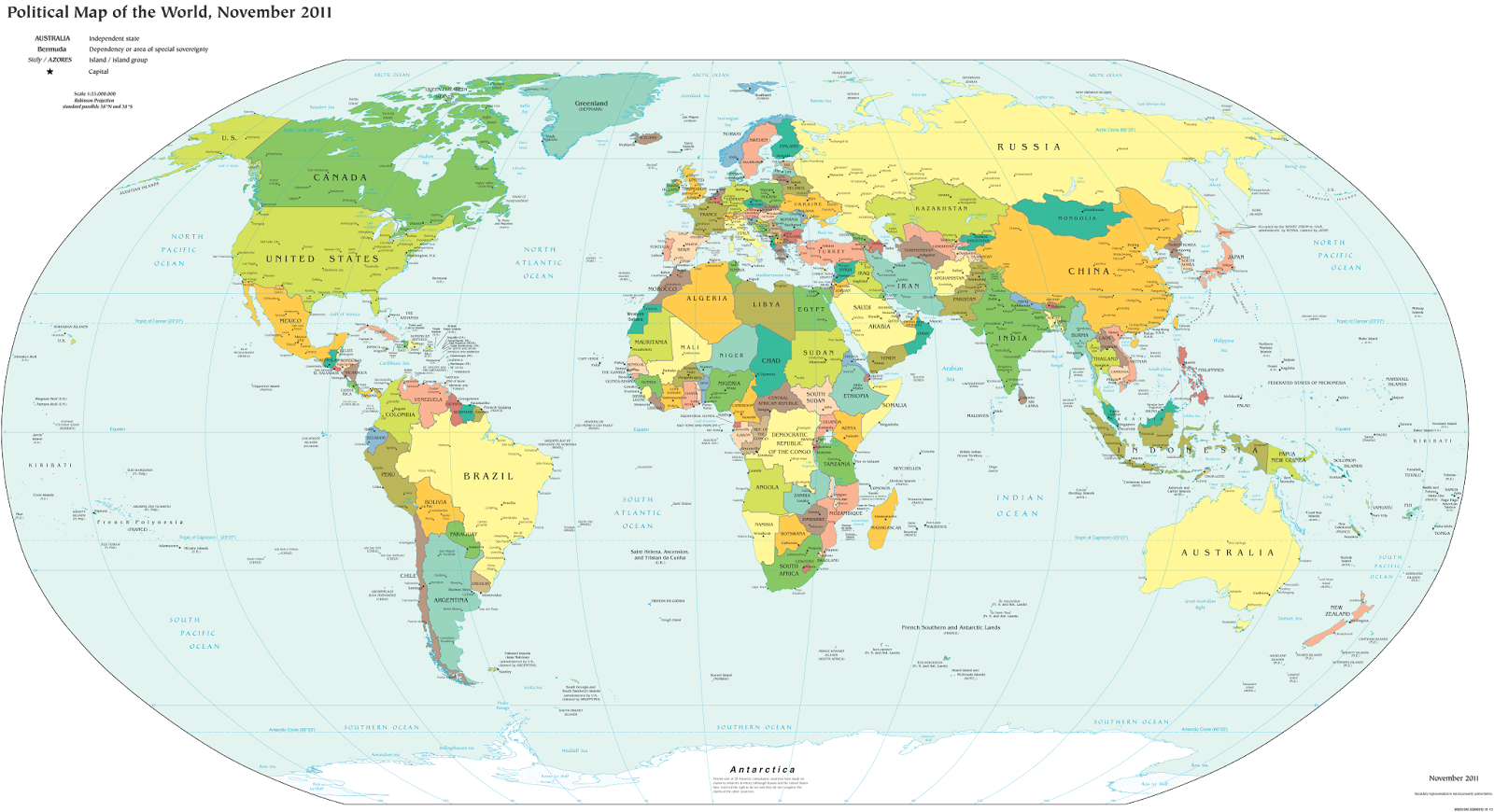 |
| A world political map published by the US government. South Sudan is the most recent addition to the UN-based list of the world’s countries. |
One of the most basic questions for map-lovers is, “How many countries are there in the world?” But anyone who just gives you a number isn’t telling the whole truth. It actually depends a lot on how you define a “country”.
Here are six of the most common answers, each correct in its own way:
195 Sovereign States According to the UN
“Country” and “nation” are casual words for what political scientists call a “sovereign state”, meaning a place with its own borders and completely independent government. The question of which places count as sovereign states can be controversial, but for starters we normally count all the member and observer countries of the United Nations (UN):
UN Members: 193
UN Observer States: 2
Total: 195
These countries mostly all accept each other as sovereign states, and they’re the ones you’ll see on most world maps and lists of the world’s countries. Almost every country you’ve ever heard of is probably a member of the UN, and the two UN Observer States are Vatican City (represented by the Holy See) and Palestine. If you want to know the names of all 195, Wikipedia has a complete list.
The last addition to the list was in 2012, when Palestine became a UN Observer State, and the last time the number of full UN members changed was when South Sudan joined in 2011.
Note: Palestine’s approval as a UN Observer State was controversial, so some lists may still only have 194 countries.
201 States With At Least Partial Recognition
Several more country candidates are left out of the UN itself, but are still officially acknowledged by at least one UN member (this kind of official acceptance is called “diplomatic recognition“). These controversial countries are usually labeled on world maps as disputed territories or special cases, if they’re on the map at all.
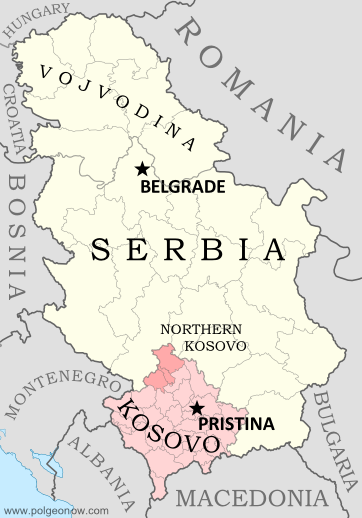 |
| Kosovo is claimed by Serbia, but recognized as independent by over 100 countries. |
UN Members: 193
UN Observer States: 2
States With Partial Recognition: 6
Total: 201
The six non-UN states with partial recognition are Taiwan, Western Sahara, Kosovo, South Ossetia, Abkhazia, and Northern Cyprus. All of these are claimed as parts of other countries, but aren’t actually controlled by them (at least not completely). The number of UN members recognizing them varies, from just one for Northern Cyprus to over 100 for Kosovo.
A few lists also include the Cook Islands and Niue as partially-recognized states. These two places sometimes act like independent countries, but they’ve never actually declared independence or tried to join the UN. They’re usually considered to be highly self-governing overseas territories of New Zealand.
204-207 De Facto Sovereign States
But wait, there’s more! Those six partially recognized countries aren’t the only breakaway states with full self-governance. There are at least three more self-declared countries that aren’t recognized by any UN members at all, but still operate independently from the countries that claim them. These are often called “de facto” sovereign states, a fancy Latin way of saying they’re independent countries in actual fact, even if not on paper.
UN Members: 193
UN Observer States: 2
States With Partial Recognition: 6
Unrecognized de facto Sovereign States: 3 to 6 (see below)
Total: 204 to 207
The three places most often considered de facto independent countries are Nagorno-Karabakh, Transnistria, and Somaliland. And since 2014 there have been three more contenders for the list, questionable because they’re located in active war zones and have only limited government structures: The so-called “Islamic State” is almost out of the running now that it’s lost most of its territory in Syria and Iraq, but the Donetsk People’s Republic and the Lugansk People’s Republic, which claim independence from Ukraine, don’t seem to be going anywhere.
Tiny “micronations” declared by individual people usually aren’t taken seriously enough to put on the list. The closest contender would be Sealand, but it’s debatable whether this tiny “nation” really counts as having a territory, population, or government, all key ingredients for a sovereign state.
There are also many rebel-held territories (and fully self-governing areas like Puntland state in Somalia) that aren’t controlled by any country, but are left off the list because they don’t claim to be independent. They agree in principle that they’re part of another country, even though they might disagree about who should be in charge, or how the country should be governed.
206 Olympic Nations
Lots of people learn about the world’s list of countries by watching the Olympic Games every two years. If you’re one of them, you might be confused at why the Olympic Parade of Nations claims over 200 members, even though your atlas only has 195.
This is because the Olympics didn’t always require applicants to be independent countries. Dependent territories with partial self-government have sometimes been approved by the International Olympic Committee (IOC), and a couple of the partially-recognized states mentioned above have also managed it.
Olympic Nations that are UN Member States: 193
Olympic Nations that are UN Observer States: 1
Olympic Nations that are Partially-recognized States: 2
Olympic Nations that are Dependent Territories: 10
Total IOC-Recognized Olympic Nations: 206
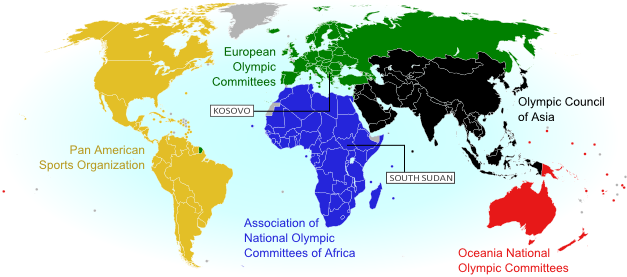 |
| The Olympics include most of the world’s independent countries, and some dependent territories too. |
About half of the dependent territories in the Olympics are overseas possessions of the US (like Puerto Rico) or the UK (like Bermuda). Some nearly-independent “countries” like the Cook Islands (associated with New Zealand) and Aruba (a “constituent country” of the Netherlands) are included too.
Every UN member country is also in the Olympics, with the latest addition, South Sudan, joining in August 2015. The one UN Observer State in the Olympics is Palestine; Vatican City apparently isn’t interested. As for the two partially-recognized countries in the games, Kosovo became an Olympic Nation in 2014, and Taiwan has been a member for some time, but has to call itself “Chinese Taipei” after a deal struck with China in the 1980s.
Learn More: Parade of Nations: Which Countries Are (and Aren’t) in the Olympics
211 FIFA Countries Eligible for the World Cup
Soccer – or “football” as it’s known in many countries – is the world’s most popular sport, and most international matches all the way up to the World Cup are regulated by an organization called FIFA. If you’re a soccer super-fan, you might know that, until recently, there were 209 member countries that compete in FIFA matches (even though most don’t make it to the World Cup). That’s already more than the number of Olympic Nations, and definitely more than the total independent countries on most world maps.
Like the Olympics, FIFA didn’t always require independence or international recognition for its members. Now it’s a bit stricter, but any team that’s already a member is allowed to stay. The two newest members, which joined in May 2016, both made it in under special circumstances: Kosovo, a partially-recognized country, was voted in after being recognized by more than half of the UN’s members; and Gibraltar, an overseas territory of the UK, recently got a court order allowing it in without being independent.
Based on European tradition, FIFA also allows England, Scotland, Wales, and Northern Ireland to compete as separate teams, even though they’re all part of the UK.
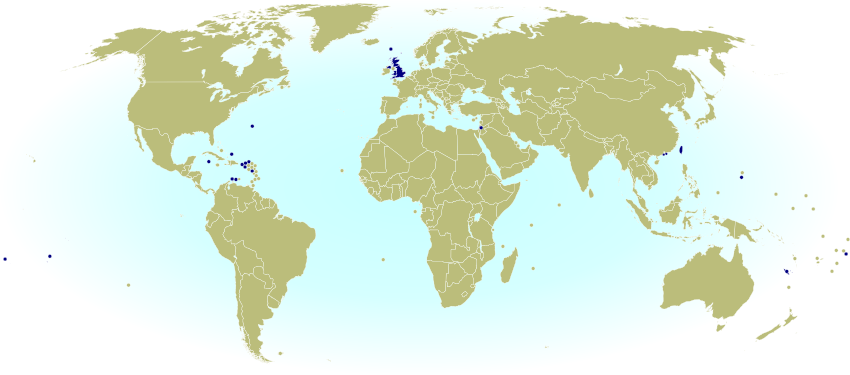 |
| Map from 2014 of FIFA members that aren’t recognized as independent countries by the UN |
Teams of UN Member States: 186
Teams of UN Observer States: 1
Teams of Partially Recognized States: 2
Teams of UK Constituent Countries: 4
Teams of Dependent Territories: 18
Total FIFA Member Associations: 211
You might notice that not all of the 193 UN member states are included. That’s because several very small countries aren’t members, plus the UK is replaced by its four “constituent countries”, which aren’t UN members on their own.
Learn More: Which Countries Are (and Aren’t) Part of FIFA? (2014)
249 Country Codes in the ISO Standard List
Ever been filling out an internet form, and had to choose from a surprisingly long list of countries? You were probably looking at the international standard “country code” list, formally known as ISO 3166-1. Lots of companies and other organizations adopt this standard list instead of spending their own time compiling one. The standard also includes convenient two-letter codes for each country, like us for the United States, de for Germany, and jp for Japan, which you might recognize from website addresses specific to those countries.
This ISO standard is based on an official list kept by the UN…but then why on Earth are there 249 country codes? That’s way more than the total number of UN member and observer countries! Well, the standard list does leave out some breakaway states not recognized by the UN, but makes up for it by listing dependent territories separately from their parent countries. In other words, the ISO list is more an answer to the question, “How many countries and territories in the world?” than “How many countries in the world?”
This means there are “country codes” not just for actual countries, but also for nearly-independent states, overseas colonies, uninhabited islands, and even Antarctica! This is important, because organizations might need an option for every place that any person can be located, and dependent territories often aren’t technically part of the countries they belong to.
UN Members: 193
UN Observer States: 2
States With Partial Recognition: 2
Inhabited Dependent Territories: 45
Uninhabited Territories: 6
Antarctica: 1
Total: 249
So there you have it! Next time someone tells you “There are 194 countries in the world,” remember that the real answer isn’t so simple!
Maybe in a year or two you could add Catalonia to the list. Relations between Catalonia and Spain have reached a no return point, and the last polls show that about 51% of catalans would vote yes to a independence referendum, and only 22% would vote no. I supose this isue could interest you, as a person interested in world politics and geography.
http://independentcatalonia.blogspot.com/
http://www.helpcatalonia.cat/
http://en.wikipedia.org/wiki/Catalan_independentism
Yes, this issue is definitely of interest to Political Geography Now – if Catalonia ever does vote for independence, you'll definitely see it discussed here!
Hopefully Kurdistan will be the next U.N recognised country
Southern Sudan? A country? Not fully recognized?
South Sudan is a recognized country (although not every country has made a point of individually recognizing it yet, they presumably have all accepted it, since it was admitted unanimously into the U.N.). They don't have an Olympic committee yet, but that's only because they haven't gotten around to creating one.
For what ? Back stabbing every country helped them and being problem to all its neighbors
there are 54 countries in africa , 47 europ , 44 asia , 23 north america , 14 ausralia , 12 south america and 0 antartica .
54+47+44+23+14+12+0=194
there r 194 countries in our world.
there are 54 countries in africa , 47 europ , 44 asia , 23 north america , 14 ausralia , 12 south america and 0 antartica .
54+47+44+23+14+12+0=194
there r 194 countries in our world.
europe:44, asia:47
Now that is a question that's somewhat difficult to answer, as there is no one right answer. Many sources offer different answers, and depending on the source, there are 189, 191, 192, 193, 194, 195 or 196 independent countries in the world today.
so how believe that who is correct answer.
It is indeed an interesting issue but the UN does qualify a country straight ahead without looking at the economic capability of a country. if catalona wants to be internationally recognized, they need to have a reliable and standard economy.
meany
Awesome info. So around 200 countries in the world i believe.
actually there are approx. 267 countries in the world!
By what definition?
If you consider Catalonia will be independent soon, by the same token you could consider Scotland, Brittany, Corsica, Basque Country, Galicia, Northern Italy (Padania), the French section of Belgium and Bavaria becoming independent. All of those are European regions with some degree of nationalistic independence movements. And that's just in Europe. We haven't touched on Tibet, Xinjiang, Outer Mongolia, & Manchuria in China or the Sikh region in India.
Africa, South America and the Middle East have largely been divided by European colonial claims of Britain, France, Germany, Belgium, Spain & Portugal. Such boundaries were made to suit the colonial powers without regard to cultural & linguistic differences in the regions. Ultimately those cultural & linguistic differences will manifest themselves and bring about international boundaries based on those differences, instead of being based on the colonial powers.
This movement has already manifested itself in the break up of the former Yugoslavia and the former Czechoslovakia. Catholic Scotland wants to break away from protestant England. Wales may follow. Prosperous Bavaria, Padania & Catalonia would break away from Germany, Italy & Spain, unless the powers that be get some sense into tax policies so the more prosperous regions are not drained of their resources to support less prosperous regions.
"Catholic Scotland"? I thought the biggest religion in Scotland was Presbyterianism.
Ignorant people! Scotland is not Catholic!
I think the guy is confusing the nothern ireland situation but scotland is by no means a catholic region.
Syria is to be split into two – Arab Syria and American Syria; Nigeria to be split into three – Northern Nigeria (Boko Harum section), Nigeria and Biafra; South Africa to be split into two – South Africa (black) and Cape Town (white); DRC to b split into six countries; Libya into two and Eqypt into two. That makes many many countries for the USA to enter into bilateral agreements with for blood OIL.
be a independent humn of this world …….rather being an dependent citizen of independent country.. god possper the human who is humnholic not other illogical things..
yes ,i thinku r right but austraia is consider as one country
yes ,i thinku r right but austraia is consider as one country
Europe and Asia has 100 countries
boring
confusing how many countries are?……….
The point is, there's no single correct answer. It all depends on how you define "country", and many people don't agree on the definition.
hippidy ga ga boo boo
You are not making any positive contribution to these discussions. Please do not be sentimental.
Is it correct to say that there are "more than 200 countries" in the world?
By some definitions? Yes. By the most common definition? No.
There really is no one right answer.
Eelam should be separated from Srilanka. Though the movement was supressed now with genocide by Srilankan goverment… it will happen one day..
I am not a Catalan nationalist, nor a Spaniard, but it is obvious that if failed states like Afghanistan and Somalia, barely functioning states like Guinea-Bissau, and ridiculously small states like Nauru, Palau, Dominica, Liectenstein, and Monaco could all be considered countries in their own right, then there should be no problem with a prosperous, large region like Catalonia being considered a nation. Catalonia has 7.5 million people, which would make it the 99th largest population in the world. It would be greater than the majority of the recognized nations- places like Serbia, Nicaragua, Denmark, Norway, Ireland, Kuwait, Jamaica, and Iceland. Their economy is strong: the second largest stock market in Spain, one of the highest per person GDP in Spain (above most areas of Europe), and has long been considered one of the two economic motors of Spain (along with the Basque Country).
somebody just got their corn flakes crapped in.
244 countries in the world
244 countries in world
Your polls are absolutely unofficial… And wrong… You should be more careful… or learn how to count.
Catalonia is a beautiful traditional region of Spain. A part of the whole cannot decide to break apart based on a couple power-thirsty politicians.
For those who are interested, PolGeoNow has an article on Catalonia and the movement for it to declare independence from Spain:
http://www.polgeonow.com/2013/02/catalonia-europes-newest-nation.html
there are 54 countries in africa , 47 europ , 44 asia , 23 north america , 14 ausralia , 12 south america and 0 antartica .
54+47+44+23+14+12+0=194
there r 194 countries in our world.
While thinking about watching the Olympics tonight, I casually asked my grown daughter how many countries there are in the world. My daughter said there's no need to argue about facts anymore since you can just look them up on the internet. I'll have to refer her to this website.
Always glad to be of service!
What about Niue and the Cook Islands? Wouldn't that bring the total to 206?
Good question! Niue and Cook Islands have a gray status in between that of dependent territories and independent countries, so it's hard to decide what to count them as. They don't usually appear on U.N.-based lists of the world's countries, and they haven't actually declared independence either, so they're most commonly counted as dependent territories.
But it's true that they have some features of independent countries (apparently including diplomatic recognition from a few U.N. members), so you could just as well include them to bring the list of "recognized or de facto independent states" up to 206. Yet another way of counting the world's countries!
The question was how many lands are there in the world? Not how many countries are in the world!
aprx. 195 countries in the world
They've played a clever game while outpacing, socially and politically , thier neighbours – and they are increasingly secular. Sorry they don't fit into the blood and iron or sit back and let it happen mold.
there are 12 months in a year
RJT are you from the UK?
there are heaps
Well one planet, One land as they are all connected in one way or another.
As to how many countries, well…. a finite amount, as you can only break a whole up so many times.
who is anyonymus thing/
newzland also be the part of australia
New Zealand is a separate country to Australia. I think you mean to say Australasia, not Australia.
243 country in the world,
I THINK THERES 19
The most widely used term (besides Australia) for the ethnic continent would be Oceania
Even Scotland could gain independence.
These figures are manipulated and wrong. As a Catalan, I love Catalonia with the rest of the regions of Spain, as the majority of Catalans, who feel first Spaniards. But the present regional Government manipulates the news in their controlled TV, newspapers, radio, schools, etc. Catalan language is a minority language in Catalonia, and people like peace, But a minority wants the rupture with the rest of Spain to protect their politicians, who have stolen many thousands of millions of Euro (like ex president Pujol) in order to dscape from the Spanish Justice and the jail.
Please answer the question without seeing day dreams of Eelam which never happen.