Venezuela Joins Mercosur, Paraguay Suspended

Map of intergovernmental organizations in South America: Mercosur, the Andean Community, and UNASUR (Venezuela and Paraguy indicated)
South America’s intergovernmental organizations: Mercosur in green, the Andean Community (CAN) in (orange), and remaining members of UNASUR in blue (claimed territorial extents). Map by Evan Centanni, based on this map by Wikimedia user Luan.

After over six years of waiting, Venezuela today officially joined Mercosur (the “Southern Common Market”), one of South America’s two main trade blocs.

The country was previously part of the continent’s other major bloc, the Andean Community (CAN), but left that organization last year in anticipation of the switch to Mercosur (see Venezuela Leaves Andean Community).

By the time the Venezuela left CAN last year, its application had finally been approved by all Mercosur member states except for Paraguay; but despite support from that country’s president, an opposition party in its congress continued to block Venezuela’s entry into the trade organization.

That all changed last month, when Paraguay’s government was overthrown in a political spectacle that many denounced as a thinly veiled coup. The country’s membership in Mercosur was suspended as a result, and the rest of the organization quickly took advantage of Paraguay’s absence to vote Venezuela into the group. Full membership for the newcomer was scheduled to enter effect on July 31, 2012.
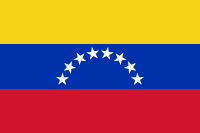
Flag of VenezuelaCountry Name:  
• Venezuela (English, Spanish)
Official Name:  
• Bolivarian Republic of Venezuela (English)
• República Bolivariana de Venezuela (Spanish)
Capital: Caracas

Mercosur was founded in 1994 by Argentina, Brazil, Paraguay, and Uruguay, with Venezuela today becoming the first new full member (several other South American countries are “associate members” or observers). Integration within the bloc includes a customs union (free movement of goods across borders) as well as economic and judicial coordination between member states.

The countries of both Mercosur and the Andean Community also belong to the Union of South American Nations (UNASUR), a broader organization that includes all of the continent’s sovereign states. Mercosur and UNASUR are the abbreviations based on the groups’ Spanish names, but they are also known by their Portuguese abbreviations, Mercosul and UNASUL.

Graphic of Venezuelan flag is in the public domain (source).

Venezuela Leaves Andean Community

Country Name: Venezuela (English, Spanish)
Official Name: Bolivarian Republic of Venezuela (English), República Bolivariana de Venezuela (Spanish)
News Category: Intergovernmental Organization Membership
Summary: Venezuela has withdrawn from the Andean Community (CAN) customs union, in favor of joining Mercosur, another union in South America. The switch has been represented as a protest against free trade agreements made with the United States on the part of CAN members Peru and Colombia. Admission into Mercosur is still pending, though Venezuela remains a member of the Union of South American Nations (UNASUR).

Venezuela (red) has left CAN (orange) in anticipation of joining
Mercosur (green). Other UNASUR members are in blue. Map
includes all claimed territories of the member states. My own
work, based on this map by Wikimedia user Luan (terms of use).

Full Story
Although nation-states are usually considered the basic units of the modern political globe, it has become common in recent decades for countries to work together towards integration at a higher level. The most well known case, and probably the furthest advanced, is the European Union. However, there are a number of other intergovernmental organizations working for integration in other parts of the world. In South America, supranational integration has progressed largely through two major trade blocs: the Southern Common Market (known by its Spanish or Portuguese abbreviations, “Mercosur” or “Mercosul”) and the Andean Community (known by the Spanish abbreviation, CAN).

The Andean Community represents a group of countries in the northwestern part South America, while Mercosur is centered around the southeastern region of the continent. The country of Venezuela, located in the north of the continent at the meeting place of the two blocs, has long been a member of the Andean Community. However, in 2006 the Venezuelan government announced the intention to switch its membership to Mercosur. Citing free trade agreements made between the United States and CAN members Peru and Colombia, Venezuelan president Hugo Chávez announced that he believed CAN was no longer relevant. After five years, Venezuela fully withdrew this month from the Andean Community. Admission to Mercosur is still pending, though it seems likely in the near future.

CAN and Mercosur have both implemented trade agreements forming customs unions between their members – that is, they have mostly eliminated tariffs between member countries, and have also unified their external customs regulations to be consistent among the whole bloc. They have also proceeded with other cooperative programs, such as coordinating economic policies and setting up courts with international jurisdiction. Over the last decade, they have been working towards integrating with each other to form the Union of South American Nations (USAN or UNASUR/UNASUL), an organization modeled after the European Union. In fact, UNASUR includes all of South America’s sovereign states, independently of their membership in CAN or Mercosur, which means that Venezuela will remain a member of UNASUR during its transition period. Venezuela’s bid to join Mercosur had originally been seen as a gesture towards integration between Mercosur and CAN, though that is clearly not the case now that the country has withdrawn from CAN.

Wikipedia:
Venezuela
Andean Community (CAN)
Southern Common Market (Mercosur)
Union of South American Nations (UNASUR)