Map: Which Schengen Borders are Closed to Passport-Free Travel in August 2017?

Last year, we explained Europe’s Schengen free travel area in plain English, then published maps of which European countries had temporarily reintroduced border controls as of March 2016, August 2016, and February 2017. Here’s an update and summary for August of 2017.
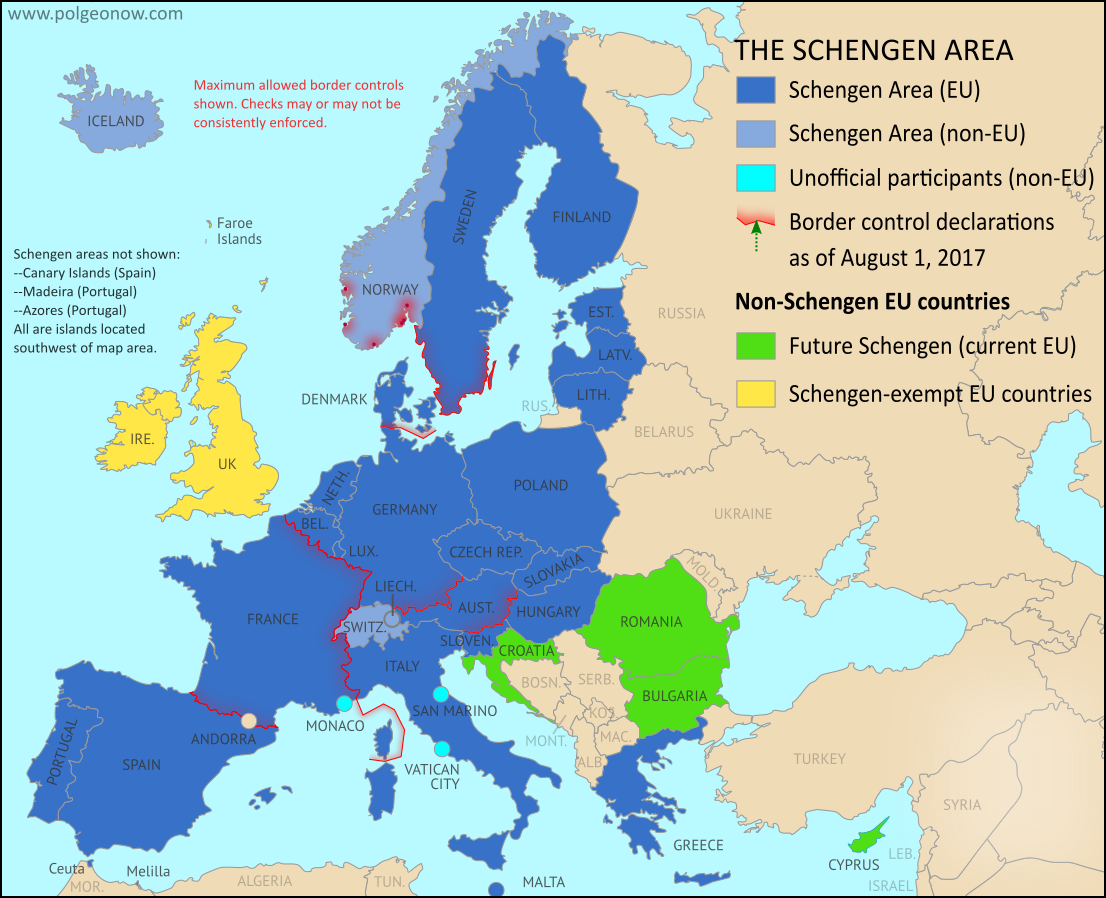
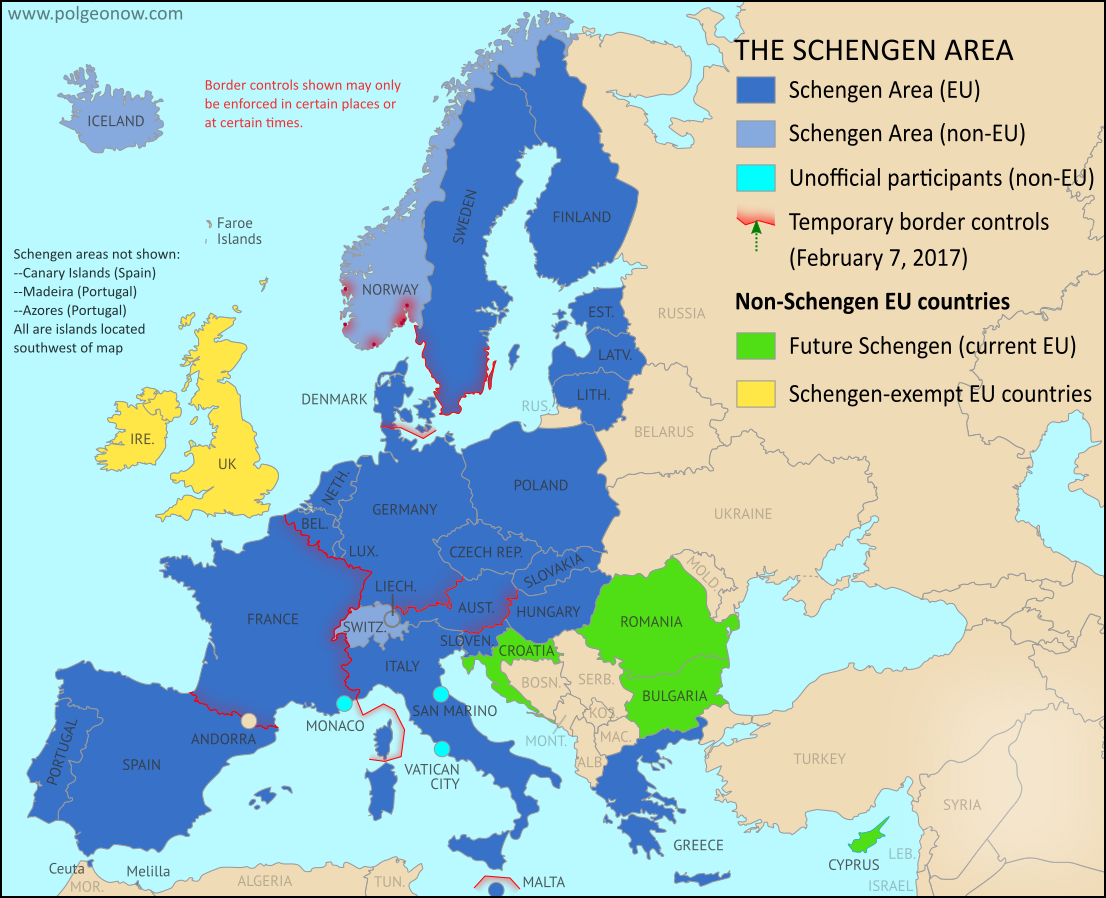
Schengen borders map showing temporary reintroduction of border controls in the Schengen Area (the European Union's border-free travel zone) as of August 2017, showing internal Schengen borders closed to passport-free travel in the period after the election of French President Emmanual Macron.
Map by Evan Centanni, from blank map by Ssolbergj. License: CC BY-SA

Article by Evan Centanni

Current Border Controls Between Schengen Countries

As anyone who’s visited Europe in recent decades knows, much of the continent is linked together as part of the “Schengen Area“, a collection of countries that don’t make travelers show any ID to cross back and forth across their borders (though this system is overseen by the European Union, the Schengen Area and the EU aren’t the same thing). But the system does allow countries to temporarily reintroduce border controls under certain circumstances.

With the spike in numbers of refugees and other immigrants arriving in Europe in the past two years, many Schengen countries have rushed to control the flow of people by using these special temporary exemptions. When we published our previous map of border controls within Schengen this past February, there were seven member countries reserving the right to perform border checks. Now there’s one fewer, and the remaining six have renewed their declarations – perhaps for the last time.

It’s important to note that the border controls shown on the map above are the maximum allowed under each country’s declaration – actual enforcement may be extensive, limited, or even absent depending on the circumstances.

Learn More: The UK already isn’t part of the Schengen Area or Eurozone, so what will change when it leaves the EU?

The 5 Schengen Countries with Negotiated Border Controls
Map of the European Union (EU) and prospective member countries
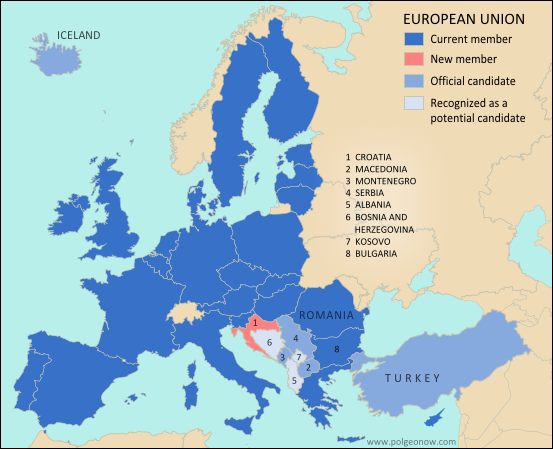
The full EU and prospective members

Amid fears that the Schengen Area’s dream of free travel was going down the drain, the foreign ministers of the EU’s member countries met up and hashed out a compromise solution last year, with five countries reducing the scope of their border controls by refocusing them on high-priority areas:

  • Germany agreed to control only its border with Austria, ruling out border controls with Switzerland, the Czech Republic, Luxembourg, Belgium, the Netherlands, and Denmark.
  • Austria agreed to control only its borders with Slovenia and Hungary, ruling out border controls with Italy, Switzerland, Liechtenstein, the Czech Republic, and Slovakia.
  • Denmark agreed to control only its border with Germany (including land crossings and ferry connections), ruling out border control for arrivals from Sweden or Norway.
  • Sweden agreed to control only crossings over the bridge from Denmark and sea arrivals along its western and southern coastline, ruling out controls for land borders with Norway and Finland or arrivals by sea along its east-central and northern coasts.
  • Norway agreed to control only arrivals in ports with ferry connections to Sweden, Denmark, and Germany, ruling out controls along its land borders with Sweden and Finland.

These border controls were extended three more months in November 2016, then another three months in February 2017. Finally, on May 11, the EU government approved one more extension – this time for six months. But this will be the final extension allowed under official Schengen rules: According to the plan, the five affected countries will have to phase out all Schengen-internal border controls by the deadline of November 11, 2017.

In fact, Sweden had already announced just before the extension that it would be ending some border checks for travelers arriving from Denmark; but the announcement said other types of checks would continue, and the country did go ahead and notify the EU that it would accept the extension to November.

France’s Border Controls Extended for the Fifth Time

Unlike most of the countries with temporary border checks, which have focused their controls on specific stretches of borders popular with refugees and other migrants, France has reserved the right to maintain controls on all its borders – except, presumably, the boundary with tiny Monaco, which for immigration control purposes is already treated like part of France.

Unlike other countries with border checks, France’s controls are justified mostly as an anti-terrorism measure, not as a way of keeping out migrants. The French border controls were first declared in 2015 and have been in place ever since then due to several extensions:

Start Date Duration Stated Reason
Nov. 13, 2015* 1 month Paris Climate Change Conference 
Dec. 14, 2015 6 months, 12 days “emergency state as introduced further to Paris attacks
May 27, 2016 2 months Euro 2016 and Tour de France
July 26, 2016 6 months “emergency state as introduced further to Nice attack
Jan. 27, 2017 5 months, 18 days “persistent terrorist threat”
July 16, 2017 3 months, 15 days “persistent terrorist threat”

*France’s November-December 2015 border controls were only for air and land borders (sea ports were excluded)

The most recent extension, posted on the EU’s Schengen website but apparently not reported in the English-language media, expires after October 31. This is probably part of newly elected President Emmanuel Macron’s plans to extend the country’s overall state of emergency, though Macron does say he believes in preserving Schengen’s free-travel principles in the long run. That attitude stands in contrast to his defeated opponent for the presidency, Marine Le Pen, who had promised to suspend all participation in Schengen while also preparing for a vote on leaving the EU.

Temporary Border Controls in Malta, Portugal, Italy, and Germany

At the time of our last Schengen border control map report, the tiny island country of Malta had also declared temporary border checks as a security precaution while the country was hosting two important political summits related to migration into Europe. Those checks lasted for just twenty days, expiring after February 9.

Since then, Portugal also announced temporary border controls, for security during a visit by the Pope (May 10-14), and Italy did the same when hosting a G7 summit (May 10-30). Germany also reserved the right to enforce controls on all its borders – not just with Austria – from May 15 to July 9 while it prepared to host the G20 financial summit.

These truly temporary suspensions of free travel are a normal part of the Schengen system, and all three countries have since let the declared controls expire.

Learn More:
Which Countries Are in the Schengen Area, and Which EU Countries Aren’t? 
Map of Temporary Schengen Border Controls in March 2016 
Map of Temporary Schengen Border Controls in August 2016 
Map of Temporary Schengen Border Controls in February 2017 
Why Brexit Matters: 5 Things That Might Change When Britain Leaves the EU

By Bryn Jansson

Map of the European Union, including all member countries, official candidate countries, and potential candidate countries, as 2017 (colorblind accessible).
Map of current and future EU member countries

Brexit Process Finally Begins

The United Kingdom (UK) and the European Union (EU) began formal divorce negotiations in Brussels last Monday, June 19, starting a 21-month sprint to the March 2019 Brexit deadline. (“Brexit” is short for “British Exit” from the EU, since “Britain” is another name for the UK.)

UK voters’ surprise choice to leave the EU happened exactly a year ago, on June 23, 2016 – but it didn’t automatically trigger the two-year countdown clock on exit negotiations necessary for departure under Article 50 of the EU’s Lisbon Treaty.

In fact, the referendum didn’t actually do anything, except signal to the British government that its voters wanted to leave. While all leading politicians promised to respect the results, the official process couldn’t start until the UK delivered formal notice to the EU. Theresa May, the UK prime minister who replaced David Cameron last July, wanted to make sure the British government had its priorities and negotiating positions in order before delivering the notice. After many months, she finally did that on March 29, 2017.

How Brexit Affects the UK

Now it’s time for the UK and the rest of the EU to negotiate the details of the divorce. But the UK already wasn’t part of the EU’s free-travel Schengen Area, or part of the shared-currency Eurozone. So what will actually change when the country quits?

“Hard Brexit” vs. “Soft Brexit”

Most details of the UK’s break from the EU are still unknown, but the many possibilities can be divided into two general categories: A “Soft Brexit” would allow the UK to keep some of its special economic ties to the EU, and maybe even the Single Market arrangement that lets goods, money, services, and labor move freely between member countries (the so-called “four freedoms”).

“Hard Brexit”, on the other hand, would mean a clean break from the Single Market, requiring the UK and the EU to negotiate their economic relationship from scratch. The EU insists on including the “four freedoms” as a package deal, so if the UK doesn’t want one of them, it’ll have to give up access to all of them. EU leaders fear that letting the UK pick and choose the best parts of membership might encourage other countries to do the same.

Some non-EU member countries, like Norway and Switzerland, do have partial membership in the Single Market; they generally still have to accept the “four freedoms”, but are allowed exceptions from certain market-wide regulations. They also were never in the EU to begin with, so they were able to negotiate from a stronger position.

Most of the potential changes involve the EU’s “Single Market”, a system that allows goods, money, services, and labor (people) to move around inside the EU as if it was all one country. (Because the UK isn’t part of Schengen, it’s allowed to do border checks and set its own visa policies for non-Europeans; but the Single Market guarantees that citizens of other EU countries can still move to the UK and work there.)

Here are five of the biggest areas where things might change when the Brexit is complete:

1

The Issue: Immigration

Why It Matters: Immigration was one of the driving issues behind the Leave campaign’s success in the Brexit vote last year. Then-Prime Minister David Cameron had promised to drastically reduce migration; but as long as EU law required free movement of labor for EU citizens in and out of Britain, his hands were pretty much tied.

Brexit supporters ran on a platform of regaining control over the country’s borders, promising to limit immigration to much smaller rates than British people are used to now. Since the immigration issue was one of the most visible of the campaign, it’ll be a big deal in the news during negotiations.

What Might Happen: Current Prime Minister Theresa May has consistently said Brexit must mean full control of the UK’s borders and the flow of people coming into the country. While politicians aren’t known for keeping their promises, this is one she’s been clear on for so long that it would be hard for her to break it.

In an April interview, however, May expressed openness to an “implementation period” in which businesses and governments would have time to adjust to new policies. This could include an extension of the free movement of people – though May still insisted that border and immigration policy would be under British control during that period.

2

The Issue: The Border with Ireland

Why It Matters: One of the more difficult circles to square will be the fate of the border between Ireland (an independent country) and Northern Ireland (a part of the UK). Even though the UK isn’t part of the EU’s Schengen free travel area, it has a special agreement to keep the Irish border open to travelers, and the “four freedoms” of the EU Single Market let residents easily do business on either side.

From the 1960s to the 1990s, some 3,500 people in Northern Ireland were killed in a violent conflict over whether the region should join independent Ireland or stay in the UK. The Good Friday Agreement of 1998 led to a cease-fire that’s mostly held since, probably in part because the border is “irrelevant”. But that could all change after Brexit, when the boundary might come to divide the EU Single Market from a border-controlled UK. Meanwhile, tens of thousands of jobs are threatened if cross-border economic activities get cut off.

In last year’s Brexit referendum – where Irish citizens residing in the UK were allowed to vote alongside their British neighbors – Northern Ireland voted against leaving the EU, but with sharp differences from district to district.

Gibraltar and Brexit

Brexit negotiations will also decide the future of Gibraltar, a tiny UK-controlled peninsula attached to southern Spain. The territory, though not officially part of the UK, has been under British control since 1713, and some in Spain hope to use the negotiations as leverage to advance their own country’s claims to it.

The EU has promised Spain veto powers over any future trade deal involving Gibraltar, which would allow the Spanish government to “demand concessions or make the border with Gibraltar harder to cross, effectively isolating the territory.” Whether Spain will use its power that way is still unknown.

Meanwhile, the May government has insisted that British policy toward Gibraltar – which includes promises not to give the territory to Spain without its residents’ permission – will not change. (Gibraltarians voted overwhelmingly against Brexit last year, but are even more against joining Spain.)

What Might Happen: Former UK prime minister Tony Blair thinks a hard border with checkpoints and passport controls “really would be a disaster.” Fortunately, both sides have said they want to leave the border as open as possible: May has promised work for a practical solution allowing free travel between Ireland and Northern Ireland while still “protecting the integrity of the UK’s immigration system”, and the EU negotiating guidelines call for a “flexible and creative” approach. Some have suggested this could mean an open border in Ireland, with a “hard border” separating Northern Ireland from the rest of the UK.

However it turns out, you can bet PolGeoNow will be covering these developments!

3

The Issue: Citizens’ Rights

Why It Matters: Thanks to the free movement of people guaranteed by the EU, about 1.2 million British nationals live in other EU states, and 3.2 million non-British EU citizens live in the UK. Many have lived there for decades. Until now, they’ve enjoyed access to most of the same rights and privileges as their local neighbors, but Britain’s exit from the EU opens that up to debate.

If no agreement is reached, EU citizens wishing to stay in the UK would have to deal with British immigration laws, which advocacy groups say are already some of the strictest in Europe. They could also lose access to other services they have now, like health care, social security, and pensions. The same thing could also happen to UK citizens living in other EU countries, like the half-million British expats who have relocated to sunnier Spain and France

What Might Happen: Both sides generally favor allowing existing residents to stay and retain access to services, though the details will take time to hammer out. The EU wants these rights guaranteed by the European Court of Justice (ECJ), but the UK government has been clear that the ECJ will not have any jurisdiction in Britain after Brexit. Another issue is what day citizens must arrive by to be eligible under the agreement: The day of the referendum? The day Article 50 was triggered? The day an agreement is ratified? We should find out soon, since both the EU and the UK have agreed citizens’ rights is one of the first topics on the agenda.

4

The Issue: “Passporting”

Why It Matters: Confusingly, “passporting” has nothing to do with what we usually think of as a passport: the identity document that gets stamped when you enter a new country. In this case, it’s actually an authorization that allows banks and other financial institutions in one EU country to do business in the any of the others. This is a specific part of the Single Market, but it’s especially important because London’s status as Europe’s unofficial “financial capital” means there’s a huge volume of cross-border financial business between the UK and the rest of the EU. One estimate indicates that if the UK lost all EU passporting rights, it could cost almost $25 billion in annual revenue. Another says London banks may have to move close to $2 trillion, or 17 percent of the UK banking system, to EU-based locations. Yet another claims that up to 80,000 jobs in the finance sector could leave London in the next two years as banks prepare for the worst.

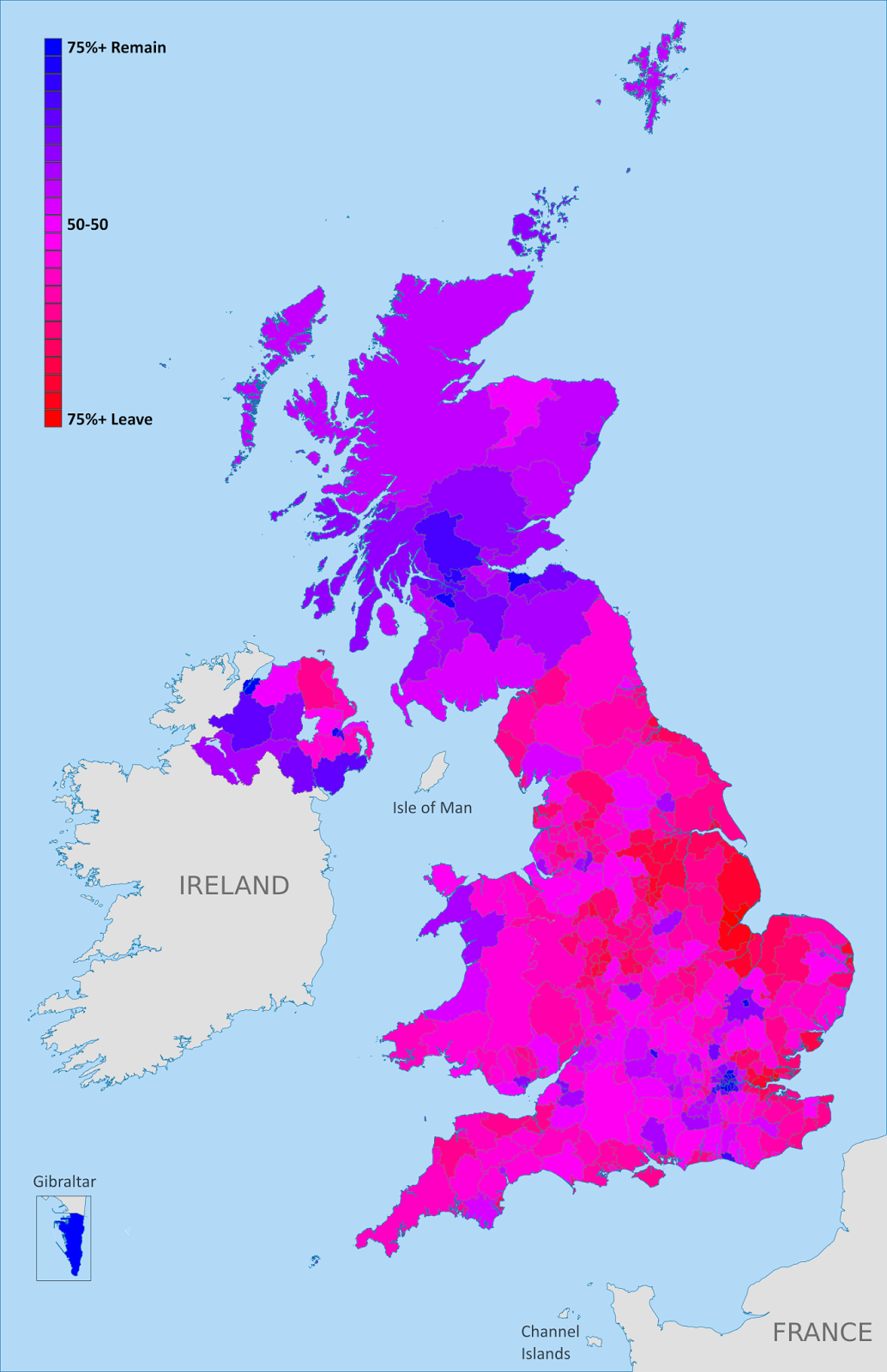
UK Brexit vote map: Map of election results in Britain's June 2016 referendum on leaving the European Union (EU). Continuous red-to-blue color scheme gives a more honest depiction of the similarities between different election districts. Colorblind accessible.
Map of UK Brexit vote results

What Might Happen: Only EU-based firms are eligible for passports, so unless an exception is negotiated as part of Brexit, British banks will lose that right. It won’t stop them from conducting business elsewhere, but it does mean they have to apply for a license in each individual country. Ominously for the UK, new French president Emmanuel Macron is on the record saying British financial institutions shouldn’t get a special deal. Britain’s finance industry is already expecting to lose full passporting rights, but hopes a more limited deal could allow some important services to continue.

5

The Issue: Economic Access

Why It Matters: This really is the issue of the whole negotiation process; it’s woven into all the other topics discussed above. How close and what type of an economic relationship will the UK and the EU have after Brexit is finalized?

What Might Happen: Though anything is still technically possible at this point (staying in the Single Market, getting out, keeping other agreements, or temporarily staying in while a new relationship is finalized), May’s government has been fairly clear about its plans to pull the UK out of the Single Market and renegotiate its relationship with the EU from scratch.

But since her Conservative Party lost its parliamentary majority in June’s snap elections, there’s been a push to at least keep Britain in the EU’s customs union. A customs union is a less-ambitious version of the Single Market, where member countries have a shared policy on imports from non-members, and no taxes on importing or exporting between members. It doesn’t include free movement of people, or the unified rules of business that make free movement of labor and services practical in the EU.

Only time will tell how the recent electoral losses will affect May’s negotiating positions, but the decision on whether to allow free movement of people will be the linchpin. If the UK is willing to accept this, it can get the greater economic access that Northern Ireland and London’s financial sector want. But if full control over British borders is non-negotiable, the UK will get only partial access at best.

Following this story? View all Brexit articles on PolGeoNow!

Schengen Border Controls in February 2017: Map of Free Travel Restrictions

There are newer versions of this map available. To see them, view all Schengen Area articles. 

Last year, we explained Europe’s Schengen free travel area in plain English, then published maps of which European countries had temporarily reintroduced border controls as of March 2016 and August 2016. We now present an updated map and summary of the situation.

Schengen border checks map: map of Temporarily Reintroduced Border Control in the Schengen Area (the European Union's border-free travel zone) as of February 2017, color-coded for EU Schengen countries, non-EU Schengen countries, future Schengen countries, and Schengen-exempt EU countries, as well as microstates unofficially participating in the Schengen agreements (colorblind accessible).
Map by Evan Centanni, from blank map by Ssolbergj. License: CC BY-SA

(Subscribers click here to view this article in the members area.)

Article by Evan Centanni

Changes to Schengen Border Controls Since 2016

As anyone who’s visited Europe in recent decades knows, much of the continent is linked together as part of the “Schengen Area“, a collection of countries that don’t make travelers show any ID to cross back and forth across their borders (though this system is overseen by the European Union, the Schengen Area and the EU are not the same thing). But the system does allow countries to temporarily reintroduce border controls under certain circumstances.

With the spike in numbers of refugees and other immigrants arriving in Europe in the past two years, many Schengen countries have rushed to control the flow of people by using these special temporary border controls. When we published our previous map of temporary Schengen border controls in August of last year, there were six countries policing their borders with fellow Schengen members. At the moment there are seven, but the situation has largely remained the same since last summer.

It’s important to note that the border controls shown on the map above are the maximum possible under each country’s declaration – in some cases actual controls may be limited to only certain parts of these borders, or to certain times.

Map of the European Union (EU) and prospective member countries
The full EU and prospective members

France’s Border Controls Extended

Unlike most of the countries with temporary border checks, which have focused their controls on specific stretches of borders popular with refugees and other migrants, France has reserved the right to maintain controls on all its borders – except, presumably, the boundary with tiny Monaco, which for immigration-control purposes is already treated as if it were within France.

Unlike other countries with border checks, France’s controls are justified mostly as an anti-terrorism measure, not as a way of keeping out migrants. The French border controls were declared over a year ago and have been in place ever since then due to several extensions:

Start Date Duration Stated Reason
Nov. 13, 2015* 1 month Paris Climate Change Conference 
Dec. 14, 2015 6 months, 12 days “emergency state as introduced further to Paris attacks
May 27, 2016 2 months Euro 2016 and Tour de France
July 26, 2016 6 months “emergency state as introduced further to Nice attack
January 27, 2017 5 months, 18 days “persistent terrorist threat”

*France’s November-December 2015 border controls were only for air and land borders (sea ports were excluded)

The most recent extension, declared on the 27th of last month, had the most generic justification yet, and came as France’s front-running presidential candidate promised to “ignore” the Schengen agreement and re-institute permanent border checks if he’s elected this May.

The 5 Schengen Countries with Negotiated Border Controls

Amid fears that the Schengen Area’s dream of free travel was going down the drain, the foreign ministers of the EU’s member countries met up and hashed out a compromise solution last year, with five countries reducing the scope of their border controls by refocusing them on high-priority areas:

  • Germany agreed to control only its border with Austria, ruling out border controls with Switzerland, the Czech Republic, Luxembourg, Belgium, the Netherlands, and Denmark.
  • Austria agreed to control only its borders with Slovenia and Hungary, ruling out border controls with Italy, Switzerland, Liechtenstein, the Czech Republic, and Slovakia.
  • Denmark agreed to control only its border with Germany (including land crossings and ferry connections), ruling out border control for arrivals from Sweden or Norway.
  • Sweden agreed to control only crossings over the bridge from Denmark and sea arrivals along its western and southern coastline, ruling out controls for land borders with Norway and Finland or arrivals by sea along its east-central and northern coasts.
  • Norway agreed to control only arrivals in ports with ferry connections to Sweden, Denmark, and Germany, ruling out controls along its land borders with Sweden and Finland.

These border controls, originally set to expire in November, were extended another three months, and now expire on February 11-12. However, EU leaders appear to have approved yet another three month extension, to May 2017, and Germany’s government is talking about switching to France-style anti-terrorism controls.

Temporary Border Controls in Malta

Besides those same six countries, border controls are also in place right now for the tiny island country of Malta. However, Malta’s border checks are truly temporary, and are only scheduled for January 21 to February 9, as a security precaution while the country is hosting two important political summits related to migration into Europe.

Learn More:
Which Countries Are in the Schengen Area, and Which EU Countries Aren’t? 
Map of Temporary Schengen Border Controls in March 2016 
Map of Temporary Schengen Border Controls in August 2016 

Map of Border Controls Inside Europe’s Schengen Area: August 2016

There are newer versions of this map available. To see them, view all Schengen Area articles.

Last March, we explained Europe’s Schengen free travel area in plain English, then published a map of which European countries had temporarily reintroduced border controls. We now present an updated and improved version of the border control map, reflecting several changes from the past five months.

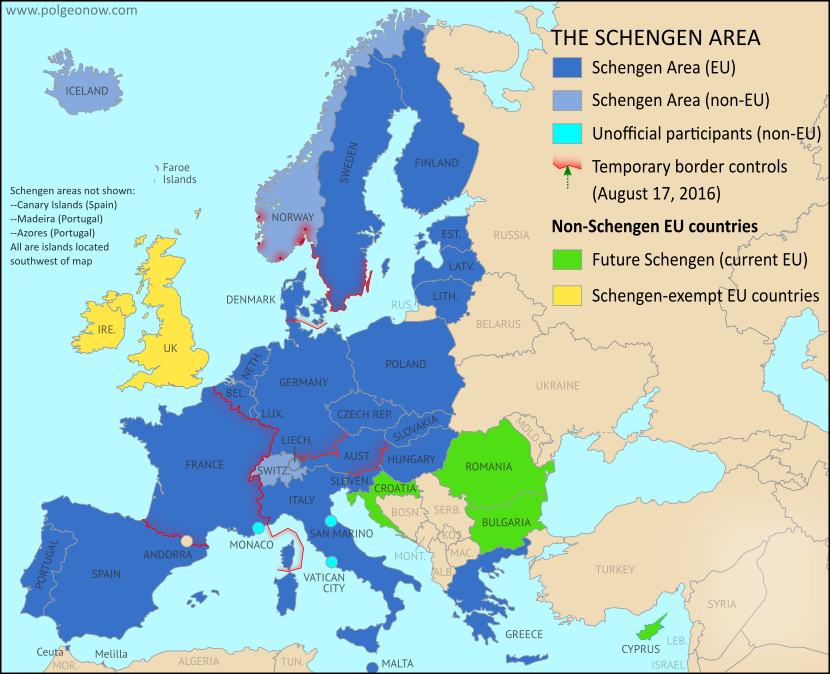
Map of Temporarily Reintroduced Border Control in the Schengen Area (the European Union's border-free travel zone) in August 2016, color-coded for EU Schengen countries, non-EU Schengen countries, future Schengen countries, and Schengen-exempt EU countries, as well as microstates unofficially participating in the Schengen agreements (colorblind accessible).
Map by Evan Centanni, from blank map by Ssolbergj. License: CC BY-SA

(Subscribers click here to view this article in the members area.)

Article by Evan Centanni

Changes to Schengen Border Controls Since March

As anyone who’s visited Europe in recent decades knows, much of the continent is linked together as part of the “Schengen Area“, a collection of countries that don’t make travelers show any ID to cross back and forth across their borders (though this system is overseen by the European Union, the Schengen Area and the EU are not the same thing). But the system does allow countries to temporarily reintroduce border controls under certain circumstances.

With last year’s spike in numbers of refugees and other immigrants arriving in Europe, many Schengen countries have rushed to control the flow of people by using these special temporary border controls. When we published our previous map of temporary Schengen border controls back in March, there were seven countries policing their borders with fellow Schengen members. Today there are only six, and there have been major changes to which borders are controlled:

Belgium’s French Border Controls Expire

In February, Belgium controversially declared an emergency reintroduction of controls along part of its border with France, which it claimed was necessary to limit flows of displaced people caused by the forced closure of a major refugee camp in France. Normally, emergency border controls have to be renewed every ten days, though Belgium announced from the outset that it planned to keep them for a whole month. However, in the end the country did respect the two-month renewal limit on emergency controls, letting them expire in late April.

Denmark Border Controls Expire, then are Reintroduced

Map of the European Union (EU) and prospective member countries
The full EU and prospective members

Denmark declared emergency controls at all its borders in January, citing “unexpected migratory flow” as the reason. Like Belgium, it kept them in place for the full two months allowable, ending on March 4.

However, Denmark followed that expiration immediately with a normal, non-emergency reintroduction of border controls, which it said were to deal with a “big influx of persons seeking international protection”.

EU-brokered Compromise Aims to Stabilize Schengen

Amid fears that the Schengen Area’s dream of free travel was going down the drain, the foreign ministers of the EU’s member countries met up and hashed out a compromise solution, which they published as an EU “recommendation” document on May 12. Though a lot of their recommendations involved telling Greece to try harder not to let refugees into Europe, they also came up with a plan to reduce the scope of the border controls by refocusing them on high-priority areas.

In exchange for keeping their controls for another six months (more than the normal maximum), five of the six remaining countries agreed to limit which parts of their borders they would police:

  • Germany agreed to control only its border with Austria, ruling out border controls with Switzerland, the Czech Republic, Luxembourg, Belgium, the Netherlands, and Denmark.
  • Austria agreed to control only its borders with Slovenia and Hungary, ruling out border controls with Italy, Switzerland, Liechtenstein, the Czech Republic, and Slovakia.
  • Denmark agreed to control only its border with Germany (including land crossings and ferry connections), ruling out border control for arrivals from Sweden or Norway.
  • Sweden agreed to control only crossings over the bridge from Denmark and sea arrivals along its western and southern coastline, ruling out controls for land borders with Norway and Finland or arrivals by sea along its east-central and northern coasts.
  • Norway agreed to control only arrivals in ports with ferry connections to Sweden, Denmark, and Germany, ruling out controls along its land borders with Sweden and Finland.

All of these border controls will be up for renegotiation after November 11-12, 2016.

France’s Border Controls Continue

The sixth country, France, has continued to control all its borders – except, presumably, the boundary with tiny Monaco, which for immigration-control purposes is already treated as if it were within French borders. France has been policing all its borders since December 14, 2015, when it introduced border controls for security in the aftermath of the massive terror attacks in Paris.

In May 2016, when its border controls were nearing their six-month expiration date (the maximum allowed for any one purpose), France notified the EU that it was extending controls for two more months while it hosted the European soccer championship and the Tour de France cycling race (major sporting events are a normal reason for Schengen countries to temporarily reintroduce border controls).

Before the two months was up, France had experienced another episode of bloody terrorist violence, the July 14 attack in the city of Nice, and it used the resulting state of emergency as reasoning to declare another six months of border controls, to last until January 2017.

And One More: Temporary Border Controls in Poland

Although the number of Schengen countries with reintroduced border controls fell to six after Belgium’s expired, for one month since our last update there were again seven of them. Poland implemented a routine reintroduction of controls on all its borders from July 4 to August 2, for security during a NATO summit and a Catholic Church “World Youth Day” event that featured a visit from Pope Francis.

The EU’s official Temporary Introduction of Border Control page actually lists Poland’s controls as continuing until September 2, but this appears to be an error. Other sources, including the same site’s comprehensive PDF record of border control notifications, all say the controls ended on August 2.

Learn More:
Map of Temporary Schengen Border Controls in March 2016
Which Countries Are in the Schengen Area, and Which EU Countries Aren’t? 

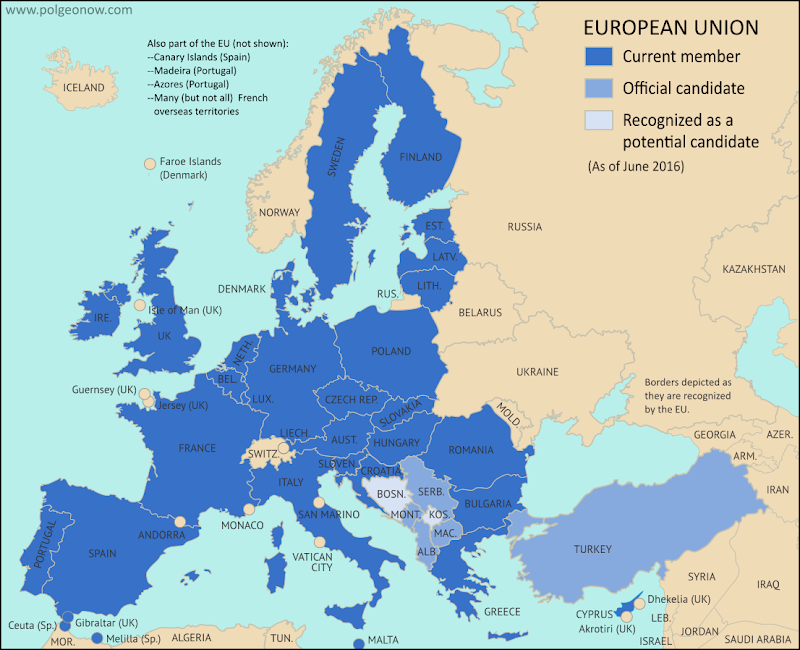
Map: Which Countries are in the European Union, Which Aren’t, and Which Want to Join?

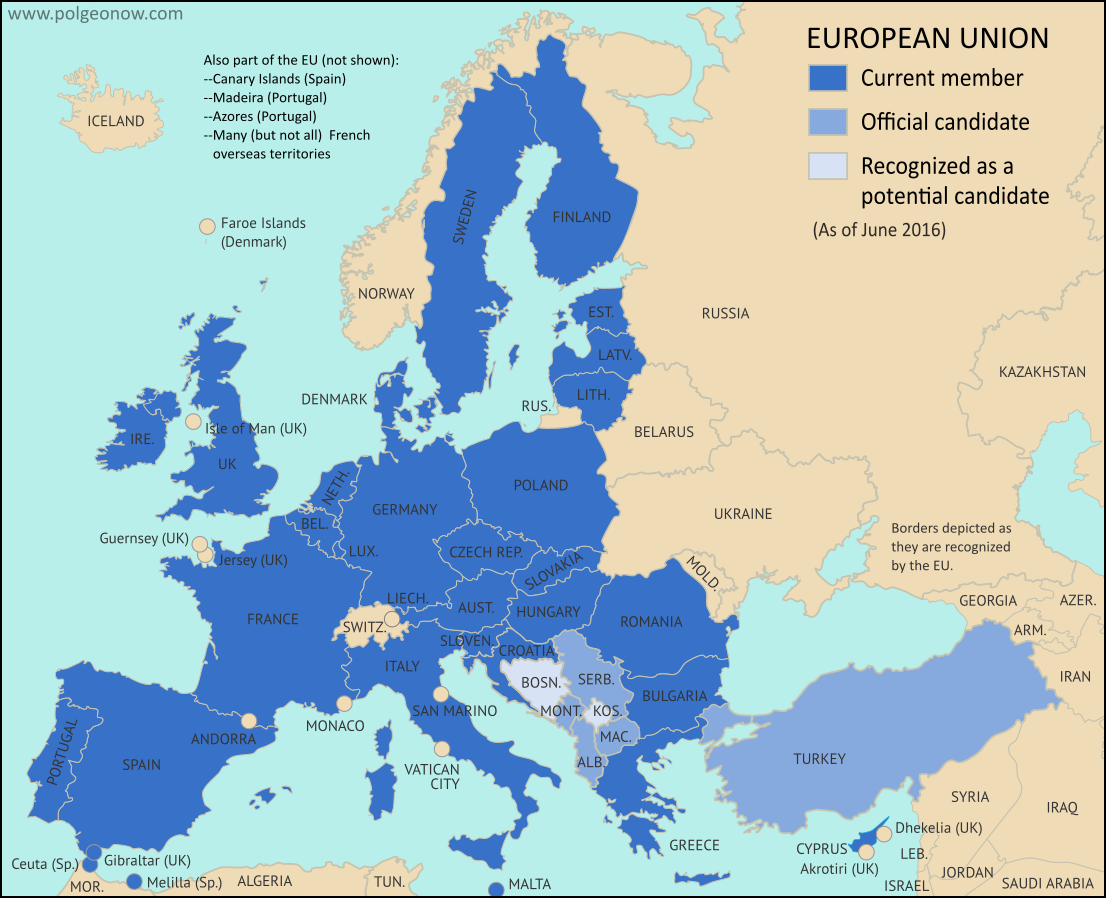
The UK is preparing to quit the European Union (EU) after the 2016 “Brexit” vote. But how much do you know about the EU’s membership roster? Here’s a map and list of which countries are in the EU, which ones are trying to join, and which European countries are in neither group.

Map of the European Union, including all member countries, official candidate countries, and potential candidate countries, as of June 2016 (colorblind accessible).
The UK is still part of the EU for now, since the vote to leave hasn’t been implemented yet.
Map by Evan Centanni, from blank map by Ssolbergj. License: CC BY-SA

(Subscribers click here to view this article in the members area.)

What is the European Union?

Europe’s continental union is probably most famous to outsiders for its euro currency and Schengen free travel area. But it’s actually much more than that. After all, the UK is preparing to leave the EU, but it’s not even in the Schengen Area or euro currency zone anyway!

What unites the countries of the European Union is a set of laws that all members are required to share. Mostly these are laws about things like the economy, trade, natural resources, and immigration (a major sticking point in Britain). Some countries or territories have exemptions from certain laws, but overall, being an EU member means agreeing to follow a set of rules set out by the collaborative union government in Brussels.

The idea is that Europe can do better economically, and better guarantee basic rights and standards of living, if all the countries work together as one. Needless to say, not everyone in Europe agrees this is a good thing (or that it works), and that’s how Britain has ended up headed for the exit. But at the same time, many other countries are still scrambling to join.

Which Countries are in the European Union? (Full List of EU Members)

The European Union currently has 28 member countries. The UK is still a member for now, but is expected to leave in about two years. 

List of  EU Member Countries
 Austria
 Belgium
 Bulgaria
 Croatia
 Cyprus*
 Czech Republic
 Denmark (except the Faroe Islands and Greenland)
 Estonia
 Finland
 France (except some overseas regions and territories)
 Germany
 Greece
 Hungary
 Ireland
 Italy
 Latvia
 Lithuania
 Luxembourg
 Malta
 Netherlands (except Caribbean islands)
 Poland
 Portugal
 Romania
 Slovakia
 Slovenia
 Spain
 Sweden
 United Kingdom (UK)** (not including Jersey, Guernsey, the Isle of Man, or overseas territories except Gibraltar)

*The Republic of Cyprus holds EU membership on behalf of both southern and northern Cyprus, though the north is controlled by the unrecognized breakaway Turkish Republic of Northern Cyprus, where EU law is considered to be “suspended” until the dispute can be resolved. Two British military bases on Cyprus’s southern coast, Akrotiri and Dhekelia, are considered territories of the UK and are not part of the EU. Incidentally, it is arguable whether the whole island of Cyprus is even located in Europe, but it was allowed in on the basis of its shared cultural history (78% of the population is ethnically Greek).

**In June 2016, the UK voted to exit the EU. Though the country has already been excluded from some high-level EU meetings, it has not yet begun the legal process of leaving. Once it does, there will likely be around two years of exit negotiations before it fully separates itself from the union.

Which Countries are in Line to Join the EU?

European Union membership is open any “European” country (a fuzzily-defined concept) that can convince existing members it will meet the standards of EU membership. These include being free and democratic, respecting human rights, and having a “functioning market economy” (basically anything except total economic chaos or communism). New members also have to adopt all the EU’s laws before joining, prepare to efficiently implement new EU laws made after joining, and have the “capacity to cope” with having their economies basically merged with all the other member countries. Normally, they’re also required to plan on adopting the euro as their currency, but not right away after joining. 

List of Official EU Candidate Countries
Joining the EU requires years of negotiation with the existing member countries, and the EU has a list of official candidate countries that are working on it now.

 Albania
 Macedonia
 Montenegro
 Serbia
 Turkey

Turkey applied all the way back in 1987, but is still struggling to get approval from the existing EU members. The other candidate countries are mostly at early stages of membership negotiations, or haven’t even formally started yet. 

List of Potential EU Candidate Countries
The EU also has an official designation for “potential candidates” that haven’t been fully invited to apply yet:

 Bosnia and Herzegovina
 Kosovo

What Other European Countries Aren’t in the EU?

So which countries are left, that aren’t in the European Union and aren’t even applying for membership? There are actually quite a few. Some may hope to apply further in the future, while others have decided not to apply at all. 

List of European Countries That Aren’t EU Members, Candidates, or Potential Candidates
 Andorra
 Belarus
 Moldova
 Iceland*
 Liechtenstein
 Monaco 
 Norway*
 Russia**
 San Marino
 Switzerland*
 Ukraine
 Vatican City 

*Switzerland, Norway, and Iceland have all applied for EU membership in the past, but later suspended or withdrawn their applications

**Russia is located partially in Europe and partially in Asia, but its historical center and the majority of its population are on the European side

List of Arguably European Countries That Aren’t EU Members, Candidates, or Potential Candidates
There are some cases where it’s not clear if a country is in Europe or not. The countries of the Transcaucasia region are sometimes considered culturally European, and sit right along the most commonly-used line between the European and Asian continents (following the divide of the Caucasus Mountains). Meanwhile, Kazakhstan is rarely treated as European, but part of it also lies on the European side of the line (here following the Ural River).

 Armenia (physically on Asian side, but within Transcaucasia)
 Azerbaijan (in Transcaucasia, mostly in Asia with small parts in Europe)
 Georgia (in Transcaucasia, mostly in Asia with small parts in Europe)
 Kazakhstan (mostly in Asia, with a small part in Europe)

These lists exclude several unrecognized or partially recognized breakaway states that the European Union doesn’t even consider to be countries: Northern Cyprus, Transnistria, Abkhazia, South Ossetia, Nagorno-Karabakh, the Donetsk People’s Republic, and the Lugansk People’s Republic

The disputed Republic of Kosovo, claimed by Serbia and only recognized by 56% of the world’s countries, is generally acknowledge as a country by the EU, which is why it was allowed to become a “potential candidate” country.

Who Will Join or Leave Next?

The future is impossible to predict, but you can stay up to date on European Union membership by checking back frequently with Political Geography Now, or by signing up for email updates from the box on the right-hand side of this page! You can also view all European Union articles, or follow PolGeoNow on Twitter for even more news and facts!

Related:
Map of How Britain Voted in the Brexit Referendum
9 Geography Facts You Should Know About the Brexit and Britain’s EU Membership 
Photo Essay: British Territory Gibraltar and the Brexit Referendum

Article by Evan Centanni. Country flags and associated HTML code from Wikipedia (licensed under CC BY-SA).

Which Countries Use the Euro? (Map of the Eurozone)

This Eurozone map and explainer article have been updated to June 2016. You can also view the original version from 2014.

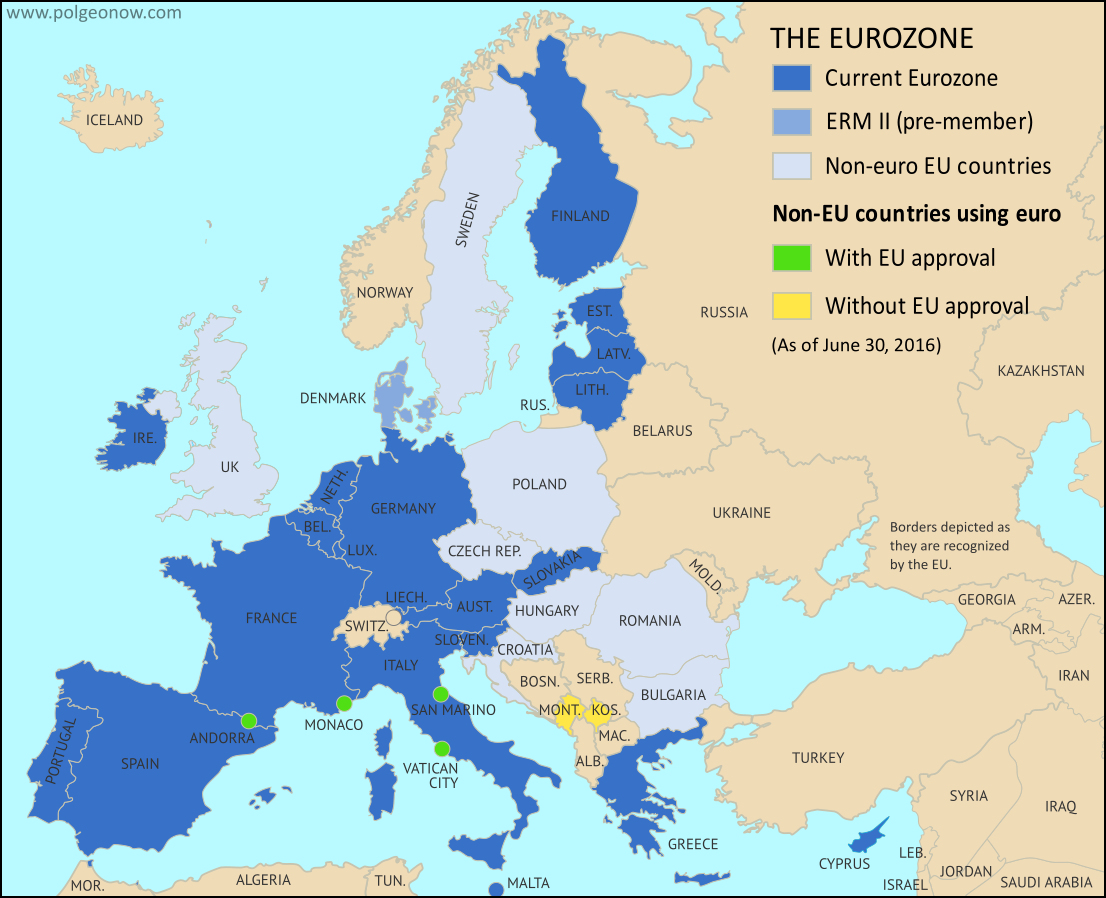
Map of the Eurozone (euro area), showing which countries use the euro as their currency. Includes members, pre-members (ERM II), EU non-members using the euro, and other EU countries (color blind accessible).
The Eurozone, European Union, and other countries using the euro.
Map by Evan Centanni, from blank map by Ssolbergj. License: CC BY-SA

(Subscribers click here to view this article in the members area.)

Article by Caleb Centanni, with additional content by Evan Centanni 

What is the Eurozone?
Officially called the “euro area”, the Eurozone is a nickname for the group of countries in Europe that share a single currency, called the euro. The euro currency is administered by the European Union (EU), but many countries in the EU don’t use the euro, and some countries outside the EU do use it. The European Central Bank, the governing financial body of the Eurozone, is headquartered in Frankfurt, Germany. Germany, along with eleven other EU countries, became a founding member of the Eurozone in 1999.

Since then, eight more members have joined after meeting the five necessary economic criteria. This has brought the total to nineteen members, including all but nine of the 28 European Union member countries.

Which EU Countries Don’t Use the Euro?

Map of the European Union (EU) and prospective member countries in 2016 (color blind accessible)
The EU and prospective members

One country, Denmark, is part of the European Exchange Rate Mechanism (ERM II), which ties members’ currency to the euro and is a necessary step for joining the Eurozone. However, Denmark is allowed to opt out of adopting the euro, despite its ERM II membership. All members of the European Union were required by the Maastricht Treaty of 1992 to change to the euro after meeting the criteria. However, both Denmark and the UK negotiated exceptions to the requirement later in that year. Seven other EU members are still required to adopt the euro in the future.

Which Non-EU Countries Do Use the Euro?

There are four tiny countries outside the EU – Andorra, Monaco, San Marino, and Vatican City – that have monetary agreements allowing them to use the euro as their official currency. Meanwhile, two other EU non-members, Montenegro and the disputed Republic of Kosovo, have unilaterally adopted the euro without coming to any agreement with the Central Bank. The EU has expressed its dissatisfaction with these unilateral adoptions, but the currency’s use in the two countries has gone forward anyway.

What Next for the Eurozone?
Many countries sought Eurozone membership at the beginning of the financial crisis in 2008, but most became less interested after the euro was hit by its own crisis in 2009. Meanwhile, Danish polls suggest the country is unlikely to support moving to the new currency any time soon. However, all EU members except Denmark and the UK are legally required to eventually adopt the currency.

You can stay up to date on Eurozone membership by bookmarking this article (which will be updated if anything changes), or by checking Political Geography Now for new articles about countries joining or leaving the Eurozone. You can also sign up for email updates from the box on the right-hand side of this page, or follow PolGeoNow on Twitter for even more news and facts!

Articles using versions of this map:
Lithuania Joins the Eurozone (2015)
Latvia Joins the Eurozone (2014)
 

UK Votes to Quit EU: Map of How Britain Voted in the Brexit Referendum

(Subscribers click here to view this article in the members area.)

By Evan Centanni

UK Brexit vote map: Map of election results in Britain's June 2016 referendum on leaving the European Union (EU). Continuous red-to-blue color scheme gives a more honest depiction of the similarities between different election districts. Colorblind accessible.
Map of election results in the UK’s “Brexit” referendum. Modified by Evan Centanni from Wikimedia map by Mirrorme22, Nilfanion, TUBS, and Sting (CC BY-SA).

UK Votes to Quit EU
The results are in for yesterday’s referendum on UK membership in the European Union, and the winner is “Leave”. Brits voted by a margin of 52% to 48% in favor of exiting the European Union, making a “Brexit” (British exit from the EU) more or less guaranteed in the coming years. Britain will become the first member country ever to leave the EU, and the British overseas territory of Gibraltar is expected to get pulled out with it.

Learn More: Brexit: 9 Geography Facts You Should Know About the Referendum and Britain’s EU Membership

Who Voted to Stay
Voter tendencies varied a lot from place to place. Support for the “Remain” side was strong across Scotland, culturally Irish parts of Northern Ireland, the London area, and a handful of other cities in England (led by Cambridge, Oxford, and Brighton).

By far the greatest show of support for Remain was a win by 96% in Gibraltar – which isn’t even in the UK proper, but got to vote because of its unique status as a British external territory that’s in the EU.

Photo Essay: Gibraltar and the Brexit Referendum

Gold: Districts with over 50% for Remain
Blue: Districts with over 50% for Leave
Map from Wikimedia Commons (click for more info)

Who Voted to Leave
The “Leave” vote, on the other hand, was strongest in eastern England, with substantial support from all across England, Wales, and the most ethnically British parts of Northern Ireland. The vast majority of the UK’s population lives in England, and this was enough to carry the referendum.

The district with the highest support for Leave was Boston, England, where 76% of voters favored leaving the EU

England, Wales, Scotland, and Northern Ireland
Taking the UK’s “constituent countries” as wholes, England and Wales each voted 53% for Leave vs. 47% for Remain, while Scotland supported Remain by 62% to 38%, and Northern Ireland supported Remain by 56% to 44%.

Scotland was the most consistently supportive of Remain, with every district at least 50% in favor of staying in the EU. England, Wales, and Northern Ireland all had some districts that went each way, though Northern Ireland was probably the most geographically divided, with 7 districts favoring Leave, and 11 favoring Remain.

Brexit: 9 Geography Facts You Should Know About the Referendum and Britain’s EU Membership

(Subscribers click here to view this article in the members area.)

By Evan Centanni 

The European Union. Click for full map and list of members.

Today the UK is voting on whether to leave the European Union. If you’ve been paying attention to the news, you’ve probably heard about the intense debate over whether Brits should vote “Leave” or “Remain”. But if you’re like me and mainly in this for the geography trivia, here are some fun facts you might not know about the so-called “Brexit”:

1. The UK has been a member of the EU since before there was an EU

The European Economic Community (EEC), founded in 1957 for economic cooperation between democracies in Western Europe, was the predecessor of today’s European Union. The UK wasn’t a founding member of the EEC, but joined in the organization’s first wave of expansion in 1973, along with Ireland and Denmark (plus the British territory of Gibraltar and the Danish territory of Greenland). This made the UK automatically a member when the EEC and related organizations were relaunched as the more ambitious European Union in 1993.

2. Long before the UK wanted to leave the EU, France didn’t want to let it in

The UK chose not to join the European Economic Community (EEC) in 1957, but changed its mind and applied for membership a few years later. But its first two attempts to join, in 1963 and 1967, were vetoed by French President Charles de Gaulle. De Gaulle thought the UK was too different from mainland Europe, and that allowing it into the organization could only slow down the other countries’ progress. Then, just like now, leaders of Britain’s three major political parties favored membership, while British “anti-European campaigners” wanted no part of it. Still, the EEC’s other five members – Belgium, the Netherlands, Luxembourg, Italy, and West Germany – favored the UK to join, and after De Gaulle lost power in 1969, France conceded the point.

3. The UK would be the first member country ever to leave the European Union

Ever since the EEC was formed in 1957, all the way through the inauguration of the EU and up to today, no member country has ever left the organization. If Britain votes today to leave, it will be the first. But there are three territories that have historically quit the EEC/EU: (1) Algeria, considered part of France until its independence in 1962; (2) Greenland, a Danish territory, which negotiated an exit in 1985; and (3) Saint Barthélemy, a French island in the Caribbean, which opted out in 2012 after splitting with fellow French territory Guadeloupe. Since these three territories were only part of the EU through connections to their parent countries, the organization never actually lost any members.

4. Until 2009, it was arguably illegal for a member country to leave the EU

Overseas territories can more or less leave the EU at will, as long as their parent countries consent. But for member countries themselves – like the UK – the original EEC and EU charters didn’t provide a clear path for exiting the organization. For decades, it was up for debate whether countries had an unwritten right to withdrawal, or whether the treaties binding member countries to the EU were legally permanent. This could have made it a long and bitter legal battle if the UK had tried to quit Europe in earlier decades. But since 2009, with a new treaty revising the basic EU rules, member countries have a guaranteed option to negotiate an exit from the organization (though that treaty was nearly vetoed by voters in Ireland).

5. Many citizens of other countries can vote in the Brexit referendum

The UK and lots of other countries that used to be part of the British Empire (plus a couple that weren’t) are now part of an organization called the Commonwealth of Nations. There about a million voting-age citizens of other Commonwealth countries (such as Australia, India, Canada, or Nigeria) living in Britain now, and British law allows them to vote there as well. But citizens of other Commonwealth countries are only allowed to vote in the referendum if they currently live in the UK.

6. Citizens of other EU countries don’t get a vote – unless they’re from Ireland, Malta, or Cyprus

Citizens of all EU countries also have the right to live in Britain, as part of EU law. But they don’t get to vote in the EU referendum, even if they live in the UK. That is, not unless they’re from Malta, Cyprus, or Ireland. Maltese and Cypriot citizens living in the UK can vote because their countries are also part of the Commonwealth (see above). Ireland left the Commonwealth in 1949, but Northern Ireland is still part of the UK, and a special treaty gives all Irish citizens the right to vote in the referendum if they live in Northern Ireland or Great Britain (British citizens can also vote in Ireland if they move there).

7. Most residents of British overseas territories can’t vote either (except Gibraltar)

The UK still has quite a few overseas territories left over from its colonial days – mostly small islands scattered across the world’s seas. Together, they have a population of about a quarter million people, most of whom are now British citizens. But just being a UK citizen isn’t enough for you to vote in the Brexit referendum – even citizens from England aren’t eligible if they’ve been outside the UK for more than 15 years (and overseas territories aren’t technically part of the UK, even though they legally belong to it). The one exception is Gibraltar, a British territory in southern Europe, whose people have been specially granted the vote as residents of the only British overseas territory that’s inside the EU.

(Photo Essay: Gibraltar and the Brexit Referendum)

The Channel Islands and the Isle of Man, whose special status as “crown dependencies” makes them more like younger siblings of the UK than territorial possessions, aren’t part of the EU, and residents only get to vote if they’ve lived in Britain in the last 15 years.

8. The referendum isn’t technically the last word on whether Britain leaves the EU

When UK citizens go to the polls today, they’re joining in a public consultation on whether their country should quit the European Union. But even if they vote “Leave”, the UK can’t actually exit until its legislature, the Parliament, separately votes to repeal the EU treaty laws. The referendum isn’t actually legally binding, so members of parliament could vote against the will of the people if they wanted. But as BBC says, that would be considered “political suicide“, and probably wouldn’t happen – unless the parliament decides to have early elections, and legislators get replaced by new members campaigning on an anti-Brexit platform. But that’s pretty unlikely too, since two-thirds of the current parliament would have to vote to put themselves up early for re-election.

9. Even if the people vote “Leave”, it will be a long time before Britain actually leaves the EU

Though EU member countries do now have the right to leave the organization, they’re expected to negotiate with the rest of the EU over the details. The 2009 Treaty of Lisbon sets a time limit of two years, after which the exiting country doesn’t have to put up with any more, and can leave whether it’s reached an agreement or not. But many observers think the negotiations would take even more than two years, with the British government agreeing to extend the deadline to avoid a bad arrangement. So even if “Leave” takes the day, the UK will likely be part of the EU for some years to come.

Stay tuned to PolGeoNow for more on the geography of the Brexit referendum!

Learn More: 
Which Countries Are in the EU, Which Aren’t, and Which Want to Join?
What’s the difference between the EU and Europe’s Schengen free travel area?
Which countries use the euro currency? (Hint: Many EU members don’t!)

On the Ground: Gibraltar and the “Brexit” Referendum

This is the first installment of PolGeoNow’s On the Ground, a new series of exclusive photo essays on what political geography looks like in the real world. Whether it’s borders, nationalism, or other geopolitical phenomena, we’ll bring the on-the-ground situations to your screen in vivid detail.

Update 2016-06-24: Gibraltar on Thursday voted in favor of the UK staying in the European Union, by an incredible margin of  96% to 4%. However, the UK as a whole voted to leave the EU, meaning that Gibraltar can expect to get pulled out with it, against the wishes of the Gibraltarians.
 

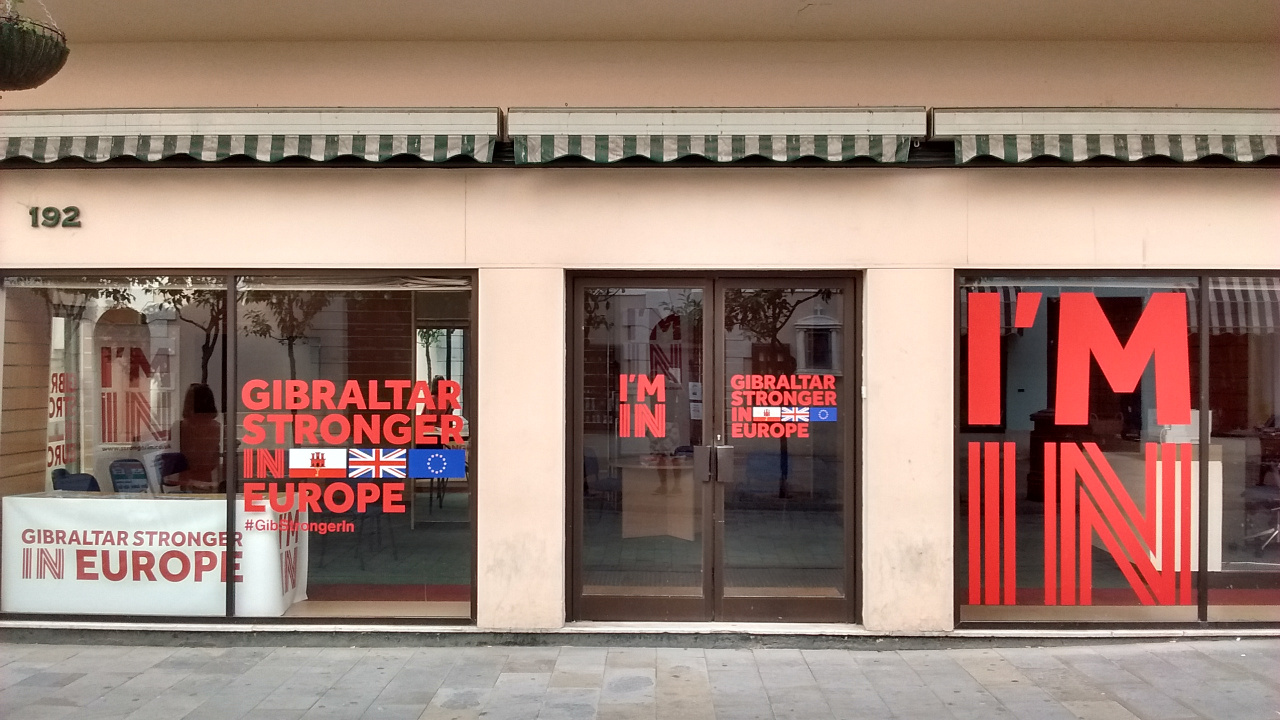
Photo of the Gibraltar Stronger in Europe campaign office on the British territory's main street. Gibraltar's population is overwhelmingly against a so-called Brexit, or departure of the UK from the European Union.

Subscribers click here to view this article in the ad-free members area. Not a member yet? Learn about PolGeoNow subscriptions!

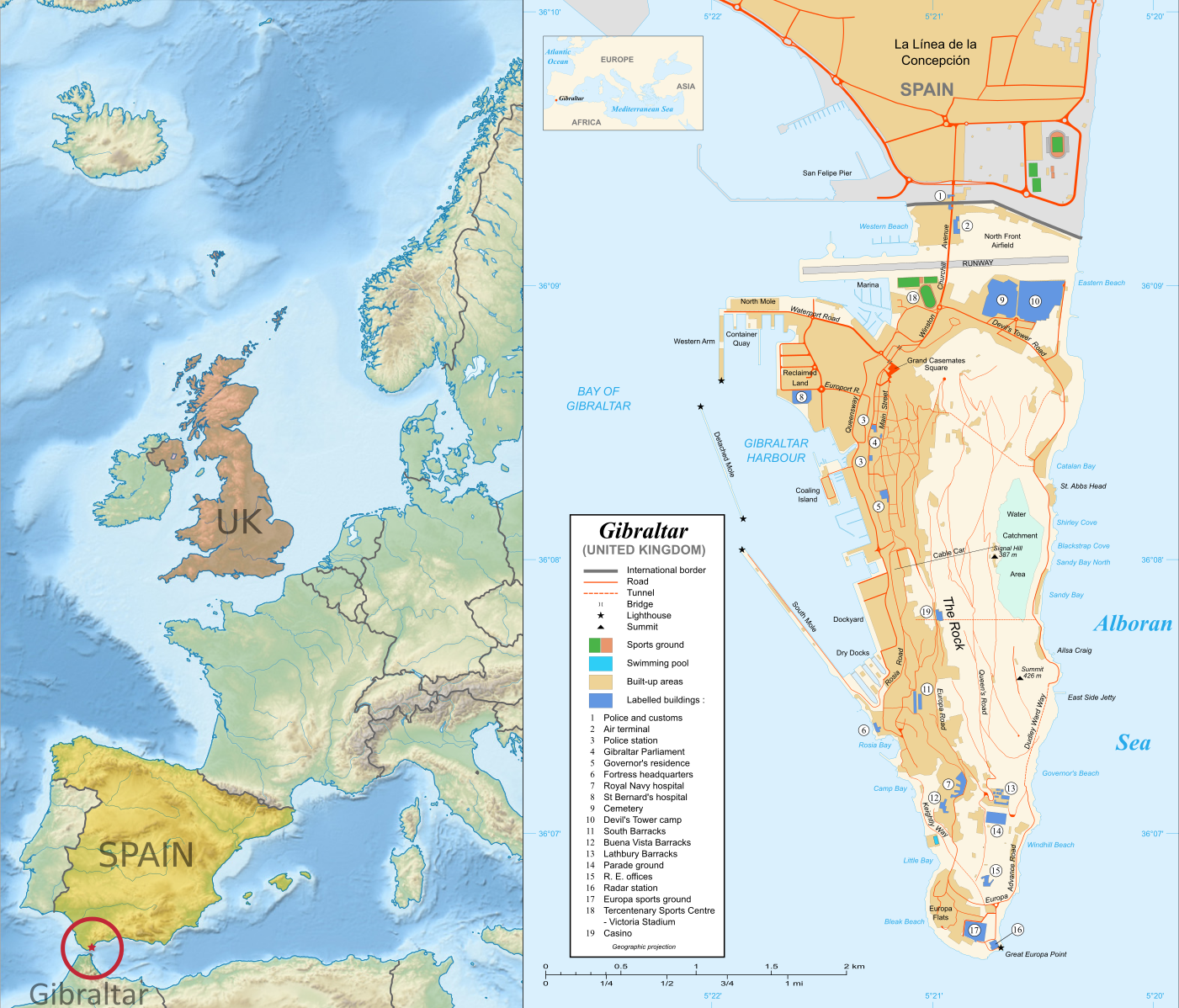
Map of Gibraltar and its location in Europe relative to the UK and Spain
Right: Map of Gibraltar by Eric Gaba (source; CC BY-SA)
Left: Gibraltar’s location in Europe (based on this Wikimedia Commons map by TUBS; CC BY-SA)

Gibraltar prepares to vote on whether UK should leave European Union
Last month, PolGeoNow’s Evan Centanni and Meihsing Kuo visited the small British territory of Gibraltar (pronounced “jih-BRALL-ter”), one month ahead of the UK’s referendum on whether to leave or remain in the European Union (EU).

Gibraltar, a tiny peninsula connected to Spain – and claimed by the Spanish government – is the only British overseas territory that’s part of the EU. It’s also the only external territory whose residents are eligible to vote in the so-called “Brexit” referendum without living in the UK proper. (“Brexit” is an abbreviation for “British exit” from the EU.)

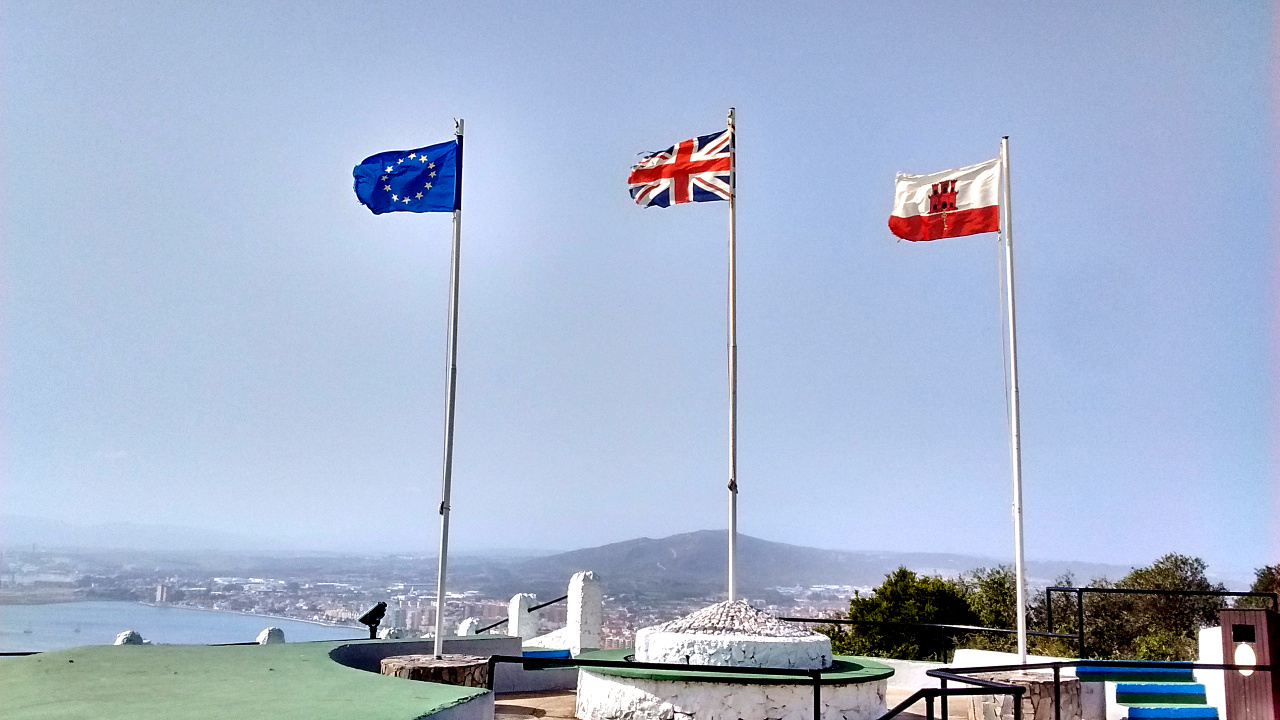
Photo of the European Union (EU), United Kingdom (UK), and Gibraltar flags flying side by side. Gibraltar is the only British territory that's also part of the EU.
Gibraltar flies the European Union flag (left), the flag of the United Kingdom (middle), and its own flag (right)

Gibraltar is a short walk from the Spanish town of La Línea, whose name means “the line” in Spanish – a reference to the line of fortifications Spain built along the border in the 18th Century, when it was still trying to capture the peninsula from Britain by force. (The town’s full name is La Línea de la Concepción, a reference the doctrine of the Immaculate Conception, a central tenet of the Spanish forces’ Roman Catholic religion. Incidentally, most Gibraltarians are also Catholic.)

Because Gibraltar and Spain are both part of the EU, residents of both are free to live or work in the other. Thousands of people live in Spain, where food and rent are cheaper, and commute to work in Gibraltar, where wages and employment are higher. Gibraltar residents also rely on the semi-open border for access to affordable goods from Spain. But that could all come grinding to a halt if the UK decides to leave the union.

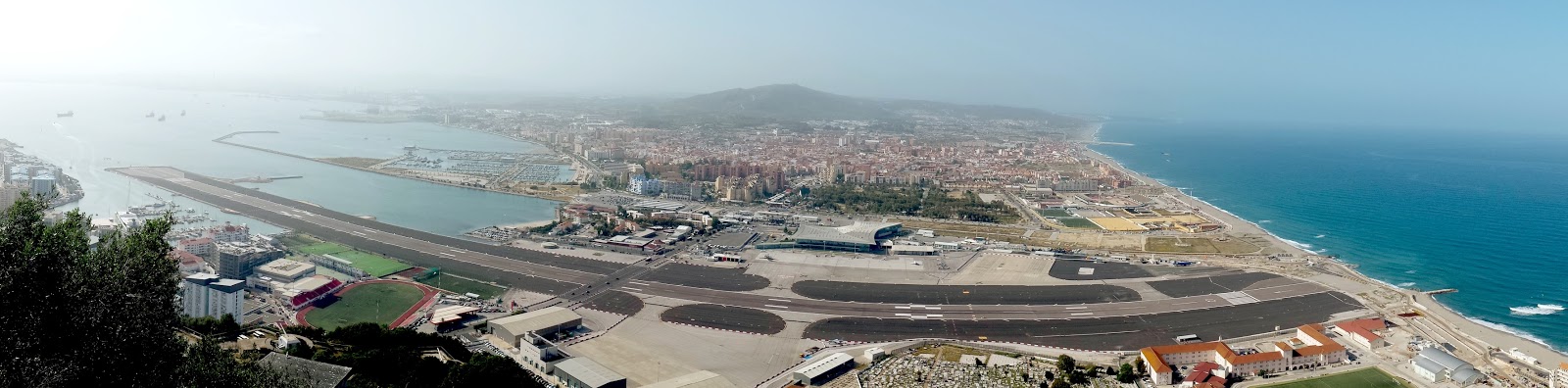
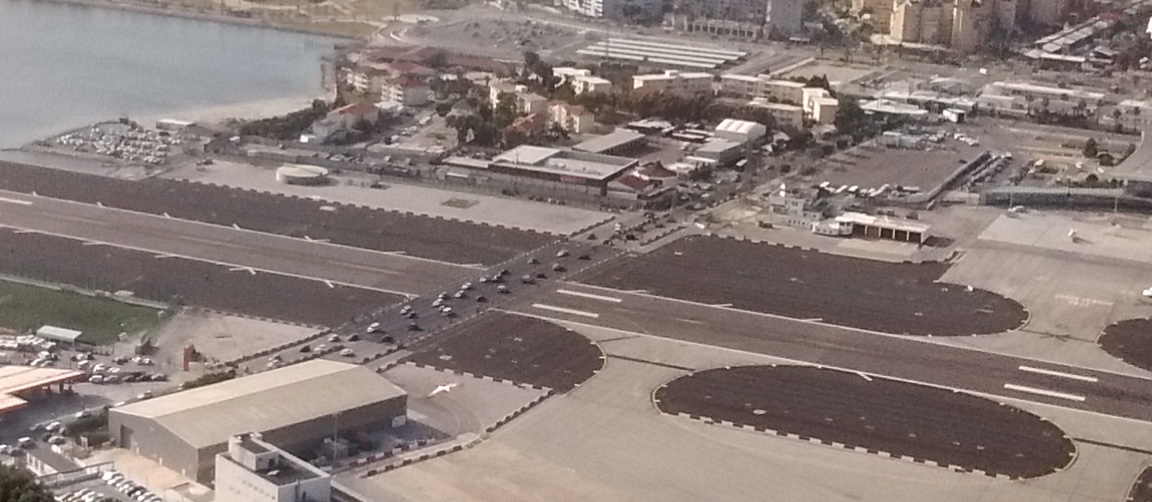
Aerial-style photo of the entire border between La Linea de la Concepcion, Spain, and the British territory of Gibraltar, as seen from atop the Rock of Gibraltar. At front and center is the Gibraltar Airport and runway.
The entire border of Spain (background) and Gibraltar (foreground), as seen from the Rock of Gibraltar. The border runs approximately along the far edge of the airport facilities. Click to see the picture at full size. (Photo by Meihsing Kuo)

Gibraltar is a special EU territory that’s outside the Customs Union and the Schengen Area, so there are still passport and customs checks at the border (though they seemed pretty lax to us). But in pre-EU days, Spain closed the border altogether as a way of protesting British control of the peninsula.

Photo of the border crossing facility between La Linea de la Concepcion, Spain, and the British territory of Gibraltar, including everyday vehicle and foot traffic.
Crossing the border from Spain into Gibraltar. In the background is the Rock of Gibraltar.

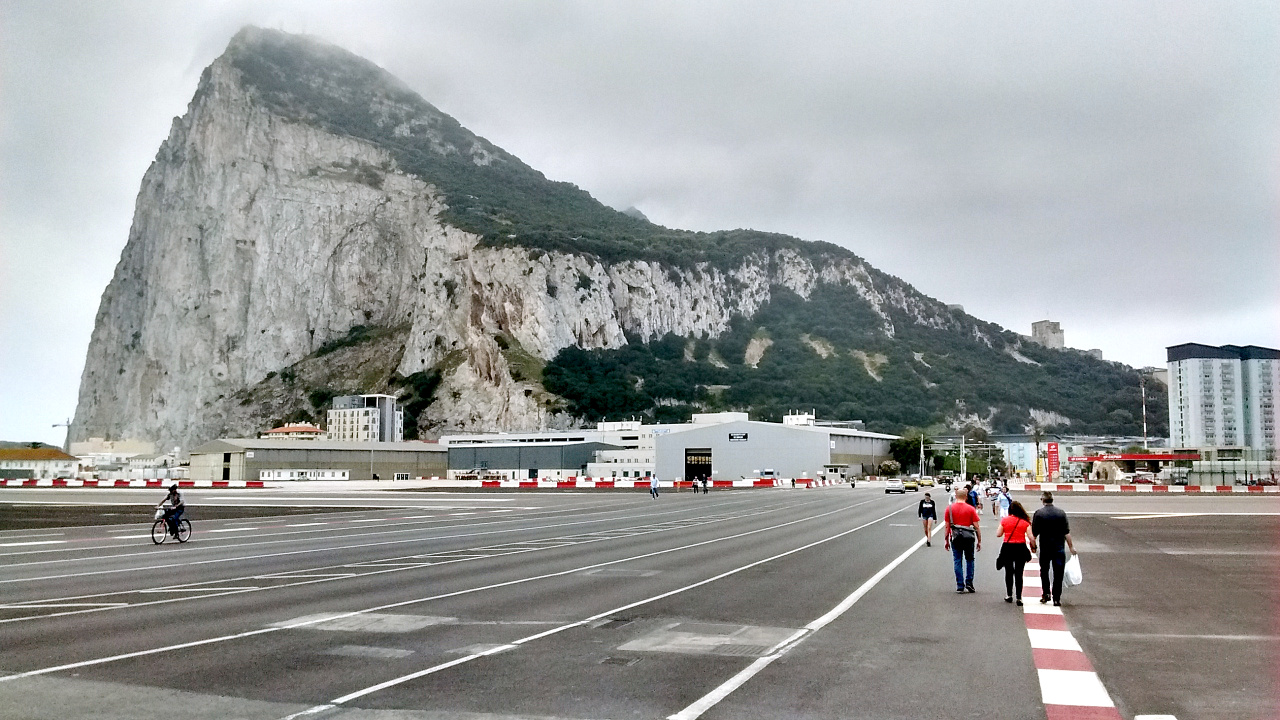
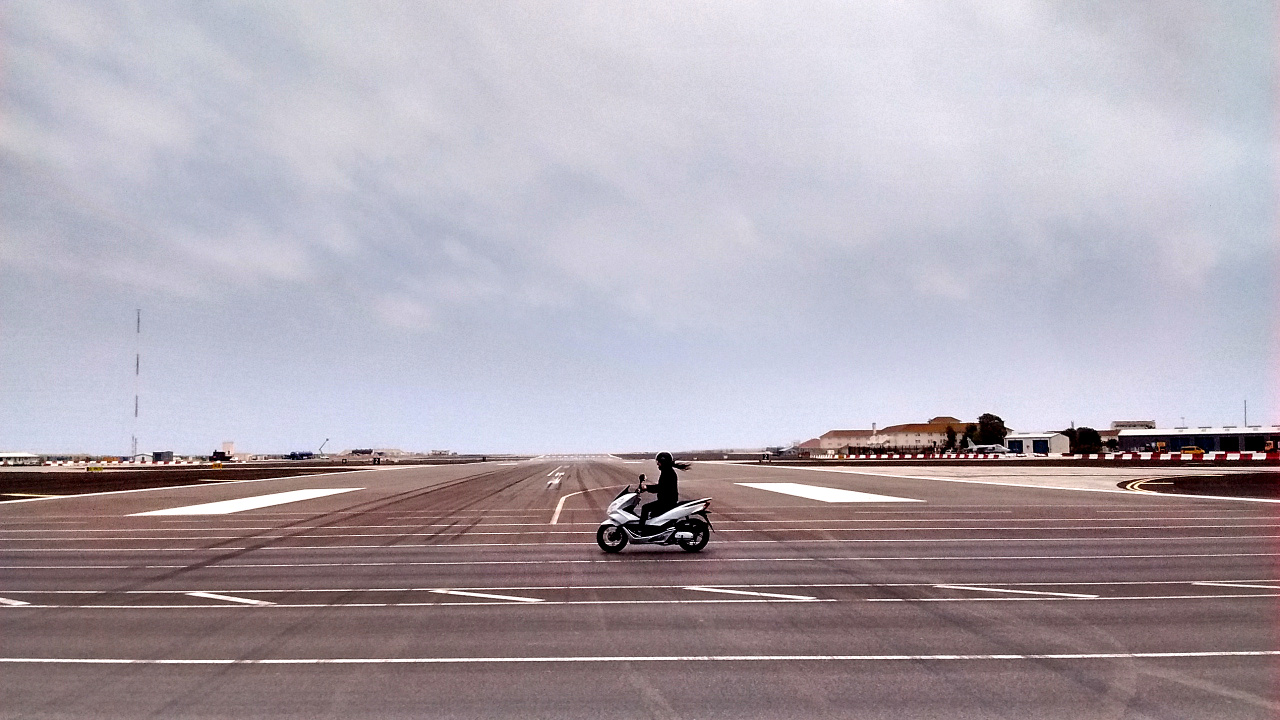
As a funny side-effect of Gibraltar’s position on a tiny peninsula, all traffic across the border has to cross the runway of the Gibraltar airport. There are only five or ten airplane takeoffs and landings each day, but each time there is one, cars and pedestrians have to wait for it to finish before they can go from Spain to Gibraltar or back. A planned traffic bypass is years overdue.

Photo of an airplane landing at the Gibraltar airport, crossing the only road that passes between Spain and the British colony, and temporarily stopping all cross-border traffic.

Photo of cars and other traffic crossing the runway of the Gibraltar airport after having waited for a plane to land. The road crossing the runway is the only land route in or out of the British territory which borders Spain.

Photo of pedestrians and a cyclist crossing the runway of the Gibraltar airport. The road crossing the runway is the only land route in or out of the British territory which borders Spain.

Photo of a motorcycle crossing the runway of the Gibraltar airport. The road crossing the runway is the only land route in or out of the British territory which borders Spain.

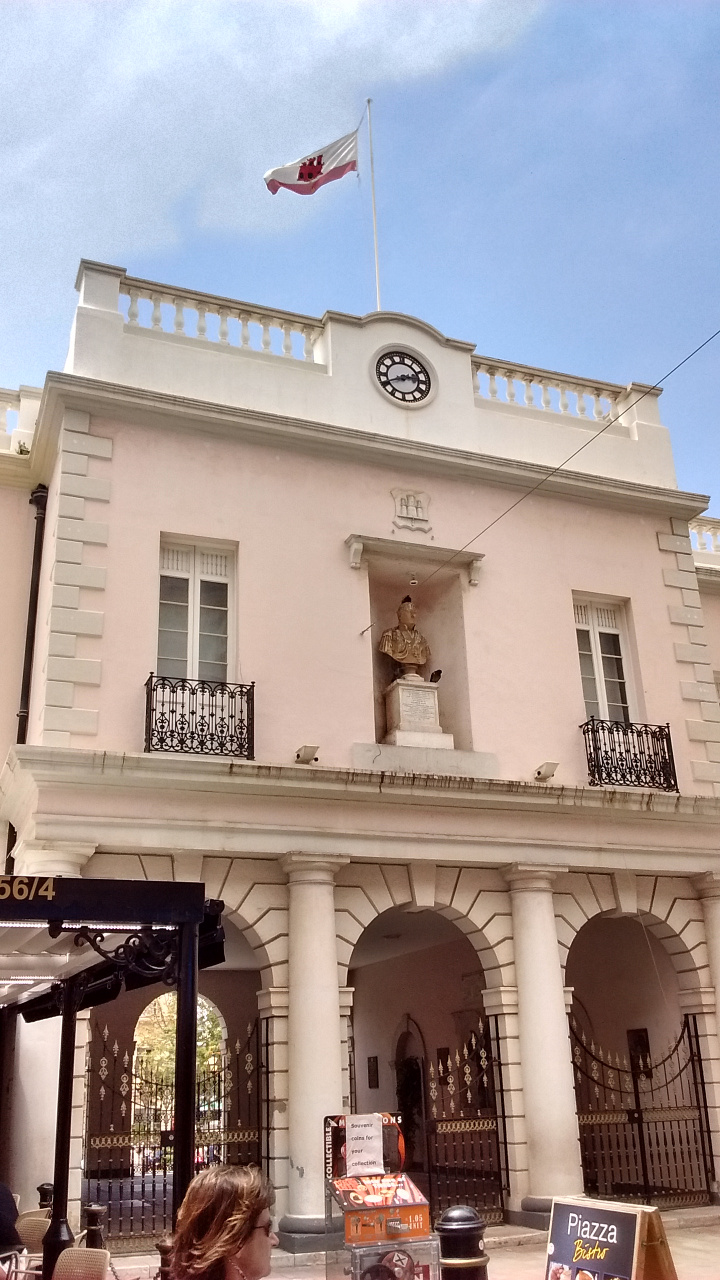
Photo of the Gibraltar Parliament building, headquarters of self-government in the highly-autonomous British territory.
The Gibraltar Parliament building

Unlike British colonies of the past, Gibraltar is almost completely self-governed by its own elected parliament. For internal matters, the Gibraltar parliament doesn’t even legally answer to the British parliament in Westminster. But although Gibraltar’s not considered part of the UK, its land officially belongs to the UK, and it can’t have its own military or international relations. That means if the UK cuts ties with the EU, Gibraltar is along for the ride.

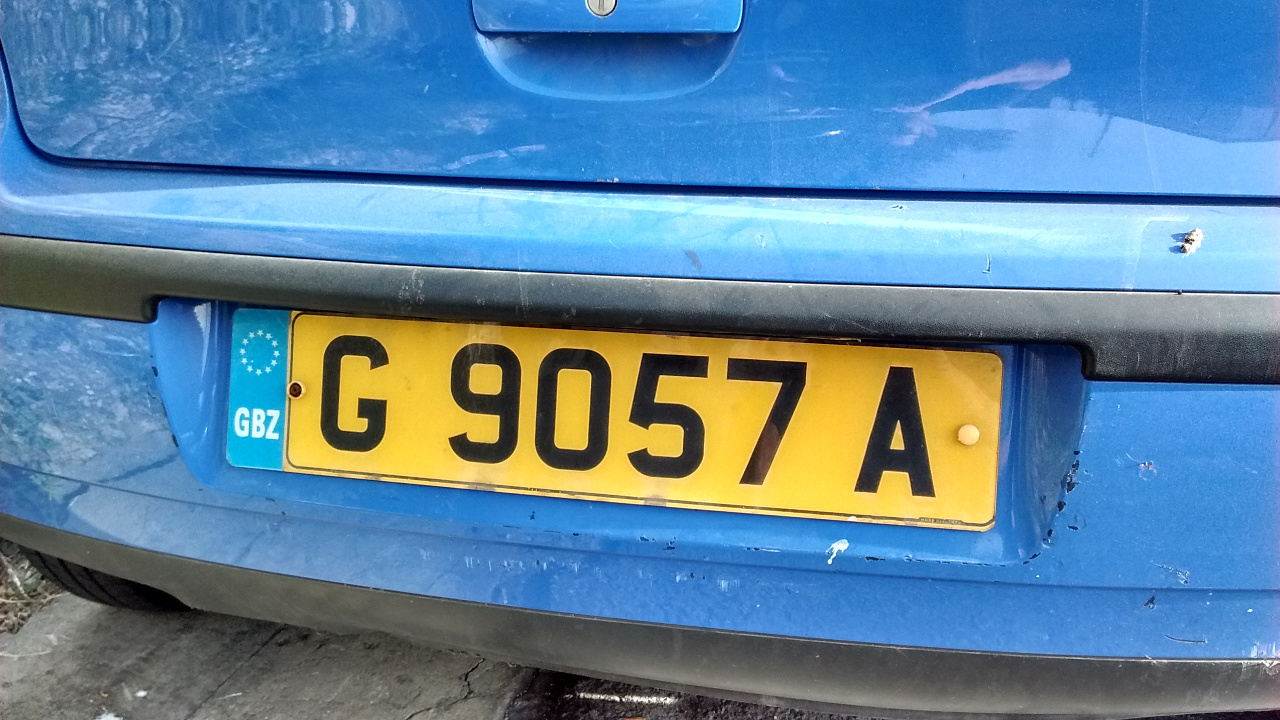
Photo of a yellow vehicle registration plate (license plate) in Gibraltar, showing the pan-European plate design and GBZ country code designation.
Gibraltar vehicle plates have their own country code – GBZ.

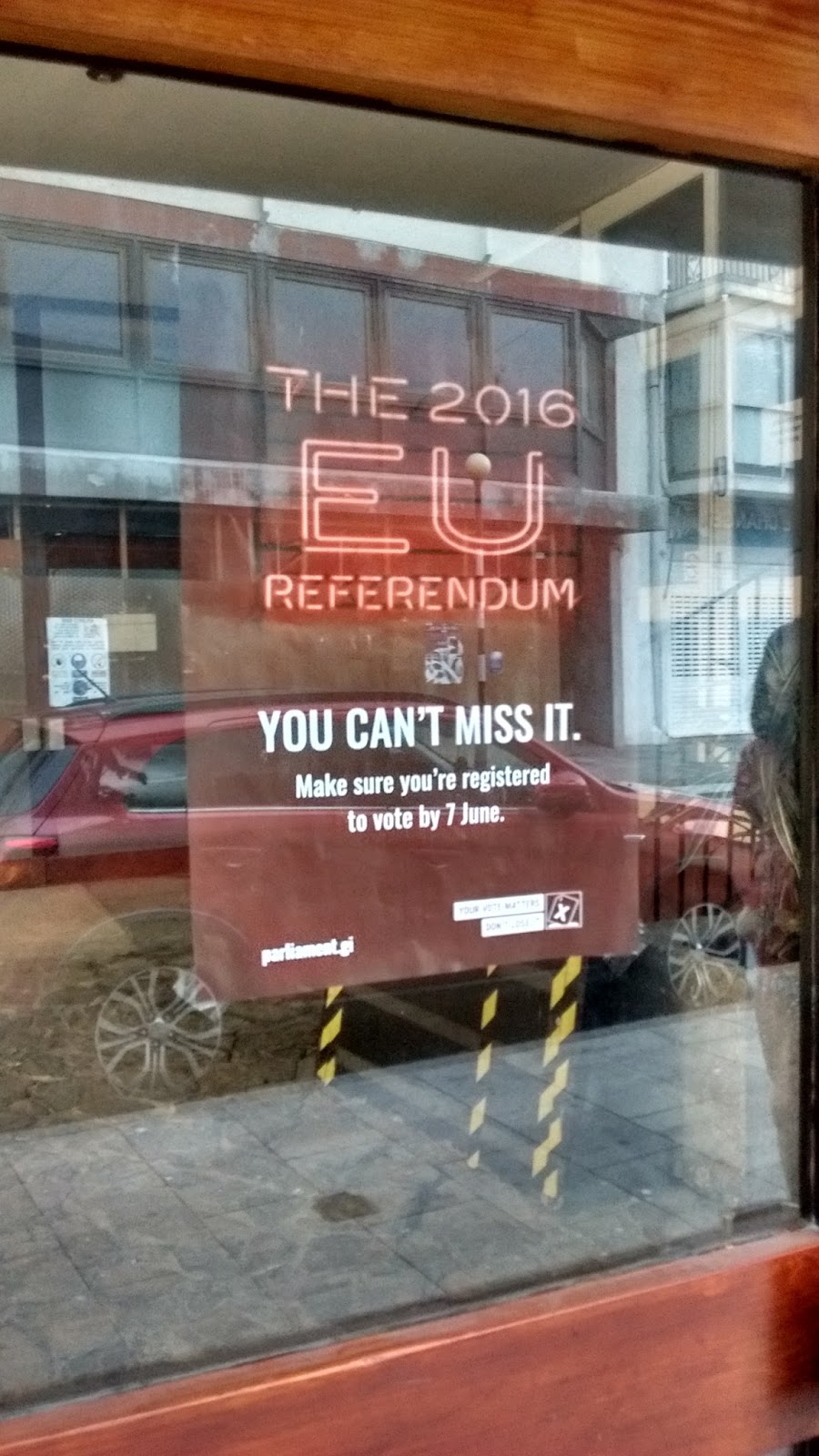
Photo of a bring-out-the-vote poster in a window in Gibraltar, posted by the territorial government to remind residents to vote in the upcoming Brexit referendum on whether Britain should leave the European Union (EU)
Gibraltar government promoting voter turnout in the “Brexit” referendum

Gibraltarians are able to vote in EU elections through a special arrangement that treats them as constituents of southwestern England, and the same arrangement will allow them to vote in the “Brexit” referendum. Though the territory’s 23,000 registered voters are just a drop in the bucket compared to the 45 million or so in the UK, this referendum might come right down to the wire, so it’s not out of the question that they could make a difference.

In any case, Gibraltarians want to be heard, even if only as justification to demand help from the UK if they do get pulled out of the EU. Because of the Gibraltar’s heavy dependence on the border, all three of the territory’s political parties are campaigning for the UK to remain in the union. And what about regular voters? A local newspaper poll found that 88% of people who planned to vote supported staying in the EU.

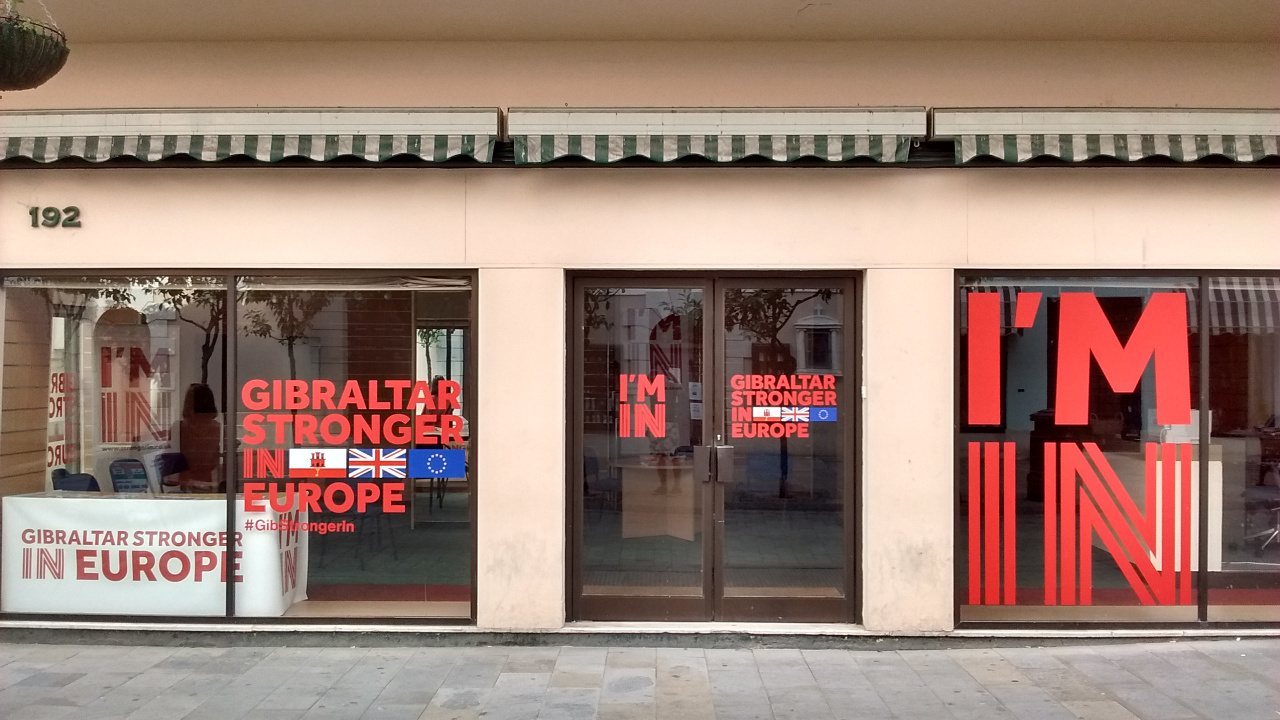
Photo of the Gibraltar Stronger in Europe campaign office on the British territory's main street. Gibraltar's population is overwhelmingly against a so-called Brexit, or departure of the UK from the European Union.
The Gibraltar chapter of Britain’s anti-Brexit “Stronger In” campaign has a prominent office on the town’s main street.

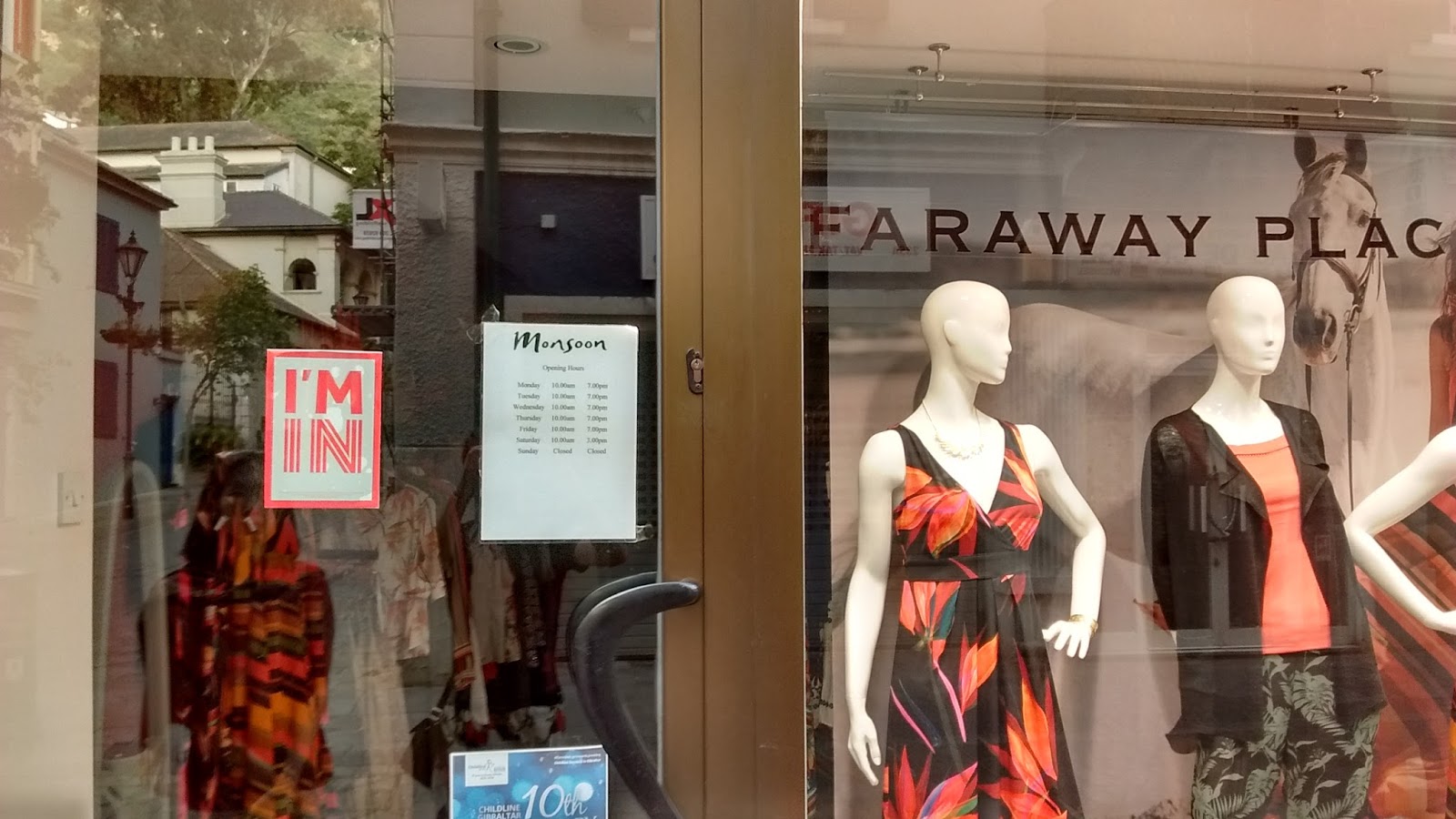
Photo of a shop window in Gibraltar, prominently displaying a sticker that reads I'm In, indicating that the business supports voting for the UK to remain in the European Union (EU) in the upcoming Brexit referendum.
Continued EU membership is uncontroversial in Gibraltar. “I’m In” stickers show many local businesses’ open support of the campaign to vote against leaving the EU.

It’s hard to say exactly what will happen to Gibraltar if the UK does choose to quit the European Union – and that uncertainty is part of what most Gibraltarians are trying to avoid. For now Gibraltar seems content to be a British territory: residents have already twice voted against joining Spain. But if they feel betrayed and abandoned by a UK that wants no part in the EU, could demands for greater autonomy or even independence be around the corner? Only time will tell.

Photos and text by Evan Centanni, except where specified otherwise. All rights reserved.

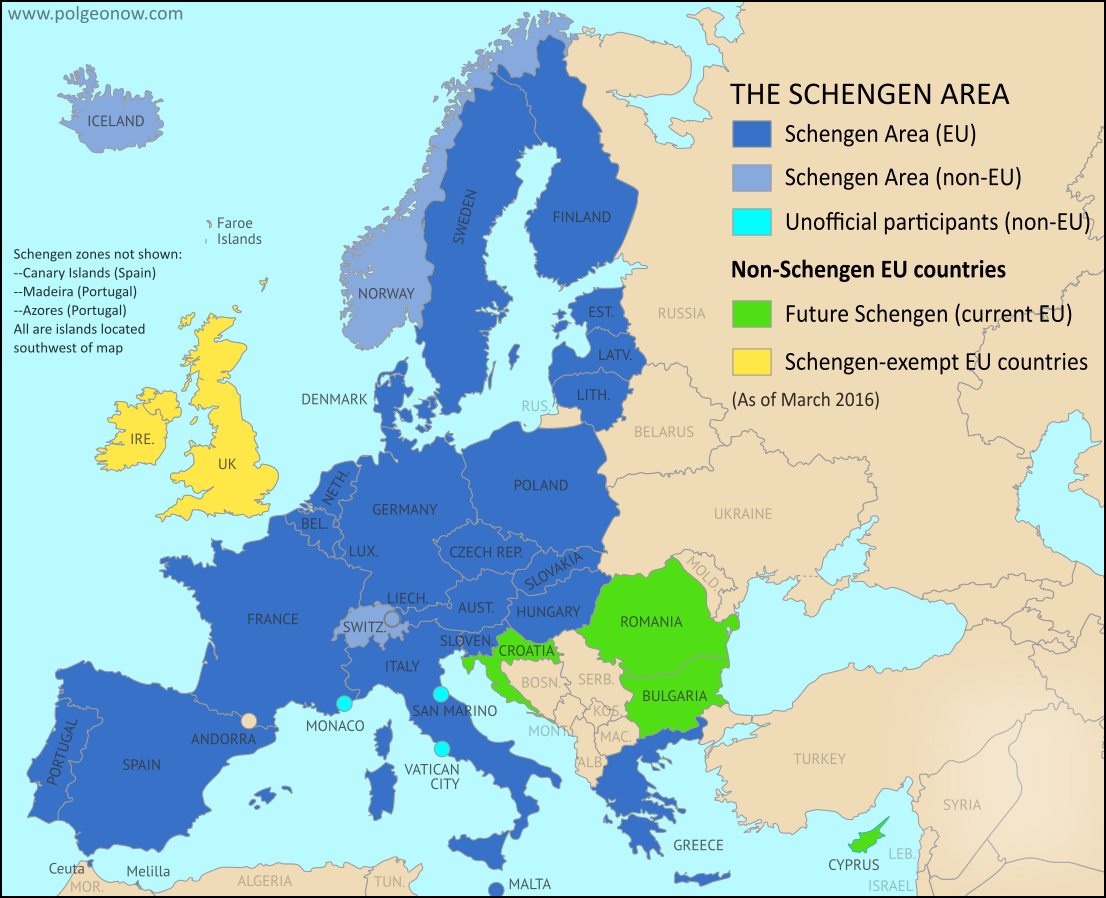
Map of the Schengen Area, Europe’s Border-free Travel Zone

The European Union’s Schengen free-travel zone is in danger of falling apart: In the companion to this article, we map which Schengen borders have had ID checks reintroduced to regulate the movement of refugees.

But what exactly is the Schengen Area? What’s the difference between Schengen and the EU? And which countries does Schengen include? Read on for all the answers, explained in plain English!

Map of the Schengen Area (the European Union's border-free travel zone), color-coded for EU Schengen countries, non-EU Schengen countries, future Schengen countries, and Schengen-exempt EU countries, as well as microstates unofficially participating in the Schengen agreements (colorblind accessible).
Map by Evan Centanni, from blank map by Ssolbergj. License: CC BY-SA

Subscribers click here to view this article in the ad-free members area. Not a member yet? Learn about PolGeoNow subscriptions!

Article by Evan Centanni

What is the Schengen Area?

If you’ve traveled in Europe anytime in the last 20 years, you probably know that many of Europe’s countries have open borders, without any kind of customs or ID check required to cross from one country to another. This is because of the Schengen Agreement, a 1985 treaty that has since been expanded and made into a law of the European Union (EU).

The combined area of all the participating countries is known as the “Schengen Area”, and is now a core part of the EU system. For the purposes of most travelers, the Schengen Area might as well be just one country: not only have border checks been mostly eliminated (until recently), but a visa to any Schengen country is also good for travel to all of them.

Each of the Schengen countries is small compared to the world’s largest countries, like the US and China. But in total, the Schengen Area has more people than US, and a land area about half as big as the US or China.

Map of the European Union (EU) and prospective member countries
The full EU and prospective members

Schengen Area vs. European Union: What’s the Difference?

Although the Schengen Area and the EU are closely connected, they’re not the same thing. Some countries are part of the EU, but not the Schengen Area, while others are part of the Schengen Area, but not the EU.

The most important difference is that the EU is much more than just the Schengen Area: it’s also an economic union, with unified customs and tax laws and its own currency, as well as a political union with an elected government that manages shared laws and foreign policy for all the member countries.

Learn More: Map of the Eurozone (countries that use the EU’s euro currency)

The Schengen Agreement was originally a treaty completely separate from EU law, but is now operated and regulated by the EU government. (Awkwardly, the non-EU Schengen countries now have barely any say over the rules and administration of the area, though they’re welcome to leave any time).

Which Countries are in the Schengen Area? (List of Schengen Countries)

There are 26 official Schengen countries, all of them in Europe. The only parts of the Schengen Area outside of Europe are: (1) the Canary Islands, a part of Spain off the coast of West Africa; (2) Madeira a part of Portugal also made up of islands off West Africa; (3) the Azores, a part of Portugal made up of islands far out in the Atlantic Ocean; and (4) the cities of Ceuta and Melilla (and presumably nearby uninhabited territories) which are part of Spain but located on the coast of North Africa.

Here’s a list of all the official Schengen countries:

Schengen countries that are also EU members

 Austria
 Belgium
 Czech Republic
 Denmark (except the Faroe Islands and Greenland)
 Estonia
 Finland
 France (except overseas regions and territories)
 Germany
 Greece
 Hungary
 Italy
 Latvia
 Lithuania
 Luxembourg
 Malta
 Netherlands (except Caribbean islands)
 Poland
 Portugal
 Slovakia
 Slovenia
 Spain (with partial exceptions for Ceuta and Melilla*)
 Sweden

Schengen countries that are not EU members

 Iceland
 Liechtenstein
 Norway (except Svalbard)
 Switzerland

There are also three very small countries that might as well be part of the Schengen Area, because their borders with the official Schengen countries are completely open:

Unofficial Schengen Area participants

 Monaco (only borders France)
 San Marino (surrounded by Italy)
 Vatican City (surrounded by Italy)

*Ceuta and Melilla are two cities on the coast of North Africa that are part of Spain. They are officially part of the Schengen Area, but still have border checks for travelers going from the two cities to other parts of the Schengen Area. This is for enforcement of a special Spanish law that allows some Moroccan citizens to visit Ceuta or Melilla – but not the rest of the Schengen Area – without a visa.
 

Which EU Members Aren’t Schengen Countries?

Most of Europe’s non-Schengen countries aren’t EU members, but there are also six EU member countries that aren’t in the Schengen Area. Four of these are legally required to join the Schengen Area at some point in the future (as part of the deal of joining the EU), but haven’t been allowed in yet:

EU members that are future Schengen Countries

 Bulgaria
 Croatia
 Cyprus
 Romania

Although joining the EU usually means a country has to work towards joining the Schengen Area too, there are two EU members that negotiated special exceptions from the Schengen agreements, so they won’t ever have to become Schengen countries:

EU members that are Schengen-exempt

 Ireland
 United Kingdom (UK)