Gambia Rejoins the Commonwealth (Map)

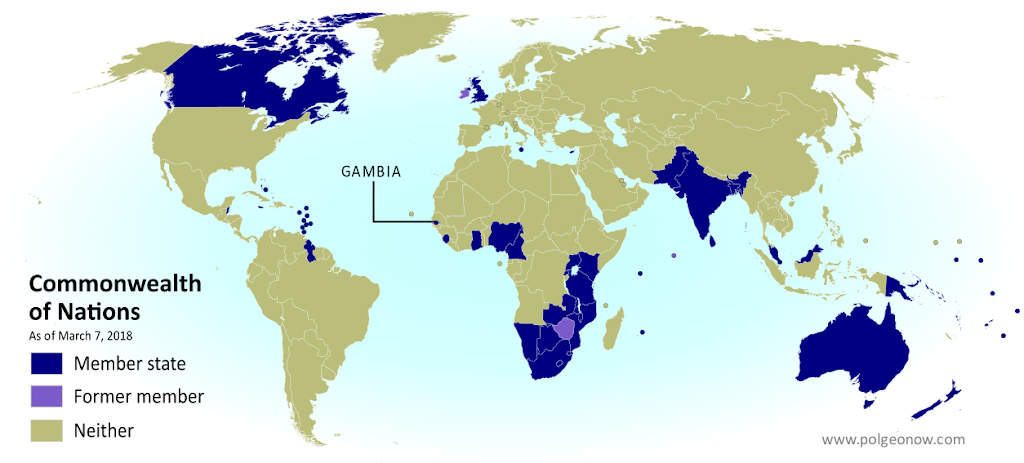
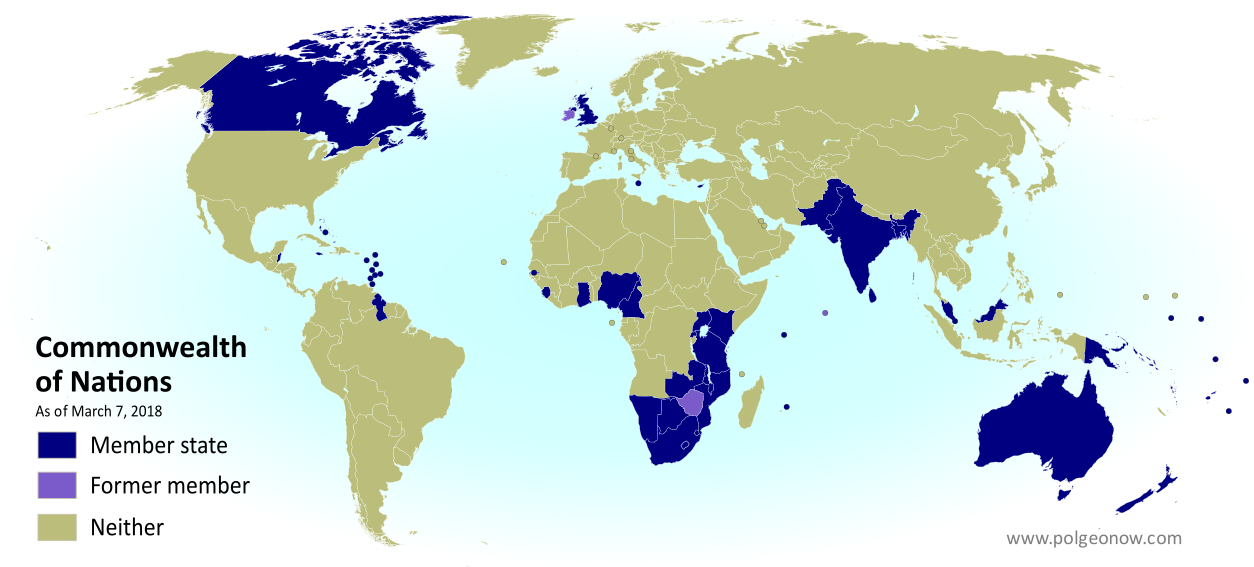
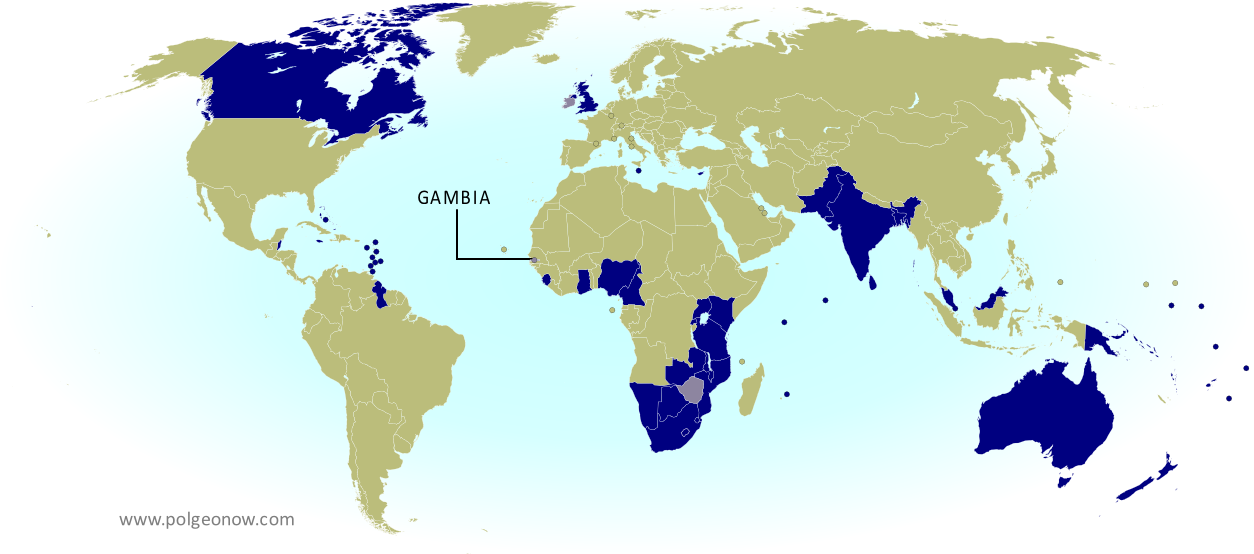
Map of the Gambia in the Commonwealth of Nations (British Commonwealth) as of 2018, color coded for former and current member countries (colorblind accessible).
Map by Evan Centanni, modified from public domain graphic. Visit our Commonwealth of Nations page to check for newer versions, or contact us for permission to use this map.

Commonwealth Readmits Gambia as Member

Last month the Republic of the Gambia was accepted back into the Commonwealth of Nations, a club of countries that were formerly part of the British Empire. The tiny West African country left the organization in 2013 under pressure from other members to improve its democracy and human rights record.

Flag of the Gambia Country Name:  
• The Gambia
Official Name:  
• Republic of the Gambia
Capital: Banjul

See Also: Gambia Withdraws from the Commonwealth (2014 article)

But since eccentric leader Yahyeh Jammeh was forced to step down last year after losing an election, new Gambian president Adama Barrow has made a point of reversing his predecessor’s more controversial policies. This has included undoing the country’s 2015 name change, canceling its withdrawal from the International Criminal Court, and now rejoining the Commonwealth.

Unanimous Decision

The Gambia’s readmission into the Commonwealth took effect on February 8, 2018, after its application was approved unanimously by the leaders of the other member countries. The move to re-apply had likewise been approved unanimously by the country’s own National Assembly.

Sometimes called the “British Commonwealth”, the Commonwealth of Nations is mainly a forum for cooperation between countries that were once parts of the British Empire (though it has also admitted other countries in the past). But any association it has with British colonialism is mostly symbolic –  Queen Elizabeth II is the formal “Head of the Commonwealth”, but within the organization itself, all members are equal and decisions are made by consensus.

Learn More: What is the Commonwealth of Nations, and what does it do?

Why Did Gambia Rejoin the Commonwealth?

In contrast to the country’s unceremonious departure in 2013, the Gambia’s reasons for rejoining the Commonwealth are pretty clear.

In a press release, the Gambian government explained that it feels exclusion from the Commonwealth was a loss for the country, shutting it out from cooperation on things like health and education while denying it the opportunity to punch above its weight on the international stage. The statement specifically mentioned the need for the tiny coastal country to have a voice on climate change issues, and also on how richer countries try to help poorer countries.

In a separate interview, Gambia’s foreign minister mentioned that membership will also help Gambia build its judicial system, allow it to participate in the Commonwealth Games (a major world sporting event), and make it easier for its citizens to live in other Commonwealth countries. When “Commonwealth citizenship” was stripped from the Gambia in 2015, Gambians living abroad lost the right to vote in the UK and some other Commonwealth countries, among many other privileges.

Flag of the Commonwealth of NationsOrganization Name:  
• Commonwealth of Nations
Founded: 1931 and 1949 in London, UK
Headquarters: London, UK
Website: thecommonwealth.org/

Commonwealth Members

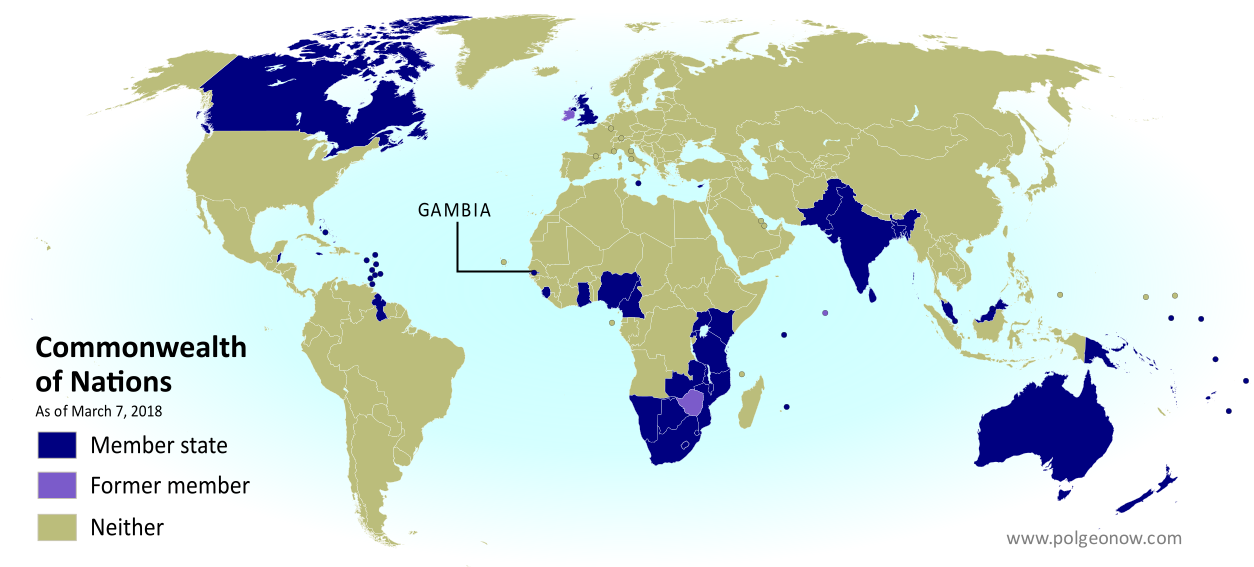
The Commonwealth of Nations now has 53 members, making up about a quarter of all the world’s countries. The number today is the same as after the Gambia first left, since the Gambia’s readmission is offset by the Maldives quitting the group in 2016. Participation in the Commonwealth is completely voluntary, and any member country can leave or reapply at will.

With the Gambia back in, there are now just three ex-Commonwealth countries in the world: Ireland left when it broke ties with the UK in 1949, and Zimbabwe exited in 2003 after a year of suspension over democracy issues.

It’s a common misconception that all the Commonwealth countries recognize the queen of England as their monarch. The countries that do share Queen Elizabeth II are called the “Commonwealth Realms“, but most Commonwealth countries don’t have a king or queen at all, and a few have their own separate monarchs. Elizabeth II’s current position as Head of the Commonwealth is separate from her role as the queen of the Realms, gives her no authority over member countries, and won’t be automatically inherited by her successor.

See Also: Queen Elizabeth’s 16 Countries: The Commonwealth Realms

Interested in the Commonwealth? You can always find the latest map and related articles on our Commonwealth of Nations page.


Low-resolution graphic of the Commonwealth flag is displayed under fair use principles (source). Flag of the Gambia is in the public domain (source).

What Are the Commonwealth Countries? Map of the Commonwealth of Nations

This map and explainer will be updated whenever there’s a change in Commonwealth membership, including suspensions and reinstatements. You can find articles on each change by scrolling to the bottom of this page, or by viewing all Commonwealth articles on PolGeoNow.

The Commonwealth: Who belongs to it? Map of current and former member countries of the Commonwealth of Nations (British Commonwealth) as of March 2018 (colorblind accessible).
Map by Evan Centanni, modified from public domain graphic. Contact us for permission to use this map.

(Subscribers click here to view this article in the members area.)

What is the Commonwealth of Nations?

The Commonwealth of Nations – formerly the “British Commonwealth”, but now usually just called “the Commonwealth” – is a loose association of countries that grew out of the British Empire as its colonies transitioned into independent countries during the 20th Century. It more or less took its modern form in 1949, but its history goes back at least to 1926, when the most Westernized colonies of the British Empire were transitioning towards independence. It’s mostly a casual forum for cooperation between countries that used to be British colonies or dependencies (though some other countries have joined), and it has a charter promoting values like world peace, democracy, and human rights.

Flag of the Commonwealth of NationsOrganization Name:  
• Commonwealth of Nations
Founded: 1931 and 1949 in London, UK
Headquarters: London, UK
Website: thecommonwealth.org/

What does the Commonwealth Do?

Unlike the European Union, World Trade Organization, and many other prominent intergovernmental organizations, the Commonwealth isn’t built around any kind of trade agreement or economic treaty, though its member countries do tend to favor trading with each other. Instead, it’s mostly a framework for promoting democracy and human rights, raising money for economic development, and nurturing cultural ties between its member countries.

Commonwealth-wide organizations coordinate international cooperation on education, professional development, and most famously sports: The Olympics-style Commonwealth Games are held every four years as a symbol of friendship between countries with historical ties to each other.

How Many Countries are in the Commonwealth?

Today there are 53 Commonwealth nations – about a quarter of all the world’s countries – all of them independent countries that also have membership in the UN. Participation in the Commonwealth is completely voluntary, and a member country can leave or reapply whenever it wants.

In the history of the Commonwealth, six countries have quit the organization, and one country, Fiji, was pushed out in 1987 over a military coup. Ireland, a member from the organization’s beginning, became the first to leave when it broke ties with the British monarchy and became a republic in 1949. At the time, the Commonwealth was still only for semi-independent “Dominions” sharing the British Queen or King.

South Africa then left in 1961 over the apartheid controversy, and Pakistan quit in 1972 when the Commonwealth recognized Bangladesh’s secession. Three more countries – Zimbabwe, the Gambia, and the Maldives – have withdrawn over the past fifteen years after being accused of disrespecting democracy or human rights. Fiji, South Africa, Pakistan, and the Gambia have all since rejoined.

Another four former members countries are gone from the Commonwealth simply because they don’t exist anymore: In 1949, semi-independent Newfoundland merged with Canada; in 1963, Malaya merged with Singapore, Sarawak, and North Borneo to form Malaysia (with Singapore splitting off again two years later and joining the Commonwealth separately); and in 1964 Tanganyika and Zanzibar merged to form Tanzania. All the new countries that resulted from those mergers are now Commonwealth members themselves.

See Also: BBC timeline of Commonwealth history (1926-2014)

Which Commonwealth countries is the queen head of? Map of current and former Commonwealth Realms - independent countries that share the British monarchy.
Map of the Commonwealth Realms: independent countries that share Queen Elizabeth II as their head of state

The Commonwealth and the Queen

It’s a common misconception that all Commonwealth countries recognize the British Queen as their leader. Although Queen Elizabeth II is the official “Head of the Commonwealth” for now, most member countries don’t recognize any king or queen in their own constitutions, and a few have their own separate monarchs.

Still, 16 of the 53 Commonwealth countries do recognize the queen as their official leader, despite having fully independent governments. These countries are a subset of the Commonwealth known as the “Commonwealth Realms“.

Learn More: Which Commonwealth countries is the queen head of?

Commonwealth News on Political Geography Now

Political Geography Now brings you ongoing coverage of all changes to Commonwealth membership, including withdrawals, admissions, suspensions, and reinstatements. News articles about these changes, as well as other features related to the Commonwealth, are listed here:

Map of the Gambia in the Commonwealth of Nations (British Commonwealth) as of 2018, color coded for former and current member countries (colorblind accessible).Gambia Rejoins the Commonwealth
Under a new government, Gambia rejoined the Commonwealth in February 2018, four years after leaving.

Full map and article

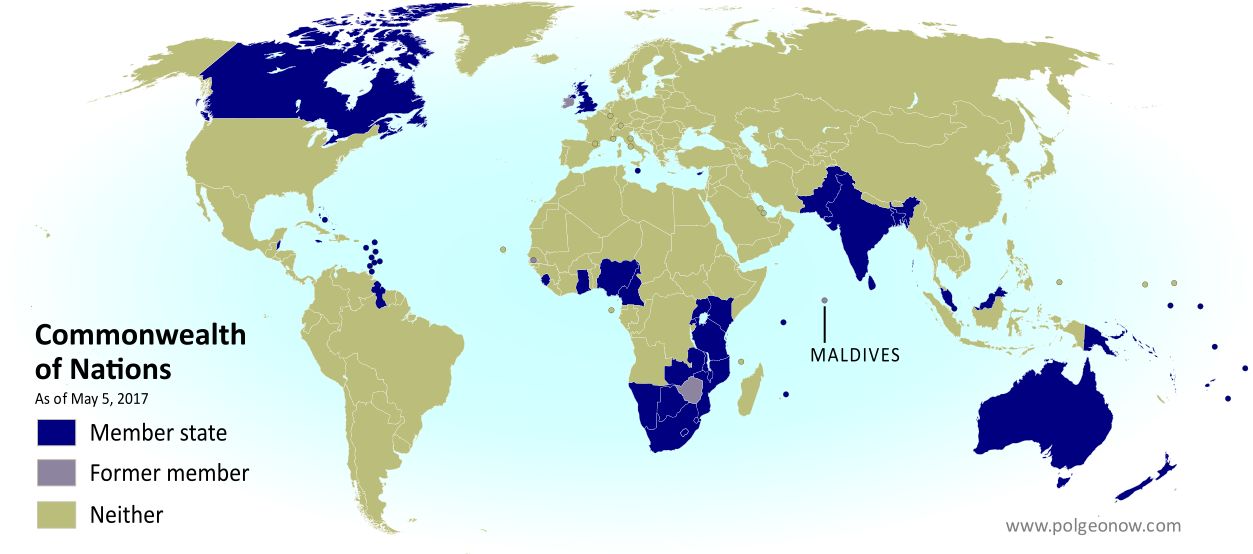
Map of current and former member countries of the Commonwealth of Nations (British Commonwealth) as of May 2017, showing where the Maldives are on the world map after the country left the organization (colorblind accessible).Maldives Withdraws from the Commonwealth
The small Indian Ocean country of the Maldives chose to exit the Commonwealth in October 2016 after being threatened with suspension.

Full map and article

Map of current and former member countries of the Commonwealth of Nations (British Commonwealth) as of 2014, marking the Gambia, which withdrew from the organization in 2013 (colorblind accessible).Gambia Withdraws from the Commonwealth
In October 2013, the eccentric ruler of the Gambia, a tiny country in West Africa, withdrew unexpectedly from the Commonwealth, complaining of “neo-colonialism”.

Full map and article

Which Commonwealth countries is the queen head of? Map of current and former Commonwealth Realms - independent countries that share the British monarchy.Queen Elizabeth’s 16 Countries: The Commonwealth Realms
How can 16 of the Commonwealth countries all share the same queen, but still be independent? Which countries are they? Find all the answers in this popular PolGeoNow feature!

Full map and article


Graphic of the Commonwealth flag is displayed under fair use principles (source).

Map: Which Schengen Borders are Closed to Passport-Free Travel in August 2017?

Last year, we explained Europe’s Schengen free travel area in plain English, then published maps of which European countries had temporarily reintroduced border controls as of March 2016, August 2016, and February 2017. Here’s an update and summary for August of 2017.

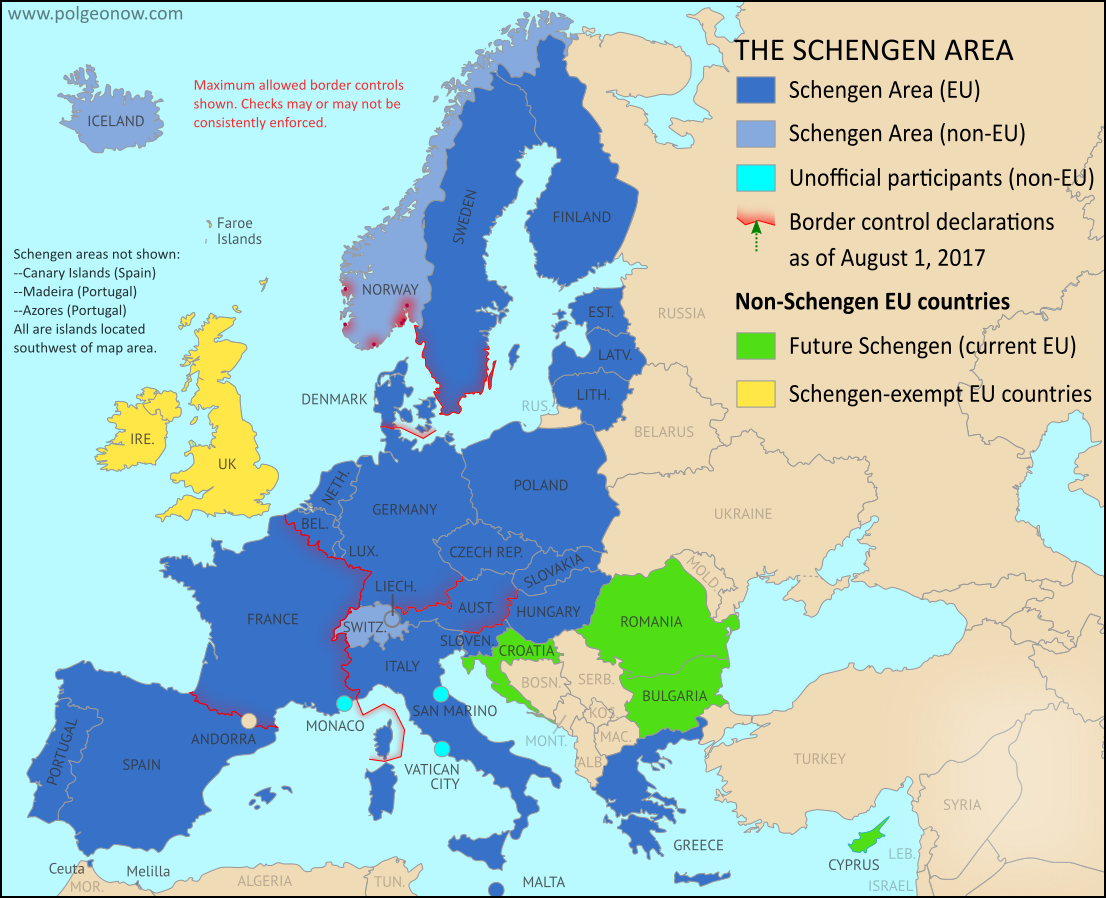
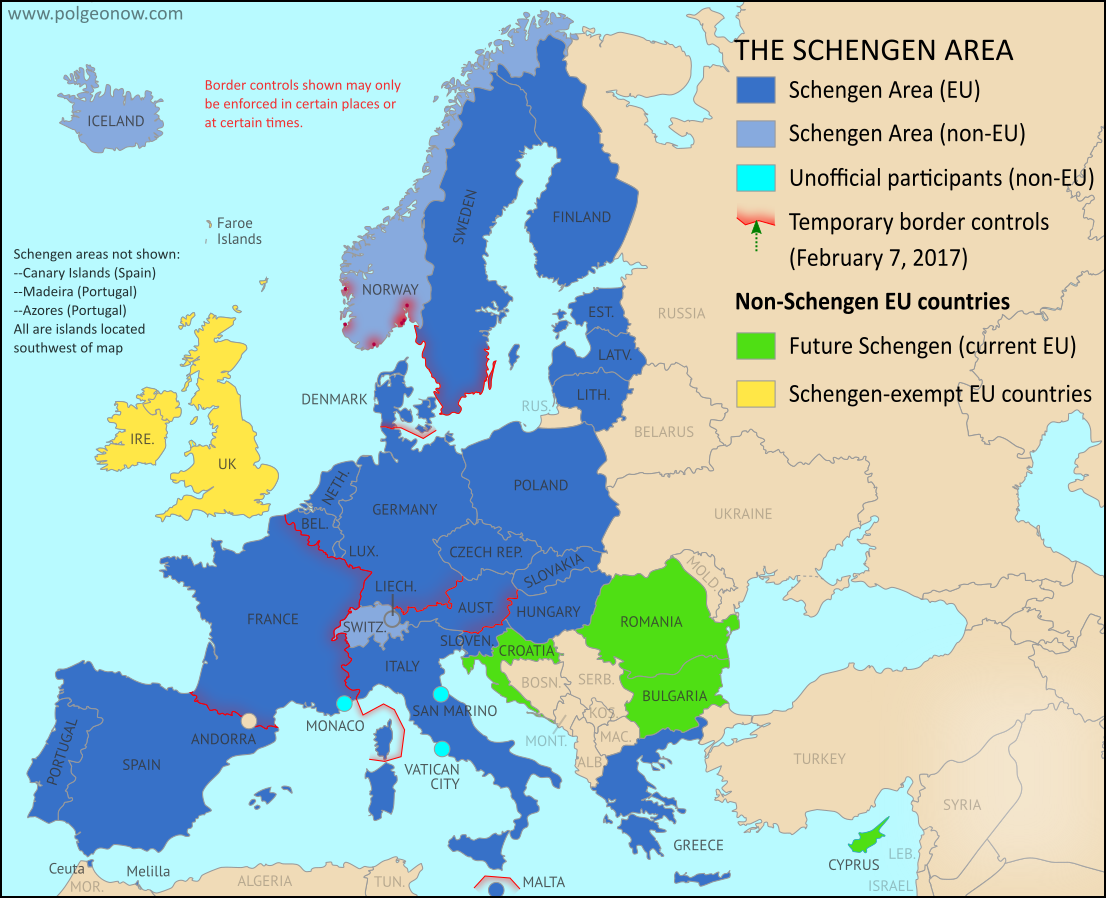
Schengen borders map showing temporary reintroduction of border controls in the Schengen Area (the European Union's border-free travel zone) as of August 2017, showing internal Schengen borders closed to passport-free travel in the period after the election of French President Emmanual Macron.
Map by Evan Centanni, from blank map by Ssolbergj. License: CC BY-SA

Article by Evan Centanni

Current Border Controls Between Schengen Countries

As anyone who’s visited Europe in recent decades knows, much of the continent is linked together as part of the “Schengen Area“, a collection of countries that don’t make travelers show any ID to cross back and forth across their borders (though this system is overseen by the European Union, the Schengen Area and the EU aren’t the same thing). But the system does allow countries to temporarily reintroduce border controls under certain circumstances.

With the spike in numbers of refugees and other immigrants arriving in Europe in the past two years, many Schengen countries have rushed to control the flow of people by using these special temporary exemptions. When we published our previous map of border controls within Schengen this past February, there were seven member countries reserving the right to perform border checks. Now there’s one fewer, and the remaining six have renewed their declarations – perhaps for the last time.

It’s important to note that the border controls shown on the map above are the maximum allowed under each country’s declaration – actual enforcement may be extensive, limited, or even absent depending on the circumstances.

Learn More: The UK already isn’t part of the Schengen Area or Eurozone, so what will change when it leaves the EU?

The 5 Schengen Countries with Negotiated Border Controls

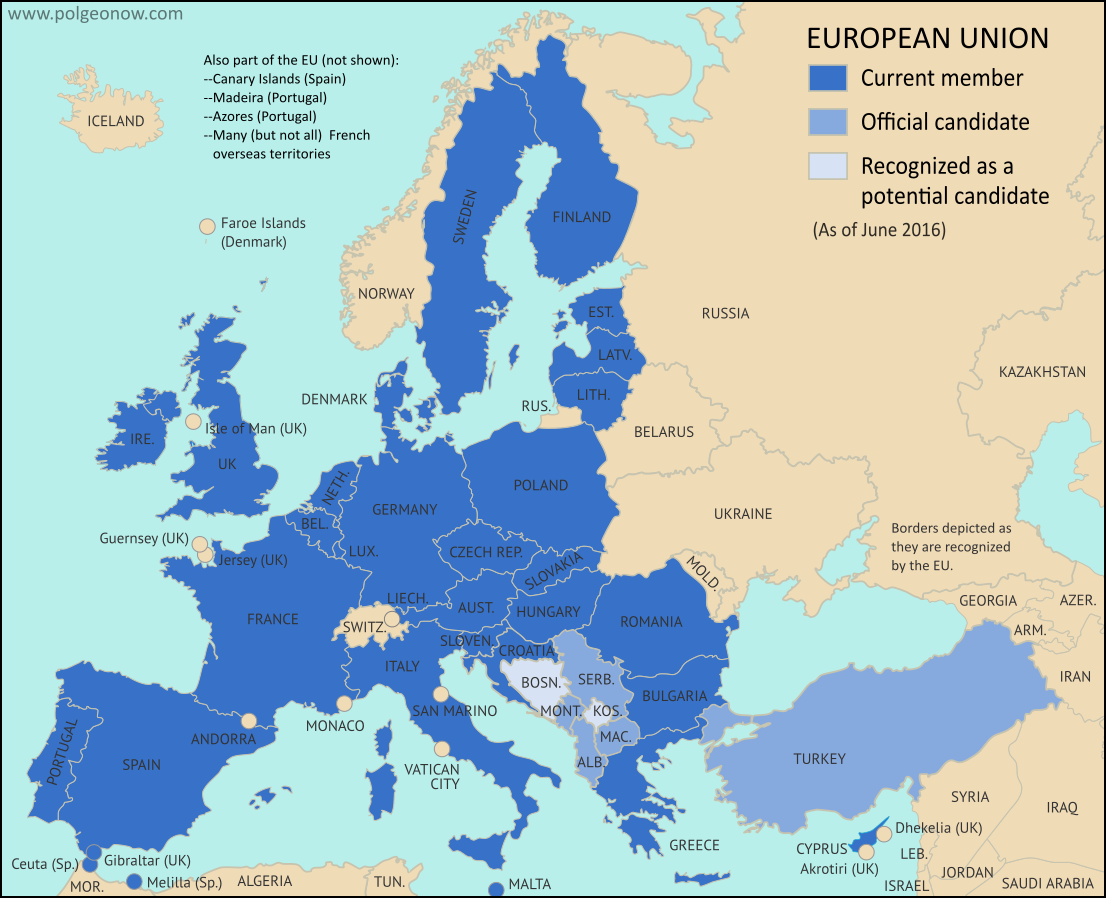
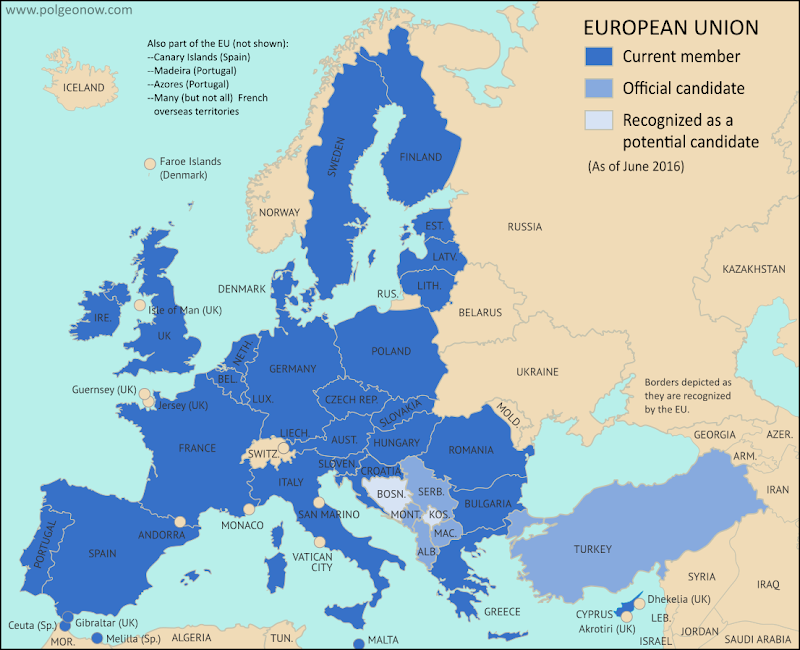
Map of the European Union (EU) and prospective member countries
The full EU and prospective members

Amid fears that the Schengen Area’s dream of free travel was going down the drain, the foreign ministers of the EU’s member countries met up and hashed out a compromise solution last year, with five countries reducing the scope of their border controls by refocusing them on high-priority areas:

  • Germany agreed to control only its border with Austria, ruling out border controls with Switzerland, the Czech Republic, Luxembourg, Belgium, the Netherlands, and Denmark.
  • Austria agreed to control only its borders with Slovenia and Hungary, ruling out border controls with Italy, Switzerland, Liechtenstein, the Czech Republic, and Slovakia.
  • Denmark agreed to control only its border with Germany (including land crossings and ferry connections), ruling out border control for arrivals from Sweden or Norway.
  • Sweden agreed to control only crossings over the bridge from Denmark and sea arrivals along its western and southern coastline, ruling out controls for land borders with Norway and Finland or arrivals by sea along its east-central and northern coasts.
  • Norway agreed to control only arrivals in ports with ferry connections to Sweden, Denmark, and Germany, ruling out controls along its land borders with Sweden and Finland.

These border controls were extended three more months in November 2016, then another three months in February 2017. Finally, on May 11, the EU government approved one more extension – this time for six months. But this will be the final extension allowed under official Schengen rules: According to the plan, the five affected countries will have to phase out all Schengen-internal border controls by the deadline of November 11, 2017.

In fact, Sweden had already announced just before the extension that it would be ending some border checks for travelers arriving from Denmark; but the announcement said other types of checks would continue, and the country did go ahead and notify the EU that it would accept the extension to November.

France’s Border Controls Extended for the Fifth Time

Unlike most of the countries with temporary border checks, which have focused their controls on specific stretches of borders popular with refugees and other migrants, France has reserved the right to maintain controls on all its borders – except, presumably, the boundary with tiny Monaco, which for immigration control purposes is already treated like part of France.

Unlike other countries with border checks, France’s controls are justified mostly as an anti-terrorism measure, not as a way of keeping out migrants. The French border controls were first declared in 2015 and have been in place ever since then due to several extensions:

Start Date Duration Stated Reason
Nov. 13, 2015* 1 month Paris Climate Change Conference 
Dec. 14, 2015 6 months, 12 days “emergency state as introduced further to Paris attacks“
May 27, 2016 2 months Euro 2016 and Tour de France
July 26, 2016 6 months “emergency state as introduced further to Nice attack“
Jan. 27, 2017 5 months, 18 days “persistent terrorist threat”
July 16, 2017 3 months, 15 days “persistent terrorist threat”

*France’s November-December 2015 border controls were only for air and land borders (sea ports were excluded)

The most recent extension, posted on the EU’s Schengen website but apparently not reported in the English-language media, expires after October 31. This is probably part of newly elected President Emmanuel Macron’s plans to extend the country’s overall state of emergency, though Macron does say he believes in preserving Schengen’s free-travel principles in the long run. That attitude stands in contrast to his defeated opponent for the presidency, Marine Le Pen, who had promised to suspend all participation in Schengen while also preparing for a vote on leaving the EU.

Temporary Border Controls in Malta, Portugal, Italy, and Germany

At the time of our last Schengen border control map report, the tiny island country of Malta had also declared temporary border checks as a security precaution while the country was hosting two important political summits related to migration into Europe. Those checks lasted for just twenty days, expiring after February 9.

Since then, Portugal also announced temporary border controls, for security during a visit by the Pope (May 10-14), and Italy did the same when hosting a G7 summit (May 10-30). Germany also reserved the right to enforce controls on all its borders – not just with Austria – from May 15 to July 9 while it prepared to host the G20 financial summit.

These truly temporary suspensions of free travel are a normal part of the Schengen system, and all three countries have since let the declared controls expire.

Learn More:
Which Countries Are in the Schengen Area, and Which EU Countries Aren’t? 
Map of Temporary Schengen Border Controls in March 2016 
Map of Temporary Schengen Border Controls in August 2016 
Map of Temporary Schengen Border Controls in February 2017 

Why Brexit Matters: 5 Things That Might Change When Britain Leaves the EU

By Bryn Jansson

Map of the European Union, including all member countries, official candidate countries, and potential candidate countries, as 2017 (colorblind accessible).
Map of current and future EU member countries

Brexit Process Finally Begins

The United Kingdom (UK) and the European Union (EU) began formal divorce negotiations in Brussels last Monday, June 19, starting a 21-month sprint to the March 2019 Brexit deadline. (“Brexit” is short for “British Exit” from the EU, since “Britain” is another name for the UK.)

UK voters’ surprise choice to leave the EU happened exactly a year ago, on June 23, 2016 – but it didn’t automatically trigger the two-year countdown clock on exit negotiations necessary for departure under Article 50 of the EU’s Lisbon Treaty.

In fact, the referendum didn’t actually do anything, except signal to the British government that its voters wanted to leave. While all leading politicians promised to respect the results, the official process couldn’t start until the UK delivered formal notice to the EU. Theresa May, the UK prime minister who replaced David Cameron last July, wanted to make sure the British government had its priorities and negotiating positions in order before delivering the notice. After many months, she finally did that on March 29, 2017.

How Brexit Affects the UK

Now it’s time for the UK and the rest of the EU to negotiate the details of the divorce. But the UK already wasn’t part of the EU’s free-travel Schengen Area, or part of the shared-currency Eurozone. So what will actually change when the country quits?

“Hard Brexit” vs. “Soft Brexit”

Most details of the UK’s break from the EU are still unknown, but the many possibilities can be divided into two general categories: A “Soft Brexit” would allow the UK to keep some of its special economic ties to the EU, and maybe even the Single Market arrangement that lets goods, money, services, and labor move freely between member countries (the so-called “four freedoms”).

“Hard Brexit”, on the other hand, would mean a clean break from the Single Market, requiring the UK and the EU to negotiate their economic relationship from scratch. The EU insists on including the “four freedoms” as a package deal, so if the UK doesn’t want one of them, it’ll have to give up access to all of them. EU leaders fear that letting the UK pick and choose the best parts of membership might encourage other countries to do the same.

Some non-EU member countries, like Norway and Switzerland, do have partial membership in the Single Market; they generally still have to accept the “four freedoms”, but are allowed exceptions from certain market-wide regulations. They also were never in the EU to begin with, so they were able to negotiate from a stronger position.

Most of the potential changes involve the EU’s “Single Market”, a system that allows goods, money, services, and labor (people) to move around inside the EU as if it was all one country. (Because the UK isn’t part of Schengen, it’s allowed to do border checks and set its own visa policies for non-Europeans; but the Single Market guarantees that citizens of other EU countries can still move to the UK and work there.)

Here are five of the biggest areas where things might change when the Brexit is complete:

1

The Issue: Immigration

Why It Matters: Immigration was one of the driving issues behind the Leave campaign’s success in the Brexit vote last year. Then-Prime Minister David Cameron had promised to drastically reduce migration; but as long as EU law required free movement of labor for EU citizens in and out of Britain, his hands were pretty much tied.

Brexit supporters ran on a platform of regaining control over the country’s borders, promising to limit immigration to much smaller rates than British people are used to now. Since the immigration issue was one of the most visible of the campaign, it’ll be a big deal in the news during negotiations.

What Might Happen: Current Prime Minister Theresa May has consistently said Brexit must mean full control of the UK’s borders and the flow of people coming into the country. While politicians aren’t known for keeping their promises, this is one she’s been clear on for so long that it would be hard for her to break it.

In an April interview, however, May expressed openness to an “implementation period” in which businesses and governments would have time to adjust to new policies. This could include an extension of the free movement of people – though May still insisted that border and immigration policy would be under British control during that period.

2

The Issue: The Border with Ireland

Why It Matters: One of the more difficult circles to square will be the fate of the border between Ireland (an independent country) and Northern Ireland (a part of the UK). Even though the UK isn’t part of the EU’s Schengen free travel area, it has a special agreement to keep the Irish border open to travelers, and the “four freedoms” of the EU Single Market let residents easily do business on either side.

From the 1960s to the 1990s, some 3,500 people in Northern Ireland were killed in a violent conflict over whether the region should join independent Ireland or stay in the UK. The Good Friday Agreement of 1998 led to a cease-fire that’s mostly held since, probably in part because the border is “irrelevant”. But that could all change after Brexit, when the boundary might come to divide the EU Single Market from a border-controlled UK. Meanwhile, tens of thousands of jobs are threatened if cross-border economic activities get cut off.

In last year’s Brexit referendum – where Irish citizens residing in the UK were allowed to vote alongside their British neighbors – Northern Ireland voted against leaving the EU, but with sharp differences from district to district.

Gibraltar and Brexit

Brexit negotiations will also decide the future of Gibraltar, a tiny UK-controlled peninsula attached to southern Spain. The territory, though not officially part of the UK, has been under British control since 1713, and some in Spain hope to use the negotiations as leverage to advance their own country’s claims to it.

The EU has promised Spain veto powers over any future trade deal involving Gibraltar, which would allow the Spanish government to “demand concessions or make the border with Gibraltar harder to cross, effectively isolating the territory.” Whether Spain will use its power that way is still unknown.

Meanwhile, the May government has insisted that British policy toward Gibraltar – which includes promises not to give the territory to Spain without its residents’ permission – will not change. (Gibraltarians voted overwhelmingly against Brexit last year, but are even more against joining Spain.)

What Might Happen: Former UK prime minister Tony Blair thinks a hard border with checkpoints and passport controls “really would be a disaster.” Fortunately, both sides have said they want to leave the border as open as possible: May has promised work for a practical solution allowing free travel between Ireland and Northern Ireland while still “protecting the integrity of the UK’s immigration system”, and the EU negotiating guidelines call for a “flexible and creative” approach. Some have suggested this could mean an open border in Ireland, with a “hard border” separating Northern Ireland from the rest of the UK.

However it turns out, you can bet PolGeoNow will be covering these developments!

3

The Issue: Citizens’ Rights

Why It Matters: Thanks to the free movement of people guaranteed by the EU, about 1.2 million British nationals live in other EU states, and 3.2 million non-British EU citizens live in the UK. Many have lived there for decades. Until now, they’ve enjoyed access to most of the same rights and privileges as their local neighbors, but Britain’s exit from the EU opens that up to debate.

If no agreement is reached, EU citizens wishing to stay in the UK would have to deal with British immigration laws, which advocacy groups say are already some of the strictest in Europe. They could also lose access to other services they have now, like health care, social security, and pensions. The same thing could also happen to UK citizens living in other EU countries, like the half-million British expats who have relocated to sunnier Spain and France

What Might Happen: Both sides generally favor allowing existing residents to stay and retain access to services, though the details will take time to hammer out. The EU wants these rights guaranteed by the European Court of Justice (ECJ), but the UK government has been clear that the ECJ will not have any jurisdiction in Britain after Brexit. Another issue is what day citizens must arrive by to be eligible under the agreement: The day of the referendum? The day Article 50 was triggered? The day an agreement is ratified? We should find out soon, since both the EU and the UK have agreed citizens’ rights is one of the first topics on the agenda.

4

The Issue: “Passporting”

Why It Matters: Confusingly, “passporting” has nothing to do with what we usually think of as a passport: the identity document that gets stamped when you enter a new country. In this case, it’s actually an authorization that allows banks and other financial institutions in one EU country to do business in the any of the others. This is a specific part of the Single Market, but it’s especially important because London’s status as Europe’s unofficial “financial capital” means there’s a huge volume of cross-border financial business between the UK and the rest of the EU. One estimate indicates that if the UK lost all EU passporting rights, it could cost almost $25 billion in annual revenue. Another says London banks may have to move close to $2 trillion, or 17 percent of the UK banking system, to EU-based locations. Yet another claims that up to 80,000 jobs in the finance sector could leave London in the next two years as banks prepare for the worst.

UK Brexit vote map: Map of election results in Britain's June 2016 referendum on leaving the European Union (EU). Continuous red-to-blue color scheme gives a more honest depiction of the similarities between different election districts. Colorblind accessible.
Map of UK Brexit vote results

What Might Happen: Only EU-based firms are eligible for passports, so unless an exception is negotiated as part of Brexit, British banks will lose that right. It won’t stop them from conducting business elsewhere, but it does mean they have to apply for a license in each individual country. Ominously for the UK, new French president Emmanuel Macron is on the record saying British financial institutions shouldn’t get a special deal. Britain’s finance industry is already expecting to lose full passporting rights, but hopes a more limited deal could allow some important services to continue.

5

The Issue: Economic Access

Why It Matters: This really is the issue of the whole negotiation process; it’s woven into all the other topics discussed above. How close and what type of an economic relationship will the UK and the EU have after Brexit is finalized?

What Might Happen: Though anything is still technically possible at this point (staying in the Single Market, getting out, keeping other agreements, or temporarily staying in while a new relationship is finalized), May’s government has been fairly clear about its plans to pull the UK out of the Single Market and renegotiate its relationship with the EU from scratch.

But since her Conservative Party lost its parliamentary majority in June’s snap elections, there’s been a push to at least keep Britain in the EU’s customs union. A customs union is a less-ambitious version of the Single Market, where member countries have a shared policy on imports from non-members, and no taxes on importing or exporting between members. It doesn’t include free movement of people, or the unified rules of business that make free movement of labor and services practical in the EU.

Only time will tell how the recent electoral losses will affect May’s negotiating positions, but the decision on whether to allow free movement of people will be the linchpin. If the UK is willing to accept this, it can get the greater economic access that Northern Ireland and London’s financial sector want. But if full control over British borders is non-negotiable, the UK will get only partial access at best.

Following this story? View all Brexit articles on PolGeoNow!

The Maldives’ Withdrawal from the Commonwealth

Map of current and former member countries of the Commonwealth of Nations (British Commonwealth) as of May 2017, showing where the Maldives are on the world map after the country left the organization (colorblind accessible).
Map by Evan Centanni, modified from public domain blank world map

Article by Evan Centanni

Maldives Quits the Commonwealth

Flag of the Gambia Country Short Name:  
• The Maldives (English)
• Dhivehi Raajje (Maldivian)
Official Name:  
• Republic of Maldives (English)
•Dhivehi Raa’jeyge Jumhooriyya (Maldivian)
Capital: Malé

The Maldives, a country of small islands in the Indian Ocean, withdrew from the Commonwealth of Nations last October, three weeks after the organization threatened it with suspension for a third time over human rights and democracy concerns.

Formerly called the “British Commonwealth”, the Commonwealth of Nations is a loose association of countries that used to be part of the British Empire. One of its main roles is promoting democracy, human rights, and economic development, and the organization’s monitors have accused the Maldivian government of various anti-democratic activities since the country’s first elected president was deposed in 2012.

Learn More: What is the Commonwealth, and Which Countries Are In It? (Map)

A high-profile international news documentary had also accused the government of extensive corruption the month before the country withdrew. For its part, the Maldivian government accused the Commonwealth of picking on a tiny country as a way to get attention and show off its dedication to democracy. In a statement responding to the Maldives’ withdrawal, the Commonwealth’s secretary-general expressed “sadness and disappointment”, but also hope that the country would eventually choose to rejoin the organization in the future.

The Maldives isn’t the first country to quit the Commonwealth under human rights pressure. In fact, it’s the third in fifteen years, after the Gambia left for similar reasons in 2013, and Zimbabwe did the same ten years earlier.

Related: Queen Elizabeth’s 16 Countries: The Commonwealth Realms

Graphic of the Maldivian flag is in the public domain (source).

Schengen Border Controls in February 2017: Map of Free Travel Restrictions

There are newer versions of this map available. To see them, view all Schengen Area articles. 

Last year, we explained Europe’s Schengen free travel area in plain English, then published maps of which European countries had temporarily reintroduced border controls as of March 2016 and August 2016. We now present an updated map and summary of the situation.

Schengen border checks map: map of Temporarily Reintroduced Border Control in the Schengen Area (the European Union's border-free travel zone) as of February 2017, color-coded for EU Schengen countries, non-EU Schengen countries, future Schengen countries, and Schengen-exempt EU countries, as well as microstates unofficially participating in the Schengen agreements (colorblind accessible).
Map by Evan Centanni, from blank map by Ssolbergj. License: CC BY-SA

(Subscribers click here to view this article in the members area.)

Article by Evan Centanni

Changes to Schengen Border Controls Since 2016

As anyone who’s visited Europe in recent decades knows, much of the continent is linked together as part of the “Schengen Area“, a collection of countries that don’t make travelers show any ID to cross back and forth across their borders (though this system is overseen by the European Union, the Schengen Area and the EU are not the same thing). But the system does allow countries to temporarily reintroduce border controls under certain circumstances.

With the spike in numbers of refugees and other immigrants arriving in Europe in the past two years, many Schengen countries have rushed to control the flow of people by using these special temporary border controls. When we published our previous map of temporary Schengen border controls in August of last year, there were six countries policing their borders with fellow Schengen members. At the moment there are seven, but the situation has largely remained the same since last summer.

It’s important to note that the border controls shown on the map above are the maximum possible under each country’s declaration – in some cases actual controls may be limited to only certain parts of these borders, or to certain times.

Map of the European Union (EU) and prospective member countries
The full EU and prospective members

France’s Border Controls Extended

Unlike most of the countries with temporary border checks, which have focused their controls on specific stretches of borders popular with refugees and other migrants, France has reserved the right to maintain controls on all its borders – except, presumably, the boundary with tiny Monaco, which for immigration-control purposes is already treated as if it were within France.

Unlike other countries with border checks, France’s controls are justified mostly as an anti-terrorism measure, not as a way of keeping out migrants. The French border controls were declared over a year ago and have been in place ever since then due to several extensions:

Start Date Duration Stated Reason
Nov. 13, 2015* 1 month Paris Climate Change Conference 
Dec. 14, 2015 6 months, 12 days “emergency state as introduced further to Paris attacks“
May 27, 2016 2 months Euro 2016 and Tour de France
July 26, 2016 6 months “emergency state as introduced further to Nice attack“
January 27, 2017 5 months, 18 days “persistent terrorist threat”

*France’s November-December 2015 border controls were only for air and land borders (sea ports were excluded)

The most recent extension, declared on the 27th of last month, had the most generic justification yet, and came as France’s front-running presidential candidate promised to “ignore” the Schengen agreement and re-institute permanent border checks if he’s elected this May.

The 5 Schengen Countries with Negotiated Border Controls

Amid fears that the Schengen Area’s dream of free travel was going down the drain, the foreign ministers of the EU’s member countries met up and hashed out a compromise solution last year, with five countries reducing the scope of their border controls by refocusing them on high-priority areas:

  • Germany agreed to control only its border with Austria, ruling out border controls with Switzerland, the Czech Republic, Luxembourg, Belgium, the Netherlands, and Denmark.
  • Austria agreed to control only its borders with Slovenia and Hungary, ruling out border controls with Italy, Switzerland, Liechtenstein, the Czech Republic, and Slovakia.
  • Denmark agreed to control only its border with Germany (including land crossings and ferry connections), ruling out border control for arrivals from Sweden or Norway.
  • Sweden agreed to control only crossings over the bridge from Denmark and sea arrivals along its western and southern coastline, ruling out controls for land borders with Norway and Finland or arrivals by sea along its east-central and northern coasts.
  • Norway agreed to control only arrivals in ports with ferry connections to Sweden, Denmark, and Germany, ruling out controls along its land borders with Sweden and Finland.

These border controls, originally set to expire in November, were extended another three months, and now expire on February 11-12. However, EU leaders appear to have approved yet another three month extension, to May 2017, and Germany’s government is talking about switching to France-style anti-terrorism controls.

Temporary Border Controls in Malta

Besides those same six countries, border controls are also in place right now for the tiny island country of Malta. However, Malta’s border checks are truly temporary, and are only scheduled for January 21 to February 9, as a security precaution while the country is hosting two important political summits related to migration into Europe.

Learn More:
Which Countries Are in the Schengen Area, and Which EU Countries Aren’t? 
Map of Temporary Schengen Border Controls in March 2016 
Map of Temporary Schengen Border Controls in August 2016 

Morocco Joins African Union; CAR Un-suspended (Map)

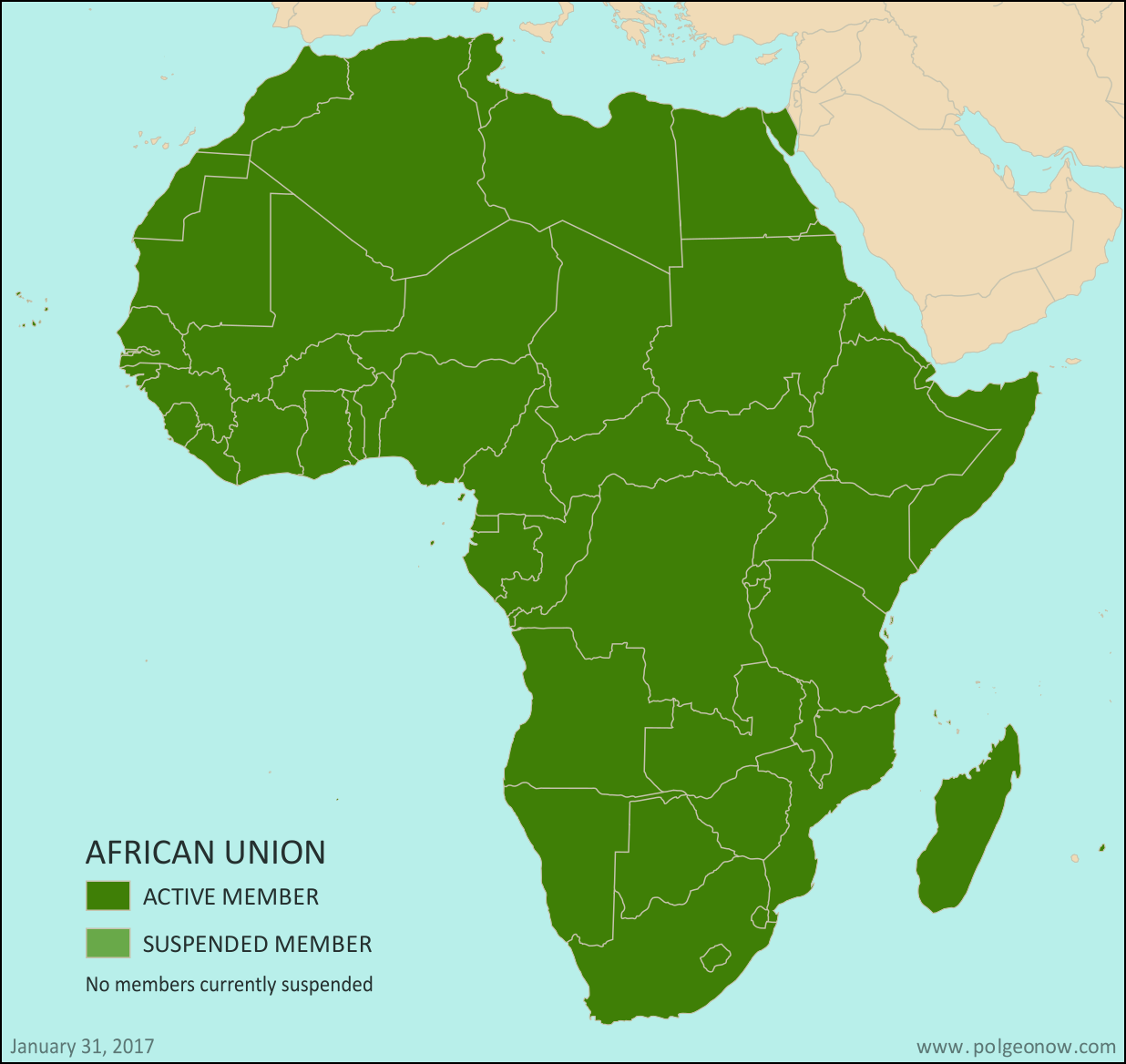
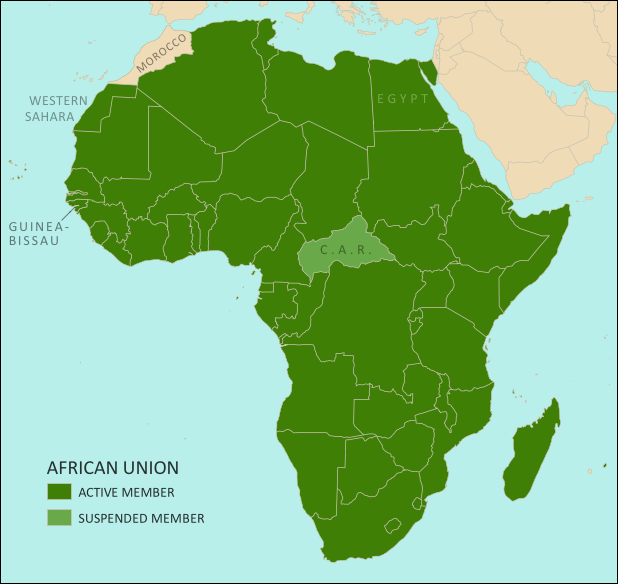
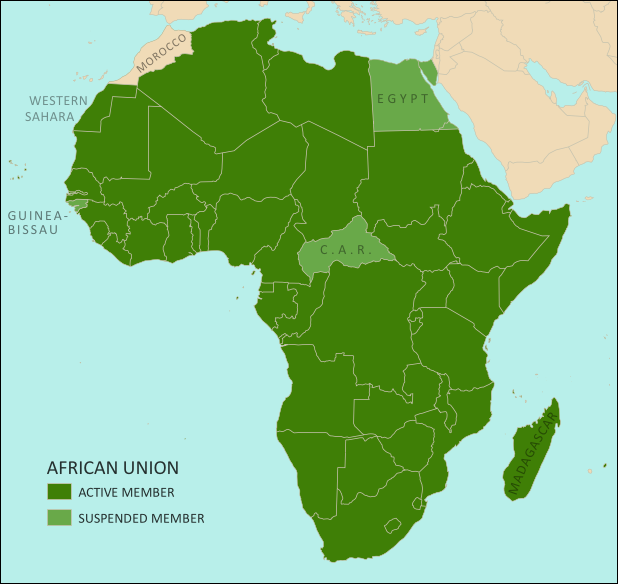
African Union: Map of Africa showing which countries are in the African Union, including active and suspended member countries, updated for the January 2017 admission of Morocco as a member, as well as the April 2016 lifting of the Central African Republic's (CAR) suspension (colorblind accessible).
Map by Evan Centanni, from this blank map by Eric Gaba. License: CC BY-SA

(Subscribers click here to view this article in the members area.)

Article by Evan Centanni

Morocco Rejoins AU after Long Absence

The North African country of Morocco became the 55th member of the African Union (AU) this week, after member countries voted to let it back into the organization after 33 years on its own. Morocco withdrew from the Organisation for African Unity (OAU), an earlier version of the AU, in 1984. The AU now includes every independent country in Africa, not counting the unrecognized breakaway state of Somaliland. The last country to join was South Sudan, which became a member three weeks after declaring independence in July 2011.

Moroccan flagCountry Name:  
• Morocco (English)
• al-Maghrib (Arabic)
• Lmaɣrib (Berber)
Official Name:  
• Kingdom of Morocco (English)
• al-Mamlakah al-Maghribiyah (Arabic)
• Tageldit n Lmaɣrib (Berber)
Capital: Rabat

Why Morocco Withdrew from the African Union

Morocco’s hasty departure from the OAU three decades ago was a protest move, after the organization voted to let disputed Western Sahara become a member. Western Sahara is mostly controlled by Morocco, which absorbed it into the Moroccan kingdom after Spanish colonial forces withdrew in the 1970s.

But Morocco’s move was controversial, and the international community has never fully accepted it. Meanwhile, the local Polisario Front has considered Western Sahara an independent country since 1976 (formally known as the Sahrawi Arab Democratic Republic, or SADR).

Bringing Morocco Back Into the Fold

Reports suggest Morocco may hope that being part of the AU will help it end the SADR’s independence claims. Meanwhile the Polisario government, which represents Western Sahara in the AU, hopes for the opposite, arguing that membership in the organization will limit Morocco’s ability to play by its own rules.

A total of nine AU member countries, including South Africa, voted against Morocco’s readmission. Zimbabwe, Namibia, Mozambique, Botswana, and Algeria were also reportedly among the dissenters. Africans sometimes see Moroccan control of Western Sahara as a kind of continued colonialism, and several of the opposing countries are ones where freedom from European-imposed power systems didn’t come easily. A total of 39 countries voted in favor of letting Morocco back in, but with the understanding that Western Sahara would also remain a member.

(Editor’s note: The African Union has 54 members, not counting Morocco; our understanding is that six of them abstained from voting on the decision, or were absent.)

Flag of the Central African RepublicCountry Name:  
• Central African Republic (English)
• Centrafrique (French)
• Bêafrîka (Sango)
Official Name:  
• Central African Republic (English)
• République centrafricaine (French)
• Ködörösêse tî Bêafrîka (Sango)
Capital: Bangui

Central African Republic Suspension Lifted

Another change to the African Union map came in April 2016, when the Central African Republic (CAR) was reinstated as an active member of the organization after a three-year suspension. The CAR was suspended in 2013 after a rebel takeover of its capital, followed by the installation of a weak compromise government.

Though chaos and violence still continues in the country, the AU cited “the successful completion of the transition process and the restoration of normal constitutional order” when re-activating the country’s membership last year, referring to a new presidential election conducted in February. African Union rules don’t require countries to be democratic, but any unconstitutional change of government results in a quick suspension.

Haiti: The Country That DIDN’T Join the AU

In May of last year, news spread that the Caribbean island country of Haiti was about to join the African Union as a full member. Haiti has close cultural ties to Africa, since most of its population is descended from West Africans brought to the Caribbean as slaves. As the second country in the Americas to win independence, soon after the United States, it’s sometimes seen as a symbol of African liberation from colonialism.

By last year, the country already had an observer seat at the AU, but would have been the first member country without any territory on the African continent. Only one problem: Despite making its way into major, reputable news outlets, the story turned out to be untrue. Within days, the African Union issued a statement confirming that the reports were false, and that Haiti was not on track to ever become an AU member. The press release clarified that according to the organization’s founding rules, “only African States can join the African Union“. 

Graphics of the Moroccan flag and the Central African flag are in the public domain.

Map: Which Countries are in the African Union?

This map and explainer will be updated whenever there’s a change in AU membership, including suspensions and reinstatements. News about each change will be published in separate articles, which you can find listed below, or by viewing all African Union content on PolGeoNow.

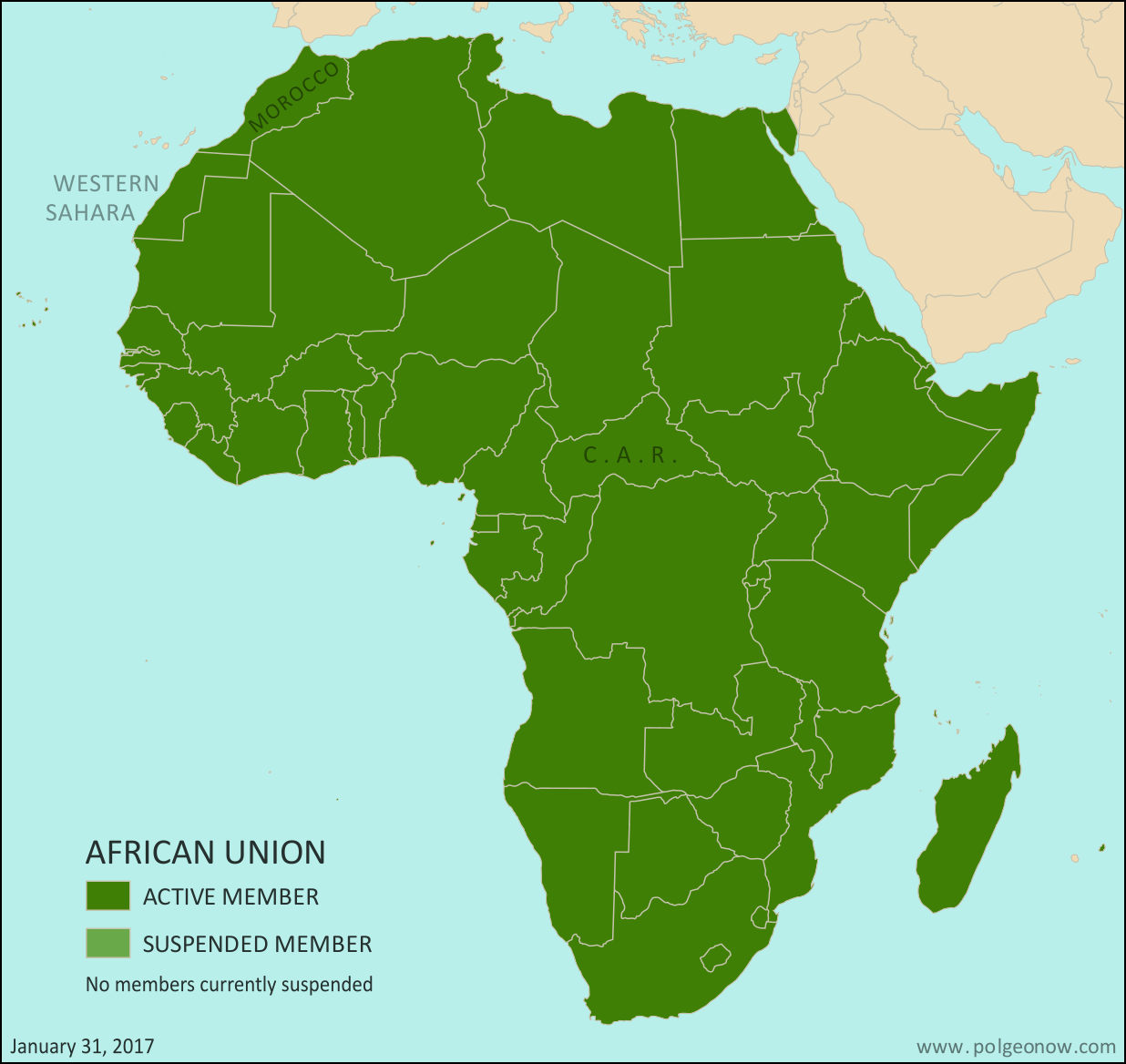
African Union members map: Map of Africa, showing which countries are in the African Union (AU) (colorblind accessible).
Map by Evan Centanni, from this blank map by Eric Gaba. License: CC BY-SA

(Subscribers click here to view this article in the members area.)

Article by Evan Centanni

What is the African Union?

Formed launched in 2002 as a replacement for the earlier Organization of African Unity (OAU), the AU is an intergovernmental organization that works on increasing cooperation, stability, and development within the continent of Africa. The organization is headquartered in Addis Ababa, Ethiopia. (Ethiopia is the only African country that the European empires never colonized, and is also the second most populous country in Africa.)

Flag of the African Union (AU)Organization Name:  
• African Union (English)
• al-Āthḥād al-’Āfrīqī (Arabic)
• Union africaine (French)
• União Africana (Portuguese)
• Unión Africana (Spanish)
• Umoja wa Afrika (Swahili)
Launched: 2002 in Durban, South Africa
Headquarters: Addis Ababa, Ethiopia
Website: www.au.int

Compared to the neighboring European Union (EU), the AU is only a loose forum for cooperation between its member countries. AU members do not have an integrated economic system, union-wide laws, or shared foreign policy, though further integration is a goal for the future.

After the readmission of Morocco, the African Union now includes every UN-recognized country in Africa. The parts of Africa not represented in the AU are a few groups of offshore islands controlled by European countries, as well the small Spanish enclaves in North Africa. The breakaway Republic of Somaliland is not a member, but is considered by the AU to be part of member-state Somalia.

Changes to African Union Membership

Political Geography Now has reported on all changes to the African Union members map, including suspensions and reinstatements, since 2013. The news articles for each of these changes, with maps pointing out the countries involved, are listed here:

Map of Africa showing active and suspended members of the African Union (AU). Updated for the January 2017 admission of Morocco and the April 2016 lifting of the Central African Republic's suspension (colorblind accessible).Morocco Joins African Union; CAR Un-suspended (Map)
The North African kingdom of Morocco joined the AU in January 2017, 33 years after withdrawing from an earlier version of the organization. The Central African Republic’s suspension was lifted in April 2016.

Full map and article

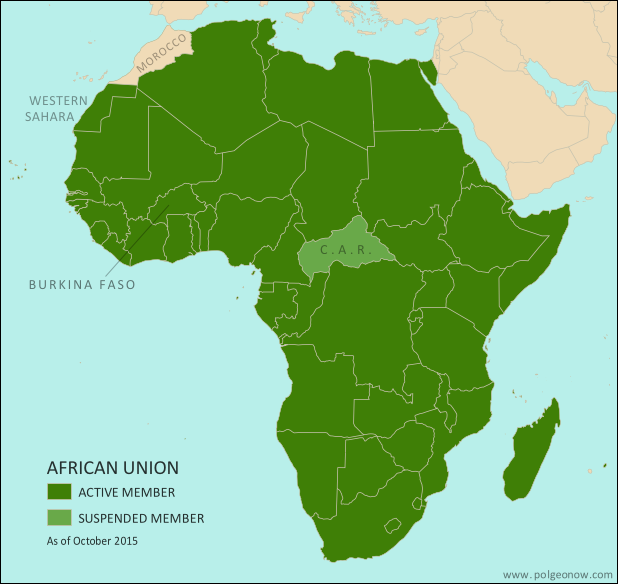
Map of Africa showing active and suspended members of the African Union (AU). Updated for the September 2015 suspension and reinstatement of Burkina Faso (colorblind accessible).African Union Suspends Burkina Faso, Then Reinstates it Again
In September 2015, the West African country of Burkina Faso was suspended from the AU after a military coup, but quickly reinstated to active membership when the coup leaders backed down.

Full map and article

Map of Africa showing active and suspended members of the African Union (AU). Updated for the June 2014 reinstatement of suspended members Egypt and Guinea Bissau (colorblind accessible).African Union Reinstates Egypt and Guinea Bissau
North Africa’s Egypt and West Africa’s Guinea Bissau both had their AU suspensions lifted in June 2014, after each held new elections to replace a coup-installed government.

Full map and article

Map of Africa showing active and suspended members of the African Union (AU). Updated for the January 2014 reinstatement of suspended member Madagascar (colorblind accessible).Madagascar Un-suspended from African Union 
The African island country of Madagascar ended its five-year suspension from the AU in January 2014, after a coup-installed military government was replaced with a newly elected president.

Full map and article

Map of Africa showing active and suspended members of the African Union (AU). Updated for the July 2013 suspension of Egypt (colorblind accessible).Egypt Suspended from African Union 
The North African country of Egypt, one of Africa’s largest, was suspended from the AU in July 2013 after a military coup.

Full map and article

Low-resolution graphic of the African Union flag is displayed under fair use principles (source).

Map of Border Controls Inside Europe’s Schengen Area: August 2016

There are newer versions of this map available. To see them, view all Schengen Area articles.

Last March, we explained Europe’s Schengen free travel area in plain English, then published a map of which European countries had temporarily reintroduced border controls. We now present an updated and improved version of the border control map, reflecting several changes from the past five months.

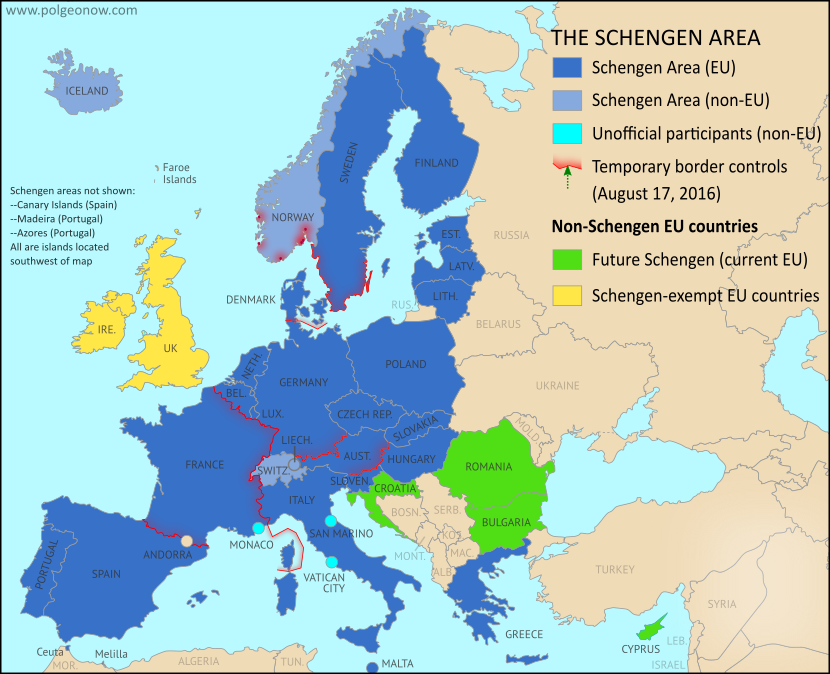
Map of Temporarily Reintroduced Border Control in the Schengen Area (the European Union's border-free travel zone) in August 2016, color-coded for EU Schengen countries, non-EU Schengen countries, future Schengen countries, and Schengen-exempt EU countries, as well as microstates unofficially participating in the Schengen agreements (colorblind accessible).
Map by Evan Centanni, from blank map by Ssolbergj. License: CC BY-SA

(Subscribers click here to view this article in the members area.)

Article by Evan Centanni

Changes to Schengen Border Controls Since March

As anyone who’s visited Europe in recent decades knows, much of the continent is linked together as part of the “Schengen Area“, a collection of countries that don’t make travelers show any ID to cross back and forth across their borders (though this system is overseen by the European Union, the Schengen Area and the EU are not the same thing). But the system does allow countries to temporarily reintroduce border controls under certain circumstances.

With last year’s spike in numbers of refugees and other immigrants arriving in Europe, many Schengen countries have rushed to control the flow of people by using these special temporary border controls. When we published our previous map of temporary Schengen border controls back in March, there were seven countries policing their borders with fellow Schengen members. Today there are only six, and there have been major changes to which borders are controlled:

Belgium’s French Border Controls Expire

In February, Belgium controversially declared an emergency reintroduction of controls along part of its border with France, which it claimed was necessary to limit flows of displaced people caused by the forced closure of a major refugee camp in France. Normally, emergency border controls have to be renewed every ten days, though Belgium announced from the outset that it planned to keep them for a whole month. However, in the end the country did respect the two-month renewal limit on emergency controls, letting them expire in late April.

Denmark Border Controls Expire, then are Reintroduced

Map of the European Union (EU) and prospective member countries
The full EU and prospective members

Denmark declared emergency controls at all its borders in January, citing “unexpected migratory flow” as the reason. Like Belgium, it kept them in place for the full two months allowable, ending on March 4.

However, Denmark followed that expiration immediately with a normal, non-emergency reintroduction of border controls, which it said were to deal with a “big influx of persons seeking international protection”.

EU-brokered Compromise Aims to Stabilize Schengen

Amid fears that the Schengen Area’s dream of free travel was going down the drain, the foreign ministers of the EU’s member countries met up and hashed out a compromise solution, which they published as an EU “recommendation” document on May 12. Though a lot of their recommendations involved telling Greece to try harder not to let refugees into Europe, they also came up with a plan to reduce the scope of the border controls by refocusing them on high-priority areas.

In exchange for keeping their controls for another six months (more than the normal maximum), five of the six remaining countries agreed to limit which parts of their borders they would police:

  • Germany agreed to control only its border with Austria, ruling out border controls with Switzerland, the Czech Republic, Luxembourg, Belgium, the Netherlands, and Denmark.
  • Austria agreed to control only its borders with Slovenia and Hungary, ruling out border controls with Italy, Switzerland, Liechtenstein, the Czech Republic, and Slovakia.
  • Denmark agreed to control only its border with Germany (including land crossings and ferry connections), ruling out border control for arrivals from Sweden or Norway.
  • Sweden agreed to control only crossings over the bridge from Denmark and sea arrivals along its western and southern coastline, ruling out controls for land borders with Norway and Finland or arrivals by sea along its east-central and northern coasts.
  • Norway agreed to control only arrivals in ports with ferry connections to Sweden, Denmark, and Germany, ruling out controls along its land borders with Sweden and Finland.

All of these border controls will be up for renegotiation after November 11-12, 2016.

France’s Border Controls Continue

The sixth country, France, has continued to control all its borders – except, presumably, the boundary with tiny Monaco, which for immigration-control purposes is already treated as if it were within French borders. France has been policing all its borders since December 14, 2015, when it introduced border controls for security in the aftermath of the massive terror attacks in Paris.

In May 2016, when its border controls were nearing their six-month expiration date (the maximum allowed for any one purpose), France notified the EU that it was extending controls for two more months while it hosted the European soccer championship and the Tour de France cycling race (major sporting events are a normal reason for Schengen countries to temporarily reintroduce border controls).

Before the two months was up, France had experienced another episode of bloody terrorist violence, the July 14 attack in the city of Nice, and it used the resulting state of emergency as reasoning to declare another six months of border controls, to last until January 2017.

And One More: Temporary Border Controls in Poland

Although the number of Schengen countries with reintroduced border controls fell to six after Belgium’s expired, for one month since our last update there were again seven of them. Poland implemented a routine reintroduction of controls on all its borders from July 4 to August 2, for security during a NATO summit and a Catholic Church “World Youth Day” event that featured a visit from Pope Francis.

The EU’s official Temporary Introduction of Border Control page actually lists Poland’s controls as continuing until September 2, but this appears to be an error. Other sources, including the same site’s comprehensive PDF record of border control notifications, all say the controls ended on August 2.

Learn More:
Map of Temporary Schengen Border Controls in March 2016
Which Countries Are in the Schengen Area, and Which EU Countries Aren’t? 

Map: Liberia and Afghanistan Join WTO

(Subscribers click here to view this article in the members area.)

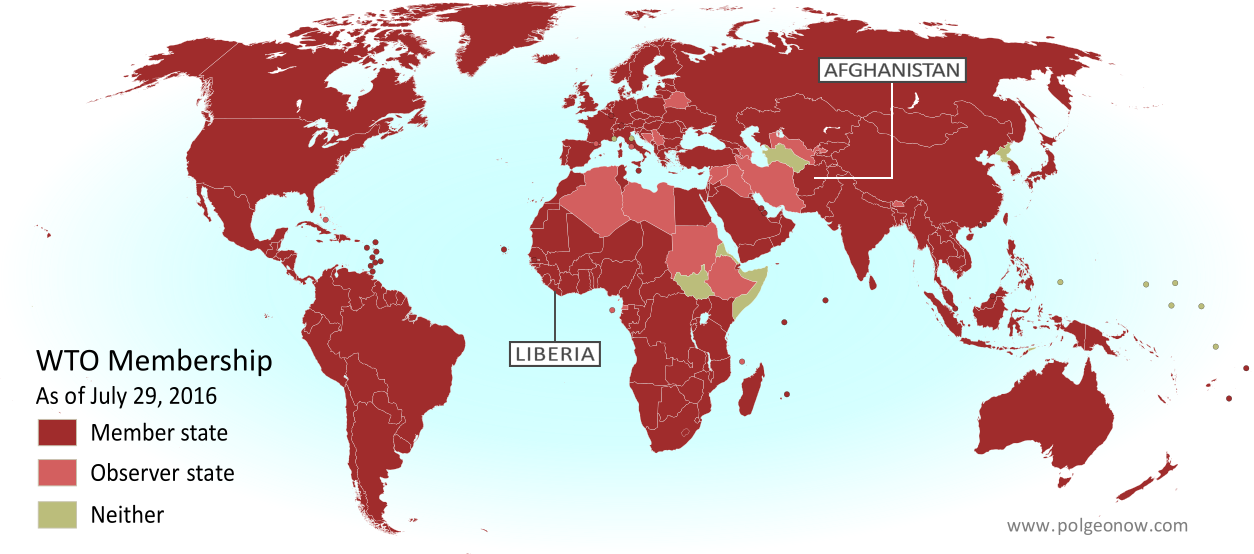
Map of World Trade Organization (WTO) member and observer countries, updated for August 2016 to include new members Liberia and Afghanistan (labeled). Color blind accessible.
Map by Evan Centanni, from public domain blank map.

Additional reporting by Caleb Centanni

Two New WTO Member Countries

This month two more countries are joining the World Trade Organization (WTO), a global body founded in 1995 to promote the management and expansion of international trade. Liberia officially became the WTO’s 163rd member on July 14, and Afghanistan joins the list as member number 164 on July 29. The last new member to join the WTO was Kazakhstan in November of last year.

Joining the WTO requires a country to sign onto a set of free trade treaties managed by the organization, and to change its laws to follow the WTO’s rules for free market trade. In return, each member country gets access to cheaper trade with all the other members, who aren’t allowed to play favorites when deciding whose imports to tax or not tax.

Logo of the World Trade Organization (WTO) Organization Name:  
• World Trade Organization (English)
• Organisation mondiale du commerce (French)
• Organización Mundial del Comercio (Spanish)
Founded: 1994 in Marrakech, Morocco (commenced in 1995)
Headquarters: Geneva, Switzerland
Website: www.wto.org

A diverse West African nation, Liberia declared independence in 1847, making it the oldest continuously independent country in Africa today. Liberia’s admission to the WTO comes after almost 10 years of negotiation, getting official approval to join in December 2015 and submitting its ratified acceptance of membership on June 14 of this year.

Afghanistan, located along the ancient Silk Road on the border of South and Central Asia, is about the 40th largest country in the world by both area and population. Afghanistan was also approved for membership last December, and submitted its ratified membership acceptance on June 29, after 11 years of negotiations.

How Many Countries are in the WTO?

Of the 195 UN-recognized countries in the world, 160 (82%) are members of the WTO. Another four members are not UN-recognized nations: China’s self-governed territories of Hong Kong and Macau, the European Union, and the disputed state of Taiwan, which participates under the name “Separate Customs Territory of Taiwan, Penghu, Kinmen and Matsu (Chinese Taipei)”.

There are also 20 WTO “observers”, down from 22 now that Liberia and Afghanistan have become full members. These countries are partially included in the organization, and have all applied for full membership (except the Holy See administration of Vatican City, which doesn’t plan to). There are only 15 UN-recognized countries that are neither members nor observers of the WTO.

Two countries, East Timor and Somalia, submitted membership applications last year, but don’t yet have WTO observer status.

More: View all articles on new WTO member countries since 2011

WTO logo is displayed without permission, based on fair use principles (source).