Watching the 2018 World Cup? Check out our updated edition of this article!
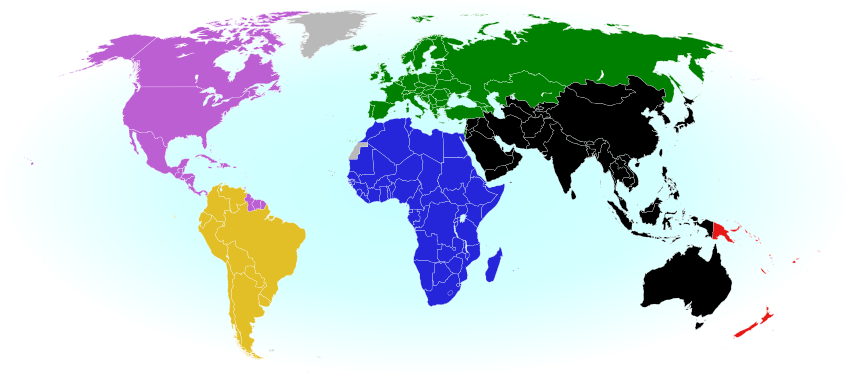 |
| The six continental confederations of national football teams associated with FIFA. Not all confederation members are individually members of FIFA. Map by Evan Centanni, based on work by EOZyo (source). |
Football/soccer fans around the world are tuning in tonight for the beginning of the month-long FIFA World Cup in Brazil. But how much do you know about which teams can compete? Which countries were eligible to enter the tournament, and which are excluded? Read on for an exclusive guide to the roster of FIFA national football teams…
Premium members click here to view this article in the ad-free members area. Not a member yet? Subscribe now!
How many countries participate in FIFA?
There are currently 209 national football teams with official FIFA membership, which is required to compete for qualification in the World Cup. FIFA members are divided into six continental confederations that preside over competitions within each region (see map above).*
You might have noticed that 209 is more than the number of actual independent countries in the world. After all, the United Nations only recognizes 195. That’s because, much like the Olympics, FIFA used to allow dependent territories to apply for membership. Now they only admit recognized independent countries (with a few exceptions), but teams that became members in the past are allowed to stay on regardless of their sovereignty status.
FIFA members that aren’t independent countries
Today there are 18 dependent territories with FIFA-eligible national football teams:
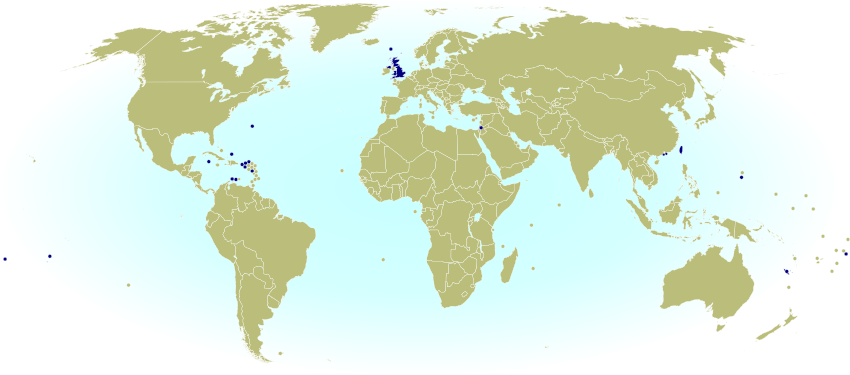 |
| Click to enlarge: FIFA members that aren’t independent countries. By Evan Centanni, from public domain base map (source). |
North America & the Caribbean
 Anguilla (UK)
 Aruba (Netherlands)
 Bermuda (UK)
 British Virgin Islands (UK)
 Cayman Islands (UK)
 Curaçao (Netherlands)
 Montserrat (UK)
 Puerto Rico (US)
 Turks and Caicos Islands (UK)
 U.S. Virgin Islands (US)
Asia
 Guam (US)*
 Hong Kong (China)
 Macau (China)
Europe
 Faroe Islands (Denmark)
Oceania
 American Samoa (US)
 Cook Islands (New Zealand)
 New Caledonia (France)
 Tahiti (France)
By tradition, each of the four “countries” making up the UK also has a separate team, despite them not being independent themselves:
 England
 Northern Ireland
 Scotland
 Wales
Also as in the Olympics, disputed states Palestine and Taiwan (known in sports as “Chinese Taipei“) are included as special cases without the requirement for fully-recognized independence. In fact, Palestine is now treated as an independent country by the UN, but that wasn’t yet the case when it was first admitted to FIFA in 1998.
Changes since 2010
Since the last World Cup in 2010, one new country has joined FIFA: South Sudan. This East African nation only became independent in 2011, after the 2010 World Cup in South Africa was already over. It’s now fully eligible, but still wasn’t able to enter in this year’s Cup because qualification matches began just before it joined.
Meanwhile, the Netherlands Antilles were eligible for the last time in 2010, though they didn’t manage to qualify for the World Cup finals. Later that same year, the Dutch dependency was split into several separate territories, and its FIFA membership was inherited only by the largest island, Curaçao, which entered for the 2014 Cup but again didn’t qualify. Two of the other island territories, Bonaire and Sint Maarten, formed their own national teams but have not been accepted as FIFA members. However, they have been allowed to participate in their relevant continental organization, the Confederation of North, Central American and Caribbean Association Football (CONCACAF).
Which countries aren’t members of FIFA?
Even though quite a few dependent territories are FIFA members, there are still a few fully independent countries that aren’t eligible:
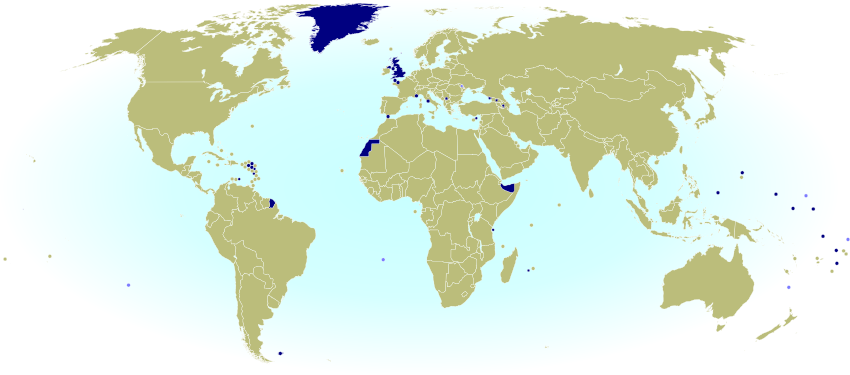 |
| Click to enlarge: Countries and territories without FIFA membership. Dark Blue: national team not recognized by FIFA; Light Blue: no known national team. Map by Evan Centanni, from public domain base map (source). |
Europe
 Monaco
 United Kingdom (UK)
 Vatican City
Oceania
 Kiribati
 Marshall Islands
 Micronesia
 Nauru
 Palau
Tuvalu
The Marshall Islands are the only independent, UN-recognized country that don’t have any national team at all. All the others on the list do have teams (yes, even Vatican City!), but are not members of FIFA. This means they’re not eligible even to enter into qualifying matches for the World Cup, though Kiribati and Tuvalu do participate as associate members in the relevant continental organization, the Oceania Football Confederation (OFC).
Even though Palestine and Taiwan managed to secure membership, other partially unrecognized countries haven’t been able to get into FIFA. There are seven non-FIFA teams belonging to de facto independent countries:
 Abkhazia
 Kosovo
 Nagorno-Karabakh
 Northern Cyprus
 Somaliland
 South Ossetia
 Western Sahara
Another unrecognized breakaway state, Transnistria, doesn’t have a national team.
Finally, there are many dependent territories that have never been able to get into FIFA. Of these, eleven territories or country subdivisions have full or associate membership in the continental confederations, but not in FIFA itself:
Africa
 Réunion (France)
 Zanzibar (Tanzania)
North America and the Caribbean
 Bonaire (Netherlands)
French Guiana (France)*
Guadeloupe (France)
 Martinique (France)
Saint-Martin (France)
 Sint Maarten (Netherlands)
Asia
 Northern Mariana Islands (US)*
Europe
 Gibraltar (UK)
Oceania
 Niue (New Zealand)
Which countries qualified for the 2014 FIFA World Cup in Brazil?
Even if a country is an eligible FIFA member, it still has to compete in the pre-tournament qualification process before moving on to the actual World Cup. Out of the 208 countries eligible at the time of qualification (remember, South Sudan missed out), there are just 32 countries qualifying for this year’s World Cup finals in Brazil. One of them, Bosnia and Herzegovina, is in the finals for the first time after gaining independence from Yugoslavia in 1992. See below for a full map of eligible and qualifying national teams in this year’s Cup:
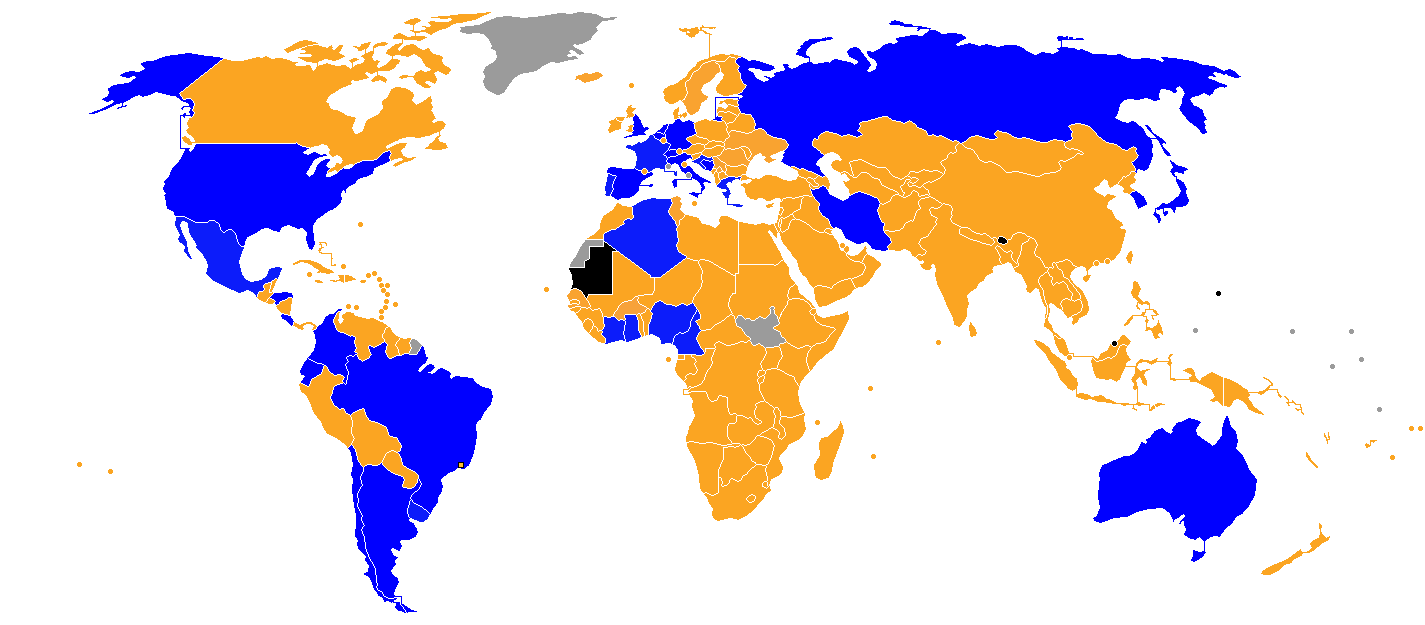 |
| Blue = countries qualifying for the 2014 FIFA World Cup; orange = countries eliminated in the qualifying rounds; black = countries that didn’t enter; gray = countries that weren’t members when qualification began. Map by Jlsa and IgorMagic (source; CC BY-SA). |
Enjoy the matches!
Note
*The six continental football confederations are based on the geographical borders of the world’s continents, but there are some exceptions. The Asian Football Confederation also includes Australia, Guam, and the Northern Mariana Islands (usually considered part of Oceania), while Caribbean countries, including South America’s Guyana, Suriname, and French Guiana, are grouped with North and Central America. As in the Olympics, Israel is a member of the European confederation despite its location on the Asian continent. Turkey, Kazakhstan, Armenia, Azerbaijan, and Georgia are also grouped with Europe but located mostly in Asia.