Map Update: Kosovo Recognized by 3 More Countries in 2015 (108/193 UN members)

Premium members click here to view this article in the ad-free members area. Not a member yet? Subscribe now!
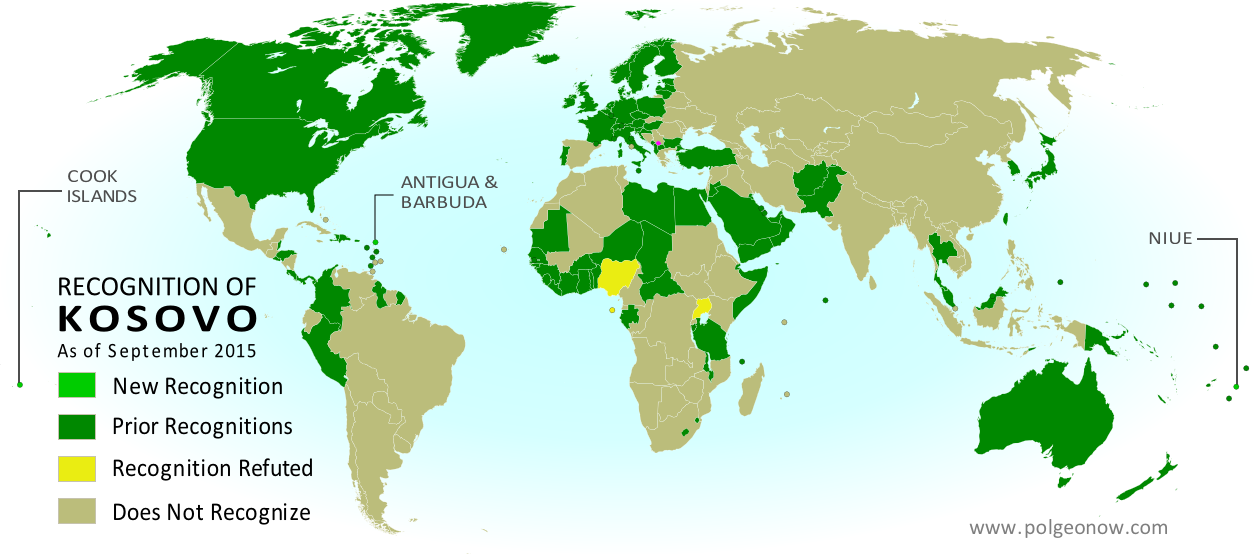
Map of countries that recognize the Republic of Kosovo as an independent state, updated to September 2015, with the most recent additions (Antigua and Barbuda, Cook Islands, and Niue) highlighted. Also shows countries that have refuted claims that they recognized Kosovo: Sao Tome and Principe, Nigeria, and Uganda.
Map by Evan Centanni, modified from public domain graphic (source).

Flag of the Republic of KosovoCountry Name:  
• Kosovo (English, Serbian)
• Kosova (Albanian)
Official Name:  
Republic of Kosovo (English)
Republika e Kosovës (Albanian)
Republika Kosovo (Serbian)
Capital: Pristina/Prishtina

Article by Evan Centanni, with additional reporting by Caleb Centanni

New Recognitions for Kosovo
Since our last Kosovo recognition map report nearly a year ago, the breakaway republic’s independence has been endorsed by three more countries. However, only one of these three new recognizers, Antigua and Barbuda, is a fully independent country and UN member. The other two, the Cook Islands and Niue, are semi-independent states often considered to be overseas territories of New Zealand.

Antigua and Barbuda, a small two-island country in the Caribbean, reportedly recognized Kosovo as independent on May 20, 2015, after several years of talks between the two states’ foreign ministers. Kosovo is now recognized by about half of the island countries in the Caribbean.

Also in May, the Cook Islands recognized Kosovo, with nearby Niue joining a month later. The Cook Islands and Niue are two nearly independent Pacific island countries in “free association” with New Zealand. They are often considered dependent territories rather than independent countries; their people retain New Zealand citizenship, and they have never declared independence or tried to join the UN. However, they are self-governed, with the choice to become independent at any time, and there’s no rule against them diplomatically recognizing other countries or being recognized in return.

Before this year, the last country to recognize Kosovo was Solomon Islands in August 2014. With the addition of Antigua and Barbuda, Kosovo is now considered independent by 108 of the 193 UN member countries (about 56 percent).

What is Kosovo?
The Republic of Kosovo, located in southeastern Europe, controversially declared independence from Serbia in 2008. It has been blocked from UN membership by objections from Serbia, Russia, and other countries who see its secession as invalid. In addition to the 108 UN members recognizing Kosovo, its independence is also acknowledged by non-UN member Taiwan. For more on Kosovo’s special situation, see our first Kosovo recognition report, which also includes a map of Kosovo’s location relative to Serbia.

Refuted Recognitions
In the past, the government of the Republic of Kosovo has been accused of exaggerating its numbers by claiming recognition from countries that didn’t really intend to recognize it. Three African countries – São Tomé and Príncipe, Uganda, and Nigeria – have denied recognizing Kosovo, and are not included in our numbers. However, they are often included in lists compiled by pro-Kosovo sources, so we have illustrated them in yellow on the above map.

And what about the most recent additions to the list? Antigua and Barbuda’s recognition of Kosovo has not been confirmed by sources outside Kosovo’s government, but because it has not been denied either, we are presuming its truth for now. The Cook Islands and Niue, on the other hand, both have online documents confirming that they’ve established diplomatic relations with Kosovo. Diplomatic relations aren’t always the same thing as recognition, but the documents make it fairly clear that the two states indeed consider Kosovo to be an independent country.

Stay Up to Date: Check for further news and map updates related to Kosovo’s recognition by viewing all Kosovo articles on Political Geography Now.
 
Flag graphic by Cradel (source). License: CC BY-SA
Kosovo Becomes an Olympic Nation

Premium members click here to view this article in the ad-free members area. Not a member yet? Subscribe now!

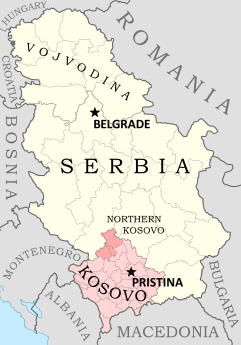
Map of Serbia, Kosovo, and North Kosovo
Kosovo controversially claims independence from Serbia (Northern Kosovo is under partial pro-Serbian control). Map by Evan Centanni, based on these two blank maps by Nord-NordWest. License: CC BY-SA

By Evan Centanni

Next Stop: Rio 2016
Disputed country Kosovo has become the 205th member of the International Olympic Committee (IOC), making it an official Olympic Nation and allowing it to field a team at the 2016 Olympics in Brazil. Its full acceptance came at an IOC meeting in Monaco on December 9, after being granted “provisional recognition” in October.

Kosovo’s admission process has been ongoing for five years, and the self-proclaimed country was denied the chance to participate in the London Olympics of 2012. However, one Kosovan athlete attended the games with the team from Albania, a neighboring country with close cultural ties to Kosovo.

Disputed Status
Located in southeastern Europe, Kosovo controversially declared independence from Serbia in 2008, while under the control of UN peacekeepers. Since then, it has been recognized as independent by over half of the world’s countries, including the US and most of the European Union. However, Russia, China and many other countries still consider it to be rightfully part of Serbia.

Flag of the Republic of KosovoCountry Name:  
• Kosovo (English, Serbian)
• Kosova (Albanian)
Official Name:  
• Republic of Kosovo (English)
Republika e Kosovës (Albanian)
Republika Kosovo (Serbian)
Capital: Pristina/Prishtina

Serbia strongly opposed Kosovo’s admission into the Olympics, arguing that Kosovan athletes had been invited to join the Serbian team. However, in the name of good sportsmanship, Serbia’s Olympic committee has declined to file a formal protest.

Rules and Precedents
Kosovo will become one of only three disputed countries allowed to send teams to the Olympics, after Taiwan (participating as “Chinese Taipei“) and Palestine. Other breakaway states, like Western Sahara, Abkhazia, and Northern Cyprus, are still shut out.

Most Olympic Nations are fully-recognized UN member countries, but the rules don’t explicitly require that. Official IOC regulations say only that every new member must be an “independent State recognised by the international community“. This has often been assumed to mean UN membership, but the IOC apparently decided it’s good enough to be recognized individually by 107 out of 193 UN member countries.

The last time the IOC admitted new members was in 2007, when Montenegro and Tuvalu both joined. Both of those countries were members of the UN prior to becoming Olympic Nations.

See Also: 
Which Countries Are (and Aren’t) in the Olympics?
Which Countries Recognized Kosovo as Independent?
 

Flag graphic by Cradel (source). License: CC BY-SA

Map Update: Kosovo Now Recognized by Every Country in Oceania (107/193 UN members)

Premium members click here to view this article in the ad-free members area. Not a member yet? Subscribe now!

Map of countries that recognize the Republic of Kosovo as an independent state, updated for October 2014, with the most recent addition (Solomon Islands) and disputed recognitions highlighted
Countries recognizing the Republic of Kosovo in green, highlighting recent additions. Disputed recognitions in yellow. Kosovo in magenta. Map by Evan Centanni, modified from public domain graphic (source).

Flag of the Republic of KosovoCountry Name:  
• Kosovo (English, Serbian)
• Kosova (Albanian)
Official Name:  
Republic of Kosovo (English)
Republika e Kosovës (Albanian)
Republika Kosovo (Serbian)
Capital: Pristina/Prishtina

By Caleb Centanni

Solomon Islands Recognizes Kosovo
Kosovo, a small breakaway state in the Balkan Region of Southeastern Europe, was recently recognized as an independent country by Solomon Islands (the country’s name is officially singular, with no “the”). This completes Kosovo’s recognition by every UN member country in the Oceania region, which includes Australia, New Zealand, and the islands of the South Pacific.

Solomon Islands, a former British protectorate in Melanesian cultural region of the South Pacific, recognized Kosovo on August 13, 2014. The foreign minister of the island country indicated that a decision was made based on “the improvement of relations between Serbia and Kosovo.” Kosovo’s foreign ministry announced the recognition on the same day.

In the past, many recognitions have been announced only by the Kosovan government, sometimes calling their validity into question (See also “Disputed Recognitions” below). In this case, however, the comments of the Solomon Islands foreign minister leave little doubt.

Solomon Islands’ recognition is Kosovo’s fourth this year, and the twelfth since the beginning of 2013. Prior to this, the most recent recognition was by Togo this past July. Kosovo is now considered a sovereign state by 107 of the 193 UN member countries (just over 55 percent).

Disputed Country
The Republic of Kosovo declared independence from Serbia in 2008, but has been blocked from UN membership by objections from Serbia, Russia, and other countries who see its secession as invalid. In addition to the 107 UN members recognizing Kosovo, its independence is also acknowledged by non-UN member Taiwan. For more on Kosovo’s special situation, see our first Kosovo recognition report, which also includes a map of Kosovo’s location relative to Serbia.

Disputed Recognitions
There are a few countries that appear on lists of UN members recognizing Kosovo, but whose actual recognitions have been called into question. The most contentious case is the African island nation of São Tomé and Príncipe, which announced its recognition of Kosovo on March 13, 2012. However, on January 7, 2013, the country’s president declared the recognition invalid on the grounds that he had not been informed of the decision. Despite this, Kosovo’s government still claims recognition from São Tomé and Príncipe. Political Geography Now has chosen not to include São Tomé and Príncipe in its tallies of recognition until the dispute has been resolved.

The Kosovan foreign ministry also still includes Uganda and Nigeria in its list of “Countries that have recognized the Republic of Kosova”, despite these two recognitions having been strongly refuted. However, as discussed in our previous Kosovo article, even the Kosovan government seems not to actively claim recognition from Uganda and Nigeria anymore.

After Solomon Islands’ recognition took effect in August, the South Pacific country’s foreign minister stated that 109 nations had recognized Kosovo (two more than our tally of 107). This likely indicates that the Solomon Islands was including São Tomé and Principe, bringing the total up from 107 to 108. The figure of 109 could be a reference to the recognition of Kosovo by Taiwan, another disputed non-UN member state that Solomon Islands considers to be an independent country.

Stay Up to Date: Check for further news and map updates related to Kosovo’s recognition by viewing all Kosovo articles on Political Geography Now.

Related Articles:
Kosovo Recognition Map Update: July 2014
North Kosovo Status Changing After Serbia Deal
Which Countries Recognize Palestine as Independent?
 
Flag graphic by Cradel (source). License: CC BY-SA

North Kosovo Status Changing After Serbia Deal

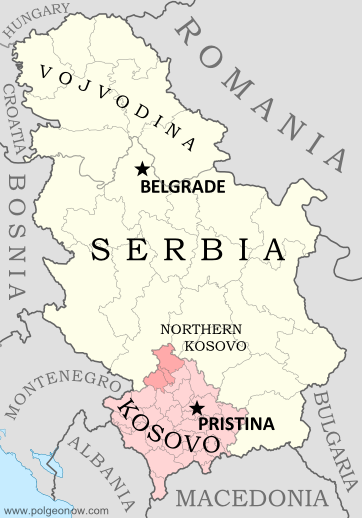
Map of Serbia, Kosovo, and North Kosovo
Map by Evan Centanni, based on these two blank maps by Nord-NordWest. License: CC BY-SA

Kosovo & Serbia in Historic Agreement
Serbia and the breakaway Republic of Kosovo reached a landmark deal on Friday to normalize their relations, partially compromising on several contentious issues between the two governments in southeastern Europe. Kosovo declared its independence from Serbia in 2008, but due to Serbia’s opposition it has still not achieved full international recognition. 

Status Change for North Kosovo
North Kosovo is the largest of several areas within Kosovo where the majority of people are part of the Serb ethnic group, whereas 90% of people in Kosovo as a whole are ethnically Albanian. When Kosovo split from Serbia, many Serbs in the north refused to go, governing themselves separately from Kosovo and choosing instead to continue cooperating with and accepting government funding from Serbia.

Territory Name:  
• North Kosovo (English)
• Severno Kosovo (Serbian)
Kosova Veriore (Albanian)
Claimants: 
• Republic of Kosovo
• Serbia
Actual Control: Local pro-Serbia groups, foreign peacekeepers
Status: No official status
Capital: Kosovska Mitrovica (de facto)

Under the new agreement, Serbia will stop treating North Kosovo as part of its territory, in exchange for the region receiving a degree of autonomy within Kosovo. Notably, Serbs in North Kosovo will now be able to legally manage their own police force. However, there may still be a bumpy road ahead, since Serb leaders in North Kosovo are refusing to accept the compromise.

Flag of the Republic of KosovoCountry Name:  
• Kosovo (English, Serbian)
• Kosova (Albanian)
Official Name:  
Republic of Kosovo (English)
Republika e Kosovës (Albanian)
Republika Kosovo (Serbian)
Status: Partially recognized; claimed by Serbia
Capital: Pristina/Prishtina

Eligibility for EU

The biggest benefit Serbia gets out of this week’s deal is eligibility to apply for membership in the European Union (EU). The EU, which admits new members on a case-by-case basis, had told Serbia it would never be considered unless it first relinquished control of North Kosovo. Serbia has also agreed not to get in the way if Kosovo applies to join the EU too.

Serbia Still Not Recognizing Kosovo
The Holy Grail for Kosovo would have been official diplomatic recognition of its independence from Serbia. However, the agreement stopped short of Serbia calling Kosovo an independent country. Kosovo’s Prime Minister has claimed that the deal counts as recognition anyway, but Serbia has emphatically denied this.

Kosovo is recognized as independent by about half of all the world’s countries, including the majority of the EU and NATO, but opposition from Serbia and Russia has kept it locked out of the UN. For a current map of all of the countries that recognize Kosovo, see Kosovo Recognition Update: April 2103.

Article by Evan Centanni. Kosovo flag graphic by Cradel (source) (CC BY-SA).

Kosovo Now Recogized by Half of U.N. (97/193)

Map of countries that recognize the Republic of Kosovo as an independent state, updated for December 2012 with most recent additions highlighted
Countries recognizing the Republic of Kosovo in green, with the five most recent additions to the list labelled. Kosovo in magenta. Map by Evan Centanni, modified from public domain graphic (source).

Flag of the Republic of KosovoCountry Name:  
• Kosovo (English, Serbian)
• Kosova (Albanian)
Official Name:  
Republic of Kosovo (English)
Republika e Kosovës (Albanian)
Republika Kosovo (Serbian)
Capital: Pristina/Prishtina

Kosovo Recognition Update
Since our last report on recognition of the Republic of Kosovo, five more U.N. members have endorsed independence for the disputed country in southeastern Europe. This brings the list of member countries recognizing Kosovo to 97, or just over 50% of the U.N. (there are currently 193 sovereign states in the U.N.).

One country, the Southeast Asian island state of East Timor, actually recognized Kosovo back in September, before our last report. However, we didn’t know that at the time, so it didn’t make it into that update.

The other four U.N. member countries which have granted recognition to Kosovo since last time are Burundi in West Africa, Fiji in the South Pacific, and two small Caribbean island states, Dominica and St. Kitts and Nevis. A full list of countries recognizing Kosovo, including references and dates of recognition, is available on Wikipedia.

The Republic of Kosovo seceded from Serbia in 2008, but has been blocked from U.N. membership by objections from Serbia, Russia, and other countries which see its secession as invalid. In addition to the 97 U.N. members who individually recognize Kosovo, its independence is also acknowledged by one non-U.N. member, Taiwan. For more on Kosovo’s special situation, see our first Kosovo recognition report from earlier this year.

Stay Up to Date: Check for further updates to this story by viewing all Kosovo articles on Political Geography Now. 

Flag graphic by Cradel (source). License: CC BY-SA

Kosovo Diplomatic Recognition Continues

Country Name: Kosovo (English, Serbian), Kosova (Albanian)
Official Name: Republic of Kosovo (English), Republika e Kosovës (Albanian),
Republika Kosovo (Serbian)
News Categories: Recognition, Partially Recognized States, Breakaway States
Summary: The Republic of Kosovo has continued to receive diplomatic recognition from other countries, despite widespread opposition to its 2008 declaration of independence from Serbia. Thirteen more U.N. members have declared their recognition of independent Kosovo just within the last year.

Flag of the Republic of Kosovo
Flag of the Republic of Kosovo.
Image by Cradel (source). License: CC BY-SA

Full Story
The majority of recently independent countries, such as South Sudan and Montenegro, enjoy unopposed recognition from the U.N. and its members. However, acceptance into the international community doesn’t always come so easily. Kosovo is one example: because it declared its independence without first coming to an agreement with its former host country (unlike South Sudan and Montenegro), it has struggled to gain acceptance as a sovereign state. The last of the Balkan countries to declare independence after the breakup of Yugoslavia in the 1990s, Kosovo was first separated unofficially from the country in 1999, when NATO intervened militarily in the province to stop Serbian government violence against ethnic Albanians. The Albanians are a cultural group from southeastern Europe who speak a unique language only distantly related to other European tongues, and like the Bosniaks in nearby Bosnia & Herzegovia, are one of the few majority-Muslim European peoples. They also form a majority of the population in the neighboring country of Albania.

Map of Kosovo within Serbia
Kosovo, claimed as a province of Serbia, is
policed by U.N. and E.U. peacekeepers. The
Republic of Kosovo also governs the region,
except for the Serbian-loyalist north. Map is
my own work, based on these two blank
maps by Nord-NordWest. License: CC BY-SA

Policed by a U.N. peacekeeping mission since 1999, most of Kosovo has never since been controlled by the Yugoslav (now Serbian) government, though the U.N. still officially considers it to be a province of Serbia. Despite fierce political opposition from Serbia, Russia, and other countries, as well as from the ethnic Serb minority within Kosovo, the local government declared independence in 2008. The self-proclaimed Republic of Kosovo government has since administered the territory alongside the U.N. and another police force sent by the European Union, though the Northern Kosovo area, a Serb-majority region, has resisted independence and continues to support the Serbian government in Belgrade, even setting up roadblocks to keep out the Kosovan police – a sort of breakaway state within a breakaway state.

The Republic of Kosovo has not been admitted into the U.N., and it is recognized by only 88 U.N. member countries (many of them NATO members or countries with Muslim populations) and one other state (Taiwan). Serbia and Russia still strongly oppose independence for Kosovo, but the list of states recognizing its sovereignty has nevertheless continued to grow. Within the last year, 13 more U.N. members have offered diplomatic recognition of Kosovan independence: Andorra, the Central African Republic, Guinea, Niger, Benin, Saint Lucia, Nigeria, Gabon, Ivory Coast, Kuwait, Uganda, Ghana, and Haiti.

Map of countries recognizing the Republic of Kosovo
Diplomatic recognition of the Republic of Kosovo. Countries that recognized Kosovan independence recently (in the last twelve months) in light green, others in dark green; Kosovo in magenta. Public domain (source).

Sources: See citations on Wikipedia’s list of Entities that recognize Kosovo as an independent state.