
 |
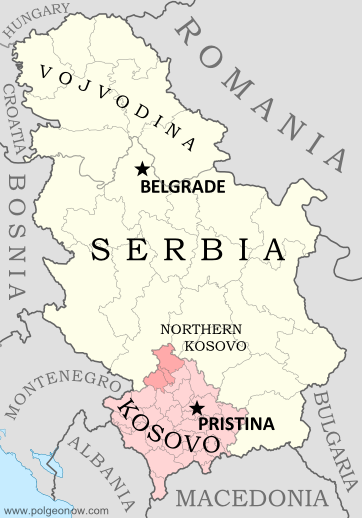
| Map by Evan Centanni, based on these two blank maps by Nord-NordWest. License: CC BY-SA |
Kosovo & Serbia in Historic Agreement
Serbia and the breakaway Republic of Kosovo reached a landmark deal on Friday to normalize their relations, partially compromising on several contentious issues between the two governments in southeastern Europe. Kosovo declared its independence from Serbia in 2008, but due to Serbia’s opposition it has still not achieved full international recognition.
Status Change for North Kosovo
North Kosovo is the largest of several areas within Kosovo where the majority of people are part of the Serb ethnic group, whereas 90% of people in Kosovo as a whole are ethnically Albanian. When Kosovo split from Serbia, many Serbs in the north refused to go, governing themselves separately from Kosovo and choosing instead to continue cooperating with and accepting government funding from Serbia.
| Territory Name: • North Kosovo (English) • Severno Kosovo (Serbian) • Kosova Veriore (Albanian) Claimants: • Republic of Kosovo • Serbia Actual Control: Local pro-Serbia groups, foreign peacekeepers Status: No official status Capital: Kosovska Mitrovica (de facto) |
Under the new agreement, Serbia will stop treating North Kosovo as part of its territory, in exchange for the region receiving a degree of autonomy within Kosovo. Notably, Serbs in North Kosovo will now be able to legally manage their own police force. However, there may still be a bumpy road ahead, since Serb leaders in North Kosovo are refusing to accept the compromise.
 Country Name: Country Name: • Kosovo (English, Serbian) • Kosova (Albanian) Official Name: • Republic of Kosovo (English) • Republika e Kosovës (Albanian) • Republika Kosovo (Serbian) Status: Partially recognized; claimed by Serbia Capital: Pristina/Prishtina |
Eligibility for EU
The biggest benefit Serbia gets out of this week’s deal is eligibility to apply for membership in the European Union (EU). The EU, which admits new members on a case-by-case basis, had told Serbia it would never be considered unless it first relinquished control of North Kosovo. Serbia has also agreed not to get in the way if Kosovo applies to join the EU too.
Serbia Still Not Recognizing Kosovo
The Holy Grail for Kosovo would have been official diplomatic recognition of its independence from Serbia. However, the agreement stopped short of Serbia calling Kosovo an independent country. Kosovo’s Prime Minister has claimed that the deal counts as recognition anyway, but Serbia has emphatically denied this.
Kosovo is recognized as independent by about half of all the world’s countries, including the majority of the EU and NATO, but opposition from Serbia and Russia has kept it locked out of the UN. For a current map of all of the countries that recognize Kosovo, see Kosovo Recognition Update: April 2103.
Article by Evan Centanni. Kosovo flag graphic by Cradel (source) (CC BY-SA).
Kosovo declared independence in February 2008. That is when their parliament actually affirmed it, when the world began to recognize it and the day Kosovars celebrate it.
Lest it be feared that the agreement will not stand the test of time, its use is only temporary, until Serbia and Kosovo become states. that's when the EU can really maintain peace in that region See http://thewordenreport.blogspot.com/2013/04/the-role-of-eu-as-peace-maker-case-of.html
Lest it be supposed that the agreement must be so strong as to endure indefinately, it is merely a means by which Servia and Kosovo can become E.U. states. As states, Serbia and Kosovo would be contained. http://www.thewordenreport.blogspot.com/2013/04/the-role-of-eu-as-peace-maker-case-of.html at the Worden Report.
You're absolutely right. I apologize for the error, and it's been corrected now.
For anyone who's wondering, I had accidentally indicated 1999 as Kosovo's date of independence. That's the year that the Kosovo war ended, leaving Kosovo outside of Serbian control and under the care of the United Nations. The declaration of independence came nine years later.
I would note that Serbia is indisputably already a state, and Kosovo is often considered to be one as well. Joining the EU would give them EU membership only, not statehood, though it may help Kosovo to become even more widely recognized as a state.
The part I don't get is what Serbia gets out of this. How is joining the EU advantageous, considering its current financial problems? And even if it is advantageous, why do Serbians think they will get accepted, considering that Germany is unwilling to support more nations with poor economic track records and Turkey, which has a growing economy, has still not been accepted? It looks like Kosovo has just won a but of their territory back at zero cost and Serbia has gotten nowhere.
I'm not an economic analyst, but apparently many countries still want to get into the EU despite its current troubles, so there must still be some solid economic rationale for that. And the EU had specifically told Serbia that the North Kosovo issue was the main thing blocking it form joining, so it's implied that they're already planning to let Serbia in if it solves that problem (and I believe that since the deal Serbia's application for membership is indeed going forward). Turkey may still not have met the conditions given to it by the EU for admission.
A man who puts Dr. before his name/surname should really be a little better informed about the situation he is talking about. And not spamming us with some 3rd grade propaganda material (I'm addressing to the link this wannabe expert provided us with). Where the story maker didn't even bother or was to lazy and ignorant to find a real map of the area or he is in fact provoking Serbs with the map he presented. Any one who is informed just look at the little map in the link, its like a slap in the face.
Shame on you wannabe expert.