Announcement: The Future of PolGeoNow

Dear Readers,

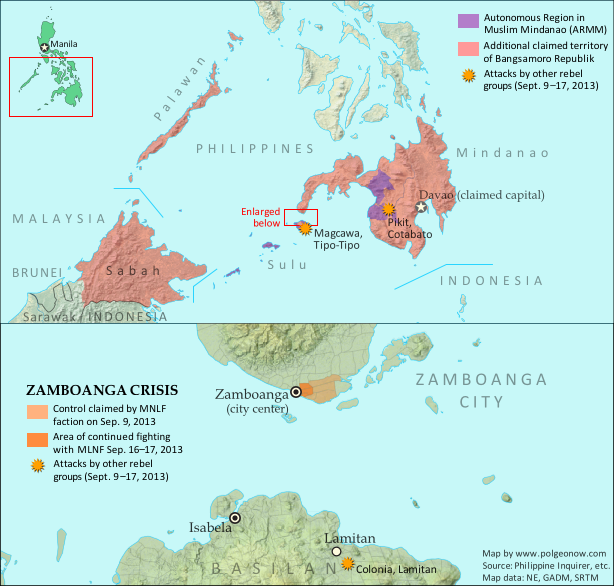
Map of territory in the Philippines and Malaysia claimed by the Bangsamoro Republik, plus territorial control by the Moro National Liberation Front (MNFL) as part of the the Zamboanga crisis.
This map took 20 hours of work.

Two and a half years ago, I started Political Geography Now as a site for people who want to keep up with changes to the world political map. It’s grown a great deal in both readership and coverage of world events since then. And as some of you know, it’s been almost entirely a labor of love. Putting out new maps and reports requires hours of work every week, but has earned me almost zero money.

I’m happy that I can use my free time to create something cool. But after years of living paycheck-to-paycheck off part-time side jobs, the stress of creating almost-weekly new maps and articles has become too much to juggle. I’m busy all the time, but still struggling to pay my rent each month. If Political Geography Now is going to continue publishing its high-quality maps and articles, it needs to start generating some modest income.

I don’t want end or scale back the blog any more than you do, so here’s the plan: from next month PolGeoNow will continue to publish many free articles and maps on the site, but also start offering some paid premium content. If you can’t afford to pay, I understand – you’ll still get to enjoy regular updates and great maps, and the entire catalog of past articles will always be freely accessible. But if you are able to pay to support our work, you’ll get access to even more original maps and in-depth, professional reporting. I hope to even expand coverage in some areas, for example by publishing more frequent updates to conflict zone maps.
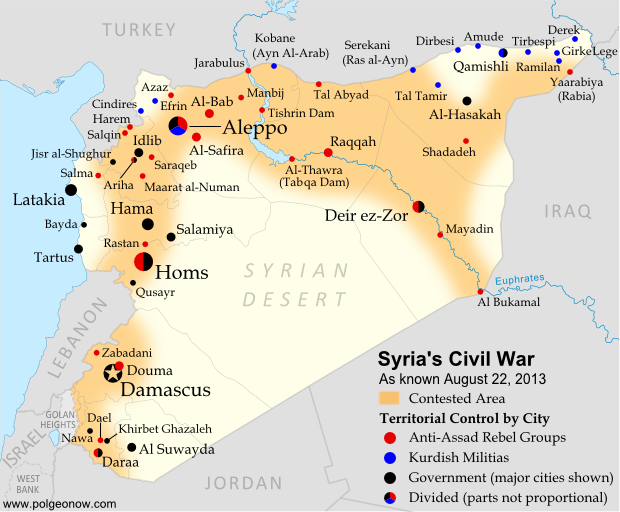
Map of territorial control in Syria's civil war
Want more frequent Syria updates?

Though it may be possible to buy individual articles in the future, I’m starting off by offering paid subscriptions to access all premium content online. Besides all the great content, subscribing will also get you an ad-free interface and discounts on special services or products the site may provide in the future. If you’re already sold, you can sign up now to lock in the introductory price!

Moving to even a partial paid model has been a very tough decision, and I hope you can all bear with us through the transition. I’m always happy to hear feedback from PolGeoNow readers, so feel free to let me know about any of your advice or concerns. Thank you so, so much for all your wonderful support so far!

All the best,

Evan Centanni
evan@polgeonow.com
New premium subscriptions: Sign Up Now!

No More Bangsamoro Republik: Philippine Rebel Occupation Defeated

Map of territory in the Philippines and Malaysia claimed by the Bangsamoro Republik, plus territorial control by the Moro National Liberation Front (MNFL) during last month's Zamboanga crisis.
Claims and territorial control of the MNLF rebels and Bangsamoro Republik during last month’s crisis. Click to see full-sized map and article. Map by Evan Centanni.

Territory Retaken by Government
Last month, Political Geography Now mapped Moro rebel control in the Philippines’ Zamboanga crisis. The rebels, drawn from a group which had declared independence from the Philippines as the Bangsamoro Republik, had occupied several neighborhoods of Zamboanga City in the country’s southwest after an aborted attempt to raise their flag in the city center.

Ten days after we published that article, the government of the Philippines declared the crisis over, with all hostages freed and only scattered fighting occurring over the next two days as the surviving rebels attempted to escape the area. After nearly three weeks of chaos, the city of Zamboanga was once again fully under government control.

What of the MNLF fighters?
Though hundreds of rebels from the Moro National Liberation Front (MNLF) were killed in the fighting, some did escape, and the attack’s commander Habier Malik is still missing. Nur Misuari, the faction’s leader and founder of the self-declared Bangsamoro Republik, was not present at the attack but is now wanted on charges of rebellion. But he may have more than just the government to worry about – Malik’s surviving men from the Zamboanga attack are also said to be on the hunt for Misuari, who allegedly tricked them into participating. According to Mujiv Hataman, governor of the officially sanctioned Autonomous Region in Muslim Mindanao (ARMM), Misuari promised Malik’s men that U.N. peacekeepers would arrive soon after the attack to secure Bangsamoro independence and reward each fighter with 10,000 pesos (US $230) and a new weapon.

BIFF Attacks
Attacks by other Moro rebel groups in nearby regions continued until just after Zamboanga was secured. In particular, the Bangsamoro Islamic Freedom Fighters (BIFF), a splinter group from the Moro Islamic Liberation Fighters (MILF) who are currently in peace talks with the Philippine government, continued launching attacks elsewhere in Mindanao into early October. The BIFF is not closely tied to Nur Misuari’s MNLF, and these were apparently just opportunistic attacks taking advantage of the military’s distraction during the crisis in Zamboanga.

More information: Bangsamoro Republik? Philippine Separatists Seize Territory (map)

Map Update: Kosovo Recognized by 3 More Countries (103/193)

Map of countries that recognize the Republic of Kosovo as an independent state, updated for October 2013 with most recent additions (Thailand, Libya, Granada) and disputed recognitions highlighted
Countries recognizing the Republic of Kosovo in green, highlighting recent additions. Disputed recognitions in yellow. Kosovo in magenta. Map by Evan Centanni, modified from public domain graphic (source).

Flag of the Republic of KosovoCountry Name:  
• Kosovo (English, Serbian)
• Kosova (Albanian)
Official Name:  
Republic of Kosovo (English)
Republika e Kosovës (Albanian)
Republika Kosovo (Serbian)
Capital: Pristina/Prishtina

By Evan Centanni

New Kosovo Recognitions
Late last month, three more countries extended formal recognition to the self-proclaimed Republic of Kosovo. The breakaway state in southeastern Europe now is recognized as independent by at least 103 U.N. member countries (53%). As discussed in our previous Kosovo recognition map update, there are three additional recognitions which are currently in question. Political Geography Now has now chosen to exclude all of these from future tallies until the question of their validity is resolved.

The three U.N. member countries which have recently recognized Kosovo are Thailand in Southeast Asia, Libya in North Africa and Grenada in the Caribbean. All three offered their recognition within a few days of each other near the end of September, during the meeting of the U.N. General Assembly in New York. Libya’s decision in particular was publically announced from the sidelines of that meeting.

The Republic of Kosovo declared independence from Serbia in 2008, but has been blocked from U.N. membership by objections from Serbia, Russia, and other countries who see its secession as invalid. In addition to the 103 U.N. members recognizing Kosovo, its independence is also acknowledged by non-U.N. member Taiwan. For more on Kosovo’s special situation, see our first Kosovo recognition report, which also includes a map of Kosovo’s location relative to Serbia.

Stay Up to Date: Check for further news and map updates on Kosovo’s recognition by viewing all Kosovo articles on Political Geography Now.

Related Articles:
Kosovo Recognition Map Update: August 2013
North Kosovo Status Changing After Serbia Deal
Who Recognizes Palestine in 2013?
 

Flag graphic by Cradel (source). License: CC BY-SA

New ALBA Member: Saint Lucia (Map)

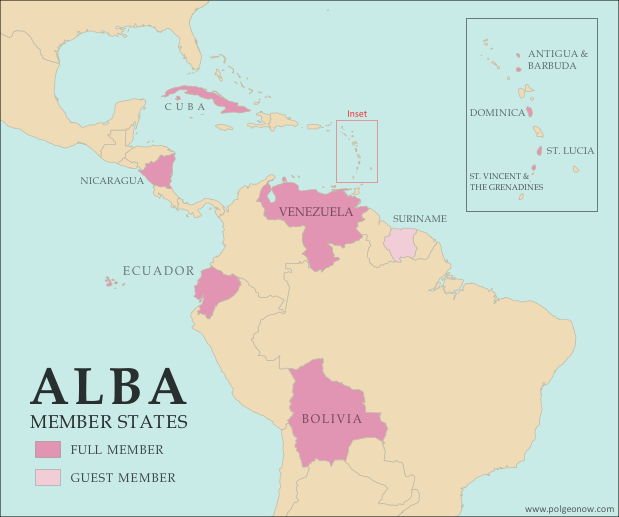
Map of the Bolivarian Alliance for the Peoples of Our Americas (ALBA), showing full member countries, including new member Saint Lucia, as well as special guest members (colorblind accessible).
The Bolivarian Alliance for the Peoples of Our Americas (ALBA). Map by Evan Centanni.

Emblem of the Bolivarian Alliance for the Peoples of Our Americas (ALBA)Organization Name:  
• Bolivarian Alliance for the Peoples of Our Americas (English)
• Alianza Bolivariana para los Pueblos de Nuestra América (Spanish)
Launched: 2004 in Havana, Cuba
Headquarters: Caracas, Venezuela
Website: www.alianzabolivariana.org

Article by Evan Centanni

What is ALBA?
The Bolivarian Alliance for the Peoples of Our Americas (ALBA) is an intergovernmental organization open to countries located in the region of the Americas. “Bolivarian” refers to Simón Bolívar, a 19th century leader who founded several South American countries and wanted the whole continent to unite together as a single nation.

ALBA was founded in 2004, as a response to the U.S.’s rejected proposal to create a Free Trade Area of the Americas (FTAA). The FTAA would have extended the North American Free Trade Agreement (NAFTA) – which has lowered trade barriers between the U.S., Canada, and Mexico – to all of South America, Central America, and the Caribbean except for Cuba.

As a counter to the capitalist spirit of the FTAA proposal, Presidents Hugo Chávez of Venezuela and Fidel Castro of Cuba soon agreed to create ALBA, an organization for promoting greater integration among the socialist and social democratic countries of the region.

ALBA plans to eventually introduce a new currency, the SUCRE, which will be shared by the member countries just like how the euro is the shared currency of much of the European Union. Virtual SUCRE currency is already in use for some electronic transfers of money between ALBA member countries.

Past Growth
Although Cuba and Venezuela were originally the only two members of ALBA, the like-minded governments of Bolivia and Nicaragua joined in 2006 and 2007 respectively. Dominica became a member in 2008, followed by Antigua and Barbuda, Ecuador, and Saint Vincent and the Grenadines in 2009. Early last year, the organization admitted Suriname and Saint Lucia as “special guest members,” indicating that they were in the process of achieving full membership. Membership in ALBA is not exclusive – many member countries are also part of other regional blocs such as UNASUR, Mercosur, or the Caribbean Community (CARICOM).

New Member

Flag of Saint Lucia Country Name:  
• Saint Lucia (English)
Sainte-Lucie (French)
Official Name: (same)
Capital: Castries

While Suriname remains a special guest member, Saint Lucia was officially inducted as a full member at the end of this July. Saint Lucia is a small island country in the Caribbean, which was both a British and a French colony at times in the past. The Saint Lucian government’s decision to join ALBA has garnered mixed responses from opposition parties, and becoming part of the anti-imperialist organization is seen by some as a break from the island’s history of close ties with the U.K. There is also debate over the role of the new SUCRE currency in a country that already uses the shared East Caribbean dollar.

Related Articles:
Venezuela Joins Mercosur, Paraguay Suspended
Croatia Joins European Union, Leaves CEFTA
Laos and Tajikistan Join WTO