Vatican City Administration Recognizes Palestine as a Country (map)

(Keep up with changes to Palestine’s situation: view all Palestine updates.)

Map of countries that recognize the State of Palestine as an independent country, updated for June 2015 with recent addition Vatican City (Holy See) highlighted
Click to enlarge: Countries recognizing the State of Palestine in green, with most recent addition highlighted. Palestine in magenta (circled). Map by Evan Centanni, modified from public domain graphic (source).

Subscribers click here to view this article in the ad-free members area. Not a member yet? Subscribe now!

Article by Evan Centanni

Vatican Recognizes Palestine
Last month the Holy See – the official administration of the Roman Catholic Church and government of Vatican City – became the latest national government to recognize Palestine as an independent country. The explicit acknowledgement of Palestine’s statehood came with a treaty signed May 13, 2015, regarding the activities of the Catholic Church within Palestine’s territory. 

In the face of criticism from Israel’s government and other groups, the Vatican played down the significance of the treaty, saying that the Holy See had really recognized Palestine ever since supporting the UN vote on Palestinian’s statehood in 2012. However, official diplomatic recognition usually requires an explicit statement by the country’s government, so the Holy See was presumed not to formally recognize Palestine until now.

Learn More: What’s the difference between Vatican City and the Holy See?

Vatican City is now one of about half the world’s countries whose government recognizes both Palestine and Israel as independent countries. But Palestine is recognized by only a few countries in Europe, and the Holy See is only the fifth European government to recognize since the end of the Cold War. The last was Sweden in October 2014, preceded by Iceland in 2011, Montenegro in 2006, and Bosnia in 1992.
Flag of Palestine Country Name:  
• Palestine (English)
Filasṭīn (Arabic)
Official Name:  
• State of Palestine (English)
• Dawlat Filasṭin (Arabic)
Capital: 
• Jerusalem (claimed)
Ramallah (administrative)

Palestine: Disputed Country
The Palestinian Liberation Organization (PLO) declared independence for Palestine in 1988, and has been seeking international acceptance for the proclaimed country ever since. Though its claimed territories are disputed and largely occupied by Israel, the “State of Palestine” is recognized by more than two-thirds of the world’s countries, and is also treated as a country by the UN General Assembly, where it is an “Observer State” but not a member.

The Holy See also has Observer State status in the UN, making Vatican City and Palestine the only two countries that are acknowledged as independent by the UN, but do not have votes in the General Assembly.

The number of individual countries recognizing Palestine as independent has grown gradually over the past decades. Last year we reported that 135 UN member states officially recognized Palestine (70% of all UN members), and this is still the case today, since Vatican City is not a full UN member. Palestine is also recognized by the proclaimed government of Western Sahara, a fellow disputed country whose independence is not formally recognized by the UN at all.

Related:
Is Palestine Really a Country?
Palestine Recognized as a Country by the U.N.
Map of Countries Recognizing Kosovo
What is Vatican City?

This week, the Catholic Church chose a new leader, Pope Francis. The selection and announcement of the new pope took place in Vatican City, the Church’s sovereign territory within Rome. Is Vatican City really “the world’s smallest country”, or a country at all?  And what’s the difference between Vatican City and the Holy See? Read all about it!

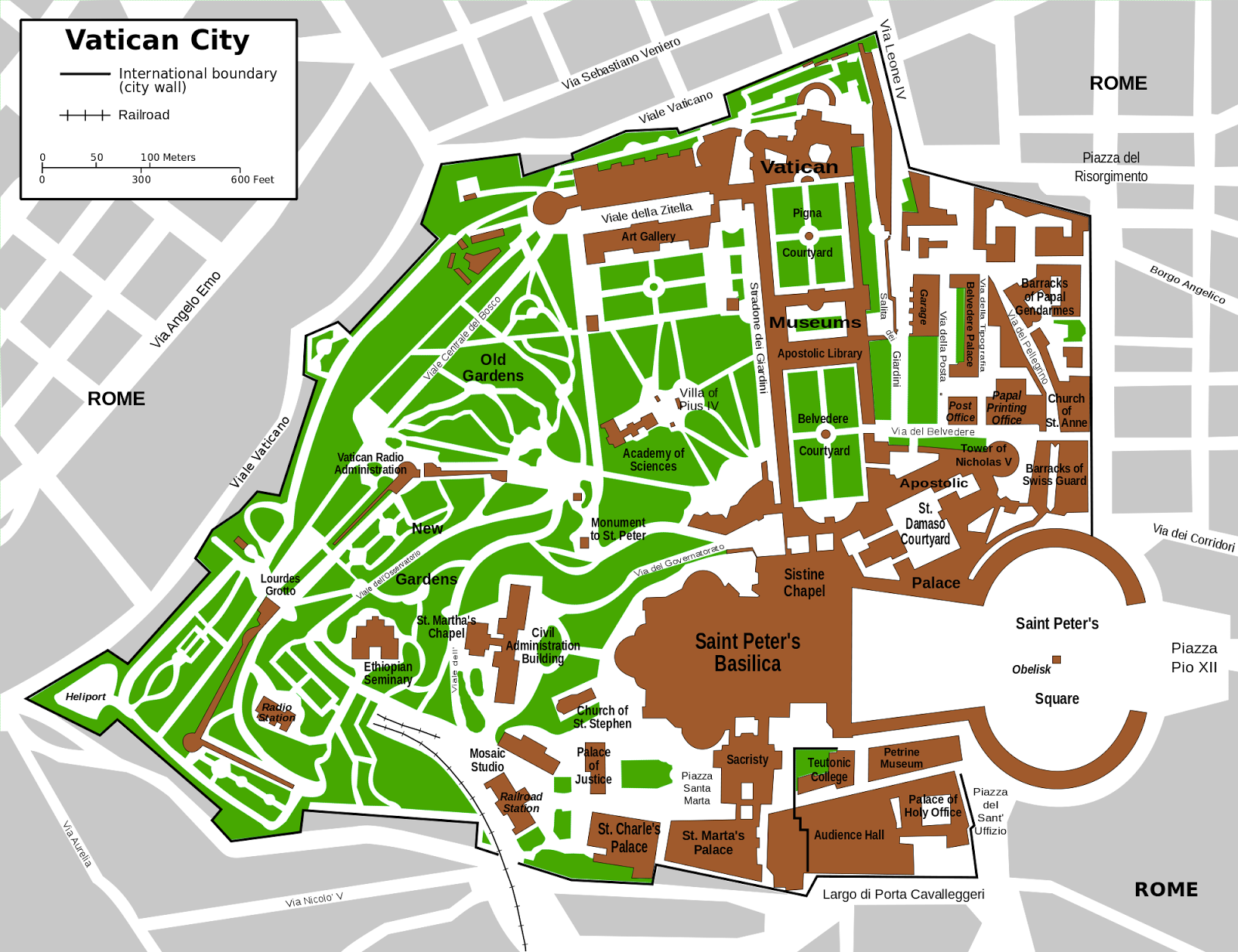
Large scale (close-up) map of Vatican City
Map of Vatican City (click to enlarge). By Francesco Piraneo G./Wikimedia Commons (CC BY-SAsource).

What is Vatican City?

Vatican City was created by the Lateran Treaty in 1929 to ensure the Catholic Church’s independence from the control of other countries, and has an area of only about 0.17 sq mi (0.44 sq km), or about one-eighth the size of Central Park in New York. In addition to the Pope, the state said to have a population of about 800, most of whom are either clergy or members of the Swiss Guard.

Located within the city of Rome, Vatican City is surrounded on all sides by Italy, and nearly encircled by a stone city wall except for in St. Peter’s Square, where it is separated from Italy only by a white line drawn on the ground. Various religious and administrative buildings are located within Vatican City’s confines, but more than half of its area is taken up by the green space of the Vatican Gardens.

Flag of Vatican CityCountry Name:  
• Vatican City (English)
• Città del Vaticano (Italian)
Official Name:  
• Vatican City State (English)
• Stato della Città del Vaticano (Italian)
Capital: Vatican City

Is Vatican City really a country?

Yes, technically. Although it doesn’t really have the kind of population and national cultural identity we would often expect from a “country”, it is recognized worldwide as a “sovereign state”, which means it rules itself and answers to no one else. This makes it by far the world’s smallest independent “country”, at less than a quarter the size of the runner-up, Monaco.

Vatican City’s supreme leader is the Bishop of Rome, a.k.a. the Pope, who is also head of the worldwide Catholic Church. And not only is its independence undisputed by the international community, but it actually maintains diplomatic relations with the U.N. and many countries – sort of. Vatican diplomacy is conducted not in the name of Vatican City itself, but directly by the Catholic Church in the name of the “Holy See”.

What’s the difference between Vatican City and the Holy See?

In short, Vatican City is a state (i.e. country), while the Holy See is a religious organization which happens to govern Vatican City, but has a broader purpose. In Catholic Church terminology, a “see” is the seat of authority of a particular bishop, and the “Holy See” refers to the authority of the Bishop of Rome (the Pope).

So the Holy See is the religious authority presiding over Catholic churches all across Rome (and by extension, the entire Catholic world), but it has normal government authority only in Vatican City and its “extraterritorial properties“. These properties, mostly churches or historical palaces located elsewhere in Rome, have a status similar to foreign embassies: they are technically part of Italy, but are under the legal jurisdiction of the Holy See.

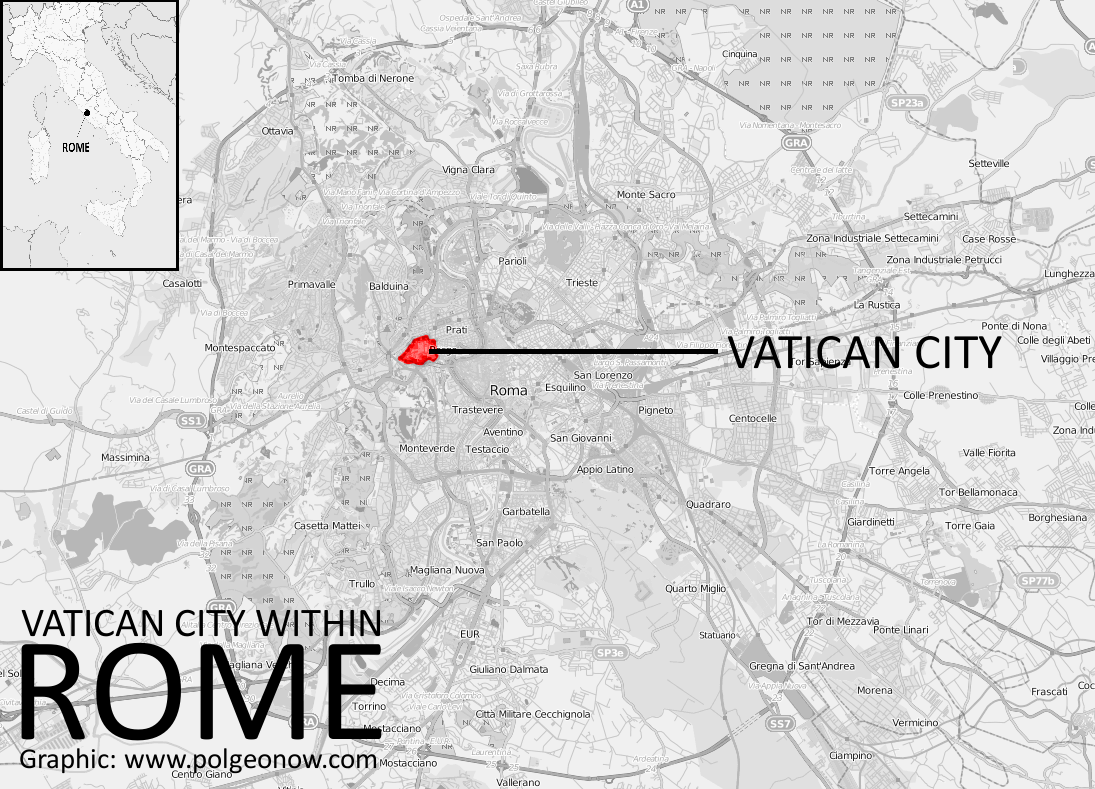
Map showing location of Vatican City within Rome
Vatican City’s location within Rome (click to enlarge). By Evan Centanni. Background map by Dr. Blofeld. License: CC BY-SAsource).

The term “the Vatican” can mean either Vatican City itself, or the Holy See, sort of like how “Washington” or “Beijing” can refer to the U.S. or Chinese governments rather than just the cities.

Bonus Facts

• Vatican City is the only undisputed country in the world which is not a member of the U.N. However, the Holy See does have status as a “permanent observer state” in the U.N. General Assembly. The only other U.N. observer state is Palestine, which just gained that status in November 2012.

• Although Vatican City was created only in 1929, the Holy See has existed for many hundreds of years. It was often recognized as a “sovereign entity” even when it had no territory, though at many points in history it did control territories much larger than today’s Vatican City.

• The Holy See’s official language is Latin, but Vatican City uses Italian as its state language. The Vatican’s only military force, the Swiss Guard, gives orders in German.

Graphic of the Vatican City flag is in the public domain (source).