All About Nagorno-Karabakh’s 2017 Name Change

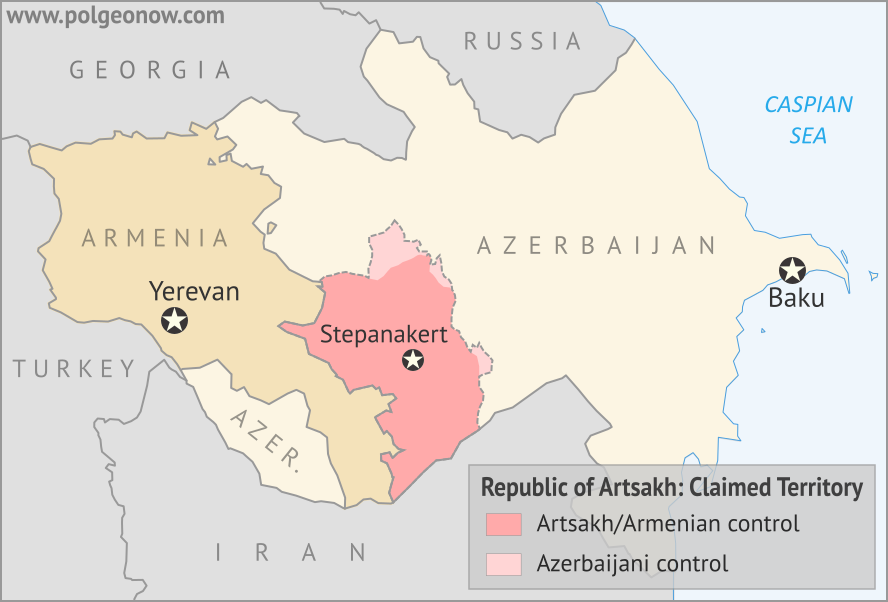
Map of the self declared Republic of Artsakh (Nagorno-Karabakh Republic) in relation to Armenia and Azerbaijan. Includes capital cities Yerevan, Baku, and Stepanakert.
Map by Evan Centanni, modified from this map by Bourrichon and Lesqual. License: CC BY-SA

Nagorno-Karabakh is Now “Artsakh”

Most country name changes are just modifications to the country’s official long name, or a switch in the name’s preferred English translation. But last year, one self-proclaimed country changed its title completely.

In February 2017, the disputed Nagorno-Karabakh Republic officially became the “Republic of Artsakh“. The name switch was part of a new constitution, approved in an internationally-controversial Feb. 20 referendum. According to the breakaway government’s official figures, the referendum passed by 88%, with a voter turnout of 76%.

What is Nagorno-Karabakh/Artsakh?

The status of the so-called Republic of Artsakh is a matter of hot dispute. According to the UN and all its member countries, Nagorno-Karabakh was never officially a country at all. The region is claimed by Azerbaijan and labeled a disputed territory by the international community, but it declared independence during the breakup of the Soviet Union, and has been ruled separately from Azerbaijan since the early 1990s.

In terms of military defense and day-to-day administration, Artsakh is heavily integrated with neighboring Armenia (most people living there are culturally Armenian). But the region’s government officially considers itself an independent country, and Armenia maintains a formal separation, neither recognizing Artsakh’s independence nor making it officially part of Armenia.

The only formal recognition of Artsakh’s independence comes from three other unrecognized, self-proclaimed countries – Abkhazia, South Ossetia, and Transnistria – plus a long list of local governments inside the US who have made symbolic declarations of support (presumably at the urging of that country’s Armenian political lobby).

Nagorno-Karabakh and Artsakh: Both Names Accepted

The name “Republic of Artsakh” didn’t come out of nowhere – in fact, it was already an official alternate name for the claimed country. The new constitution basically just switches the two names’ places:

Before After
Main Name in Constitution Nagorno-Karabakh Republic Republic of Artsakh
Official Alternate Name Artsakh Republic Republic of Nagorno-Karabakh

The old constitution declares that the two names are “the same”, and the new one similarly states that both official titles “are identical”. “Artsakh Republic” is also still in use by some official sources, probably as an alternate English translation. Minor spelling variants seen in government sources include “Nagorno Karabakh” (without the hyphen) and “Nagorno Karabagh”.

What Does “Artsakh” Mean, and Why Choose it Over “Nagorno-Karabakh”?

“Artsakh” is probably easier to remember and pronounce for most people, but the change is also related to the history of the two names. “Nagorno-Karabakh” is actually the Russian name of the region, from when it was part of the Soviet Union, but the “Karabakh” part is based on its name in the Azerbaijani language (likely coming from ancient words meaning “Black Garden“). 

The territory now being disputed is the highland area of the historic Karabakh region, with the Russian word “nagorno” (or “nagorny”) added on signify that. In other words, “Nagorno-Karabakh” means “Upper Karabakh” in Russian.

“Artsakh”, on the other hand, is a thoroughly Armenian name for the territory. Though the actual origin of the word has been lost to history, it was the undisputed name of an Armenian province that occupied the area from ancient times into the Middle Ages. Given that, it’s no surprise that this name is preferred by the Armenia-oriented government of the disputed republic, or by its culturally Armenian majority population.
Flag of the autonomous community of Catalonia Short Name:  
• Artsakh (English, Armenian)
• Dağlıq Qarabağ (Azerbaijani)
Alternate Short Name:
• Nagorno-Karabakh (English)
• Lerrnayin Gharabagh (Armenian)
Full Declared Name:
• Republic of Artsakh (English)
• Artsakhi Hanrapetut’yun (Armenian)
Alternate Full Name:
• Nagorno-Karabakh Republic (English)
• Lernayin Gharabaghi Hanrapetut’yun (Armenian)
Capital: Stepanakert
Status According to Azerbaijan: Armenia-occupied area of Azerbaijan

When Did The Name Change Officially Happen?

When a fully-recognized country, like the Czech Republic, changes its name, it’s fairly simple to the confirm that the change has gone into effect: It soon gets registered in UN databases and the ISO standard list of country codes and names. But for a disputed breakaway region like Artsakh, there’s no such official international documentation.

As with Malawi’s 2012 flag change, we at PolGeoNow were unsure at first if the change had officially come into effect yet – part of the reason we haven’t published an article until now. News outlets reported on Nagorno-Karabakh’s Feb. 20 referendum, but none seemed to say when the change would actually become official (at least, not in English).

So we dug a little deeper, learning that the official law authorizing the referendum says:

[The changes will] enter into force from the moment of publishing the drafts in the “Official Bulletin of the Nagorno Karabakh Republic” within five days after announcing the resolution of the Central Commission or the Supreme Court on the results of the the [sic] Referendum.

We couldn’t find the Official Bulletin in English online, but a declaration on the final referendum results from the Central Electoral Commission is dated to February 23. This seems to suggest that the official name change happened within five days of that, by February 28, 2017. Confirming that the new name has been adopted, the official website of the republic’s president is using “Artsakh”, even though some other government websites haven’t yet changed their headers.

PolGeoNow reports on every country name change that happens in the world! To see the full list, view all country name change articles.

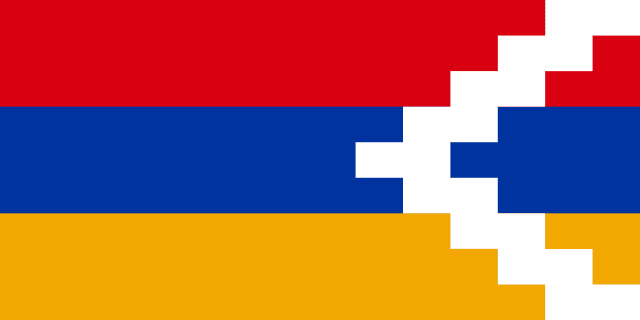
Graphic of the flag of the Republic of Artsakh is in the public domain (source).

Portuguese Community Admits New Member & Observer Countries (Map)

Map of the Community of Portuguese Language Countries (CPLP), including both member states and associated observers. Updated for the July 2014 summit, which admitted new member Equatorial Guinea and new associate observers Georgia, Japan, Namibia, and Turkey (colorblind accessible).
Map by Evan Centanni, starting from public domain blank map (license: CC BY-NC-SA).

Premium members click here to view this article in the ad-free members area. Not a member yet? Subscribe now!

Article by Karina Barquet

Flag of the Community of Portuguese Language Countries (aka Community of Portuguese-speaking Countries, CPLP)Organization Name:  
• Community of Portuguese Language Countries (English)
• Community of Portuguese-Speaking Countries (English – alternative name)
• Comunidade dos Países de Língua Portuguesa (Portuguese)
Founded: 1996 in Lisbon, Portugal
Headquarters: Lisbon, Portugal
Website: www.cplp.org

New Member Country for CPLP
The Community of Portuguese Language Countries (known by the Portuguese acronym CPLP) welcomed a new member this year. Equatorial Guinea joined the organization following its approval at the 10th CPLP Heads of State Summit in Dili, East Timor on July 23, 2014.

The CPLP is an intergovernmental organization for cooperation amongst countries where Portuguese is an official language. It was  founded in 1996 with seven member countries: Portugal, Brazil, Angola, Cape Verde, Guinea-Bissau, Mozambique, and São Tomé and Príncipe. East Timor joined the community in 2002 after gaining independence.

New Observer Countries
In addition to new member Equatorial Guinea, the CPLP’s July 2014 summit also admitted four new Associate Observer countries: Georgia, Japan, Namibia, and Turkey. These joined the two previously-admitted Associate Observers, Mauritius and Senegal.

Equatorial Guinea is a small country located in Central Africa. Its name reflects the country’s location near both the equator and the Gulf of Guinea. Equatorial Guinea is a former Spanish colony, and Spanish is the first official language, followed by French. A new law drafted in 2011 declared Portuguese the third official language in the country, though it is unclear whether that law ever went into effect.

The push to adopt Portuguese as an official language was a result of President Obiang’s efforts in 2007 to improve communications, trade, and bilateral relations with Portuguese-speaking countries, and to meet an important requirement to become a full member of the CPLP. Other requirements for joining CPLP included political reforms to give room for effective democracy and respect for human rights.

The 10th Summit also saw the reincorporation of Guinea-Bissau as a full member of the CPLP, after its suspension following a coup d’etat in April 2012. Guinea-Bissau was readmitted in the wake of the country’s recent presidential and legislative elections, and the transition of the CPLP’s presidency from President of Mozambique, Armando Guebuza, to the President of East Timor, Matan Ruak, who will be in office for the next two years.

Low-resolution graphic of the CPLP flag is displayed under fair use principles (source).

Map: “Eurasian Union” Gets New Member

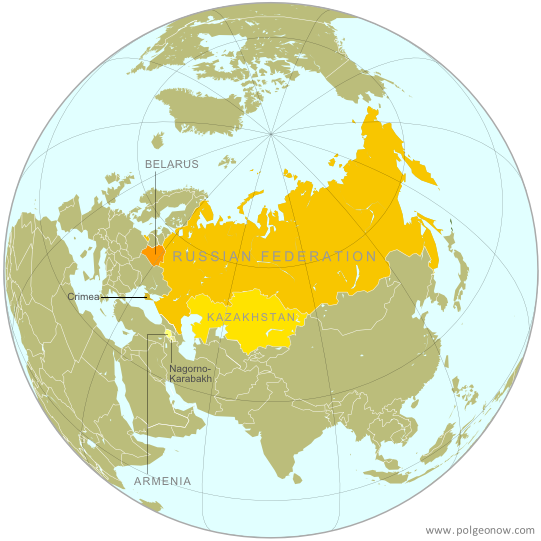
Map of the Eurasian Economic Union (EEU), also known as the Eurasian Union. Includes new member Armenia, as well as prior members Russia, Belarus, and Kazakhstan, and disputed territories Crimea and Nagorno-Karabakh.
The Eurasian Economic Union’s four member countries, plus disputed territories that might be officially or unofficially included. Map by Evan Centanni, starting from this map by Keverich2. License: CC BY-SA

Premium members click here to view this article in the ad-free members area. Not a member yet? Subscribe now!

Article by Evan Centanni

Armenia Joins Eurasian Economic Union
The Eurasian Economic Union (EEU), widely seen as a Russian-led answer to the European Union (EU), just welcomed its fourth member country. Armenia, a small former Soviet republic in the Caucasus region of Western Asia, joined Russia, Belarus, and Kazakhstan in the trade bloc after signing the organization’s founding treaty last Friday, October 10. However, the EEU, which will unite the four member countries’ economies into a single cooperatively-managed entity, doesn’t officially go into effect until New Year’s Day (January 1, 2015).

Flag of ArmeniaCountry Name:  
• Armenia (English)
• Hayastan (Armenian) 
Official Name:  
• Republic of Armenia (English) 
• Hayastani Hanrapetutyun (Armenian)
Capital: Yerevan

What is the “Eurasian Union”?
Though sometimes called just the “Eurasian Union”, the EEU is for now strictly economic in nature. Russia has shown interest in eventually expanding it into a political union to match the EU – however, that path is unpopular with fellow founding member Kazakhstan, which sees political union as a threat to the independence it gained after the breakup of the Soviet Union in 1991.

The economic union hopes to increase trade and lower prices by establishing a “Single Economic Space,” where goods, services, money, and people can all move freely from country to country without the obstruction of borders or import taxes. Industrial development, agriculture, and transportation will also be managed cooperatively, and people from one country will be able to live and work in any of the other countries without a visa.

What’s the difference: Eurasian Economic Union, EURASEC, and the Customs Union
Though the EEU has not yet gone into effect, Russia, Belarus, and Kazakhstan are already united in an organization called “the Customs Union“. This union partially combines the countries’ economies by replacing customs checks along their mutual borders with a unified customs policy for all imports coming into the three-country bloc. Armenia is apparently still not a member of the Customs Union, though the issue will presumably become moot on January 1, when the Customs Union is replaced with the new EEU.

The EEU is not the same thing as the Eurasian Economic Community (EURASEC), an earlier attempt at economic integration among former Soviet countries. EURASEC includes more countries than the EEU, but its members’ economies are not closely unified. The EEU in many ways grew out of the broader organization, and the member countries have agreed to dissolve EURASEC once the EEU comes into force on January 1, 2015.

Armenia’s Path to Membership
Armenia had originally sought to join the Customs Union this past spring, in advance of the EEU treaty coming into effect. However, its membership has been repeatedly delayed. Many suspect this was because of disagreements with the current Customs Union member countries over the Nagorno-Karabakh Republic, an Armenian-backed breakaway state that the rest of the world considers to be part of the neighboring ex-Soviet country of Azerbaijan. Even Armenia doesn’t officially recognize Nagorno-Karabakh, which declared independence in 1991, but makes no secret of being the breakaway state’s main supporter.

Map of the breakaway Nagorno-Karabakh Republic relative to Armenia and Azerbaijan
The breakaway Nagorno-Karabakh Republic (NKR)
Orange: Former NK Autonomous region in USSR
White: Current NKR territorial control
(public domain map by VartanM and Kmusser; source)

Because Armenia doesn’t maintain any border checks along its boundary with Nagorno-Karabakh, questions have been raised about whether the disputed territory will become an unofficial part of the EEU along with Armenia. With the other EEU members insisting Nagorno-Karabakh can’t be part of the union, and Armenia insisting it won’t set up border checks, it’s unclear how this issue will be resolved.

Meanwhile, another disputed territory will almost certainly be treated as part of the EEU, and officially at that. Crimea, recognized by the rest of the world as part of Ukraine, came under Russian control after a hostile takeover earlier this year. Since Russia, the most powerful member of the new EEU, considers Crimea a legitimate part of its territory, it seems unlikely the region will be excluded in any way from the new economic union.

Graphic of the Armenian flag is in the public domain (source).