The Gambia Changes Its Name Back

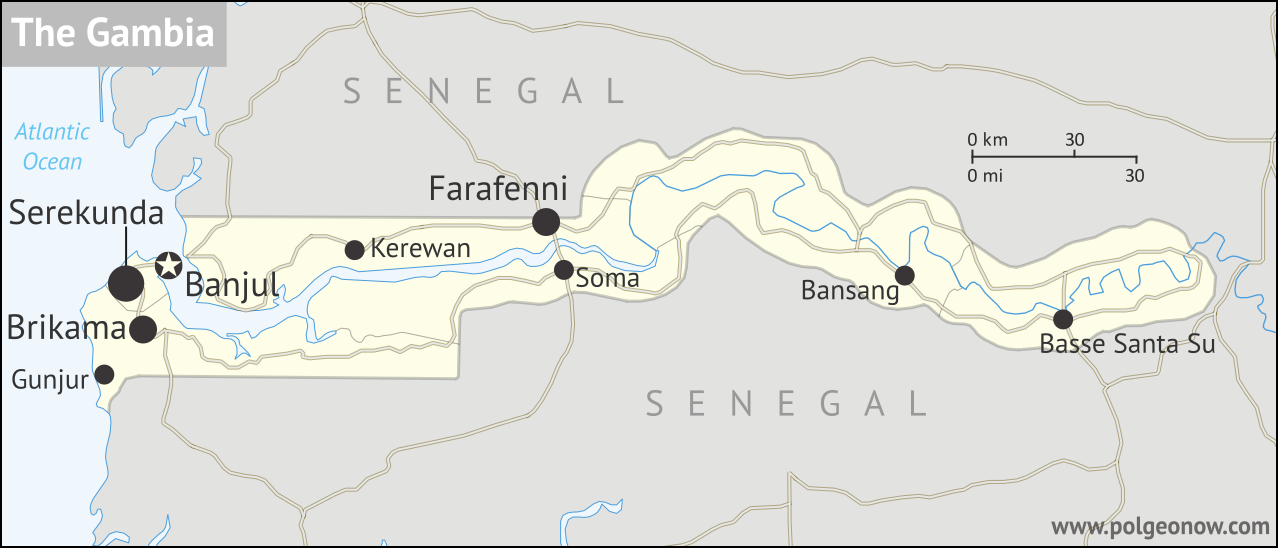
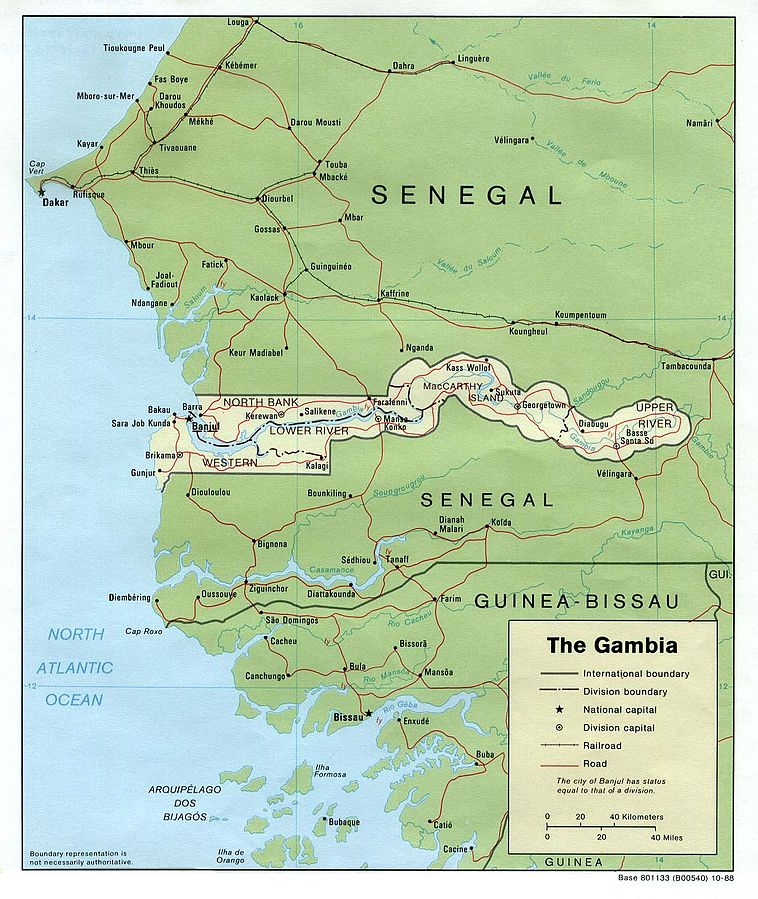
Map of the Gambia: towns, roads, borders, and rivers, with scale shown.
Map by Evan Centanni. Contact for usage rights.

Gambia Name Change Reversal

Last year we reported on how the Gambia, a tiny country located along the banks of a river in West Africa, had changed its official name at the UN. The country’s maverick dictator had decided in 2015 to switch from “Republic of The Gambia” to “Islamic Republic of The Gambia”.

Learn More: The Gambia’s 2015-2016 Name Change

Then, this January, the country’s longtime president stepped down. He had unexpectedly conceded defeat in a late-2016 election, though in the end it still took the threat of an invasion by neighboring countries to force him out. Within 10 days, the new president had already declared a reversal of the name change.
Flag of the Gambia Country Short Name:  
• The Gambia
Official Name:  
• Republic of the Gambia
Capital: Banjul

Name Change Registered with UN and ISO

Since most of the world’s countries, including the Gambia, are part of the United Nations (UN), it’s expected that if a country’s name changes, the change will be filed with the administrative offices of the UN. This lets world organizations and other countries know they should start using the new name.

Unlike the Gambia’s first name change, which was declared in 2015 but not formally registered until months into 2016, this year’s reversal all happened pretty fast. About a month and a half after the president’s announcement about the rollback, the change was already being distributed to users of ISO 3166, the international standard list of countries and country codes used by organizations and companies all around the world.

That meant the name had already been changed in the UN’s official name database too – ISO bases its country names on official UN usage – though PolGeoNow hasn’t been able to determine exactly when the UN change was made.

Name Changed in Other Languages

Unlike some countries that have only changed their name for foreign language speakers, English is actually the official language of the Gambia. The UN, on the other hand, has six official languages, so the name change reversal also took effect in each of those:

Language Before After
English the Islamic Republic of the Gambia the Republic of the Gambia
French la République islamique de Gambie la République de Gambie
Spanish la República Islámica de Gambia la República de Gambia
Russian Исламская Республика Гамбия Республика Гамбия
Chinese 冈比亚伊斯兰共和国 冈比亚共和国
Arabic  جمهورية غامبيا الإسلامية جمهورية غامبيا

Islam in the Gambia

Even though the country’s earlier name change made it sound like the Islamic religion would be playing a larger role in the government, that didn’t ever really happen. Ninety percent of Gambians are Muslims, and there’s not complete separation between church and state in the country, but the Gambian constitution does protect freedom of religion. In the year and a half since the country was first declared an “Islamic republic” and when the name was changed back, there wasn’t much indication that anything had actually changed.

How Often Do Countries Change Their Names?

Out of the world’s nearly 200 countries, there’s an average of about one official country name change each year, most of them involving adjustments to the country’s full name or preferred English name. The Gambia is the first UN-recognized country to change its name in 2017, while 2016 also saw a slightly different kind of name change for the Czech Republic. (Editor’s Note: As we reported later, the unrecognized, self-proclaimed Nagorno-Karabakh Republic also changed its name, in February 2017.)

Before the Gambia’s original “Islamic Republic” announcement in 2015, no countries had changed their names since Cape Verde in 2013. That African island country changed its preferred English name at the UN to Cabo Verde, the same as its native Portuguese-language name; the same year, war-torn Libya had clarified its new long-form name as “State of Libya”. The year before, Somalia’s 2012 constitution changed the country’s full name to the Federal Republic of Somalia, and a new Hungarian constitution traded “Republic of Hungary” for just “Hungary”.

More substantial changes to countries’ names, not just involving translation decisions or adjustments to full names, are much less common. The best recent examples are Yugoslavia’s name change to “Serbia and Montenegro” in 2003, Western Samoa’s change to just “Samoa” in 1997, and Zaire’s reversion to its previous name of “Democratic Republic of the Congo”, also in 1997.

Click here to see all articles on country name changes!

Graphic of the flag of the Gambia is in the public domain (source).
The Gambia’s Name Change

(Subscribers click here to view this article in the members area.)

US government map of the Gambia (source)

The Gambia Changes Official Name
If you read our review of world political geography changes in 2015, you might remember a brief note on the official name of the Gambia, a tiny country located along the banks of a river in West Africa. Last December, the Gambia’s maverick dictator decided to declare the country an “Islamic republic”, a designation that can have various meanings and is used by four other countries in the world.

At the time, at least one regional news source claimed that the country’s official name had indeed been changed from “Republic of The Gambia” to “Islamic Republic of The Gambia”. But for a country’s name to be formally changed, its government normally has to pass a law or at least issue some kind of proclamation, and at the time it wasn’t clear whether that had actually  happened.

Flag of the Gambia Country Name:  
• The Gambia
Official Name:  
• Islamic Republic of the Gambia
Capital: Banjul

New Name Registered with UN and ISO
Since most of the world’s countries, including the Gambia, are part of the United Nations (UN), it’s expected that if the country’s name changes, the change will be filed with the administrative offices of the UN so world organizations and other countries will know to start using the new one.

And earlier this year, that finally happened, with the UN updating its terminology database to show that the Gambia’s official long-form English name had been changed to “the Islamic Republic of the Gambia”.

This confirmed the name change, and soon led to the same modification being made to ISO 3166, the international standard list of countries and country codes that’s used by organizations and companies all around the world.

How Often Do Countries Change Their Names?
Out of the world’s nearly 200 countries, there’s an average of about one official country name change each year, most of them involving changes to the country’s full name or preferred English name. Besides the Gambia, no countries changed their names in 2014 or 2015, with the last country to do so being Cape Verde in late 2013. That African island country changed its preferred English name at the UN to Cabo Verde, the same as its native Portuguese-language name; the same year, war-torn Libya clarified its new long-form name as “State of Libya”. The year before, Somalia’s 2012 constitution changed the country’s full name to the Federal Republic of Somalia, and a new Hungarian constitution traded “Republic of Hungary” for just “Hungary”.

More substantial changes to countries’ names, involving more than just translation decisions or adjustments to full names, are much less common. The best recent examples are Yugoslavia’s name change to “Serbia and Montenegro” in 2003, Western Samoa’s change to just “Samoa” in 1997, and Zaire’s reversion to its previous name of “Democratic Republic of the Congo”, also in 1997.

Name Changed in Other Languages
Unlike some countries that have only changed their name for foreign language speakers, English is actually the official language of the Gambia. The UN, on the other hand, has six official languages, so the country’s new name also had to be translated and made official in each of those languages:

Language Before After
English the Republic of the Gambia the Islamic Republic of the Gambia
French la République de Gambie la République islamique de Gambie
Spanish la República de Gambia la República Islámica de Gambia
Russian Республика Гамбия Исламская Республика Гамбия
Chinese 冈比亚共和国 冈比亚伊斯兰共和国
Arabic جمهورية غامبيا جمهورية غامبيا الإسلامية

Islam in the Gambia
Although the country’s name change might seem to suggest that the Islamic religion will be playing a larger role in the government, this doesn’t seem to be the case. Ninety percent of Gambians are Muslims, and there is not complete separation between church and state. But the Gambian constitution does protect freedom of religion, and there’s little sign anything is changing in that area.

Graphic of the flag of the Gambia is in the public domain (source).
What is Vatican City?

This week, the Catholic Church chose a new leader, Pope Francis. The selection and announcement of the new pope took place in Vatican City, the Church’s sovereign territory within Rome. Is Vatican City really “the world’s smallest country”, or a country at all?  And what’s the difference between Vatican City and the Holy See? Read all about it!

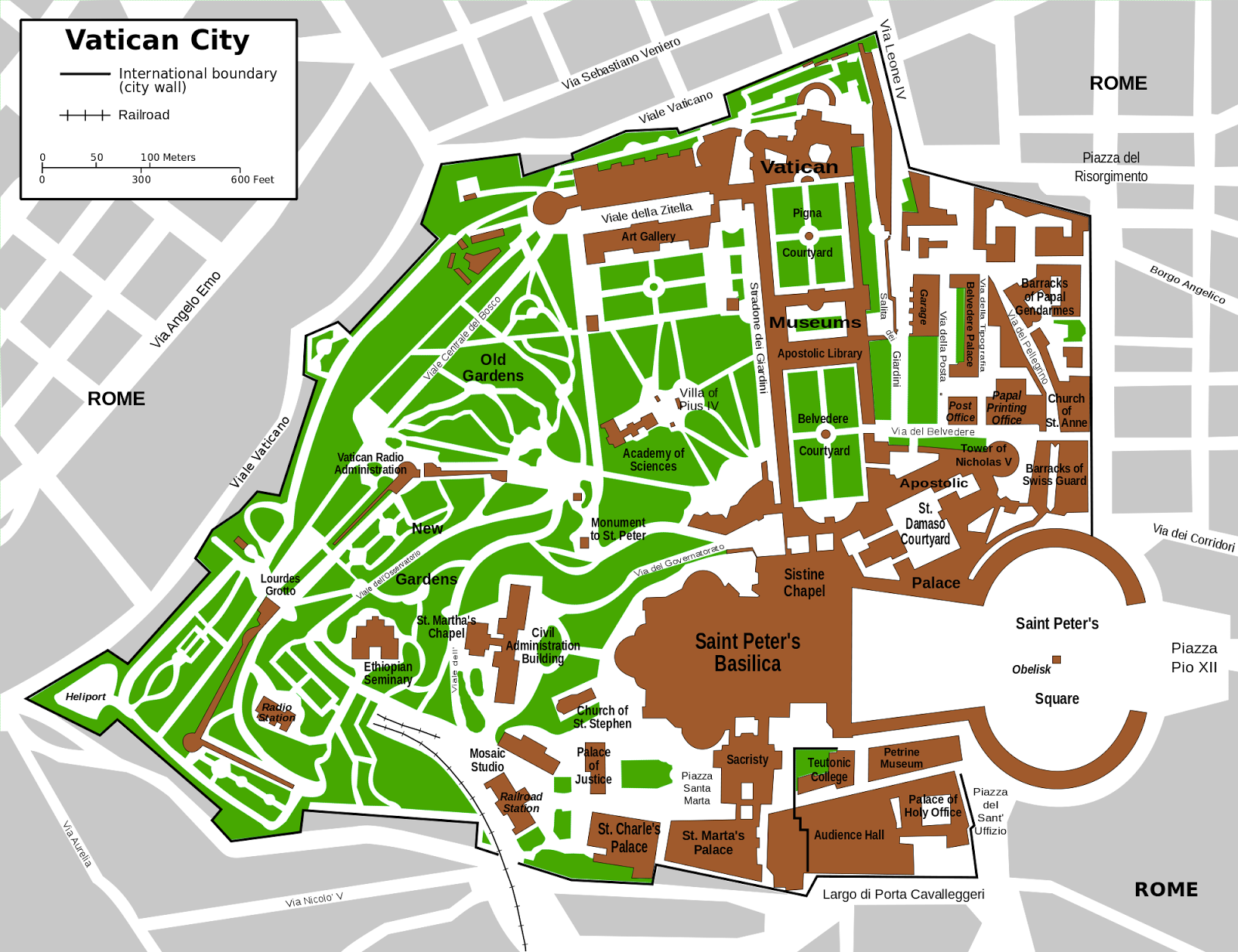
Large scale (close-up) map of Vatican City
Map of Vatican City (click to enlarge). By Francesco Piraneo G./Wikimedia Commons (CC BY-SAsource).

What is Vatican City?

Vatican City was created by the Lateran Treaty in 1929 to ensure the Catholic Church’s independence from the control of other countries, and has an area of only about 0.17 sq mi (0.44 sq km), or about one-eighth the size of Central Park in New York. In addition to the Pope, the state said to have a population of about 800, most of whom are either clergy or members of the Swiss Guard.

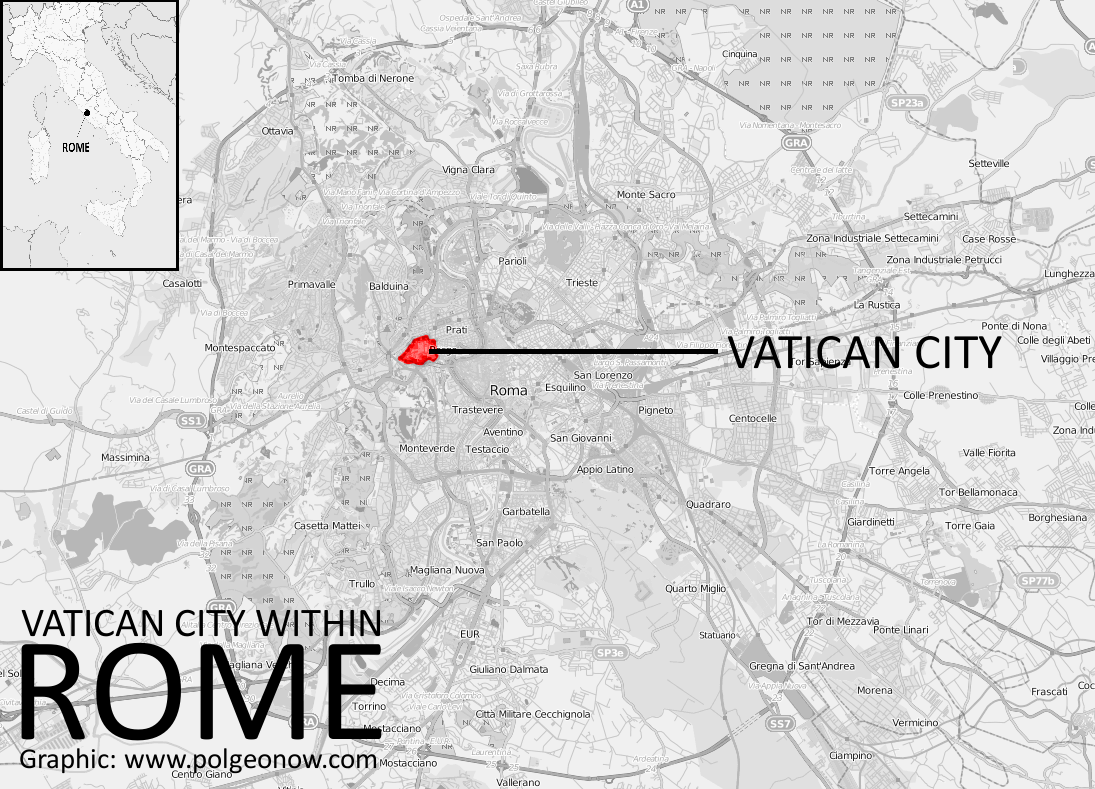
Located within the city of Rome, Vatican City is surrounded on all sides by Italy, and nearly encircled by a stone city wall except for in St. Peter’s Square, where it is separated from Italy only by a white line drawn on the ground. Various religious and administrative buildings are located within Vatican City’s confines, but more than half of its area is taken up by the green space of the Vatican Gardens.

Flag of Vatican CityCountry Name:  
• Vatican City (English)
• Città del Vaticano (Italian)
Official Name:  
• Vatican City State (English)
• Stato della Città del Vaticano (Italian)
Capital: Vatican City

Is Vatican City really a country?

Yes, technically. Although it doesn’t really have the kind of population and national cultural identity we would often expect from a “country”, it is recognized worldwide as a “sovereign state”, which means it rules itself and answers to no one else. This makes it by far the world’s smallest independent “country”, at less than a quarter the size of the runner-up, Monaco.

Vatican City’s supreme leader is the Bishop of Rome, a.k.a. the Pope, who is also head of the worldwide Catholic Church. And not only is its independence undisputed by the international community, but it actually maintains diplomatic relations with the U.N. and many countries – sort of. Vatican diplomacy is conducted not in the name of Vatican City itself, but directly by the Catholic Church in the name of the “Holy See”.

What’s the difference between Vatican City and the Holy See?

In short, Vatican City is a state (i.e. country), while the Holy See is a religious organization which happens to govern Vatican City, but has a broader purpose. In Catholic Church terminology, a “see” is the seat of authority of a particular bishop, and the “Holy See” refers to the authority of the Bishop of Rome (the Pope).

So the Holy See is the religious authority presiding over Catholic churches all across Rome (and by extension, the entire Catholic world), but it has normal government authority only in Vatican City and its “extraterritorial properties“. These properties, mostly churches or historical palaces located elsewhere in Rome, have a status similar to foreign embassies: they are technically part of Italy, but are under the legal jurisdiction of the Holy See.

Map showing location of Vatican City within Rome
Vatican City’s location within Rome (click to enlarge). By Evan Centanni. Background map by Dr. Blofeld. License: CC BY-SAsource).

The term “the Vatican” can mean either Vatican City itself, or the Holy See, sort of like how “Washington” or “Beijing” can refer to the U.S. or Chinese governments rather than just the cities.

Bonus Facts

• Vatican City is the only undisputed country in the world which is not a member of the U.N. However, the Holy See does have status as a “permanent observer state” in the U.N. General Assembly. The only other U.N. observer state is Palestine, which just gained that status in November 2012.

• Although Vatican City was created only in 1929, the Holy See has existed for many hundreds of years. It was often recognized as a “sovereign entity” even when it had no territory, though at many points in history it did control territories much larger than today’s Vatican City.

• The Holy See’s official language is Latin, but Vatican City uses Italian as its state language. The Vatican’s only military force, the Swiss Guard, gives orders in German.

Graphic of the Vatican City flag is in the public domain (source).