Which Countries Use the Euro? (Map of the Eurozone)

This Eurozone map and explainer article have been updated to June 2016. You can also view the original version from 2014.
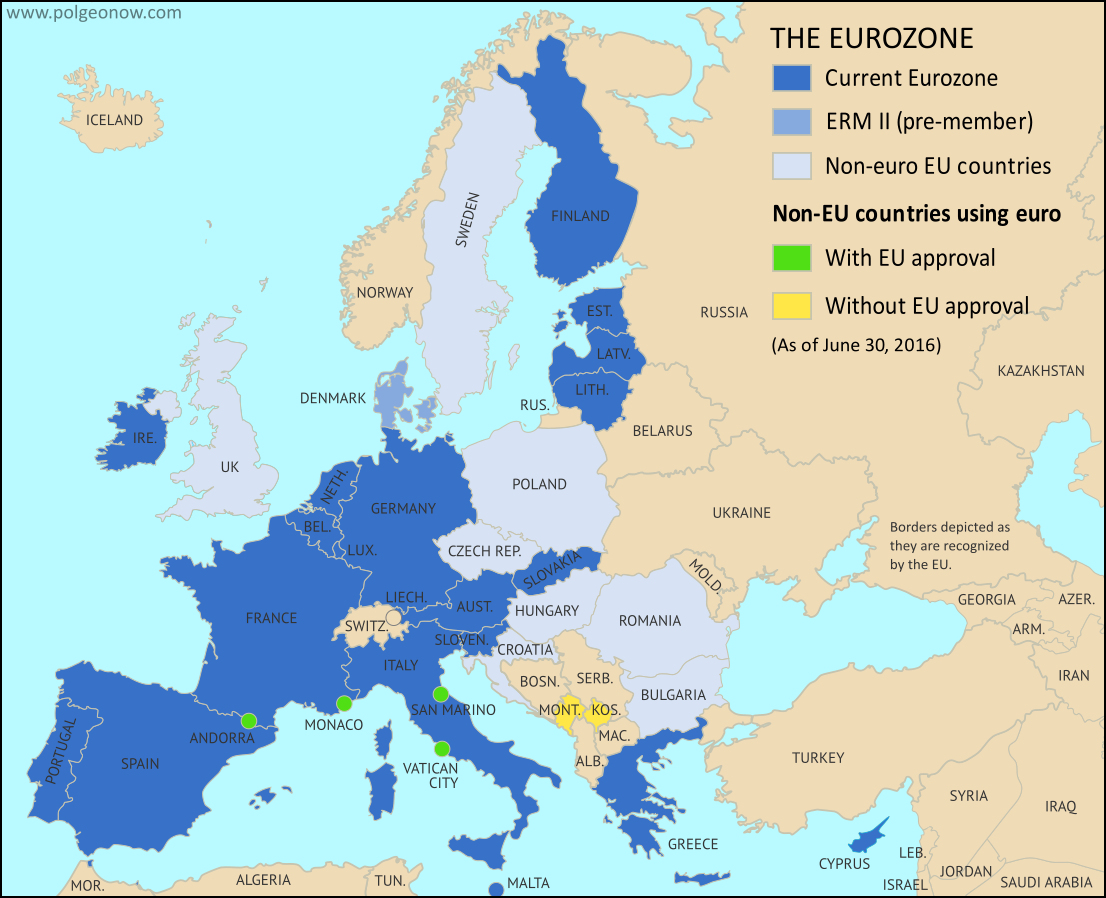
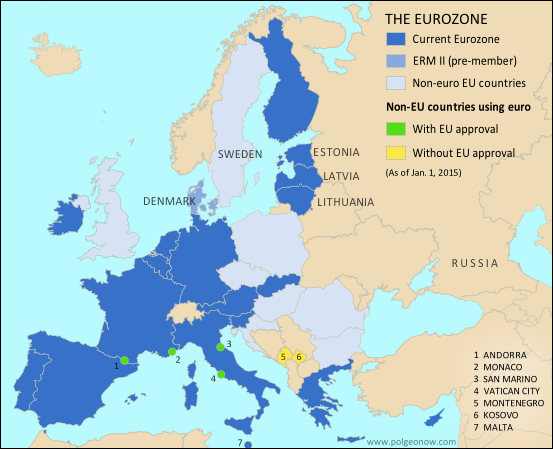
Map of the Eurozone (euro area), showing which countries use the euro as their currency. Includes members, pre-members (ERM II), EU non-members using the euro, and other EU countries (color blind accessible).
The Eurozone, European Union, and other countries using the euro.
Map by Evan Centanni, from blank map by Ssolbergj. License: CC BY-SA

(Subscribers click here to view this article in the members area.)

Article by Caleb Centanni, with additional content by Evan Centanni 

What is the Eurozone?
Officially called the “euro area”, the Eurozone is a nickname for the group of countries in Europe that share a single currency, called the euro. The euro currency is administered by the European Union (EU), but many countries in the EU don’t use the euro, and some countries outside the EU do use it. The European Central Bank, the governing financial body of the Eurozone, is headquartered in Frankfurt, Germany. Germany, along with eleven other EU countries, became a founding member of the Eurozone in 1999.

Since then, eight more members have joined after meeting the five necessary economic criteria. This has brought the total to nineteen members, including all but nine of the 28 European Union member countries.

Which EU Countries Don’t Use the Euro?
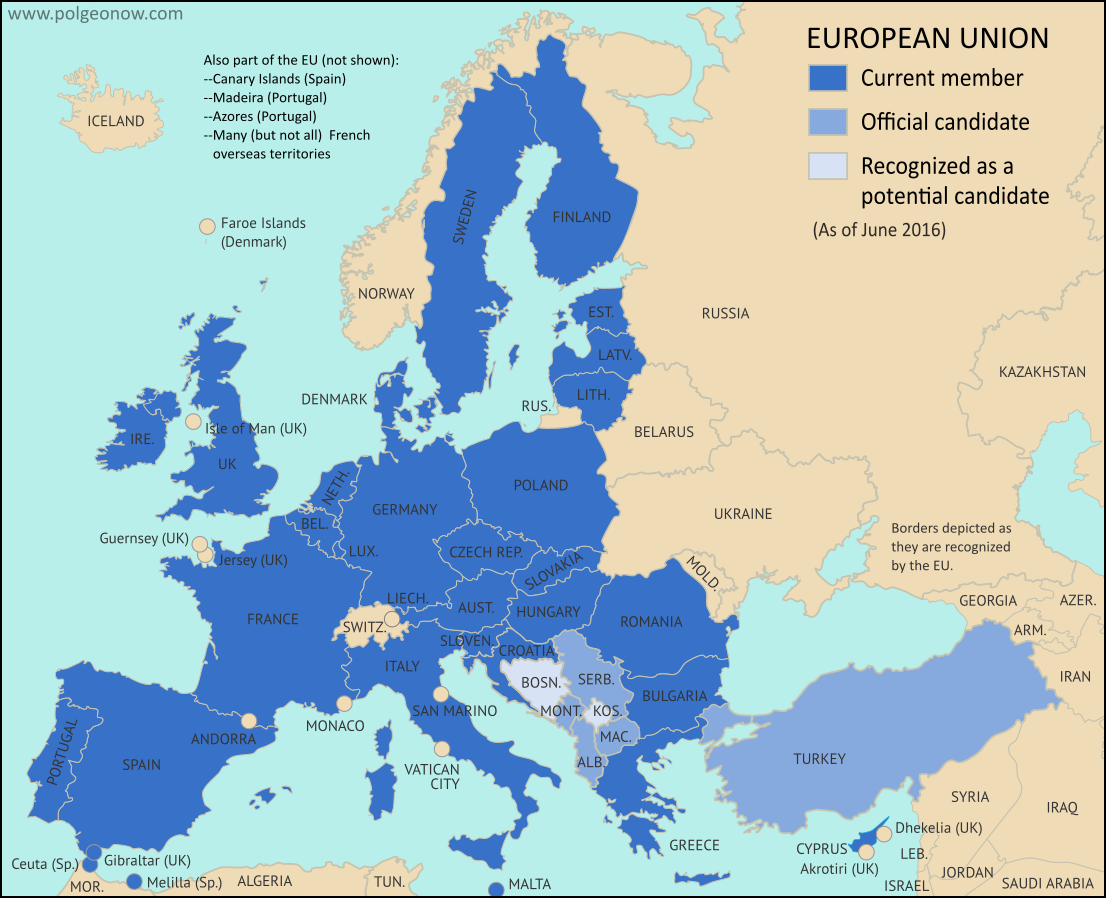
Map of the European Union (EU) and prospective member countries in 2016 (color blind accessible)
The EU and prospective members

One country, Denmark, is part of the European Exchange Rate Mechanism (ERM II), which ties members’ currency to the euro and is a necessary step for joining the Eurozone. However, Denmark is allowed to opt out of adopting the euro, despite its ERM II membership. All members of the European Union were required by the Maastricht Treaty of 1992 to change to the euro after meeting the criteria. However, both Denmark and the UK negotiated exceptions to the requirement later in that year. Seven other EU members are still required to adopt the euro in the future.

Which Non-EU Countries Do Use the Euro?

There are four tiny countries outside the EU – Andorra, Monaco, San Marino, and Vatican City – that have monetary agreements allowing them to use the euro as their official currency. Meanwhile, two other EU non-members, Montenegro and the disputed Republic of Kosovo, have unilaterally adopted the euro without coming to any agreement with the Central Bank. The EU has expressed its dissatisfaction with these unilateral adoptions, but the currency’s use in the two countries has gone forward anyway.

What Next for the Eurozone?
Many countries sought Eurozone membership at the beginning of the financial crisis in 2008, but most became less interested after the euro was hit by its own crisis in 2009. Meanwhile, Danish polls suggest the country is unlikely to support moving to the new currency any time soon. However, all EU members except Denmark and the UK are legally required to eventually adopt the currency.

You can stay up to date on Eurozone membership by bookmarking this article (which will be updated if anything changes), or by checking Political Geography Now for new articles about countries joining or leaving the Eurozone. You can also sign up for email updates from the box on the right-hand side of this page, or follow PolGeoNow on Twitter for even more news and facts!

Articles using versions of this map:
Lithuania Joins the Eurozone (2015)
Latvia Joins the Eurozone (2014)
 

Lithuania Joins the Eurozone (map)

Even as doubts persist about the future of the euro, and talk is in the air about a possible exit for Greece, other countries have still moved forward with adopting the currency. One such country joined the Eurozone just last week.

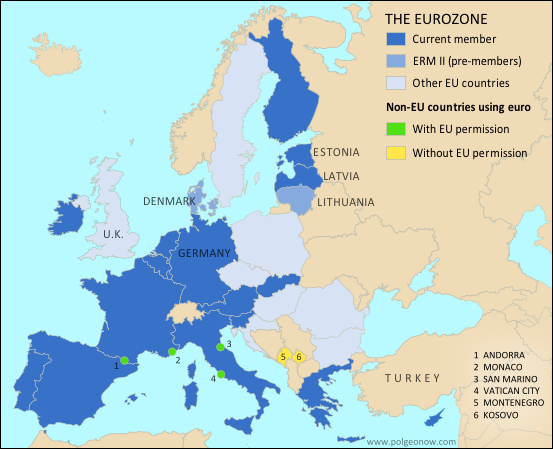
Map of the Eurozone (euro area), showing which countries use the euro as their currency. Includes members, pre-members (ERM II), EU non-members using the euro, and other EU countries (colorblind accessible).
The Eurozone, European Union, and other countries using the euro.
Map by Evan Centanni, from blank map by Ssolbergj. License: CC BY-SA

Premium members click here to view this article in the ad-free members area. Not a member yet? Subscribe now!

Article by Karina Barquet

Lithuania Joins Eurozone
Lithuania, a European Union (EU) member state since 2004, just joined the Eurozone on January 1. This makes it the 19th member of the currency union, and the last of the three Baltic States to adopt the euro (the others being Estonia and Latvia). The last country to adopt the euro was Latvia, which joined the zone one year before Lithuania. Up to now, Lithuania’s official currency was the litas.

Located in northeastern Europe, Lithuania has a population of about 3 million. In addition to being an EU member, Lithuania is also member of the Council of Europe, a full member of the Schengen Agreement, NATO, and the Nordic Investment Bank, and involved in the Nordic-Baltic cooperation framework.

Map of the European Union (EU) and prospective member countries
The full EU and prospective members

For over a decade, Lithuania has been striving to obtain full EU integration, with the expectation of increasing the country’s financial stability and foreign investment. A bid to join the Eurozone in 2007 was rejected based on unstable and slightly-too-high inflation rates, and Lithuania briefly became the EU’s worst-performing economy during the financial crash of 2009.

However, since 2013 the country has again become one of Europe’s fastest-growing economies, and government debt is well below the EU’s 60% threshold for joining the Eurozone. Lithuania’s government has also struggled with public skepticism about adopting the euro, but support grow throughout 2014. This has been attributed to Russia’s takeover of the Crimea region from Ukraine, an unsettling event for Lithuanians who remember the many decades their country spent under Soviet occupation during the 20th Century.

See Also:  What is the Eurozone?

Latvia Joins the Eurozone (map)

This article was originally published as “Map: Which Countries Use the Euro? (Plus: This Year’s New Addition)”. To see newer versions of the map, view all Eurozone articles on PolGeoNow.

Map of the Eurozone (euro area), showing which countries use the euro as their currency. Includes members, pre-members (ERM II), EU non-members using the euro, and other EU countries (colorblind accessible).
The Eurozone, European Union, and other countries using the euro.
Map by Evan Centanni, from blank map by Ssolbergj. License: CC BY-SA

Premium members click here to view this article in the ad-free members area. Not a member yet? Subscribe now!

Article by Caleb Centanni

Eurozone Adds New Member
The Eurozone, an economic union of states in the European Union (EU) that have adopted the euro as their currency, added its eighteenth member in January. This is the organization’s first new admission since Estonia joined in 2011.

Latvia, a small former-Soviet republic in the Baltic Region, officially adopted the euro on January 1, 2014. Latvia has had one of Europe’s fastest growing economies in recent years, and this swift recovery from the recent recession helped it meet the Eurozone’s criteria for 2014. Latvia’s adoption of the euro was approved by the country’s parliament in January 2013, despite polls showing public opinion on the decision with less than 50 percent in favor.

The European Central Bank, the governing financial body of the Eurozone, is headquartered in Frankfurt, Germany. Germany, along with eleven other EU countries, became a founding member of the Eurozone in 1999. Since then, seven more members have joined after meeting the five necessary economic criteria. This has brought the total to eighteen members, comprising all but ten of the 28 European Union member states.

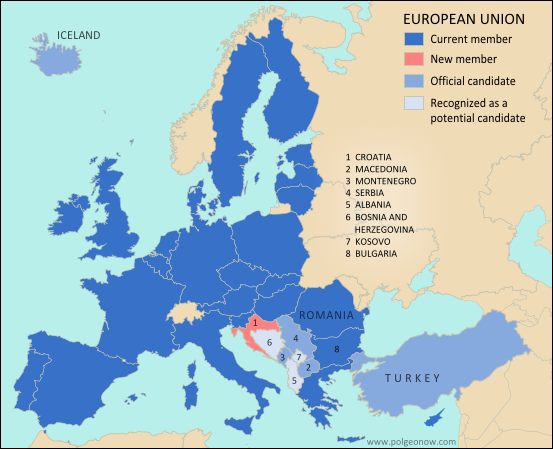
Map of the European Union (EU) and prospective member countries
The EU and prospective members

Two more countries, Denmark and Lithuania, are members of the European Exchange Rate Mechanism (ERM II), which ties members’ currency to the euro and is a necessary step for joining the Eurozone. However, Denmark is allowed to opt out of adopting the euro, despite its ERM II membership. All members of the European Union were required by the Maastricht Treaty of 1992 to change to the euro after meeting the criteria. However, both Denmark and the UK negotiated exceptions to the requirement later in that year. Seven other EU members are still required to adopt the euro in the future.

There are also four small states outside of the EU – Andorra, Monaco, San Marino, and Vatican City -which have monetary agreements allowing them to use the euro as their official currency. Meanwhile two other EU non-members, Montenegro and the disputed state of Kosovo, have unilaterally adopted the euro without coming to any agreement with the Central Bank. The EU has expressed its dissatisfaction with these unilateral adoptions, but the currency’s use in the two states has gone forward anyway.

Many countries sought Eurozone membership at the beginning of the financial crisis in 2008, but most became less interested after the euro was hit by its own crisis in 2009. Meanwhile, recent Danish polls suggest the country is unlikely to support moving to the new currency any time soon. However, Latvia’s neighbor Lithuania is still scheduled to join in 2015.