Taiwan Loses Recognition from Dominican Republic, Burkina Faso (Map)

You can always find the latest version of this map, and a list of all related articles, on our Which Countries Recognize Taiwan? page.
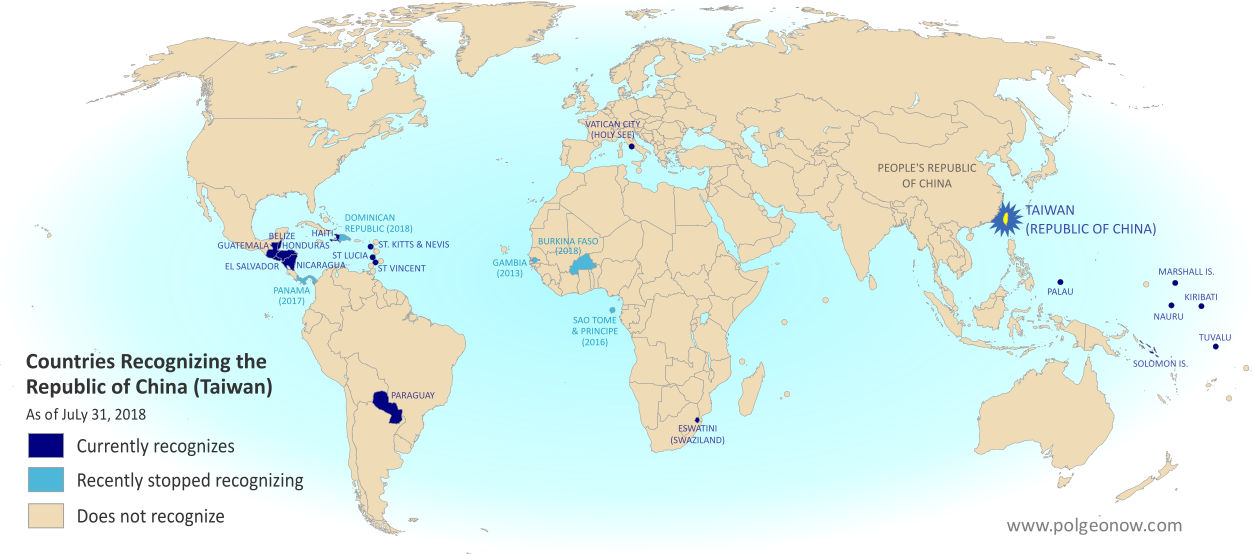
Map of who recognizes Taiwan (what countries recognize the Republic of China) in July 2018. Marks countries that have cut diplomatic ties with Taiwan (withdrawn recognition) in the last ten years: Burkina Faso, the Dominican Republic, Panama, Sao Tome and Principe, and the Gambia. Also answers question: Where is Republic of China located? (Colorblind accessible)
Click to enlarge. By Evan Centanni, modified from public domain blank world map.

Article by Evan Centanni

Dominican Republic, Burkina Faso Drop Taiwan
Flag of the Republic of China (Taiwan) Short Name (informal):  
• Taiwan (English)
• ROC (English)
• Táiwān (Chinese)
Official Name (in constitution):  
• Republic of China (English)
• Zhōnghuá Mínguó (Chinese)
Other names used officially:  
• “Republic of China (Taiwan)” (government offices)
• Chinese Taipei (international sports)
• Taiwan, Province of China (used by UN without Taiwan’s input)   
Capital: 
Taipei (de facto)
Claimed by: People’s Republic of China 

This past May, disputed Taiwan lost its official endorsements from both the Dominican Republic in the Caribbean, and Burkina Faso in West Africa. The two countries have cut ties with Taiwan in favor of setting up official relations with Mainland China, endorsing the Mainland’s claim that Taiwan is part of China.

The islands of Taiwan operate like an independent country today, but are governed under the constitution of the “Republic of China” (ROC), the government that ruled Mainland China before the country’s communist revolution (the administration that now rules the Mainland is called the People’s Republic of China, or PRC).

Since 1991, Taiwan’s government has sought recognition separate from Mainland China in the UN, without challenging the PRC’s right to the Mainland. But because the Mainland government insists Taiwan can’t be separate, it cuts ties with any countries that set up relations with Taiwan, even if they want to stay friends with China too.

The Dominican Republic announced it was cutting ties with Taiwan on May 1, 2018, saying the reason was “history and socioeconomic reality”. This reality allegedly includes the equivalent of $3.1 billion US dollars in investments and loans from China, though the Dominican government only mentioned future tourism opportunities as an example.

Burkina Faso followed on May 24, even though it had just co-sponsored Taiwan’s bid to become an observer at World Health Organization (WHO) meetings. The Burkinabe government also cited “socio-economic challenges” and the “evolution of the world” as the reasons for its switch.

Learn More: What Exactly is Taiwan, and Do Countries Really “Recognize” It?

Republic of China: Shrinking Recognition

Today, only 18 countries in the world (about 9%) still have formal diplomatic relations with the Taiwan-based “Republic of China” government – the closest equivalent to officially “recognizing” Taiwan as a country. Before the Dominican Republic and Burkina Faso cut ties in May, the last two countries to drop Taiwan in favor of the PRC were Panama in June 2017 and São Tomé and Príncipe in December 2016.

Only one country, the Gambia, abandoned Taiwan between 2008 and 2016, during a “diplomatic truce” initiated by Taiwan’s most Mainland-friendly president (even then, the PRC waited until Taiwan elected a more independence-leaning president before restoring its own relations with the Gambia).

Taiwan’s last remaining “diplomatic ally” in Africa is tiny Eswatini (Swaziland), whose king recently promised not to follow Burkina Faso in switching to the PRC. Supporters of a separate Taiwan worry their next loss might be the Holy See, government of the Catholic Church’s independent Vatican City in Rome. The Vatican has recently been working to patch up its bad relationship with the Mainland Chinese government.

Learn More: What’s the difference between Vatican City and the Holy See?

Graphic of the Republic of China (Taiwan) flag is in the public domain (source).
African Union Suspends Burkina Faso, Then Reinstates it Again (Map)

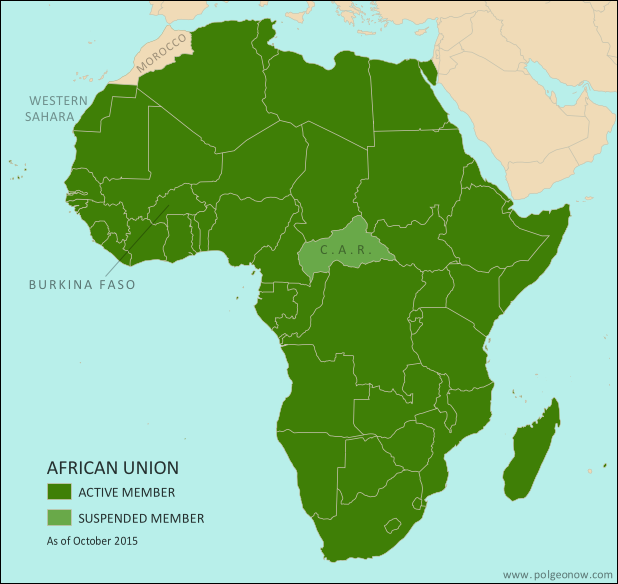
Map of the African Union, including active and suspended member countries, updated for the September 2015 suspension and reinstatement of Burkina Faso (colorblind accessible).
Map by Evan Centanni, from this blank map by Eric Gaba. License: CC BY-SA

Premium members click here to view this article in the ad-free members area. Not a member yet? Subscribe now!

Article by Evan Centanni

Coup Crisis
On September 18, Burkina Faso was suspended from the African Union (AU) by the organization’s Peace and Security Council. The action was in response to a government takeover by soldiers loyal to the country’s former president Blaise Compaore, who was pushed out in a popular uprising a year ago.

A military coup usually gets a country automatically suspended and sanctioned by the Peace and Security Council, which aims to promote constitutional rule in all AU member countries. (This pro-democracy policy has no affect on dictatorships that are already long-established.)

Resolution & Reinstatement
In a quick resolution to the crisis, Burkina Faso’s coup was over just a week after it started; the internationally-supported president was released from custody, and the coup leader stepped down apologetically after popular protests and mediation by neighboring countries. The AU Peace and Security Council, which is always in session, responded by lifting Burkina Faso’s suspension on September 26.

After Burkina Faso’s return to active membership, there is only one remaining suspended AU member: the Central African Republic (CAR). The CAR was suspended in March 2013 after a rebel takeover, followed by the installation of a weak compromise government. Planned elections probably would have gotten the CAR reinstated to the AU later this month, but they’ve been delayed after a new outbreak of violence.

Flag of the African Union (AU)Organization Name:  
• African Union (English)
• al-Āthḥād al-’Āfrīqī (Arabic)
• Union africaine (French)
• União Africana (Portuguese)
• Unión Africana (Spanish)
• Umoja wa Afrika (Swahili)
Launched: 2002 in Durban, South Africa
Headquarters: Addis Ababa, Ethiopia
Website: www.au.int

What is the African Union?
Formed launched in 2002 as a replacement for the earlier Organization of African Unity (OAU), the AU is an intergovernmental organization that works on increasing cooperation, stability, and development within the continent of Africa. The organization is headquartered in Addis Ababa, Ethiopia. (Ethiopia is the only African country that the European empires were never able to colonize, and is also the second most populous country in Africa.)

Compared to the neighboring European Union (EU), the AU is only a loose forum for cooperation between its member countries. AU members do not have an integrated economic system, union-wide laws, or shared foreign policy, though further integration is a possibility for the future.

The African Union includes every UN-recognized country in Africa except for Morocco. Morocco withdrew from the OAU in 1984, after the organization chose to admit the Sahrawi Arab Democratic Republic (SADR), a disputed country that claims ownership of the mostly Moroccan-controlled Western Sahara territory. The only other parts of Africa not represented in the AU are a few groups of offshore islands controlled by European countries, as well the small Spanish enclaves in North Africa. The breakaway Republic of Somaliland is not a member, but is considered by the AU to be part of member-state Somalia.

Low-resolution graphic of the African Union flag is displayed under fair use principles (source).

Niger and Burkina Faso Resolve Territorial Dispute

Update: In May 2015, Niger and Burkina Faso formally agreed to implement this ICJ ruling, with the practical aspects of exchanging territories to be completed by the end of the following year.

Map of the disputed territory between Niger and Burkina Faso, which was divided between the two countries in an April 2013 ruling by the International Court of Justice
Map by Evan Centanni. Sources: ICJ, Natural Earth. Africa inset based on this map by TUBS/Wikimedia Commons (CC BY-SA).

By Evan Centanni
 
Border Dispute Settled
Last week, a territorial dispute between the West African countries of Niger and Burkina Faso was resolved peacefully with a ruling from the International Court of Justice (ICJ). Both countries’ governments agreed to respect the court’s ruling on where their border should lie, a question which had persisted ever since they both achieved independence in 1960.

In the ruling, the court drew an official border based on a careful analysis of a 1927 document establishing the pre-independence boundary between the two former French colonies, also turning to a 1960 French map which both countries had agreed to use as a secondary reference. The new border splits the disputed area between Burkina Faso and Niger, and will help put an end to confusion regarding policing and tax collection in the border area.

The ICJ, or World Court, is a part of the U.N., and is tasked mainly with arbitrating disagreements between U.N. member countries. It should not be confused with the International Criminal Court (ICC), which prosecutes individuals for war crimes. Niger and Burkina Faso had agreed by treaty to send the case of their disputed border to the ICJ for settlement, and both have expressed satisfaction with the result.

Further Reading: Full Text of ICJ ruling on Burkina Faso/Niger Frontier Dispute (PDF)

Unclaimed Land
An interesting curiosity noted in this case is that Burkina Faso and Niger’s respective border claims left a small strip of land claimed by neither country. The area, stretching between two locations referred to as the Tong-Tong and Tao astronomic markers, was left unclaimed because Burkina Faso considered the border to be a straight line running between the two markers, while Niger also respected a third marker placed a bit east of the line.

The third marker had originally been intended to lie exactly along the line between Tong-Tong and Tao, but was placed inaccurately. It is not entirely clear why Niger would choose to define its border in a way that would give it less territory than did Burkina Faso’s definition, but in any case the court discounted the third marker, giving the strip of land to Niger in the final ruling. A more famous (and still outstanding) case of a territory not claimed by any country is the Bir Tawil “triangle” between Egypt and Sudan.

Related Articles:

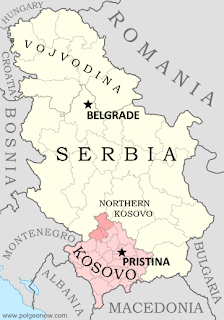
North Kosovo Status Changing after Serbia Deal

Mali Conflict Map: Gao and Timbuktu Retaken (January 2013)

There are newer versions of this map available. To see them, view all Mali maps.   

This is an update of our Mali conflict map – for the original story, see Mali Map: Islamist Control & French Intervention.

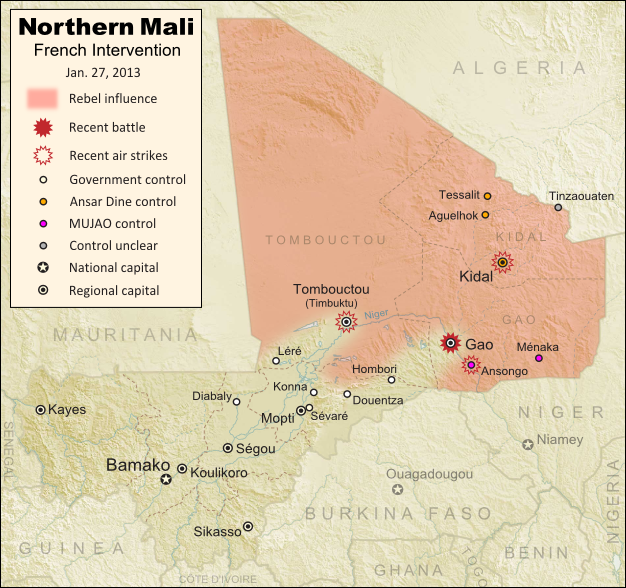
Updated map of fighting and territorial control in Mali during the January 2013 French intervention against the Islamist forces of Ansar Dine and MUJAO. Reflects the Jan. 26-27 recapture of major northern cities Gao and Timbuktu by French and Malian forces.
Updated map of territorial control and fighting in Mali, as of Jan. 27, 2013. Map by Evan Centanni, modified from Wikimedia map by Orionist, using images by Carport and NordNordWest (source). License: CC BY-SA.

French-Malian troops capture two major northern cities
Events have proceeded quickly in Mali’s ongoing war since the France’s military intervention against radical Islamist rebels began just over two weeks ago. This weekend, French and Malian troops recaptured Gao and Timbuktu, two of the three major towns seized by separatist rebels last spring and taken over by radical right-wing militias a few months later.

After taking back most of the country’s central region earlier this week (See: Mali Map Update 2: Douentza Secured by Government), the allied French-Malian forces proceeded northeast from Diabaly and Douentza. On Friday, they took the town of Hombori on the road to Gao, even as Al Qaeda linked MUJAO rebels destroyed a bridge near the border with Niger in order to obstruct a looming invasion by Nigerien and Chadian troops.

Flag of MaliCountry Name:  
• Mali (English, French, Bambara)
Official Name:  
• Republic of Mali (English)
• République du Mali (French) 
• Mali ka Fasojamana (Bambara)
Capital: Bamako

On Saturday, the French and Malian armies seized Gao itself, where they seem to have encountered a limited amount of resistance from the rebels of MUJAO. Many of the militants had already fled the major cities after weeks of French airstrikes against their positions, and on Sunday the allied troops swept quickly through Léré and all the way to Timbuktu, where they are reportedly now establishing control.

Also in the past week, a major faction of the rebel group Ansar Dine defected, forming a new organization called the Islamic Movement for the Azawad. The new faction, dominated by Malian Tuareg people, claims to renounce Islamic extremism, instead saying they want to negotiate peacefully for increased autonomy in the country’s north.

Meanwhile, the French and Malian armies are receiving increasing support from other countries. The U.S., though not directly involved in the conflict, has been providing logistical support to the French military. And several days ago, troops from the neighboring country of Burkina Faso became the first foreign African forces to be deployed alongside the Malian and French contingents (though they still aren’t on the front lines).

On a darker note, accusations have spread of ethnically-motivated murders of Tuareg and Arab civilians by the Malian military (the northern rebels are mostly Tuareg and Arab people). This comes amid the mysterious barring of foreign journalists from towns occupied by the Malian and French forces. Officials have denied any knowledge of such killings, but human rights organizations have been increasingly raising alarms over the alleged abuse.

Original Story: Mali Map: Islamist Control & French Intervention

Recommended Reading: In Mali, Diabaly residents helped repel Islamist militants

Graphic of Malian flag is in the public domain (source).