African Union Reinstates Egypt and Guinea-Bissau (Map)

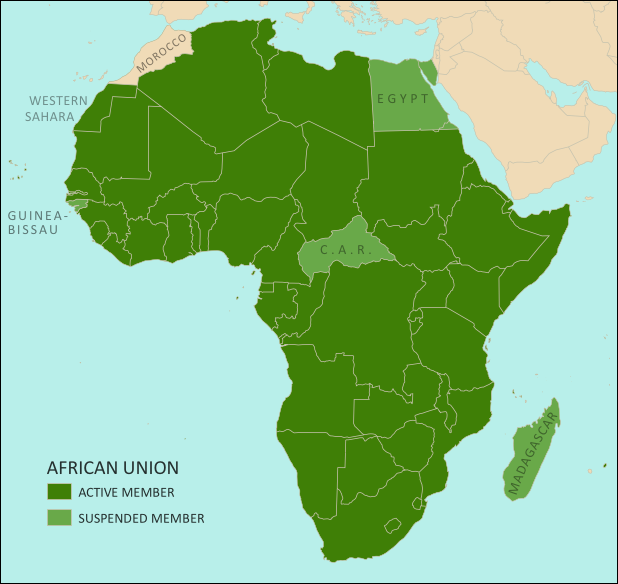
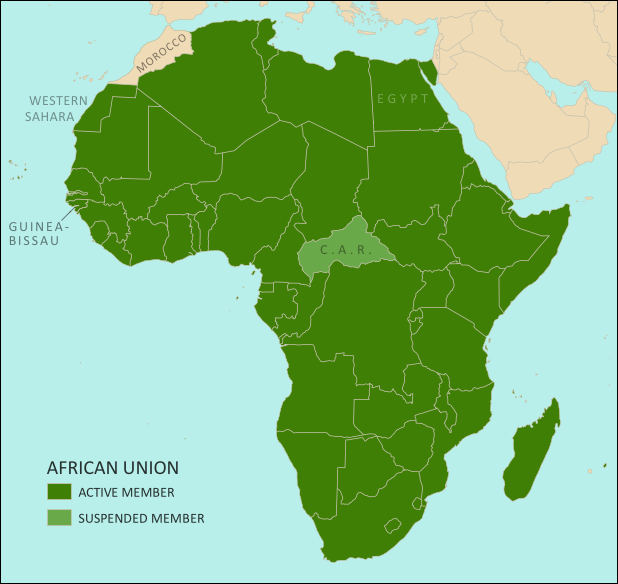
Map of the African Union, including active and suspended members, updated for the June 2014 reinstatement of Egypt and Guinea-Bissau (colorblind accessible).
The African Union as of July 2014. Map by Evan Centanni, from this blank map by Eric Gaba.
License: CC BY-SA

Premium members click here to view this article in the ad-free members area. Not a member yet? Subscribe now!

Article by Evan Centanni

Suspensions Lifted
At a meeting in June, the African Union (AU) decided to end the suspensions of Egypt and Guinea-Bissau from the regional organization. Egypt was suspended from the AU last year after its elected government was overthrown by the military. Its reinstatement comes after the events of this May, when the country held its first presidential election since the takeover. Guinea-Bissau had been suspended since a 2012 coup, and was similarly allowed back in after holding elections this April.

The AU’s Peace and Security Council typically suspends member countries when they experience coups or other breakdowns of constitutional rule. Though this is billed as a pro-democracy policy, it does not affect undemocratic governments which are already long-established. After Guinea-Bissau and Egypt’s reinstatement, there is currently only one remaining suspended AU member, the Central African Republic (CAR), which is experiencing serious turmoil in the aftermath of an aborted rebel takeover.
Flag of the African Union (AU)Organization Name:  
• African Union (English)
• al-Āthḥād al-’Āfrīqī (Arabic)
• Union africaine (French)
• União Africana (Portuguese)
• Unión Africana (Spanish)
• Umoja wa Afrika (Swahili)  
Launched: 2002 in Durban, South Africa
Headquarters: Addis Ababba, Ethiopia
Website: www.au.int

What is the African Union?
Formed in 1999-2002 to replace the earlier Organization of African Unity (OAU), the AU is an intergovernmental organization which works on increasing cooperation, stability, and development within the continent of Africa. It has a secretariat based in Addis Ababa, Ethiopia, though many of its most important decisions are made during annual summits of the continent’s national leaders.

Every UN-recognized country in Africa is a member of the African Union except for Morocco, which withdrew from the OAU in 1984 after the organization chose to admit the partially-recognized state of Western Sahara, a disputed territory which Morocco claims and largely occupies. The only other parts of Africa not represented in the AU are a few groups of offshore islands controlled by European countries, as well the small Spanish enclaves in North Africa. The breakaway Republic of Somaliland is not a member, but is considered by the AU to be part of member-state Somalia.

Low-resolution graphic of the African Union flag is displayed under fair use principles (source). Flag of Madagascar is in the public domain (source).
Map: Kosovo Recognized by 4 More Countries (101/193)

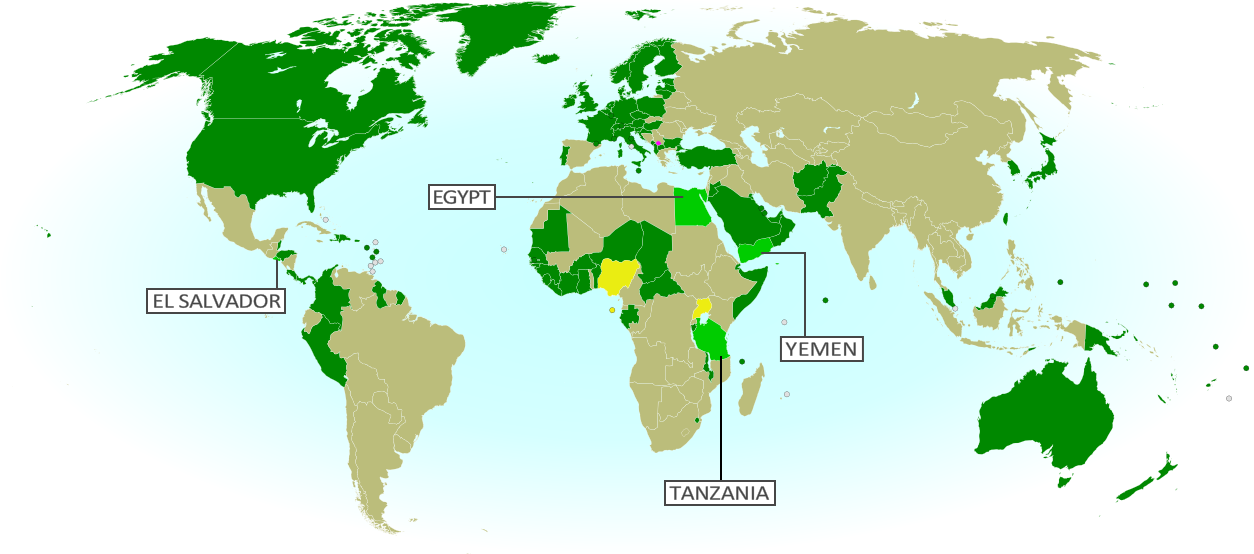
Map of countries that recognize the Republic of Kosovo as an independent state, updated for August 2013 with most recent additions and disputed recognitions highlighted
Countries recognizing the Republic of Kosovo in green, with the four most recent additions highlighted. Disputed recognitions in yellow. Kosovo in magenta. Map by Evan Centanni, modified from public domain graphic (source).

Flag of the Republic of KosovoCountry Name:  
• Kosovo (English, Serbian)
• Kosova (Albanian)
Official Name:  
Republic of Kosovo (English)
Republika e Kosovës (Albanian)
Republika Kosovo (Serbian)
Capital: Pristina/Prishtina

By Evan Centanni

New Kosovo Recognitions
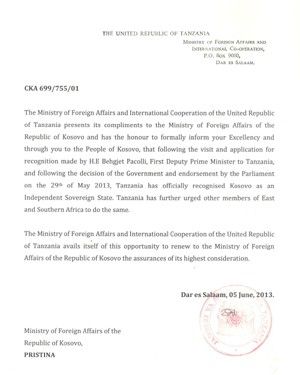
Over the past four months, the breakaway Republic of Kosovo has received diplomatic recognition from two more U.N. member countries. The self-proclaimed southeastern European country now claims recognition from 101 U.N. member countries (52%), up from 99 in our previous Kosovo recognition update (see “Disputed Recognitions” below for details on why the total has only been incremented by two).

Tanzania, a republic in East Africa, recognized Kosovo at the end of May, and nearby Egypt extended its recognition a month later (just days before the breakout of its current constitutional crisis). Yemen had already endorsed Kosovo’s independence earlier in June, and the small Central American country of El Salvador apparently followed suit by the end of the month.

The Republic of Kosovo declared independence from Serbia in 2008, but has been blocked from U.N. membership by objections from Serbia, Russia, and other countries who see its secession as invalid. In addition to the 101 U.N. members from whom Kosovo claims recognition, its independence is also acknowledged by non-U.N. member Taiwan. For more on Kosovo’s special situation, see our first Kosovo recognition report, which also includes a map of Kosovo’s location relative to Serbia.

Disputed Recognitions
As explained in our previous Kosovo recognition report, there has been doubt cast on some of Kosovo’s claimed recognitions. In fact, if the Kosovan government’s past disputed claims of recognition are included, the total number of U.N. member countries recognizing the breakaway state is now 103. However, a recent report from Kosovo’s foreign ministry only claims 101 U.N. member recognitions, even while acknowledging the four most recent additions. This suggests they may finally have given up on the questionable claims of recognition from  Nigeria and Uganda (the third disputed recognition, from São Tomé and Príncipe, is better documented). In any case, the total number of countries recognizing Kosovo now forms over half of the U.N. membership even without counting disputed recognitions.

Stay Up to Date: Check for further updates to this story by viewing all Kosovo articles on Political Geography Now.

Related Articles:
North Kosovo Status Changing After Serbia Deal
Kosovo Recognition Update: April 2013
Who Recognizes Palestine in 2013?
 

Flag graphic by Cradel (source). License: CC BY-SA

Egypt Suspended from African Union

Map of the African Union, including active and suspended members, updated for the July 2013 suspension of Egypt (colorblind accessible).
The African Union. Map by Evan Centanni, from this blank map by Eric Gaba. License: CC BY-SA

Flag of the Arab Republic of Egypt Country Name:  
• Egypt (English)
Miṣr (Arabic)
Official Name:  
• Arab Republic of Egypt (English)
• Ǧumhūriyyat Miṣr al-ʿArabiyyah (Arabic)
Capital: Cairo

Article by Evan Centanni

African Union Suspends Egypt
Egypt, the third most populous country in Africa, was suspended last weekend from that continent’s regional organization, the African Union (AU). The suspension comes after months of unrest in the country, in which massive popular protests led to the military overthrow of the government last week. The suspension is being taken very seriously by the parties involved.

The AU’s Peace and Security Council typically suspends member countries when they experience coups or other breakdowns of constitutional rule. Egypt joins three other African countries which are also currently suspended for similar incidents: Madagascar, Guinea-Bissau, and the Central African Republic (CAR) (see the links for information on each country’s constitutional crisis).

See Also: Rebel Takeover of Central African Republic (map)

What is the African Union?

Flag of the African Union (AU)Organization Name:  
• African Union (English)
• al-Āthḥād al-’Āfrīqī (Arabic)
• Union africaine (French)
• União Africana (Portuguese)
• Unión Africana (Spanish)
• Umoja wa Afrika (Swahili)  
Launched: 2002 in Durban, South Africa
Headquarters: Addis Ababba, Ethiopia
Website: www.au.int

Formed in 1999-2002 to replace the earlier Organization of African Unity (OAU), the AU is an intergovernmental organization which works on increasing cooperation, stability, and development within the continent of Africa. It has a secretariat based in Addis Ababa, Ethiopia, though many of its most important decisions are made during annual summits of the continent’s national leaders.

Every UN-recognized country in Africa is a member of the African Union except for Morocco, which withdrew from the OAU in 1984 after the organization chose to admit the partially recognized state of Western Sahara, a disputed territory which Morocco claims and largely occupies. The only other parts of Africa not represented in the AU are a few groups of offshore islands controlled by European countries, as well the small Spanish enclaves in North Africa. The breakaway Republic of Somaliland is not a member, but is considered by the AU to be part of Somalia.

Low-resolution graphic of the African Union flag is displayed under fair use principles (source).

Related Articles:

Croatia Joins EU, Leaves CEFTA