All About Swaziland’s Name Change (With Maps)

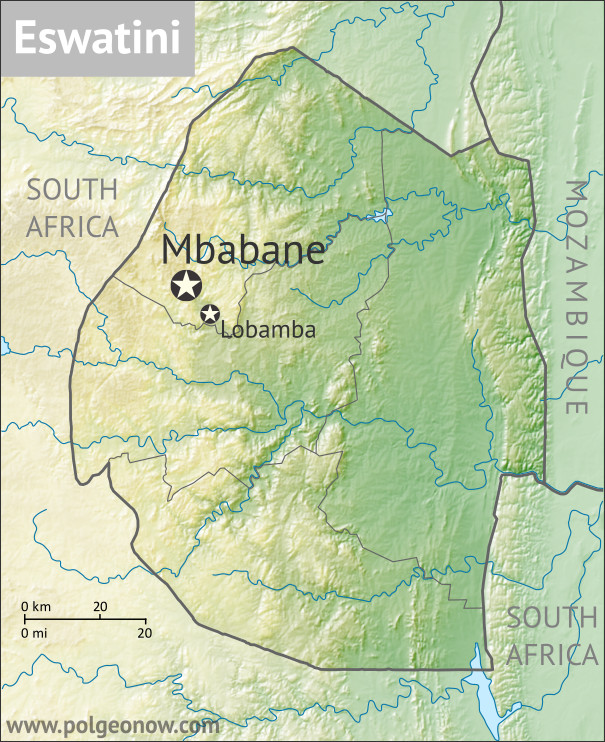
Topographic map of Eswatini (Swaziland), showing terrain, rivers, bordering countries, and capital cities.
Eswatini, formerly known as Swaziland. Based on this map by Htonl and NordNordWest.

Swaziland’s New Name

If you follow PolGeoNow on Twitter, you already know that the small, southern African country of Swaziland was renamed “Eswatini” this April. The full English name of the country, previously “Kingdom of Swaziland”, has also been changed to “Kingdom of Eswatini”.

The rename was first announced by the country’s king on April 19 – his 50th birthday. (Some media incorrectly reported that April 19 was also Swaziland’s 50th anniversary of independence. The country is indeed celebrating its 50th this year, but the actual day of the anniversary is September 6.)

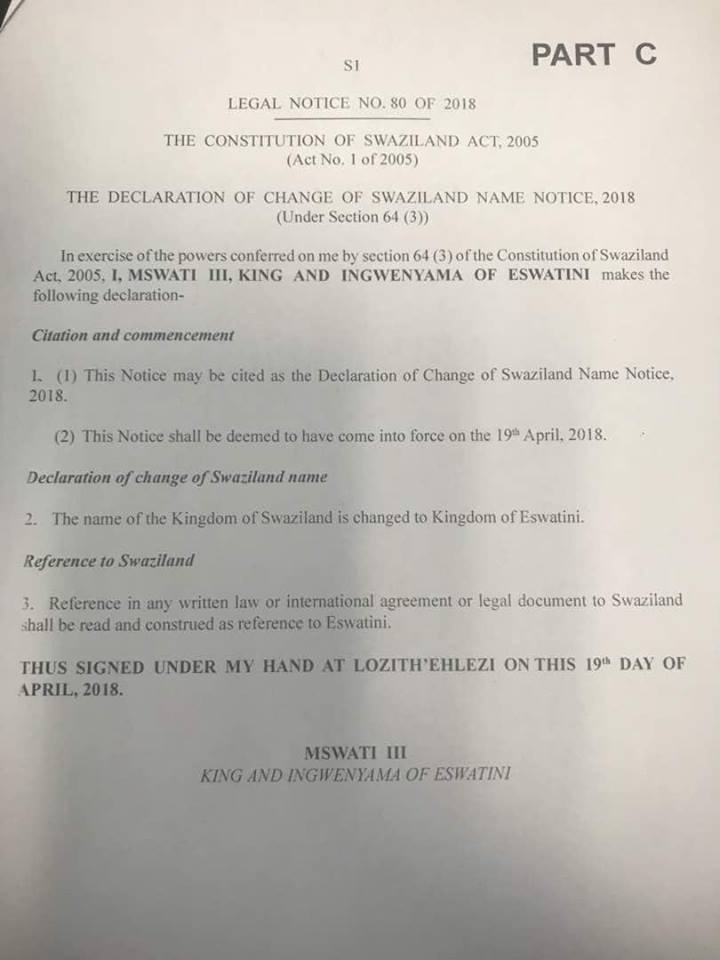
The change was apparently effective immediately: A purported copy of the legal order making the new name official, also dated April 19, was posted on a Swaziland news blog in May, with some validation from other sources.

The announcement was unexpected, but King Mswati III has been using the new name in speeches for years, so it wasn’t a complete surprise. Still, citizens of the country of course had varying opinions on the change. Some called it long overdue, while others denounced it as a distraction from more important national issues. Some of those critics noted that renaming a country isn’t purely a symbolic act – you also have to spend time and money changing all the things the name is written on.

Why “Eswatini”?

Actually, “eSwatini” was already the country’s name – in the local Swazi language. Like Cape Verde’s switch to “Cabo Verde” in 2013, this is just a case of adjusting the official English name to match the native name. And just like “Swaziland” in English, eSwatini means “place of the Swazi people” in Swazi (or as the language calls itself, “Swati”).

But why change the English name to match the Swazi one? King Mswati argued that it only makes sense to do the same as other African countries, many of which “reverted to their ancient, native names” when they became independent. For Swaziland, he said, that ancient name was eSwatini.

On top of that, some people considered the name “Swaziland” an awkward mix of the Swazi and English languages, and the king has complained that the name “Swaziland” often gets mistaken for “Switzerland”.

Capitalization: Eswatini or eSwatini?

Journalists reporting on the name change when it first happened in April spelled the new country name “eSwatini”, with a lowercase “e” and capital “S”. That’s the way the country’s name is properly written in the Swazi language, and it was also spelled that way in the government’s official transcript of King Mswati’s September 2017 speech to the United Nations (which was delivered in English). Capitalizing only the second letter of a name is unusual in English, but then, that doesn’t stop you from shopping on eBay with your iPhone.

Where is Eswatini? Map of Eswatini's location in Africa. Formerly known as the Kingdom of Swaziland, the country was renamed Kingdom of Eswatini in 2018.
Location of Eswatini (Swaziland) in Africa. Derived from this blank map by Eric Gaba. License: CC BY-SA

Still, the point seems to be moot: The purported legal order for Swaziland’s name change spells it “Eswatini” with a capital “E” and lower case “s”, and official sources from other countries have done the same – probably following the official notice they’ve received from the Swazi government.

The government’s own websites, where the name has been updated, also use the capital “E” spelling for the name. So that seems to be the officially proper way to write it.

[Edit: The official ISO standard list of countries, now updated, also uses the capital “E” spelling.]

Eswatini: How to Pronounce It?

So what’s the correct pronunciation of Eswatini? Well, international news outlets we checked have been pronouncing it “ess-wah-TEE-nee”. But King Mswati himself seems to pronounce it differently – to our ears, it sounds more like “eh-SWAH-tee-nee”, with emphasis on the “swa”.

You can listen for yourself in his announcement speech, or in his September 2017 speech to the United Nations (country name at 1:59, 3:08, and 6:08).

Eswatini vs. Swaziland: Which Name Wins?

Ultimately, no country’s government can completely control what people call it in another language, and it’s always been common for places to have completely different names in foreign tongues. Think of how Deutschland and Nippon are known as “Germany” and “Japan” in English – it would be pretty hard to convince all English speakers to switch to the native names.

And every language does this. In some, like Chinese or Arabic, almost every single country’s name is at least a little different from the native version, since they have to spell it using a whole different writing system that doesn’t have the same letters.
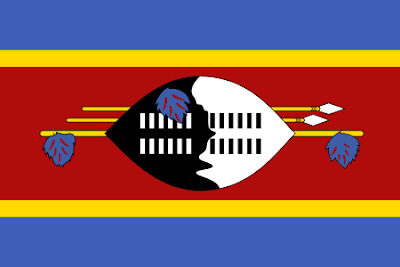
Flag of Eswatini (Swaziland)Country Name:  
• Eswatini (official English)
• eSwatini (Swazi)
• Swaziland (unofficial English)
Full Name:  
• Kingdom of Eswatini (English)
• Umbuso weSwatini (Swazi)
Capital:  
• Mbabane (executive and UN-registered official)
• Lobamba (legislative and ceremonial) 
Adjective: Swazi

In English, some news outlets and organizations have already switched from Swaziland to Eswatini (or more often, eSwatini with the lowercase “e”), but many more haven’t. Only time will tell, but country name changes are usually slow to catch on, especially if they involve substituting a non-English word for the traditional English name.

Wikipedia, whose editors prioritize commonly-used names over official ones, still calls Côte d’Ivoire “Ivory Coast” 30 years after the country ordered the switch. Traditional, more English-sounding names still prevail for Cabo Verde and Timor-Leste too, and the Czech Republic’s invented short name hasn’t made the grade yet either. (On the other hand, changes for Zaire and Western Samoa in the 1990s have caught on just fine.)

So What Really Changes?

Besides English-language signs and documents within the country, Swaziland’s name change will also affect official usage in the United Nations (UN), and foreign governments and diplomats have been asked to use the new name for official English communications. Meanwhile, the ISO 3166-1 international standard list of country codes is based on UN usage, so pretty soon “Eswatini” should start showing up as an option on drop-down lists of the world’s countries. Other websites and apps, like Google Maps, may also make the switch.

At the moment, the UN’s official country names website and the ISO 3166-1 country name database are still showing “Swaziland”, but it looks like they just haven’t been updated yet. A different UN web page lists the country as “Eswatini (Kingdom of)”, and foreign governments haven’t waited to jump on board. It’s almost certainly just a matter of time until ISO and the UN country name site also show “Eswatini”.

Once the UN page updates, we can answer our last question: The UN also records official country names in Arabic, Chinese, French, Russian and Spanish – so is Swaziland only changing its name in English, or in other UN languages too? We’ll let you know when we find out!

Update 2018-07-16: ISO has now updated its list with the new name, Eswatini, spelled with a capital “E”. The name has also been changed in French, which is the only other language that ISO offers its standard in (there are Russian and Spanish versions of the ISO website, but the standard country names aren’t translated into those languages.)

PolGeoNow always reports on changes to countries’ names – learn about others by viewing all country name change articles.

Graphic of the Swazi flag is in the public domain (source).

ICYMI: Cape Verde’s Name Change

In the following weeks, PolGeoNow will be publishing several short “in case you missed it (ICYMI)” articles on events from 2013. This is news that we weren’t able to cover when it first broke, but that we thought our readers might still want to know about.

Premium members click here to view this article in the ad-free members area. Not a member yet? Subscribe now!

Topographic map of Cape Verde, now known officially as Cabo Verde
Cape Verde, now officially Cabo Verde (click to enlarge). Map by Oona Räisänen/Wikimedia (CC BY-SA) (source).

By Evan Centanni

Cape Verde Changes Official Name
If you read our article on the year 2013 in political geography changes, you’ve already heard about the change to Cape Verde’s official English name. But since keeping track of country name changes is one of the primary missions of Political Geography Now, we are now presenting this in-depth report on the topic.

On October 25, 2013, this West African island country changed its official English name at the U.N., from “Cape Verde” to “Cabo Verde”. Unlike other recent country name changes, like those of Libya or Hungary, Cape Verde is changing its short-form official name as well as the long-form one. The long name has also been changed, from “Republic of Cape Verde” to “Republic of Cabo Verde”.

Location on the globe of Cape Verde, now known officially as Cabo Verde
Location of Cabo Verde. Graphic slightly modified from this map by Eddo/Wikimedia (CC BY-SA).

Language Issues
In fact, in its own official language of Portuguese the country has always been known as Cabo Verde, meaning “green cape”. But curiously, partially translated “Cape Verde” has long been the established English name. Perhaps to avoid the inconvenience of juggling these slightly different appellations, the country’s government has now requested to be known only by the fully Portuguese version. It is also promoting a name change in French, from “le Cap-Vert” to just “Cabo Verde”.

How Do You Say That?
The traditional English name of the country, Cape Verde, is pronounced “kayp verd”. On the other hand, the new name is presumably intended to be pronounced as closely as possible to the Portuguese: approximately “kah-bo vehr-dih” (the “e” at the end is pronounced something like an English “short i”). Our bet is that common English usage will default to either “vehr-day” or “vehr-dee”.

What’s in a Name Change?

Flag of Cabo Verde (Cape Verde)Country Name:  
• Cabo Verde (Portugues, official English)
• Cape Verde (traditional English)
Full Name:  
• Republic of Cabo Verde (English)
• República de Cabo Verde (Portugues)
Capital: Praia
Demonym: Cape Verdean (traditional), Cabo Verdean (official)

Ultimately no country’s government can control what people call it in another language, and it’s always been normal for them to be called very different names by speakers of foreign tongues. Think of how Deutschland and Italia are known as “Germany” and “Italy” in English – it would be very difficult to convince all English speakers to switch to the native names. And every language does this. For some, such as Chinese or Arabic, every country’s name is at least a bit different from its native appellation, due to the needs of transliterating from Latin letters into the language’s native script.

What Cape Verde’s change will affect is official usage in the United Nations, and diplomats will also be obliged to use the new name in official English communications. Meanwhile, the international standard list of country codes, ISO 3166-1, is based on U.N. usage, meaning that “Cabo Verde” will soon begin appearing on country lists online and elsewhere (though the change hasn’t come through quite yet).

Some organizations, like National Geographic, which already favors using native names whenever possible, will also oblige the Cape Verdean government in their publications. However, the majority of news media and average people may be reluctant to make the switch, as has been the case with Ivory Coast and East Timor.

Graphic of the flag of Cape Verde (Cabo Verde) is in the public domain (source).

5 Countries You’ve Never Heard of (by Their Native Names)

Think you know your world geography? Maybe you know most or all of the world’s countries…by their English names. But in their own official languages, many nation-states are called something completely different. Maybe you remember España, Deutschland, or Nippon from your high school language class – but there are a lot more than that! See if you can guess these five….

Misr
Also known in casual speech as Masr, this country is considered heir to the ancient kingdom of Kemet.  Locals trade in pounds, but drive on the right side of the road. As a country, Misr ranks 127th in GDP per capita, but boasts the world’s 10th-largest active military. Bizarrely, its independence in 1922 was declared not by the nation’s own people, but by another country. One of the world’s oldest forms of Christianity is headquartered here, where it was founded by Saint Mark in the 1st century.

Location of Egypt on the globe

Egypt  (Arabic: Misr, Masr)
Kemet was Egypt’s native name under the ancient Pharaohs, its last fully independent rulers until 1922, when colonial master Britain unilaterally declared it a sovereign state. Although a majority of Egyptians are Muslim, about 10% are Coptic Orthodox Christians.

(Wikipedia: Egypt)

 Map by Martin23230 and Nableezy (source). License: CC BY-SA


Hrvatska
The kuna is legal tender in this land of a thousand islands, the biggest of which are Cres and Krk. The country’s legislature is known as the Sabor, and is currently led by Speaker Josip Leko. Hrvatska has a strong military industry, and its troops are currently serving in Afghanistan and Kosovo. Fertility rates are among the world’s lowest, and the country’s population is shrinking. The second largest city is Split (that’s its name), and on an alphabetical list of the world’s national capitals, Hrvatska’s is dead last.

Croatia  (Croatian: Hrvatska)
Though centered on the European mainland, Croatia’s coastline is lined by nearly 50 inhabited islands, plus hundreds more that are unpopulated. The country’s military contributes significantly to U.N. peacekeeping missions, and the national capital is Zagreb.

(Wikipedia: Croatia)

Shqipëria
Bujar Nishani is the president of this republic, which is divided into 12 qark and 36 rreth. Fifty-eight percent of the country’s labor force is engaged in agriculture, and its currency for trading is the lek. The majority language here is Shqip, and Islam is the largest religion, though by some estimates over 70% of the population are not even religious. The Lonely Planet travel guidebooks recommended Shqipëria as the No. 1 country to visit in 2011.

Albania  (Albanian: Shqipëria)
The Albanian language, also spoken in Kosovo, is very distinct from neighboring tongues. Islam became the dominant faith in Albania during its centuries of Ottoman rule, but the post-war communist regime banned all religion, declaring Albania the world’s first “atheist” nation.

(Wikipedia: Albania)

Bhārat
This country is currently facing one of the world’s deadliest ongoing communist insurgencies, and counts Surat, Pune, and Lucknow among its dozen most populous cities. The national anthem is Jana Gana Mana, but the “national song” is Vande Mataram. Field hockey is considered the national sport, though kho kho and gilli-danda are also popular. Bhārat hosts the world’s third-largest Muslim population, and long ago was the site of one of history’s oldest known civilizations.

India  (Hindi: Bhārat)
There are 13 cities of over two million people in India, and dozens more with over one million (I challenge you to name five). Meanwhile, a decades-old war simmers with the Maoist Naxalite rebels. India’s population exceeds 1.2 billion, of whom about 13% follow Islam.

(Wikipedia: India)

Map by Ssolbergj (source). License: CC BY-SA

Suomi
Although this country and its majority language share the same name, that name changes depending on where it is in your sentence: Suomi is her country, but She’s going to Suomessa. The five largest cities include Espoo, Turku, and Vantaa, and as of 2012 the president was Sauli Niinistö. Water covers ten percent of Suomen‘s surface area (not counting the sea), and the remaining land has been occupied by its both of its major neighbors. Suomi is considered one of the three least corrupt countries in the world.

Finland  (Finnish: Suomi)
The Finnish language, unrelated to most other European tongues, has over a dozen noun cases. Finland is covered with thousands of lakes, and for centuries was controlled by the Swedish and Russian empires. The country ranks highly in various measures for quality of living .

(Wikipedia: Finland)

So, how many did you guess right? Tell us on Twitter or Facebook!

(Except where otherwise specified, all maps are in the public domain.)