All About Swaziland’s Name Change (With Maps)

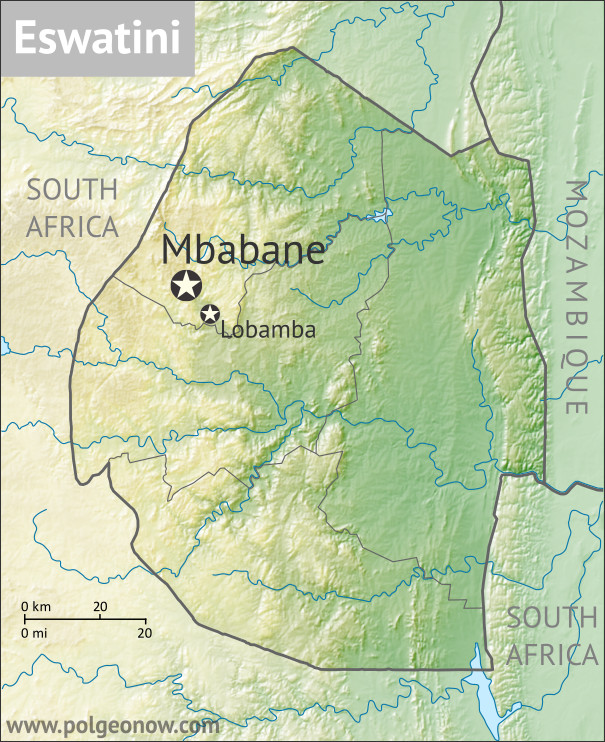
Topographic map of Eswatini (Swaziland), showing terrain, rivers, bordering countries, and capital cities.
Eswatini, formerly known as Swaziland. Based on this map by Htonl and NordNordWest.

Swaziland’s New Name

If you follow PolGeoNow on Twitter, you already know that the small, southern African country of Swaziland was renamed “Eswatini” this April. The full English name of the country, previously “Kingdom of Swaziland”, has also been changed to “Kingdom of Eswatini”.

The rename was first announced by the country’s king on April 19 – his 50th birthday. (Some media incorrectly reported that April 19 was also Swaziland’s 50th anniversary of independence. The country is indeed celebrating its 50th this year, but the actual day of the anniversary is September 6.)

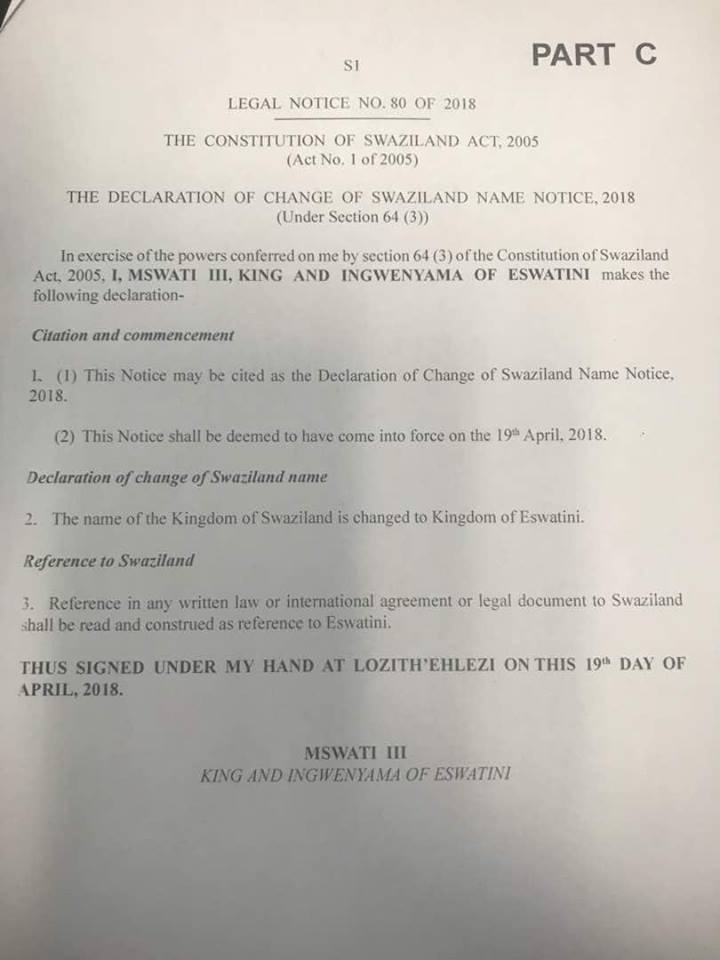
The change was apparently effective immediately: A purported copy of the legal order making the new name official, also dated April 19, was posted on a Swaziland news blog in May, with some validation from other sources.

The announcement was unexpected, but King Mswati III has been using the new name in speeches for years, so it wasn’t a complete surprise. Still, citizens of the country of course had varying opinions on the change. Some called it long overdue, while others denounced it as a distraction from more important national issues. Some of those critics noted that renaming a country isn’t purely a symbolic act – you also have to spend time and money changing all the things the name is written on.

Why “Eswatini”?

Actually, “eSwatini” was already the country’s name – in the local Swazi language. Like Cape Verde’s switch to “Cabo Verde” in 2013, this is just a case of adjusting the official English name to match the native name. And just like “Swaziland” in English, eSwatini means “place of the Swazi people” in Swazi (or as the language calls itself, “Swati”).

But why change the English name to match the Swazi one? King Mswati argued that it only makes sense to do the same as other African countries, many of which “reverted to their ancient, native names” when they became independent. For Swaziland, he said, that ancient name was eSwatini.

On top of that, some people considered the name “Swaziland” an awkward mix of the Swazi and English languages, and the king has complained that the name “Swaziland” often gets mistaken for “Switzerland”.

Capitalization: Eswatini or eSwatini?

Journalists reporting on the name change when it first happened in April spelled the new country name “eSwatini”, with a lowercase “e” and capital “S”. That’s the way the country’s name is properly written in the Swazi language, and it was also spelled that way in the government’s official transcript of King Mswati’s September 2017 speech to the United Nations (which was delivered in English). Capitalizing only the second letter of a name is unusual in English, but then, that doesn’t stop you from shopping on eBay with your iPhone.

Where is Eswatini? Map of Eswatini's location in Africa. Formerly known as the Kingdom of Swaziland, the country was renamed Kingdom of Eswatini in 2018.
Location of Eswatini (Swaziland) in Africa. Derived from this blank map by Eric Gaba. License: CC BY-SA

Still, the point seems to be moot: The purported legal order for Swaziland’s name change spells it “Eswatini” with a capital “E” and lower case “s”, and official sources from other countries have done the same – probably following the official notice they’ve received from the Swazi government.

The government’s own websites, where the name has been updated, also use the capital “E” spelling for the name. So that seems to be the officially proper way to write it.

[Edit: The official ISO standard list of countries, now updated, also uses the capital “E” spelling.]

Eswatini: How to Pronounce It?

So what’s the correct pronunciation of Eswatini? Well, international news outlets we checked have been pronouncing it “ess-wah-TEE-nee”. But King Mswati himself seems to pronounce it differently – to our ears, it sounds more like “eh-SWAH-tee-nee”, with emphasis on the “swa”.

You can listen for yourself in his announcement speech, or in his September 2017 speech to the United Nations (country name at 1:59, 3:08, and 6:08).

Eswatini vs. Swaziland: Which Name Wins?

Ultimately, no country’s government can completely control what people call it in another language, and it’s always been common for places to have completely different names in foreign tongues. Think of how Deutschland and Nippon are known as “Germany” and “Japan” in English – it would be pretty hard to convince all English speakers to switch to the native names.

And every language does this. In some, like Chinese or Arabic, almost every single country’s name is at least a little different from the native version, since they have to spell it using a whole different writing system that doesn’t have the same letters.
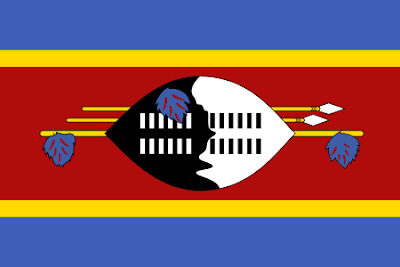
Flag of Eswatini (Swaziland)Country Name:  
• Eswatini (official English)
• eSwatini (Swazi)
• Swaziland (unofficial English)
Full Name:  
• Kingdom of Eswatini (English)
• Umbuso weSwatini (Swazi)
Capital:  
• Mbabane (executive and UN-registered official)
• Lobamba (legislative and ceremonial) 
Adjective: Swazi

In English, some news outlets and organizations have already switched from Swaziland to Eswatini (or more often, eSwatini with the lowercase “e”), but many more haven’t. Only time will tell, but country name changes are usually slow to catch on, especially if they involve substituting a non-English word for the traditional English name.

Wikipedia, whose editors prioritize commonly-used names over official ones, still calls Côte d’Ivoire “Ivory Coast” 30 years after the country ordered the switch. Traditional, more English-sounding names still prevail for Cabo Verde and Timor-Leste too, and the Czech Republic’s invented short name hasn’t made the grade yet either. (On the other hand, changes for Zaire and Western Samoa in the 1990s have caught on just fine.)

So What Really Changes?

Besides English-language signs and documents within the country, Swaziland’s name change will also affect official usage in the United Nations (UN), and foreign governments and diplomats have been asked to use the new name for official English communications. Meanwhile, the ISO 3166-1 international standard list of country codes is based on UN usage, so pretty soon “Eswatini” should start showing up as an option on drop-down lists of the world’s countries. Other websites and apps, like Google Maps, may also make the switch.

At the moment, the UN’s official country names website and the ISO 3166-1 country name database are still showing “Swaziland”, but it looks like they just haven’t been updated yet. A different UN web page lists the country as “Eswatini (Kingdom of)”, and foreign governments haven’t waited to jump on board. It’s almost certainly just a matter of time until ISO and the UN country name site also show “Eswatini”.

Once the UN page updates, we can answer our last question: The UN also records official country names in Arabic, Chinese, French, Russian and Spanish – so is Swaziland only changing its name in English, or in other UN languages too? We’ll let you know when we find out!

Update 2018-07-16: ISO has now updated its list with the new name, Eswatini, spelled with a capital “E”. The name has also been changed in French, which is the only other language that ISO offers its standard in (there are Russian and Spanish versions of the ISO website, but the standard country names aren’t translated into those languages.)

PolGeoNow always reports on changes to countries’ names – learn about others by viewing all country name change articles.

Graphic of the Swazi flag is in the public domain (source).
What is Vatican City?

This week, the Catholic Church chose a new leader, Pope Francis. The selection and announcement of the new pope took place in Vatican City, the Church’s sovereign territory within Rome. Is Vatican City really “the world’s smallest country”, or a country at all?  And what’s the difference between Vatican City and the Holy See? Read all about it!

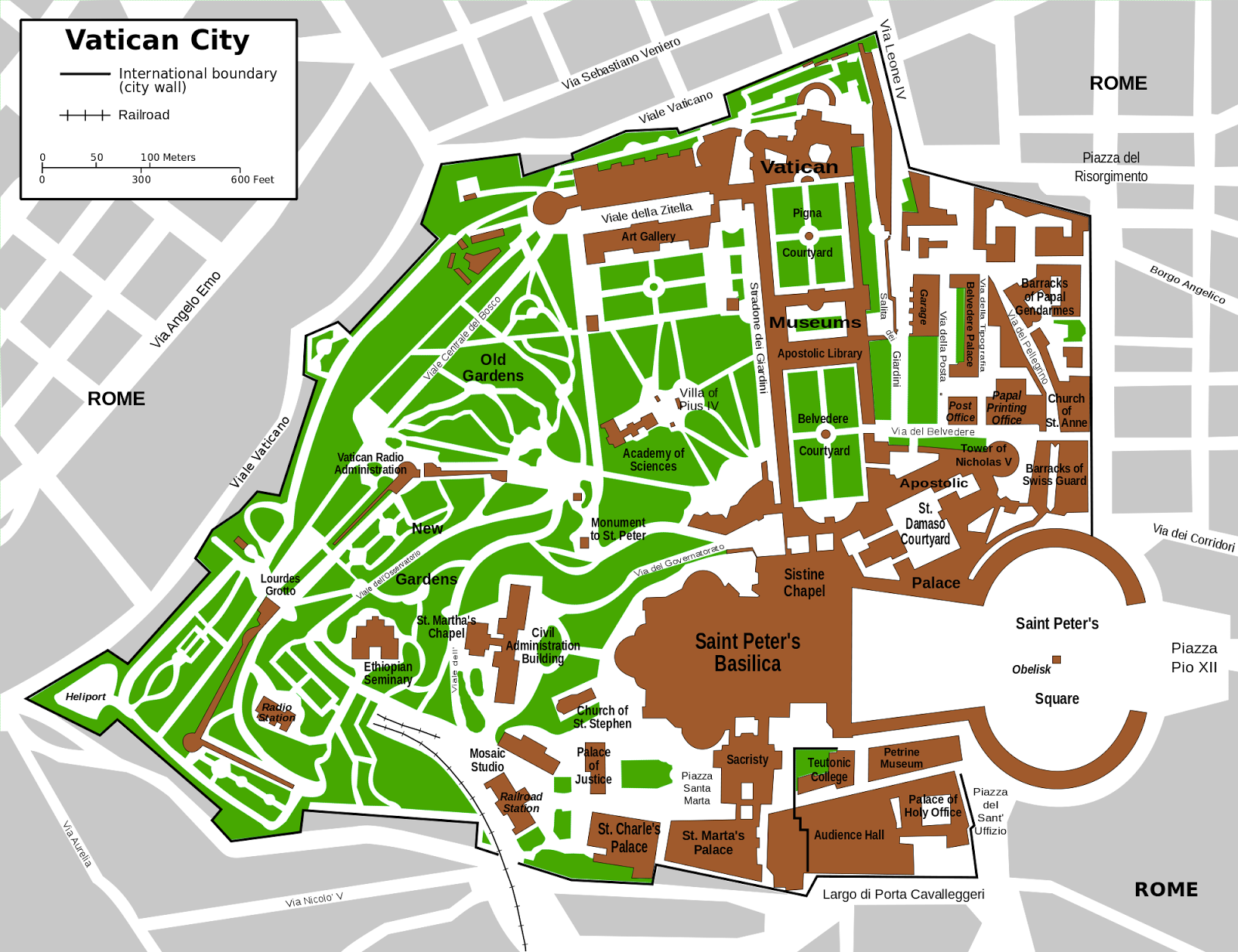
Large scale (close-up) map of Vatican City
Map of Vatican City (click to enlarge). By Francesco Piraneo G./Wikimedia Commons (CC BY-SAsource).

What is Vatican City?

Vatican City was created by the Lateran Treaty in 1929 to ensure the Catholic Church’s independence from the control of other countries, and has an area of only about 0.17 sq mi (0.44 sq km), or about one-eighth the size of Central Park in New York. In addition to the Pope, the state said to have a population of about 800, most of whom are either clergy or members of the Swiss Guard.

Located within the city of Rome, Vatican City is surrounded on all sides by Italy, and nearly encircled by a stone city wall except for in St. Peter’s Square, where it is separated from Italy only by a white line drawn on the ground. Various religious and administrative buildings are located within Vatican City’s confines, but more than half of its area is taken up by the green space of the Vatican Gardens.

Flag of Vatican CityCountry Name:  
• Vatican City (English)
• Città del Vaticano (Italian)
Official Name:  
• Vatican City State (English)
• Stato della Città del Vaticano (Italian)
Capital: Vatican City

Is Vatican City really a country?

Yes, technically. Although it doesn’t really have the kind of population and national cultural identity we would often expect from a “country”, it is recognized worldwide as a “sovereign state”, which means it rules itself and answers to no one else. This makes it by far the world’s smallest independent “country”, at less than a quarter the size of the runner-up, Monaco.

Vatican City’s supreme leader is the Bishop of Rome, a.k.a. the Pope, who is also head of the worldwide Catholic Church. And not only is its independence undisputed by the international community, but it actually maintains diplomatic relations with the U.N. and many countries – sort of. Vatican diplomacy is conducted not in the name of Vatican City itself, but directly by the Catholic Church in the name of the “Holy See”.

What’s the difference between Vatican City and the Holy See?

In short, Vatican City is a state (i.e. country), while the Holy See is a religious organization which happens to govern Vatican City, but has a broader purpose. In Catholic Church terminology, a “see” is the seat of authority of a particular bishop, and the “Holy See” refers to the authority of the Bishop of Rome (the Pope).

So the Holy See is the religious authority presiding over Catholic churches all across Rome (and by extension, the entire Catholic world), but it has normal government authority only in Vatican City and its “extraterritorial properties“. These properties, mostly churches or historical palaces located elsewhere in Rome, have a status similar to foreign embassies: they are technically part of Italy, but are under the legal jurisdiction of the Holy See.

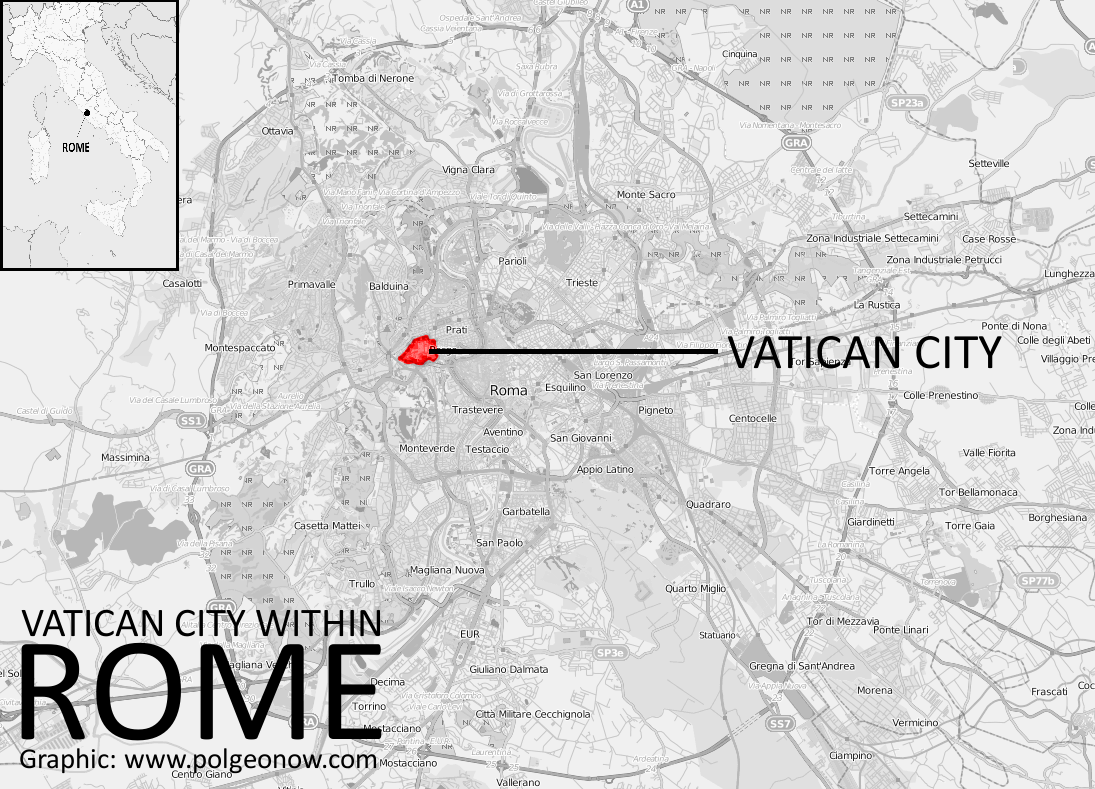
Map showing location of Vatican City within Rome
Vatican City’s location within Rome (click to enlarge). By Evan Centanni. Background map by Dr. Blofeld. License: CC BY-SAsource).

The term “the Vatican” can mean either Vatican City itself, or the Holy See, sort of like how “Washington” or “Beijing” can refer to the U.S. or Chinese governments rather than just the cities.

Bonus Facts

• Vatican City is the only undisputed country in the world which is not a member of the U.N. However, the Holy See does have status as a “permanent observer state” in the U.N. General Assembly. The only other U.N. observer state is Palestine, which just gained that status in November 2012.

• Although Vatican City was created only in 1929, the Holy See has existed for many hundreds of years. It was often recognized as a “sovereign entity” even when it had no territory, though at many points in history it did control territories much larger than today’s Vatican City.

• The Holy See’s official language is Latin, but Vatican City uses Italian as its state language. The Vatican’s only military force, the Swiss Guard, gives orders in German.

Graphic of the Vatican City flag is in the public domain (source).
Feature: Queen Elizabeth’s 16 Countries

Did you know that Elizabeth II is not just the Queen of England and the UK, but of 15 other independent countries too? Read on for quick answers to all your questions about this unusual arrangement…

Map of the Commonwealth Realms - independent countries that share the British monarchy.
Map of the Commonwealth realms – independent countries which share the British monarchy. Current realms in dark blue, former realms in light blue. By Evan Centanni, modified from public domain Wikipedia map (source).

Which countries share the Queen?
Her Majesty Queen Elizabeth II is the official head of state for 16 different independent countries, known as the “Commonwealth realms” – a smaller club than the Commonwealth of Nations, many of whose members are now queenless republics. The current Commonwealth realms, in order of independence, are:

Personal flag of Queen Elizabeth II
Personal flag of Queen Elizabeth II (source) License: CC BY-SA.

 United Kingdom
 Canada
 Australia
 New Zealand
 Jamaica
 Barbados
 The Bahamas
 Grenada
 Papua New Guinea
 Solomon Islands
 Tuvalu
 Saint Lucia
 Saint Vincent and the Grenadines
 Belize
 Antigua and Barbuda
 Saint Kitts and Nevis

Just as the sun never sets in the British Empire, the monarchy never set in the realms – each one inherits the queen’s role from its time as a former British colony (with the exception of northern Papua New Guinea, which passed directly from German to Australian control before uniting with the British south in independence).

Sixteen countries – is that all?
Although the independent realms total 16, the number of “countries” with Elizabeth II as their queen actually increases to 19 when including the four “home nations” that make up the U.K.: England, Scotland, Wales, and Northern Ireland. But that’s not all – as if 16 realms weren’t enough for one woman, the Queen of England also reigns over three Crown Dependencies (Guernsey and Jersey in the Channel Islands, plus the Isle of Man) and the 14 British Overseas Territories, all of which are dependent on the U.K., but aren’t considered part of the kingdom itself. And interestingly, the Realm of New Zealand includes two associated states, the Cook Islands and Niue, which could remain royal subjects even if New Zealand itself were to fire the queen from its government.

Map of the entire reign of Queen Elizabeth II (1952-2012), marking current and former realms and territories.
Entire reign of Queen Elizabeth II (1952-2012). Current in red, former in blue (dark = sovereign realm; light = territory or dependency). Click to enlarge. Excludes Antarctic claims. By Evan Centanni, from public domain map (source).

Historically, there are about 20 more countries which were Commonwealth realms during parts of the last Century, but have since abandoned the monarchy to become republics. Still, the current list is longer than it used to be – at the time of Queen Elizabeth II’s coronation in 1952, there were only seven realms: the U.K., Australia, Canada, New Zealand, Pakistan, South Africa, and Ceylon (now Sri Lanka).


How can countries share the same monarch and still be sovereign states?
Every one of the Commonwealth realms is a fully-fledged independent country and a member of the U.N., despite sharing the same queen. So how does that work? Each country has separately and independently designated Elizabeth II (and her royal line) as its head of state, and the British parliament has no authority whatsoever over the governments of any of the other realms. In a certain legal sense, these 16 countries just happen to have chosen the same family to form their monarchy.

To show this independence, each realm calls the queen by its own national title – she is not only the the Queen of England, but the Queen of Australia, the Queen of Canada, the Queen of the Bahamas, etc. As for Her Majesty, she’s been said to be “equally at home in all of her realms”. But since she has only has one physical body, she still mainly lives in the oldest realm: the U.K. In her other countries, she’s represented on an everyday basis by appointed viceroys (the highest-level viceroys are called governors-general).

But if they’re all controlled by the same person, isn’t that like being one country?

Flag of Elizabeth II, Queen of Barbados
Flag of Elizabeth II, Queen of Barbados. See all flags of Elizabeth II. By Barryob (source). License: CC BY-SA.

Unlike in medieval personal unions, where a single monarch had power over two or more countries, the queen has next to no power in her modern realms. Although there are some decision-making powers ceremonially assigned to her, for the most part she can now only exercise them if asked to by the country’s government. Since modern constitutional monarchies require the royal family to stay out of politics, the queen serves as a symbol of a loyalty to one’s nation that transcends political differences.

Still, this must create some awkward situations now and then, right?
Absolutely – since the queen mainly acts only on the “advice” of her countries’ governments, she officially takes both sides whenever two realms disagree, and has also been found engaging in trade competition with herself. She may also be simultaneously neutral and at war when one realm is involved in an international conflict and others are not; in extreme cases, the monarch of the Commonwealth realms may even declare war against him or herself, as happened in the Indo-Pakistani War of 1947 (during the reign of King George VI).

Learn More: The Commonwealth of Nations includes a lot more than just the Realms – so what is it, exactly?