Map: Palestine Recognized by Two More Countries (134/193)

(Keep up with changes to Palestine’s situation: view all Palestine updates.)

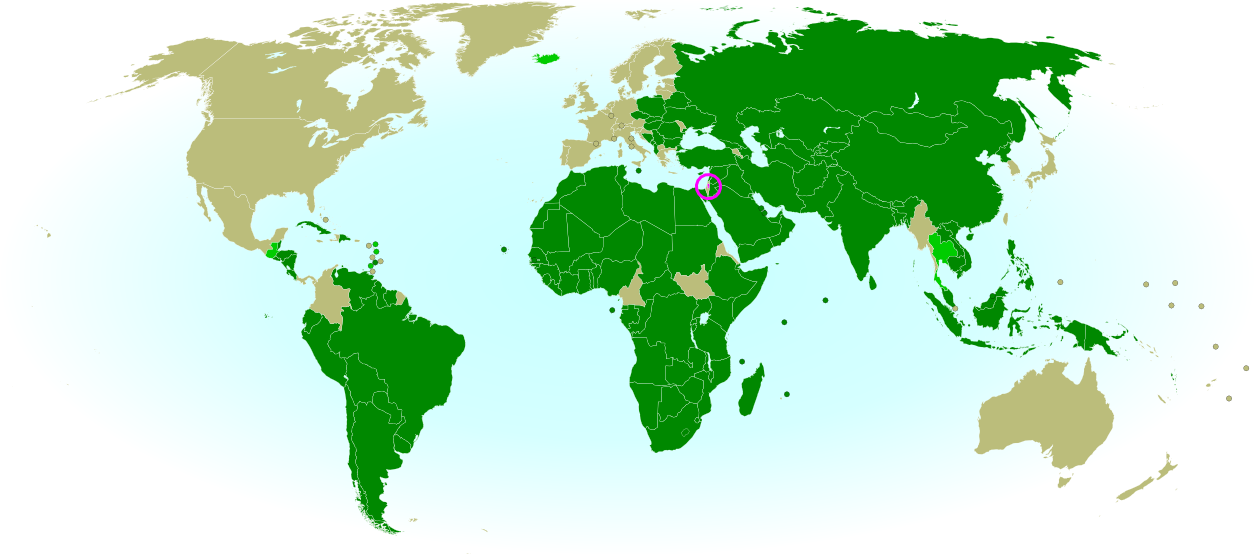
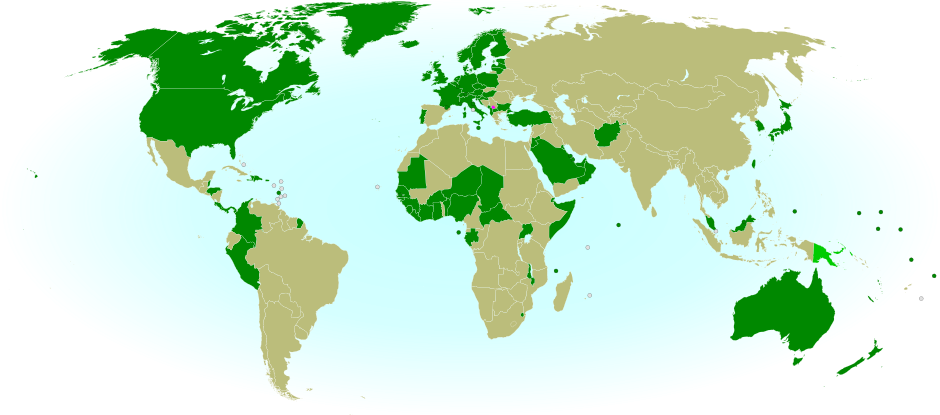
Map of countries that recognize the State of Palestine as an independent country, updated for November 2013 with recent additions Haiti and South Sudan highlighted
Countries recognizing the State of Palestine in green, with most recent additions highlighted. Palestine in magenta (circled). Click to enlarge. Map by Evan Centanni, modified from public domain graphic (source).

By Evan Centanni

List Grows By Two
After being recognized as an Observer State by the U.N. last year to the protest of Israel, the U.S., and other Western countries, the State of Palestine is slowly continuing to receive diplomatic recognition from individual U.N. members. Last May we reported that 132 U.N. member states had officially recognized Palestine, and now the list has grown to 134 (69% of the world body’s total membership). Palestine is also recognized by the proclaimed government of disputed Western Sahara, which is not a member of the U.N.

Flag of Palestine Country Name:  
• Palestine (English)
Filasṭīn (Arabic)
Official Name:  
• State of Palestine (English)
• Dawlat Filasṭin (Arabic)
Capital: 
• Jerusalem (claimed)
Ramallah (administrative)

New Recognition
The most recent country to recognize Palestine as independent is the Caribbean nation of Haiti, which did so near the end of this past September. An official ceremony was held for Haiti’s recognition at U.N. headquarters in New York, in which both Haiti and Caribbean neighbor Grenada signed agreements to establish diplomatic relations with the State of Palestine. However, Grenada has already been on the list for some time, offering its recognition a full two years ago according to the official website of Palestine’s U.N. delegation.

One More Country: Mystery Solved
As discussed in our previous Palestine recognition article, since last year the number of recognitions claimed by Palestine’s U.N. mission has been higher by one than the total number actually documented by observers. However, the confusion has now been cleared up by the publication of an official list on the delegation’s website.

This list includes one more country than previous third-party lists, recording newly independent country South Sudan as having offered its recognition on July 14, 2011, on the same day that it joined the U.N. In retrospect, this should come as no surprise, since South Sudan firmly supported Palestine’s 2011 bid for U.N. membership, and apparently did actually announce that it would grant diplomatic recognition (though that statement occurred later than the date now claimed by Palestine).

Related Articles:
Palestine Recognized as a Country by the U.N.
Is Palestine Really a Country?
Map of Countries Recognizing Kosovo

Map Update: Kosovo Recognized by 3 More Countries (103/193)

Map of countries that recognize the Republic of Kosovo as an independent state, updated for October 2013 with most recent additions (Thailand, Libya, Granada) and disputed recognitions highlighted
Countries recognizing the Republic of Kosovo in green, highlighting recent additions. Disputed recognitions in yellow. Kosovo in magenta. Map by Evan Centanni, modified from public domain graphic (source).

Flag of the Republic of KosovoCountry Name:  
• Kosovo (English, Serbian)
• Kosova (Albanian)
Official Name:  
Republic of Kosovo (English)
Republika e Kosovës (Albanian)
Republika Kosovo (Serbian)
Capital: Pristina/Prishtina

By Evan Centanni

New Kosovo Recognitions
Late last month, three more countries extended formal recognition to the self-proclaimed Republic of Kosovo. The breakaway state in southeastern Europe now is recognized as independent by at least 103 U.N. member countries (53%). As discussed in our previous Kosovo recognition map update, there are three additional recognitions which are currently in question. Political Geography Now has now chosen to exclude all of these from future tallies until the question of their validity is resolved.

The three U.N. member countries which have recently recognized Kosovo are Thailand in Southeast Asia, Libya in North Africa and Grenada in the Caribbean. All three offered their recognition within a few days of each other near the end of September, during the meeting of the U.N. General Assembly in New York. Libya’s decision in particular was publically announced from the sidelines of that meeting.

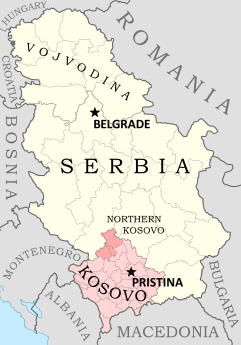
The Republic of Kosovo declared independence from Serbia in 2008, but has been blocked from U.N. membership by objections from Serbia, Russia, and other countries who see its secession as invalid. In addition to the 103 U.N. members recognizing Kosovo, its independence is also acknowledged by non-U.N. member Taiwan. For more on Kosovo’s special situation, see our first Kosovo recognition report, which also includes a map of Kosovo’s location relative to Serbia.

Stay Up to Date: Check for further news and map updates on Kosovo’s recognition by viewing all Kosovo articles on Political Geography Now.

Related Articles:
Kosovo Recognition Map Update: August 2013
North Kosovo Status Changing After Serbia Deal
Who Recognizes Palestine in 2013?
 

Flag graphic by Cradel (source). License: CC BY-SA

Map: Kosovo Recognized by 4 More Countries (101/193)

Map of countries that recognize the Republic of Kosovo as an independent state, updated for August 2013 with most recent additions and disputed recognitions highlighted
Countries recognizing the Republic of Kosovo in green, with the four most recent additions highlighted. Disputed recognitions in yellow. Kosovo in magenta. Map by Evan Centanni, modified from public domain graphic (source).

Flag of the Republic of KosovoCountry Name:  
• Kosovo (English, Serbian)
• Kosova (Albanian)
Official Name:  
Republic of Kosovo (English)
Republika e Kosovës (Albanian)
Republika Kosovo (Serbian)
Capital: Pristina/Prishtina

By Evan Centanni

New Kosovo Recognitions
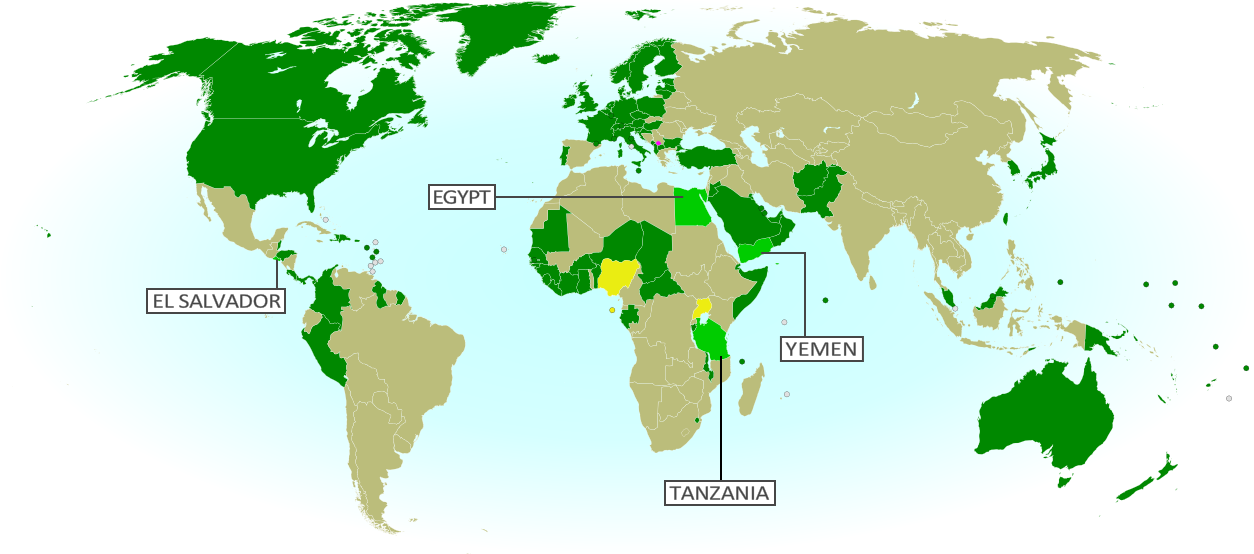
Over the past four months, the breakaway Republic of Kosovo has received diplomatic recognition from two more U.N. member countries. The self-proclaimed southeastern European country now claims recognition from 101 U.N. member countries (52%), up from 99 in our previous Kosovo recognition update (see “Disputed Recognitions” below for details on why the total has only been incremented by two).

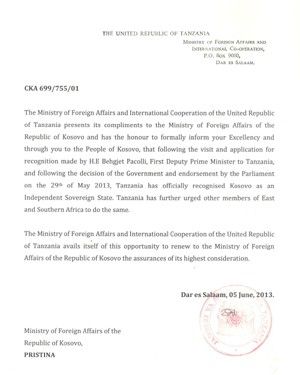
Tanzania, a republic in East Africa, recognized Kosovo at the end of May, and nearby Egypt extended its recognition a month later (just days before the breakout of its current constitutional crisis). Yemen had already endorsed Kosovo’s independence earlier in June, and the small Central American country of El Salvador apparently followed suit by the end of the month.

The Republic of Kosovo declared independence from Serbia in 2008, but has been blocked from U.N. membership by objections from Serbia, Russia, and other countries who see its secession as invalid. In addition to the 101 U.N. members from whom Kosovo claims recognition, its independence is also acknowledged by non-U.N. member Taiwan. For more on Kosovo’s special situation, see our first Kosovo recognition report, which also includes a map of Kosovo’s location relative to Serbia.

Disputed Recognitions
As explained in our previous Kosovo recognition report, there has been doubt cast on some of Kosovo’s claimed recognitions. In fact, if the Kosovan government’s past disputed claims of recognition are included, the total number of U.N. member countries recognizing the breakaway state is now 103. However, a recent report from Kosovo’s foreign ministry only claims 101 U.N. member recognitions, even while acknowledging the four most recent additions. This suggests they may finally have given up on the questionable claims of recognition from  Nigeria and Uganda (the third disputed recognition, from São Tomé and Príncipe, is better documented). In any case, the total number of countries recognizing Kosovo now forms over half of the U.N. membership even without counting disputed recognitions.

Stay Up to Date: Check for further updates to this story by viewing all Kosovo articles on Political Geography Now.

Related Articles:
North Kosovo Status Changing After Serbia Deal
Kosovo Recognition Update: April 2013
Who Recognizes Palestine in 2013?
 

Flag graphic by Cradel (source). License: CC BY-SA

Who Recognizes Palestine in 2013?

(Keep up with changes to Palestine’s situation: view all Palestine updates.)

 Palestine is now an Observer State in the U.N., but it’s still not recognized individually by all U.N. member countries. Read on for more about the latest countries to recognize Palestine, plus other recent changes to its international status.

Map of countries that recognize the State of Palestine as an independent country, updated for May 2013 with most recent additions highlighted
Countries recognizing the State of Palestine in green, with most recent additions highlighted in lighter green. Palestine in magenta (circled). Map by Evan Centanni, modified from public domain graphic (source).


By Evan Centanni

Countries that Recognize the State of Palestine
Despite opposition from Israel, the U.S., and other Western countries, Palestine was recognized as an Observer State by the U.N. last year. However, recognition by individual countries is a separate matter. In September of 2011 we reported that the declared State of Palestine had accumulated recognition from 126 U.N. members plus partially-recognized Western Sahara. But have more states recognized Palestine as an independent country since then?

Yes, a few. As highlighted on the map above, several more U.N. member countries have recognized the State of Palestine over the last year and a half. New additions since our previous update are the Caribbean island nations of Dominica, Antigua and Barbuda, and Grenada, plus Thailand in Southeast Asia and Iceland in Europe. The latest, recognizing Palestine for the first time just last month, is the Central American state of Guatemala.

Flag of Palestine Country Name:  
• Palestine (English)
Filasṭīn (Arabic)
Official Name:  
• State of Palestine (English)
• Dawlat Filasṭin (Arabic)
Capital: 
• Jerusalem (claimed)
Ramallah (administrative)

This brings the total number of U.N. members that consider Palestine a sovereign state to 132, or about 68 percent. Or could it be more? Last year, before Guatemala’s announcement, the Palestinian government was already claiming recognition from 132 countries, and the U.N. resolution which made it an Observer State mention that Palestine was already recognized by 132 “members of the United Nations”. However, no additional recognitions have emerged in the months since then, so it seems likely that it was an error. The number 132 probably refers to the 131 U.N. members recognizing at the time, plus Western Sahara.

Wikipedia: List of countries recognizing Palestine

Palestine in UNESCO
Also since our September 2011 report, Palestine was accepted as a member of the United Nations Educational, Scientific and Cultural Organization (UNESCO), a specialized agency of the U.N. This happened before its elevation to Observer State status in the General Assembly, and was quite controversial at the time. It was speculated that becoming an Observer State would increase the likelihood of Palestine being accepted into more U.N. organizations in the future – however, this has not yet happened.

Change of Standard ISO Name
Another change to Palestine’s treatment internationally came with a February 2013 update to the standard list of country codes and names from the International Organization for Standardization (ISO). This standard, which is used by many organizations and companies around the world, is tied to official United Nations usage. After the Palestinian government received Observer State status from the U.N., its name was changed in the standard from “the Occupied Palestinian Territory” to “the State of Palestine”.

Online company Google caused a bit of a stir last week when it changed the name of its Palestinian search page from “Palestinian Territories” to “Palestine”, receiving criticism from the Israeli government. However, Google argued that it was not making a political statement, but only following the lead of the U.N. and the standard used by websites around the world.

Check For Updates: See more recent recognition reports by viewing all Palestine posts.

Related Articles:

Is Palestine Really a Country?

Kosovo Recognition Update: April 2013 (99/193)

Map of countries that recognize the Republic of Kosovo as an independent state, updated for April 2013 with most recent additions highlighted
Countries recognizing the Republic of Kosovo in green, with the two most recent additions highlighted. Disputed recognitions in yellow. Kosovo in magenta. Map by Evan Centanni, modified from public domain graphic (source).

Flag of the Republic of KosovoCountry Name:  
• Kosovo (English, Serbian)
• Kosova (Albanian)
Official Name:  
Republic of Kosovo (English)
Republika e Kosovës (Albanian)
Republika Kosovo (Serbian)
Capital: Pristina/Prishtina

By Evan Centanni

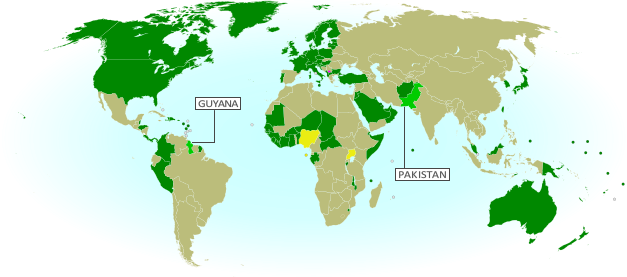
New Kosovo Recognitions: Pakistan & Guyana
The self-proclaimed Republic of Kosovo has reportedly been diplomatically recognized by two more U.N. member countries since our last Kosovo report. The government of the small state in southeastern Europe now claims recognition from 99 U.N. member countries, or about 51% of the world body (there are currently 193 sovereign states in the U.N.).

The Islamic Republic of Pakistan in South Asia extended diplomatic recognition to Kosovo on December 24, in a move confirmed by Pakistan’s foreign ministry. Then last month, Kosovo was also recognized by the Caribbean country of Guyana in South America, according to Kosovo’s foreign ministry (though this has not yet been confirmed by independent sources).

The Republic of Kosovo declared independence from Serbia in 2008, but has been blocked from U.N. membership by objections from Serbia, Russia, and other countries which see its secession as invalid. In addition to the 99 U.N. members from whom Kosovo claims recognition, its independence is also acknowledged by one non-U.N. member, Taiwan. For more on Kosovo’s special situation, see our first Kosovo recognition report, which also includes a map of Kosovo’s location relative to Serbia.

Disputed Recognitions
Like Kosovo itself, the list of countries recognizing the Republic of Kosovo is subject to some controversy. Some opponents of independence have cast suspicion on the self-declared republic’s claims of international recognition, which are sometimes not confirmed by sources outside Kosovo’s government. And they may be on to something: recognition by Nigeria, Uganda, and São Tomé and Príncipe, three countries located in Africa, is currently subject to dispute. Political Geography Now will be following this issue closely in future, and keeping our readers as informed as possible.

Stay Up to Date: Check for further updates to this story by viewing all Kosovo articles on Political Geography Now. 

Flag graphic by Cradel (source). License: CC BY-SA

Kosovo Now Recogized by Half of U.N. (97/193)

Map of countries that recognize the Republic of Kosovo as an independent state, updated for December 2012 with most recent additions highlighted
Countries recognizing the Republic of Kosovo in green, with the five most recent additions to the list labelled. Kosovo in magenta. Map by Evan Centanni, modified from public domain graphic (source).

Flag of the Republic of KosovoCountry Name:  
• Kosovo (English, Serbian)
• Kosova (Albanian)
Official Name:  
Republic of Kosovo (English)
Republika e Kosovës (Albanian)
Republika Kosovo (Serbian)
Capital: Pristina/Prishtina

Kosovo Recognition Update
Since our last report on recognition of the Republic of Kosovo, five more U.N. members have endorsed independence for the disputed country in southeastern Europe. This brings the list of member countries recognizing Kosovo to 97, or just over 50% of the U.N. (there are currently 193 sovereign states in the U.N.).

One country, the Southeast Asian island state of East Timor, actually recognized Kosovo back in September, before our last report. However, we didn’t know that at the time, so it didn’t make it into that update.

The other four U.N. member countries which have granted recognition to Kosovo since last time are Burundi in West Africa, Fiji in the South Pacific, and two small Caribbean island states, Dominica and St. Kitts and Nevis. A full list of countries recognizing Kosovo, including references and dates of recognition, is available on Wikipedia.

The Republic of Kosovo seceded from Serbia in 2008, but has been blocked from U.N. membership by objections from Serbia, Russia, and other countries which see its secession as invalid. In addition to the 97 U.N. members who individually recognize Kosovo, its independence is also acknowledged by one non-U.N. member, Taiwan. For more on Kosovo’s special situation, see our first Kosovo recognition report from earlier this year.

Stay Up to Date: Check for further updates to this story by viewing all Kosovo articles on Political Geography Now. 

Flag graphic by Cradel (source). License: CC BY-SA

Palestine Recognized as a Country by the U.N.

(Keep up with changes to Palestine’s situation: view all Palestine updates.)

This Thursday, the U.N. General Assembly voted to change Palestine’s status in the organization from “observer” to “observer state”. This is the first time the international body has recognized Palestine as a state, giving it the same status enjoyed by U.N. non-member Vatican City. 
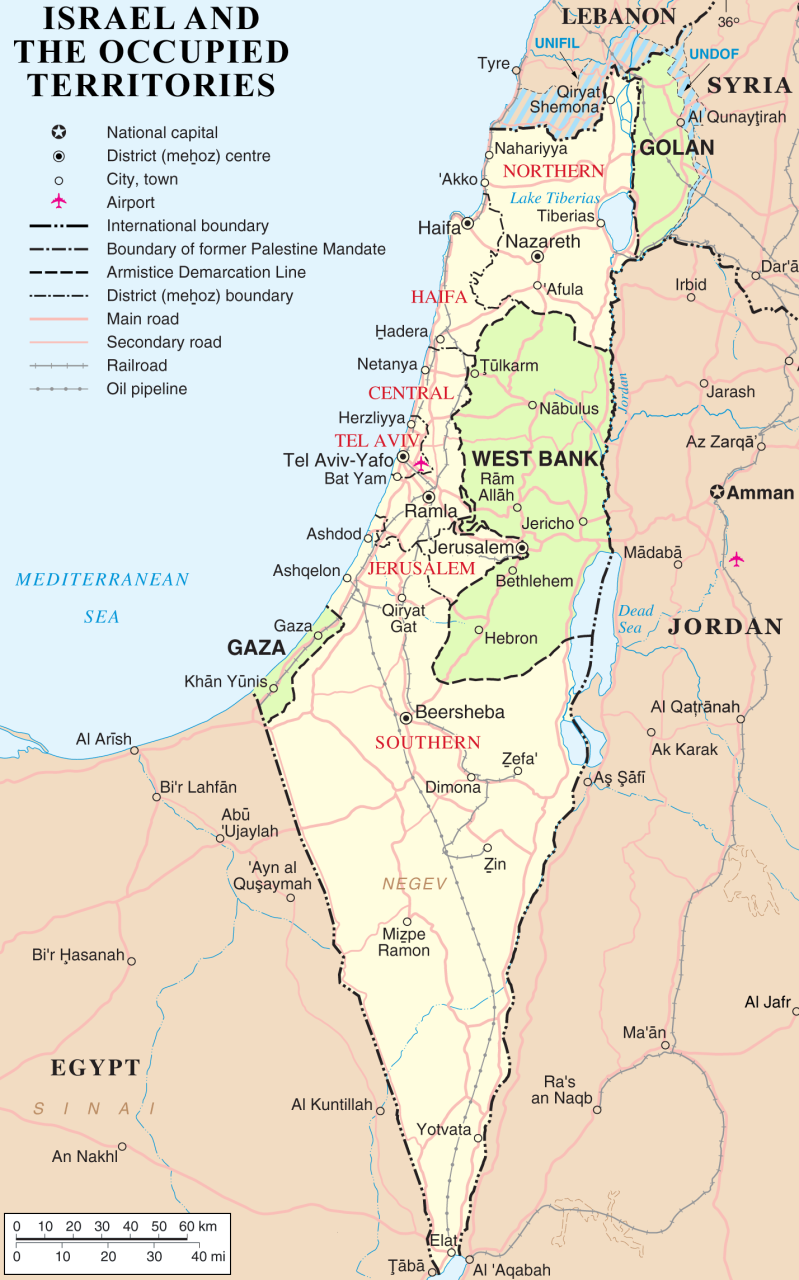
Map of Israel with the occupied territories of the West Bank, Gaza Strip, and Golan Heights highlighted
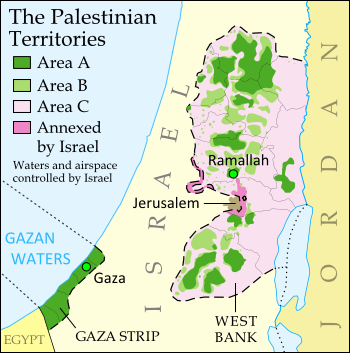
The State of Palestine claims the West Bank and Gaza, which are largely occupied by Israel. The Golan Heights are not part of the Palestinian Territories. Public domain map (source).

Until this Thursday, Palestine was a partially recognized country, acknowledged by some U.N. member nations, but not by the U.N. itself (See also: How many countries are there in the world?). Although its delegation has had observer status at the U.N. since 1974, it was never classified as a “state”, being treated as something between a country and a non-government organization. Now, the organization has officially voted to change Palestine’s status to “observer state” – effectively a recognition that it’s an independent country, even though it’s still not a U.N. member.

The Palestinian delegation campaigned to join the U.N. as a member last year, but had to give up after the U.S. promised to veto the application in the U.N. Security Council. Observer status, on the other hand, is determined by a majority vote in the U.N. General Assembly, which no single country can veto. That vote happened on November 29th, with members voting 138 to 9 in favor of granting Palestine observer state status (41 members abstained, and 5 were absent from the vote; see the full breakdown of national votes).

The only other U.N. observer state is the Holy See, which represents Vatican City. Many other countries have been observer states in the past, but all of them have since been accepted into the U.N. as full members (the last to join were Switzerland in 2002 and North and South Korea in 1991). While yesterday’s events may help settle Palestine’s legal status, the situation on the ground is more complicated, with most of the country’s claimed territory under the control of Israel. The recognized Palestinian government also does not currently administer the Gaza Strip, one of the Palestinian Territories, which is instead controlled by right-wing opposition party Hamas. But despite their differences, the leadership of Hamas supported the campaign for statehood at the U.N.

Document: Full text of U.N. General Assembly resolution authorizing state observer status for Palestine
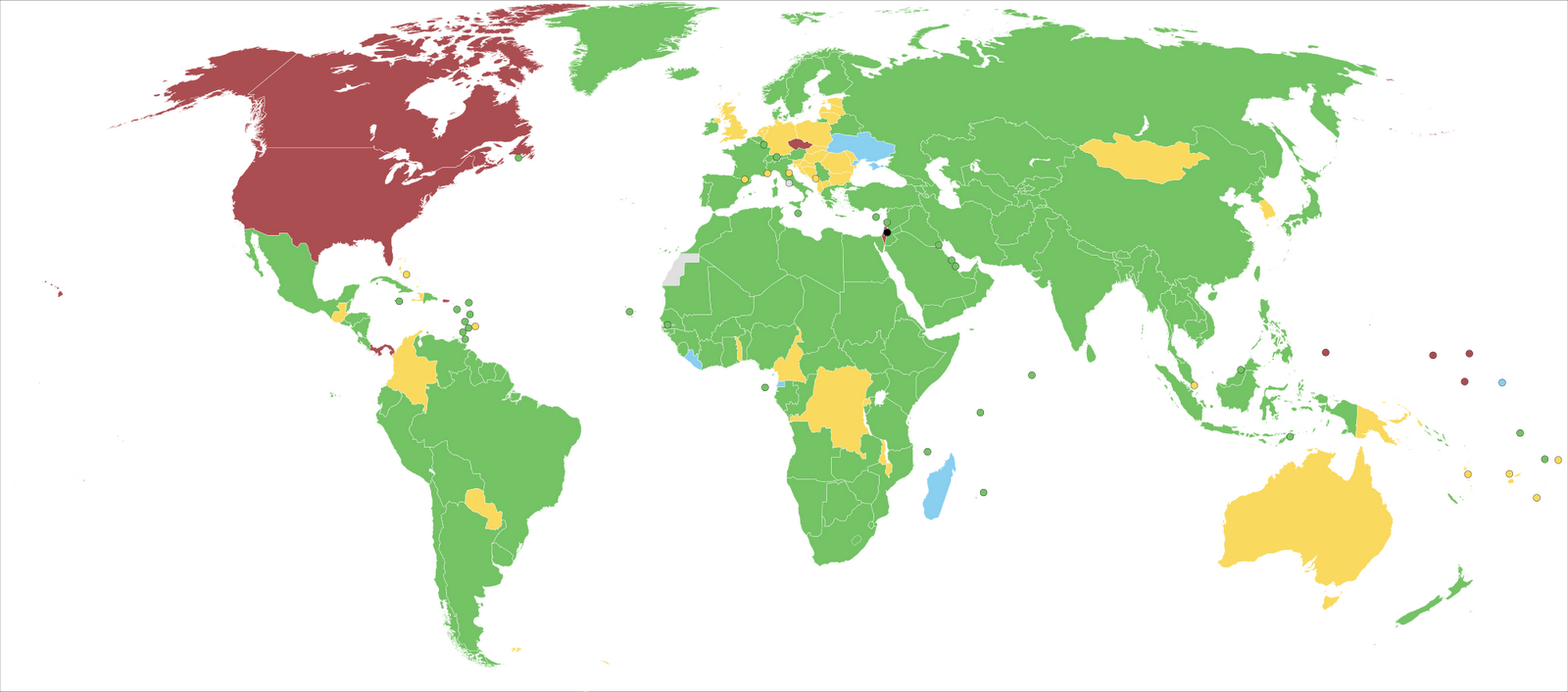
Color-coded map showing how each U.N. member voted on the General Assembly resolution recognizing Palestine as an observer state
Results of U.N. General Assembly vote on granting observer state status to Palestine. Green: In favor; Red: Against; Yellow: Abstaining; Blue: Absent; Black: Palestine. Map by B1mbo/Wikimedia (source). License: CC BY-SA

What will change with Palestine’s new status?
Since the change is to Palestine’s political status, the effects will be mostly in the domain of politics. Its actual role within the U.N. General Assembly will change little, because observers’ privileges are mostly assigned on a case-by-case basis anyway. But now other U.N. agencies are more likely to consider Palestine for membership. It already successfully joined UNESCO last year, but was rejected from the U.N.-connected International Criminal Court (ICC) on the basis that members need to be states. Possible Palestinian membership in the ICC has received a lot of political attention, because it would allow Palestine to pursue war crimes charges against the Israeli government.
Flag of Palestine Country Name:  
• Palestine (English)
Filasṭīn (Arabic)
Official Name:  
• State of Palestine (English)
• Dawlat Filasṭin (Arabic)
Capital: 
• Jerusalem (claimed)
Ramallah (administrative)

The current Israeli administration of Prime Minister Benjamin Netanhyahu, supported by the U.S., insists that the statehood bid violated the terms of the Oslo Accords by bypassing the existing peace process between Israel and the Palestinians. And in the weeks leading up to the vote, Netanyahu had threatened to punish the PLO for seeking statehood, possibly by withholding money from taxes that Israel collects on the Palestinian government’s behalf. But his government seemed to back down as the campaign came to an end, downplaying the results of the vote and saying they wouldn’t retaliate unless Palestine tries to take them to court in the ICC. Some Israelis, such as the previous prime minister, Ehud Olmert, actually supported the statehood bid.

Another area to watch will be Palestine’s treatment by geographers: since the most common definition of “independent country” in maps and other publications is “member or observer state of the U.N.”, Palestine may begin showing up on more maps and lists of countries from now on. Although it’s already shown on many maps, it’s usually indicated as special-case disputed territory rather than a country. Alternatively, if Palestine’s nationhood proves too controversial, we could possibly see some change in how independent countries are defined in maps and books. In the U.S., some may choose to follow the lead of the American government, which currently recognizes all U.N. members and observers except Palestine.

Further Reading: Q&A – Palestinian bid for upgraded UN status (BBC), Why Palestine Won Big at the U.N. (TIME)

Kosovo Recognized by Papua New Guinea (92/193)

Map of countries that recognize the Republic of Kosovo as independent, updated for Papua New Guinea's recognition in October 2012
Countries recognizing the Republic of Kosovo in green, with the most recent, Papua New Guinea (lower right), in lighter green. Kosovo in magenta. Map by Evan Centanni, modified from public domain graphic (source).

Flag of the Republic of KosovoCountry Name:  
• Kosovo (English, Serbian)
• Kosova (Albanian)
Official Name:  
Republic of Kosovo (English)
Republika e Kosovës (Albanian)
Republika Kosovo (Serbian)
Capital: Priština

Kosovo Recognition Update
Southeastern Europe’s disputed Republic of Kosovo has been recognized by one more U.N. member country, four months after the last similar endorsement (See: Kosovo Recognized by Chad). The latest state to offer diplomatic recognition to Kosovo is Papua New Guinea, a Melanesian country located north of Australia, whose Prime Minister proclaimed its support on October 3. The Republic of Kosovo, which seceded from Serbia in 2008, is now officially considered independent by 92 U.N. member countries (48%) plus non-member Taiwan. It has not been admitted into the U.N. itself, due to objections from Serbia, Russia, and other countries which see its secession as invalid. For more on Kosovo’s special situation, see our first report on Kosovo from earlier this year.

Stay Updated: Check for more recent posts by viewing all Kosovo articles on Political Geography Now. 

Flag graphic by Cradel (source). License: CC BY-SA

Kosovo Recognized by Chad (Total: 91/193)

Map of countries that recognize the Republic of Kosovo as independent, updated for June 2012
Countries recognizing the Republic of Kosovo in green, with the most recent, Chad, in lighter green (click to enlarge). Kosovo in magenta. Map by Evan Centanni, modified from public domain wiki map (source).

Flag of the Republic of KosovoCountry Name:  
• Kosovo (English, Serbian)
• Kosova (Albanian)
Official Name:  
Republic of Kosovo (English)
Republika e Kosovës (Albanian)
Republika Kosovo (Serbian)
Capital: Priština

Kosovo Recognition Update
In the month or so since our last report on Kosovo, one more U.N. member country has offered diplomatic recognition to the breakaway state. Chad, a diverse country in Central Africa, recognized the Republic of Kosovo on June 1, one month after a meeting between their Foreign Ministers. A southeastern European state which seceded from Serbia in 2008, Kosovo is now officially considered independent by 91 U.N. member countries (47%) plus non-member Taiwan. It has not been admitted as a member of the U.N., due to objections from Serbia, Russia, and other countries which consider it to be part of Serbia. For more on Kosovo’s special situation, see Kosovo Diplomatic Recognition Continues.

Stay Updated: Check for more recent posts by viewing all Kosovo articles on Political Geography Now.

Flag graphic by Cradel (source). License: CC BY-SA

Kosovo Recognition Update (Total: 90/193)

Country Name: Kosovo (English, Serbian), Kosova (Albanian)
Official Name: Republic of Kosovo (English), Republika e Kosovës (Albanian),
Republika Kosovo (Serbian)
News Categories: Recognition, Partially Recognized States, Breakaway States
Full Story: See Kosovo Diplomatic Recognition Continues

Map of countries that recognize the Republic of Kosovo as independent
Countries recognizing the Republic of Kosovo in green, with arrows marking the two most recent: São Tomé and Príncipe (left) and Brunei (right). Kosovo in magenta. Modified from public domain wiki map (source).

Map of Kosovo within Serbia
Kosovo, claimed as a province of Serbia, is
policed by U.N. and E.U. peacekeepers. The
Republic of Kosovo also governs the region,
except for the Serbian-loyalist north. Map is
my own work, based on these two blank
maps by Nord-NordWest. License: CC BY-SA


Kosovo Recognition Update
Since our last report on the disputed Republic of Kosovo, news has broken on two more U.N. member countries recognizing Kosovan independence. The first, the Democratic Republic of São Tomé and Príncipe, recognized the self-declared European republic on March 13 (before our last article, but the news didn’t trickle out in time to include it). São Tomé and Príncipe is a tiny, Portuguese-speaking island country located off the western coast of Africa. The second recognition came just one week ago, on April 25, from the state of Brunei Darussalam (“Brunei” for short), a small kingdom located on the island of Borneo in Southeast Asia. Kosovo is now recognized by 90 U.N. member countries (46% of the total 193), as well as non-member Taiwan. The Republic of Kosovo has not been admitted as a member of the U.N.

Stay Updated: Check for more recent posts by viewing all Kosovo articles on Political Geography Now.

Sources:  
2012-3-13. Resolution from the government of  São Tomé and Príncipe (PDF) (Portuguese)
2012-4-25. “Brunei Darussalam recognizes Kosovo independence”. Ministry of Foreign Affairs of the Republic of Kosovo.