Iraq Control Map & Timeline: The Siege of Mosul – November 2016 (Subscription)

SUBSCRIBERS CLICK HERE TO PROCEED TO ARTICLE AND MAP

There are newer versions of this map available. To see them, view all Iraq updates.

Research by Djordje Djukic. Map by onestopmap.com, Evan Centanni, and Djordje Djukic

Subscribe for full access to all conflict map reports!


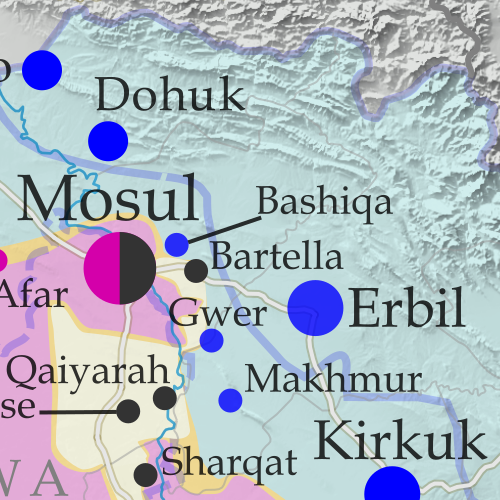
Detailed map of territorial control in Iraq as of November 4, 2016, including territory held by the so-called Islamic State (ISIS, ISIL), the Baghdad government, and the Kurdistan Peshmerga. Shows developments in the ongoing coalition battle to recapture the city of Mosul. Includes key locations from recent events, such as Bashiqa, Sharqat, and Bartella. Colorblind accessible. The battle is now on for Mosul, the so-called Islamic State’s (ISIS/ISIL) biggest city. A grand coalition of Iraqi military, Shiite and Sunni militias, and Kurdistan’s Peshmerga forces – with controversial help from the Turkish military – have now entered and mostly surrounded the city.
 
See all this and more on the latest update to PolGeoNow’s concise, professional map of control in Iraq’s civil war, including a timeline of changes since our previous Iraq map report of September 2016.

This map and report are premium professional content, available to paid subscribers of the PolGeoNow Conflict Mapping Service.

Want to see before you subscribe? Check out our most recent FREE SAMPLE Iraq map report!

Exclusive report includes:

  • Up-to-date map of current territorial control in Iraq, color-coded for the Iraqi government, “Islamic State” (ISIS/ISIL) extremists, and Kurdistan’s Peshmerga forces. Colorblind accessible.
  • Detailed indication of town-by-town control, including provincial boundaries, all major cities, and many smaller ones
  • Markers for key areas of recent fighting such as Mosul, Bashiqa, Sharqat, and Bartella
  • Timeline of changes to the situation since early September, compiled by our Iraq specialist, with links to sources

SUBSCRIBERS CLICK HERE TO PROCEED TO ARTICLE AND MAP

Not signed up yet? Click here to learn more about our professional subscription service!

Can I purchase just this map?
This map and report are not available for automated purchase to non-subscribers. If you need access or republication rights for only this map report, contact service@polgeonow.com for options.

The Gambia’s Name Change

(Subscribers click here to view this article in the members area.)

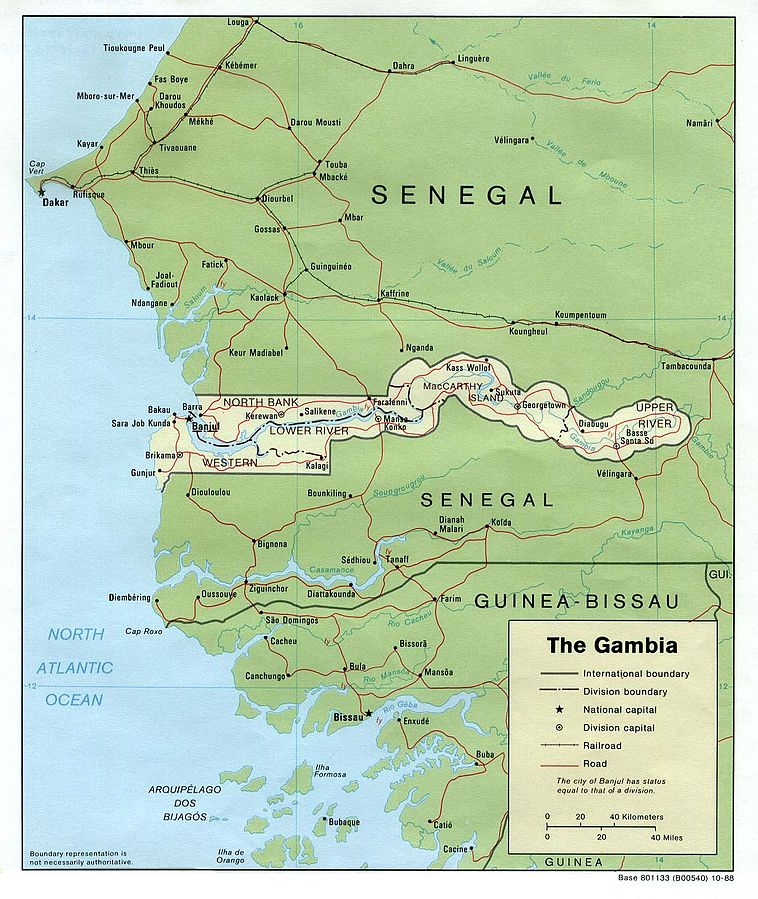
US government map of the Gambia (source)

The Gambia Changes Official Name
If you read our review of world political geography changes in 2015, you might remember a brief note on the official name of the Gambia, a tiny country located along the banks of a river in West Africa. Last December, the Gambia’s maverick dictator decided to declare the country an “Islamic republic”, a designation that can have various meanings and is used by four other countries in the world.

At the time, at least one regional news source claimed that the country’s official name had indeed been changed from “Republic of The Gambia” to “Islamic Republic of The Gambia”. But for a country’s name to be formally changed, its government normally has to pass a law or at least issue some kind of proclamation, and at the time it wasn’t clear whether that had actually  happened.

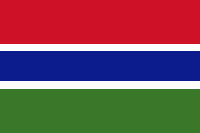
Flag of the Gambia Country Name:  
• The Gambia
Official Name:  
• Islamic Republic of the Gambia
Capital: Banjul

New Name Registered with UN and ISO
Since most of the world’s countries, including the Gambia, are part of the United Nations (UN), it’s expected that if the country’s name changes, the change will be filed with the administrative offices of the UN so world organizations and other countries will know to start using the new one.

And earlier this year, that finally happened, with the UN updating its terminology database to show that the Gambia’s official long-form English name had been changed to “the Islamic Republic of the Gambia”.

This confirmed the name change, and soon led to the same modification being made to ISO 3166, the international standard list of countries and country codes that’s used by organizations and companies all around the world.

How Often Do Countries Change Their Names?
Out of the world’s nearly 200 countries, there’s an average of about one official country name change each year, most of them involving changes to the country’s full name or preferred English name. Besides the Gambia, no countries changed their names in 2014 or 2015, with the last country to do so being Cape Verde in late 2013. That African island country changed its preferred English name at the UN to Cabo Verde, the same as its native Portuguese-language name; the same year, war-torn Libya clarified its new long-form name as “State of Libya”. The year before, Somalia’s 2012 constitution changed the country’s full name to the Federal Republic of Somalia, and a new Hungarian constitution traded “Republic of Hungary” for just “Hungary”.

More substantial changes to countries’ names, involving more than just translation decisions or adjustments to full names, are much less common. The best recent examples are Yugoslavia’s name change to “Serbia and Montenegro” in 2003, Western Samoa’s change to just “Samoa” in 1997, and Zaire’s reversion to its previous name of “Democratic Republic of the Congo”, also in 1997.

Name Changed in Other Languages
Unlike some countries that have only changed their name for foreign language speakers, English is actually the official language of the Gambia. The UN, on the other hand, has six official languages, so the country’s new name also had to be translated and made official in each of those languages:

Language Before After
English the Republic of the Gambia the Islamic Republic of the Gambia
French la République de Gambie la République islamique de Gambie
Spanish la República de Gambia la República Islámica de Gambia
Russian Республика Гамбия Исламская Республика Гамбия
Chinese 冈比亚共和国 冈比亚伊斯兰共和国
Arabic جمهورية غامبيا جمهورية غامبيا الإسلامية

Islam in the Gambia
Although the country’s name change might seem to suggest that the Islamic religion will be playing a larger role in the government, this doesn’t seem to be the case. Ninety percent of Gambians are Muslims, and there is not complete separation between church and state. But the Gambian constitution does protect freedom of religion, and there’s little sign anything is changing in that area.

Graphic of the flag of the Gambia is in the public domain (source).

Syrian Civil War Control Map & Report: October 23, 2016 (Subscription)

SUBSCRIBERS CLICK HERE TO PROCEED TO ARTICLE AND MAP

There are newer versions of this map available. To see them, view all Syria updates.

Research by Djordje Djukic. Map by onestopmap.com, Evan Centanni, and Djordje Djukic

Subscribe for full access to all conflict map reports!


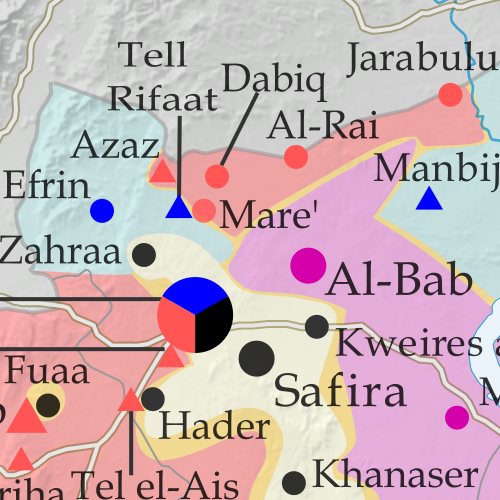
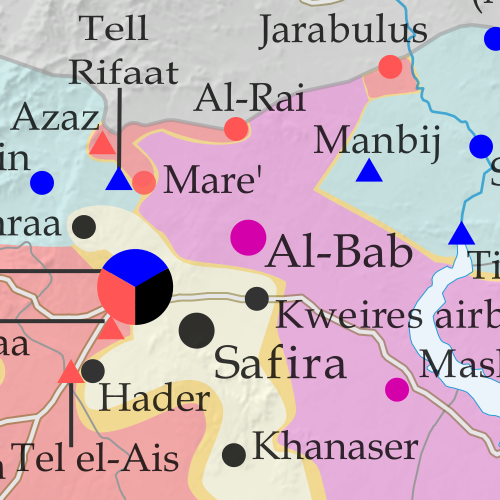
Map of fighting and territorial control in Syria's Civil War (Free Syrian Army rebels, Kurdish YPG, Syrian Democratic Forces (SDF), Jabhat Fateh al-Sham (Al-Nusra Front), Islamic State (ISIS/ISIL), and others), updated to October 25, 2016. Now includes terrain and major roads (highways). Includes recent locations of conflict and territorial control changes, such as Dabiq, Tell Rifaat, Moadamiya, and more (colorblind accessible). Since earlier this month, rebels in Syria have scored an important victory against the so-called “Islamic State” (ISIS/ISIL), even while losing ground to the government – and fighting amongst themselves – in other areas.
 
See all this and more on the latest update to PolGeoNow’s concise, professional Syrian Civil War control map, which includes a timeline of changes since our previous Syria map report in early October, with sources cited.

This map and report are premium professional content, available to paid subscribers of the PolGeoNow Conflict Mapping Service.

Want to see before you subscribe? Check out our most recent FREE SAMPLE Syria map!

Exclusive report includes:

  • Up-to-date map of current territorial control in Syria, color-coded for the Assad government, rebel groups, “Islamic State” (ISIS/ISIL) fighters, and Kurdish/SDF forces. Colorblind accessible.
  • Special symbols indicating towns dominated by rebels of the former Nusra Front (now Jabhat Fateh al-Sham) and US-backed Syrian Democratic Forces (SDF).
  • Detailed indication of city-by-city control, including key towns and other locations important to current events.
  • Locations of recent fighting and other important events, including Dabiq, Tell Rifaat, Moadamiya, and more.
  • Detailed timeline of important events and changes to territorial control since October 2, 2016, compiled by our Syria-Iraq expert, with links to sources.

SUBSCRIBERS CLICK HERE TO PROCEED TO ARTICLE AND MAP

Not signed up yet? Click here to learn more about our professional subscription service!

Can I purchase just this map?
This map and report are not available for automated purchase to non-subscribers. If you need access or republication rights for only this map report, contact service@polgeonow.com for options.

Syrian Civil War Control Map & Report: October 2, 2016 (Subscription)

SUBSCRIBERS CLICK HERE TO PROCEED TO ARTICLE AND MAP

There are newer versions of this map available. To see them, view all Syria updates.

Research by Djordje Djukic. Map by onestopmap.com, Evan Centanni, and Djordje Djukic

Subscribe for full access to all conflict map reports!


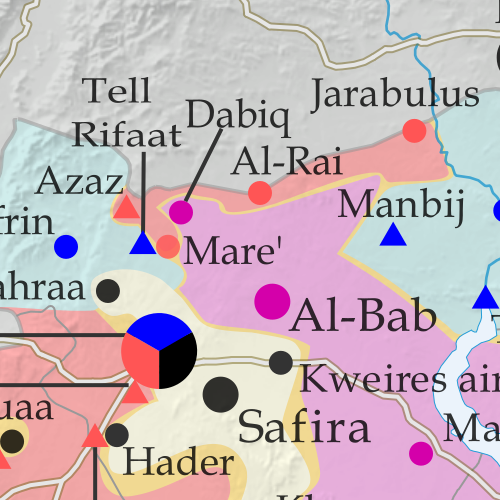
Map of fighting and territorial control in Syria's Civil War (Free Syrian Army rebels, Kurdish YPG, Syrian Democratic Forces (SDF), Jabhat Fateh al-Sham (Al-Nusra Front), Islamic State (ISIS/ISIL), and others), updated for October 2016. Now includes terrain and major roads (highways). Includes recent locations of conflict and territorial control changes, such as Dabiq, Halfaya, Suran, Jarabulus, and more (colorblind accessible). During the past month, a continued Turkish military incursion into Syria completely cut off the so-called “Islamic State” from the self-proclaimed caliphate’s last international border in the region (other than its boundaries with Syrian and Iraqi territory).

Meanwhile, the Assad government and rebel groups have continued to take territory from each other despite a brief attempt at a country-wide ceasefire.
 
See all this and more on the latest update to PolGeoNow’s concise, professional Syrian Civil War control map, which includes a timeline of changes since our previous Syria map report in late August, with sources cited.

This map and report are premium professional content, available to paid subscribers of the PolGeoNow Conflict Mapping Service.

Want to see before you subscribe? Check out our most recent FREE SAMPLE Syria map!

Exclusive report includes:

  • Up-to-date map of current territorial control in Syria, color-coded for the Assad government, rebel groups, “Islamic State” (ISIS/ISIL) fighters, and Kurdish/SDF forces. Colorblind accessible.
  • Special symbols indicating towns dominated by rebels of the former Nusra Front (now Jabhat Fateh al-Sham) and US-backed Syrian Democratic Forces (SDF).
  • Detailed indication of city-by-city control, including key towns and other locations important to current events.
  • Locations of recent fighting and military operations, including Dabiq, Halfaya, Suran, Jarabulus, and more.
  • Detailed timeline of important events and changes to territorial control since August 27, 2016, compiled by our Syria-Iraq expert, with links to sources.

SUBSCRIBERS CLICK HERE TO PROCEED TO ARTICLE AND MAP

Not signed up yet? Click here to learn more about our professional subscription service!

Can I purchase just this map?
This map and report are not available for automated purchase to non-subscribers. If you need access or republication rights for only this map report, contact service@polgeonow.com for options.

Yemen Control Map & Report: September 2016 (Subscription)

SUBSCRIBERS CLICK HERE TO PROCEED TO ARTICLE AND MAP

There are newer versions of this map available. To see them, view all Yemen updates.

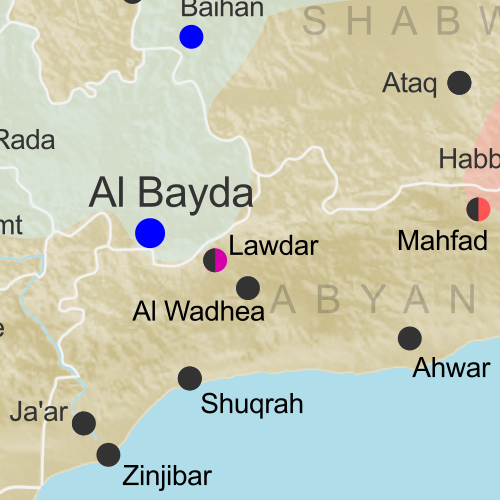
Map of territorial control in Yemen as of September 23, 2016, including territory held by the Houthi rebels and former president Saleh's forces, president-in-exile Hadi and his allies in the Saudi-led coalition and Southern Movement, Al Qaeda in the Arabian Peninsula (AQAP), and the so-called Islamic State (ISIS/ISIL). Includes recent locations of fighting, such as Taiz, Jaar, Zinjibar, Ahwar, and more.

Subscribe for full access to all conflict map reports!

Timeline by Djordje Djukic. Map by Louis Martin-Vézian, Evan Centanni, and Djordje Djukic.

Since our last Yemen control map update almost two months ago, Al Qaeda has lost a large part of its territory in Yemen, even as fighting continues between the Houthis and the Saudi-backed Hadi government.


See all this and more on the newest update to PolGeoNow’s Yemen territorial control map, which includes a timeline of changes and important events since our previous Yemen map report in early August.

This map and report are premium professional content, available to paid subscribers of the PolGeoNow Conflict Mapping Service.

Want to see before you buy? Check out our most recent FREE SAMPLE Yemen map report!

Exclusive report includes:

  • Up-to-date map of current territorial control in Yemen, color-coded for the pro-Hadi coalition, Houthi/Saleh forces, Al Qaeda in the Arabian Peninsula (AQAP), and the so-called “Islamic State” (ISIS/ISIL).
  • Color scheme now consistent with Syria, Iraq, and Libya map series
  • Detailed indication of town-by-town control, including provincial boundaries, all major cities, and many smaller ones
  • Markers for recent areas of fighting, including Taiz, Jaar, Zinjibar, Ahwar, and more
  • Timeline of changes to the situation since August 2, 2016, with links to sources

SUBSCRIBERS CLICK HERE TO PROCEED TO ARTICLE AND MAP

Not a member yet? Click here to learn more about our professional subscription service!

Can I purchase just this map?
This map and report are not available for automated purchase to non-subscribers. If you need access or republication rights for only this map report, contact service@polgeonow.com for options.

The Fall of Libya’s “Islamic State”: Sept. 2016 Control Map & Timeline (Subscription)

SUBSCRIBERS CLICK HERE TO PROCEED TO ARTICLE AND MAP

This is the second of a pair of Libya map reports, the first one chronicling the major political realignment that occurred in Libya between March and May of 2016. 

There are newer versions of this map available. To see them, view all Libya updates.

Research by Djordje Djukic. Map by onestopmap.com and Evan Centanni

Subscribe for full access to all conflict map reports!

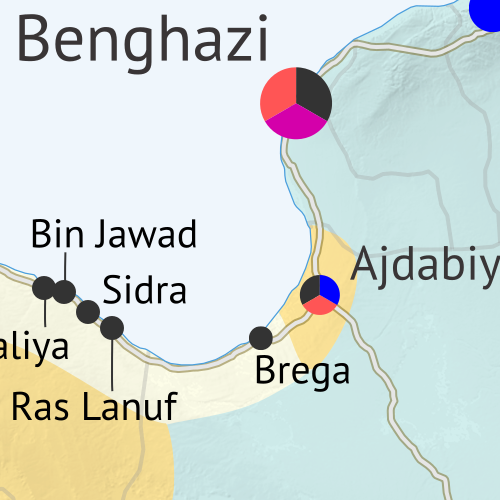
Libya control map: Shows detailed territorial control in Libya's civil war as of September 2016, including all major parties (Government of National Accord (GNA), Tobruk House of Representatives, General Haftar's Libyan National Army, Zintan militias, Petroleum Facilities Guard (PFG); Tripoli GNC government, Libya Dawn, and Libya Shield Force; Shura Council of Benghazi Revolutionaries and other hardline Islamist groups; and the so-called Islamic State (ISIS/ISIL)). Also file under: Map of Islamic State (ISIS or ISIL) control in Libya. Now includes terrain and major roads. Color blind accessible. The past four months have seen a drastic reduction in “Islamic State” (ISIS/ISIL) control in Libya, with the group now barely holding any territory in the country. Meanwhile, the struggle continues between Libya’s two rival governments, as well as other religious hardline militias.
 
See all this and more on the latest update to PolGeoNow’s concise, professional Libyan Civil War control map, which comes with a timeline of changes since our May 2016 Libya map report.

This map and report are premium professional content, available to paid subscribers of the PolGeoNow Conflict Mapping Service.

Want to see before you subscribe? Check out our most recent FREE SAMPLE Libya map!

Exclusive report includes:

  • Up-to-date map of current territorial control in Libya, color-coded for the UN-backed Government of National Accord (GNA), the rival Tobruk parliament (supported by General Haftar’s Libyan National Army), “Islamic State” (ISIS/ISIL) fighters, and other religious hardline groups. 
  • Detailed indication of city-by-city control, including key towns and other locations important to current events.
  • Locations of recent fighting and military operations, including Sirte, Ajdabiya, Abu Grain, Bin Jawad, Harawa, and more.
  • Detailed timeline of important events and changes to territorial control since May 10, 2016, with all sources cited.
  • New since last year: Major roads are marked on the map for reference

SUBSCRIBERS CLICK HERE TO PROCEED TO ARTICLE AND MAP

Not signed up yet? Click here to learn more about our professional subscription service!

Can I purchase just this map?
This map and report are not available for automated purchase to non-subscribers. If you need access or republication rights for only this map report, contact service@polgeonow.com for options.

Libya’s Political Realignment: May 2016 Control Map & Timeline

This is the first of a pair of Libya map reports, with the second spotlighting the retreat of “Islamic State” forces from May to September. The second report, with a more up-to-date map, is available to members of our conflict map subscription service. 

There are newer versions of this map available. To see them, view all Libya updates.

Libya control map: Shows detailed territorial control in Libya's civil war as of May 2016, reflecting the political realignment after UN peace deal, including all major parties (Government of National Accord (GNA), Tobruk House of Representatives, General Haftar's Libyan National Army, Zintan militias, Petroleum Facilities Guard (PFG); Tripoli GNC government, Libya Dawn, and Libya Shield Force; Shura Council of Benghazi Revolutionaries and other hardline Islamist groups; and the so-called Islamic State (ISIS/ISIL)). Also file under: Map of Islamic State (ISIS or ISIL) control in Libya. Now includes terrain and major roads. Color blind accessible.
Base map by Koen Adams of onestopmap.com, with territorial control by Evan Centanni. All rights reserved.

(Subscribers click here to view this article in the member area)

Timeline by Djordje Djukic, with additional reporting by Evan Centanni

Drastic Political Shift
Starting soon after our last Libya control map report in March, the structure of Libya’s divided control and rival governments underwent a massive realignment, with international recognition essentially switching from one side of the country to the other, and some key fighting forces switching sides as well.

Last year, the country was already divided between two rival governments, the controversial General National Congress (GNC) in the capital city of Tripoli and the more internationally-recognized House of Representatives in the eastern city of Tobruk (with forces of the so-called “Islamic State”, formerly ISIS/ISIL, holding territory in between).

In an effort to unite the two governments, a UN-backed peace deal created a new “Government of National Accord” (GNA), which last March dramatically sailed into Tripoli from Tunisia to take over the reigns. Within a few weeks, the old GNC government had yielded to GNA authority, and most of the GNC-associated Libya Dawn militias agreed to support the new government too (at least for the time being). However, the GNA failed to secure an endorsement from the legislature in Tobruk, limiting the new government’s power in the east to support from the maverick Petroleum Facilities Guard (PFG) along the central coast.

The result is that most international recognition has shifted to the new Tripoli government, whose military is largely made up of the same forces that were loyal to the controversial GNC, while Tobruk’s formerly recognized government and army are now the defiant rivals.

For the full history of the current civil war since the fall of dictator Muammar Gaddafi in 2011, including the origins of the country’s competing governments, see our detailed Libya background article and timeline from August 2015.
Flag of Libya (2011-present)Country Name:  
• Libya (English)
• Lībyā (Arabic)
Official Name:  
• State of Libya (English)
Dawlat Lībyā (Arabic) 
Capital: Tripoli

Timeline of Events
The following is a detailed timeline of major political events and changes to territorial control since our previous Libya control map of March 2016.

March 16-17, 2016
The European Union agreed on sanctions against three Libyan officials – including the president of the Tripoli-based General National Congress (GNC) – who were opposed to the new UN-backed unity government, the Government of National Accord (GNA). The designated prime minister of the GNA said he expected to move to Tripoli from the neighboring country of Tunisia within days.

March 31, 2016
The dissolution of the GNC government started, with its officials, under pressure from former allies, leaving Tripoli and going back to their home cities. Members of the Presidential Council of the GNA sailed into Tripoli the same day. Subsequently, 10 cities formerly under the control of the GNC pledged their support for the GNA. Following this, GNA support continued to spread further in the west and south of the country, while in the east support for the GNA remained uncertain.

However, the Petroleum Facilities Guard (PFG) under Ibrahim Jathran, in control of eastern oil ports including Sidra, Ras Lanuf, and Brega, did pledge its allegiance to the GNA.

April 5-6, 2016
The GNC-affiliated “National Salvation Government” in Tripoli disbanded and ceded authority to the Presidential Council. The next day, the State Supreme Council elected its president and first deputy. By this time, GNA Prime Minister Fayez al-Serraj was in control of Libya’s central bank and national oil company as well.

Read More: Foreign Policy magazine tells the story of the GNA’s whirlwind rise to power

April 17-19, 2016
The Tobruk-loyal “Libyan National Army” (LNA) organization captured the University of Benghazi, the Al-Hawari cement factory and two nearby cemeteries from religious hardline militias in Benghazi, as well as the Al-Quwarsha area of Benghazi’s district.

April 20, 2016
Forces of the so-called “Islamic State” (IS, formerly ISIS/ISIL) withdrew from positions on the outskirts of Derna, cementing the control of the Mujahideen Shura Council (MSC), a rival religious hardline group, over the town. The LNA also claimed to have taken control of IS’s abandoned positions.

Map of the territorial control (Assad government, Islamic State/ISIS/ISIL, rebel, SDF, and Kurdish) in the Syrian Civil War as of April 2016
Map of IS Control in Syria, April 2016
(click for free article and map)

April 27, 2016
IS ambushed a convoy reportedly consisting of GNA fighters and British and Italian soldiers. The attack reportedly left some Italian marines dead or wounded.

April 29, 2016
As of the end of April, the Tobruk-based House of Representatives, the previous internationally-recognised Libyan parliament, had not yet given its support to the new GNA government in Tripoli. Major sticking points were Tripoli’s disdain for LNA star general Khalifa Haftar, as well as a procedural requirement for the GNA government to present itself in person before the House (meanwhile, GNA leaders were still holed up in an old navy base in Tripoli despite the proclaimed support of many militias in the city).

Also by late April, the GNA had gained the loyalty of several important government ministries.

May 5, 2016
As GNA forces were preparing an offensive to recapture Sirte from IS forces, IS launched a pre-emptive attack. In the offensive, IS claimed to have captured several villages, including Abu Grain, Baghla, and Abu Najaym.

May 10, 2016
A military faction in the eastern city of Ajdabiya declared that it did not support the Tobruk-based LNA.

Timeline continued in subscriber article:
The Fall of Libya’s “Islamic State”: Sept. 2016 Control Map & Timeline

Graphic of the Libyan flag is in the public domain (source).

Iraq Control Map & Report: September 2016

There are newer versions of this map available. To see them, view all Iraq updates.

Detailed map of territorial control in Iraq as of September 5, 2016, including territory held by the so-called Islamic State (ISIS, ISIL), the Baghdad government, and the Kurdistan Peshmerga. Includes results of recent fighting around Qaiyarah (Qayyarah) south of Mosul. Color blind accessible.
Basemap by Koen Adams of onestopmap.com, with territorial control by Evan Centanni and Djordje Djukic. All rights reserved.

(Subscribers click here to view this article in the member area.)

Research and timeline by Djordje Djukic

Summary of Recent Events
After recapturing Ramadi from the so-called “Islamic State” (IS; formerly ISIS/ISIL), the Iraqi government and allies have set their sights on Mosul, the largest IS-controlled city, and until a few years ago the second largest city in Iraq (some sources say half or more of its population fled after the IS takeover in 2014). Since our last Iraq control map report at the end of June, the main change to territorial control has been the government capture of Qaiyarah, a town south of Mosul that’s still more or less surrounded by IS and Kurdish controlled ground.

See Also: Syrian Civil War Control Map: August 2016

Flag of IraqCountry Name:  
• Iraq (English, Kurdish)
• al-‘Irāq (Arabic)
Official Name:  
• Republic of Iraq (English)
• Jumhūriyyat al-‘Irāq (Arabic)
Komara Iraqê (Kurdish)
Capital: Baghdad

Timeline of Changes in Territorial Control
The following is an outline of major events since PolGeoNow’s previous Iraq map update of June 30, 2016. The abbreviation “IS” refers to the organization calling itself “the Islamic State”, also known as ISIS or ISIL. The Peshmerga is the military of Iraqi Kurdistan.

June 29-July 12, 2016
Two weeks after the military started an advance towards the Qaiyarah airbase, they took control of a village 45 kilometers from the airfield on June 29. Subsequently, on July 9, the Iraqi army captured the Qaiyarah airbase, 60 kilometers south of Mosul. Three days later, the same forces linked up with government troops which had been advancing from Makhmour since March, after they captured a village on the Tigris riverbank north of Qaiyarah.

July 3, 2016
Reports said 292 people were killed by a suicide bomber detonating an explosive-filled minibus in the Karrada district of Baghdad.

July 7, 2016
IS suicide bombers attacked a Shiite shrine in a town between Samarra and Baquba, leaving 56 people dead and more than 70 wounded. The attackers fought their way through a market before reaching the gates of the Sayyid Muhammad bin Ali al-Hadi mausoleum, where they blew themselves up.

July 9, 2016
Iraqi security forces captured two villages north of Ramadi from IS.

July 18, 2016
The Iraqi Army launched an assault on the town of Qaiyarah. Meanwhile, Iraqi security forces captured a town in the western part of Anbar province.

August 2, 2016
Iraqi security forces seized two areas south of Mosul, in the area of Qaiyarah.

August 7, 2016
IS suicide bombers attacked a village 60 kilometers south of Mosul, killing 11 people, including six soldiers.

August 14-16, 2016
Kurdish forces took control of 12 villages near Mosul. During the advances, Kurdish Peshmerga forces reached a bridge connecting Erbil, Mosul, and Kirkuk. The Kurds managed to reach the western side of the bridge, thus securing a crossing over the Grand Zab river. The crossing over the river would make it possible for Kurdish forces to eventually advance on Mosul from a new front. Meanwhile, Iraqi security forces captured four villages in the Qaiyarah area.

August 23-25, 2016
Iraqi government forces attacked the center of Qaiyarah, fully capturing the town two days later. They claimed about 250 IS fighters were killed in the battle.

August 29, 2016
Five IS attackers, including a suicide bomber, killed 15 people at a wedding in a town west of Karbala (south of Baghdad, far outside of the IS control zone).

August 30, 2016
It was revealed that before retreating from the Qaiyarah airbase, IS had almost completely destroyed the facility. This was seen as possibly hindering any future attempt by Iraqi forces to retake Mosul, since the air base was intended to be used as a staging area for any future operations against the city.

August 31, 2016
Human Rights Watch accused Sunni pro-government militias of recruiting children into their ranks.

Graphic of the Iraqi flag is in the public domain (source).
Syrian Civil War Control Map & Report: August 2016 (Subscription)

SUBSCRIBERS CLICK HERE TO PROCEED TO ARTICLE AND MAP

There are newer versions of this map available. To see them, view all Syria updates.

Research by Djordje Djukic. Map by onestopmap.com, Evan Centanni, and Djordje Djukic

Subscribe for full access to all conflict map reports!


Map of fighting and territorial control in Syria's Civil War (Free Syrian Army rebels, Kurdish YPG, Syrian Democratic Forces (SDF), Al-Nusra Front, Islamic State (ISIS/ISIL), and others), updated for August 2016. Now includes terrain and major roads (highways). Includes recent locations of conflict and territorial control changes, such as Jarabulus, Manbij, Daraya, Hasakah, and more (color blind accessible). Syria’s war has seen several major territorial changes in the past month, with a Turkish military intervention bringing IS defeats even as the rival, Kurdish-led Syrian Democratic Forces have captured key territory from both IS and the Assad government. Meanwhile, the government has scored some major victories of its own against rebel forces.
 
See all this and more on the latest update to PolGeoNow’s concise, professional Syrian Civil War control map, which includes a timeline of changes since our previous Syria map report in late July, with sources cited.

This map and report are premium professional content, available to paid subscribers of the PolGeoNow Conflict Mapping Service.

Want to see before you subscribe? Check out our most recent FREE SAMPLE Syria map!

Exclusive report includes:

  • Up-to-date map of current territorial control in Syria, color-coded for the Assad government, rebel groups, “Islamic State” (ISIS/ISIL) fighters, and Kurdish/SDF forces. Color blind accessible.
  • Special symbols indicating towns dominated by rebels of the Nusra Front (now Jabhat Fateh al-Sham) and US-backed Syrian Democratic Forces (SDF).
  • Detailed indication of city-by-city control, including key towns and other locations important to current events.
  • Locations of recent fighting and military operations, including Jarabulus, Manbij, Daraya, Hasakah, and more.
  • Detailed timeline of important events and changes to territorial control since July 25, 2016, compiled by our Syria-Iraq expert, with links to sources.

SUBSCRIBERS CLICK HERE TO PROCEED TO ARTICLE AND MAP

Not signed up yet? Click here to learn more about our professional subscription service!

Can I purchase just this map?
This map and report are not available for automated purchase to non-subscribers. If you need access or republication rights for only this map report, contact service@polgeonow.com for options.

Map of Border Controls Inside Europe’s Schengen Area: August 2016

There are newer versions of this map available. To see them, view all Schengen Area articles.

Last March, we explained Europe’s Schengen free travel area in plain English, then published a map of which European countries had temporarily reintroduced border controls. We now present an updated and improved version of the border control map, reflecting several changes from the past five months.

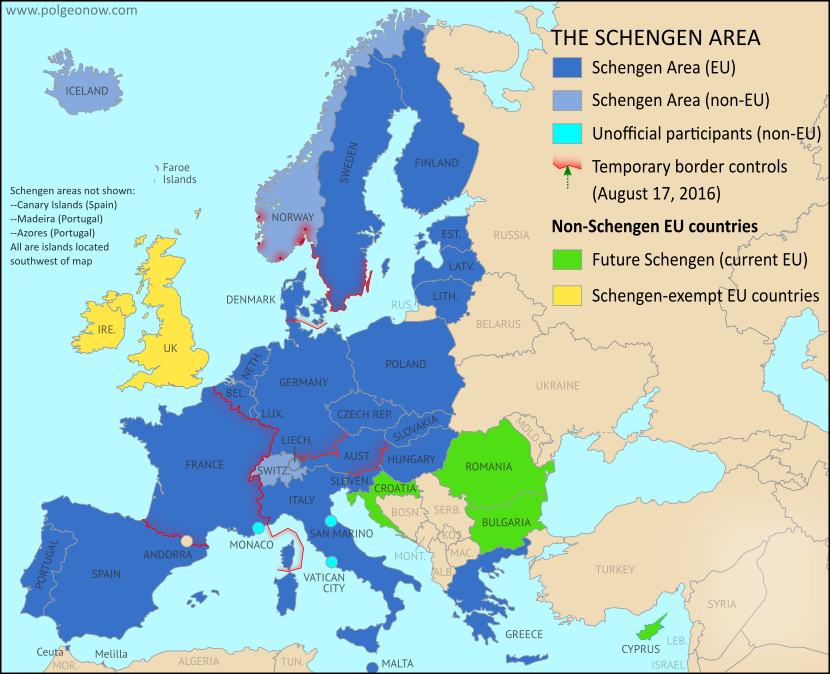
Map of Temporarily Reintroduced Border Control in the Schengen Area (the European Union's border-free travel zone) in August 2016, color-coded for EU Schengen countries, non-EU Schengen countries, future Schengen countries, and Schengen-exempt EU countries, as well as microstates unofficially participating in the Schengen agreements (colorblind accessible).
Map by Evan Centanni, from blank map by Ssolbergj. License: CC BY-SA

(Subscribers click here to view this article in the members area.)

Article by Evan Centanni

Changes to Schengen Border Controls Since March

As anyone who’s visited Europe in recent decades knows, much of the continent is linked together as part of the “Schengen Area“, a collection of countries that don’t make travelers show any ID to cross back and forth across their borders (though this system is overseen by the European Union, the Schengen Area and the EU are not the same thing). But the system does allow countries to temporarily reintroduce border controls under certain circumstances.

With last year’s spike in numbers of refugees and other immigrants arriving in Europe, many Schengen countries have rushed to control the flow of people by using these special temporary border controls. When we published our previous map of temporary Schengen border controls back in March, there were seven countries policing their borders with fellow Schengen members. Today there are only six, and there have been major changes to which borders are controlled:

Belgium’s French Border Controls Expire

In February, Belgium controversially declared an emergency reintroduction of controls along part of its border with France, which it claimed was necessary to limit flows of displaced people caused by the forced closure of a major refugee camp in France. Normally, emergency border controls have to be renewed every ten days, though Belgium announced from the outset that it planned to keep them for a whole month. However, in the end the country did respect the two-month renewal limit on emergency controls, letting them expire in late April.

Denmark Border Controls Expire, then are Reintroduced

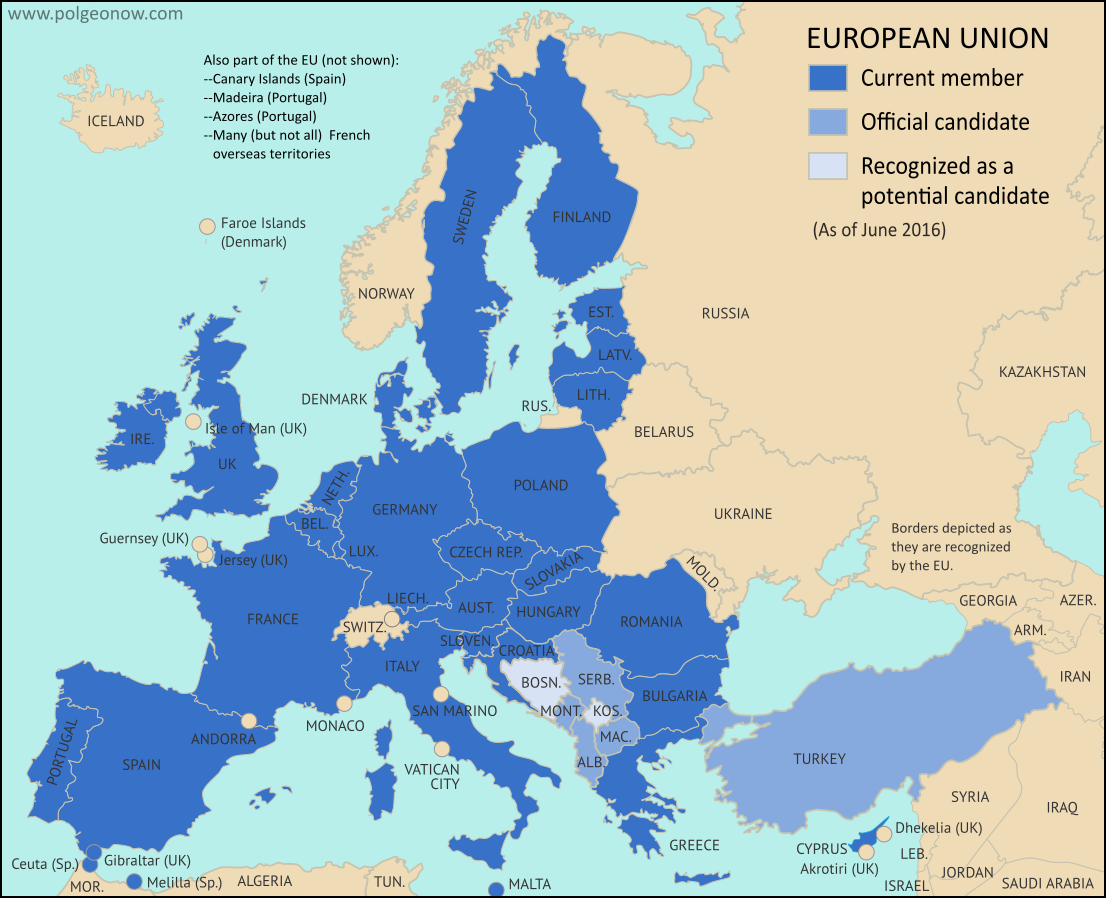
Map of the European Union (EU) and prospective member countries
The full EU and prospective members

Denmark declared emergency controls at all its borders in January, citing “unexpected migratory flow” as the reason. Like Belgium, it kept them in place for the full two months allowable, ending on March 4.

However, Denmark followed that expiration immediately with a normal, non-emergency reintroduction of border controls, which it said were to deal with a “big influx of persons seeking international protection”.

EU-brokered Compromise Aims to Stabilize Schengen

Amid fears that the Schengen Area’s dream of free travel was going down the drain, the foreign ministers of the EU’s member countries met up and hashed out a compromise solution, which they published as an EU “recommendation” document on May 12. Though a lot of their recommendations involved telling Greece to try harder not to let refugees into Europe, they also came up with a plan to reduce the scope of the border controls by refocusing them on high-priority areas.

In exchange for keeping their controls for another six months (more than the normal maximum), five of the six remaining countries agreed to limit which parts of their borders they would police:

  • Germany agreed to control only its border with Austria, ruling out border controls with Switzerland, the Czech Republic, Luxembourg, Belgium, the Netherlands, and Denmark.
  • Austria agreed to control only its borders with Slovenia and Hungary, ruling out border controls with Italy, Switzerland, Liechtenstein, the Czech Republic, and Slovakia.
  • Denmark agreed to control only its border with Germany (including land crossings and ferry connections), ruling out border control for arrivals from Sweden or Norway.
  • Sweden agreed to control only crossings over the bridge from Denmark and sea arrivals along its western and southern coastline, ruling out controls for land borders with Norway and Finland or arrivals by sea along its east-central and northern coasts.
  • Norway agreed to control only arrivals in ports with ferry connections to Sweden, Denmark, and Germany, ruling out controls along its land borders with Sweden and Finland.

All of these border controls will be up for renegotiation after November 11-12, 2016.

France’s Border Controls Continue

The sixth country, France, has continued to control all its borders – except, presumably, the boundary with tiny Monaco, which for immigration-control purposes is already treated as if it were within French borders. France has been policing all its borders since December 14, 2015, when it introduced border controls for security in the aftermath of the massive terror attacks in Paris.

In May 2016, when its border controls were nearing their six-month expiration date (the maximum allowed for any one purpose), France notified the EU that it was extending controls for two more months while it hosted the European soccer championship and the Tour de France cycling race (major sporting events are a normal reason for Schengen countries to temporarily reintroduce border controls).

Before the two months was up, France had experienced another episode of bloody terrorist violence, the July 14 attack in the city of Nice, and it used the resulting state of emergency as reasoning to declare another six months of border controls, to last until January 2017.

And One More: Temporary Border Controls in Poland

Although the number of Schengen countries with reintroduced border controls fell to six after Belgium’s expired, for one month since our last update there were again seven of them. Poland implemented a routine reintroduction of controls on all its borders from July 4 to August 2, for security during a NATO summit and a Catholic Church “World Youth Day” event that featured a visit from Pope Francis.

The EU’s official Temporary Introduction of Border Control page actually lists Poland’s controls as continuing until September 2, but this appears to be an error. Other sources, including the same site’s comprehensive PDF record of border control notifications, all say the controls ended on August 2.

Learn More:
Map of Temporary Schengen Border Controls in March 2016
Which Countries Are in the Schengen Area, and Which EU Countries Aren’t?