Disputed Territory: The Senkaku/Diaoyu Islands

You may have heard the news about China and Japan’s ongoing territorial dispute over a group of islands in the East China Sea. But what are the Senkaku/Diaoyu Islands, and why are they so fiercely contested? Read on for all these answers and more!
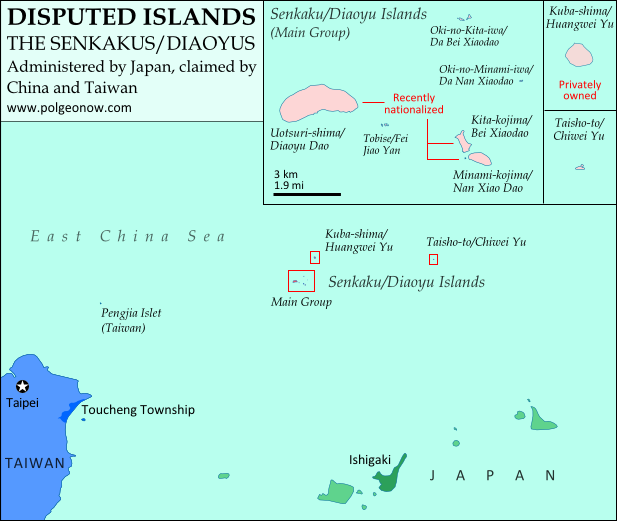
Map of the Senkaku/Diaoyu Islands, disputed between Japan, China, and Taiwan; includes location as well as detail of islands
Map of the disputed Senkaku/Diaoyu Islands (by Evan Centanni).

Article by Omar Alkhalili

About the Islands
The Senkaku/Diaoyu Islands are a collection of five small islets and three rocks in the East China Sea, all of which are uninhabited. The largest of the islands has an area of 4.32 km² and the smallest is only 0.45 km². They are located about 140 km from the nearest inhabited Japanese islands, 300 km from mainland China and 170 km from Taiwan. They are administered by Japan but claimed by both the People’s Republic of China (PRC) and Taiwan, whose government is known officially as the Republic of China (ROC).
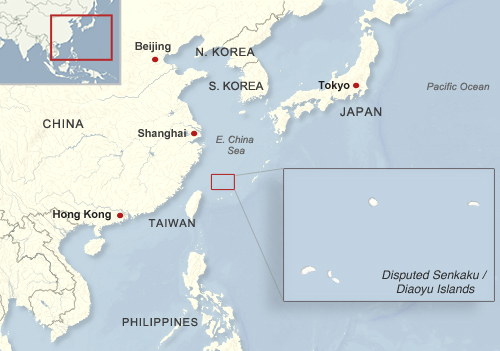
Map of the location of the disputed Senkaku/Diaoyu Islands within Asia
Location of the disputed Senkaku/Diaoyu Islands in Asia
Public domain graphic (source)

In English, the islets have historically been referred to as the Pinnacle Islands, but are now more often called by their Japanese and Chinese names. In Japan, they are known as the Senkaku Islands, whereas in mainland China they are called the Diaoyu Islands and in Taiwan they are referred to as the Diaoyutai (Tiaoyutai) Islands. They are administered by Japan as part of Ishigaki, a municipality in Okinawa Prefecture, while the PRC and ROC both consider them part of Toucheng township in Taiwan’s Yilan County, despite the fact that the two rival governments do not recognize each other.

While it considers the islands part of Ishigaki, Japan’s central government does not allow the city to develop or survey them. Four of the islands have been privately owned since 1932, but the government bought three of them last year after renting them for some time. One of the privately owned islands is still leased to the Japanese Ministry of Defense, which has allowed the United States military to use it as a practice bombing range for aircraft.

History of Claims and Control

Territory Name:  
Senkaku-shotō (Japanese)
• Diàoyúdǎo (Mandarin – China)
• Diàoyútái (Mandarin – Taiwan)
Pinnacle Islands (English – historical) 
Claimants: 
• Japan
• China (People’s Republic of China)
• Taiwan (Republic of China)
Actual Control: Japan
Administrative Status: Part of the country
Capital: N/A (uninhabited)

Japan, mainland China and Taiwan all root their claims to the Senkakus/Diaoyus in the region’s history. China was aware of the islands’ existence since the 15th century, and the PRC and ROC claim that the islands have been part of Chinese territory since at least the 16th century. However, the Japanese government holds that when it surveyed the islands in the late 1800s, they were uninhabited and showed no signs of having been under Chinese administration.

Japan took control of the islands in 1895, and with the exception of the American occupation of Japan from 1945 to 1972, has held onto them ever since. Both Chinas now consider the islands to be part of Taiwan province, which China ceded to Japan in 1895 after the First Sino-Japanese War. However, they hold that Japan returned the rights to the islands to China by surrendering to the Allied Powers at the end of World War II. Japan insists that these islands were not part of the territory that it gave up in surrendering, arguing that they were always considered part of the Ryukyu island chain rather than Taiwan. China and Taiwan did not voice their claim to the Senkaku/Diaoyu islands until after the U.S. occupation Okinawa ended in 1972.

On top of the historical claims, various economic issues complicate the dispute. The islands’ territorial waters include rich fishing grounds and lie along the path of strategically important shipping lanes. Potential oil reserves have also been identified nearby.

Current Dispute
In recent years, tensions over the Senkaku/Diaoyu Islands have flared between Japan and both Chinese governments. After a series of incidents in 1996 that included Japanese activists installing a light house on one of the islands and the death of a Chinese activist due to drowning, there have been continued instances of Chinese activists attempting to sail to the islands, resulting in their arrest and detention.

Aerial view of two of the Senkaku/Diaoyu Islands disputed between Japan, China, and Taiwan
Aerial photo of Kita-kojima/Bei Xiaodao and Minami-kojima/Nan Xiaodao in the Senkaku/Diaoyu Islands
(Courtesy of Japan National Land Image Information (Color Aerial Photographs, Ministry of Land, Infrastructure, Transport and Tourism; source)

In 2010, an incident involving the detention of a Chinese ship crew precipitated mass protests in Chinese cities. Two years later, before the Japanese government’s purchase of three of the islands, the then Governor of Tokyo came up with his own plan to buy the islands, sparking protests in China and resulting in the detention of a group of activists from Hong Kong. Mainland China has challenged Japanese control of the islands through incursions into their territorial waters and airspace. In 2013, the mainland government announced that it plans to survey the islands in order to safeguard its maritime interests.

Recently, some progress has been made in resolving the dispute, with Japan and Taiwan arriving at an agreement allowing Taiwanese fishermen access to a large portion of the island’s surrounding waters. This agreement may create an obstacle for mainland China as its government becomes isolated in its efforts to challenge Japanese control. However, Taiwan still retains its claims to the Senkakus/Diaoyus, and there is no clear end in sight for the dispute between the three governments.

Omar Alkhalili is a contributor to Political Geography Now. He is a graduate of Ramapo College of New Jersey with a Bachelor of Arts Degree in Political Science. He can be reached at omaralkha@gmail.com.

See Also: The Eight Islands of the Senkaku/Diaoyu Group (profiles and aerial photos)

Related Articles:

Niger and Burkina Faso Resolve Territorial Dispute

War in Somalia: Map of Al Shabaab Control (June 2013)

There are newer versions of this map available. To see them, view all Somalia articles on PolGeoNow.

Since the beginning of the year, Somalia’s federal government and its allies have made some major breakthroughs in the war to take back the country from Al Shabaab, Somalia’s local branch of Al Qaeda. This is the third installment in our series of Al Shabaab control maps, marking territorial changes since our last Somalia map update in December 2012.

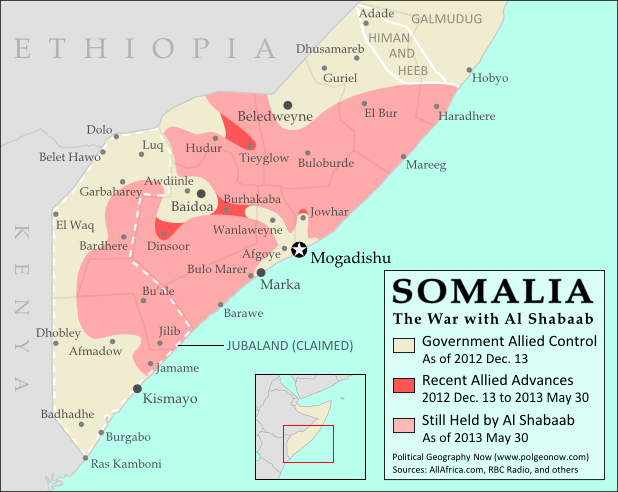
Map of Al Shabaab control in southern Somalia just before June 2013, highlighting recent advances by government and African Union troops since December. Includes the newly recaptured Mogadishu-Baidoa highway corridor, plus Bulo Marer, site of crashed U.S. drone aircraft. Also marks claimed territory of Jubaland state.
Southern Somalia: recent government-allied advances in the war against Al Shabaab. Original map by Evan Centanni. Incorporates elements from this blank map by Eric Gaba and this locator map by TheEmirr. (license: CC BY-SA).

Connecting Mogadishu and Baidoa
After news came in of the Somali Federal Government and its allies completing their control of southern Somalia’s major cities last fall, further progress against the Al Qaeda affiliate group Al Shabaab at first made only slow progress. But since the beginning of this year, at least one major breakthrough has been made.

Background & Actor Profiles: War in Somalia – The Retreat of Al Shabaab 

After several years of being cut off by Al Shabaab, Mogadishu and the key inland city of Baidoa were finally reconnected in February after African Union and Somali forces captured Burhakaba, the last major town lying on the highway between the two cities. As a result, the Al Shabaab’s territory in Somalia has been split into two pieces, though security is probably not so tight that the militants can’t slip back and forth across the narrow band held by the Somali government.

Flag of SomaliaCountry Name:  
Somalia (English)
Soomaaliya (Somali)
• aṣ-Ṣūmāl (Arabic)
Official Name:  
Federal Republic of Somalia (English)
Jamhuuriyadda Federaalka Soomaaliya (Somali)
Jumhūriyyat aṣ-Ṣūmāl al-Fideraaliya (Arabic) 
Capital: Mogadishu

Ethiopian and Somali troops had previously taken the town of Dinsoor, another major town in the region of Baidoa, in mid-December (just after our previous Somalia map update). And fighting in the area continued after the captured of Burhakaba as well, with the Baidoa suburb of Aw Diinle falling to Al Shabaab in March. Although it was reported recaptured soon afterwards, Al Shabaab forces were apparently still present until just a couple weeks ago.

Ethiopian Withdrawal
The town of Hudur north of Baidoa was recaptured by Al Shabaab in March after Ethiopian forces withdrew from the town. Ethiopia soon reported that it would be withdrawing completely from the war in Somalia in the near future.

This is important news, since the Ethiopians have been the major force in the war against Al Shabaab near the Ethiopia-Somalia border for the past year and a half. The African Union Mission in Somalia (AMISOM) has slowly rolled into position to fill the gap, but Ethiopia has still not yet completely withdrawn.

Meanwhile, Somalia’s own army reportedly scored a victory with the capture of Tiyeglow town east of Hudur in May. Hudur itself, however, is apparently still Al Shabaab territory, despite early reports suggesting it was recaptured by Somali forces.

Somalia’s Airspace
The federal government of Somalia announced recently that the country’s airspace will be returning to its control after nearly two decades of U.N. stewardship. However, the northern Somali breakaway state of Somaliland (not shown on this map) has reacted with anger, announcing the seizure of its own airspace from the U.N. in order to preempt the takeover by Mogadishu.

And in other news related to air power, the Somali government and AMISOM last February seized a strategic airfield north of the town of Jowhar, which will help the allies project their power as they push the war ever deeper into Al Shabaab’s remaining territory. The U.S. also has a covert presence in Somalia’s skies and one of its drone aircraft is believed to have crashed this week over the Al Shabaab base of Bulo Marer, not far from the port city of Marka.

Political Struggle for Jubaland
After the capture of Kismayo port by Kenyan forces last September, a political power struggle has emerged in the city. Local groups, backed by Kenya and other neighboring countries, have declared an autonomous area called Jubaland, which claims three of the surrounding administrative regions as a federal state of Somalia.

The central government in Mogadishu, which did not approve the plan, has vigorously opposed Jubaland’s formation, but political conflict and confusion continues in Kismayo, where the leader of the Ras Kamboni militia is now claiming to be the state’s elected president.

Stay Up-to-Date: See past and future updates to this map by filtering for posts about Al Shabaab, or view all Somalia articles.

Related Articles:

Graphic of Somali flag is in the public domain (source).

Nigeria Conflict Map: Assault on Boko Haram

There are newer versions of this map available. To see them, view all Nigeria updates.

Nigeria’s Boko Haram rebels have been active for some years, but it’s only in recent months that they’ve become known to control territory in the country’s far northeast. Now they’re facing a full-on assault from the government after the president declared a state of emergency. Read on for details!

Map of Boko Haram control in northeastern Nigeria, and progress made by the government after declaring a state of emergency and launching a military campaign against the rebels in May 2013.
Boko Haram control and the government intervention in Nigeria’s northeast. Map by Evan Centanni.

Boko Haram Control in Borno State
Nigeria, Africa’s most populous country, has faced regular attacks from the rebels of Boko Haram over the past several years. Operating in the country’s predominantly Muslim north, the fighters claim to seek a purer Islamic society uninfluenced by Western ideas and teaching. While the group’s area of operations stretches across much of northern Nigeria, spilling over into northern Cameroon, until recently Boko Haram was not known for controlling any specific territory.

However, over the past few months there has been more and more talk of areas in Nigeria’s far northeastern Borno State falling under full control of Boko Haram, especially in the area of Lake Chad and the remote border with Cameroon. A report from the U.N.’s IRIN humanitarian news agency lists eight local government areas (similar to counties) in Borno which it says Boko Haram has taken over since January of this year.

Background: What is Boko Haram? A summary and detailed history

Flag of NigeriaCountry Name:  
• Nigeria*
Official Name:  
• Federal Republic of Nigeria*
Capital: Abuja
*There are hundreds of languages spoken in Nigeria, but only English is official.

State of Emergency
Last week, Nigerian President Goodluck Jonathan brought the situation to the world’s attention, announcing that the Boko Haram rebels had wrested control of some areas on the country, and declaring a state of emergency in Nigeria’s three northeasternmost states of Borno, Yobe, and Adamawa. The next day, troops flooded into the region, and a government offensive against the rebels began.

Though details are sparse, fighting since then seems to have focused largely on raiding Boko Haram camps in the central and southern areas of Borno state, leaving the other two states, as well as Borno’s capital, relatively calm. Political Geography Now has not discovered any reports of fighting so far along Borno’s northern border with Niger, despite that being an area claimed by IRIN to be under Boko Haram control.

There have been airstrikes against Boko Haram at various locations which have not been disclosed, though one is reported to be the Sambisa Game Reserve south of Maiduguri, part of a stretch of forest where the rebels are known to have hideouts for avoiding the Nigerian army. By May 17th, government forces had reportedly secured a border crossing with Cameroon at Gambaru Ngala, and this Monday the Nigerian government claimed to have recaptured the towns of New Marte, Hausari, Kirenowa, Wulgo, and Chikun Ngulalo from Boko Haram.*

(*Chikun Ngulalo is not shown on the map above, as we have been unable to locate its position.)

Stay tuned for more updates as new information becomes available. Keep up by checking Political Geography Now homepage, or use the Nigeria filter to view only stories about this country.

Related Articles:

Graphic of the Nigerian flag is in the public domain (source).

Who Recognizes Palestine in 2013?

(Keep up with changes to Palestine’s situation: view all Palestine updates.)

 Palestine is now an Observer State in the U.N., but it’s still not recognized individually by all U.N. member countries. Read on for more about the latest countries to recognize Palestine, plus other recent changes to its international status.

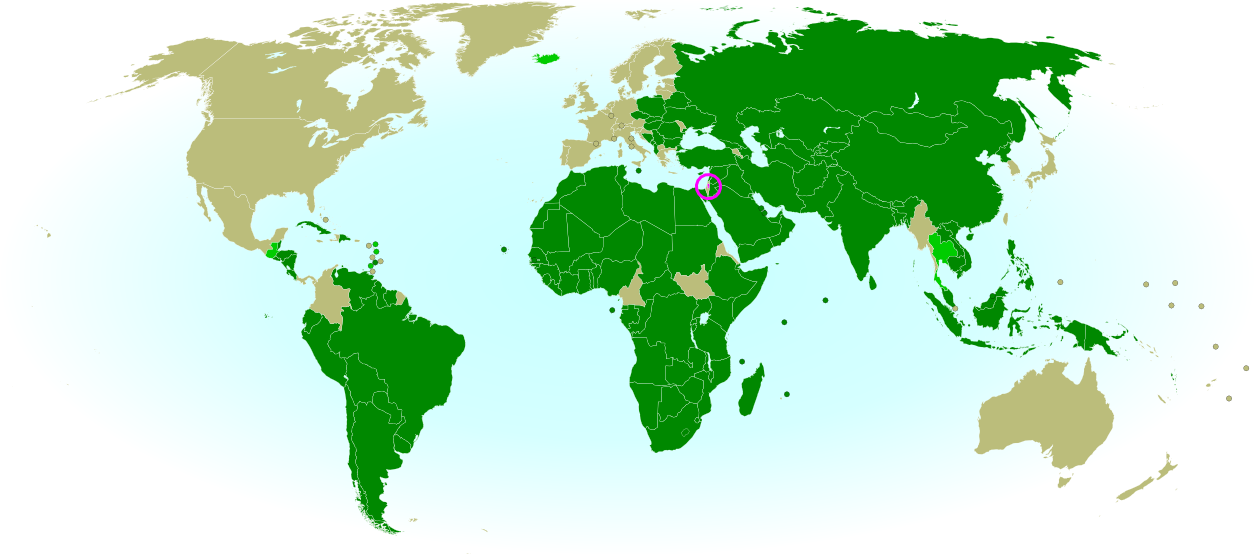
Map of countries that recognize the State of Palestine as an independent country, updated for May 2013 with most recent additions highlighted
Countries recognizing the State of Palestine in green, with most recent additions highlighted in lighter green. Palestine in magenta (circled). Map by Evan Centanni, modified from public domain graphic (source).


By Evan Centanni

Countries that Recognize the State of Palestine
Despite opposition from Israel, the U.S., and other Western countries, Palestine was recognized as an Observer State by the U.N. last year. However, recognition by individual countries is a separate matter. In September of 2011 we reported that the declared State of Palestine had accumulated recognition from 126 U.N. members plus partially-recognized Western Sahara. But have more states recognized Palestine as an independent country since then?

Yes, a few. As highlighted on the map above, several more U.N. member countries have recognized the State of Palestine over the last year and a half. New additions since our previous update are the Caribbean island nations of Dominica, Antigua and Barbuda, and Grenada, plus Thailand in Southeast Asia and Iceland in Europe. The latest, recognizing Palestine for the first time just last month, is the Central American state of Guatemala.

Flag of Palestine Country Name:  
• Palestine (English)
Filasṭīn (Arabic)
Official Name:  
• State of Palestine (English)
• Dawlat Filasṭin (Arabic)
Capital: 
• Jerusalem (claimed)
Ramallah (administrative)

This brings the total number of U.N. members that consider Palestine a sovereign state to 132, or about 68 percent. Or could it be more? Last year, before Guatemala’s announcement, the Palestinian government was already claiming recognition from 132 countries, and the U.N. resolution which made it an Observer State mention that Palestine was already recognized by 132 “members of the United Nations”. However, no additional recognitions have emerged in the months since then, so it seems likely that it was an error. The number 132 probably refers to the 131 U.N. members recognizing at the time, plus Western Sahara.

Wikipedia: List of countries recognizing Palestine

Palestine in UNESCO
Also since our September 2011 report, Palestine was accepted as a member of the United Nations Educational, Scientific and Cultural Organization (UNESCO), a specialized agency of the U.N. This happened before its elevation to Observer State status in the General Assembly, and was quite controversial at the time. It was speculated that becoming an Observer State would increase the likelihood of Palestine being accepted into more U.N. organizations in the future – however, this has not yet happened.

Change of Standard ISO Name
Another change to Palestine’s treatment internationally came with a February 2013 update to the standard list of country codes and names from the International Organization for Standardization (ISO). This standard, which is used by many organizations and companies around the world, is tied to official United Nations usage. After the Palestinian government received Observer State status from the U.N., its name was changed in the standard from “the Occupied Palestinian Territory” to “the State of Palestine”.

Online company Google caused a bit of a stir last week when it changed the name of its Palestinian search page from “Palestinian Territories” to “Palestine”, receiving criticism from the Israeli government. However, Google argued that it was not making a political statement, but only following the lead of the U.N. and the standard used by websites around the world.

Check For Updates: See more recent recognition reports by viewing all Palestine posts.

Related Articles:

Is Palestine Really a Country?

Mali Conflict Map: Hardline Rebels on the Run, Separatists Rebounding (May 2013)

There are newer versions of this map available. To see them, view all Mali maps.  

This is an update within our Mali conflict map series – for the original story, see Mali Map: Islamist Control & French Intervention.

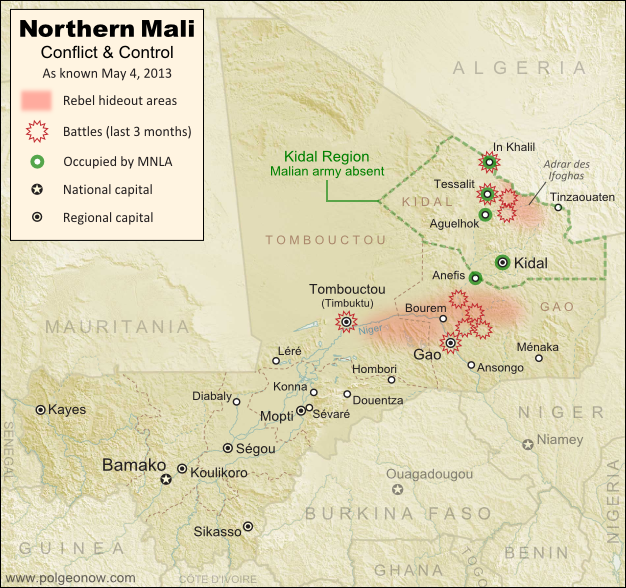
Updated map of fighting and territorial control in Mali during the 2013 French and African intervention against Islamist rebel groups MUJAO, Ansar Dine, and Al Qaeda in the Islamic Maghreb (AQIM). Reflects the situation as of May 4, 2013, including areas occupied by Tuareg rebels of the National Movement for the Liberation of Azawad (MNLA).
Updated map of territorial control and fighting in Mali, as of May 4, 2013. Map by Evan Centanni, modified from Wikimedia map by Orionist, using images by Carport and NordNordWest (source). License: CC BY-SA.

Towns Cleared of Islamist Rebels
Since our last Mali update in February, the country’s religious extremist rebel groups have continued their retreat from the northern cities that they controlled for half a year. The military intervention by France and Mali’s neighbors has somewhat reunited the country, though with some important exceptions.

In Mali’s far northeast, French and Chadian forces have driven Ansar Dine and Al Qaeda in the Islamic Maghreb (AQIM) out of the important towns of Aguelhok and Tessalit, afterwards seeing heavy combat in the nearby mountains of the Adrar des Ifoghas, where Chad claims to have killed two key regional Al Qaeda leaders. Though many rebels are said to have fled the country, some are still holed up deep in the mountains, and have launched terrorist attacks on the regional capital of Kidal.

More information: Regular situation reports from the French army (in French)

Northern Mali’s biggest city, Gao, was secured by French forces early in the intervention, and is now patrolled by troops from Mali and other African countries. However, the Al Qaeda-offshoot rebels of the Movement for Unity and Jihad in West Africa (MUJAO), who ruled the city for months, have continued their resistance, initiating two major battles in Gao during February, and another in March. Timbuktu has faced similar attacks, which have been variously attributed to either MUJAO or AQIM.

Flag of MaliCountry Name:  
• Mali (English, French, Bambara)
Official Name:  
• Republic of Mali (English)
• République du Mali (French) 
• Mali ka Fasojamana (Bambara)
Capital: Bamako

MUJAO fighters are now based in the villages and countryside surrounding Gao, especially just across the River Niger and in the valleys to the northeast, where French soldiers have been involved in lethal confrontations with the militants. The stretch of the River Niger between Gao and Timbuktu has also seen MUJAO activity, but at least one major town along the route, Bourem, has been secured by the allied forces.

Photos: Mali Conflict Enters New Phase (The Atlantic)

Kidal, Azawad, and the MNLA
The National Movement for the Liberation of Azawad (MNLA), a secular rebel organization made up mostly of people from the Tuareg ethnic group, has sprung back to life in Mali’s far northeast. It now occupies most of the Kidal region, including the capital and key towns, cooperating with the French and Chadian armies but forbidding Malian troops from entering.

The group, which initiated the rebellion in northern Mali last year – declaring an independent country called “Azawad” before being pushed out by Ansar Dine and MUJAO – now seeks again to negotiate with the Malian government. It has ceased its explicit calls for independence, even saying it “recognizes the borders” of Mali, though it has since begun issuing official “Republic of Azawad” documents to drivers passing through Mali’s far northeast.

This second rise of the MNLA was made possible by concerns that Malian soldiers were abusing, and in some cases murdering, Tuareg civilians in the cities they had retaken. Kidal, unlike Gao and Timbuktu, actually has a Tuareg majority, and the MNLA is relatively popular there. After the extremist Ansar Dine rebels fled from Kidal ahead of the French advance, the MNLA welcomed the foreign troops, cooperating with the soldiers from France and Chad. The Malian army, apparently sensing it’s not welcome, has mostly not entered the region.

The MNLA now operates a checkpoint in Anefis, on the border of Kidal and Gao regions, and has defended itself against other rebel groups in the surrounding desert as well as in the town of In Khalil on the border of Mali and Algeria. In February, the MNLA also claimed control of Menaka in Gao region, but the town is now known to be under the control of African troops from neighboring Niger.

Northern Mali: Looking Forward
The future is not at all certain for Mali’s north, with Islamist militants still active and the MNLA calling for greater autonomy against the wishes of the Malian government. Deepening the uncertainty, France and Chad, by far the two strongest armies currently in Mali, are both beginning to withdraw their forces, not wanting to become stuck in an ongoing guerrilla war. However, there’s still hope for Mali not to descend back into chaos; the U.N. security council has authorized a peacekeeping mission to take over starting from July, which will work under the name Multidimensional Integrated Stabilization Mission in Mali (MINUSMA).

Related Articles:

Central African Republic: Map of Rebel Advance to Capital

Graphic of Malian flag is in the public domain (source).

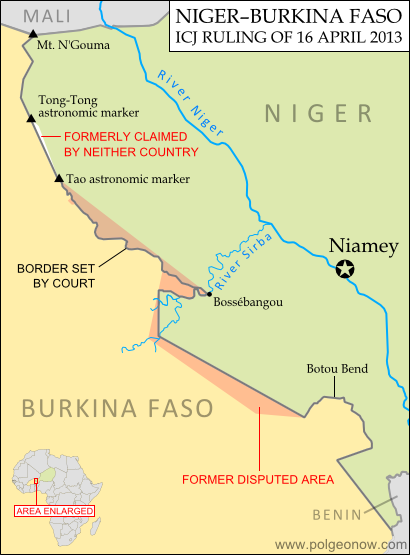
Niger and Burkina Faso Resolve Territorial Dispute

Update: In May 2015, Niger and Burkina Faso formally agreed to implement this ICJ ruling, with the practical aspects of exchanging territories to be completed by the end of the following year.

Map of the disputed territory between Niger and Burkina Faso, which was divided between the two countries in an April 2013 ruling by the International Court of Justice
Map by Evan Centanni. Sources: ICJ, Natural Earth. Africa inset based on this map by TUBS/Wikimedia Commons (CC BY-SA).

By Evan Centanni
 
Border Dispute Settled
Last week, a territorial dispute between the West African countries of Niger and Burkina Faso was resolved peacefully with a ruling from the International Court of Justice (ICJ). Both countries’ governments agreed to respect the court’s ruling on where their border should lie, a question which had persisted ever since they both achieved independence in 1960.

In the ruling, the court drew an official border based on a careful analysis of a 1927 document establishing the pre-independence boundary between the two former French colonies, also turning to a 1960 French map which both countries had agreed to use as a secondary reference. The new border splits the disputed area between Burkina Faso and Niger, and will help put an end to confusion regarding policing and tax collection in the border area.

The ICJ, or World Court, is a part of the U.N., and is tasked mainly with arbitrating disagreements between U.N. member countries. It should not be confused with the International Criminal Court (ICC), which prosecutes individuals for war crimes. Niger and Burkina Faso had agreed by treaty to send the case of their disputed border to the ICJ for settlement, and both have expressed satisfaction with the result.

Further Reading: Full Text of ICJ ruling on Burkina Faso/Niger Frontier Dispute (PDF)

Unclaimed Land
An interesting curiosity noted in this case is that Burkina Faso and Niger’s respective border claims left a small strip of land claimed by neither country. The area, stretching between two locations referred to as the Tong-Tong and Tao astronomic markers, was left unclaimed because Burkina Faso considered the border to be a straight line running between the two markers, while Niger also respected a third marker placed a bit east of the line.

The third marker had originally been intended to lie exactly along the line between Tong-Tong and Tao, but was placed inaccurately. It is not entirely clear why Niger would choose to define its border in a way that would give it less territory than did Burkina Faso’s definition, but in any case the court discounted the third marker, giving the strip of land to Niger in the final ruling. A more famous (and still outstanding) case of a territory not claimed by any country is the Bir Tawil “triangle” between Egypt and Sudan.

Related Articles:

North Kosovo Status Changing after Serbia Deal

North Kosovo Status Changing After Serbia Deal

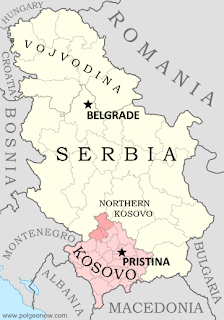
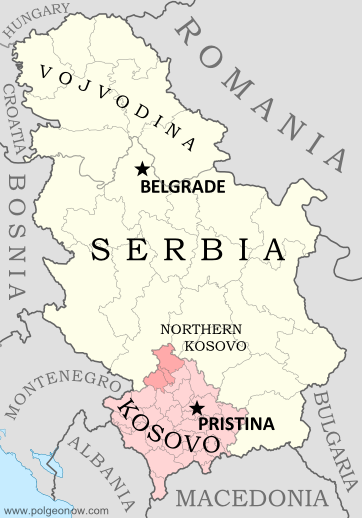
Map of Serbia, Kosovo, and North Kosovo
Map by Evan Centanni, based on these two blank maps by Nord-NordWest. License: CC BY-SA

Kosovo & Serbia in Historic Agreement
Serbia and the breakaway Republic of Kosovo reached a landmark deal on Friday to normalize their relations, partially compromising on several contentious issues between the two governments in southeastern Europe. Kosovo declared its independence from Serbia in 2008, but due to Serbia’s opposition it has still not achieved full international recognition. 

Status Change for North Kosovo
North Kosovo is the largest of several areas within Kosovo where the majority of people are part of the Serb ethnic group, whereas 90% of people in Kosovo as a whole are ethnically Albanian. When Kosovo split from Serbia, many Serbs in the north refused to go, governing themselves separately from Kosovo and choosing instead to continue cooperating with and accepting government funding from Serbia.

Territory Name:  
• North Kosovo (English)
• Severno Kosovo (Serbian)
Kosova Veriore (Albanian)
Claimants: 
• Republic of Kosovo
• Serbia
Actual Control: Local pro-Serbia groups, foreign peacekeepers
Status: No official status
Capital: Kosovska Mitrovica (de facto)

Under the new agreement, Serbia will stop treating North Kosovo as part of its territory, in exchange for the region receiving a degree of autonomy within Kosovo. Notably, Serbs in North Kosovo will now be able to legally manage their own police force. However, there may still be a bumpy road ahead, since Serb leaders in North Kosovo are refusing to accept the compromise.

Flag of the Republic of KosovoCountry Name:  
• Kosovo (English, Serbian)
• Kosova (Albanian)
Official Name:  
Republic of Kosovo (English)
Republika e Kosovës (Albanian)
Republika Kosovo (Serbian)
Status: Partially recognized; claimed by Serbia
Capital: Pristina/Prishtina

Eligibility for EU

The biggest benefit Serbia gets out of this week’s deal is eligibility to apply for membership in the European Union (EU). The EU, which admits new members on a case-by-case basis, had told Serbia it would never be considered unless it first relinquished control of North Kosovo. Serbia has also agreed not to get in the way if Kosovo applies to join the EU too.

Serbia Still Not Recognizing Kosovo
The Holy Grail for Kosovo would have been official diplomatic recognition of its independence from Serbia. However, the agreement stopped short of Serbia calling Kosovo an independent country. Kosovo’s Prime Minister has claimed that the deal counts as recognition anyway, but Serbia has emphatically denied this.

Kosovo is recognized as independent by about half of all the world’s countries, including the majority of the EU and NATO, but opposition from Serbia and Russia has kept it locked out of the UN. For a current map of all of the countries that recognize Kosovo, see Kosovo Recognition Update: April 2103.

Article by Evan Centanni. Kosovo flag graphic by Cradel (source) (CC BY-SA).

What is North Korea?

North Korea’s threats of war have captured the world’s attention in recent weeks, leaving citizens of other East Asian countries anxiously awaiting the latest news. A new war is unlikely, but how much do you know about North Korea, its international status, and its dispute with the south?

Map of North Korea and South Korea
Map by Johannes Barre & Patrick Mannion (CC BY-SA) (source)

What is North Korea?
Located on the northern half of the Korean Peninsula between South Korea and China (and sharing a short border with Russia), North Korea is a medium-sized East Asian country of about 24 million people. Despite its size, it boasts the fourth-largest army in the world, and has remained officially at war with South Korea since 1950.

Sometimes considered one of the world’s last remaining communist states, North Korea actually claims no longer to follow communist ideology. However, it surely does hold the distinction of having the world’s most closed borders, with its totalitarian government tightly controlling the flow of information and people in and out of the country.

What territory does North Korea claim?
North Korea doesn’t actually have “north” in its official name, which is the Democratic People’s Republic of Korea (DPRK). This is because it claims to be the rightful government of all of Korea, including the south. South Korea (officially the Republic of Korea) also maintains the same claim, with both sides seeking eventual unification. Korea hasn’t been a single independent country for over 100 years, since it lost its independence in 1905 and was absorbed into the Japanese Empire in 1910.

How did Korea become divided?

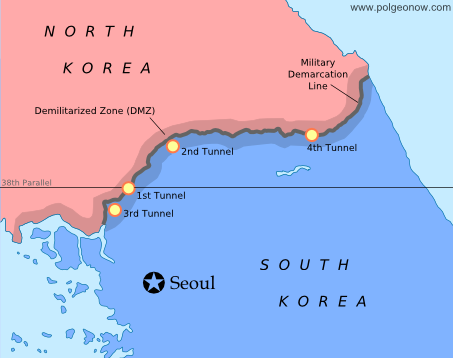
Map of the Military Delimitation Line (armistice line) and Demilitarized Zone (DMZ) separating North and South Korea
Armistice line and DMZ dividing North and South Korea. Modified by Evan Centanni from this map by Rishabh Tatiraju (CC BY-SA).

When Japan lost World War II in 1945, Korea was divided temporarily between U.S. and Russian control, with the boundary placed arbitrarily at the latitude 38° north. However, the Russian-held area in the north and the U.S.-held area in the south ended up forming two rival governments, a political situation that culminated with the north’s 1950 invasion of the south.

In the first large-scale conflict of the Cold War, an American-led U.N. intervention force fought off the Russian- and Chinese-supported north in the three-year-long Korean War. The armistice that brought fighting to an end in 1953 drew a new boundary close to the old one, but not as straight, also establishing a 4 km (2.5 mi) wide Demilitarized Zone (DMZ) around the line. However, because both Koreas seek reunification, neither recognizes the armistice line as an official border.

Map of North and South Korea's differing claims for their maritime boundary in the Yellow Sea
Korean boundary in the Yellow Sea: the U.N.’s Northern Limit Line (A) and North Korea’s claimed line (B). Map modified by Evan Centanni from this one by Amble, 玖巧仔 and Tomchen1989 (CC BY-SA).

Are there any other “disputed territories” between North and South Korea?
Yes – although technically the entire Korean peninsula is disputed between the north and the south, even the unofficial boundary is contested in the Yellow Sea off Korea’s west coast. The armistice agreement didn’t specify a sea boundary, and U.N. forces later drew a simple line running between North Korea and the nearest South Korean islands (the Northern Limit Line). However, North Korea has rejected this boundary, drawing its own line to carefully avoid the South’s islands while claiming the surrounding waters for itself.

What is North Korea’s international status?
Despite North Korea and South Korea claiming to represent the same larger Korea, they are both members of the U.N., after being admitted at the same time as Cold War politics were thawing in 1991. North Korea is now acknowledged around the world as an independent country, with only South Korea and Japan refusing to recognize it. Meanwhile, North Korea maintains active diplomatic relations with most of the world’s countries, with a few major exceptions, such as the U.S. and France.

Flag of North Korea (Democratic People's Republic of KoreaCountry Name:  
• North Korea (English)
• Chosŏn (Korean)
Official Name:  
• Democratic People’s Republic of Korea (English)
• Chosŏn Minjujuŭi Inmin Konghwaguk (Korean)
Capital: Pyongyang

Article by Evan Centanni

Kosovo Recognition Update: April 2013 (99/193)

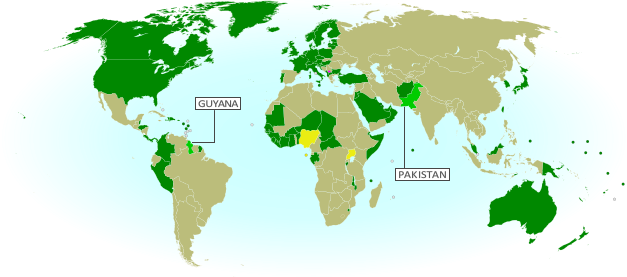
Map of countries that recognize the Republic of Kosovo as an independent state, updated for April 2013 with most recent additions highlighted
Countries recognizing the Republic of Kosovo in green, with the two most recent additions highlighted. Disputed recognitions in yellow. Kosovo in magenta. Map by Evan Centanni, modified from public domain graphic (source).

Flag of the Republic of KosovoCountry Name:  
• Kosovo (English, Serbian)
• Kosova (Albanian)
Official Name:  
Republic of Kosovo (English)
Republika e Kosovës (Albanian)
Republika Kosovo (Serbian)
Capital: Pristina/Prishtina

By Evan Centanni

New Kosovo Recognitions: Pakistan & Guyana
The self-proclaimed Republic of Kosovo has reportedly been diplomatically recognized by two more U.N. member countries since our last Kosovo report. The government of the small state in southeastern Europe now claims recognition from 99 U.N. member countries, or about 51% of the world body (there are currently 193 sovereign states in the U.N.).

The Islamic Republic of Pakistan in South Asia extended diplomatic recognition to Kosovo on December 24, in a move confirmed by Pakistan’s foreign ministry. Then last month, Kosovo was also recognized by the Caribbean country of Guyana in South America, according to Kosovo’s foreign ministry (though this has not yet been confirmed by independent sources).

The Republic of Kosovo declared independence from Serbia in 2008, but has been blocked from U.N. membership by objections from Serbia, Russia, and other countries which see its secession as invalid. In addition to the 99 U.N. members from whom Kosovo claims recognition, its independence is also acknowledged by one non-U.N. member, Taiwan. For more on Kosovo’s special situation, see our first Kosovo recognition report, which also includes a map of Kosovo’s location relative to Serbia.

Disputed Recognitions
Like Kosovo itself, the list of countries recognizing the Republic of Kosovo is subject to some controversy. Some opponents of independence have cast suspicion on the self-declared republic’s claims of international recognition, which are sometimes not confirmed by sources outside Kosovo’s government. And they may be on to something: recognition by Nigeria, Uganda, and São Tomé and Príncipe, three countries located in Africa, is currently subject to dispute. Political Geography Now will be following this issue closely in future, and keeping our readers as informed as possible.

Stay Up to Date: Check for further updates to this story by viewing all Kosovo articles on Political Geography Now. 

Flag graphic by Cradel (source). License: CC BY-SA

Central African Republic: Map of Rebel Advance to Capital (March 2013)

Last January, rebels in the Central African Republic agreed to a ceasefire with the government, after taking over much of the country. Now, despite the formation of a unity government, the ceasefire has broken down and the rebels are once again advancing on the capital and other towns. Read on for a summary of events. Update (March 24, 2013): The Séléka rebel coalition has now taken the national capital, Bangui.

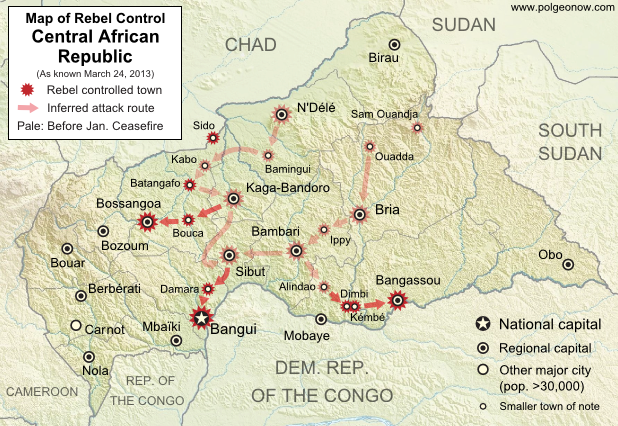
Map of 2012-2013 rebellion in the Central African Republic, showing current rebel control as of March 24, 2013, from the breakdown of the ceasefire up to the capture of the national capital city, Bangui
Advance of Séléka rebels in the Central African Republic, highlighting attacks occurring since the Jan. 11 ceasefire. Map fact-checked and expanded by Evan Centanni from this map by Wikimedia user Keitsist. License: CC BY-SA

Original Article: Central African Republic – Map of Rebel Control

Ceasefire Violations
After reaching a ceasefire with the government on January 11th, the Central African Republic’s Séléka rebel coalition began integration into a new unity government, with several rebel leaders receiving prominent positions in President François Bozizé’s cabinet. However, the violence did not end completely.

Bands of rebels attacked the southern towns of Dimbi and Kémbé less than two weeks after the ceasefire, and occupied the southern city of Mobaye for two weeks in February before finally withdrawing on the 20th. Another group attacked and took over the northern town of Sido on March 1st. By March 12th, the rebels in the south advanced once again to seize regional capital Bangassou.

Flag of the Central African RepublicCountry Name:  
• Central African Republic (English)
• Centrafrique (French)
• Bêafrîka (Sango)
Official Name:  
• Central African Republic (English)
• République centrafricaine (French)
•Ködörösêse tî Bêafrîka (Sango)
Capital: Bangui

Ceasefire Breakdown
On March 18th, it was reported that the Séléka rebels had “detained” their five ministers from the Central African Republic unity government, and issued a 72-hour deadline for their demands to be met. Sure enough, on March 20th a rebel spokesperson announced that the ceasefire had come to an end.

In the northwest, rebels claimed to capture Bouca and Batangafo soon afterwards (the latter had already been reported taken once in December). In the south, they continued onward toward the capital city of Bangui, seizing the town of Damara despite the presence of a multinational African peacekeeping force, which did not fire a shot. Meanwhile, they had captured yet another regional capital, Bossangoa, in the northwest.

Capital Seized by Rebels (update)
Today, March 24th, the Séléka coalition rebels reportedly took control of the national capital, Bangui, with President Bozizé fleeing across the border into the Democratic Republic of the Congo. It still remains unclear what will happen next. Stay tuned to Political Geography Now for further updates!

Graphic of the flag of the Central African Republic is in the public domain (source).