ICYMI: The Gambia’s Withdrawal from the Commonwealth

“In case you missed it” – this is an article featuring news we couldn’t cover when it first broke, but that we thought you might still want to know about. Those who read our article on the year 2013 in political geography changes already heard about the Gambia’s withdrawal from the Commonwealth of Nations – now here’s the full story.

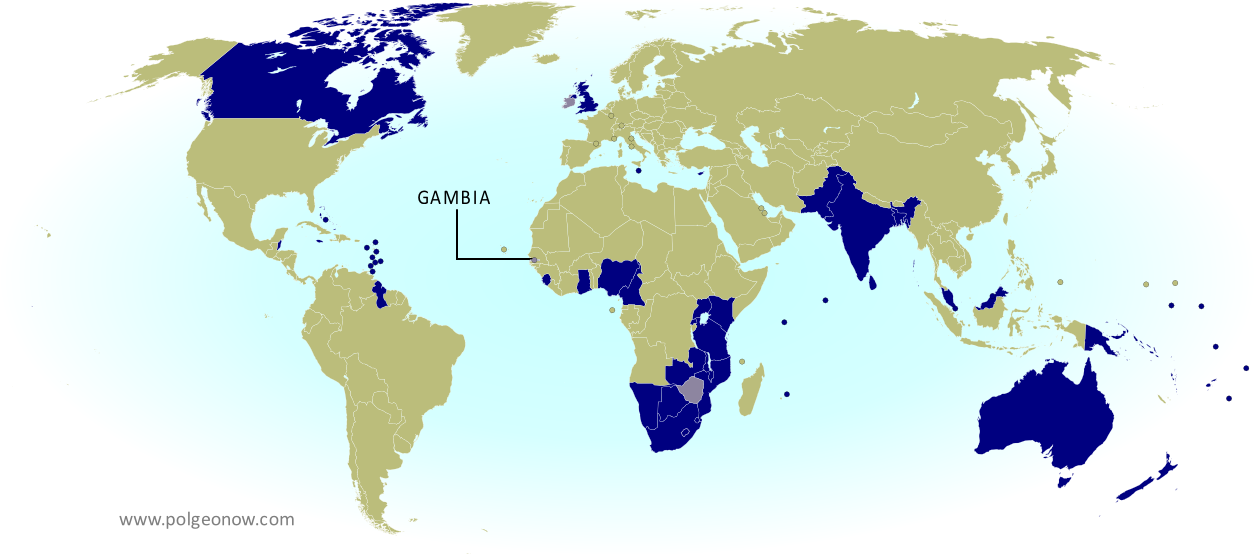
Map of current and former member countries of the Commonwealth of Nations (British Commonwealth) as of 2014, marking the Gambia, which recently withdrew from the organization (colorblind accessible).
The Commonwealth of Nations. Current members in dark blue, former members in lavender. Map by Evan Centanni, modified from public domain blank map.

Premium members click here to view this article in the ad-free members area. Not a member yet? Subscribe now!

Flag of the Gambia Country Name:  
• The Gambia
Official Name:  
• Republic of the Gambia
Capital: Banjul

Article by Evan Centanni

Unceremonious Departure
The Gambia, a small country in West Africa, withdrew from the Commonwealth of Nations last October in an unexpected move by idiosyncratic dictator Yahya Jammeh. The official announcement gave no explicit reason for leaving, but it did include language rejecting “neo-colonialism”.

Sometimes called the “British Commonwealth”, the Commonwealth of Nations is mainly a forum for cooperation between countries that were once parts of the British Empire (though it has also admitted other countries in the past). But any association it has with British colonialism is mostly symbolic – although Queen Elizabeth II is the formal “Head of the Commonwealth”, within the organization itself, all members are equal and decisions are made by consensus.

See Also: 2013: The Year in Political Geography Changes

Flag of the Commonwealth of NationsOrganization Name:  
• Commonwealth of Nations
Founded: 1931 and 1949 in London, U.K.
Headquarters: London, U.K.
Website: thecommonwealth.org/

But the Commonwealth does involve itself in the promotion of human rights and democratic government, and this might be how it ran afoul of the Gambia’s ruler. In 2012 Jammeh had rejected a Commonwealth proposal to open commissions in the Gambia for human rights, press freedom, and opposition to corruption. Meanwhile, in early 2013 the country scored especially low in the U.K.’s Human Rights and Democracy report.

Commonwealth Members
The Commonwealth of Nations now has 53 members, all of them independent countries which also have membership in the U.N. Participation in the Commonwealth is completely voluntary, and any member country can leave or reapply at will. Besides the Gambia, there are only two other former Commonwealth members in the world today. Founding member Ireland left when it broke ties with the U.K. in 1949, and Zimbabwe exited in 2003 after a year of suspension over democratic irregularities.

It’s a common misconception that countries must recognize the queen of England as their monarch in order to be members of the Commonwealth. In fact, many Commonwealth members are republics with no monarchies. The countries that do share the queen are a subset known as the “Commonwealth Realms“. Elizabeth II’s current title of “Head of the Commonwealth” is separate from her role as the queen of the Realms, gives her no authority over member countries, and won’t be automatically inherited by her successor.

See Also: Queen Elizabeth’s 16 Countries: The Commonwealth Realms

Low-resolution graphic of the Commonwealth flag is displayed under fair use principles (source). Flag of the Gambia is in the public domain (source).

Update: Ukraine Control Overview Map (Premium)

Updated map of control in Ukraine, as of April 5, 2014. Includes final protester occupations, annexation of Crimea, and areas seized by Russian and Ukrainian militaries outside of Crimea.

Download PDF
buy

(Subscribe via Paypal)

This is a brief supplement to our Mar. 4 report, Ukraine Map: Occupations, Autonomy, & Invasion. See that report for a detailed overview of protester occupations and declarations of autonomy in the first two stages of the Ukraine crisis: the anti-Yanukovich Maidan movement and the eastern pro-Russian protests. 

The current article is an update on the current control situation in Ukraine from Mar. 4 to the present. This map and article are exclusive premium content, available only to members or for individual purchase. Buy now (US$5.99).

Premium article includes:

  • Simple updated map of the political situation in Ukraine since Mar. 4
  • Shows the last of the pro-Russian protester occupations, the annexation of Crimea, and seizures by the Ukrainian and Russian militaries outside of Crimea proper
  • Report on the course of events since the last report, explaining each detail shown on the map
  • In-line links to sources of information

Members click here to proceed to article and map

Not a member yet? Subscribe Now!

Crimea Joins Russia, Gives Up Independence, Becomes Disputed Territory

Premium members click here to view this article in the ad-free members area. Not a member yet? Subscribe now!

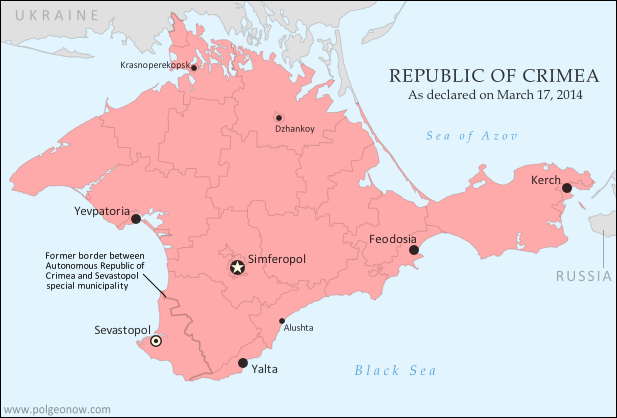
Map of the claimed Republic of Crimea, which briefly declared independence from Ukraine on Mar. 17 before being annexed by Russia
The claimed Republic of Crimea which has now joined Russia (click to see full-sized map). By Evan Centanni, based on this blank map.

By Evan Centanni

Russia Annexes Crimea
The Crimean peninsula, which declared independence from Ukraine ten days ago as the Republic of Crimea, has now been absorbed into Russia. This was part of the plan all along – the claimed Republic of Crimea had requested to join Russia at the same time that it declared independence.

Related: Complete Map of Locations Seized by Russia in Crimea (Premium)

Once Russia had recognized Crimea as an independent country, Russian president Vladimir Putin then argued all that was necessary for his country to absorb the region was a treaty between the two supposedly sovereign states. The unification treaty between Crimea and Russia was signed on Mar. 18, the day after the peninsula’s declaration of independence. The treaty went into full effect on Mar. 21 after it was ratified by both houses of the Russian parliament and formally signed into law by Putin.

See Also: Crimea Declares Independence: Is It Really a Country? 

Geographical Implications

Flag of Crimea Territory Name:  
• Crimea (English)
Krym (Russian, Ukrainian)
Qırım (Crimean Tatar)
Claimants: 
• Ukraine
• Russia
Actual Control: Russia
Status: Federal subject of Russia (Republic of Crimea)/federal city (Sevastopol)
Capital: Simferopol/Sevastopol

Crimea’s annexation by Russia brings about several simultaneous changes to the world’s political geography situation:

Besides those country-level changes, there has also been an adjustment to the subnational administrative status of Crimea. Ukraine’s Autonomous Republic of Crimea and the special municipality of Sevastopol, which united to claim independence as the Republic of Crimea, have now been separated again as divisions within the Russian Federation. The former Autonomous Republic of Crimea is now the Republic of Crimea, a federal subject of Russia, and Sevastopol is a “city of federal significance” (also a type of federal subject within the Russian Federation).

Transitioning Between Two Countries
Russia’s annexation of Crimea may look complete on paper, but changing the whole region from Ukrainian to Russian administration is going to be a major logistical headache. In addition to the issues of distributing Russian citizenship to all Crimeans and figuring out what to do with members of the Ukrainian military who are stationed there, infrastructure will be a major issue.

Crimea has no land link to the rest of Russia, so new bridges and pipelines will need to be built if the region isn’t going to remain heavily dependent on Ukraine. There will also be a major stir-up to the communications system as telephone area codes are completely replaced to fit into Russia’s system. An extra digit will also need to be added to postal codes, and clocks will be permanently set two hours forward this Sunday to switch to the same time zone as Moscow.
 

Map of Russian seizures and military actions in the Crimea region which it recently annexed from Ukraine.

Also check out our premium map report: 
Complete Map of Locations of Russian Seizures or Attacks in Crimea

More Related Articles:
Ukraine Crisis Overview Map: Occupations, Autonomy, & Invasion (Premium)
How Sharply Divided is Ukraine, Really? Honest Maps of Language and Elections

Graphic of the Crimean flag  is in the public domain (source).

Premium Map Report: Russian Control of Crimea

Map of Russian seizures and military actions in the Crimea region which it recently annexed from Ukraine.

Download PDF
buy

(Subscribe via Paypal)

After a month of low-level conflict, Russian military control of Crimea appears to be nearly complete. Here’s a complete map – to the best of our knowledge – of all locations of Russian seizures and other military actions inside and outside of the Crimea region. This map and article are exclusive premium content, available only to members and for individual purchase. Buy now (US$4.99).

Premium article includes:

  • Exclusive map of Russian seizure and attack locations inside and outside of Crimea
  • Guide to all locations on the map, with brief summary of what has happened at each
  • In-line links to sources of information

Members click here to proceed to article and map

Not a member yet? Subscribe Now!

Crimea Declares Independence: Is It Really a Country?

On Monday, two regional governments on the Crimean Peninsula controversially declared their independence from Ukraine as the new Republic of Crimea. While the declaration has been rejected by most of the world community, and Crimea hopes to swiftly unite with Russia, for now it might be considered a de facto sovereign state. Read on for details.

Map of the newly declared independent Republic of Crimea, seceding from Ukraine to join Russia (colorblind accessible).
The Republic of Crimea. Map by Evan Centanni, based on this blank map.

Premium members click here to view this article in the ad-free members area. Not a member yet? Subscribe now!

By Evan Centanni

Declaration of Independence
Following Ukraine’s revolution, the explosion of pro-Russian protests in the east, and the subsequent occupation of the Crimean peninsula by Russian forces (see our premium report, Ukraine Map: Occupations, Autonomy, & Invasion), a new independent country has been declared on the coast of the Black Sea.

The Republic of Crimea’s declaration of independence (English translation) was actually adopted on March 11, but was not to go into effect until and unless endorsed by this Sunday’s popular referendum. Yet sure enough, Crimea’s population, more than half of whom identify as Russians, apparently voted in favor of the split from Ukraine. Many minority Crimean Tatars – and possibly ethnic Ukrainians as well – planned to boycott the vote, though that still doesn’t explain the referendum’s passage by a suspiciously high 97 percent.

It’s difficult to verify whether the election was free and fair, as it was held under military occupation and against the will of Ukraine’s government, with European election observers refusing to participate in validating the outcome. Even some of the regional leaders who arranged it did not come to power legally within the Ukrainian constitution (though they claim the same of the current Ukrainian government in Kiev). Given all these issues, it may never be known whether a majority of Crimea’s people truly do want the split with Ukraine.

See Also: How Sharply Divided is Ukraine, Really? Honest Maps of Language and Elections

Union of Two Regions

Flag of CrimeaCountry Name:  
• Crimea (English)
Krym (Russian, Ukrainian)
Qırım (Crimean Tatar)
Full Name:  
• Republic of Crimea (English) 
• Respublika Krym (Russian, Ukrainian)
• Qırım Cumhuriyeti (Crimean Tatar)
Capital: Simferopol

A political geography detail left out of many reports is the fact that, under the Ukrainian constitution, Crimea is actually divided between two different regional governments. The majority of the peninsula falls under the jurisdiction of the Autonomous Republic of Crimea – a special regional administration with more power than Ukraine’s provinces but less power than a U.S. state. But another sizable chunk is governed by the special municipality of Sevastopol, a city which is not part of any Ukrainian province.

Crimea’s process of exiting Ukraine was endorsed by both the parliament of the Autonomous Republic of Crimea and the city council of Sevastopol, though as previously mentioned, both bodies are led by politicians installed under questionable circumstances during the past few weeks. By agreeing to this declaration, the active governments of the two administrative areas have effectively agreed to unite into a single independent country for now.

Joining Russia
Although the process involves declaring Crimea and independent country, the goal is actually to join Russia as an autonomous republic within that country’s federal system (once united with Russia, Sevastopol will likely return to its status as a separate municipality). Accordingly, the newly declared Republic of Crimea has already applied to join the Russian Federation (i.e. Russia), and Russian president Vladimir Putin has already signed a treaty to allow Crimea’s admission. However, the treaty will need to be ratified by Russia’s parliament before Crimea can become part of the country under Russian law.

International Recognition
The key to acceptance by a new country into the international community is diplomatic recognition from other countries. Given the way it came about, Crimea is unlikely to receive recognition from many of the world’s states. However, it has already joined the club of breakaway states with at least one recognition, after its independence was officially acknowledged by Russia. An independent Crimea has also apparently been endorsed by three other mostly-unrecognized pro-Russian breakaway states: Abkhazia, South Ossetia, and Nagorno-Karabakh.

Is Crimea a Real Country?
Though most lists of the world’s countries include only those with recognition from the United Nations, other proclaimed nations can sometimes be described as de facto (“in actual fact”) independent countries if the reality on the ground shows they aren’t part of any other country. Since Crimea is clearly no longer controlled by Ukraine and is not yet claimed by Russia, it probably could be placed in this category.

Similar cases which are often described as de facto independent countries are Northern Cyprus, which is recognized only by Turkey, and Abzhazia and South Ossetia, which are recognized only by Russia and a few others. These claimed countries may be puppet states – under the close political influence of a neighboring nation – but through history that often hasn’t stopped countries from receiving recognition and even being members of the U.N. (think of eastern Europe during the Cold War, or Iraq and Afghanistan after the U.S. invasions).

A country can be de facto independent without being established through a democratic process or within the laws of the country it’s splitting from. Though unilateral declarations of independence can be tricky to trade in for diplomatic recognition these days, many modern countries were created this way, from Croatia to Bangladesh to the United States. So the questionable circumstances surrounding Crimea’s declaration and referendum don’t actually disqualify it from being considered a country.

In fact, the Crimean declaration of independence made specific mention of Kosovo, another claimed country which declared independence after being occupied by foreign powers – in that case, NATO intervening to protect ethnic Albanians from the government of Serbia. Though Russia has been among the strongest opponents of Kosovo’s independence, supporters of Crimea’s secession from Ukraine have been quick to point to a judgment from the International Court of Justice (ICJ) which ruled that Kosovo’s declaration of independence did not violate international law.

Graphic of the flag of Crimea is in the public domain (source).

Madagascar Un-Suspended from African Union

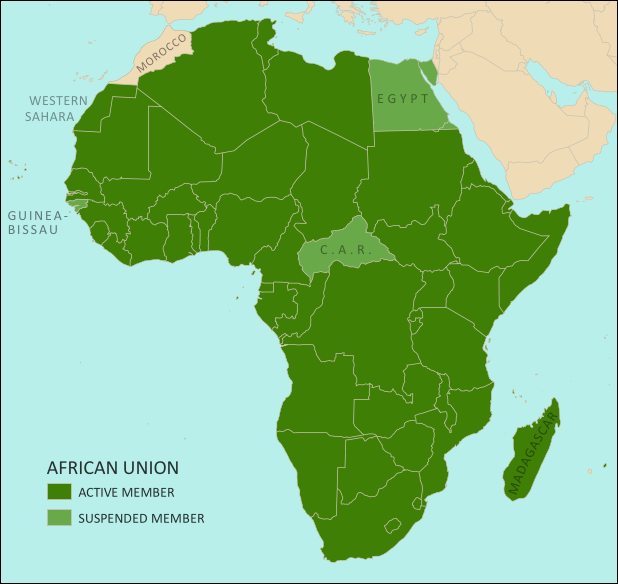
Map of the African Union, including active and suspended members, updated for the January 2014 reinstatement of Madagascar (colorblind accessible).
The African Union as of March 2014. Map by Evan Centanni, from this blank map by Eric Gaba.
License: CC BY-SA

Premium members click here to view this article in the ad-free members area. Not a member yet? Subscribe now!

Flag of Madagascar Country Name:  
• Madagascar (English, French)
Madagasikara (Malagasy)
Official Name:  
• Republic of Madagascar (English)
• Repoblikan’i Madagasikara (Malagasy)
• République de Madagascar (French)
Capital: Antananarivo

Article by Evan Centanni

Madagascar Suspension Ends
This past January, the African Union decided to lift the suspension of Madagascar from the regional organization. Madagascar’s membership was suspended in 2009, after the president was forced out in popularly-supported military coup. The country’s reinstatement to the AU follows a new presidential election this past December

The AU’s Peace and Security Council typically suspends member countries when they experience coups or other breakdowns of constitutional rule. Though this is billed as a pro-democracy policy, it does not affect undemocratic governments which are already long-established. After Madagascar’s reinstatement, there are currently three remaining suspended AU members: Guinea-Bissau, the Central African Republic (CAR), and Egypt, whose suspension we reported on last year.

See Also: Rebel Takeover of Central African Republic (map)

What is the African Union?

Flag of the African Union (AU)Organization Name:  
• African Union (English)
• al-Āthḥād al-’Āfrīqī (Arabic)
• Union africaine (French)
• União Africana (Portuguese)
• Unión Africana (Spanish)
• Umoja wa Afrika (Swahili)  
Launched: 2002 in Durban, South Africa
Headquarters: Addis Ababba, Ethiopia
Website: www.au.int

Formed in 1999-2002 to replace the earlier Organization of African Unity (OAU), the AU is an intergovernmental organization which works on increasing cooperation, stability, and development within the continent of Africa. It has a secretariat based in Addis Ababa, Ethiopia, though many of its most important decisions are made during annual summits of the continent’s national leaders.

Every UN-recognized country in Africa is a member of the African Union except for Morocco, which withdrew from the OAU in 1984 after the organization chose to admit the partially-recognized state of Western Sahara, a disputed territory which Morocco claims and largely occupies. The only other parts of Africa not represented in the AU are a few groups of offshore islands controlled by European countries, as well the small Spanish enclaves in North Africa. The breakaway Republic of Somaliland is not a member, but is considered by the AU to be part of Somalia.

Low-resolution graphic of the African Union flag is displayed under fair use principles (source). Flag of Madagascar is in the public domain (source).

How Sharply Divided is Ukraine, Really? Honest Maps of Language and Elections

There’s no question that Ukraine’s current crisis arose from major political divisions in the country, and it’s true that language is an issue. But some online news websites have sensationalized and exaggerated these divisions through misleading maps. PolGeoNow offers a pair of maps that better communicate the blurriness of the supposed lines between western and eastern Ukraine. 

(For a map of current events from January up to this week, including protester control, government occupations, and the Russian invasion, purchase our premium map of the Ukraine crisis or become a member.)
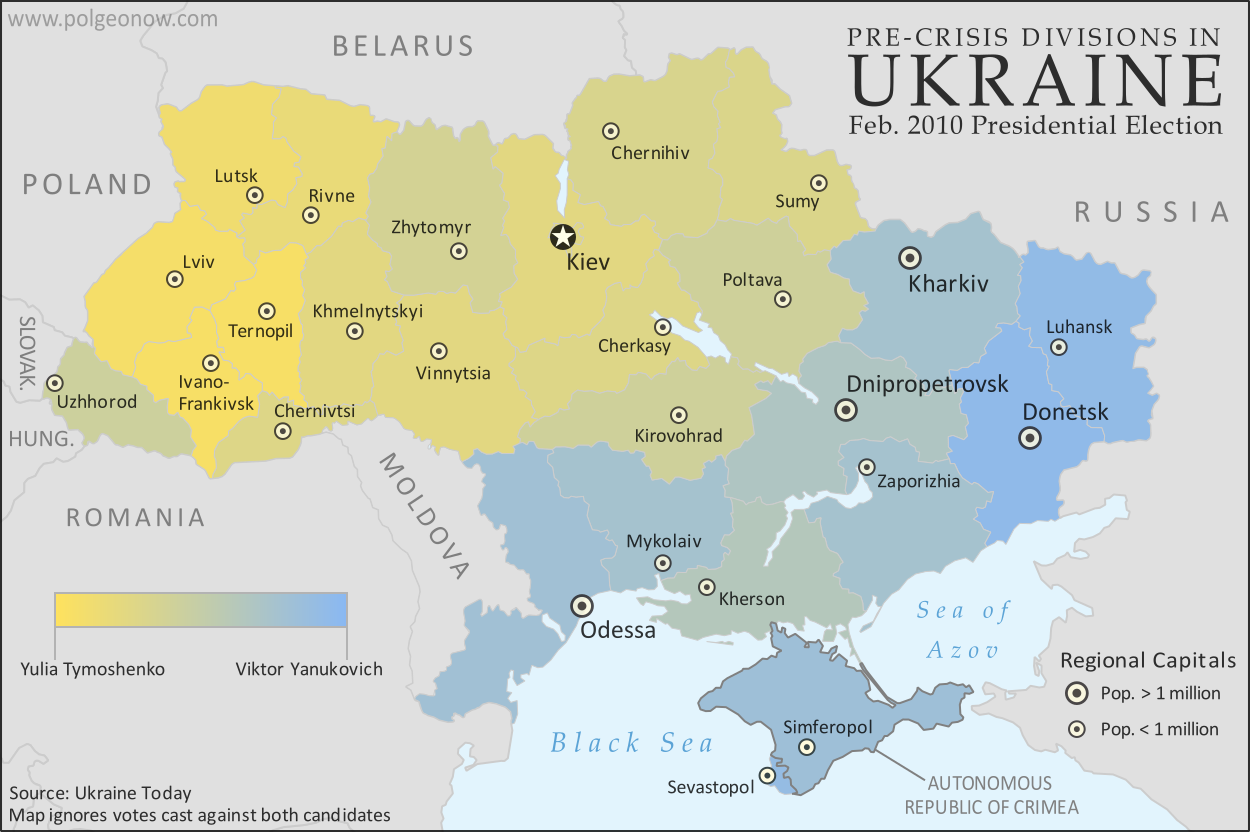
Map of the results of Ukraine's February 2010 presidential runoff election between Yulia Tymoshenko and Viktor Yanukovich
A more honest map of Ukraine’s 2010 presidential election. By Evan Centanni.

Premium members click here to view this article in the ad-free members area. Not a member yet? Subscribe now!

Article by Evan Centanni 

Misleading Ukraine Maps
In January, the Washington Post’s Max Fisher wrote a popular map-illustrated blog post about the political and linguistic divisions fueling Ukraine’s crisis, then at the height of its pro-Europe protest phase. Later, CNN followed the Post’s lead and published a similar set of maps. However, the maps in both articles are designed in a way that makes the divisions look much sharper and more black-and-white than they really are. There’s not, as Fisher preposterously claims, “an actual, physical line” splitting Ukraine in half. Instead, there’s a gradual shading of mixed populations whose ethnic identities and voting history don’t always correlate to the country’s current political divisions.

The 2010 Presidential Election
The centerpiece of Max Fisher’s Washington Post article is a map superimposing early protest information on a map of results from the 2010 presidential election, in which the now-ousted Viktor Yanukovich won a majority over opposition candidate Yulia Tymoshenko. Although Fisher did distinguish in the map between regions voting overwhelmingly for one candidate and regions where the winner received a narrower majority, the sharpness of the east-west division is badly exaggerated by the colors he chose.

Using orange for Tymoshenko and blue for Yanukovich was normal, but the regions with highly-mixed results should have used some color in between. Instead, the map uses light orange for small Tymoshenko victories and light blue for small Yanukovich victories, making regions that actually weren’t far apart in their votes still look sharply separated due to the clashing colors. CNN’s equivalent map is even worse, using bright red and bright blue. With eye-grabbing, clashing colors like that, it’s no wonder someone might think Ukraine is literally bisected down the middle.

But that’s just not the reality. As the map above shows more clearly, many regions, including even some in the west, voted only narrowly for one candidate over the other. The colors don’t transition perfectly smoothly from one end of the country to the other – every region went to one candidate by at least 10 percentage points – but there’s not a sharp dividing line either. A more detailed map, with the districts of each region separately colored, would probably show an even less distinct divide.

So how well do the 2010 election results map to the current crisis? Not too badly. The Lviv region did end up taking a leadership role in the protests against Yanukovich, and Donetsk has been among the forefront of regions opposing him. However, protests did eventually spread across the whole country by February, and there were some exceptions to the yellow vs. blue pattern. If you’d like to make a detailed comparison, check out our political overview map report for the Ukraine crisis, accessible to premium members or by individual purchase.

Map of languages in Ukraine by region (oblast), showing gradation between Ukrainian and Russian languages while marking regions with large proportions of residents with other native tongues
Ukraine is even less clearly cut in half by language. Map by Evan Centanni.

Native Languages: Ukrainian vs. Russian
Both the Washington Post article and the CNN post also feature maps of the languages spoken in Ukraine. CNN does better on this than on the election map, at least choosing somewhat similar orange and red colors in an attempt to show the gradient in the proportion of Russian speakers across Ukraine’s regions. The Post’s Max Fisher, on the other hand, continues with the misleading contrasting colors, cutting Ukraine simplistically into an orange half and a blue half for the Ukrainian and Russian languages.

Most egregiously, Fisher’s map uses the label “Predominantly Russian-speaking” to blanket a number of regions where there are actually more native Ukrainian speakers than native Russian speakers. As the above map shows, Ukrainian is actually the majority language across most of the country. Only four regions – Donetsk, Luhansk, Crimea, and the special municipality of Sevastopol – have more Russian than Ukrainian speakers.

When comparing this map with the election map at top, it becomes clear that language is not as great an indicator of Ukrainian politics as some commentators imply. People whose mother tongue is Russian make up only 30% of Ukraine’s population according to the 2001 census, yet Viktor Yanukovich received more than 49% of the national vote in 2010 (as compared with Tymoshenko’s 45%).

It’s true that the strongest opposition to the new interim government is coming from the regions with Russian-speaking majorities, but there may be a specific reason for this: one of the new revolutionary government’s first acts was to repeal a Yanukovich-era law granting legal rights to minority languages such as Russian. (Note that being “ethnically Russian”, at least in official statistics, is not the same thing as being a native speaker of the Russian language; only 17% of people in Ukraine identify as “Russians”; many of the remaining Russian-speakers identify only as Ukrainians.)
Flag of Ukraine Full Country Name:  
• Ukraine (English)
• Ukrayina (Ukrainian)
Capital: Kiev

Other Major Languages
Another fact left out of the Washington Post and CNN maps is that Ukrainian and Russian are not the only major languages in Ukraine. Although they are by far the most widely-spoken nationwide, within several regions there are other languages which come in second or third. By now many followers of the news know that Crimea has significant population of Crimean Tatars, who speak a language related to Turkish. In the Crimean autonomous region, speakers of Crimean Tatar (11%) outnumbered speakers of Ukrainian (10%) in 2001.

But Crimea isn’t the only region with major minority language communities. In Chernivtsi, Romanian (12%) and Moldovan (7%) both outnumber Russian (5%), and in nearby Zakkarpatsia (capital: Uzhhorod) 13% of residents are native speakers of Hungarian. In Odessa, Ukrainian and Russian are the biggest languages, but Bulgarian (5%) and Moldovan (4%) are also present. (Data from Ukraine’s 2001 census, retrieved here).

Graphic of the Ukrainian flag is in the public domain (source).

Map of the 2014 Ukraine crisis, before and after the ouster of President Yanukovich, updated to March 3, 2014. Details shown include protester occupations, declarations of autonomy, and Russian invasion.

Want to see a comprehensive map of political control in Ukraine’s crisis from January up to this week? Purchase our premium map report for just $5.99.

Or you can become a member, and get access to all our premium content!

Ukraine Map: Occupations, Autonomy, & Invasion (Premium)

Map of the 2014 Ukraine crisis, before and after the ouster of President Yanukovich, updated to March 3, 2014. Details shown include protester occupations, declarations of autonomy, and Russian invasion.

Download PDF
buy

(Subscribe via Paypal)

PolGeoNow begins our Ukraine coverage with this overview of the political situation from January to the present, both before and after the overthrow of President Viktor Yanukovich’s government. Details shown include protester occupations, declarations of autonomy, and Russian invasion. This map and article are exclusive premium content, available only to members and for individual purchase. Buy now (US$5.99).

Premium article includes:

  • Exclusive map of the political situation in Ukraine’s 2014 crisis
  • Shows protester occupations, regional capitals overrun, autonomy declarations, and locations of Russian military siege
  • Report on the course of events, explaining each detail shown on the map
  • In-line links to sources of information

Members click here to proceed to article and map

Not a member yet? Subscribe Now!

South Sudan War Map: Current Rebel Control (Update #4) (Premium)

Map of rebel control in South Sudan's ongoing rebellion, showing situation at the time of the ceasefire of January 23, 2014

Download PDF
buy

(Subscribe via Paypal)

This is Part 1 of a double map report on territorial control in South Sudan’s ongoing rebellion, available exclusively to premium subscribers or for individual purchase. This map shows current territorial control for late February 2014, including several changes since the time of the ceasefire. Buy now (US$3.99).

To see the map of control at the time of the ceasefire on January 23, see Part 1.

Premium article includes:

  • Exclusive map of current rebel control up to February 21, 2014
  • Multiple changes to territorial control since previous update
  • Several more new locations added to the map
  • Report chronicling changes to territorial control since the ceasefire, including links to sources

Members click here to proceed to article and map

Not a member yet? Subscribe Now!

South Sudan War Map: Control at Time of January Ceasefire (Update #3) (Premium)

Map of rebel control in South Sudan's ongoing rebellion, showing situation at the time of the ceasefire of January 23, 2014

Download PDF
buy

(Subscribe via Paypal)

This is Part 1 of a double map report on territorial control in South Sudan’s ongoing rebellion, available exclusively to premium subscribers or for individual purchase. This map shows territorial control as of January 23, when the warring parties signed their ceasefire agreement (including major changes from previous update). Buy now (US$3.99).

To see the map of current control as of late February, go to Part 2.

Premium article includes:

  • Exclusive map of rebel control at the time the ceasefire was signed on January 23, 2014
  • Multiple changes to territorial control since previous update
  • Several new locations added to the map
  • Report chronicling changes to territorial control and describing the situation at the time of the ceasefire, including links to sources

Members click here to proceed to article and map

Not a member yet? Subscribe Now!