Maps of How Scotland’s Regions Really Voted

Good geographers know that maps can lie to you. Every map emphasizes some aspects of a place at the expense of others, giving it a lot of power to lead careless readers astray. Maps of Scotland’s recent independence referendum are misleading us about the reality, even if not intentionally.

Premium members click here to view this article in the ad-free members area. Not a member yet? Subscribe now!
 

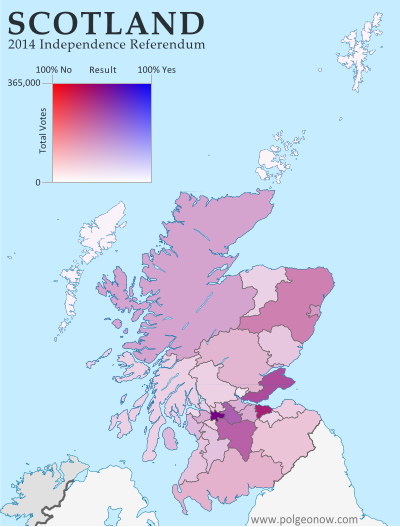
Map of results in Scotland's September 18, 2014 independence referendum. Voters were polled on whether or not to separate from the UK. Map shows relative proportion of yes and no votes for each of Scotland's council areas, using a gradient rather than contrasting colors for small differences.
Map by Evan Centanni, based on blank map by TUBS and NordNordWest (CC BY-SA)

By Evan Centanni

Misleading Maps
By now you’ve probably heard the results of Scotland’s independence referendum: voters chose “no” by a solid margin of 55% to 45%. Check out our previous article to learn more about what would have happened if Scotland had voted “yes”.

Maps like this one from the BBC and this one from Wikipedia have popped up since the results came out, showing how each of Scotland’s council areas voted. Most of the country is in red for “no”, with a few “yes” areas in green.

But if one area went 51% for “yes”, and another 51% for “no”, those two areas actually voted almost identically – yet contrasting red/green maps make us feel like they’re polar opposites (not to mention that one-in-thirty readers has trouble seeing the difference between red and green).

How the Councils Really Voted
Whether each area’s people voted just over or just under 50% in favor isn’t actually that important. What matters is how far the balance was tipped in each region. This is not the U.S. presidential election, where the final vote is actually made by delegates obligated to go by the majority in each state. All the votes across Scotland were pooled together to determine the result, so which side of the 50-yard line each area came out on has no effect .

In reality, the vote was split in every part of Scotland. No council area voted more than 58% in favor of independence or more than 68% against. The above map is designed to show how close the vote really was all across the country. Since no area came close to voting completely for independence (blue) or completely against it (red), on this map Scotland’s council areas all end up colored in purplish hues.

For Your Reference: Map of Scotland’s council areas with names labelled

Map of results in Scotland's September 18, 2014 independence referendum. Voters were polled on whether or not to separate from the UK. Map shows relative proportion of yes and no votes for each of Scotland's council areas, using a gradient rather than contrasting colors for small differences and shading to represent the total number of valid ballots case in each region as a way of normalizing for population.
Map by Evan Centanni, based on blank map by TUBS and NordNordWest (CC BY-SA)

The Glasgow metropolitan area, the main region where independence bagged more than half the vote, appears as a slightly bluish purple lump in the bottom-center, while border areas that voted “no” by a larger margin turn out purplish-red (as does Orkney, the group of islands just north of the Scottish mainland). Most of the remaining councils voted more narrowly against independence, showing up in intermediate hues.

Population Matters
In fact, the above map still hides an important factor in the results: the council areas didn’t each have the same number of votes. While turnout was high across the country (75-91%), population varies drastically from council to council. Glasgow city cast nearly 356,000 ballots, while rural Orkney had a mere 14,887.

The second map (at left) tries to show the relative importance of each area in deciding the countrywide result. Here, the same range of purple hues are made lighter or darker depending on how many total valid ballots were cast in each council area. It’s a bit more complicated to read, but the message is clear.

Flag of ScotlandCountry Name:  
• Scotland (English, Scots)
• Alba (Scottish Gaelic)
Current Status:  
Country within the United Kingdom 
Capital: Edinburgh

The outer islands’ voting populations are so small that they look white to the naked eye, with each group contributing only about five percent as many votes as the biggest city. Meanwhile, Scotland’s two major cities of Glasgow (left, bluish) and Edinburgh (right, reddish) stand out sharply with their huge numerical advantage.

The country’s number three city, Aberdeen, seems to have its votes divided between the surrounding Aberdeenshire (large, medium-shaded chunk at upper-right) and the city proper (lighter-shaded kernel along the coast). Meanwhile, the Scottish Highlands, the huge region at upper-left, are sparsely populated but carry some collective clout due to sheer size.

Maps that contrast colors on either side of the 50% mark may be a simple and attention-catching way to show election results, but they mislead us by making countries look more geographically-divided than they really are.

See Also: How Sharply Divided is Ukraine, Really? Honest Maps of Language and Elections

Scottish Independence Poll: What is Scotland, and What Will Happen if it Votes to Leave the UK?

Premium members click here to view this article in the ad-free members area. Not a member yet? Subscribe now!
 

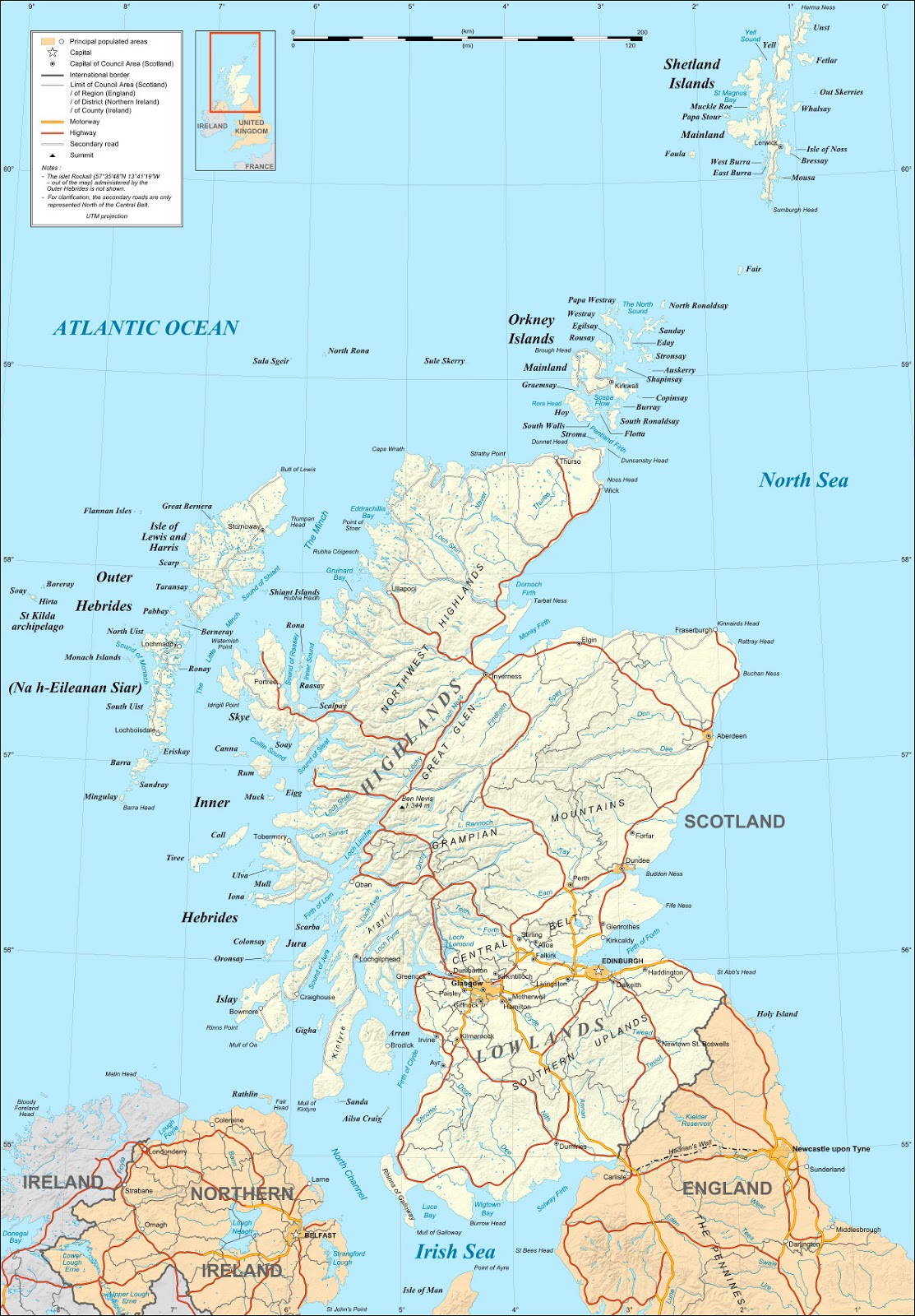
Map of Scotland. On September 18, 2014, Scotland will vote on whether to leave the UK and become an independent country.
Map of Scotland by Eric Gaba (source). License: CC BY-SA

By Evan Centanni

Scotland’s Independence Vote
On Thursday (September 18), residents of Scotland will vote in a referendum on whether to leave the United Kingdom (UK). But is Scotland a country already? What will happen if voters choose “yes” in the referendum? And what other changes would this bring to Scotland and the UK’s political geography? Read on for the answers to these questions and more!

Crash Course: History of Scotland
Scotland is the name of the northern third of Great Britain, the main island of the UK, which is shared with England to the south and Wales to the southwest. It originated as the Kingdom of Alba, an independent Celtic country that was unified around the year 900.

It remained an independent kingdom throughout the Middle Ages, gradually absorbing Anglo-Saxon culture from the south until it came to be ruled by English-speaking monarchs, who called it “Scots” or “Scotland” after the Latin name for the Gaels, the predominant Celtic people of the region.

Starting from the late 1200s, Scotland and England became enemies, and Scotland allied closely with England’s enemy France. But tensions eventually cooled, and in 1603 Scotland’s King James VI inherited the throne of England (where he became known as James I), paving the way for the two countries’ eventual unification. At first, they were still two independent countries that just happened to share the same monarch, but in 1707 their parliaments passed the Acts of Union, controversially joining them together as a single kingdom.
Flag of ScotlandCountry Name:  
• Scotland (English, Scots)
• Alba (Scottish Gaelic)
Current Status:  
Country within the United Kingdom 
Capital: Edinburgh

Then what is Scotland now? Is Scotland a country?
Since the union 300 years ago, Scotland has maintained some separation from England, especially in terms of its legal system and religious institutions. Like England and Wales (and sometimes Northern Ireland), Scotland is still called a “country” today, despite not being an independent country. After the union, the Scottish parliament was merged with the English one in London. But in 1999 Scotland was once again given its own parliament, which eventually came to be dominated by pro-independence parties.

Though Scotland and England are just considered parts of the UK in most world organizations like the UN or the European Union, they do have their own national soccer teams that compete separately in official FIFA events such as the World Cup (See: Which Countries Are (and Aren’t) Members of FIFA?).

The UK won’t just let Scotland leave, will it?
Actually, it will. True, modern countries rarely let pieces of their territory break off without a fight, and usually don’t accept the outcome even if the separatists come out victorious. And even in highly democratic Western Europe, other would-be breakaways like Catalonia face daunting legal obstacles in their quests for independence. But the UK has come a long way since the American Revolution, and since the 20th century decolonization of the British Empire it’s become relatively supportive of self-determination (the right of peoples to govern themselves).

That’s not to say London wants Scotland to go. The British government did agree to allow Scotland’s independence referendum, but is campaigning doggedly for a “no” vote. In a very rare show of unity, all three of the UK’s major political parties have joined in the “Better Together” campaign to talk Scotland out of secession. Nevertheless, the British government in London has clearly asserted that they’ll accept the results of the vote, even if the answer is “yes” to Scottish independence.

If it’s a “yes”, will Scotland become independent right away?
No, it will stay part of the UK for a little bit longer. The Scottish and British governments will need months or years to negotiate the exact terms of separation, such as “the allocation of assets and liabilities.”

Last year, Scotland’s government proposed March 24, 2016 as the date to declare independence if the referendum passes, but it’s not set in stone yet. That would be the day after the current Scottish parliament finishes its term in office, and March 24 is also the anniversary of the “Union of the Crowns,” when King James first became the monarch of both Scotland and England (see history crash course above).

What changes will the UK have to make if Scotland leaves?
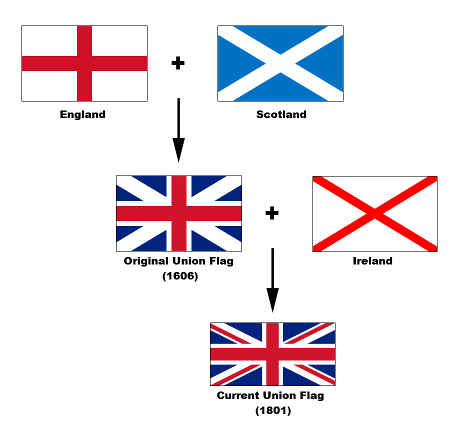
Diagram of the component flags of the UK's Union Jack flag, including the flags of Scotland, England, and Ireland. The UK will likely have to change its flag if Scotland becomes independent.
Development of the UK’s flag (source)

An independent Scotland could keep its current name and flag – ironically, it would be the UK that might have to change. The current full name of the UK is the “United Kingdom of Great Britain and Northern Ireland”, and without Scotland it would only have control over two-thirds of Great Britain.

But even if the UK decides to let that one fly, it will probably still have to change its iconic “Union Jack” flag. The blue background and diagonal white bars of that flag are actually the flag of Scotland, a design known as the St. Andrew’s Cross. Flag enthusiasts are already proposing new designs, many making a point of adding a symbol for Wales, which was left out of the current flag because it was considered part of England at the time the banner was designed.

(See also: Other countries that have changed their flags recently

Will Scotland stay in the EU, NATO, and other important organizations?
Not automatically, in most cases. It will have to re-apply as a new member country for most organizations. The United Nations will probably accept an independent Scotland as long as Britain doesn’t object, though Scotland will have to give up the veto power that the UK gets as a member of the UN Security Council. 

The European Union could be more complicated. It’s technically possible for the EU to keep an independent Scotland in the organization without making it reapply, but there’s a hot debate over whether that would really happen. Meanwhile, if Scotland applies anew to the EU, there’s a chance it could face a veto from Spain, which is determined not to let go of its own separatist region, Catalonia. On the other hand, if Scotland votes “no”on Thursday, it could still end up leaving the EU unwillingly – the British government is planning a 2017 referendum on whether the whole UK should leave the European body. Most Scottish people want to stay in the EU, but they could be outnumbered at the polls by euroskeptics to their south.

NATO membership for an independent Scotland is also uncertain. The Scottish National Party’s anti-nuclear policy could mean the end of the UK Trident program, Britain’s only active nuclear weapons system, which is based in Scotland. Though Scotland’s close relationship to other members would seem to make its entry into the alliance a sure thing, and there are many NATO member countries without nuclear weapons, some think NATO would be annoyed with an independent Scotland for essentially disarming another member, the UK.

What about the Olympics and World Cup?
As mentioned earlier, Scotland already has its own FIFA football (soccer) team, but it currently competes in the Olympics as part of Great Britain. Scottish leaders are hopeful that the country can compete independently in the 2016 Olympics in Brazil, but it could be a bit of a rush if it declares independence that same year.

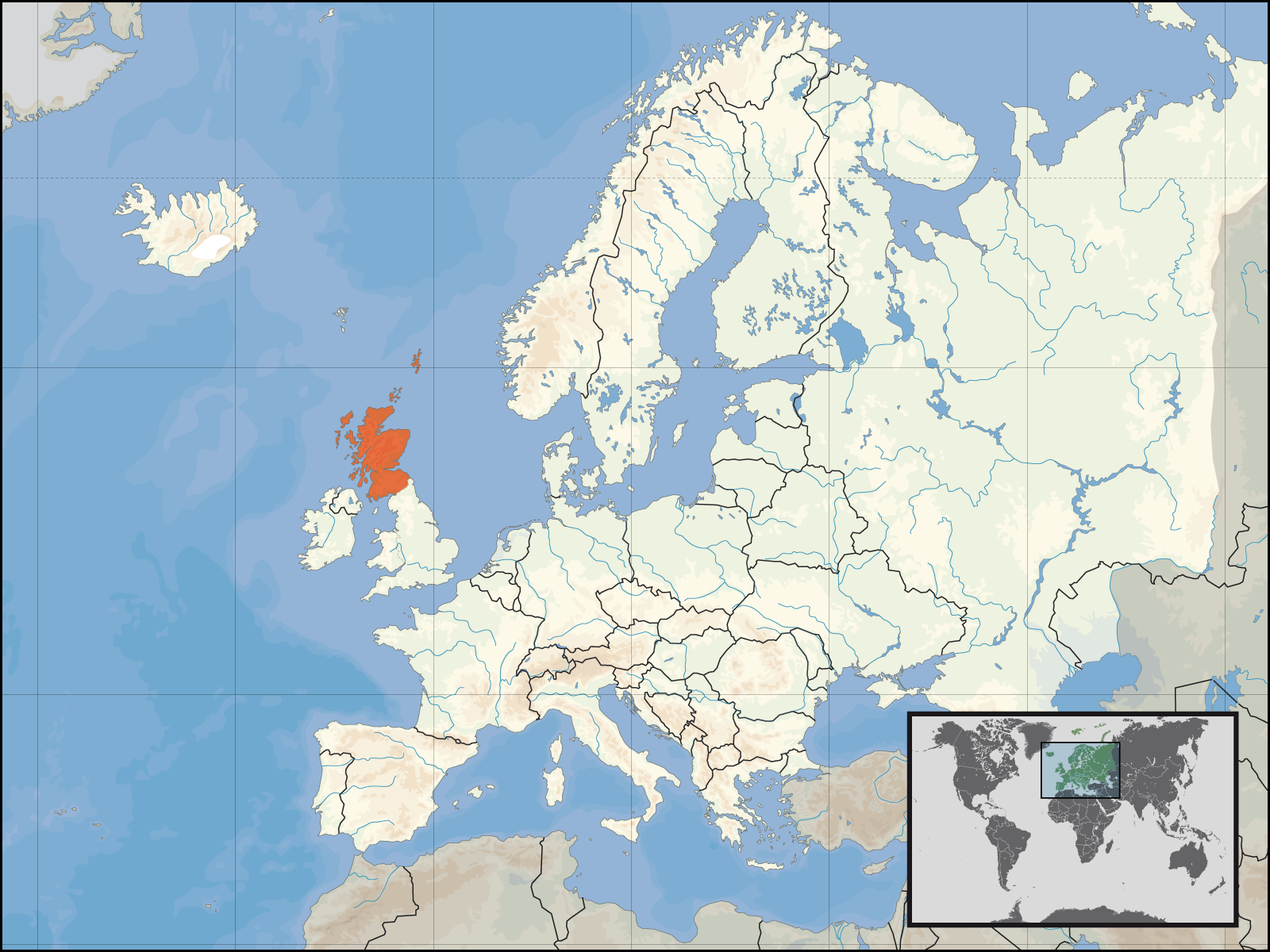
Map of an independent Scotland's location within Europe. On September 18, 2014, Scotland will vote on whether to leave the UK to become an independent country.
Scotland’s location with Europe
Map by Rab-k and David Liuzzo (source)

First, an independent Scotland would first have to prove it’s a real country by joining the UN. Probably not a big problem; in 2011, South Sudan achieved this within days of independence. But a bigger problem might be the time it takes to organize a national Olympic committee – something South Sudan still has yet to do. If Scotland doesn’t get its stuff together quick, Scottish athletes will have to compete under the UK flag one more time. (See also: Which Countries Are (and Aren’t) in the Olympics?)

But can the queen stay?
Scotland’s leader, Alex Salmond, says the independent Scotland would keep Queen Elizabeth II as its monarch, making her Queen of Scotland just as she’s also the Queen of the United Kingdom and 15 other independent countries. However, it may not be up to him: some political forces in Scotland are pushing for a separate referendum on whether to keep the queen or abolish the monarchy and become a republic.

Will all of Scotland go along with independence?
Probably, but that wasn’t always a given. Three island groups along Scotland’s fringes – Orkney, Shetland, and the Outer Hebrides – have been less enthusiastic about independence than many other parts of the country. Earlier this year, a group of islanders tried to organize a second referendum that would allow the island groups to declare their own independence or rejoin the UK if Scotland splits. That plan doesn’t seem to have caught on, but the islands’ local governments have taken advantage of the controversy to secure extra autonomy (self-rule) regardless of whether Scotland leaves the UK or not.

So, what will happen to Scotland if it votes “no”?
If the referendum fails, Scotland will stay part of the UK, probably for a long time to come, since the results will be seen as a popular rejection of separation. But that doesn’t mean nothing will change. In a bid to dissuade Scottish voters from independence, British political leaders have made strong promises that if Scotland stays in the UK, it will get much greater powers of self-government within Britain than it has now. These would include greater control over its finances, taxation, and possibly welfare, big issues in a region that usually votes for the left-of-center Labour Party, yet often finds itself stuck in a Britain ruled by the opposing Conservatives.

What will happen next? Stay tuned to PolGeoNow for more updates on Scottish independence!

Syria Civil War Map: September 2014 (#14) (Premium)

There are newer versions of this map available. To see them, view all Syria updates.

Detailed map of fighting and territorial control in Syria's Civil War (Free Syrian Army and Nusra Front rebels, Kurdish groups, ISIS/ISIL/Islamic State and others), updated to September 2014.

Download PDF
buy

(Subscribe via Paypal to view all premium content online)

Our Syrian Civil War coverage continues with this updated situation map, showing changes to territorial control since our previous Syria map report in August. Government forces, the Islamic State (ISIS), and the allied rebels have all made territorial gains during the past weeks.

This map and article are exclusive premium content, available to paid subscribers or for individual purchase.
Buy now (US$9.99)

Premium map includes:

  • Up-to-date map of current territorial control in Syria, color-coded for the Assad government, rebel groups, Islamic State (ISIS) extremists, and Kurdish self-protection forces
  • Detailed indication of city-by-city control, highlighting key towns relevant to current events
  • Recent areas of fighting including Tabqa Airbase, Halfaya, Quneitra Province and more
  • Timeline of events since mid-August, including both territorial changes and major political happenings

MEMBERS CLICK HERE TO PROCEED TO ARTICLE AND MAP

NOT A MEMBER YET? SUBSCRIBE NOW!

Ukraine War Rebel Control Map: September 2014 (Premium)

There are newer versions of this map available. To see them, view all Ukraine updates.

Detailed map of pro-Russian rebel control in Ukraine's eastern provinces of Donetsk and Luhansk, claimed by the breakaway Donetsk People's Republic and Lugansk People's Republic. Updated to September 1, 2014

Download PDF
buy

(Subscribe via Paypal to access all premium content online)

Russia is now being accused of directly invading eastern Ukraine, and opposition control in the region has seen major changes since our last Ukraine war map update.

This is detailed map and timeline of pro-Russian territorial control in eastern Ukraine’s Donetsk and Luhansk regions, home to the claimed Donetsk People’s Republic, Lugansk People’s Republic, and Federation of Novorossiya. Updated to the start of September 2014.

This map report is exclusive premium content, available to paid subscribers or for individual purchase.
Buy now (US$9.99)

Premium map includes:

  • Detailed, updated map of Donetsk and Luhansk regions, showing both past and current rebel control
  • Indication of which districts and cities have had their administrations occupied by separatists
  • Timeline of changes to territorial control since July, and summary of major trends

MEMBERS CLICK HERE TO PROCEED TO ARTICLE AND MAP

NOT A MEMBER YET? SUBSCRIBE NOW!

Latvia Joins the Eurozone (map)

This article was originally published as “Map: Which Countries Use the Euro? (Plus: This Year’s New Addition)”. To see newer versions of the map, view all Eurozone articles on PolGeoNow.

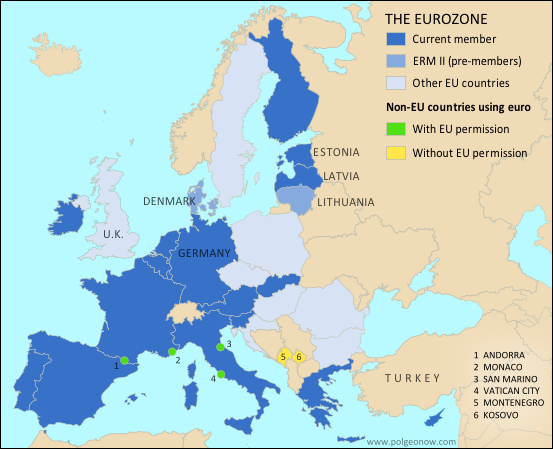
Map of the Eurozone (euro area), showing which countries use the euro as their currency. Includes members, pre-members (ERM II), EU non-members using the euro, and other EU countries (colorblind accessible).
The Eurozone, European Union, and other countries using the euro.
Map by Evan Centanni, from blank map by Ssolbergj. License: CC BY-SA

Premium members click here to view this article in the ad-free members area. Not a member yet? Subscribe now!

Article by Caleb Centanni

Eurozone Adds New Member
The Eurozone, an economic union of states in the European Union (EU) that have adopted the euro as their currency, added its eighteenth member in January. This is the organization’s first new admission since Estonia joined in 2011.

Latvia, a small former-Soviet republic in the Baltic Region, officially adopted the euro on January 1, 2014. Latvia has had one of Europe’s fastest growing economies in recent years, and this swift recovery from the recent recession helped it meet the Eurozone’s criteria for 2014. Latvia’s adoption of the euro was approved by the country’s parliament in January 2013, despite polls showing public opinion on the decision with less than 50 percent in favor.

The European Central Bank, the governing financial body of the Eurozone, is headquartered in Frankfurt, Germany. Germany, along with eleven other EU countries, became a founding member of the Eurozone in 1999. Since then, seven more members have joined after meeting the five necessary economic criteria. This has brought the total to eighteen members, comprising all but ten of the 28 European Union member states.

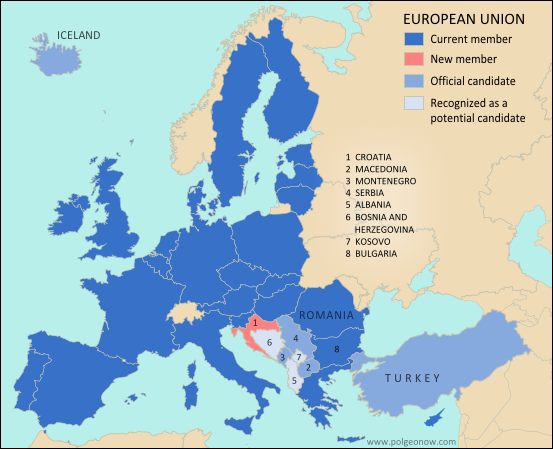
Map of the European Union (EU) and prospective member countries
The EU and prospective members

Two more countries, Denmark and Lithuania, are members of the European Exchange Rate Mechanism (ERM II), which ties members’ currency to the euro and is a necessary step for joining the Eurozone. However, Denmark is allowed to opt out of adopting the euro, despite its ERM II membership. All members of the European Union were required by the Maastricht Treaty of 1992 to change to the euro after meeting the criteria. However, both Denmark and the UK negotiated exceptions to the requirement later in that year. Seven other EU members are still required to adopt the euro in the future.

There are also four small states outside of the EU – Andorra, Monaco, San Marino, and Vatican City -which have monetary agreements allowing them to use the euro as their official currency. Meanwhile two other EU non-members, Montenegro and the disputed state of Kosovo, have unilaterally adopted the euro without coming to any agreement with the Central Bank. The EU has expressed its dissatisfaction with these unilateral adoptions, but the currency’s use in the two states has gone forward anyway.

Many countries sought Eurozone membership at the beginning of the financial crisis in 2008, but most became less interested after the euro was hit by its own crisis in 2009. Meanwhile, recent Danish polls suggest the country is unlikely to support moving to the new currency any time soon. However, Latvia’s neighbor Lithuania is still scheduled to join in 2015.

Belarus’s Quiet Flag Change

Sometimes geopolitical changes make headlines, but other times they slip quietly under the radar. Such is the case with the flag of Belarus, which was changed without fanfare (or explanation) by a government decree back in 2012. We don’t want you to miss any changes to the world’s list of countries and flags, so we now present a belated report on this little-known event.

Premium members click here to view this article in the ad-free members area. Not a member yet? Subscribe now!

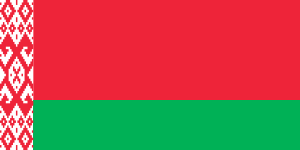
Flag of Belarus, 2012-present
Flag of Belarus, 1995-2012
Flag of Belarus, 1991-1995

By Caleb Centanni

Belarus, a former Soviet state in Eastern Europe, made a slight change to its flag in early 2012. On Feb. 10 of that year, the State Committee for the Standardization of the Republic of Belarus announced a minor change to the ornamental pattern on the left margin of the flag.

The pattern originally occupied one-twelfth of the flag’s total length, and was located inside a white margin making up one-ninth of the flag design. The ornamental pattern has now been extended to fill the entire one-ninth margin. The Belarusian government apparently provided no specific reason for the change.

Other than this minor adjustment, the current flag of Belarus has been in place since 1995, when it replaced the traditional white-red-white flag after a controversial referendum that critics denounced as unconstitutional.

Belarusian President Alexander Lukashenko supported the adoption of the 1995 flag, which is very similar to the Soviet-era flag. State-owned media argued the traditional tricolor flag was unacceptable due to its use by Nazi collaborators in World War II.

Country Name:  
• Belarus (English)
• Bielaruś (Belarusian)
• Belorussia (Russian) 
Official Name:  
• Republic of Belarus (English)
• Respublika Bielaruś (Belarusian)
• Respublika Belarus’ (Russian)  
Capital: Minsk

The white-red-white flag was re-adopted in 1991 after the collapse of the Soviet Union, and some still consider it the rightful flag of Belarus. Opposition activists have continued to use it in protests against the Lukashenko administration.

However, the flag is officially banned in the country, and many protesters have been arrested for displaying it, contributing to allegations of authoritarianism and the labeling of Belarus as a dictatorship by many international commentators.

All versions of the flag of Belarus are in the public domain (1995-2012 source; 2012-present source).

Syria Civil War Map: August 2014 (#13)

There are newer versions of this map available. To see them, view all Syria updates.

Premium subscribers have already seen our new Syria map format, which shows full areas of control for each major faction in the civil war. Now, we present this month’s update free of charge for your convenience. 

To get many more Syrian Civil War map updates like this one, sign up now for a premium subscription!

Map of fighting and territorial control in Syria's Civil War (Free Syrian Army rebels, Kurdish groups, Al-Nusra Front, Islamic State (ISIS/ISIL) and others), updated for August 2014. Highlights recent locations of conflict and territorial control changes.
Territorial control in the Syrian Civil War as of August 2014. Map by Evan Centanni, starting from blank map by NordNordWest. License: CC BY-SA

Premium members click here to view this article in the ad-free members area.

Threats from All Sides
Since our last Syria map update in early July, the lines of control in the civil war have not changed drastically. However, fighting on all fronts has resulted in numerous small but important changes to the situation, as the Assad government is now facing serious challenges from both the newly rebranded Islamic State (formerly ISIS/ISIL) and a loose coalition of various other rebel groups (including both the Free Syrian Army and Al-Nusra).

Rebel Advances
Opposition forces made advances against the army in two parts of Hama province over the past month, beginning in mid-July with their capture of Rahjan in the province’s east. Before the end of the month, they had also advanced nearly to the city of Hama, by some accounts fully capturing Khitab and nearby towns. In early August, major fighting erupted in Arsal, a town across the border in Lebanon. Rebels recently driven out of nearby Syrian areas struggled with the Lebanese army over several days before eventually retreating.

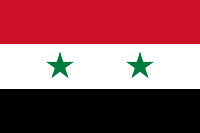
Flag of Syria under the current governmentCountry Name:  
• Syria (English)
• Sūriyya/Sūryā (Arabic)
Official Name:  
• Syrian Arab Republic (English)
• al-Jumhūriyyah al-‘Arabīyah  as-Sūriyyah (Arabic)
Capital: Damascus

Rebel Setbacks
However, signs of a rift among the rebel coalition may be emerging. Similarly to how ISIS began carving out its own territory late last year, the rebel Al-Nusra Front last month declared its own “emirate” and seized the northwestern towns of Salqin, Harem, and Darkush from formerly allied rebel groups. The powerful Al-Nusra Front is an official affiliate of Al Qaeda, but has up to now cooperated and mixed freely with less extreme anti-government rebels. It remains to be seen whether recent events signal a permanent split.

The rebels, including Al-Nusra, have also suffered some defeats. Formerly the major power in Syria’s eastern Deir ez-Zor province, they have now been completely driven out, with the Islamic State last month replacing them in Deir ez-Zor city and driving them out of their last territories to the city’s northwest (the Islamic State’s main campaign for Deir ez-Zor province was covered in last month’s update).

Within Syria’s largest city of Aleppo, rebel fighters also were driven back from some of their positions by an early-July government advance.

Consolidating the “Caliphate”
Above all, the past month has seen a strengthening of the “Islamic State” group, formerly known as the Islamic State of Iraq and al-Sham (ISIS). After seizing much of neighboring Iraq in June, ISIS declared itself to be the Caliphate, a historical term for an empire of all Muslims, and shortened its name to “Islamic State”. Controlling the major Iraqi city of Mosul, it has used this newfound power to consolidate its territories in both countries.

Map of the Islamic State's control in Iraq as of August 2014
The Islamic State’s control in Iraq (click for premium article and map).

In Syria, the Islamic State has nearly completed its control of Raqqah province. Though it already held the capital, three key military bases in the province were still controlled by the Assad government. Two of those, known as Division 17 and Brigade 93, were seized by the Islamic State earlier this month, while the last, Tabqa Airbase, is now under siege. In neighboring Hasakah province, Islamic State fighters also captured a key government base, the 121st Artillery Regiment, even waging battles on the outskirts of Hasakah city and advancing nearly to Qamishli on the Turkish border. However, government forces also scored some victories, maintaining joint control of the city with Kurdish forces and at one point pushing the militants back towards their stronghold in Shadadi.

Islamic State Advances West
The Islamic State has also begun striking out west from its current territories in both the north and the south. In Aleppo province it has been very slowly taking back ground it lost to the rebel coalition in January, seizing the town of Akhtarin just last week. Meanwhile, it has also been pushing against the Kurdish enclave of Kobane (Ayn al-Arab) from both sides. More prominently, Islamic State forces last month boldly stormed the Sha’er gas field near Palmya, far from their established frontiers, though the government soon recaptured it.

But pockets of Islamic State control have been appearing even farther afield, possibly in connection with the group’s efforts to bring small rebel brigades over to its side. Some reports say the town of Deir Ful near Homs city is now in Islamic State hands, and the group briefly captured a neighborhood outside Damascus last month.

Don’t miss future updates to the Syria and Iraq control maps! Become a member now!

Graphic of the Syrian flag is in the public domain (source).

Iraq Conflict Control Map: August 2014 (Premium)

There are newer versions of this map available. To see them, view all Iraq updates.

Detailed map of territorial control in Iraq in August 2014, including cities and countryside held by the Islamic State (ISIS, ISIL) and the Kurdistan Peshmerga.

Download PDF
buy

(Subscribe via Paypal to view all premium content online)

This is the latest update to our series of maps documenting territorial control in the current war in Iraq, with a number of updates since the previous edition in late June. 

It includes control by the Maliki goverment, Kurdish forces, and the Islamic State (formerly known as ISIS), and has been re-styled to fit seamlessly with our popular control maps of the Syrian Civil War.

This map and article are exclusive premium content, available only to paid members or for individual purchase. Buy now (US$9.99)

Premium map includes:

  • Up-to-date map of current territorial control in Iraq, color-coded for the Maliki government, ISIS/Islamic State extremists, and Kurdish forces
  • Detailed indication of city-by-city control, highlighting key towns relevant to current events
  • Includes recent areas of fighting including Sinjar, Qaraqosh, Mosul Dam, Erbil province, and more
  • In-depth article summarizes changes since June, including ISIS’s declaration of an Islamic caliphate, with links to sources

MEMBERS CLICK HERE TO PROCEED TO ARTICLE AND MAP

NOT A MEMBER YET? SUBSCRIBE NOW!

African Union Reinstates Egypt and Guinea-Bissau (Map)

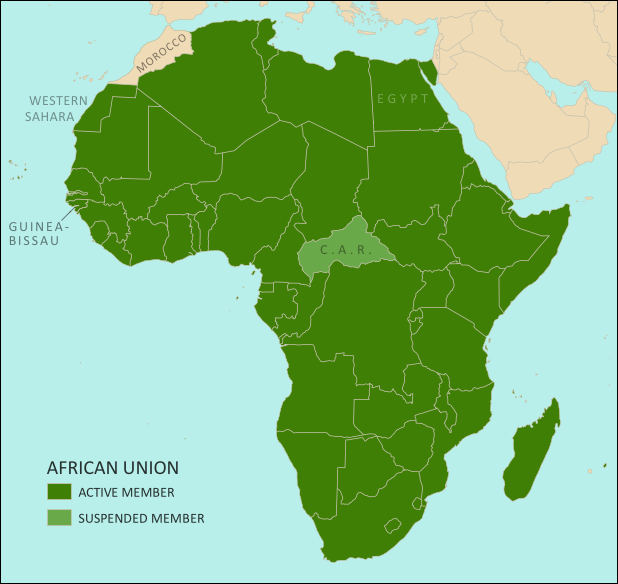
Map of the African Union, including active and suspended members, updated for the June 2014 reinstatement of Egypt and Guinea-Bissau (colorblind accessible).
The African Union as of July 2014. Map by Evan Centanni, from this blank map by Eric Gaba.
License: CC BY-SA

Premium members click here to view this article in the ad-free members area. Not a member yet? Subscribe now!

Article by Evan Centanni

Suspensions Lifted
At a meeting in June, the African Union (AU) decided to end the suspensions of Egypt and Guinea-Bissau from the regional organization. Egypt was suspended from the AU last year after its elected government was overthrown by the military. Its reinstatement comes after the events of this May, when the country held its first presidential election since the takeover. Guinea-Bissau had been suspended since a 2012 coup, and was similarly allowed back in after holding elections this April.

The AU’s Peace and Security Council typically suspends member countries when they experience coups or other breakdowns of constitutional rule. Though this is billed as a pro-democracy policy, it does not affect undemocratic governments which are already long-established. After Guinea-Bissau and Egypt’s reinstatement, there is currently only one remaining suspended AU member, the Central African Republic (CAR), which is experiencing serious turmoil in the aftermath of an aborted rebel takeover.

Flag of the African Union (AU)Organization Name:  
• African Union (English)
• al-Āthḥād al-’Āfrīqī (Arabic)
• Union africaine (French)
• União Africana (Portuguese)
• Unión Africana (Spanish)
• Umoja wa Afrika (Swahili)  
Launched: 2002 in Durban, South Africa
Headquarters: Addis Ababba, Ethiopia
Website: www.au.int

What is the African Union?
Formed in 1999-2002 to replace the earlier Organization of African Unity (OAU), the AU is an intergovernmental organization which works on increasing cooperation, stability, and development within the continent of Africa. It has a secretariat based in Addis Ababa, Ethiopia, though many of its most important decisions are made during annual summits of the continent’s national leaders.

Every UN-recognized country in Africa is a member of the African Union except for Morocco, which withdrew from the OAU in 1984 after the organization chose to admit the partially-recognized state of Western Sahara, a disputed territory which Morocco claims and largely occupies. The only other parts of Africa not represented in the AU are a few groups of offshore islands controlled by European countries, as well the small Spanish enclaves in North Africa. The breakaway Republic of Somaliland is not a member, but is considered by the AU to be part of member-state Somalia.

Low-resolution graphic of the African Union flag is displayed under fair use principles (source). Flag of Madagascar is in the public domain (source).

Map Update: Kosovo Recognized by 3 More Countries in 2014 (106/193)

Premium members click here to view this article in the ad-free members area. Not a member yet? Subscribe now!

Map of countries that recognize the Republic of Kosovo as an independent state, updated for July 2014, with most recent additions (Togo, Tonga, Lesotho) and disputed recognitions highlighted
Countries recognizing the Republic of Kosovo in green, highlighting recent additions. Disputed recognitions in yellow. Kosovo in magenta. Map by Evan Centanni, modified from public domain graphic (source).

Flag of the Republic of KosovoCountry Name:  
• Kosovo (English, Serbian)
• Kosova (Albanian)
Official Name:  
Republic of Kosovo (English)
Republika e Kosovës (Albanian)
Republika Kosovo (Serbian)
Capital: Pristina/Prishtina

By Caleb Centanni

Kosovo Recognition Continues Growing
Over the last six months, three new countries have extended diplomatic recognition to the self-proclaimed Republic of Kosovo. The breakaway state, located in the Balkan Region of Southeastern Europe, is now recognized by at least 106 U.N. member nations (about 55%). Kosovo’s government claims recognition from 107 U.N. members, but one of these has been called into question (see “Disputed Recognitions” below).

The three new states which have recognized Kosovo are Tonga, in January; Lesotho, in February; and Togo, on July 2nd. Tonga is a Pacific Island state, Togo is a small country located in West Africa, and Lesotho is an enclave surrounded by South Africa. None of these countries’ governments appear to have confirmed their recognitions, with the information coming only from Kosovo’s foreign ministry. However, so far none of them has disputed Kosovo’s claims.

The Republic of Kosovo declared independence from Serbia in 2008, but has been blocked from U.N. membership by objections from Serbia, Russia, and other countries who see its secession as invalid. In addition to the 106 U.N. members recognizing Kosovo, its independence is also acknowledged by non-U.N. member Taiwan. For more on Kosovo’s special situation, see our first Kosovo recognition report, which also includes a map of Kosovo’s location relative to Serbia.

Disputed Recognitions
The African Island nation of São Tomé and Príncipe announced its recognition of Kosovo on March 13, 2012. However, on January 7, 2013, the President of the small country declared the recognition invalid on the grounds that he had not been informed of the decision. Despite this, Kosovo still maintains that the recognition is valid. Political Geography Now has chosen not to include São Tomé and Príncipe in its tallies of recognition until the dispute has been resolved.

In addition to this, Kosovo has previously claimed that two other African countries, Nigeria and Uganda, recognized its independence. However, Nigeria clearly stated in March that it did not recognize the breakaway state, and Kosovo’s foreign ministry recently included Uganda in a discussion of nations that “have not yet recognized Kosovo”, also indicating that there are only 107 U.N. members currently recognizing the country. Despite this, the ministry’s website has still not dropped Nigeria and Uganda from its list of “Countries that have recognized the Republic of Kosova”.

Stay Up to Date: Check for further news and map updates related to Kosovo’s recognition by viewing all Kosovo articles on Political Geography Now.

Related Articles:
Kosovo Recognition Map Update: October 2013
North Kosovo Status Changing After Serbia Deal
Who Recognizes Palestine in 2013?
 
Flag graphic by Cradel (source). License: CC BY-SA