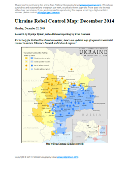
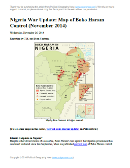
Ukraine War Rebel Control Map: December 2014 (Premium)

There are newer versions of this map available. To see them, view all Ukraine updates.

Detailed map of pro-Russian rebel control in Ukraine's eastern provinces of Donetsk and Luhansk, claimed by the breakaway Donetsk People's Republic and Lugansk People's Republic. Updated to December 21, 2014

Download PDF
Buy now

(Subscribe via Paypal to access all premium content online)

Research by Djordje Djukic, with additional reporting by Evan Centanni

Control lines have begun to solidify in Ukraine’s civil war, with government forces on one side and the fighters of the self-proclaimed Donetsk People’s Republic, Lugansk People’s Republic, and Federation of Novorossiya on the other side. 

PolGeoNow presents our district-by-district map of control in eastern Ukraine, updated for December 2014, including a timeline of major events and changes to territorial control since our previous Ukraine map update in September.

This map report is exclusive premium content, available to paid subscribers or for individual purchase.
Buy now (US$9.99)

Premium map includes:

  • Detailed, updated map of Donetsk and Luhansk regions, showing both past and current rebel control
  • Indication of which districts and cities have had their administrations occupied by separatists
  • Timeline of changes to territorial control since September, and summary of major trends

MEMBERS CLICK HERE TO PROCEED TO ARTICLE AND MAP

NOT A MEMBER YET? SUBSCRIBE NOW!

Map: Which Countries Recognize Palestine in 2014?

(Keep up with changes to Palestine’s situation: view all Palestine updates.)

Map of countries that recognize the State of Palestine as an independent country, updated for December 2014 with recent addition Sweden highlighted
Countries recognizing the State of Palestine in green, with most recent addition highlighted. Palestine in magenta (circled). Click to enlarge. Map by Evan Centanni, modified from public domain graphic (source).

Premium members click here to view this article in the ad-free members area. Not a member yet? Subscribe now!

Article by Evan Centanni

Disputed Country
Palestine declared independence in 1988, and its government continues to pursue recognition as a country today. Though its claimed territories are disputed and largely occupied by Israel, the “State of Palestine” has gathered recognition from more than two-thirds of the world’s countries, and is also treated as a country by the U.N. General Assembly, where it is an “Observer State” but not a member.

The number of individual countries recognizing Palestine as independent has grown gradually over the past decades. A year ago we reported that 134 U.N. member states officially recognized Palestine, and as of December 2014 the number is now 135 (70% of all U.N. members). Palestine is also recognized by the proclaimed government of Western Sahara, another disputed country that’s not formally recognized by the U.N.

Flag of Palestine Country Name:  
• Palestine (English)
Filasṭīn (Arabic)
Official Name:  
• State of Palestine (English)
• Dawlat Filasṭin (Arabic)
Capital: 
• Jerusalem (claimed)
Ramallah (administrative)

Sweden’s Recognition of Palestine
Only one new country has endorsed Palestine’s independence in 2014, but it’s a big one. On October 30, Palestine was officially recognized by Sweden, a major European country and and member of the European Union (EU). This is a big deal because most of Western Europe does not recognize Palestine, and of the 50-60 total countries worldwide that don’t recognize, about half are in Europe.

Palestinian Recognition in Europe
Sweden is the first country to begin recognizing Palestine after becoming a member of of the EU, an organization that tends to take a centrist stance on the Israeli-Palestinian conflict. In recent months, legislatures in France, Spain, Ireland, and the UK have also voted in support of recognizing Palestine, but so far none of their governments has followed through with official recognition.

However, Sweden isn’t the only EU country that endorses Palestine’s claimed independence: Malta, Czechoslovakia, Cyprus, Hungary, Romania, Bulgaria, and Poland all recognized it in 1988, before they became EU members.* Russia, Belarus, Ukraine, Serbia, and Albania also retain recognition from 1988, but are not members of the EU. And yet, neither is Sweden the only European country to recognize Palestine since the end of the Cold War. Bosnia recognized in 1992, Montenegro in 2006, and Iceland in 2011. 

*After the breakup of Czechoslovakia, the Czech Republic and Slovakia inherited their recognition of Palestine, though the current Czech government does its best to ignore that fact, having become a very close ally of Israel. Cyprus, on the other hand, has recently reaffirmed its original position on Palestinian independence. 

Related Articles:
Is Palestine Really a Country?
Palestine Recognized as a Country by the U.N.
Map of Countries Recognizing Kosovo

Syria Civil War Map: December 2014 (Premium)

There are newer versions of this map available. To see them, view all Syria updates.

Detailed map of territorial control in Syria's Civil War (Free Syrian Army and Nusra Front rebels, Kurdish groups, ISIS/ISIL/Islamic State and others), updated to December 2014 for siege of Kobani (Ayn al-Arab), government capture of Morek, rebel capture of Nawa, and other developments.

Download PDF
Buy now

(Subscribe via Paypal to view all premium content online)

Research by T.H., with additional reporting by Evan Centanni

Our popular map of territorial control in the Syrian Civil War has been updated for December 2014, showing changes to the situation since the previous Syria map report in October. 

The map and accompanying report show largely unreported advances by the Islamic State, as well as important gains for both the government and rebels.

This map and report are exclusive premium content, available to paid subscribers or for individual purchase.
Download PDF (US$14.99)

Premium map includes:

  • Up-to-date map of current territorial control in Syria, color-coded for the Assad government, rebel groups, Islamic State (ISIS) extremists, and Kurdish self-protection forces
  • Detailed indication of city-by-city control, highlighting key towns relevant to current events
  • Recent areas of fighting, including Kobani (Ayn al-Arab), Morek, Nawa, and many others
  • Timeline of events since early October, with focus on changes to territorial control

MEMBERS CLICK HERE TO PROCEED TO ARTICLE AND MAP

NOT A MEMBER YET? SUBSCRIBE NOW!

Nigeria War Update: Map of Boko Haram Control (November 2014) (Premium)

There are newer versions of this map available. To see them, view all Nigeria updates.

Detailed map of Boko Haram's territorial control in its war with Nigeria, marking and labeling each town reportedly under the group's control in Borno, Yobe, and Adamawa states. Includes recent flashpoints such as Chibok, Mubi, Maiha, Abadam, Malam Fatori, and Damasak.

Download PDF
Buy now

(Subscribe via Paypal to view all premium content online)

Reporting by T.H. and Evan Centanni

Despite short-lived claims of a ceasefire, Nigeria’s northern insurgency has continued unabated since late September, when we published our free map of Boko Haram control in Nigeria.

This premium report and map update detail the many changes since then, which have seen Boko Haram’s “Islamic Caliphate” grow to control an area the size of Belgium.

This map and article are exclusive premium content, available only to paid members or for individual purchase. Buy now (US$9.99)

Premium report includes:

  • Map of Boko Haram’s overall area of control in Nigeria, updated to Nov. 25, 2014.
  • Detailed map shows almost every individual town or village known to have been captured by the group, including recent flashpoints like Chibok, Mubi, and Abadam.
  • Summary and detailed timeline of territorial changes and major events since late September.

MEMBERS CLICK HERE TO PROCEED TO ARTICLE AND MAP

NOT A MEMBER YET? SUBSCRIBE NOW!

Portuguese Community Admits New Member & Observer Countries (Map)

Map of the Community of Portuguese Language Countries (CPLP), including both member states and associated observers. Updated for the July 2014 summit, which admitted new member Equatorial Guinea and new associate observers Georgia, Japan, Namibia, and Turkey (colorblind accessible).
Map by Evan Centanni, starting from public domain blank map (license: CC BY-NC-SA).

Premium members click here to view this article in the ad-free members area. Not a member yet? Subscribe now!

Article by Karina Barquet

Flag of the Community of Portuguese Language Countries (aka Community of Portuguese-speaking Countries, CPLP)Organization Name:  
• Community of Portuguese Language Countries (English)
• Community of Portuguese-Speaking Countries (English – alternative name)
• Comunidade dos Países de Língua Portuguesa (Portuguese)
Founded: 1996 in Lisbon, Portugal
Headquarters: Lisbon, Portugal
Website: www.cplp.org

New Member Country for CPLP
The Community of Portuguese Language Countries (known by the Portuguese acronym CPLP) welcomed a new member this year. Equatorial Guinea joined the organization following its approval at the 10th CPLP Heads of State Summit in Dili, East Timor on July 23, 2014.

The CPLP is an intergovernmental organization for cooperation amongst countries where Portuguese is an official language. It was  founded in 1996 with seven member countries: Portugal, Brazil, Angola, Cape Verde, Guinea-Bissau, Mozambique, and São Tomé and Príncipe. East Timor joined the community in 2002 after gaining independence.

New Observer Countries
In addition to new member Equatorial Guinea, the CPLP’s July 2014 summit also admitted four new Associate Observer countries: Georgia, Japan, Namibia, and Turkey. These joined the two previously-admitted Associate Observers, Mauritius and Senegal.

Equatorial Guinea is a small country located in Central Africa. Its name reflects the country’s location near both the equator and the Gulf of Guinea. Equatorial Guinea is a former Spanish colony, and Spanish is the first official language, followed by French. A new law drafted in 2011 declared Portuguese the third official language in the country, though it is unclear whether that law ever went into effect.

The push to adopt Portuguese as an official language was a result of President Obiang’s efforts in 2007 to improve communications, trade, and bilateral relations with Portuguese-speaking countries, and to meet an important requirement to become a full member of the CPLP. Other requirements for joining CPLP included political reforms to give room for effective democracy and respect for human rights.

The 10th Summit also saw the reincorporation of Guinea-Bissau as a full member of the CPLP, after its suspension following a coup d’etat in April 2012. Guinea-Bissau was readmitted in the wake of the country’s recent presidential and legislative elections, and the transition of the CPLP’s presidency from President of Mozambique, Armando Guebuza, to the President of East Timor, Matan Ruak, who will be in office for the next two years.

Low-resolution graphic of the CPLP flag is displayed under fair use principles (source).

War in Iraq: Map of Control in October 2014 (#4) (Premium)

There are newer versions of this map available. To see them, view all Iraq updates.

Detailed map of control in Iraq in late October 2014, including territory held by the Islamic State (ISIS, ISIL), the Baghdad government, and the Kurdistan Peshmerga.

Download PDF
Buy now

(Subscribe via Paypal to view all premium content online)

Research by Djordje Djukic and Evan Centanni

PolGeoNow presents our latest update on territorial control in Iraq, which is still split three ways between the Baghdad government, the Kurdistan Regional Government, and the Islamic State (ISIS). This report covers a number of important changes to territorial control since our last Iraq map update in August.

This map and article are exclusive premium content, available only to paid members or for individual purchase. Buy now (US$9.99)

Premium map includes:

  • Up-to-date map of current territorial control in Iraq, color-coded for the Iraqi government, ISIS/Islamic State extremists, and Kurdish Peshmerga forces
  • Detailed indication of city-by-city control, highlighting key towns relevant to current events
  • Includes recent areas of fighting including Hit, Jurf al-Sakar, Mosul Dam, Jalula, and more
  • Timeline-style report on changes to the situation since August, with links to sources

MEMBERS CLICK HERE TO PROCEED TO ARTICLE AND MAP

NOT A MEMBER YET? SUBSCRIBE NOW!

Map Update: Kosovo Now Recognized by Every Country in Oceania (107/193 UN members)

Premium members click here to view this article in the ad-free members area. Not a member yet? Subscribe now!

Map of countries that recognize the Republic of Kosovo as an independent state, updated for October 2014, with the most recent addition (Solomon Islands) and disputed recognitions highlighted
Countries recognizing the Republic of Kosovo in green, highlighting recent additions. Disputed recognitions in yellow. Kosovo in magenta. Map by Evan Centanni, modified from public domain graphic (source).

Flag of the Republic of KosovoCountry Name:  
• Kosovo (English, Serbian)
• Kosova (Albanian)
Official Name:  
Republic of Kosovo (English)
Republika e Kosovës (Albanian)
Republika Kosovo (Serbian)
Capital: Pristina/Prishtina

By Caleb Centanni

Solomon Islands Recognizes Kosovo
Kosovo, a small breakaway state in the Balkan Region of Southeastern Europe, was recently recognized as an independent country by Solomon Islands (the country’s name is officially singular, with no “the”). This completes Kosovo’s recognition by every UN member country in the Oceania region, which includes Australia, New Zealand, and the islands of the South Pacific.

Solomon Islands, a former British protectorate in Melanesian cultural region of the South Pacific, recognized Kosovo on August 13, 2014. The foreign minister of the island country indicated that a decision was made based on “the improvement of relations between Serbia and Kosovo.” Kosovo’s foreign ministry announced the recognition on the same day.

In the past, many recognitions have been announced only by the Kosovan government, sometimes calling their validity into question (See also “Disputed Recognitions” below). In this case, however, the comments of the Solomon Islands foreign minister leave little doubt.

Solomon Islands’ recognition is Kosovo’s fourth this year, and the twelfth since the beginning of 2013. Prior to this, the most recent recognition was by Togo this past July. Kosovo is now considered a sovereign state by 107 of the 193 UN member countries (just over 55 percent).

Disputed Country
The Republic of Kosovo declared independence from Serbia in 2008, but has been blocked from UN membership by objections from Serbia, Russia, and other countries who see its secession as invalid. In addition to the 107 UN members recognizing Kosovo, its independence is also acknowledged by non-UN member Taiwan. For more on Kosovo’s special situation, see our first Kosovo recognition report, which also includes a map of Kosovo’s location relative to Serbia.

Disputed Recognitions
There are a few countries that appear on lists of UN members recognizing Kosovo, but whose actual recognitions have been called into question. The most contentious case is the African island nation of São Tomé and Príncipe, which announced its recognition of Kosovo on March 13, 2012. However, on January 7, 2013, the country’s president declared the recognition invalid on the grounds that he had not been informed of the decision. Despite this, Kosovo’s government still claims recognition from São Tomé and Príncipe. Political Geography Now has chosen not to include São Tomé and Príncipe in its tallies of recognition until the dispute has been resolved.

The Kosovan foreign ministry also still includes Uganda and Nigeria in its list of “Countries that have recognized the Republic of Kosova”, despite these two recognitions having been strongly refuted. However, as discussed in our previous Kosovo article, even the Kosovan government seems not to actively claim recognition from Uganda and Nigeria anymore.

After Solomon Islands’ recognition took effect in August, the South Pacific country’s foreign minister stated that 109 nations had recognized Kosovo (two more than our tally of 107). This likely indicates that the Solomon Islands was including São Tomé and Principe, bringing the total up from 107 to 108. The figure of 109 could be a reference to the recognition of Kosovo by Taiwan, another disputed non-UN member state that Solomon Islands considers to be an independent country.

Stay Up to Date: Check for further news and map updates related to Kosovo’s recognition by viewing all Kosovo articles on Political Geography Now.

Related Articles:
Kosovo Recognition Map Update: July 2014
North Kosovo Status Changing After Serbia Deal
Which Countries Recognize Palestine as Independent?
 
Flag graphic by Cradel (source). License: CC BY-SA

Map: “Eurasian Union” Gets New Member

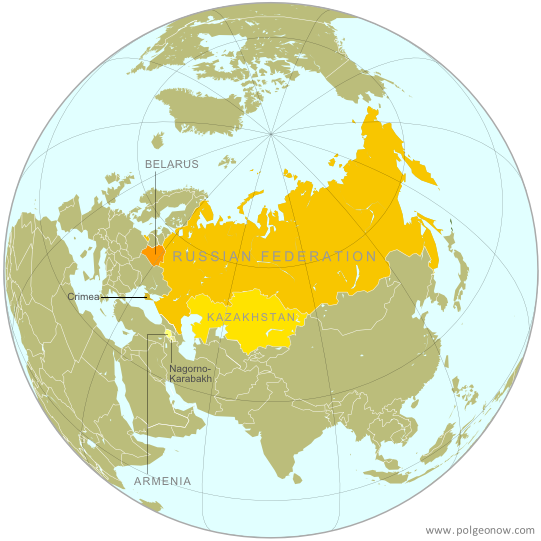
Map of the Eurasian Economic Union (EEU), also known as the Eurasian Union. Includes new member Armenia, as well as prior members Russia, Belarus, and Kazakhstan, and disputed territories Crimea and Nagorno-Karabakh.
The Eurasian Economic Union’s four member countries, plus disputed territories that might be officially or unofficially included. Map by Evan Centanni, starting from this map by Keverich2. License: CC BY-SA

Premium members click here to view this article in the ad-free members area. Not a member yet? Subscribe now!

Article by Evan Centanni

Armenia Joins Eurasian Economic Union
The Eurasian Economic Union (EEU), widely seen as a Russian-led answer to the European Union (EU), just welcomed its fourth member country. Armenia, a small former Soviet republic in the Caucasus region of Western Asia, joined Russia, Belarus, and Kazakhstan in the trade bloc after signing the organization’s founding treaty last Friday, October 10. However, the EEU, which will unite the four member countries’ economies into a single cooperatively-managed entity, doesn’t officially go into effect until New Year’s Day (January 1, 2015).

Flag of ArmeniaCountry Name:  
• Armenia (English)
• Hayastan (Armenian) 
Official Name:  
• Republic of Armenia (English) 
• Hayastani Hanrapetutyun (Armenian)
Capital: Yerevan

What is the “Eurasian Union”?
Though sometimes called just the “Eurasian Union”, the EEU is for now strictly economic in nature. Russia has shown interest in eventually expanding it into a political union to match the EU – however, that path is unpopular with fellow founding member Kazakhstan, which sees political union as a threat to the independence it gained after the breakup of the Soviet Union in 1991.

The economic union hopes to increase trade and lower prices by establishing a “Single Economic Space,” where goods, services, money, and people can all move freely from country to country without the obstruction of borders or import taxes. Industrial development, agriculture, and transportation will also be managed cooperatively, and people from one country will be able to live and work in any of the other countries without a visa.

What’s the difference: Eurasian Economic Union, EURASEC, and the Customs Union
Though the EEU has not yet gone into effect, Russia, Belarus, and Kazakhstan are already united in an organization called “the Customs Union“. This union partially combines the countries’ economies by replacing customs checks along their mutual borders with a unified customs policy for all imports coming into the three-country bloc. Armenia is apparently still not a member of the Customs Union, though the issue will presumably become moot on January 1, when the Customs Union is replaced with the new EEU.

The EEU is not the same thing as the Eurasian Economic Community (EURASEC), an earlier attempt at economic integration among former Soviet countries. EURASEC includes more countries than the EEU, but its members’ economies are not closely unified. The EEU in many ways grew out of the broader organization, and the member countries have agreed to dissolve EURASEC once the EEU comes into force on January 1, 2015.

Armenia’s Path to Membership
Armenia had originally sought to join the Customs Union this past spring, in advance of the EEU treaty coming into effect. However, its membership has been repeatedly delayed. Many suspect this was because of disagreements with the current Customs Union member countries over the Nagorno-Karabakh Republic, an Armenian-backed breakaway state that the rest of the world considers to be part of the neighboring ex-Soviet country of Azerbaijan. Even Armenia doesn’t officially recognize Nagorno-Karabakh, which declared independence in 1991, but makes no secret of being the breakaway state’s main supporter.

Map of the breakaway Nagorno-Karabakh Republic relative to Armenia and Azerbaijan
The breakaway Nagorno-Karabakh Republic (NKR)
Orange: Former NK Autonomous region in USSR
White: Current NKR territorial control
(public domain map by VartanM and Kmusser; source)

Because Armenia doesn’t maintain any border checks along its boundary with Nagorno-Karabakh, questions have been raised about whether the disputed territory will become an unofficial part of the EEU along with Armenia. With the other EEU members insisting Nagorno-Karabakh can’t be part of the union, and Armenia insisting it won’t set up border checks, it’s unclear how this issue will be resolved.

Meanwhile, another disputed territory will almost certainly be treated as part of the EEU, and officially at that. Crimea, recognized by the rest of the world as part of Ukraine, came under Russian control after a hostile takeover earlier this year. Since Russia, the most powerful member of the new EEU, considers Crimea a legitimate part of its territory, it seems unlikely the region will be excluded in any way from the new economic union.

Graphic of the Armenian flag is in the public domain (source).

Syria Civil War Map: October 2014 (#15) (Premium)

There are newer versions of this map available. To see them, view all Syria updates.

Detailed map of territorial control in Syria's Civil War (Free Syrian Army and Nusra Front rebels, Kurdish groups, ISIS/ISIL/Islamic State and others), updated to October 2014 for siege of Kobani (Ayn al-Arab) and other developments.

Download PDF
buy

(Subscribe via Paypal to view all premium content online)

Our territorial control map of the Syrian Civil War has been updated for October, showing changes to the situation since the previous Syria map report in September. The map and accompanying timeline show the Islamic State’s advance against Kurdish-held Kobani, as well as other developments from the past few weeks.

This map and article are exclusive premium content, available to paid subscribers or for individual purchase.
Buy now (US$9.99)

Premium map includes:

  • Up-to-date map of current territorial control in Syria, color-coded for the Assad government, rebel groups, Islamic State (ISIS) extremists, and Kurdish self-protection forces
  • Detailed indication of city-by-city control, highlighting key towns relevant to current events
  • Recent areas of fighting, including Kobani (Ayn al-Arab), Deir al-Adas, and others
  • Timeline of events since mid-September, with focus on changes to territorial control

MEMBERS CLICK HERE TO PROCEED TO ARTICLE AND MAP

NOT A MEMBER YET? SUBSCRIBE NOW!

War in Nigeria: Map of Boko Haram Control (September 2014)

There are newer versions of this map available. To see them, view all Nigeria updates.

Detailed map of Boko Haram territorial control in its war with Nigeria, marking and labeling each town reportedly under the group's control in Borno, Yobe, and Adamawa states. Includes Damboa, Buni Yadi, Madagali, Gwoza, Gujba, Gulak, Bama, Gulani, Shuwa, Marte, Kukawa, Michika, Dikwa, Bularafa, Bazza, Gambaru Ngala, Buni Gari, Banki, Bara, Pulka, Bumsa, Ashgashiya, Limankara, Njibulwa and more.
Map by Evan Centanni. All rights reserved.

Premium members click here to view this article in the ad-free members area. Not a member yet? Sign up now!

Conflict tracking by T.H., with additional reporting by Evan Centanni

Boko Haram vs. Nigeria
Though it’s waged a bloody war against the Nigerian government for many years, rebel group Boko Haram rarely could claim significant territorial control until recently. Though they did take over a number of remote areas in spring of last year (see our 2013 Boko Haram control map), the militants were soon driven back into hiding by the Nigerian military.

The insurgency never went away, with Boko Haram’s bombings and other attacks, often on schools and other public places, increasing in number and lethality from 2013 into early 2014. (Also see our 2013 report for more background on Boko Haram).

Territorial Resurgence
However, this summer saw a striking change in the trajectory of Boko Haram’s rebellion. Likely inspired by the Islamic State organization in Iraq and Syria, Boko Haram initiated a new strategy of capturing and holding towns and villages. The campaign began in late July, and has gone much farther than last year’s seizure of several small towns. By early September there was talk of an imminent invasion of Maiduguri, the capital of Nigeria’s far northeastern Borno State. That hasn’t happened yet, but neither does Boko Haram seem to be abandoning its newly won territory anytime soon.
Flag of NigeriaCountry Name:  
• Nigeria*
Official Name:  
• Federal Republic of Nigeria*
Capital: Abuja
*There are hundreds of local languages in Nigeria, but only English is official.

Chronology of Events
The following is a timeline of major events and changes to territorial control since Boko Haram began seizing towns in northeastern Nigeria this summer.

2014.04.15 Boko Haram kidnaps hundreds of schoolgirls in Chibok, Borno State, gaining attention from around the world. At this time, Boko Haram is not yet known to hold any clearly-defined territory. As of September 2014, the Chibok girls are apparently still missing, and the town is said to be abandoned.

2014.07 Boko Haram erects tollgates on major routes in northern and central Borno State, where it holds rural influence.

2014.07.21 Boko Haram reportedly captures Damboa, raising its flag over the major Borno town.

2014.07.23 Boko Haram destroys a bridge between Maiduguri and Ngala, Borno State. Current control of Damboa is unclear, but there is no government presence.

2014.07.28 Apparent consensus that Boko Haram controls Damboa and the surrounding local government area

2014.08.03 Around this time, Boko Haram takes over Gujba, its first town captured in Yobe State.

2014.08.06 Boko Haram seizes the key town of Gwoza in Borno.

2014.09.10 Around this time, Boko Haram occupies the town of Ashigashia just outside Nigeria’s borders, in neighboring Cameroon.

2014.08.11 Nigerian government claims to have recaptured Damboa. A month later, the town is reportedly still deserted.

2014.08.17 Over the weekend, Boko Haram reportedly takes control of Michika in Adamawa State, but the town will be more widely reported as captured three weeks later.

2014.08.21 Boko Haram takes Buni Yadi in Yobe State.

2014.08.21 Boko Haram captures Madagali, Adawama State.

2014.08.23 Boko Haram takes over Pulka, Borno State.

2014.08.24 Media report that Boko Haram leader Abubakar Shekau has declared a “caliphate” (Islamic empire) in Gwoza, but he may only have meant that it was now ruled according to Islamic law.

2014.08.25 Boko Haram captures Ngala and Gambaru, Borno State.

2014.08.28 Boko Haram captures Dikwa and Marte, Borno State.

2014.08.29 Cameroon’s military retakes Ashigashia town from Boko Haram.

2014.09.01 Boko Haram attacks Bama, Borno State.

2014.09.02 Bara in Yobe State captured by Boko Haram.

2014.09.02 Boko Haram allegedly captures Bama, a major town in Borno, but the situation remains unclear.

2014.09.03 Boko Haram seizes Banki in Borno State and Gulani in Yobe State.

Map of Boko Haram control in Nigeria in May 2013
Boko Haram control in Nigeria, 2013 (click for free map and report).

2014.09.07 Boko Haram captures town of Gulak, Adamawa State.

2014.09.08 Boko Haram captures Michika, Adamawa State. Government claims to recapture Bama.

2014.09.10 Nigerian military claims to recapture Michika, Uba, and Gulak.

2014.09.11 Bama residents say Boko Haram controls the town, despite continued government insistence to the contrary.

2014.09.13 Unidentified Boko Haram commander reportedly captured during attempt to occupy Konduga.

2014.09.18 Catholic Church source says Boko Haram now controls 25 towns. In addition to locations already mentioned, the list includes Shuwa, Kukawa, Bularafa, Bazza, Buni Gari, Bumsa, Taltaba*, Limankara, and Njibulwa. Michika, Gulak, and Ashigashia are also still listed despite earlier claims they were retaken by government forces. A longer accounting of “31 towns and villages” adds Wulgo, Ngoshe, Attagara, Barawa*, Arbokko, Kirawa.

2014.09.19 Nigerian government begins investigating the possible death of Boko Haram leader Abubakar Shekau. The army of Cameroon also took credit for Shekau’s death, but some believe he was actually killed over a year ago, and that the recent death was of an imposter.

2014.09.26 Boko Haram again tries to capture Konduga, on the way into Borno State capital Maiduguri, but is stopped by government forces.


*PolGeoNow was unable to determine the precise geographical locations of Taltaba and Barawa. For this reason, they do not appear on the above map.

Don’t miss future updates to the map of Boko Haram control in Nigeria! Become a member now!

Graphic of the Nigerian flag is in the public domain (source).