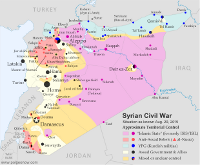
Syrian Civil War Control Map: September 2015 (Subscription)

There are newer versions of this map available. To see them, view all Syria updates.

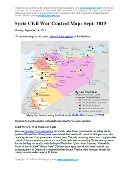
Map of fighting and territorial control in Syria's Civil War (Free Syrian Army rebels, Kurdish YPG, Al-Nusra Front, Islamic State (ISIS/ISIL), and others), updated for September 2015. Highlights recent locations of conflict and territorial control changes, such as Abu Duhur airbase, Qadam district, Mansoura, Marea, and more.

Subscribe for full access to all conflict map reports!

Download PDF:
Buy now

Research by Djordje Djukic, with additional reporting by Evan Centanni

Anti-government rebels in Syria, including fighters from the Al Qaeda-affiliated Nusra Front, have further consolidated their control of Idlib province in the country’s northwest. Meanwhile, forces of the “Islamic State” are again occupying parts of the capital city, Damascus, even as they besiege several other locations in Syria.

See all this and more on the newest update to PolGeoNow’s concise, professional-quality Syrian Civil War control map, which includes a timeline of changes since our previous Syria map report last month.

This map and report are professional subscriber content, available to paid members or for separate purchase. Download PDF (US$19.99)

Want to see before you buy? Check out our most recent FREE SAMPLE Syria map!

Exclusive map report includes:

  • Up-to-date map of current territorial control in Syria, color-coded for the Assad government, rebel groups, “Islamic State” (ISIS/ISIL) extremists, and Kurdish YPG forces. Special symbol indicates rebel-held towns dominated by Al Qaeda affiliate Jabhat al-Nusra (the Nusra Front).
  • Detailed indication of city-by-city control, highlighting key towns and other locations important to current events.
  • Locations of recent fighting and military operations, including Abu Duhur airbase, Marea, Qadam district, Mansoura, and more.
  • Detailed timeline of important events and changes to territorial control since August 20, 2015, compiled by our Syria-Iraq expert, with links to sources.

MEMBERS CLICK HERE TO PROCEED TO ARTICLE AND MAP

Not a member yet? Click here to learn more about our professional subscription service!

War in Libya: Map of Control in August 2015

There are newer versions of this map available. To see them, view all Libya updates.

This is the first of a series of professional Libya control maps. Secure your access to future updates: sign up now for our conflict map subscription service!
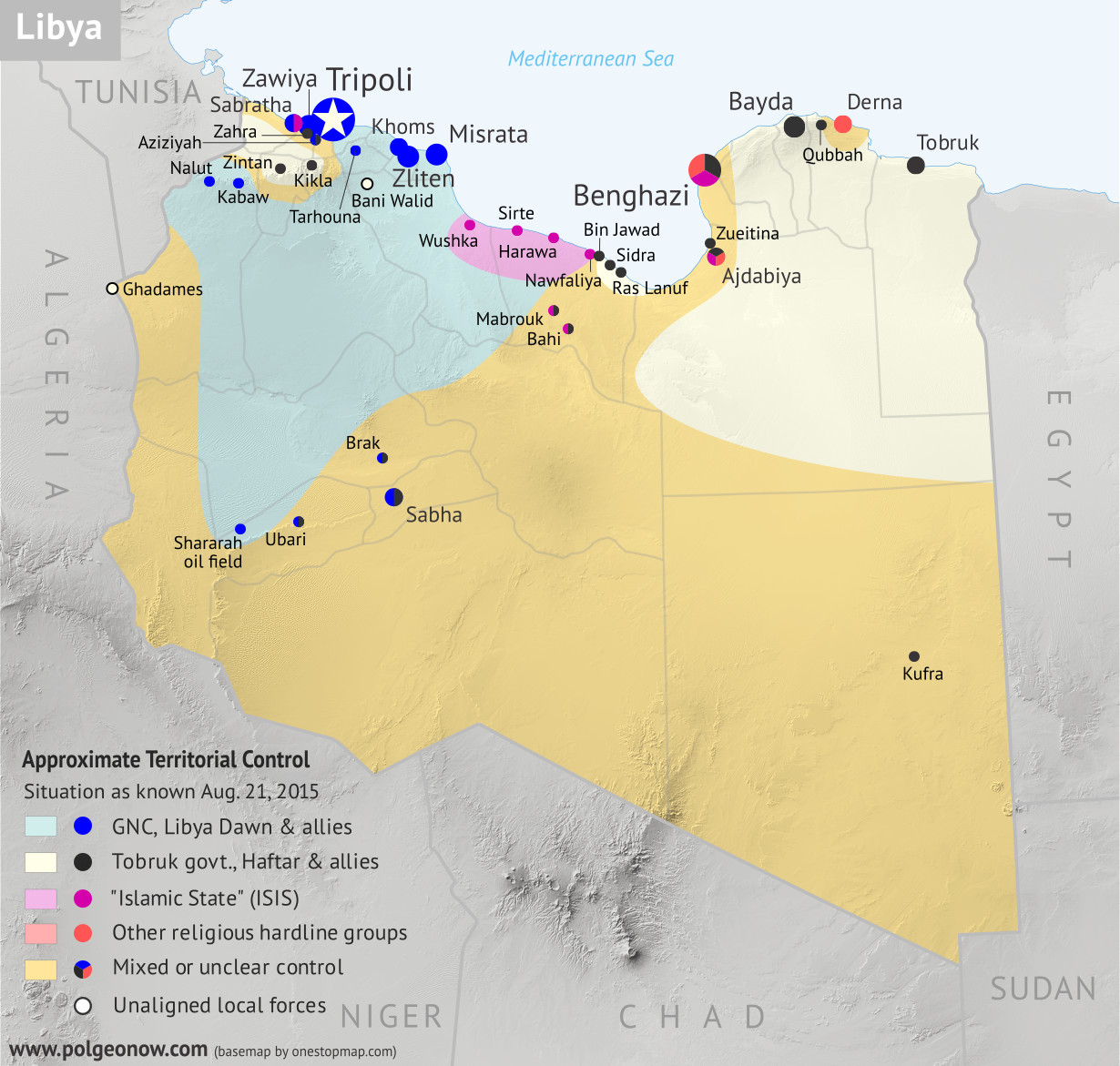
Libya control relief map: Shows detailed territorial control in Libya's civil war as of August 2015, including all major parties (Tobruk government, General Haftar's Operation Dignity forces, and Zintan militias; Tripoli GNC government, Libya Dawn, and Libya Shield Force; Shura Council of Benghazi Revolutionaries and other hardline Islamist groups; and the so-called Islamic State). Also file under: Map of Islamic State (ISIS) control in Libya.
Base map by Koen Adams of onestopmap.com, with territorial control by Evan Centanni. All rights reserved.

Subscribers click here to view this article in the ad-free members area. Not a member yet? Subscribe now! 

Background summary by Djordje Djukic; timeline by Evan Centanni and T.H.

Included in this free article:

  • Concise summary of events in Libya since the fall of Muammar Gaddafi in 2011
  • Detailed timeline of conflict, changes to territorial control, and political events since 2011, with each mentioned location illustrated on the map above

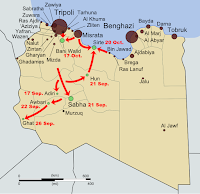
Map showing the final stage of Libya's first civil war (aka the Libyan Revolution) in 2011
The final stage of Libya’s first civil war

Historical Summary: From Revolution to Second Civil War
The Libyan Civil War started with opposition protests against the rule of Muammar Gaddafi, lasting from 15 February through 23 October 2011 and ending with the death of Gaddafi and the victory of pro-opposition forces.

Despite initial claims by opposition activist groups that 30,00050,000 people were killed, most of them civilians whose deaths were caused by Gaddafi’s forces, the estimates were afterwards reduced greatly. A later official estimate established that only 4,700 rebels and their supporters and a similar number of Gaddafi loyalists were killed. An additional 2,100 people were missing, and the number for civilian fatalities was not given, but was no longer claimed to be in the tens of thousands.

Following the end of the war, an interim government was formed in November 2011, and the first public elections took place in January of 2012. However, what followed was a country-wide breakdown of law and order as former rebel groups seized local power in individual places. Many of these groups refused to pledge allegiance to a unified military command, instead reporting to local military councils that became de facto local governments. The rival militias frequently clashed with each other over territory, while vigilante revenge killings and looting and robbery of the civilian population also took place. In addition, 7,000 people  accused of being Gaddafi supporters, mostly civilians (including women and children), remained imprisoned and were subjected to torture. A pro-Gaddafi armed group called the Green Resistance also sprung up conducting hit-and-run attacks against the former rebel groups.

Weapons proliferation also became an issue, with many former Gaddafi-era weapons stockpiles being plundered. This influx of weapons into private hands had effects ranging far beyond Libya’s borders, contributing to the strength of separatists who took over northern Mali in 2012, as well as the religious extremist fighters who soon usurped the separatist revolution. before being beaten back by a French intervention.

During this time, religious radicalism was on the rise in Libya, and on September 11, 2012, extremists attacked the US consulate in Benghazi, killing four Americans. Among the dead was the United States ambassador, Christopher Stevens, as well as two CIA agents.

On 23 December, 2013, the General National Congress (GNC), the legislative authority of Libya elected in July 2012, unilaterally extended its mandate by one year based on one interpretation of the 2011 Constitutional Declaration. Thus they refused to hold new elections that had been expected to happen in January 2014. Following this, public protests against the GNC took place, and General Khalif Haftar proclaimed the dissolution of the GNC. Discontent with the GNC stemmed from it allegedly being dominated by religious conservatives, suppression of inconvenient debates, imposition of gender segregation, and pushes for the introduction of Islamic law as the official basis for national law.

On the morning of 16 May, 2014, general Haftar’s forces attacked religious hard-line militias in and around Benghazi, ultimately sparking what some now call the Second Libyan Civil War. On 25 June, new legislative elections were held for the Council of Deputies (also known as the House of Representatives). Nationalists and liberals won the majority of the seats in the elections. However, a religious conservative block calling itself the new GNC, and made up of politicians who were on the loosing side of the elections, took advantage of support from a coalition of militias known as Libya Dawn to take control of Libya’s capital city of Tripoli. Subsesequently, the newly-elected Council of Deputies moved its seat of power to the eastern city of Tobruk and gained the backing of Haftar’s part of the Libyan National Army.

Over the following year, the GNC set up its power base in the western part of the country, controlling Tripoli, Misrata, Zliten and several other towns. The internationally-recognized Council of Deputies established itself in the east and south of the country, with its de facto capital in Tobruk and control over most of the country’s oil fields. Allied forces also controlled a string of towns in the mountains southwest of Tripoli. A force of Tuareg fighters reportedly allied with Libya Dawn took control of the southwestern sliver of Libya, while contesting the area’s largest town of Sabha with Tebu fighters aligned with the Tobruk government. Local forces took control of the former Gaddafi stronghold of Bani Walid, among unconfirmed allegations that the town’s new administration was made up of Gaddafi loyalists.

Map of the territorial control (Baghdad government, Islamic State/ISIS/ISIL, and Kurdistan peshmerga) in Iraq as of May 2015
Recent map of “Islamic State” control in Iraq, the organization’s home country

The Shura Council of Benghazi Revolutionaries, a coalition of radical religious militias, took control of the eastern Libyan town of Derna and continued contesting Benghazi with Haftar’s “Operation Dignity” forces. During this time, Libya also saw the entry of the so-called “Islamic State” (a.k.a ISIS), which also initially set itself up in Derna, but was pushed out by the Shura Council. It then took control of the north-central city of Sirte, Gaddafi’s hometown, and its surrounding area, after evicting GNC forces. Egypt and the United Arab Emirates conducted airstrikes on several occasions against both the GNC forces and IS fighters, in support of the Tobruk government, while Qatar and Turkey gave their support to the GNC.

Overall, between January 1, 2014, and July 21, 2015, one estimate said that 3,934 people had been killed in violence throughout the country. The multi-sided conflict continues today despite multiple attempts to strike a peace deal between the rival governments.

CHRONOLOGY OF EVENTS
The following is a detailed timeline of important events related to conflict, territorial control, and politics in Libya from 2011 to the present.

Part I: An Unstable Peace

2011.10.24 The former rebels of the National Transitional Council declared the Libyan Revolution complete, after defeating the forces of former national leader Muammar Gaddafi, receiving recognition from the UN as Libya’s legitimate government, and finally tracking down and killing Gaddafi himself. The civil war had lasted about eight months, resulted in thousands of deaths, and left the country in control of a patchwork of local militias.

2012.01.23-25 Local fighters took control of Bani Walid, once a Gaddafi stronghold, after a dispute with revolutionary government forces. A ceasefire deal recognized the local groups as the legitimate administration of the town.

2012.09.11 A pair of attacks in Benghazi , later attributed to the religious extremist group Ansar al-Sharia, killed the US ambassador and three other US personnel.

2012.10.24 Government forces and fighters from Misrata seized control of Bani Walid from local forces after a series of aggressions between rival militias from the two towns.

2013.06.08-15 Clashes erupted between pro-government forces and opposing groups in Benghazi.

2013.07-08  Government-appointed oil security chief Ibrahim Jathran went rogue, using his forces to seize control of the Ras Lanuf and Sidra oil export terminals while advocating for a decentralized government and eastern autonomy. At some point, the Zueitina oil terminal and Tobruk’s Hariga oil terminal also came under the control of Jathran’s rebels.

2013.10.10 Libya’s prime minister, Ali Zeidan, was briefly kidnapped, in what he afterwards called an attempted coup.

2013.10 By the end of October, Libya’s crucial oil industry had been brought nearly to a standstill, as a variety of opposition fighters and protesters from around the country blocked key infrastructure sites from operating.

2013.11.03 A collection of important officials unilaterally declared the formation of an autonomous government for eastern Libya, called Barqa in Arabic, or Cyrenaica by its traditional English name. The movement boasted the support of Ibrahim Jathran and his oil port blockade.

2013.11.21 Various militias, still operating in Tripoli since the revolution, agreed to leave the capital city and allow the government to assume control.

2014.01.18-29 During clashes in Sabha, fighters described as Gaddafi loyalists captured a military base before being driven out by government forces over a week later (ACLED).

2014.02.14 Major General Khalifa Haftar of the Libyan army declared the government “suspended” after the parliament’s religious conservative majority voted to make sharia the basis of national law, while also extending its own term another year. However, Haftar’s coup claim would be ignored by the government for the next several months. 
Flag of Libya (2011-present)Country Name:  
• Libya (English)
• Lībyā (Arabic)
Official Name:  
• State of Libya (English)
Dawlat Lībyā (Arabic) 
Capital: Tripoli (official); Tobruk (de facto HQ of UN-recognized government)

2014.03.11 Eastern separatists briefly took over the Sirte airport and a military base before government troops regained control (ACLED).

2014.03 Rebel leader Ibrahim Jathran attempted to sell a shipment of oil from one of the ports his Cyrenaican rebels controlled, only for the ship to be seized by US Navy forces near Cyprus and returned to the Libyan government. Meanwhile, the parliament ousted Prime Minister Ali Zeidan for failing to prevent the ship from leaving the rebel-held port, replacing him with Abdullah al-Thani.

2014.04.07 Jathran’s eastern rebels returned the Zueitina and Hariga (Tobruk) oil terminals to government hands as part of a political deal.

Part II: Return to War

2014.05.16-19 In what some describe as the beginning of Libya’s second civil war, rogue general Khalifa Haftar‘s “Libyan National Army” began what he called “Operation Dignity”, attacking several religiously conservative militias associated with the governing coalition in Tripoli. An attack in Benghazi was followed days later by the storming of the parliament in Tripoli. Meanwhile, a military base in the eastern city of Tobruk pledged its allegiance to Haftar’s army. In the following days, Haftar would gain the support of much of the military and about a third of the parliament.

2014.06.02 Renewed fighting broke out in Benghazi between Haftar’s forces and powerful religious militias nominally allied with the government in Tripoli. The struggle for control of the major eastern city would continue for over a year.

2014.06.03 Ahmed Maiteeq assumed the position of prime minister after a disputed parliamentary vote to oust al-Thani. Maiteeq was escorted into the office by the Libyan Central Shield, a religious conservative militia from Misrata, against the orders of al-Thani. Maiteeq would step down six days later after his election was ruled unconstitutional by Libya’s supreme court.

2014.06.25 In a UN-backed bid to de-escalate the political crisis, the parliament decided to call new elections, rather than follow through with its controversially extended term. Voter turnout was low, and the results would not be officially announced until nearly a month later.

2014.07.02 Ibrahim Jathran’s rebels returned the Ras Lanuf and Sidra oil terminals to the control of Prime Minister al-Thani’s government.

2014.07.13 With religious conservative candidates believed to have performed poorly in the June election, the Libyan Central Shield and an allied conservative militia launched “Operation Libya Dawn”, a battle for control of the Tripoli airport (held by the Haftar-alllied Zintan Brigades). The battle would continue for more than a month, while the conservative coalition would grow progressively larger, gain the support of the Muslim Brotherhood, and come to call itself “Libya Dawn” after the name of its inaugural mission.

2014.07.21 The results of the June election were announced, giving secular delegates a majority over the religiously-oriented coalition that had dominated the previous parliament.

2014.07.31 The Shura Council of Benghazi Revolutionaries, a new coalition of hardline religious militias including Ansar al-Sharia, the group linked to the 2012 US embassy attack, reportedly took control of most of Benghazi from Haftar’s forces. This came a day after Ansar al-Sharia declared Benghazi to be an “Islamic emirate” (a traditional word for a Muslim principality). The group was also said to control of the nearby town of Ajdabiya.

2014.08.04 The newly-elected parliament convened for the first time. Because of ongoing battles in Tripoli and Bengazi, the new government instead met in the far-eastern city of Tobruk, a stronghold of General Haftar. The new government would come to be permanently based out of Tobruk and nearby Bayda. The parliament would at one point be based aboard a rented ferry docked at Tobruk’s port, while the number of representatives in attendance would decline to just 115 out of 200 members by September.

2014.08.13 The new Libyan parliament voted to revoke official sponsorship from all regional militias, including both sides involved in the battle for the Tripoli airport.

2014.08.19-20 The western towns of Nalut and Kabaw, followed by Tarhouna, rejected the authority of the new eastern-based parliament, declaring their support for the Libya Dawn forces besieging Tripoli’s airport. Representatives from major western towns including Misrata, Khoms, and Zliten also expressed opposition to the new parliament.

2014.08.23 Despite enduring airstrikes of mysterious origin, Libya Dawn forces attained full control of the Tripoli airport, after more than a month of on-and-off fighting that virtually destroyed the facility. A day later, they reportedly controlled the entire city of Tripoli, where they called for the previous, conservative-dominated parliament, known as the General National Congress (GNC), to return to power.

2014.09.01 A week later, the GNC parliament had partially reconvened in Tripoli with the support of Libya Dawn, and appointed its own prime minister, Omar al-Hassi. Hassi would be a direct rival to Abdullah al-Thani, who had been once again chosen to lead by the new parliament in Tobruk. The Haftar-backed parliament in Tobruk remained the UN-recognized government of Libya, while the competing parliament in Tripoli would have the support of militias controlling much of the country.

Map of the territorial control (Assad government, Islamic State/ISIS/ISIL, rebel, and Kurdish) in the Syrian Civil War as of August 2015
Map of IS Control in Syria, Aug. 2015
(click for subscriber article and map).

2014.10.06 A hardline religious militia, in control of the eastern city of Derna, pledged allegiance to the “Islamic State” group of Iraq and Syria. An “Islamic emirate” had already been declared in the town the previous month.

2014.10.29 Pro-Tobruk forces claimed to be in control of most of Benghazi, after weeks of renewed heavy fighting (ACLED).

2014.11.05-07 Libya Dawn-backed Tuareg fighters, with help from Misrata, captured the Shararah oil field in southwestern Libya from pro-Tobruk militias (ACLED).

2014.11.22 Haftar-backed fighters from the Tebu ethnic group drove Libya Dawn out of southern Libya’s Ubari region (ACLED). However, fighting would flare up again the next year between pro-Tobruk Tebu fighters and pro-Tripoli Tuareg militias.

2014.11.23 Tobruk-aligned fighters from Zintan reportedly captured the western mountain town of Kikla after more than a month of battles against other regional militias associated with Libya Dawn (ACLED).

2014.12.13 Omar al-Hassi’s Tripoli-based government backed a new Libya Dawn operation to capture the Ras Lanuf and Sidra oil terminals from Ibrahim Jathran’s militias, now allied with the al-Thani government in Tobruk.

2014.12.08-10 Forces of General Haftar’s Libyan National Army (LNA) captured two towns west of Zawiya, but Libya Dawn soon pushed them back again (ACLED).

2014.12.19 A Libya Dawn-oriented Misratan militia seized Brak airbase (but not the rest of the town), located in southern Libya (ACLED).

Part III: The War in 2015

2015.01.07 The “Islamic State” organization (IS) based in Iraq and Syria officially established a branch in Libya, after one militia in Derna declared allegiance to IS in October (ACLED).

2015.01.10 UN-backed negotiations to be held in Geneva regarding the conflict in Libya were announced to include representatives from the Tripoli parliament and the allied Libya Dawn militias as well as General Haftar’s Operation Dignity forces.

2015.01.16 Libya Dawn (GNC) declared a ceasefire with Tobruk-aligned forces in the lead-up to peace talks in Geneva the following week.

2015.01.22 Forces allied with General Haftar and the Tobruk government seized the central bank in Benghazi.

2015.01.24 Ansar al-Sharia leader Mohamed al-Zahawi was killed in Benghazi clashes.

2015.01.27 IS-affiliated gunmen attacked the Corinthia Hotel in Tripoli; fighters loyal to the GNC Tripoli government fought back against the gunmen.

2015.02.04 An oil field in Mabrouk, one of Libya’s largest, was stormed by alleged IS militants.

2015.02.08 IS-aligned fighters claimed to have captured Nawfaliya, a town near Sidra oil terminal, in fighting with Libya Dawn forces. Over the next few months, control the town would apparently go back and forth between the two groups (ACLED).

2015.02.11 UN-backed peace talks were held in Ghadames, with the aim of forming a unified government between the General National Congress of Tripoli and the Tobruk-based House of Representatives.

2015.02.11-13 Fighters claiming to be IS members moved into the city of Sirte, seizing parts of the city without resistance (ACLED).

2015.02.20 IS-affiliated militants detonated car bombs in Qubbah, in what was believed to be retaliation to airstrikes by the Egyptian military on nearby IS-controlled Derna.

2015.03.02 The Tobruk parliament appointed General Haftar the official commander of the Libyan armed forces.

2015.03.03 The Mabrouk and Bahi oil fields were reported seized by religious extremist fighters, possibly from IS.

2015.03.06 Representatives from Tobruk and Tripoli met in Morocco for another round of UN-brokered peace talks, with additional sessions planned in Algeria and Belgium.

2015.03.11 It was reported that fighters from Haftar’s pro-Tobruk army had captured several towns just south and west of Tripoli (ACLED).

2015.03.24 Islamic State militants attacked government soldiers in Sirte and Benghazi, killing fighters loyal to both the Tripoli government and the internationally recognized government in Tobruk.

2015.03.27 Libya Dawn fighters loyal to the GNC government in Tripoli reportedly withdrew from positions near Ras Lanuf and Sidra oil ports, which they had been trying to capture from the Tobruk-aligned oil security forces. They initially claimed to still be in control of nearby Bin Jawad, but the Tobruk government was soon reported to have retaken the town after Libya Dawn fighters withdrew.

2015.04.01 Libya Dawn aircraft reportedly bombed an airport in Zintan.

2015.04.05 Pro-Tobruk forces claimed control of western town of Aziziyah, after two days of clashes with Libya Dawn militias (ACLED).

2015.04.12 Unidentified militants attacked South Korea’s embassy in Tripoli.

2015.04.13 IS-affiliated militants attacked the Moroccan embassy in Tripoli.

2015.04.18 Libya Dawn forces in two suburbs of Tripoli confronted General Haftar sympathizers there.

2015.04.22 Libya Dawn militias withdrew from the town of Zahra, near Tripoli, after clashes with Haftar’s LNA forces (ACLED).

2015.05.29 IS militants seized the airport in Sirte (Ghardabiya Airbase).

2014.05.31 IS fighters reportedly took control of Hawara town near Sirte after local leaders surrendered to a week-long siege (ACLED).

2015.06.09 IS fighters captured a power station in Sirte, virtually completing their control of the town (ACLED).

2015.06.09-11 The forces of IS were pushed out of Derna after a falling-out with other hardline religious militias.

2015.07.05 Hardline militia Ansar al Sharia captured a neighborhood in Benghazi from Haftar’s Tobruk-aligned Operation Dignity forces.

2015.07.12 IS fighters captured Wushka village in a push towards Libya Dawn-dominated Misrata (ACLED).

2015.07.27 A spokesperson for the Tobruk government claimed that “all the oil fields” in Libya were under the control of his government’s military. No specific information was given on the Mabrouk and Bahi fields, which were captured by likely IS fighters in March.

2015.07.31 Shura Council forces in Derna forced IS fighters out of an area just south of Derna.

2015.08.01 Fighting was reported between the Tobruk-loyal military and IS forces in Ajdabiya (ACLED).

2015.08.08-09 Shura Council religious hardliners from Derna – reportedly with air support from the Tobruk-based military – battled with IS fighters just south of the city (ACLED).

2015.08.13 Sudanese rebels groups from that country’s Darfur region were alleged to be fighting on the side of General Haftar in Kufra (ACLED).

2015.08.10-15 A local group in Sirte, cheered on by ultraconservative religious leaders, rose up against IS control of the city, leading to several days of fighting (ACLED).

2015.08.14-15 IS forces claimed to have captured an army post in Benghazi, but were repelled the next day by Haftar’s army (ACLED).

Following this story? View all Libya maps on PolGeoNow.

Graphic of Libyan flag is in the public domain (source).

Syrian Civil War Control Map: August 2015 (Subscription)

There are newer versions of this map available. To see them, view all Syria updates.

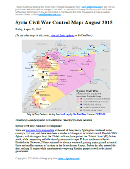
Map of fighting and territorial control in Syria's Civil War (Free Syrian Army rebels, Kurdish YPG, Al-Nusra Front, Islamic State (ISIS/ISIL), and others), updated for August 2015. Highlights recent locations of conflict and territorial control changes, such as Ayn Issa, Sarrin, Hasakah, Mansour, Frikka, Elbeyli, Qaryatain, and more.

Download PDF:
Buy now

(Subscribe via Paypal to view all premium content online)

Research by Djordje Djukic, with additional reporting by Evan Centanni

Since the end of June, the borders of the so-called “Islamic State” (IS) have changed significantly in Syria, with Kurdish advances from the north and IS pushes into the country’s west. Meanwhile, rebels continue to struggle with the Assad government for dominance over the country’s remaining territory.

See all this and more on the newest update to PolGeoNow’s professional Syrian Civil War control map, which includes a timeline of changes since our previous Syria map report at the end of June.

This map and report are professional subscriber content, available to paid members or for separate purchase. Download PDF (US$19.99)

Want to see before you buy? Check out our most recent FREE SAMPLE Syria map!

Exclusive map report includes:

  • Up-to-date map of current territorial control in Syria, color-coded for the Assad government, rebel groups, “Islamic State” (ISIS/ISIL) extremists, and Kurdish YPG forces. Special symbol indicates rebel-held towns dominated by Al Qaeda affiliate Jabhat al-Nusra (the Nusra Front).
  • Detailed indication of city-by-city control, highlighting key towns and other locations relevant to current events.
  • Locations of recent fighting and military operations, including Ayn Issa, Sarrin, Hasakah, Mansour, Frikka, Elbeyli, Qaryatain, and others
  • Detailed timeline of important events and changes to territorial control since June 29, 2015, compiled by our Syria-Iraq expert, with links to sources.

MEMBERS CLICK HERE TO PROCEED TO ARTICLE AND MAP

Not a member yet? Click here to learn more about our professional subscription service!

Yemen’s Civil War: Map of Control in August 2015 (Subscription)

There are newer versions of this map available. To see them, view all Yemen updates.

Map of territorial control in Yemen as of August 14, 2015, during Saudi Arabia's military intervention, including territory held by the Houthi rebels and former president Saleh's forces, president-in-exile Hadi and the Southern Movement, and Al Qaeda in the Arabian Peninsula (AQAP). Includes recent areas of fighting, such as Houta, Al-Anad Airbase, Dhale, Ibb, Ataq, and more.

Download PDF:
Buy now

(Subscribe via Paypal to view all premium content online)

Timeline by Djordje Djukic, with additional reporting by Evan Centanni; map by Louis Martin-Vézian and Evan Centanni

Yemen’s Houthi revolutionary government, despite support from Iran, is rapidly losing ground against the fighters aligned to President Hadi, and supporting forces from Saudi Arabia and the United Arab Emirates. 

A long list of towns have changed hands just within the last two weeks, and Al Qaeda is on the move as well. See all this and more on the newest update to PolGeoNow’s Yemen territorial control map, which includes a timeline of changes since our previous Yemen map report in July.

This map and report are exclusive premium content, available to paid subscribers or for individual purchase.
Download PDF (US$14.99)

Want to see before you buy? Check out our most recent FREE SAMPLE Yemen map report!

Exclusive map report includes:

  • Up-to-date map of current territorial control in Yemen, color-coded for the Hadi coalition, Houthi/Saleh forces, and Al Qaeda in the Arabian Peninsula (AQAP).
  • Detailed indication of town-by-town control, including provincial boundaries, all major cities, and many smaller ones
  • Markers for key areas of recent fighting such as Houta, Al-Anad Airbase, Utmah, Ibb, Rabat, Lawdar, Bayda, Ataq, and more
  • Timeline of changes to the situation since the end of July, with links to sources

MEMBERS CLICK HERE TO PROCEED TO ARTICLE AND MAP

NOT A MEMBER YET? SUBSCRIBE NOW!

New Olympic Nation: South Sudan (Map)

Paid subscribers click here to view this article in the ad-free members area. Not a member yet? Subscribe now!

World map showing the five continental associations of National Olympic Committees. Shows all Olympic nations, and labels the two newest as of August 2015, Kosovo and South Sudan.
Map of all nations in the Olympics, and their regional associations. Two newest Olympic nations labeled.
Map by Evan Centanni, starting from this blank map and modeled after this map.

By Evan Centanni

In the Olympics at Last
Last weekend, South Sudan was officially recognized by the International Olympic Committee (IOC), the organization in charge of organizing the Olympic Games. The recently independent country, located in east-central Africa, will participate in the 2016 Olympics in Rio de Janeiro, Brazil.

See Also: Which Countries Are (and Aren’t) in the Olympics? (2014)

Flag of South SudanCountry Name:  
• South Sudan
Official Name:  
• Republic of South Sudan
Capital: Juba
(There are about 60 recognized national languages in South Sudan, but English is the country’s only “official working language”.)

South Sudan became independent and joined the UN in 2011, but for the last four years has been left out of the Olympics, apparently because it did not yet have a functioning national Olympic committee (NOC). But even though the country did not have an official team at the 2012 Olympics in London, one South Sudanese runner did attend those games as a specially-approved independent athlete.

The emergence of South Sudan’s NOC has come despite the country being locked in an ongoing civil war since 2013.

Other Newcomers
South Sudan is now one of 206 official Olympic nations, and the first new IOC member since disputed Kosovo was controversially admitted last December. Prior to South Sudan and Kosovo’s admissions, the newest Olympic members were Montenegro and Tuvalu, which both joined in 2007. Like South Sudan now, Montenegro was newly independent at that time.

You may also like: 
Which Countries Are (and Aren’t) in the Olympics?
Is South Sudan a member of FIFA?
All South Sudan articles on PolGeoNow

Graphic of the South Sudanese flag is in the public domain (source).
Yemen’s Civil War: Map of Control in July 2015 (Subscription)

There are newer versions of this map available. To see them, view all Yemen updates.

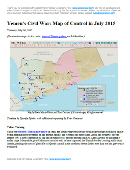
Map of territorial control in Yemen as of July 29, 2015, during Saudi Arabia's military intervention, including territory held by the Houthi rebels and former president Saleh's forces, president-in-exile Hadi and the Southern Movement, and Al Qaeda in the Arabian Peninsula (AQAP). Includes recent areas of fighting, such as Aden, Sabr, Al-Anad Airbase, Wadiah crossing, Marib, and more.

Download PDF:
Buy now

(Subscribe via Paypal to view all premium content online)

Timeline by Djordje Djukic, with additional reporting by Evan Centanni; map by Louis Martin-Vézian and Evan Centanni

In the past month, Yemen’s Saudi-backed resistance forces have finally begun making inroads against the Houthis, capturing a major southern city while also extending their control to the northern border with Saudi Arabia.

See all this and more on the newest update to PolGeoNow’s Yemen territorial control map, which includes a timeline of changes since our previous Yemen map report in June.

This map and report are exclusive premium content, available to paid subscribers or for individual purchase.
Download PDF (US$14.99)

Want to see before you buy? Check out our most recent FREE SAMPLE Yemen map report!

Exclusive map report includes:

  • Up-to-date map of current territorial control in Yemen, color-coded for the Hadi government, Houthi/Saleh forces, and Al Qaeda in the Arabian Peninsula (AQAP).
  • Detailed indication of town-by-town control, including provincial boundaries, all major cities, and many smaller ones
  • Markers for key areas of recent fighting such as Aden, Al-Anad, Sabr, Marib, Wadiah border crossing, and more
  • Timeline of changes to the situation since July, compiled by our Yemen specialist, with links to sources

MEMBERS CLICK HERE TO PROCEED TO ARTICLE AND MAP

NOT A MEMBER YET? SUBSCRIBE NOW!

War in Iraq: Map of “Islamic State” Control in July 2015 (Subscription)

There are newer versions of this map available. To see them, view all Iraq updates.

Detailed map of territorial control in Iraq as of July 23, 2015, including territory held by the so-called Islamic State (ISIS, ISIL), the Baghdad government, and the Kurdistan peshmerga. Includes recent flashpoints including Ramadi, Baiji, Habaniyah, Jalawla, and Walid border crossing.

Download PDF:
Buy now

(Subscribe via Paypal to view all premium content online)

Timeline by Djordje Djukic; map and additional reporting by Evan Centanni

Since May, fighting in Iraq has seen small but potentially important advances by all sides, including the Baghdad government (with Iranian support), the “Islamic State” extremists, and Kurdistan’s peshmerga.

See all this and more on the newest update to PolGeoNow’s Iraq territorial control map, which includes a timeline of changes since our previous Iraq map report in May.

This map and report are exclusive premium content, available to paid subscribers or for separate purchase.
Download PDF (US$14.99)

Want to see before you buy? Check out our most recent FREE SAMPLE Iraq map report!

Exclusive map report includes:

  • Up-to-date map of current territorial control in Iraq, color-coded for the Iraqi government, “Islamic State” (ISIS/ISIL) extremists, and Kurdish peshmerga forces
  • Detailed indication of town-by-town control, including provincial boundaries, all major cities, and many smaller ones
  • Markers for key areas of recent fighting such as Baiji, Ramadi, Husaybah, Walid border crossing, and more
  • Timeline of changes to the situation since May, compiled by our Iraq specialist, with links to sources

MEMBERS CLICK HERE TO PROCEED TO ARTICLE AND MAP

NOT A MEMBER YET? SUBSCRIBE NOW!

Paraguay’s Subtle Flag Change

Sometimes geopolitical changes make headlines, but other times they slip quietly under the radar. In particular, small modifications to national flags often fail to make the news. To make sure you don’t miss anything, here’s a report on one such flag change that even we discovered only recently.

Premium members click here to view this article in the ad-free members area. Not a member yet? Subscribe now!

Flag of Paraguay, obverse (front) side, 2013-present
Flag of Paraguay, 2013-present (front)

Flag of Paraguay, reverse (back) side, 2013-present
Flag of Paraguay, 2013-present (back)

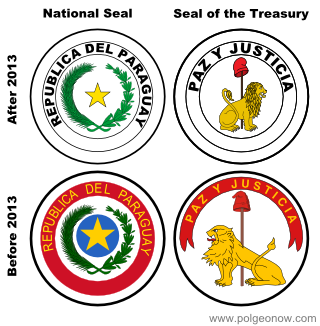
Changes to the Coat of Arms of Paraguay made in 2013, with a comparison of the National Seal and Seal of the Treasury as seen on the Paraguayan flag before and after its changes under the administration of President Federico Franco.
The Coat of Arms of Paraguay
(CC BY-SA; source graphics)

By Olga Rodriguez-Walmisley

2013 Flag Change
On July 15, 2013, Federico Franco, at that time the President of Paraguay, announced that the official seals on both sides of the Paraguayan flag would undergo changes in order to better represent the symbols first chosen for it in 1842. These two seals together make up the national coat of arms of Paraguay.

Franco said the modifications were the result of a long debate and “a consensus that is not often achieved among historians”. There had already been several changes to the seals in the past, especially after the Paraguayan War of 1864-1870, which pitted the country against Brazil, Argentina, and Uruguay.

Changes made to the National Seal
One of the biggest of the 2013 changes was to the ring around the star, where it says “República del Paraguay”. This ring has been red since about 1988, when it was changed under the rule dictator Alfredo Stroessner, whose political party was represented by that color. It is now white. The blue background behind the yellow star has also disappeared, and the text of the phrase “República del Paraguay” has changed from yellow to black.

Changes made to the Seal of the Treasury
On the reverse side of the flag, the roaring lion is now a light ochre (golden) color instead of yellow, the spear behind the lion is brown, while the cap on top of the spear, which according to tradition symbolizes liberty, continues to be red. The inscription “Paz y Justicia” (Peace and Justice) is now black instead of yellow, and the banner behind the inscription has gone from red to white.

Country Name:  
• Paraguay (English, Spanish)
• Paraguái (Guarani)
Official Name:  
• Republic of Paraguay (English)
• República del Paraguay (Spanish)
• Tetã Paraguái (Guarani)  
Capital: Asunción

Other proposed changes
According to Paraguayan Minister of Linguistic Policy Carlos Villagra Marsal, there were also unfruitful efforts to replace the palm frond on the National Seal with a pindo palm, and the olive branch with yerba mate, which would in his opinion have been better national symbols. However, he said the historians preferred to return to the original designs, rather than add entirely new elements to the flag.

The Paraguayan Flag Through History

The Blue Flag as flown under Francia

Since its independence in 1811, Paraguay has had four different major flag designs. The first flag of Paraguay, called “The Blue Flag,” was a royal blue color, with a six-pointed white star in the upper left corner representing the Virgin Mary of Asunción, who is the patron saint and namesake of the country’s capital city. The Blue Flag was in action from May 15th (the day Paraguay became independent from Spain) until June 16th of 1811. In 1826, it was reinstated by President Gaspar Rodríguez de Francia, and used in alternation with the red, white, and blue tricolor until the early 1840’s, when Francia died.

Paraguay’s second major flag design, used from June 17th until August 15th of 1811, was made up of three horizontal stripes of red, yellow, and blue. The red and yellow stripes on the top were taken from the flag of Spain, while the blue stripe on the bottom represented the Virgin Mary of Asunción.

Paraguay's first tricolor flag, of red, gold, and blue. Used in 1811.
Paraguay’s first tricolor flag
(CC BY-SA; source)

The third flag had the same color scheme as the present-day Paraguayan flag: red, white, and blue horizontal stripes. Red represented justice, white peace, and blue liberty. However, in the initial design the middle white stripe was wider than the other two, while the present-day flag sports three equal-width stripes. The early version of the flag was used until September 30th, 1812, when it was modified so that the three stripes were of equal width. The new tricolor was called the “first flag of the Republic”, since 1812 was the year Paraguay declared itself a republic, formally shedding its past as a province of Spain.

The seals of the Paraguayan coat of arms were added to the flag in November of 1842. On the front, the seal of Paraguay: a palm frond and olive branch intertwined at the bottom and open at the top, with a star in the middle, and the inscription “República del Paraguay” (Republic of Paraguay) above. On the reverse side of the flag, the seal of the Department of the Treasury was added: a lion within a circle, with the words “Paz y Justicia” (Peace and Justice) above.

Paraguay’s flag is unique in that the front and back have different designs: Saudia Arabia is the only other UN-recognized country with a national flag whose reverse side is not a mirror of the obverse—but in the case of the Saudi flag, the back side is merely a duplicate of the front side to prevent the flag’s sacred text from being reversed. (Until recently, Moldova’s flag also had a different front and back, but it was changed in 2010 so the two sides are now normal mirror images of each other.)

Graphics of the Paraguayan flag, other than the red, gold, and blue tricolor, are in the public domain (source).

Syrian Civil War Control Map: June 2015 (Subscription)

There are newer versions of this map available. To see them, view all Syria updates.

Map of fighting and territorial control in Syria's Civil War (Free Syrian Army rebels, Kurdish groups, Al-Nusra Front, Islamic State (ISIS/ISIL), and others), updated for late June 2015. Highlights recent locations of conflict and territorial control changes, such as Palmyra, Ariha, Tel Abyad, Ayn Issa, and Hasakah, Kobani, and Suwayda.

Download PDF:
Buy now

(Subscribe via Paypal to view all premium content online)

Research by T.H., with additional reporting by Evan Centanni

Since late May, rebels have consolidated their power in Syria’s northwest, Kurdish forces have extended their control across most of the border with Turkey, and the Islamic State continues advancing in the direction of Damascus.

See all this and more on the newest update to PolGeoNow’s popular Syria control map, which includes a timeline of changes since our previous Syria map report in May.

This map and report are exclusive premium content, available to paid subscribers or for separate purchase.
Download PDF (US$19.99)

Exclusive map report includes:

  • Up-to-date map of current territorial control in Syria, color-coded for the Assad government, rebel groups, Islamic State (ISIS/ISIL) extremists, and Kurdish YPG forces. Special symbol indicates rebel-held towns dominated by Al Qaeda affiliate Jabhat al-Nusra.
  • Detailed indication of city-by-city control, highlighting key towns and other locations relevant to current events.
  • Locations of recent fighting and military operations, including Tel Abyad, Ayn Issa, Hasakah, Kobani, Palmyra, Ariha, Suwayda, and more.
  • Timeline of important events and changes to territorial control since May 24, 2015, with links to sources.

MEMBERS CLICK HERE TO PROCEED TO ARTICLE AND MAP

NOT A MEMBER YET? SUBSCRIBE NOW!

Yemen’s Civil War: Map of Control in June 2015

There are newer versions of this map available. To see them, view all Yemen updates.

This is part of a series of Yemen maps and infographics created in collaboration between PolGeoNow and CIGeography. Part 1 was the Map & Infographic of Foreign Military Deployments in Yemen, and Part 2 was War in Yemen: Map of Territorial Control (April 2015).

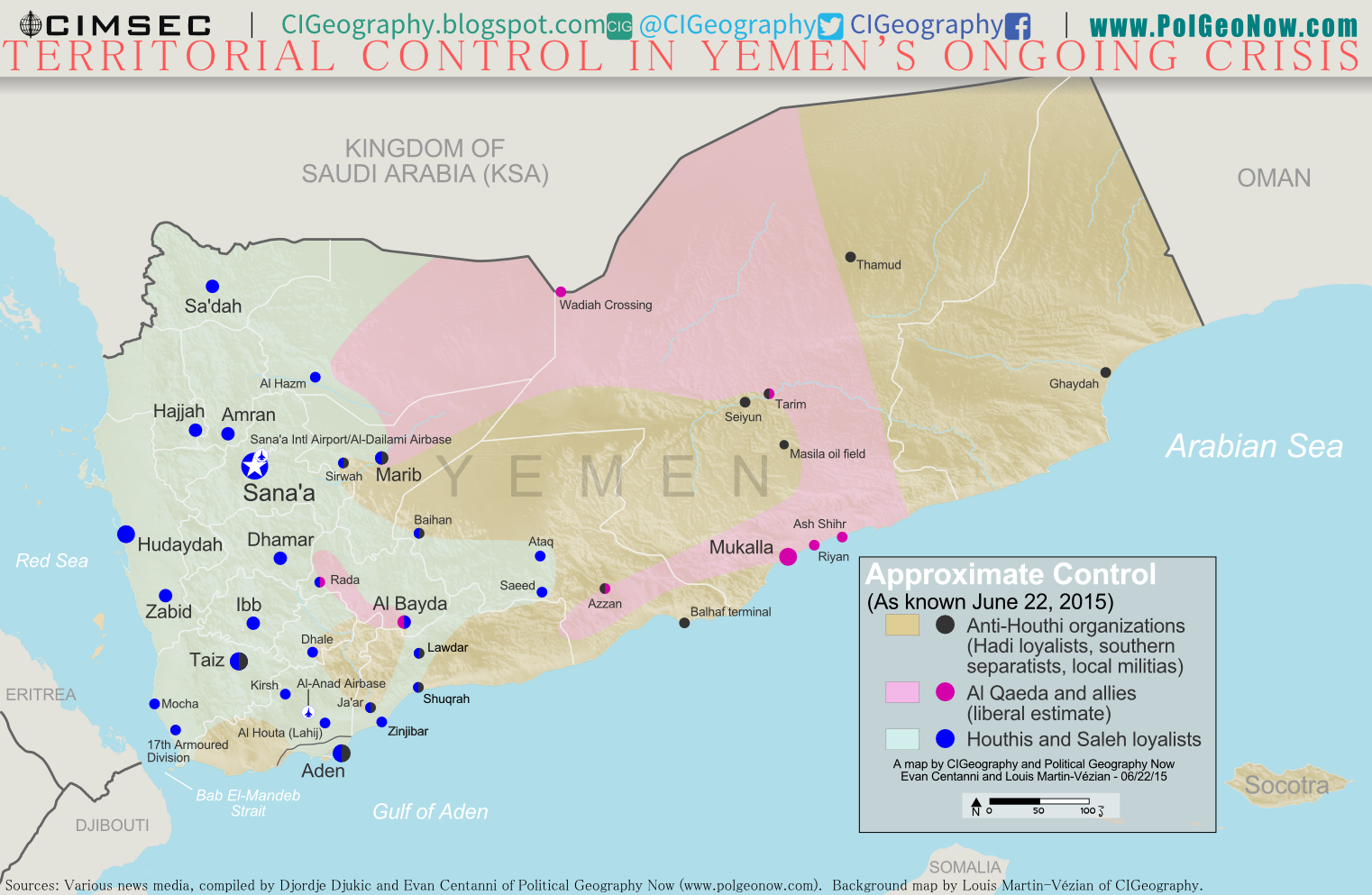
Map of territorial control in Yemen as of June 22, 2015, about two months into Saudi Arabia's military intervention, including territory held by the Houthi rebels and former president Saleh's forces, president-in-exile Hadi and the Southern Movement, and Al Qaeda in the Arabian Peninsula (AQAP).
Map by Louis Martin-Vézian and Evan Centanni (click to enlarge). All rights reserved.

Subscribers click here to view this article in the ad-free members area. Not a member yet? Subscribe now!

Timeline by Djordje Djukic, with additional reporting by Evan Centanni

Houthi Control Spreading Despite Saudi Airstrikes
Since our previous Yemen control map update in early April, Saudi Arabia and its coalition partners have continued their air and sea campaign in support of the ousted Yemeni government of President Abd Rabbuh Mansur Hadi, supported by parts of the Yemeni military and allied local and southern forces. But two months into the intervention, their opponents, the northern Houthi rebels and forces loyal to former president Ali Abdullah Saleh, have continued to expand eastward. Meanwhile, Al Qaeda fighters have consolidated their control in parts of eastern Yemen, and the port city of Aden is still divided by frequent battles.

See Also: CIGeography infographic on foreign military activity in Yemen 

Flag of YemenCountry Name:  
• Yemen (English)
• Al-Yaman (Arabic)
Official Name:  
• Republic of Yemen (English)
al-Jumhūriyyah al-Yamaniyyah (Arabic) 
Capital: Sana’a

Chronology of Events
The following is a timeline of major political events and changes to territorial control since PolGeoNow’s April 3 Yemen control map report.

April 4, 2015
Hadi troops, reinforced by Saudi weapons drops, pushed back the Houthis from the Crater district in Aden.

April 5, 2015
The Houthis advanced into the central Mualla district of Aden, capturing the provincial headquarters. Also, fighting in the Houthi-held city of Lawdar (Loder) left 24 people dead, including 21 Shiite militiamen.

April 7, 2015
The Hadhramout Tribal Alliance and pro-Hadi militiamen claimed to recapture Mukalla from Al Qaeda in the Arabian Peninsula (AQAP), but residents reported Al Qaeda was still in control of around half of the town. In addition, AQAP militants captured Wadiah border crossing with Saudi Arabia, killing two soldiers.

April 9, 2015
Houthi and allied forces captured Ataq, the provincial capital of Shabwah Governorate, after a deal was reached with local leaders and security officials

April 14, 2015
The UN Security Council passed a resolution for an arms embargo to be applied to the Houthis and their allies, with 14 in favor and Russia abstaining, after its request for the embargo to include all parties to the conflict was refused. The same day, the Houthis retreated from Aden’s Khor Maksar district after prolonged street fighting.

April 16, 2015
Al Qaeda sized the Riyan airport and Mukalla’s seaport and oil terminal, with the main government brigade responsible for security fleeing after a brief clash with the militants outside the city. In addition, the fighters captured a massive weapons depot that contained dozens of tanks, Katyusha rocket launchers and small arms. With this advance, Al Qaeda consolidated its hold on Hadhramaut province, and is believed to be back in control of most of Mukalla.

April 17-18, 2015
Houthi and allied forces attacked the base of the 35th Armored Brigade in Taiz, Yemen’s third largest city, after the brigade announced its loyalty to Hadi.

April 21, 2015
Saudi Arabia declared an end to its “Decisive Storm” air campaign, saying it would scale down the airstrikes at the request of President Hadi, but not claiming it would stop them altogether. Instead, a more limited military campaign was announced and named  “Renewal of Hope”, with the stated aim of preventing the Houthis from targeting civilians or making any territorial gains.

April 22, 2015
The Houthis captured the military base in Taiz.

April 23, 2015
The Saudi-led Coalition conducted 20 air-strikes against Houthi targets, despite saying earlier that it was winding down the campaign.

April 25, 2015
Heavy fighting took place in Marib province as pro-Houthi forces attempted to advance into the Sirwah district. Four days earlier, a local pro-Hadi official claimed that between April 2 and 22, 150 pro-Houthi and 27 anti-Houthi fighters had been killed in clashes in the province.

April 26, 2015
Pro-Hadi forces reportedly captured “several districts” in Taiz, despite losing the military base a few days earlier.

April 27, 2015
According to the Hadi government, 1,000 civilians had been killed since the start of the conflict.

April 28, 2015
A Houthi counter-attack resulted in the recapture of the Russian and German consulates and Hadi’s residence in Aden, after advances in the Khor Maksar district, and pro-Houthi forces to the north of the city made a push to the west in an attempt to recapture territory previously lost.

April 29, 2015
Houthi fighters advanced into the center of Aden, taking territory from the Russian consulate to the Crater business district, and were once again largely in control of the city’s airport. Houthi forces also repelled pro-Hadi counterattacks in the Khor Maksar and Mualla districts of the city. According to Aden’s health ministry, 375 civilians had been killed and 2,500 wounded since the battle began.

May 3, 2015
Twenty soldiers, initially described as members of the Saudi-led coalition, reportedly landed in Aden on a reconnaissance mission. Another account put the number of soldiers at 50, while Saudi Arabia denied any ground troops were sent to Yemen. The next day, the unidentified soldiers reportedly took part in fighting near the Aden airport, with pro-Hadi forces storming parts of the facility, while a spokesman for the allied Southern Popular Resistance retracted an earlier statement that the soldiers were part of the coalition, instead saying they were homegrown special forces from the south. Later, the pro-Hadi Yemeni foreign minister stated the soldiers were members of the pro-Hadi government forces who had been sent to Gulf countries to be trained before returning to Yemen.

May 6, 2015
Fighters associated with Al Qaeda captured Ash Shihr, a port east of Mukalla. 

May 7, 2015
Saudi Arabia and the United States declared a five-day ceasefire to allow aid to enter Yemen, while the UN humanitarian coordinator stated more than 1,400 people had been killed and 6,000 injured in the conflict since March 26.

May 10, 2015
The Yemeni Army accepted the proposed five-day ceasefire, and the Houthis welcomed any form of a truce. However, the same day, two coalition airstrikes hit former president Ali Abdullah Saleh’s home in Sana’a. Saleh was not there at the time, and in response to the attack openly declared his alliance with the Houthis. (Saleh had already been apparently allied with the Houthis for some time before this.)

May 11, 2015
A Moroccan fighter jet belonging to the Saudi-led coalition went missing, along with its pilot, in Yemen, and was possibly shot down by Houthi forces. At the same time, one person was killed in a Saudi town, close to the Yemeni border, by Houthi shelling. This brought the overall death toll from Houthi cross-border rocket and mortar attacks, which started the previous week, to 11.

May 12, 2015
The five-day ceasefire commenced in the evening, but some ground fighting continued.

May 13, 2015
Ceasefire violations reported in the first 24 hours included: a coalition airstrike, shelling by coalition warships on an area west of Aden, and fighting during a Houthi attempt to storm Dhale.

May 17, 2015
The five-day ceasefire ended and the Saudi-led coalition immediately resumed its airstrikes.

May 26, 2015
Pro-Hadi fighters captured Dhale and the command center of the pro-Houthi 33rd Armoured Brigade after expelling Houthi fighters from the town.

May 28, 2015
The pro-Hadi governor of Sana’a, Abdulghani Jamil, was killed along with his nephew in a shootout when Houthi fighters attempted to detain him.

May 30, 2015
The Houthis took over the city of Saeed in Shabwah province, after local leaders changed their allegiance.

June 4, 2015
According to the United Nations, the death toll from the conflict since March 19, up to May 31, reached 2,288. Another 9,755 people were wounded. Of the casualties, 1,160 of the dead were civilians, as were over 2,800 of those injured.

June 5, 2015
The Houthis and the Hadi government agreed to attend UN-brokered peace talks in Geneva.

June 6, 2015
Saudi Arabia shot down a Scud missile fired from Yemen toward a military base in southwestern Saudi Arabia. The Scud was brought down using a US-supplied Patriot surface-to-air missile defense system.

June 12, 2015
UNESCO condemned a Saudi airstrike on the old quarter of Yemen’s capital, a centuries-old heritage site considered a “jewel” of Islamic culture. The attack killed five people and destroyed several homes.

June 13, 2015
The Houthi rebel delegation, which was supposed to attend peace talks with the Hadi government, refused to board the plane for Geneva. The reason given was that the Houthis objected to there being two separate delegations in Geneva – one representing the Hadi government and the second (the Houthis) being seen as representing a “coup”. According to a Houthi representative, this was meant to pressure the Houthis to withdraw from Sana’a and did not foster an environment suitable for the continuation of broader multi-party talks.

June 14, 2015
Houthi and pro-Saleh Army forces captured Al Hazm, the capital of Jawf province, which includes much of the border with Saudi Arabia.

June 16, 2015
The Houthi delegation left for the Geneva peace talks after the United Nations agreed to broaden the negotiations to include the Socialist and Haqq parties.

June 19, 2015
The peace negotiations in Geneva ended without an agreement, but UN envoy Ismail Ould Cheikh Ahmed was optimistic that in a matter of time a ceasefire could be reached under which the rebels would withdraw from towns they had seized in the previous months, with both sides seeming supportive of the plan.

Following this story? View all Yemen maps on PolGeoNow.

Graphic of Yemeni flag is in the public domain (source).