Map: Kazakhstan Joins WTO

Premium members click here to view this article in the ad-free members area. Not a member yet? Learn about our subscription service!

Map of World Trade Organization (WTO) member and observer countries, updated for December 2015 to include new member Kazakhstan
Member and observer states of the World Trade Organization (WTO). Map by Evan Centanni, starting from public domain blank map (license: CC BY-NC-SA).

Additional reporting by Caleb Centanni

Kazakhstan Joins WTO
On November 30, Kazakhstan officially became the 162nd member of the World Trade Organization (WTO), a global body founded in 1995 to promote the management and expansion of international trade. Kazakhstan was accepted by the organization in July, and membership was ratified by the Kazakh parliament on October 31 (membership takes effect 30 days after ratification). Kazakhstan is the second country to join the WTO in 2015, after Seychelles became a member in April.

More: All PolGeoNow articles on WTO admissions since 2011

Logo of the World Trade Organization (WTO) Organization Name:  
• World Trade Organization (English)
• Organisation mondiale du commerce (French)
• Organización Mundial del Comercio (Spanish)
Founded: 1994 in Marrakech, Morocco (commenced in 1995)
Headquarters: Geneva, Switzerland
Website: www.wto.org

Kazakhstan is a landlocked former Soviet republic located mainly in Central Asia, though a small part of it is technically in Europe (depending on your definition). It’s the ninth-largest country in the world by area, and the biggest economic power in the Central Asia region, where several of the world’s few remaining non-WTO countries are located. Kazakhstan’s admission to the WTO comes after almost 20 years of negotiation and various economic reforms that made it more friendly to international business.

Of the 195 UN-recognized countries in the world, 158 (about 81%) are members of the WTO. Another four members are not UN-recognized nations: the China-administered territories of Hong Kong and Macau, the European Union, and the disputed state of Taiwan, which participates under the name “Separate Customs Territory of Taiwan, Penghu, Kinmen and Matsu (Chinese Taipei)”.
 

There are also 22 WTO “observers”, down from 23 now that Kazakhstan has become a full member. These observer countries are partially included in the organization, and have all applied for membership (except the Holy See administration of Vatican City, which does not plan to). There are only 15 UN-recognized countries that are neither members nor observers of the WTO.

WTO logo is displayed without permission, based on fair use principles (source).

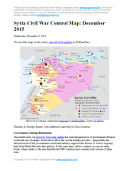
Syrian Civil War Control Map: December 2015 (Subscription)

There are newer versions of this map available. To see them, view all Syria updates.

Map of fighting and territorial control in Syria's Civil War (Free Syrian Army rebels, Kurdish YPG, Syrian Democratic Forces (SDF), Al-Nusra Front, Islamic State (ISIS/ISIL), and others), updated for December 2015. Highlights recent locations of conflict and territorial control changes, such as Kweires airbase, Hader, Kafrah, Delha, Deir Hanna, Sheikh Meskin, Hawl, and more.

Subscribe for full access to all conflict map reports!

Download PDF:
Buy now

Research by Djordje Djukic, with additional reporting by Evan Centanni

The Syrian government’s newly Russian-backed offensive against rebels and the so-called “Islamic State” (IS, formerly ISIS) is beginning to pick up momentum. Meanwhile, Western European countries are increasingly becoming involved in the war on IS as well, with a new Western-backed, multi-ethnic ground coalition making significant gains of its own against the group.

See all this and more on the newest update to PolGeoNow’s concise, professional-quality Syrian Civil War control map, which includes a timeline of changes since our previous Syria map report near the end of October.

This map and report are professional subscriber content, available to paid members or for separate purchase. Download PDF (US$24.99)

Want to see before you buy? Check out our most recent FREE SAMPLE Syria map!

Exclusive map report includes:

  • Up-to-date map of current territorial control in Syria, color-coded for the Assad government, rebel groups, “Islamic State” (ISIS/ISIL) extremists, and Kurdish YPG forces. Special symbol indicates rebel-held towns dominated by Al Qaeda affiliate Jabhat al-Nusra (the Nusra Front).
  • New in this edition: Special symbol indicates towns held by multi-ethnic anti-ISIS Syrian Democratic Forces (SDF).
  • Detailed indication of city-by-city control, highlighting key towns and other locations important to current events.
  • Locations of recent fighting and military operations, including Kweires airbase, Hader, Kafrah, Delha, Deir Hanna, Sheikh Meskin, Hawl, and more.
  • Detailed timeline of important events and changes to territorial control since October 30, 2015, compiled by our Syria-Iraq expert, with links to sources.

MEMBERS CLICK HERE TO PROCEED TO ARTICLE AND MAP

Not a member yet? Click here to learn more about our professional subscription service!

New Zealand Voting on New Flag Design

Premium members click here to view this article in the ad-free members area. Not a member yet? Learn about our subscription service!

Updated 2015-12-16: Continue to the bottom of the article for the results of the flag referendum!

Graphic illustrating the five flag designs up for a vote in New Zealand's November-December 2015 flag referendum: Silver Fern (Black and White), Silver Fern (Red, White and Blue), Silver Fern (Black, White, and Blue), Koru (black), and First to the Light (Red Peak)
The five options for a new flag of New Zealand. Clockwise from top left: Silver Fern (Red, White and Blue) by Kyle Lockwood; Silver Fern (Black, White and Blue) by Kyle Lockwood; Koru (Black) by Andrew Fyfe; Silver Fern (Black and White) by Alofi Kanter; and Red Peak by Aaron Dustin. More information in article below. License: CC BY 3.0 nz

By Evan Centanni

A New Flag For New Zealand?
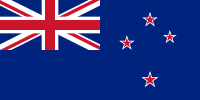
For decades, New Zealand has debated whether to change its flag, and now the country is finally putting the matter to a vote. A controversial initiative of Prime Minister John Key, the referendum officially began today, November 20. Over the coming three weeks, New Zealanders will choose their favorite from five contending flag designs. A final vote on whether to adopt the winner or stay with the old flag will happen next March. New Zealand’s current flag has been in place since 1902, nearly fifty years before the country became fully independent from the UK. Its top left corner is occupied by the so-called “Union Jack”, which is still the flag of the UK today.

Why Change the Flag?

Visual comparison of the very similar current flags of Australia and New Zealand
Current flags of New Zealand (top) and Australia (bottom)

In New Zealand, one of the most popular reasons to change the country’s flag is the same issue children all over the world have already noticed: It’s confusingly similar to the flag of Australia, especially since the two countries are right next to each other and share close historical ties.

Supporters of a change also argue that the current flag represents New Zealand’s former place as part of the British Empire, and that the country should follow Canada’s example by choosing a new flag for the post-independence era. And finally, many feel the flag’s European-style design excludes the indigenous Maori people, whose importance as New Zealand’s original inhabitants is increasingly being recognized in the country’s society and governance.

However, there are also many who oppose changing the flag. Among the top reasons are complaints that having a referendum and changing out the country’s flags is a waste of money that could be better spent elsewhere. The referendum process is expected to cost nearly $26 million New Zealand Dollars ($17 million USD), and if it passes, many physical flags will need to be replaced, from those flying on flagpoles, to military uniforms, to sports and tourism souvenirs.
Current flag of New ZealandOfficial Country Name:  
• New Zealand (English)
• Aotearoa (Maori)
Capital: Wellington

Others feel that the flag’s century of history is more important than its design, with some arguing that switching out the flag would actually be disrespectful to the many soldiers who have died while serving under it. The government notes that the flag has already been changed twice in the past, prior to the current flag being officially adopted in 1902.

Choosing a New Design
Although the parliament could have changed the flag on its own, the Key administration chose instead to involve the people more directly in the decision by holding a public consultation and referendum. The first part of the process included asking the public for their suggestions of flag designs. The government received over 10,000 proposals, including many wacky or humorous flags, such as a drawing of a kiwi bird shooting laser beams from its eyes. A government-convened “Flag Consideration Panel” narrowed down the proposals to a list of 40 candidates, then to a shortlist of just four that would appear on the ballot.

Proposed new flag design for New Zealand: Silver Fern (Black and White) by Alofi Kanter, Option A on the ballot for the November-December 2015 referendum vote

Option A: Silver Fern (Black and White) by Alofi Kanter
The first option on the ballots now being sent to voters is this black and white fern design. The silver fern, or ponga, is a native plant living only in New Zealand, and often used a symbol of the country. It appears on the national coat of arms, famously represents many New Zealand sporting associations such as the “All Blacks” national rugby team, and even as an official symbol of the country’s military at some points in history. The design with alternating black and white is based on an official branding logo adopted by the New Zealand government.

Proposed new flag design for New Zealand: Silver Fern (Red, White and Blue) by Kyle Lockwood, Option B on the ballot for the November-December 2015 referendum vote

Option B: Silver Fern (Red, White and Blue) by Kyle Lockwood

The second option on the ballot combines the silver fern with a symbol from New Zealand’s existing flag: the stars of the Southern Cross, a constellation which is mostly visible from locations in the Southern Hemisphere and helped New Zealand’s earliest settlers navigate the ocean. According to the designer, “The red represents our heritage and sacrifices made” and “blue represents our clear atmosphere and the Pacific Ocean, over which all New Zealanders, or their ancestors, crossed to get here”. This design has also won informal design competitions in the past.

Proposed new flag design for New Zealand: Koru (Black) by Andrew Fyfe, Option C on the ballot for the November-December 2015 referendum vote Option C: Koru (Black) by Andrew Fyfe
The koru is actually a variation on the silver fern, showing the spiral shape of a new fern frond as it uncurls. According to the designer, the koru represents “new life, growth, strength and peace” in indigenous Maori culture, and also could be interpreted as “a wave, a cloud, and a ram’s horn”. Twitter users, on the other hand, have humorously named this design the “hypnoflag” for its hypnotic spiral pattern.

Proposed new flag design for New Zealand: Silver Fern (Black, White and Blue) by Kyle Lockwood, Option D on the ballot in the November-December 2015 referendum vote

Option D: Silver Fern (Black, White and Blue) by Kyle Lockwood
Submitted by the same designer as Option B, this flag’s main difference is using black on the left rather than red. Black is a widely-used official national color of New Zealand. Prime Minister Key favors the silver fern designs, but many have criticized the two Kyle Lockwood designs for looking too much like corporate logos, or like a combination of the logos of New Zealand’s two biggest political parties.

But Wait, That’s Not All!
When the government first announced the shortlist of four flag designs in September, the Flag Consideration Panel was widely criticized for choosing a number of similar designs, and for consulting with a Nike shoe designer instead of flag experts. Citizens launched a social media campaign to add a popular favorite design that hadn’t made the list, and under pressure, the Prime Minister eventually gave in and added one more design to the ballot:

Proposed new flag design for New Zealand: First to the Light (Red Peak) by Kyle Lockwood, Option E on the ballot in the November-December 2015 referendum vote

Option E: First to the Light (“Red Peak”) by Aaron Dustin
This flag candidate, added late to the list due to popular demand, intentionally leaves out the traditional symbols of New Zealand in favor of something simpler. It attempts to combine Maori and British-European symbolism by being reminiscent of both Maori traditional artwork and elements of the current New Zealand flag, such as the colors and the points of the stars. Its colors represent night (black), dawn (blue), and earth (red), with the shape evoking the mountainous terrain of New Zealand and the white point symbolizing the “the collision of two tectonic plates” which formed the islands of New Zealand in prehistoric times.

What’s Next?
During the three-week voting period of the first referendum, citizens of New Zealand will rank the five designs in order of their preference, and the winner will go up against the current flag in a second three-week referendum, to be held from March 3 to 24, 2016. In that vote, New Zealanders will have the option to either make the new design their national flag, or keep the old one.

If the people vote to keep the old flag, then nothing will change. But if they vote for the new proposed flag, it will replace the old one as the country’s official flag starting from six months after the referendum results come in. New Zealand will then begin the process of gradually switching out physical flags and replacing them with flags of the new design. The old flag will remain a recognized alternative because of its status as a “flag of historical significance“.

Update: Voting Results

The winner…for now!

Official results for the first-stage referendum were released on December 15, 2015. The winner was Silver Fern (Black, White and Blue) by Kyle Lockwood. The runners-up, in order of popularity, were:

  1. Silver Fern (Red, White and Blue) by Kyle Lockwood
  2. First to the Light (“Red Peak”) by Aaron Dustin
  3. Silver Fern (Black and White) by Alofi Kanter
  4. Koru (Black) by Andrew Fyfe

Silver Fern (Black, White and Blue) will now face off against the current New Zealand flag in the second-stage referendum this coming March. Stay tuned to PolGeoNow for ongoing coverage!

Current flags of New Zealand (source) and Australia (source) are in the public domain.

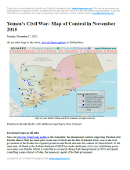
Yemen’s Civil War: Map of Control in November 2015 (Subscription)

There are newer versions of this map available. To see them, view all Yemen updates.

Map of territorial control in Yemen as of November 17, 2015, including territory held by the Houthi rebels and former president Saleh's forces, president-in-exile Hadi and his allies in the Saudi-led coalition and Southern Movement, and Al Qaeda in the Arabian Peninsula (AQAP). Includes recent areas of fighting, such as Taiz, Wadiah, Bayda, Marib, Mukayras, Mocha, Dhubab, and the Bab al-Mandeb Strait.

Subscribe for full access to all conflict map reports!

Download PDF:
Buy now

Timeline by Djordje Djukic, with additional reporting by Evan Centanni; map by Louis Martin-Vézian and Evan Centanni

Over the past month and a half, all sides in Yemen’s civil war have achieved territorial gains. The international coalition backing President Hadi – now including troops from Sudan, as well as Saudi Arabia, the UAE, and Qatar – has made gains against the Houthis, even as the Houthis have recaptured other areas. Meanwhile, Al Qaeda has taken advantage of the chaos to continue continued its gradual expansion of power.

See all this and more on the newest update to PolGeoNow’s Yemen territorial control map, which includes a timeline of changes and important events since our previous Yemen map report in September.

This map and report are exclusive premium content, available to paid subscribers or for individual purchase. Download PDF (US$19.99)

Want to see before you buy? Check out our most recent FREE SAMPLE Yemen map report!

Exclusive map report includes:

  • Up-to-date map of current territorial control in Yemen, color-coded for the pro-Hadi coalition, Houthi/Saleh forces, and Al Qaeda in the Arabian Peninsula (AQAP).
  • Detailed indication of town-by-town control, including provincial boundaries, all major cities, and many smaller ones
  • Markers for key areas of recent fighting such as Taiz, Marib, Bayda, Mukayras, the Bab al-Mandeb Strait, and more
  • Timeline of changes to the situation since late September, with links to sources

MEMBERS CLICK HERE TO PROCEED TO ARTICLE AND MAP

Not a member yet? Click here to learn more about our professional subscription service!

The Death of a Currency: Zimbabwe Dollar Demonetized

Premium members click here to view this article in the ad-free members area. Not a member yet? Learn about our subscription service!

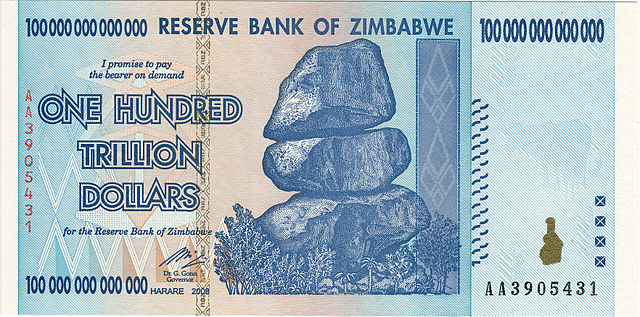
$100 trillion dollar bill in Zimbabwe dollars, front side, from Zimbabwe's worst period of hyperinflation in 2008

By Olga Rodriguez-Walmisley, with additional reporting by Evan Centanni

The End of the Zimbabwe Dollar
As of last month, the Zimbabwe dollar (Z$) no longer has any monetary value: After more than a decade of extreme inflation, it has been permanently retired. It was the official currency of Zimbabwe for 29 years, from 1980 to 2009, and continued to be circulated until this past September. Today, the government of Zimbabwe uses US dollars, while at least seven other foreign currencies are also accepted as legal tender: the South African rand, Botswana pula, British pound, Indian rupee, Chinese yuan, Japanese yen, and Australian dollar.

Because of extreme hyperinflation (at its worst, 500 billion percent in 2008), Zimbabwe’s national bank issued three massive redenominations of its currency, trading smaller-denomination new bills for much bigger-denomination old ones in 2006, 2008, and 2009. The largest bill ever printed, at the height of hyperinflation, was Z$100 trillion, which at the time of its issuance in 2008 was not enough to ride a public bus to work for a week. Ultimately unsuccessful at solving the problem, the government eventually abandoned the Zimbabwe dollar for its own use on April 12, 2009. The final conclusion to the process was the currency’s official “demonetization” this year.

Map of Zimbabwe's location within Africa
Zimbabwe’s location within Africa
Source: Wikimedia Commons. License: CC BY-SA

Demonetization
The demonetization period for the Zimbabwe dollar began Monday, June 15, 2015, and holders of the currency were given until September 30, 2015 to turn in their money to the nearest bank in exchange for US dollars. People with accounts of zero to 175 quadrillion (175,000,000,000,000,000) Zimbabwean dollars were paid a flat rate of $5 USD, and those with paper money received a rate of Z$250 trillion to $1 USD for 2008-issued notes (from the second redenomination) and Z$250 to $1 USD for 2009-issued notes (from the third redenomination). Accounts containing more than Z$175 quadrillion were exchanged at a rate of Z$35 quadrillion to $1 USD.

Finance and Economic Development Minister Patrick Chinamasa was quoted as saying that the demonetization exercise would cost US$20 million. As of August 10, 2015, local banks had reportedly converted US$4 million worth of Zimbabwean dollars to USD.

The end of the Zimbabwe dollar’s circulation signals the formalization of the multi-currency system in use since 2009, and is meant to promote confidence in the economic sector. Currently, the notes are being sold as souvenirs to tourists, and some people have even taken to making crafts out of them. However, all is not bleak for Zimbabwe’s own currency: the country’s tourism and diamond mines provide opportunities for growth, and with increased economic prosperity it is possible the Zimbabwe dollar could someday be reinstated.

Flag of ZimbabweCountry Name:  
• Zimbabwe
Official Name:  
• Republic of Zimbabwe
Capital: Harare 
Zimbabwe has 16 official languages listed in its constitution, but official business is conducted mostly in English.

History: Downfall of a Dollar
The Zimbabwe dollar’s incredible rate of hyperinflation can be traced back to an economic crash that hit the country in the first decade of the 21st Century. Some observers blame the start of Zimbabwe’s economic decline on strict pro-capitalism measures imposed on the country by international lenders in the early 1990s. But either way, it is widely recognized that by the year 2000, Zimbabwe’s economy was suffering from the country’s expensive involvement in Great African War, even as its government allegedly lied to international lenders about the true costs.

The real crash began during President Robert Mugabe’s land-reform program in 2000, which essentially confiscated farmland in the possession of white Zimbabweans and gave it to indigenous black Zimbabweans. This redistribution was part of the ideology of the Zimbabwe African National Union-Patriotic Front (ZANU-PF) political party, which has been the only party in power since the country’s independence from the United Kingdom in 1980, and which has been led by Mugabe since 1975.

The mass transfer of land ownership resulted in drastic reductions to food production, followed by the failure of various other sectors of the economy. Zimbabwe was transformed from an agricultural exporter, providing 400,000 jobs in the farming sector, to a net importer, with 94 percent unemployment. Many outsiders attributed the crash to failed policies of the undemocratic Mugabe administration, while the government and its supporters argued that sanctions from Western countries were to blame.

Facing this extreme economic crisis, Mugabe ordered that more money be printed to fill the deficit, and hyperinflation began, sometimes doubling prices several times in the same day. The currency was revalued by the government three times, “dropping zeros” from the value of the bills to counter the effects of the inflation – but it was not enough, and the decision was eventually made to abandon the Zimbabwe dollar altogether.

See Also: Official Press Release on the Demonetization of the Zimbabwe Dollar

Photo of Z$100 trillion note is in the public domain (source). Graphic of the Zimbabwean flag is also in the public domain (source).

Syrian Civil War Control Map: October 2015 (Subscription)

There are newer versions of this map available. To see them, view all Syria updates.

Map of fighting and territorial control in Syria's Civil War (Free Syrian Army rebels, Kurdish YPG, Al-Nusra Front, Islamic State (ISIS/ISIL), and others), updated for late October 2015. Highlights recent locations of conflict and territorial control changes, such as Kweires airbase, Kafr Nabudah, Aleppo area, Hama province towns, and more.

Subscribe for full access to all conflict map reports!

Download PDF:
Buy now

Research by Djordje Djukic, with additional reporting by Evan Centanni

A month into Russia’s military intervention in Syria, the Assad government and Iranian troops have made a number of small advances against both the rebels and the so-called “Islamic State” (formerly ISIS/ISIL).

See all this and more on the newest update to PolGeoNow’s concise, professional-quality Syrian Civil War control map, which includes a timeline of changes since our previous Syria map report last month.

This map and report are professional subscriber content, available to paid members or for separate purchase. Download PDF (US$24.99)

Want to see before you buy? Check out our most recent FREE SAMPLE Syria map!

Exclusive map report includes:

  • Up-to-date map of current territorial control in Syria, color-coded for the Assad government, rebel groups, “Islamic State” (ISIS/ISIL) extremists, and Kurdish YPG forces. Special symbol indicates rebel-held towns dominated by Al Qaeda affiliate Jabhat al-Nusra (the Nusra Front).
  • Detailed indication of city-by-city control, highlighting key towns and other locations important to current events.
  • Locations of recent fighting and military operations, including Kweires airbase, Kafr Nabudah, the southern Aleppo countryside, northern Hama province, and more.
  • Detailed timeline of important events and changes to territorial control since September 14, 2015, compiled by our Syria-Iraq expert, with links to sources.

MEMBERS CLICK HERE TO PROCEED TO ARTICLE AND MAP

Not a member yet? Click here to learn more about our professional subscription service!

Map of Boko Haram/”Islamic State” Control in Nigeria: October 2015

(To see other maps in this series, view all Boko Haram updates on PolGeoNow.)

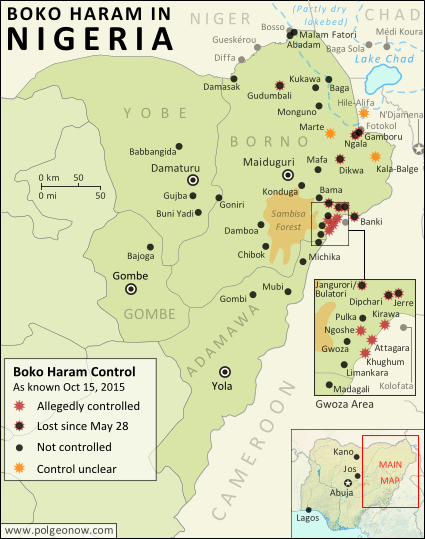
Detailed map of Boko Haram (Islamic State West Africa Province) territorial control in its war with Nigeria, marking each town reportedly under the group's control. Includes key recent locations, including Dikwa, Banki, the Sambisa Forest, and targeted areas on Lake Chad and the borders of Cameroon and Niger.
Map by Evan Centanni. All rights reserved.

(Subscribers click here to view this article in the member area) 

By Evan Centanni

The “Islamic State” in Nigeria
Northeastern Nigeria’s Boko Haram rebels, despite being pushed out of most of the territory they held last year, are still a major force in the region.

After becoming an official affiliate of Iraq and Syria’s so-called “Islamic State” (IS, a.k.a ISIS/ISIL) last March, they have now taken to calling themselves the Islamic State’s West Africa Province (ISWAP).

Status of Territorial Control
The goal of IS is to capture and hold territory, and Boko Haram still hangs on by a thread in that respect. Though the extent of their control has been blurry over the past six months (there is extremely little independent reporting from the region), military forces of Nigeria and neighboring countries have continued to announce the “recapture” of towns – an implicit acknowledgment that territory continues to be hotly contested.

Since this summer, the Nigerian government has stepped up aerial attacks against Boko Haram hideouts in the Sambisa Forest, but the result seems to have been a flood of fighters into nearby communities on border with Cameroon, while the forest remains an area of murky control.

Flag of NigeriaCountry Name:  
• Nigeria (English)*
Official Name:  
• Federal Republic of Nigeria (English)*
Capital: Abuja
*There are hundreds of local and regional languages in Nigeria, but only English has official status.

Chronology of Events
The following is a timeline of major events and changes to territorial control in northeastern Nigeria and neighboring countries since our previous update of May 28, 2015.

Note that Boko Haram launches deadly attacks on an almost daily basis across northeastern Nigeria, frequently on Cameroon’s side of the border, and occasionally in Niger and Chad as well. This timeline focuses on changes of territorial control, adding in selected items representing the biggest news and most significant cross-border incidents.

2015.06.14 Boko Haram fighters sacked the town of Babbangida, north of Yobe state capital Damataru.

2015.06.15 Boko Haram carried out a bombing with heavy casualties in N’Djamena, the capital city of Chad. An important Boko Haram leader would be captured in the city two weeks later.

2015.06.17-23 A deadly Boko Haram attack on Gueskérou, Niger was answered with a five-day long air and ground campaign by that country’s armed forces.

2015.07.01-02 Boko Haram killed almost 200 people in two days, in a wave of attacks across Borno state. As of last March, Boko Haram considers itself the West African branch of the Syria- and Iraq-based “Islamic State” (a.k.a. ISIS/ISIL). The July violence in Nigeria, targeted at non-extremist Muslims, coincided with an IS directive to increase attacks during the Muslim holy month of Ramadan.

2015.07.22 A village in the Hile-Alifa area of Cameroon was reportedly occupied by Boko Haram, two days after a brutal rebel attack on the nearby town of Kamouna.

2015.07.24 The Nigerian army said it recaptured Dikwa from Boko Haram, though the town had already been reported secured by Chadian forces in March.

2015.07.25 Boko Haram attacked the island of Médi Koura among the fragmented remains of Lake Chad, well within the borders of Chad itself. The attack would be followed by major military campaign and heavy fighting in nearby areas, as Chadian troops attempted to drive Boko Haram forces entirely out of the lake region.

2015.08.02 The Nigerian army said it rescued 178 prisoners from Boko Haram, most of them children and women. The 200 missing girls infamously kidnapped from Chibok in 2014 were not among them.

2015.08.21 An army source reported that troops had driven Boko Haram fighters out of Gudumbali.

2015.09.01 Nigerian government forces captured Gamboru-Ngala from Boko Haram. The twin towns had been secured by Chadian forces months earlier, but not protected from subsequent rebel incursions.

2015.09 In early September, Boko Haram fighters began attacking communities on the border with Cameroon after being flushed out of the Sambisa Forest by a heavy government bombing campaign. The attacks included the storming of a market in downtown Kirawa, a town known to have been under Boko Haram control in the past.

2015.09.19 A military spokesman said Nigerian troops had captured Jerre and Dipchari, on the road to Banki.

2015.09.20 A Nigerian newspaper reported that Boko Haram was operating a checkpoint on the road between Gwoza and Limankara, killing any travelers who did not have food to offer to the rebels.

Map of Boko Haram control in Nigeria in March 2015, and the multinational offensive with Cameroon, Chad, and Niger that drove the rebels back.
Multinational offensive against Boko Haram, Jan. to Mar. 2015

2015.09.22 Nigerian troops cleared Boko Haram fighters from camps in Jangurori and Bulatori, near Bama. In the process a high-level Boko Haram leader was captured.

2015.09.24 The Nigerian military said it seized Banki, on the border of Cameroon, with cooperation from the Cameroonian military. The next day, “at least 200” Boko Haram fighters allegedly surrendered to the government forces.

2015.09.23-25 Madagali, at the northern tip of Adamawa state, was reportedly abandoned by its population after three consecutive days of Boko Haram raids.

2015.10.07 The military claimed that over 100 Boko Haram fighters were killed in a failed attack on troops in Goniri, on the Borno-Yobe state line.

2014.10.08 An open letter from displaced residents to President Buhari said Boko Haram was in control of a number of villages east of Gwoza, including Ngoshe, Attagara, Kirawa, and Kughum.

2014.10.10 Dozens were killed in a Boko Haram attack on a fish market in Baga Sola, on Chad’s side of the border.

2015.10.14 The US announced it was sending 300 troops to Cameroon to assist in tracking down Boko Haram fighters.

Following this story? View all Boko Haram maps on PolGeoNow!

Timeline compiled with the help of the ACLED dataset (Raleigh, Clionadh, Andrew Linke, Håvard Hegre and Joakim Karlsen. 2010. Introducing ACLED-Armed Conflict Location and Event Data. Journal of Peace Research 47(5) 651-660.)

Graphic of the Nigerian flag is in the public domain (source).

African Union Suspends Burkina Faso, Then Reinstates it Again (Map)

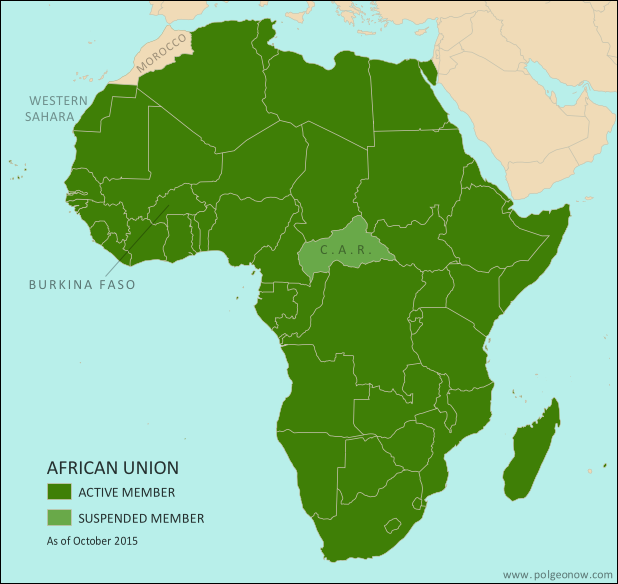
Map of the African Union, including active and suspended member countries, updated for the September 2015 suspension and reinstatement of Burkina Faso (colorblind accessible).
Map by Evan Centanni, from this blank map by Eric Gaba. License: CC BY-SA

Premium members click here to view this article in the ad-free members area. Not a member yet? Subscribe now!

Article by Evan Centanni

Coup Crisis
On September 18, Burkina Faso was suspended from the African Union (AU) by the organization’s Peace and Security Council. The action was in response to a government takeover by soldiers loyal to the country’s former president Blaise Compaore, who was pushed out in a popular uprising a year ago.

A military coup usually gets a country automatically suspended and sanctioned by the Peace and Security Council, which aims to promote constitutional rule in all AU member countries. (This pro-democracy policy has no affect on dictatorships that are already long-established.)

Resolution & Reinstatement
In a quick resolution to the crisis, Burkina Faso’s coup was over just a week after it started; the internationally-supported president was released from custody, and the coup leader stepped down apologetically after popular protests and mediation by neighboring countries. The AU Peace and Security Council, which is always in session, responded by lifting Burkina Faso’s suspension on September 26.

After Burkina Faso’s return to active membership, there is only one remaining suspended AU member: the Central African Republic (CAR). The CAR was suspended in March 2013 after a rebel takeover, followed by the installation of a weak compromise government. Planned elections probably would have gotten the CAR reinstated to the AU later this month, but they’ve been delayed after a new outbreak of violence.

Flag of the African Union (AU)Organization Name:  
• African Union (English)
• al-Āthḥād al-’Āfrīqī (Arabic)
• Union africaine (French)
• União Africana (Portuguese)
• Unión Africana (Spanish)
• Umoja wa Afrika (Swahili)
Launched: 2002 in Durban, South Africa
Headquarters: Addis Ababa, Ethiopia
Website: www.au.int

What is the African Union?
Formed launched in 2002 as a replacement for the earlier Organization of African Unity (OAU), the AU is an intergovernmental organization that works on increasing cooperation, stability, and development within the continent of Africa. The organization is headquartered in Addis Ababa, Ethiopia. (Ethiopia is the only African country that the European empires were never able to colonize, and is also the second most populous country in Africa.)

Compared to the neighboring European Union (EU), the AU is only a loose forum for cooperation between its member countries. AU members do not have an integrated economic system, union-wide laws, or shared foreign policy, though further integration is a possibility for the future.

The African Union includes every UN-recognized country in Africa except for Morocco. Morocco withdrew from the OAU in 1984, after the organization chose to admit the Sahrawi Arab Democratic Republic (SADR), a disputed country that claims ownership of the mostly Moroccan-controlled Western Sahara territory. The only other parts of Africa not represented in the AU are a few groups of offshore islands controlled by European countries, as well the small Spanish enclaves in North Africa. The breakaway Republic of Somaliland is not a member, but is considered by the AU to be part of member-state Somalia.

Low-resolution graphic of the African Union flag is displayed under fair use principles (source).

Yemen’s Civil War: Map of Control in September 2015 (Subscription)

There are newer versions of this map available. To see them, view all Yemen updates.

Map of territorial control in Yemen as of September 25, 2015, including territory held by the Houthi rebels and former president Saleh's forces, president-in-exile Hadi and his allies in the Saudi-led coalition and Southern Movement, and Al Qaeda in the Arabian Peninsula (AQAP). Includes recent areas of fighting, such as Aden, Ibb, Taiz, Bayda, Marib, Mukayras, and more.

Subscribe for full access to all conflict map reports!

Download PDF:
Buy now

Timeline by Djordje Djukic, with additional reporting by Evan Centanni; map by Louis Martin-Vézian and Evan Centanni

Forces loyal to Yemen’s exiled President Hadi, backed by troops from Saudi Arabia, the UAE, and now Qatar, have advanced rapidly against the Houthi rebels over the summer. However, with the offensive now losing momentum, battle lines are solidifying and groups such as Al Qaeda are moving to fill in the power vacuum left in the coalition’s wake.

See all this and more on the newest update to PolGeoNow’s Yemen territorial control map, which includes a timeline of changes and important events since our previous Yemen map report in August.

This map and report are exclusive premium content, available to paid subscribers or for individual purchase.
Download PDF (US$19.99)

Want to see before you buy? Check out our most recent FREE SAMPLE Yemen map report!

Exclusive map report includes:

  • Up-to-date map of current territorial control in Yemen, color-coded for the pro-Hadi coalition, Houthi/Saleh forces, and Al Qaeda in the Arabian Peninsula (AQAP).
  • Detailed indication of town-by-town control, including provincial boundaries, all major cities, and many smaller ones
  • Markers for key areas of recent fighting such as Marib, Aden, Ibb, Bayda, Mukayras, and more
  • Timeline of changes to the situation since mid-August, with links to sources

MEMBERS CLICK HERE TO PROCEED TO ARTICLE AND MAP

Not a member yet? Click here to learn more about our professional subscription service!

Map Update: Kosovo Recognized by 3 More Countries in 2015 (108/193 UN members)

Premium members click here to view this article in the ad-free members area. Not a member yet? Subscribe now!

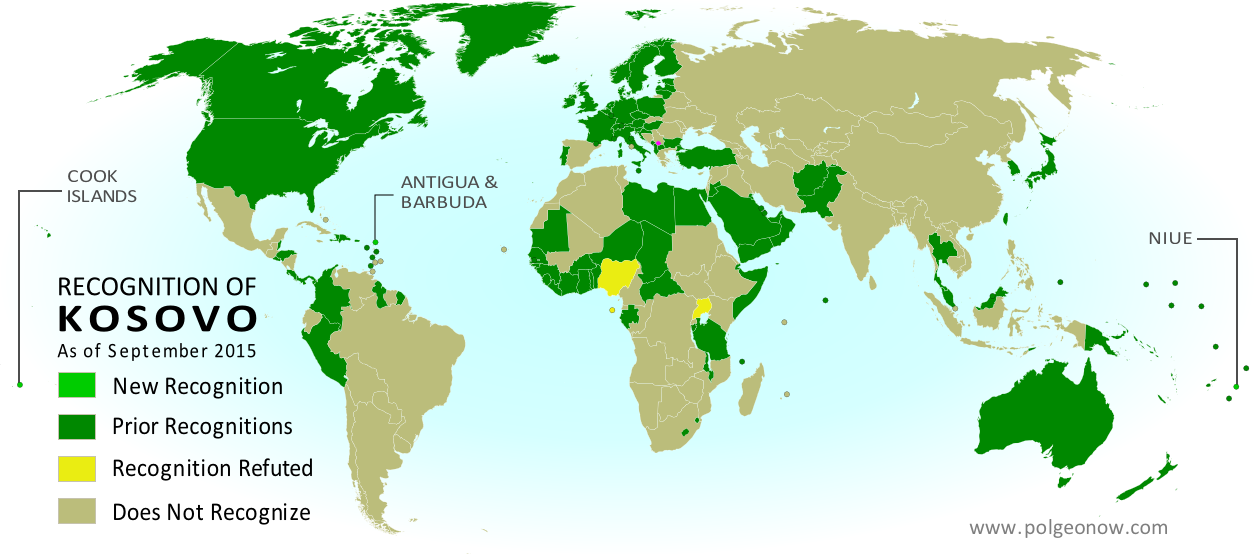
Map of countries that recognize the Republic of Kosovo as an independent state, updated to September 2015, with the most recent additions (Antigua and Barbuda, Cook Islands, and Niue) highlighted. Also shows countries that have refuted claims that they recognized Kosovo: Sao Tome and Principe, Nigeria, and Uganda.
Map by Evan Centanni, modified from public domain graphic (source).

Flag of the Republic of KosovoCountry Name:  
• Kosovo (English, Serbian)
• Kosova (Albanian)
Official Name:  
Republic of Kosovo (English)
Republika e Kosovës (Albanian)
Republika Kosovo (Serbian)
Capital: Pristina/Prishtina

Article by Evan Centanni, with additional reporting by Caleb Centanni

New Recognitions for Kosovo
Since our last Kosovo recognition map report nearly a year ago, the breakaway republic’s independence has been endorsed by three more countries. However, only one of these three new recognizers, Antigua and Barbuda, is a fully independent country and UN member. The other two, the Cook Islands and Niue, are semi-independent states often considered to be overseas territories of New Zealand.

Antigua and Barbuda, a small two-island country in the Caribbean, reportedly recognized Kosovo as independent on May 20, 2015, after several years of talks between the two states’ foreign ministers. Kosovo is now recognized by about half of the island countries in the Caribbean.

Also in May, the Cook Islands recognized Kosovo, with nearby Niue joining a month later. The Cook Islands and Niue are two nearly independent Pacific island countries in “free association” with New Zealand. They are often considered dependent territories rather than independent countries; their people retain New Zealand citizenship, and they have never declared independence or tried to join the UN. However, they are self-governed, with the choice to become independent at any time, and there’s no rule against them diplomatically recognizing other countries or being recognized in return.

Before this year, the last country to recognize Kosovo was Solomon Islands in August 2014. With the addition of Antigua and Barbuda, Kosovo is now considered independent by 108 of the 193 UN member countries (about 56 percent).

What is Kosovo?
The Republic of Kosovo, located in southeastern Europe, controversially declared independence from Serbia in 2008. It has been blocked from UN membership by objections from Serbia, Russia, and other countries who see its secession as invalid. In addition to the 108 UN members recognizing Kosovo, its independence is also acknowledged by non-UN member Taiwan. For more on Kosovo’s special situation, see our first Kosovo recognition report, which also includes a map of Kosovo’s location relative to Serbia.

Refuted Recognitions
In the past, the government of the Republic of Kosovo has been accused of exaggerating its numbers by claiming recognition from countries that didn’t really intend to recognize it. Three African countries – São Tomé and Príncipe, Uganda, and Nigeria – have denied recognizing Kosovo, and are not included in our numbers. However, they are often included in lists compiled by pro-Kosovo sources, so we have illustrated them in yellow on the above map.

And what about the most recent additions to the list? Antigua and Barbuda’s recognition of Kosovo has not been confirmed by sources outside Kosovo’s government, but because it has not been denied either, we are presuming its truth for now. The Cook Islands and Niue, on the other hand, both have online documents confirming that they’ve established diplomatic relations with Kosovo. Diplomatic relations aren’t always the same thing as recognition, but the documents make it fairly clear that the two states indeed consider Kosovo to be an independent country.

Stay Up to Date: Check for further news and map updates related to Kosovo’s recognition by viewing all Kosovo articles on Political Geography Now.
 
Flag graphic by Cradel (source). License: CC BY-SA