Syrian Civil War Control Map: March 2016 (Subscription)

MEMBERS CLICK HERE TO PROCEED TO ARTICLE AND MAP

There are newer versions of this map available. To see them, view all Syria updates.

Research by Djordje Djukic. Map by onestopmap.com, Evan Centanni, and Djordje Djukic

Subscribe for full access to all conflict map reports!

Download PDF:
Buy now
New discounted price!

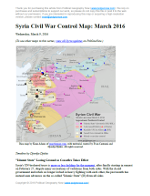
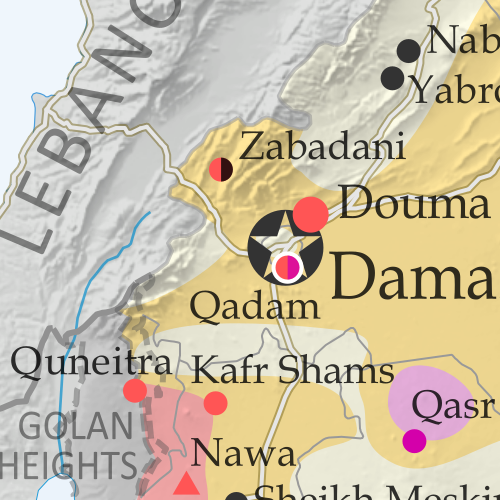
Map of fighting and territorial control in Syria's Civil War (Free Syrian Army rebels, Kurdish YPG, Syrian Democratic Forces (SDF), Al-Nusra Front, Islamic State (ISIS/ISIL), and others), updated for March 2016. Now includes terrain and major roads (highways). Highlights recent locations of conflict and territorial control changes, such as Daraa, Khanaser, Tell Rifaat, Shadadi, the Aleppo Power Plant, and more.New: Improved map now includes terrain and major roads!

With Syria’s UN-brokered truce partially holding, government, Kurdish, and rebel forces alike have turned their attention to carving away territory from the so-called “Islamic State” (ISIS/ISIL). However, the rebels also sustained some losses to government forces prior to the ceasefire taking effect.
 
See all this and more on the latest update to PolGeoNow’s concise, professional Syrian Civil War control map, which includes a timeline of changes since our previous Syria map report in early February.

This map and report are professional subscriber content, available to paid members or for separate purchase. Download PDF (US$14.99) New discounted price!

Want to see before you buy? Check out our most recent FREE SAMPLE Syria map!

Exclusive map report includes:

Map of fighting and territorial control in Syria's Civil War (Free Syrian Army rebels, Kurdish YPG, Syrian Democratic Forces (SDF), Al-Nusra Front, Islamic State (ISIS/ISIL), and others), updated for March 2016. Now includes terrain and major roads (highways). Highlights recent locations of conflict and territorial control changes, such as Daraa, Khanaser, Tell Rifaat, Shadadi, the Aleppo Power Plant, and more.
  • New since last year: Terrain shading and major highways included on map for geographic context!
  • Up-to-date map of current territorial control in Syria, color-coded for the Assad government, rebel groups, “Islamic State” (ISIS/ISIL) extremists, and Kurdish/SDF forces. 
  • Special symbols indicate towns dominated by rebels of Al Qaeda affiliate Jabhat al-Nusra (the Nusra Front) and by multi-ethnic anti-ISIS Syrian Democratic Forces (SDF).
  • Detailed indication of city-by-city control, highlighting key towns and other locations important to current events.
  • Locations of recent fighting and military operations, including Daraa, Khanaser, Tell Rifaat, Shadadi, the Aleppo Power Plant, and more.
  • Detailed timeline of important events and changes to territorial control since February 10, 2016, compiled by our Syria-Iraq expert, with links to sources.

MEMBERS CLICK HERE TO PROCEED TO ARTICLE AND MAP

Not a member yet? Click here to learn more about our professional subscription service!

Europe’s Free Travel Zone in Danger: Map of Temporary Border Controls in the Schengen Area, March 2016

There are newer versions of this map available. To see them, view all Schengen Area articles.

In the companion to this article, we explain in plain English what the Schengen Area is, and which countries are part of it. Here, we present a map of the area’s current crisis, showing where border checks have been reintroduced. Details and explanation in the article below.

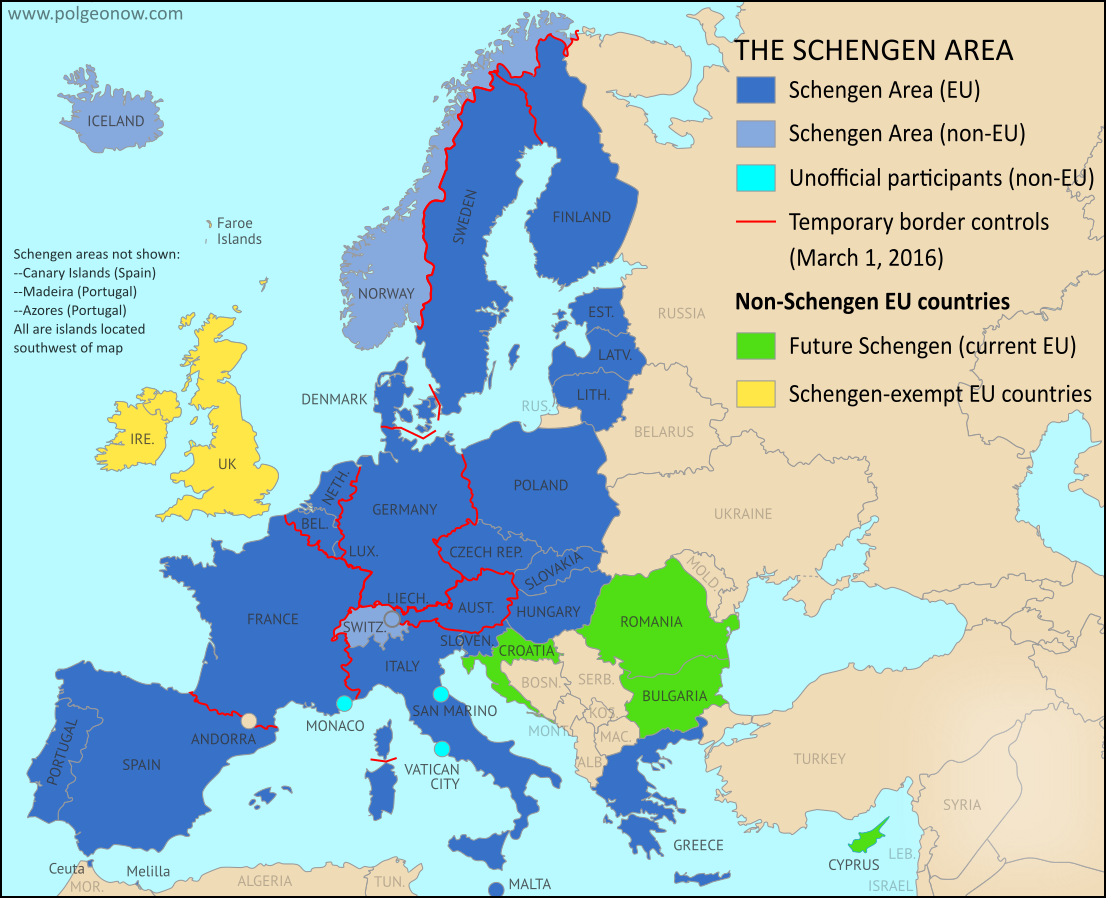
Map of Temporarily Reintroduced Border Control in the Schengen Area (the European Union's border-free travel zone), color-coded for EU Schengen countries, non-EU Schengen countries, future Schengen countries, and Schengen-exempt EU countries, as well as microstates unofficially participating in the Schengen agreements (colorblind accessible).
Map by Evan Centanni, from blank map by Ssolbergj. License: CC BY-SA

Subscribers click here to view this article in the ad-free members area. Not a member yet? Learn about PolGeoNow subscriptions!

Article by Evan Centanni

Borders Re-emerging Inside the Schengen Area

Over the past months, concern has been rising that Europe’s border-free travel zone, known as the Schengen Area, is falling apart. As unprecedented numbers of refugees and other migrants enter the Schengen Area, individual member countries have begun to re-start border checks in the places where they abolished them decades ago. Read on to learn the why, how, and where of the Schengen Area’s new border controls!

How are Schengen Border Checks Legal?

Although the Schengen rules require members to get rid of all the customs and ID checks on their borders, a country can declare a short-term exception under special circumstances. These “temporary reintroductions of border control” are tightly regulated by the EU government, which holds them to specific time limits, after which the countries have to remove the border checks again. The EU limits each country’s border controls to 30 days, which can renewed up to six months (for fast-tracked emergency declarations, the limit is 10 days and renewal up to two months).

Why do Schengen Countries Reintroduce Border Controls?

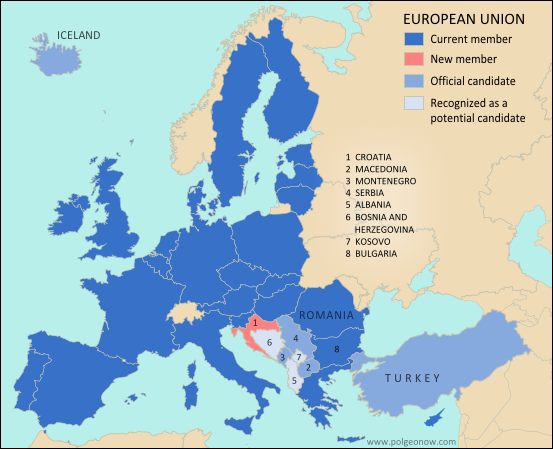
Map of the European Union (EU) and prospective member countries
The full EU and prospective members

In the past these temporary border controls were used to strengthen security for major sports events and political meetings, or in extreme cases like the 2015 Paris terrorist attacks. But everything has changed over the past year, with a historical surge in refugees coming to Europe from Syria, Afghanistan, and other places. More and more Schengen countries have been using temporary border controls to limit the number of refugees they will host or allow to pass through.

Which Schengen Countries have Reintroduced Border Controls?

At the beginning of March 2016, there were seven Schengen countries with temporary border controls: Denmark, Norway, Sweden, Austria, Germany, France, and Belgium (for Belgium, the controls are only along part of its border with France). Denmark used an emergency declaration starting January 4, so it’s scheduled to reach its two-month limit tomorrow, March 4.

After tomorrow, Denmark will presumably stop checking ID for new arrivals, though visitors leaving Denmark for neighboring Germany, Sweden, and Norway will still face checks when entering those countries. Like the rest of the countries that currently have border controls, those three national governments used regular declarations, and still have several months left before they reach the six-month limit.

Besides the current cases, Hungary and Slovenia also reintroduced border controls in connection to the refugee crisis in 2015, but only for short periods. Their border control programs have been ended again since then.

Could Schengen Border Controls Become Permanent? (Update 2016-03-04) 

On March 4, 2016, a new EU plan was revealed to remove all internal Schengen border controls by November 2016 – but only if Greece improves security on its external borders (where refugees and other migrants first arrive in Europe, often by sea to Greek islands). 

If Greece doesn’t do what the other EU members want by May 12, the EU could change the rules and allow Schengen countries to extend their border controls up to two years instead of just six months. They might even set up a coordinated system of border controls, rather than leaving countries to each declare new controls on their own. 

If the EU countries can’t agree on a better way to handle the the refugee crisis even after two years, it’s hard to say whether the Schengen Area’s free-travel principles have any future at all.

Learn More:
What’s the Difference Between the Schengen Area and the European Union?
Which Countries Are in the Schengen Area, and Which EU Countries Aren’t? 

Map of the Schengen Area, Europe’s Border-free Travel Zone

The European Union’s Schengen free-travel zone is in danger of falling apart: In the companion to this article, we map which Schengen borders have had ID checks reintroduced to regulate the movement of refugees.

But what exactly is the Schengen Area? What’s the difference between Schengen and the EU? And which countries does Schengen include? Read on for all the answers, explained in plain English!

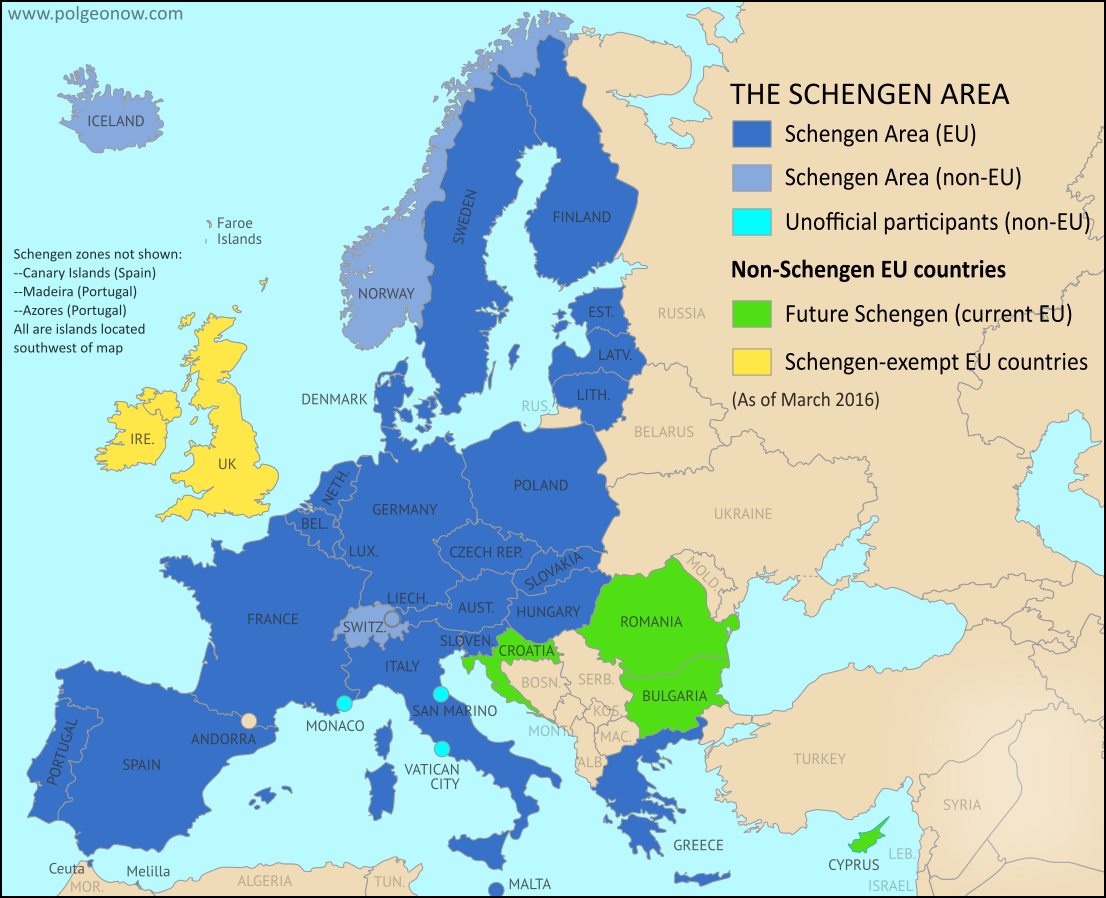
Map of the Schengen Area (the European Union's border-free travel zone), color-coded for EU Schengen countries, non-EU Schengen countries, future Schengen countries, and Schengen-exempt EU countries, as well as microstates unofficially participating in the Schengen agreements (colorblind accessible).
Map by Evan Centanni, from blank map by Ssolbergj. License: CC BY-SA

Subscribers click here to view this article in the ad-free members area. Not a member yet? Learn about PolGeoNow subscriptions!

Article by Evan Centanni

What is the Schengen Area?

If you’ve traveled in Europe anytime in the last 20 years, you probably know that many of Europe’s countries have open borders, without any kind of customs or ID check required to cross from one country to another. This is because of the Schengen Agreement, a 1985 treaty that has since been expanded and made into a law of the European Union (EU).

The combined area of all the participating countries is known as the “Schengen Area”, and is now a core part of the EU system. For the purposes of most travelers, the Schengen Area might as well be just one country: not only have border checks been mostly eliminated (until recently), but a visa to any Schengen country is also good for travel to all of them.

Each of the Schengen countries is small compared to the world’s largest countries, like the US and China. But in total, the Schengen Area has more people than US, and a land area about half as big as the US or China.

Map of the European Union (EU) and prospective member countries
The full EU and prospective members

Schengen Area vs. European Union: What’s the Difference?

Although the Schengen Area and the EU are closely connected, they’re not the same thing. Some countries are part of the EU, but not the Schengen Area, while others are part of the Schengen Area, but not the EU.

The most important difference is that the EU is much more than just the Schengen Area: it’s also an economic union, with unified customs and tax laws and its own currency, as well as a political union with an elected government that manages shared laws and foreign policy for all the member countries.

Learn More: Map of the Eurozone (countries that use the EU’s euro currency)

The Schengen Agreement was originally a treaty completely separate from EU law, but is now operated and regulated by the EU government. (Awkwardly, the non-EU Schengen countries now have barely any say over the rules and administration of the area, though they’re welcome to leave any time).

Which Countries are in the Schengen Area? (List of Schengen Countries)

There are 26 official Schengen countries, all of them in Europe. The only parts of the Schengen Area outside of Europe are: (1) the Canary Islands, a part of Spain off the coast of West Africa; (2) Madeira a part of Portugal also made up of islands off West Africa; (3) the Azores, a part of Portugal made up of islands far out in the Atlantic Ocean; and (4) the cities of Ceuta and Melilla (and presumably nearby uninhabited territories) which are part of Spain but located on the coast of North Africa.

Here’s a list of all the official Schengen countries:

Schengen countries that are also EU members

 Austria
 Belgium
 Czech Republic
 Denmark (except the Faroe Islands and Greenland)
 Estonia
 Finland
 France (except overseas regions and territories)
 Germany
 Greece
 Hungary
 Italy
 Latvia
 Lithuania
 Luxembourg
 Malta
 Netherlands (except Caribbean islands)
 Poland
 Portugal
 Slovakia
 Slovenia
 Spain (with partial exceptions for Ceuta and Melilla*)
 Sweden

Schengen countries that are not EU members

 Iceland
 Liechtenstein
 Norway (except Svalbard)
 Switzerland

There are also three very small countries that might as well be part of the Schengen Area, because their borders with the official Schengen countries are completely open:

Unofficial Schengen Area participants

 Monaco (only borders France)
 San Marino (surrounded by Italy)
 Vatican City (surrounded by Italy)

*Ceuta and Melilla are two cities on the coast of North Africa that are part of Spain. They are officially part of the Schengen Area, but still have border checks for travelers going from the two cities to other parts of the Schengen Area. This is for enforcement of a special Spanish law that allows some Moroccan citizens to visit Ceuta or Melilla – but not the rest of the Schengen Area – without a visa.
 

Which EU Members Aren’t Schengen Countries?

Most of Europe’s non-Schengen countries aren’t EU members, but there are also six EU member countries that aren’t in the Schengen Area. Four of these are legally required to join the Schengen Area at some point in the future (as part of the deal of joining the EU), but haven’t been allowed in yet:

EU members that are future Schengen Countries

 Bulgaria
 Croatia
 Cyprus
 Romania

Although joining the EU usually means a country has to work towards joining the Schengen Area too, there are two EU members that negotiated special exceptions from the Schengen agreements, so they won’t ever have to become Schengen countries:

EU members that are Schengen-exempt

 Ireland
 United Kingdom (UK)

Map of Control in Yemen’s Civil War: February 2016 (Subscription)

MEMBERS CLICK HERE TO PROCEED TO ARTICLE AND MAP

There are newer versions of this map available. To see them, view all Yemen updates.

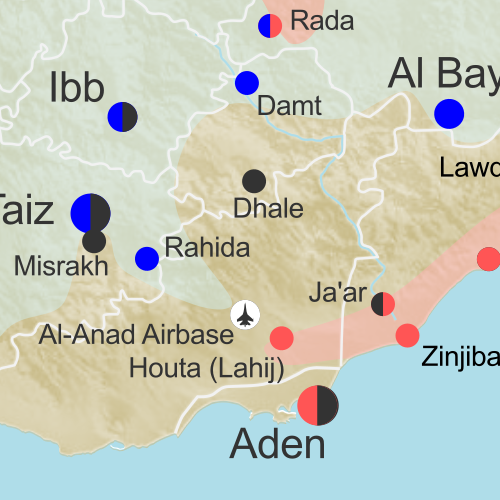
Map of territorial control in Yemen as of February 19, 2016, including territory held by the Houthi rebels and former president Saleh's forces, president-in-exile Hadi and his allies in the Saudi-led coalition and Southern Movement, Al Qaeda in the Arabian Peninsula (AQAP), and the so-called Islamic State (ISIS/ISIL). Includes recent areas of Al Qaeda takeovers and locations of other fighting, such as Shuqrah, Azzan, Habban, Ahwar, Misrakh, Fardat Nahm, and more.

Subscribe for full access to all conflict map reports!

Download PDF:
Buy now
New discounted price!

Timeline by Djordje Djukic, with additional reporting by Evan Centanni; map by Louis Martin-Vézian and Evan Centanni

Though it’s been less than three weeks since our last Yemen control map update, there have already been several changes to territorial control. Most notably, Al Qaeda in the Arabian Peninsula (AQAP) has rapidly expanded its territory, recapturing most of the towns it held from 2011 to 2012.

Meanwhile, the Saudi-led coalition supporting President Hadi has also made progress against the Houthi rebels over the past weeks.

See all this and more on the newest update to PolGeoNow’s Yemen territorial control map, which includes a timeline of changes and important events since our previous Yemen map report at the end of January.

This map and report are exclusive premium content, available to paid subscribers or for individual purchase. Download PDF (US$14.99) New discounted price!

Want to see before you buy? Check out our most recent FREE SAMPLE Yemen map report!

Exclusive map report includes:

Map of territorial control in Yemen as of February 19, 2016, including territory held by the Houthi rebels and former president Saleh's forces, president-in-exile Hadi and his allies in the Saudi-led coalition and Southern Movement, Al Qaeda in the Arabian Peninsula (AQAP), and the so-called Islamic State (ISIS/ISIL). Includes recent areas of Al Qaeda takeovers and locations of other fighting, such as Shuqrah, Azzan, Habban, Ahwar, Misrakh, Fardat Nahm, and more.
  • Up-to-date map of current territorial control in Yemen, color-coded for the pro-Hadi coalition, Houthi/Saleh forces, Al Qaeda in the Arabian Peninsula (AQAP), and “Islamic State” (ISIS/ISIL).
  • Color scheme recently updated for consistency with Syria, Iraq, and Libya map series
  • Detailed indication of town-by-town control, including provincial boundaries, all major cities, and many smaller ones
  • Markers for recent areas of Al Qaeda takeovers and locations of other fighting, such as Shuqrah, Azzan, Habban, Ahwar, Misrakh, Fardat Nahm, and more
  • Timeline of changes to the situation since January 31 2016, with links to sources

MEMBERS CLICK HERE TO PROCEED TO ARTICLE AND MAP

Not a member yet? Click here to learn more about our professional subscription service!

Map: Which Countries Recognize Palestine as Independent in 2016?

(Keep up with changes to Palestine’s situation: view all Palestine updates.)

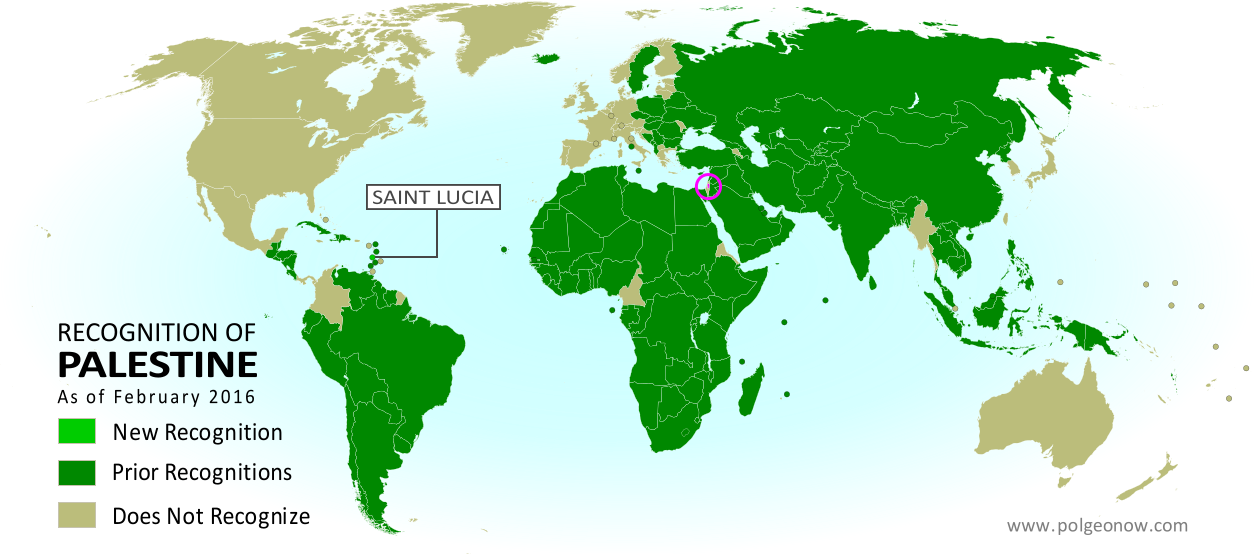
Map of countries that recognize the State of Palestine as an independent country, updated for February 2016 with recent addition Saint Lucia highlighted
Click to enlarge. Palestine in magenta (circled). Map by Evan Centanni, modified from public domain graphic (source).

Subscribers click here to view this article in the ad-free members area. Not a member yet? Learn about PolGeoNow subscriptions!

Article by Evan Centanni

Disputed Country

The Palestinian Liberation Organization (PLO) declared an independent State of Palestine in 1988, and continues to pursue its recognition as a country today. Though Palestine’s claimed territories are disputed and largely occupied by Israel, it has gathered recognition from more than two-thirds of the world’s countries, and is also treated as a country by the UN General Assembly, where it’s an “Observer State” but not a member.

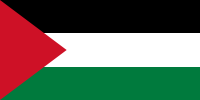
Flag of Palestine Country Name:  
• Palestine (English)
Filasṭīn (Arabic)
Official Name:  
• State of Palestine (English)
• Dawlat Filasṭin (Arabic)
Capital: 
• Jerusalem (claimed)
Ramallah (administrative)

The number of individual countries recognizing Palestine has grown gradually over the past decades. Last June we reported that 135 U.N. member states (and one observer state) officially recognized Palestine, and since September the number is now 136 (about 70% of all UN members). Palestine is also recognized by the proclaimed government of Western Sahara, another disputed country that’s not formally recognized by the UN.

Saint Lucia Recognizes Palestine

Last September, the small Caribbean island country of Saint Lucia became the latest national government to recognize Palestine as independent. The formal acknowledgement came on September 14, 2015, when the two countries’ UN representatives signed an agreement in New York to establish diplomatic relations.

Saint Lucia is now one of about half the world’s countries whose government recognizes both Palestine and Israel as independent countries. All of the independent Caribbean countries except Cuba recognize Israel, and most also recognize Palestine, with the exception of Jamaica, the Bahamas, Saint Kitts and Nevis, Barbados, and Trinidad and Tobago.

Read More:
Is Palestine Really a Country?
Palestine Recognized as a Country by the UN
Map of Countries Recognizing Kosovo

Syrian Civil War Control Map: February 2016 (Subscription)

MEMBERS CLICK HERE TO PROCEED TO ARTICLE AND MAP

There are newer versions of this map available. To see them, view all Syria updates.

Research by Djordje Djukic. Map by onestopmap.com and Evan Centanni.

Subscribe for full access to all conflict map reports!

Download PDF:
Buy now
New discounted price!

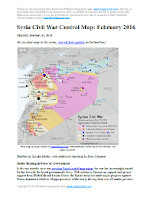
Map of fighting and territorial control in Syria's Civil War (Free Syrian Army rebels, Kurdish YPG, Syrian Democratic Forces (SDF), Al-Nusra Front, Islamic State (ISIS/ISIL), and others), updated for February 2016. Now includes terrain and major roads (highways). Highlights recent locations of conflict and territorial control changes, such as Menagh airbase, northern Aleppo, Salma, Rabia, Nubl, Baghaliya, Tishrin Dam, and more.New: Improved map now includes terrain and major roads!

As a UN-brokered truce approached, tables were beginning to turn in Syria, with the government’s Russian-backed offensive making major breakthroughs against rebel forces in Aleppo, Latakia, and elsewhere. 

Meanwhile, the so-called “Islamic State” (ISIS) continued to hold vast tracts of the country, while Kurdish-led forces gradually expanded their control in victories against ISIS and rebel fighters alike.

See all this and more on the newest update to PolGeoNow’s concise, professional Syrian Civil War control map, which includes a timeline of changes since our previous Syria map report in mid-December.

This map and report are professional subscriber content, available to paid members or for separate purchase. Download PDF (US$14.99) New discounted price!

Want to see before you buy? Check out our most recent FREE SAMPLE Syria map!

Exclusive map report includes:

Map of fighting and territorial control in Syria's Civil War (Free Syrian Army rebels, Kurdish YPG, Syrian Democratic Forces (SDF), Al-Nusra Front, Islamic State (ISIS/ISIL), and others), updated for February 2016. Now includes terrain and major roads (highways). Highlights recent locations of conflict and territorial control changes, such as Menagh airbase, northern Aleppo, Salma, Rabia, Nubl, Baghaliya, Tishrin Dam, and more.
  • New in this edition: Terrain shading and major highways included on map for geographic context!
  • Up-to-date map of current territorial control in Syria, color-coded for the Assad government, rebel groups, “Islamic State” (ISIS/ISIL) extremists, and Kurdish YPG forces. 
  • Special symbols indicate towns dominated by rebels of Al Qaeda affiliate Jabhat al-Nusra (the Nusra Front) and by multi-ethnic anti-ISIS Syrian Democratic Forces (SDF).
  • Detailed indication of city-by-city control, highlighting key towns and other locations important to current events.
  • Locations of recent fighting and military operations, including Menagh airbase, Aleppo, Salma, Rabia, Nubl, Baghaliya, Tishrin Dam, and more.
  • Detailed timeline of important events and changes to territorial control since December 9, 2015, compiled by our Syria-Iraq expert, with links to sources.

MEMBERS CLICK HERE TO PROCEED TO ARTICLE AND MAP

Not a member yet? Click here to learn more about our professional subscription service!

Yemen Civil War Control Map: January 2016 (Subscription)

MEMBERS CLICK HERE TO PROCEED TO ARTICLE AND MAP

There are newer versions of this map available. To see them, view all Yemen updates.

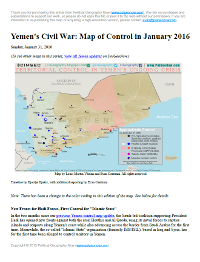
Map of territorial control in Yemen as of January 31, 2016, including territory held by the Houthi rebels and former president Saleh's forces, president-in-exile Hadi and his allies in the Saudi-led coalition and Southern Movement, Al Qaeda in the Arabian Peninsula (AQAP), and the so-called Islamic State (ISIS/ISIL). Includes recent areas of fighting, such as Aden, the Bab al-Mandeb Strait, Dhubab, Hanish Island, Harad, Maydee, Mukallah, and more.

Subscribe for full access to all conflict map reports!

Download PDF:
Buy now

Timeline by Djordje Djukic, with additional reporting by Evan Centanni; map by Louis Martin-Vézian and Evan Centanni

In the two months since our previous Yemen control map update, the Saudi-led coalition supporting President Hadi has opened new fronts against both the rival Houthis and Al Qaeda, using its naval forces to capture islands and seaports along Yemen’s coast while also advancing across the border from Saudi Arabia for the first time. 

Meanwhile, the so-called “Islamic State” organization (formerly ISIS/ISIL), based in Iraq and Syria, has for the first time been alleged to control territory in Yemen.

See all this and more on the newest update to PolGeoNow’s Yemen territorial control map, which includes a timeline of changes and important events since our previous Yemen map report in November.

This map and report are exclusive premium content, available to paid subscribers or for individual purchase. Download PDF (US$19.99)

Want to see before you buy? Check out our most recent FREE SAMPLE Yemen map report!

Exclusive map report includes:

  • Up-to-date map of current territorial control in Yemen, color-coded for the pro-Hadi coalition, Houthi/Saleh forces, Al Qaeda in the Arabian Peninsula (AQAP), and “Islamic State” (ISIS/ISIL).
  • Color scheme newly updated for consistency with Syria, Iraq, and Libya map series
  • Detailed indication of town-by-town control, including provincial boundaries, all major cities, and many smaller ones
  • Markers for key areas of recent fighting such as Aden, the Bab al-Mandeb Strait, Dhubab, Hanish Island, Harad, Maydee, Mukallah, and more
  • Timeline of changes to the situation since November 2015, with links to sources

MEMBERS CLICK HERE TO PROCEED TO ARTICLE AND MAP

Not a member yet? Click here to learn more about our professional subscription service!

2015: The Year in Political Geography Changes

Premium members click here to view this article in the ad-free members area. Not a member yet? Learn about PolGeoNow subscriptions!

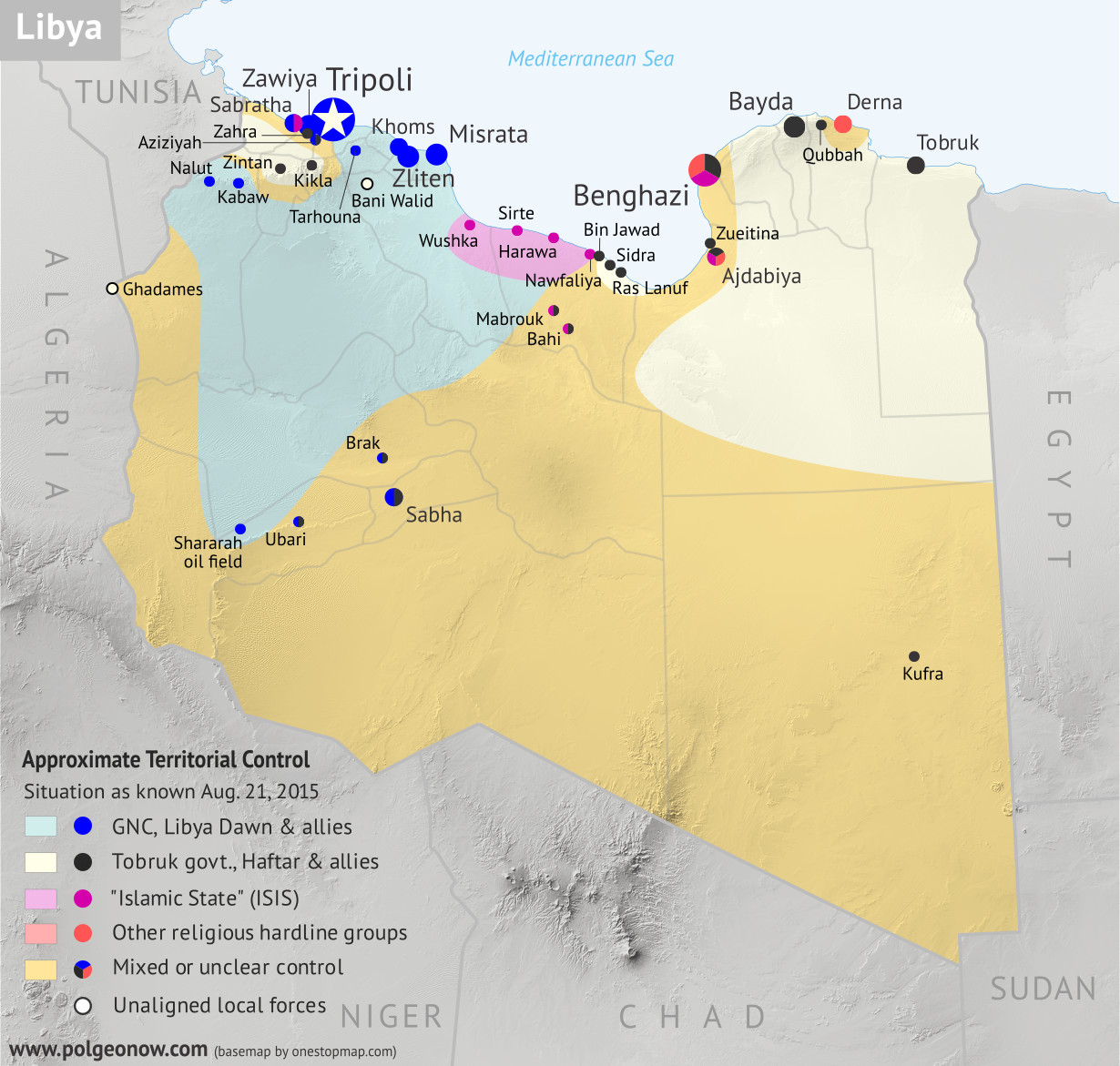
Libya control relief map: Shows detailed territorial control in Libya's civil war as of August 2015, including all major parties (Tobruk government, General Haftar's Operation Dignity forces, and Zintan militias; Tripoli GNC government, Libya Dawn, and Libya Shield Force; Shura Council of Benghazi Revolutionaries and other hardline Islamist groups; and the so-called Islamic State). Also file under: Map of Islamic State (ISIS) control in Libya.
Rival government and “Islamic State” (ISIS) control in Libya, August 2015 (click for free full-size map and article)

Inside this Review of 2015:

  • New countries, breakaway states, and micronations
  • Country name, capital, and flag changes
  • Border changes and disputed territories
  • Countries joining international organizations
  • Recognition of disputed countries
  • Rebel control in conflict zones
  • Sea borders and seabed claims
  • New states and provinces
  • Currency changes
  • World time zone changes

    It’s PolGeoNow’s mission to track changes to the world’s countries, borders, and territories, whether it’s happening formally on the books or unofficially on the ground. When new countries appear, borders change, and territorial disputes arise or are settled, you’ll hear about it here. With 2015 now concluded, here’s our look back at the events of the year!

    (For extra coverage of political geography events in 2016, follow us on Twitter!)

    Declarations of Independence: New Countries in 2015?

    The past year came and went without any major, credible claims of new countries. This was a big contrast to 2014, which saw declarations of independence coupled with real territorial control for Crimea, Donetsk, and Lugansk, all undisputed parts of Ukraine until then, plus the so-called “Islamic State” (formerly ISIS/ISIL) carved out of Iraq and Syria. While the Republic of Crimea ceased to exist after controversially merging into Russia shortly after declaring independence, the “Islamic State”, Donetsk, and Lugansk are still holding out today. The two Ukraine breakaways are settling into place under a long-term ceasefire, though in 2015 they gave up their aspirations of forming a united country called Novorossiya (“New Russia”).

    Map of rebel control in Ukraine in 2015, showing the areas claimed by the breakaway Donetsk and Lugansk People's Republics.
    Actual territorial control of the proclaimed Donetsk and Lugansk People’s Republics (formerly “Novorossiya”)

    While highly autonomous Iraqi Kurdistan and semi-independent Cook Islands both talked in 2015 about seeking full independence, no major moves came from either of them. In an echo of an aborted 2014 attempt at independence, rebels in the Central African Republic declared the autonomous “Republic of Logone“, but stopped short of claiming full independence. Meanwhile, in Fiji a project to carve out two anti-Muslim “Christian states” managed to be taken seriously enough for the country’s government to launch a police crackdown on the separatists.

    And as usual, the big dreamers of the world were not to be discouraged. In April, a small-time politician from the Czech Republic declared a new tax-free, bitcoin-trading libertarian country called “Liberland”. His would-be territory? A patch of technically-unclaimed land along the disputed border of Serbia and Croatia. As so-called “micronations” go, Liberland is having a pretty good run, prompting (critical) comments from established countries, accumulating tens of thousands of “citizenship applications”, and reportedly gaining recognition from 2014’s celebrity micronation – the “Kingdom of North Sudan” as claimed by an American seeking to make his daughter into a real princess.

    Map of the territorial control (Assad government, Islamic State/ISIS/ISIL, rebel, SDF, and Kurdish) in the Syrian Civil War as of December 9, 2015
    The “Islamic State” (in purple) controls much of former Syria

    As with all micronations, recognized countries are having none of Liberland’s independence claims, with its leadership repeatedly barred from entering the “country” by Serbian and Croatian authorities, who fully expect the border territory to be granted to one of them once they properly agree on their national boundary. It has also been widely denounced as a scam by other micronations, after unrealistically offering citizenship (at a hefty fee) to thousands of desperate Syrian and Libyan refugees.

    Regardless, Liberland has served as an inspiration for other would-be micronationalists: A group of Polish tourists soon after declared the state of “Enclava” in what they thought was neutral ground between Slovenia and Croatia, before being shut down by the Slovenian government and re-declaring their nation on a patch of ground near Liberland’s. Meanwhile, in June a Bulgarian businessman declared the “Principality of New Atlantis” on behalf of a floating raft of lava rock in international waters near New Zealand (which he has presumably not visited), after never hearing back from the Bulgarian government on his suggestions to annex it to Bulgaria.

    See all previous and future articles on newly declared countries

    Country Name, Capital & Flag Changes

    Just as in 2014, no official changes to country names, capitals, or flags came to our attention in 2015. However, each of those things almost happened:

    In December, the idiosyncratic dictator of the Gambia declared his country an “Islamic republic”, with some sources saying the country’s official name would be changed from Republic of the Gambia to Islamic Republic of the Gambia. However, as far as we can tell no name change has been registered formally, either with the UN or through legislation. Meanwhile, while not usually considered a “country”, the Boko Haram rebel group that controls territory in Nigeria has taken to calling itself the “Islamic State West Africa Province” (ISWAP) after purportedly joining the Syria- and Iraq-based “Islamic State” (ISIS) organization in March.

    Earlier in the year, Yemen’s internationally-recognized president declared that his capital had moved from Sana’a (currently occupied by the Houthi rebels) to the southern port city of Aden. However, this hasn’t formally come to pass either, and he may have been speaking figuratively anyway – certainly his government, if it’s currently based in Yemen at all, would for practical purposes be located in Aden for now.

    PolGeoNow maps of territorial control in Yemen

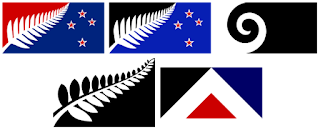
    Graphic illustrating the five flag designs up for a vote in New Zealand's November-December 2015 flag referendum: Silver Fern (Black and White), Silver Fern (Red, White and Blue), Silver Fern (Black, White, and Blue), Koru (black), and First to the Light (Red Peak)
    New Zealand voted on five proposed designs for a new flag

    There was actually quite a bit of flag news in 2015, with both Fiji and New Zealand preparing for potential changes to their flags. While Fiji’s planned flag update got delayed into 2016 pending a decision by the country’s military government, New Zealand’s democratic flag-replacement process moved forward with a nationwide referendum in November and December. In the vote, New Zealanders chose one design for the potential new flag, with the new proposal to go up against the existing flag in a second vote this March.

    We also reported in 2015 on a small change to Paraguay’s flag made two years earlierone of the many quiet flag changes that didn’t come to our attention until well after the fact.

    Everything you need to know about New Zealand’s 2015 flag referendum

    See all flag change articles on PolGeoNow

    Map of the Cooch Behar enclaves (chitmahals) traded between India and Bangladesh in 2015
    Map showing most of the Indian and Bangladeshi enclaves. By Jeroen (source). License: CC BY-SA

    Border Changes and Disputed Territories

    Summer 2015 saw a long-awaited major change to the border between India and Bangladesh, when the two countries traded over 100 enclaves (pieces of territory surrounded entirely by territory of the other country). Known as the Cooch Behar Enclaves or “chitmahals”, these “islands” of Indian territory in Bangladesh and Bengladeshi territory in India formed the majority of all the world’s national-level enclaves, but have now been mostly erased in an effort to simplify the border. Stay tuned to PolGeoNow in the near future for a full report on the border change, with a before-and-after map of the differences!

    Meanwhile, December 2015 saw the resolution of a small border dispute between Costa Rica and Nicaragua. A ruling from the UN’s International Court of Justice (ICJ) sided mostly with Costa Rica in the disagreement over administration of a small island near the mouth of the San Juan River. Niger and Burkina Faso also concluded arrangements to implement their own border deal based on another ICJ ruling from 2013 (map of the the Niger-Burkina Faso border dispute and resolution).

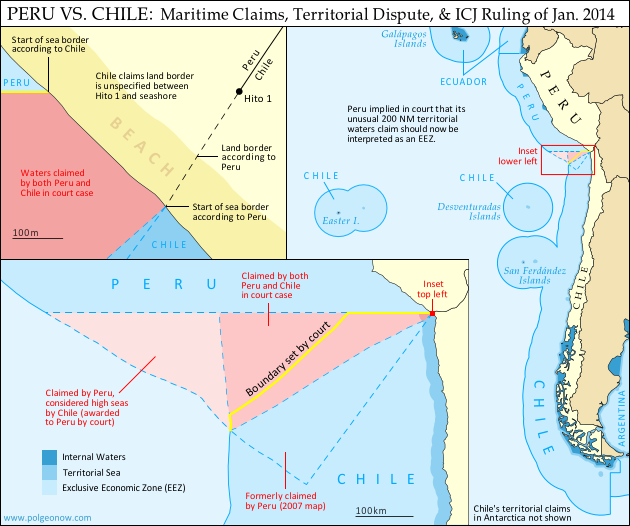
    An apparent border dispute arising between Nigeria and Benin may have been new in 2015 (PolGeoNow is currently looking into it), while Peru and Chile’s disagreement over a tiny piece of coastal land gained prominence a year after an ICJ ruling settled their adjacent sea border (map of Peru-Chile sea dispute, resolution, and remaining land dispute).

    Map of Chile and Peru's territorial waters and exclusive economic zones (EEZ), plus the details of their territorial dispute at sea and disagreement of the land border. Shows the results of the Jan. 27, 2014 ruling by the International Court of Justice (ICJ) settling the dispute.

    Meanwhile, territorial disputes over the Falkland Islands (UK-Argentina), the Senkaku/Diaoyu Islands (China-Japan-Taiwan), and the islets of the South China Sea (China-Philippines-Vietnam etc.) continued to be hot issues in 2015, while old disputes over Gibraltar (UK-Spain) and Machias Seal Island (USA-Canada) escalated slightly. A low-level territorial dispute along the coastline of India and Pakistan also made news after reports that hundreds of fisherman had been jailed for crossing carelessly or accidentally into the disputed zone.

    See Also:
    Why are the Falkland Islands so important? Map of the Falklands’ disputed seas
    Map of the uninhabited Senkaku/Diaoyu Islands, disputed between China and Japan
    Just how small are the disputed Senkaku/Diaoyu Islands? Aerial photos of each island

    See all articles on disputed territories

    Intergovernmental Organizations

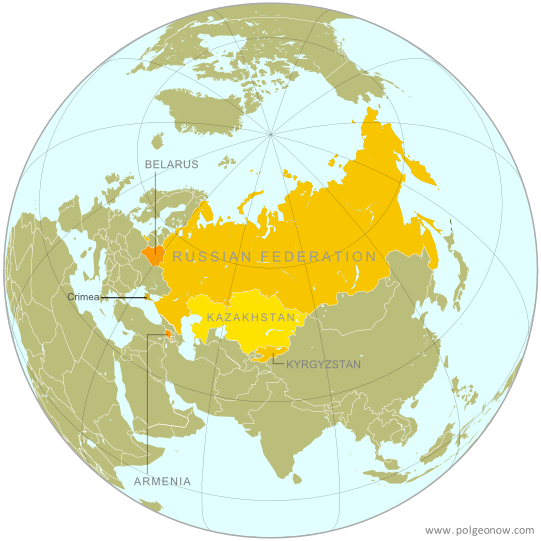
    Map of the Eurasian Economic Union (EEU), also known as the Eurasian Union. Includes new member Kyrgyzstan, as well as prior members Russia, Belarus, Kazakhstan, and Armenia, and disputed territory Crimea
    The newly founded “Eurasian Union” (free map)

    As in other years, 2015 brought many changes to countries’  membership in intergovernmental organizations:
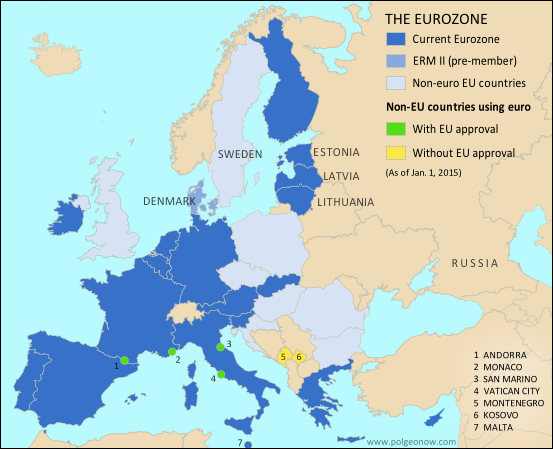
    Map of the Eurozone (euro area), showing which countries use the euro as their currency. Includes members, pre-members (ERM II), EU non-members using the euro, and other EU countries (colorblind accessible).
    Lithuania joined the Eurozone amid threats of Greece leaving (free map)

    In related news, disputed Kosovo was narrowly denied membership in UNESCO, while Bolivia was approved for membership in Mercosur, pending ratification by Brazil and Paraguay. Meanwhile, African countries agreed in principle to the creation of a massive free trade area spanning the length of the continent, while European integration degraded as some border controls in the free-movement Schengen Area were reactivated, border fences went up on the edges of the area, and (so far unrealized) fears arose that Greece would be forced to leave the Eurozone.

      See all intergovernmental organization articles

      Diplomatic Recognition

      As usual, 2015 saw several small changes in diplomatic recognition for the world’s disputed, partially recognized countries.

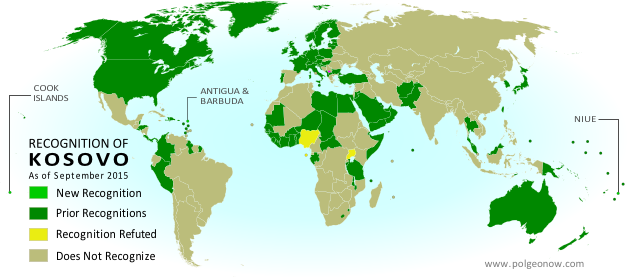
      Map of countries that recognize Kosovo as independent, updated for 2015.
      Map of which countries recognize Kosovo at the end of 2015 (free map)

      Kosovo received the most recognitions of any disputed country in 2015, though only narrowly, with its proclaimed independence newly acknowledged by UN member Antigua and Barbuda plus semi-independent non-UN countries Cook Islands and Niue (both loosely associated with New Zealand). This was a continued slowdown from 2014, when Kosovo received four new recognitions.

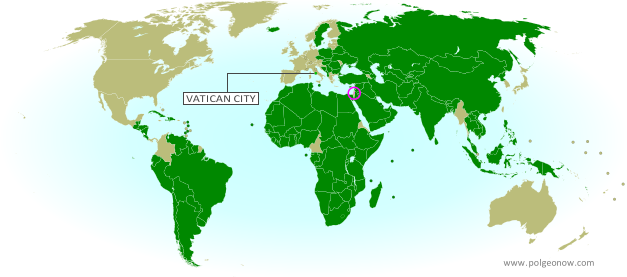
      Palestine also was only recognized by one more UN member country in 2015, the Caribbean island of St. Lucia. However, a bigger win for Palestine came from the non-UN side, when the Holy See (administration of the Catholic Church and Vatican City) clarified its own recognition of Palestine for the first time. By the numbers, this year was a slight improvement for Palestine over 2014, when it also received one UN-member recognition but nothing else. In a trend continuing from 2014, at least three more European countries’ legislatures – those of Belgium, Italy, and Greece – passed symbolic votes supporting the recognition of Palestine; however, their governments stopped short of actually extending recognition.

      Map of countries that recognize the State of Palestine as an independent country, updated for June 2015 with recent addition Vatican City (Holy See) highlighted
      Map of which countries recognize Palestine as independent
      (free map)

      The Sahrawi Arab Democratic Republic (SADR), claimed independent government of Western Sahara, saw a small uptick in official support, with African island country Mauritius reinstating recognition after “withdrawing” it the previous year. The SADR had seen a similar slight improvement to recognition in 2014, with Mauritius’s initial withdrawal offset by reinstatements from two other countries.

      In related news, the US and Cuba reestablished full diplomatic relations for the first time in half a century (though they technically already recognized each other as countries), and Palestine successfully argued that UN Observer States (currently just Palestine and the Holy See/Vatican City) should have their flags flown alongside those of UN member countries at the United Nations headquarters in New York.


      See all articles about diplomatic recognition
      See all articles about unrecognized or partially-recognized countries

      Territorial Control

      Map of Islamic State and Kurdish control in Iraq as of May 2015
      Islamic State and Kurdish control in Iraq
      (free map)

      When it came to rebel control of territory in 2015, headlines continued to be dominated by the Syrian Civil War, where rebels consolidated their power in the northwest, while Kurdish-led forces dealt significant defeats to the so-called “Islamic State” (IS, formerly ISIS) along the northern border with Turkey, even as IS fighters staged a rapid takeover of the expansive but sparsely-inhabited Syrian Desert region. A tiny Turkish enclave in Syria, the Tomb of Suleyman Shah, was also moved by Turkey to avoid damage from IS forces. In neighboring Iraq, changes to territorial control were fewer and farther between, with major events including the government recapture of Tikrit, and the loss of Anbar provincial capital Ramadi to IS, followed by its recapture at the end of the year.
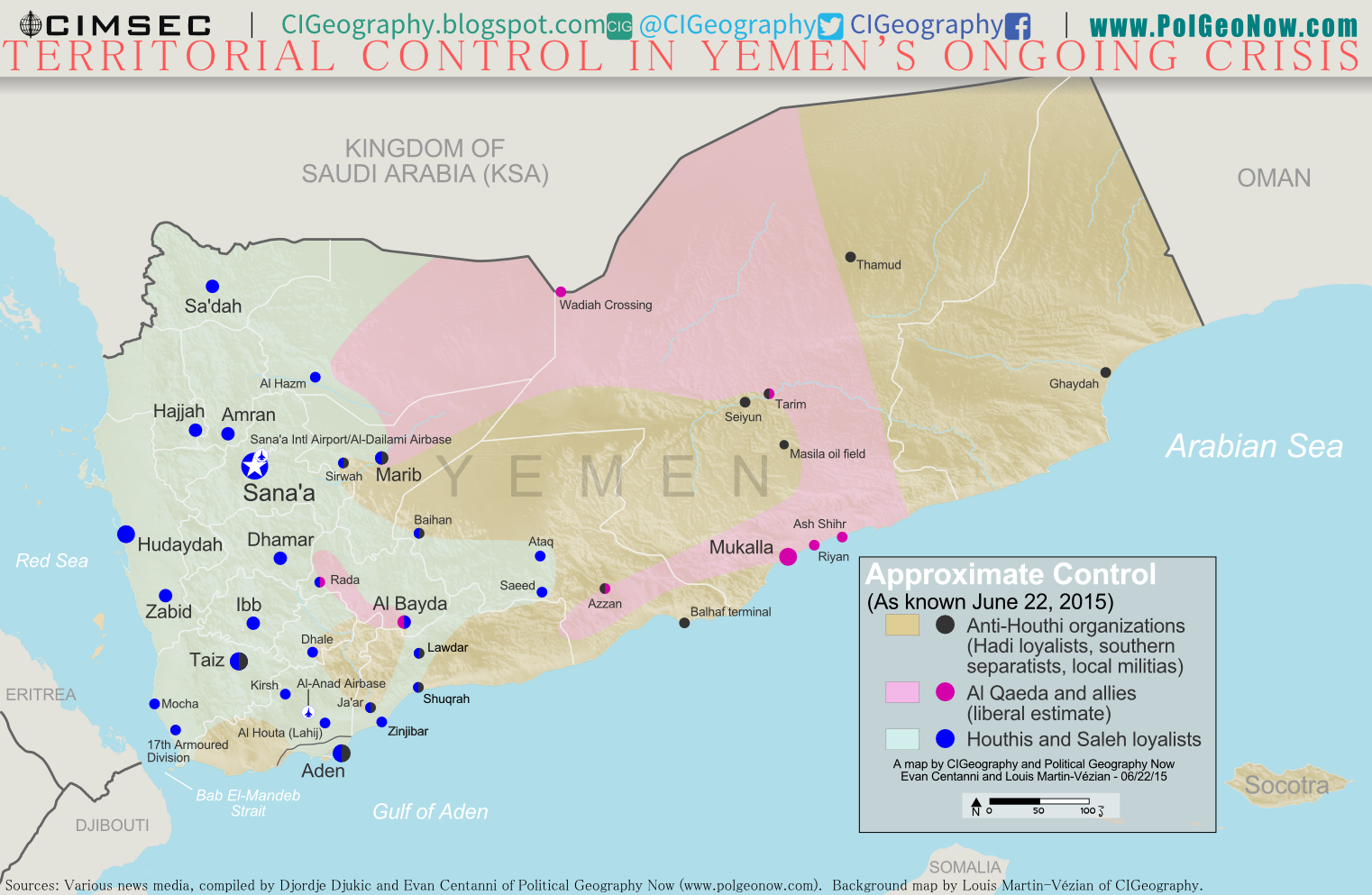
      Map of territorial control in Yemen as of June 22, 2015, about two months into Saudi Arabia's military intervention, including territory held by the Houthi rebels and former president Saleh's forces, president-in-exile Hadi and the Southern Movement, and Al Qaeda in the Arabian Peninsula (AQAP).

      PolGeoNow also began renewed coverage of Yemen in 2015, as the Houthi rebels expanded their power beyond the capital city of Sana’a and all the way to the southern port city of Aden, even as Al Qaeda’s local affiliate once again captured much of the country’s southeast. The intervention of Saudi Arabia and allies, in what has come to be seen as a Saudi-Iranian proxy war, successfully pushed back the Houthis from southern Yemen, but at the end of the year they were still firmly in control of the capital and many other areas. Some reports claimed that a new rebel group had seized territory across the border in Saudi Arabia itself, but the claims have so far been impossible to confirm.

      Long awaited map coverage of Libya’s new civil war also came to PolGeoNow in 2015, with our first map of control by rival governments and the “Islamic State” published for free in August. Meanwhile, fighting between Ukraine‘s government and Russia-backed separatists came nearly to a halt early in the year, with the signing of a ceasefire deal that has more or less held until today. Separatist rebels in Mali saw scattered challenges to their partial control of the country’s far north, but fighting there also largely ended after a peace deal.

      Map of Boko Haram control in Nigeria in March 2015, and the multinational offensive with Cameroon, Chad, and Niger that drove the rebels back.
      Nigeria, Chad, and Niger took back much of Boko Haram’s territory in 2015

      Nigeria, on the other hand, had a very eventful year in its fight against the Boko Haram rebels, who were purportedly accepted as an affiliate of the so-called “Islamic State”. The religious extremist group held large parts of Nigeria’s Borno and Yobe states at the beginning of 2015, but was nearly stripped of all control after a regional coalition force struck quickly from multiple directions. By late 2015, the group was thought to maintain control of only a few small towns, if anything at all. Regardless, the new President Buhari’s promise to defeat the rebels by the end of the year rang hollow, with bombings and other attacks continuing unabated.

      Meanwhile, Afghanistan has seen an upsurge in territorial control by the Taliban rebels, as well as activity from groups associated with the so-called “Islamic State”.  Most notably, Taliban fighters captured provincial capital Kunduz in late September, before withdrawing under heavy counterattacks a couple weeks later. A brand new map of territorial control in Afghanistan is in the works as you read this, so stay tuned our PolGeoNow’s coverage in the new future!

      Much of South Sudan remained contested between the government and rebels in 2015, while the country moved slowly toward a more stable peace deal, and nearby Central African Republic also saw some small changes to territorial control for its Seleka rebel group. To the east, Al Qaeda-affiliated Al Shabaab rebels continued to contest territory in Somalia and even Kenya, even as factions of their own group splintered off to join the “Islamic State” (and reportedly captured at least one town).

      Map of territorial control in Mali as of June 2015. Includes separatist rebel control (CMA, MNLA, MAA, HCUA) and locations of UN peacekeeper (MINUSMA) deployments, as well as the location of a brief takeover by Al Qaeda in the Islamic Maghreb (AQIM).

      Elsewhere in Africa, rebels continued to contest territory in southern Sudan and the country’s western Darfur region, and eastern Democratic Republic of the Congo remained under the ever-shifting control of dozens of different armed groups. Burundi and Burkina Faso saw buildings in their capitals briefly occupied by armed opposition in purported coup attempts, while Mozambique’s government continued to clash with Renamo rebels working out of isolated bases.

      In Southeast Asia’s Myanmar (Burma), decades-long fighting continued between the government and rebel groups, notably including the major territory-holding Kachin Independence Army, while a long-dormant conflict reignited with another rebel group in the Kokang region. Meanwhile, increasing organized crime in Central America’s El Salvador resulted in some describing much of the country as “under the control” of gangs, though it was unclear exactly what kind of “control” this was.

      See all articles on countries with divided territorial control 
      See all FREE territorial control maps on PolGeoNow

      Sea Borders and Claims

      Jurisdiction over much of the world’s oceans is still unresolved, with neighboring countries often disagreeing on where the lines fall between their respective waters, which include both territorial seas (a thin strip along the coast) and exclusive economic zones (EEZ; a much wider band where they have economic control but not full sovereignty). Though considerably less active than 2014, the past year continued to see its share of changes to these maritime claims.

      In the realm of friendly boundary negotiation, Barbados agreed on an official sea border with St. Vincent and the Grenadines, while the Philippines and disputed Taiwan resolved a fisheries conflict with a cooperation agreement, but stopped short of defining a formal international boundary. [Update 2016-02-26: France and Italy also signed an important, but under-reported, treaty to define their sea border in the Mediterranean.]

      International treaty defines how much of the sea countries can claim for their own.
      (author and license information)

      International law allows countries to claim rights to resources on the “continental shelf” well beyond the 200 nautical mile limit of their EEZs, and many countries were still in the process of doing so in 2015. Early in the year, Russia submitted its formal claim to an area of seabed under the North Pole, after earlier making a more modest claim in the Arctic Ocean (Denmark, via autonomous Greenland, submitted its own claim to the North Pole seabed a few months before). Brazil also submitted a formal claim to an area of seabed in the South Atlantic, and while 2009 Pakistan’s claim to part of the Arabian Sea bed was officially endorsed by the UN body that regulates continental shelf claims.

      However, not all interaction related to the seas this year was friendly. Among other events, a long-standing dispute over the Caribbean waters off Venezuela and Guyana began to get nasty, Somalia and Kenya talked tough over a pending court case to resolve their sea boundary, and Libya accused Italy of violating its territorial waters.

      See all articles on maritime borders and jurisdiction

      Provinces and States

      Though creating a new U.S. state is a major legislative ordeal, many countries’ provinces and other divisions are created, redrawn, or abolished at will. The many changes to the world’s administrative subdivisions can be hard to keep track of, but luckily we have the wonderful Statoids website to help with that.

      The newly created provinces of Nepal
      Map by Aotearoa (source; CC BY-SA)

      In 2015, Italy, Morocco, Nepal, and the UK region of Northern Ireland all conducted complete overhauls of their subnational divisions, replacing old provinces or equivalents with new systems of administrative units. The Democratic Republic of the Congo also nearly doubled its number of provinces in a major reform, while the president of civil war-stricken South Sudan controversially announced that he was nearly tripling the country’s provinces (however, the move met with heavy opposition and probably hasn’t gone into effect).

      Additionally, the Negros Island Region became the Philippines’ 18th region (a division above the province level), and Rumonge became the 18th province of Burundi. Just before the beginning of the year, Taiwan’s Taoyuan County was upgraded to become the disputed country’s sixth province-level “special municipality”, and renamed Taoyuan City (previously the name of one of its subdistricts).

      The new Negros Island Region of the Philippines. Map by Roel Balingit (source) CC BY-SA

      In the world of sub-province-level divisions, there are almost certainly many changes that slipped through without being noticed in 2015, but there are a few we heard about: France shuffled around its some of its districts, Luxembourg merged two of its “communes” (something like a township), and Peru created a new district in a tiny patch of land disputed with Chile (left with unclear status after the two countries settled a territorial sea dispute in court).

      Meanwhile, in the US, the state of South Dakota’s Shannon County changed its name to Oglala Lakota County to better represent its indigenous population, and Alaska’s Wade Hampton Census Area (a statistical unit equivalent in scale to a county) had its name changed to Kusilvak Census Area. Wade Hampton was a pro-slavery politician in the US South who only had the region named after him because his son-in-law served as a judge in a nearby Alaska town.

      Though not technically an administrative subdivision, we’d be remiss not to mention the Kooki Chieftanship’s secession from the Buganda Kingdom – the two being semi-official traditional monarchies within Uganda, exercising limited local powers.

      Currency Changes

      The Zimbabwe dollar was retired after losing most of its value

      The past year brought one major change to the world’s money system: The Zimbabwe dollar was formally demonetized at the end of September, meaning that it’s been erased from the list of currencies used as legal tender in the world’s countries. Zimbabwe had already been phasing out its dollar for some time, in favor of more stable foreign currencies.

      Time Zones

      Several changes to the world’s time zones happened in 2015. First, Mexico created a new time zone for the state of Quintana Roo, moving the clocks in tourist resort-town Cancun one hour forward to match US Eastern Time, where many of the state’s visitors originate.

      Then, North Korea added a whole new time zone to the world map, setting its clocks back 30 minutes from South Korea and Japan, to become the only place where standard time is 8 1/2 hours ahead of UTC (formerly Greenwich Mean Time). Meanwhile, Australia deleted a world time zone when it approved a time change for the tiny territory of Norfolk Island, once the only place in the world at +11 1/2 hours, which is now at +11 along with much of the Melanesia region. It also aligns with southeastern Australia part of the year, when some provinces go forward an hour for Daylight Savings Time while Norfolk keeps its clocks the same.

      Updated map of the time zones of the world by TimeZonesBoy (click for full map and license information)

      Chile also effectively changed its time zone by deciding to never end Daylight Savings Time (DST), leaving it at -3 hours for the whole year instead of switching back to -4 in the winter (distant Easter Island, also part of Chile, will stay at -5 hours instead of switching back to -6).

      Meanwhile, Uruguay is also now permanently at -3 after abolishing DST, which used to move it ahead to -2 in the summer. Mongolia, for its part, reintroduced DST after a history of switching back and forth, while the British Caribbean territory of the Cayman Islands introduced DST for the first time.

      In other time zone changes, the US town of Metlakatla switched from Pacific Time (-8) to Alaska Time (-9), while the Canadian town of Fort Nelson switched from Pacific Time (-8) to Mountain Time (-7). Turkey and Palestine changed the dates that Daylight Savings Time was in effect, and Egypt planned to observe DST in 2015, but changed its mind in the face of public opposition.

      What major political geography events will happen in 2016?

      Stay tuned to PolGeoNow for quality maps and reporting! Also, don’t forget to follow us on Twitter for extra reporting on world events, and add us on Facebook or Tumblr to get updates when new articles are published!

        How Many Countries Are There in the World in January 2016?

        There are newer editions of this article available. To find the most recent, view all “How Many Countries in the World” updates!

        This article was first published in 2011, and the version below was last updated in January 2016 for South Sudan’s admission as an Olympic Nation

        How many countries in the world?
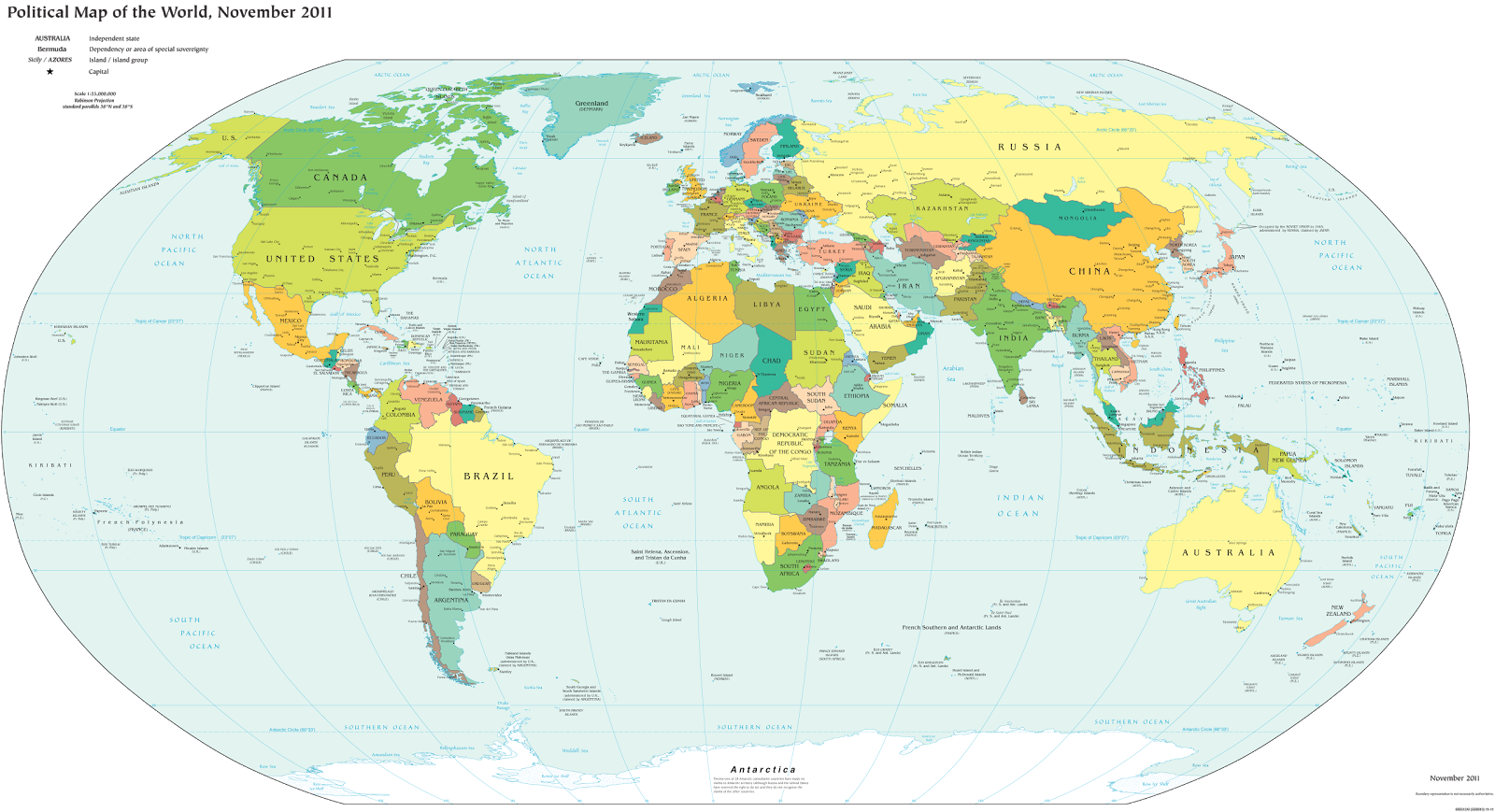
        A world political map published by the U.S. government (public domain)

        One of the most basic questions for map-lovers is, “How many countries are there in the world?” But anyone who replies with a simple number is leaving out part of the story. The fact is, the answer depends heavily on how you define “country”.

        Here are six of the most common answers, each correct in its own way:

        195 Sovereign States According to the UN
        “Country” and “nation” are casual words for what political scientists call a “sovereign state”, meaning a place with its own borders and completely independent government. The question of which places count as sovereign states can be controversial, but for starters we can count all the member and observer countries of the United Nations (UN):

        UN Members: 193
        UN Observer States: 2
        Total: 195

        These countries mostly all accept each other as sovereign states, and they’re the ones you’ll see on most world maps and many lists of the world’s countries. Most of the countries you’ve ever heard of are probably members of the UN, and the two UN Observer States are Vatican City (represented by the Holy See) and Palestine. If you want to know the names of all 195, Wikipedia has a complete list.

        The last addition to the list was in 2012, when Palestine became a UN Observer State, and the last country to join the UN as a full member was South Sudan in 2011.

        Note: Palestine’s status as a UN Observer State is controversial, so some lists may still only include 194 countries.

        201 States With At Least Partial Recognition
        Several more country candidates are left out of the UN itself, but are still officially acknowledged by at least one UN member (this kind of official acceptance is called “diplomatic recognition“). These controversial countries are usually labeled on world maps as disputed territories or special situations, if they’re on the map at all.

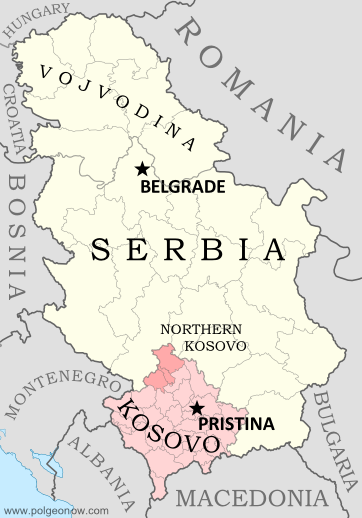
        Map of Serbia, Kosovo, and North Kosovo
        Kosovo is claimed by Serbia, but recognized as independent by over 100 countries.

        UN Members: 193
        UN Observer States: 2
        States With Partial Recognition:
        Total: 201

        The six non-UN states with partial recognition are Taiwan, Western Sahara, Kosovo, South Ossetia, Abkhazia, and Northern Cyprus. All of these are claimed as parts of other countries, but aren’t actually controlled by them (at least not completely). The number of UN members recognizing them varies, from just one for Northern Cyprus to over 100 for Kosovo.

        A few lists also include the Cook Islands and Niue as partially-recognized states. These two places sometimes act like independent countries, but they’ve never actually declared independence or tried to join the UN, and are usually considered overseas territories of New Zealand.

        204-207 De Facto Sovereign States
        But wait, there’s more! Those six partially recognized countries aren’t the only breakaway states with full self-governance. There are at least three more declared countries that aren’t recognized by any UN members at all, but still operate independently from the countries that claim them. These are often called “de facto” sovereign states, a fancy Latin way of saying that they’re independent countries in actual fact, even if not on paper.

        UN Members: 193
        UN Observer States: 2
        States With Partial Recognition:
        Unrecognized de facto Sovereign States: 3 to 6 (see below)
        Total: 204 to 207

        The three places most often considered de facto independent countries are Nagorno-Karabakh, Transnistria, and Somaliland. And since 2014 there are three more contenders for the list: the Islamic State, the Donetsk People’s Republic, and the Lugansk People’s Republic. But because these last three are located in active war zones and have only limited government structures, there’s some debate over whether they count even as de facto countries.

        Tiny “micronations” declared by individual people are usually not taken seriously enough to count on the list. The closest contender would be Sealand, but it’s debatable whether this tiny “nation” really counts as having a territory, population, or government, all key ingredients for a sovereign state.

        There are also many rebel-held territories (and fully self-governing areas like Puntland) that aren’t controlled by any country, but are left off the list because they aren’t trying to become independent countries. They agree in principle to be part of the country they’re in, even though they might disagree about who should be in charge or how the country should be governed.

        206 Olympic Nations
        Lots of people learn about the world’s list of countries by watching the Olympic Games every two years. If you’re one of them, you might be confused at why the Olympic Parade of Nations claims over 200 members, even though your atlas only has 195.

        This is because the Olympics didn’t always require applicants to be independent countries. Dependent territories with partial self-government have sometimes been approved by the International Olympic Committee (IOC), and a couple of the partially-recognized states mentioned above have also managed this.

        Olympic Nations that are UN Member States: 193
        Olympic Nations that are UN Observer States: 1
        Olympic Nations that are Partially-recognized States: 2
        Olympic Nations that are Dependent Territories: 10
        Total IOC-Recognized Olympic Nations: 206

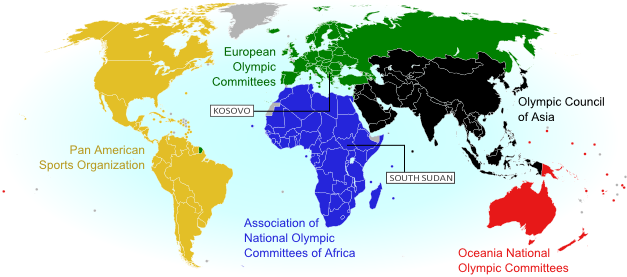
        World map showing the five continental associations of National Olympic Committees, including all nations eligible for the Olympic games
        The Olympics include most of the world’s independent countries, and some dependent territories too.

        About half of the dependent territories in the Olympics are overseas possessions of the US (such as Puerto Rico) and of the UK (such as Bermuda), and some nearly-independent “countries” such as the Cook Islands (New Zealand) and Aruba (the Netherlands) are included as well.

        Every UN member country is also in the Olympics, with the latest addition, South Sudan, joining in August 2015.  The one UN Observer State in the Olympics is Palestine; Vatican City isn’t interested. As for the two partially-recognized IOC members, Kosovo just became an Olympic Nation in 2014, and Taiwan has been a member for some time, but has to call itself  “Chinese Taipei” after a deal struck with China in the 1980s.

        See Also: Parade of Nations: Which Countries Are (and Aren’t) in the Olympics

        209 FIFA Countries Eligible for the World Cup
        Soccer, or football as it’s known outside North America, is the world’s most popular sport, and most international matches all the way up to the World Cup are regulated by an organization called FIFA. If you’re a soccer superfan, you might know there are 209 member countries that compete in FIFA matches (though most don’t make it to the World Cup). This is even more than the number of Olympic Nations, and certainly more than the number of independent countries on most world maps.

        Like the Olympics, FIFA didn’t always require independence or international recognition of its member states. Now it’s a bit stricter, but any team that’s already a member is allowed to stay. And based on European tradition, FIFA allows England, Scotland, Wales, and Northern Ireland to compete as separate teams, even though they’re all part of the UK.

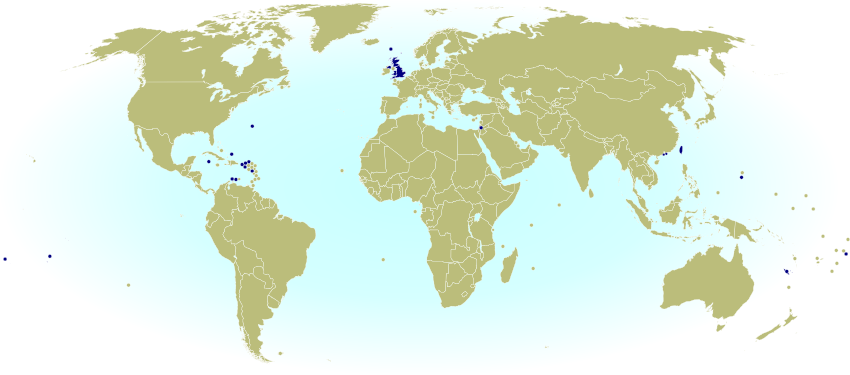
        World map marking dependent territories, partially recognized sovereign states, and subnational entities that have national football (soccer) teams recognized by FIFA, making them eligible for the World Cup.
        Map of FIFA members that aren’t recognized as independent countries by the U.N.

        Teams of UN Member States: 186
        Teams of UN Observer States: 1
        Teams of Partially Recognized States: 1
        Teams of UK Constituent Countries: 4
        Teams of Dependent Territories: 17
        Total FIFA Member Associations: 209

        You may notice that not all of the 193 UN member states are included. That’s because several very small countries aren’t members, plus the UK is replaced by its four “constituent countries”, which aren’t UN members on their own.

        See Also: Which Countries Are (and Aren’t) Part of FIFA?

        249 Country Codes in the ISO Standard List
        Have you ever been filling out an internet form, and had to choose from a surprisingly long list of countries? You were probably looking at the international standard “country code” list, officially known as ISO 3166-1. Many companies and other organizations adopt this standard list rather than spending their own time compiling one. The standard also includes convenient two-letter codes for each country, like us for the United States, de for Germany, and jp for Japan, which you might recognize from web addresses specific to those countries.

        This ISO standard is based on an official list kept by the UN….but then why on Earth are there 249 country codes? That’s way more than the total number of UN member and observer countries! Well, the standard list does leave out some breakaway states not recognized by the UN, but makes up for it by listing dependent territories separately from their mother countries. So there are country codes not only for actual countries, but also for nearly-independent states, overseas territories, uninhabited islands, and even Antarctica! This is important because organizations might need an option for every place that any person is located, and dependent territories often aren’t technically part of the countries they belong to.

        UN Members: 193
        UN Observer States: 2
        States With Partial Recognition:
        Inhabited Dependent Territories: 45
        Uninhabited Territories: 6
        Antarctica: 1
        Total: 249

        So there you have it! Next time someone tells you “There are X countries in the world,” remember that the real answer isn’t so simple!

        War in Iraq: Map of “Islamic State” Control in December 2015 (Subscription)

        MEMBERS CLICK HERE TO PROCEED TO ARTICLE AND MAP

        There are newer versions of this map available. To see them, view all Iraq updates.

        Detailed map of territorial control in Iraq as of December 23, 2015, including territory held by the so-called Islamic State (ISIS, ISIL), the Baghdad government, and the Kurdistan Peshmerga. Includes recent flashpoints including Ramadi, Baiji, Sinjar, and the Kirkuk-Daquq area.

        Subscribe for full access to all conflict map reports!

           Download PDF:
        Buy now

        Research and timeline by Djordje Djukic; map and additional reporting by Evan Centanni

        Though Iraq’s current war has been proceeding at a less-intense pace than Syria’s, there have been several important changes to territorial control in the past half a year, all involving the so-called “Islamic State” (ISIS) losing ground to the Iraqi government and Kurdistan’s Peshmerga force.

        See all this and more on the newest update to PolGeoNow’s concise, professional-quality Iraq control map, which includes a timeline of changes since our previous Iraq map report in July.

        This map and report are professional subscriber content, accessible to paid members or by separate purchase. Download PDF (US$19.99)

        Want to see before you buy? Check out our most recent FREE SAMPLE Iraq map report!

        Exclusive map report includes:

        • Up-to-date map of current territorial control in Iraq, color-coded for the Iraqi government, “Islamic State” (ISIS/ISIL) extremists, and Kurdistan’s Peshmerga forces
        • Detailed indication of town-by-town control, including provincial boundaries, all major cities, and many smaller ones
        • Markers for key areas of recent fighting such as Ramadi, Baiji, Sinjar, and more
        • Timeline of changes to the situation since July, compiled by our Iraq specialist, with links to sources 

        Note: Republishing rights are not included with PDF purchases or basic subscriptions. If you need to use one of our maps in print or online, contact service@polgeonow.com.

          MEMBERS CLICK HERE TO PROCEED TO ARTICLE AND MAP

          Not a member yet? Click here to learn more about our professional subscription service!