Brexit: 9 Geography Facts You Should Know About the Referendum and Britain’s EU Membership

(Subscribers click here to view this article in the members area.)

By Evan Centanni 

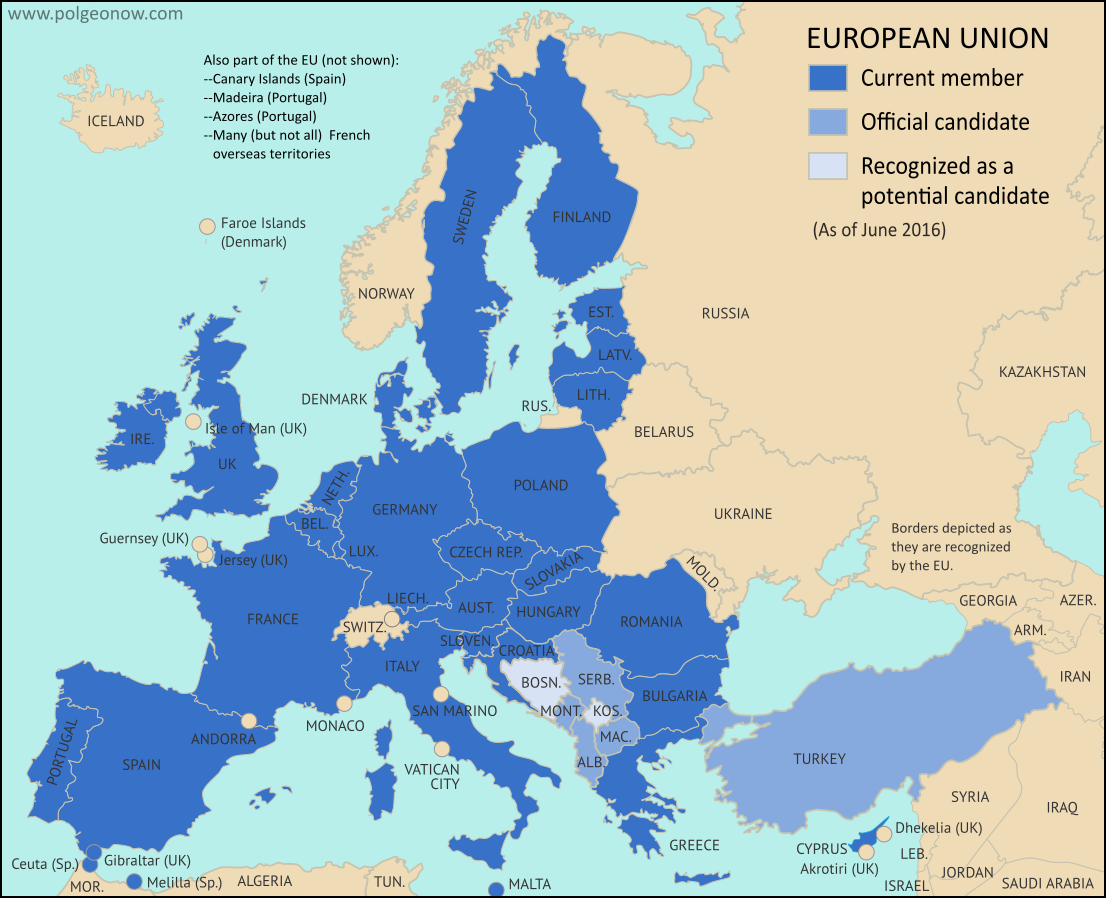
The European Union. Click for full map and list of members.

Today the UK is voting on whether to leave the European Union. If you’ve been paying attention to the news, you’ve probably heard about the intense debate over whether Brits should vote “Leave” or “Remain”. But if you’re like me and mainly in this for the geography trivia, here are some fun facts you might not know about the so-called “Brexit”:

1. The UK has been a member of the EU since before there was an EU

The European Economic Community (EEC), founded in 1957 for economic cooperation between democracies in Western Europe, was the predecessor of today’s European Union. The UK wasn’t a founding member of the EEC, but joined in the organization’s first wave of expansion in 1973, along with Ireland and Denmark (plus the British territory of Gibraltar and the Danish territory of Greenland). This made the UK automatically a member when the EEC and related organizations were relaunched as the more ambitious European Union in 1993.

2. Long before the UK wanted to leave the EU, France didn’t want to let it in

The UK chose not to join the European Economic Community (EEC) in 1957, but changed its mind and applied for membership a few years later. But its first two attempts to join, in 1963 and 1967, were vetoed by French President Charles de Gaulle. De Gaulle thought the UK was too different from mainland Europe, and that allowing it into the organization could only slow down the other countries’ progress. Then, just like now, leaders of Britain’s three major political parties favored membership, while British “anti-European campaigners” wanted no part of it. Still, the EEC’s other five members – Belgium, the Netherlands, Luxembourg, Italy, and West Germany – favored the UK to join, and after De Gaulle lost power in 1969, France conceded the point.

3. The UK would be the first member country ever to leave the European Union

Ever since the EEC was formed in 1957, all the way through the inauguration of the EU and up to today, no member country has ever left the organization. If Britain votes today to leave, it will be the first. But there are three territories that have historically quit the EEC/EU: (1) Algeria, considered part of France until its independence in 1962; (2) Greenland, a Danish territory, which negotiated an exit in 1985; and (3) Saint Barthélemy, a French island in the Caribbean, which opted out in 2012 after splitting with fellow French territory Guadeloupe. Since these three territories were only part of the EU through connections to their parent countries, the organization never actually lost any members.

4. Until 2009, it was arguably illegal for a member country to leave the EU

Overseas territories can more or less leave the EU at will, as long as their parent countries consent. But for member countries themselves – like the UK – the original EEC and EU charters didn’t provide a clear path for exiting the organization. For decades, it was up for debate whether countries had an unwritten right to withdrawal, or whether the treaties binding member countries to the EU were legally permanent. This could have made it a long and bitter legal battle if the UK had tried to quit Europe in earlier decades. But since 2009, with a new treaty revising the basic EU rules, member countries have a guaranteed option to negotiate an exit from the organization (though that treaty was nearly vetoed by voters in Ireland).

5. Many citizens of other countries can vote in the Brexit referendum

The UK and lots of other countries that used to be part of the British Empire (plus a couple that weren’t) are now part of an organization called the Commonwealth of Nations. There about a million voting-age citizens of other Commonwealth countries (such as Australia, India, Canada, or Nigeria) living in Britain now, and British law allows them to vote there as well. But citizens of other Commonwealth countries are only allowed to vote in the referendum if they currently live in the UK.

6. Citizens of other EU countries don’t get a vote – unless they’re from Ireland, Malta, or Cyprus

Citizens of all EU countries also have the right to live in Britain, as part of EU law. But they don’t get to vote in the EU referendum, even if they live in the UK. That is, not unless they’re from Malta, Cyprus, or Ireland. Maltese and Cypriot citizens living in the UK can vote because their countries are also part of the Commonwealth (see above). Ireland left the Commonwealth in 1949, but Northern Ireland is still part of the UK, and a special treaty gives all Irish citizens the right to vote in the referendum if they live in Northern Ireland or Great Britain (British citizens can also vote in Ireland if they move there).

7. Most residents of British overseas territories can’t vote either (except Gibraltar)

The UK still has quite a few overseas territories left over from its colonial days – mostly small islands scattered across the world’s seas. Together, they have a population of about a quarter million people, most of whom are now British citizens. But just being a UK citizen isn’t enough for you to vote in the Brexit referendum – even citizens from England aren’t eligible if they’ve been outside the UK for more than 15 years (and overseas territories aren’t technically part of the UK, even though they legally belong to it). The one exception is Gibraltar, a British territory in southern Europe, whose people have been specially granted the vote as residents of the only British overseas territory that’s inside the EU.

(Photo Essay: Gibraltar and the Brexit Referendum)

The Channel Islands and the Isle of Man, whose special status as “crown dependencies” makes them more like younger siblings of the UK than territorial possessions, aren’t part of the EU, and residents only get to vote if they’ve lived in Britain in the last 15 years.

8. The referendum isn’t technically the last word on whether Britain leaves the EU

When UK citizens go to the polls today, they’re joining in a public consultation on whether their country should quit the European Union. But even if they vote “Leave”, the UK can’t actually exit until its legislature, the Parliament, separately votes to repeal the EU treaty laws. The referendum isn’t actually legally binding, so members of parliament could vote against the will of the people if they wanted. But as BBC says, that would be considered “political suicide“, and probably wouldn’t happen – unless the parliament decides to have early elections, and legislators get replaced by new members campaigning on an anti-Brexit platform. But that’s pretty unlikely too, since two-thirds of the current parliament would have to vote to put themselves up early for re-election.

9. Even if the people vote “Leave”, it will be a long time before Britain actually leaves the EU

Though EU member countries do now have the right to leave the organization, they’re expected to negotiate with the rest of the EU over the details. The 2009 Treaty of Lisbon sets a time limit of two years, after which the exiting country doesn’t have to put up with any more, and can leave whether it’s reached an agreement or not. But many observers think the negotiations would take even more than two years, with the British government agreeing to extend the deadline to avoid a bad arrangement. So even if “Leave” takes the day, the UK will likely be part of the EU for some years to come.

Stay tuned to PolGeoNow for more on the geography of the Brexit referendum!

Learn More: 
Which Countries Are in the EU, Which Aren’t, and Which Want to Join?
What’s the difference between the EU and Europe’s Schengen free travel area?
Which countries use the euro currency? (Hint: Many EU members don’t!)

On the Ground: Gibraltar and the “Brexit” Referendum

This is the first installment of PolGeoNow’s On the Ground, a new series of exclusive photo essays on what political geography looks like in the real world. Whether it’s borders, nationalism, or other geopolitical phenomena, we’ll bring the on-the-ground situations to your screen in vivid detail.

Update 2016-06-24: Gibraltar on Thursday voted in favor of the UK staying in the European Union, by an incredible margin of  96% to 4%. However, the UK as a whole voted to leave the EU, meaning that Gibraltar can expect to get pulled out with it, against the wishes of the Gibraltarians.
 

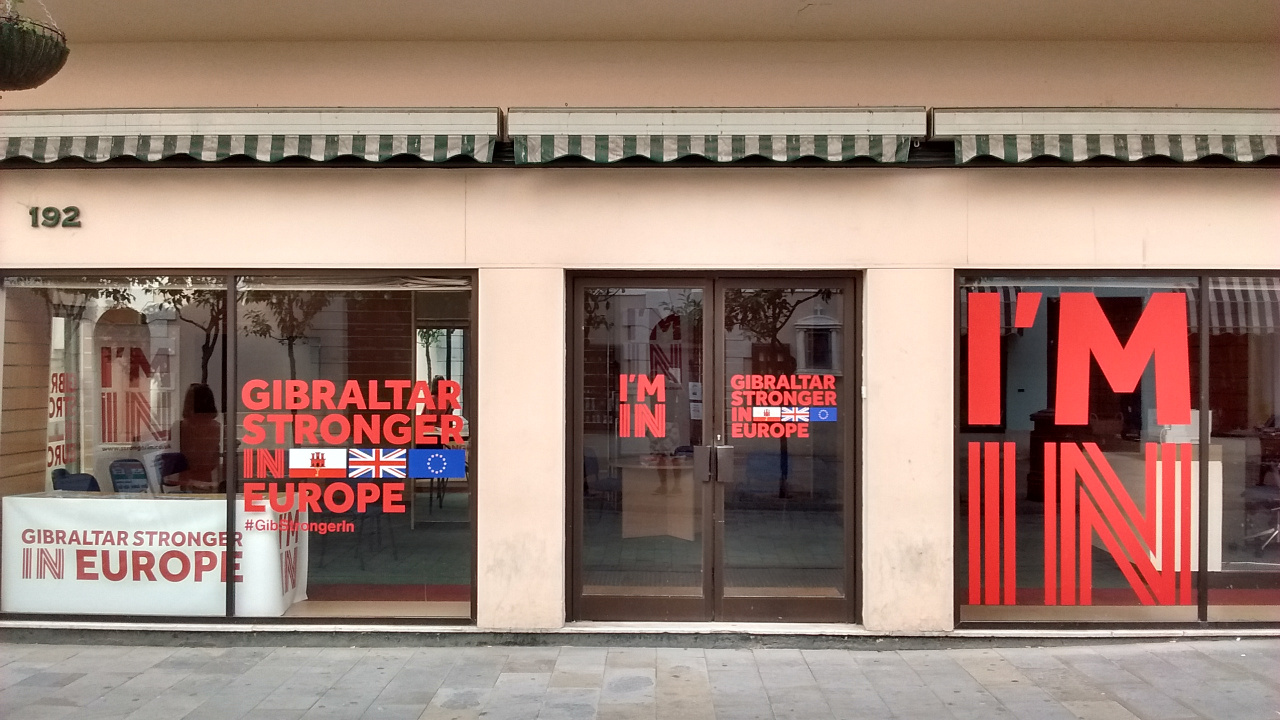
Photo of the Gibraltar Stronger in Europe campaign office on the British territory's main street. Gibraltar's population is overwhelmingly against a so-called Brexit, or departure of the UK from the European Union.

Subscribers click here to view this article in the ad-free members area. Not a member yet? Learn about PolGeoNow subscriptions!
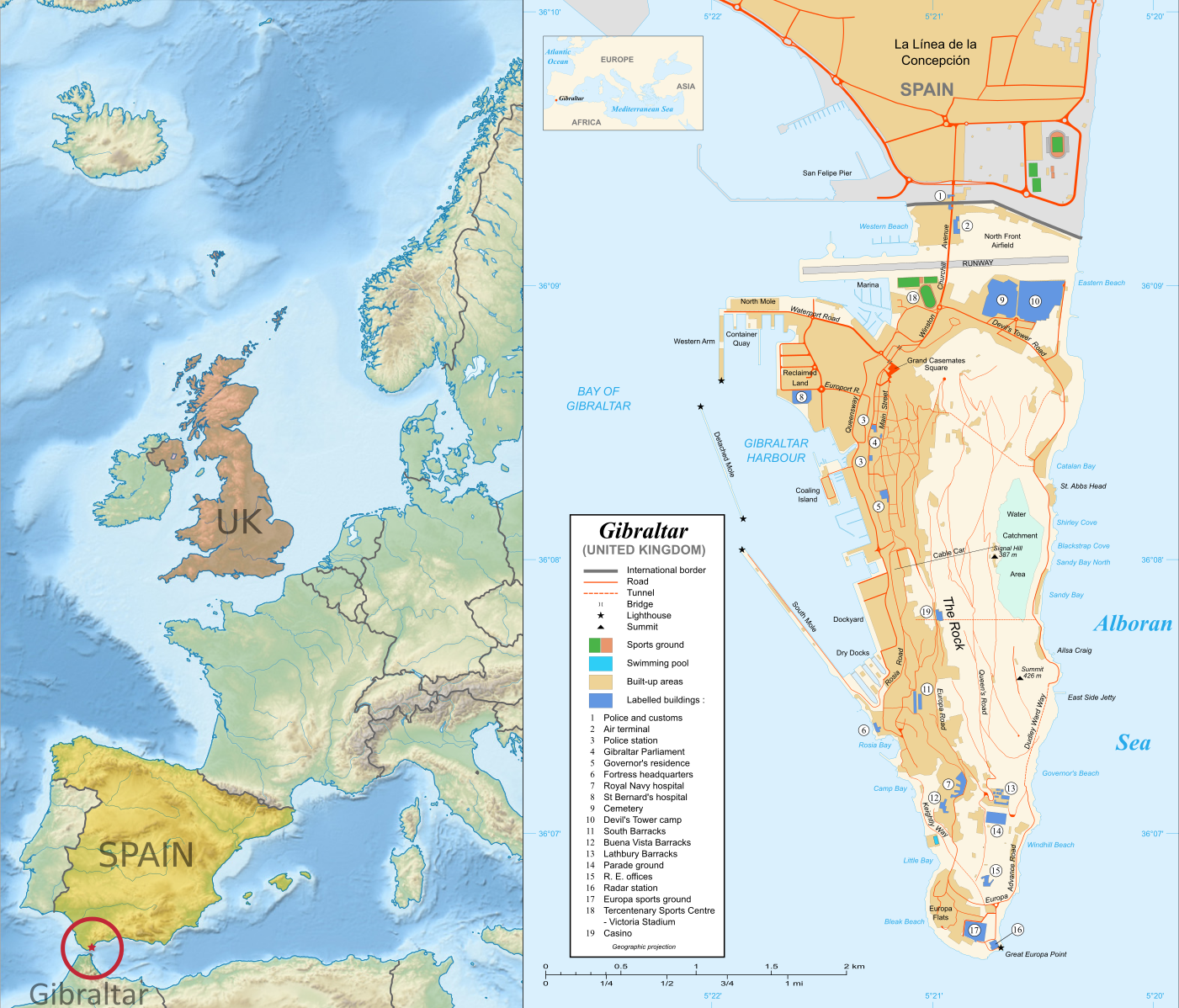
Map of Gibraltar and its location in Europe relative to the UK and Spain
Right: Map of Gibraltar by Eric Gaba (source; CC BY-SA)
Left: Gibraltar’s location in Europe (based on this Wikimedia Commons map by TUBS; CC BY-SA)

Gibraltar prepares to vote on whether UK should leave European Union
Last month, PolGeoNow’s Evan Centanni and Meihsing Kuo visited the small British territory of Gibraltar (pronounced “jih-BRALL-ter”), one month ahead of the UK’s referendum on whether to leave or remain in the European Union (EU).

Gibraltar, a tiny peninsula connected to Spain – and claimed by the Spanish government – is the only British overseas territory that’s part of the EU. It’s also the only external territory whose residents are eligible to vote in the so-called “Brexit” referendum without living in the UK proper. (“Brexit” is an abbreviation for “British exit” from the EU.)

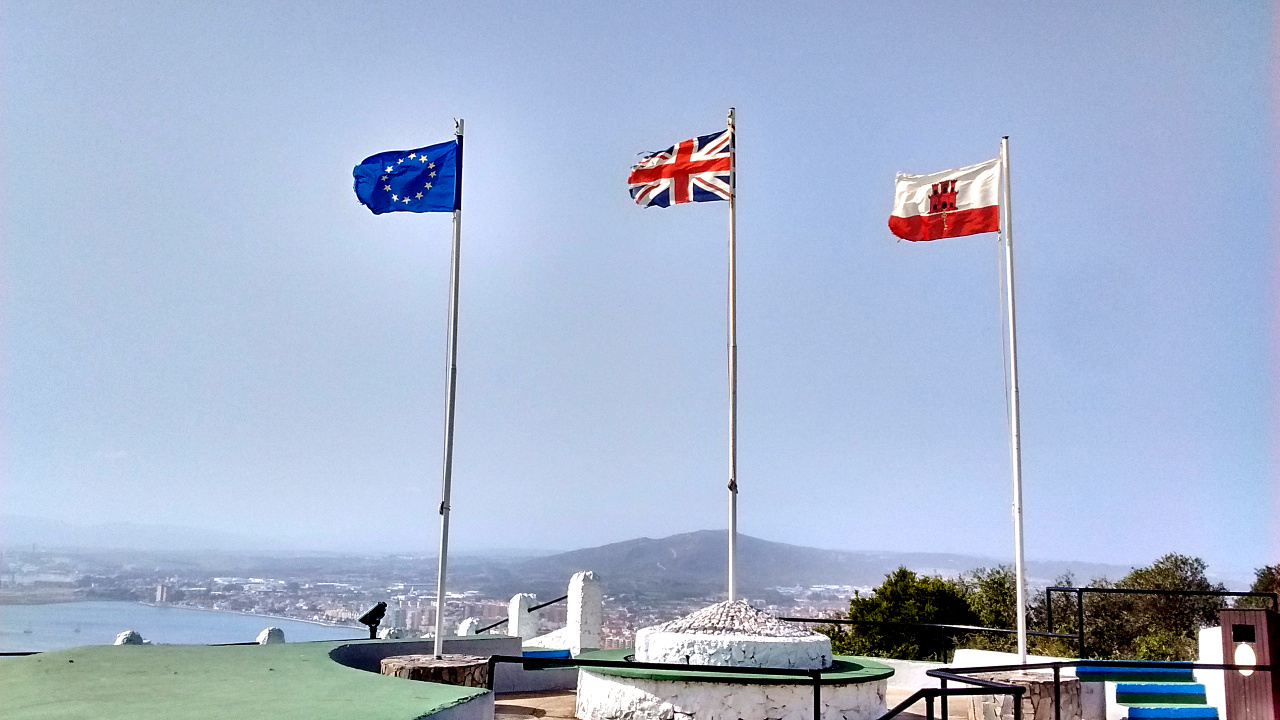
Photo of the European Union (EU), United Kingdom (UK), and Gibraltar flags flying side by side. Gibraltar is the only British territory that's also part of the EU.
Gibraltar flies the European Union flag (left), the flag of the United Kingdom (middle), and its own flag (right)

Gibraltar is a short walk from the Spanish town of La Línea, whose name means “the line” in Spanish – a reference to the line of fortifications Spain built along the border in the 18th Century, when it was still trying to capture the peninsula from Britain by force. (The town’s full name is La Línea de la Concepción, a reference the doctrine of the Immaculate Conception, a central tenet of the Spanish forces’ Roman Catholic religion. Incidentally, most Gibraltarians are also Catholic.)

Because Gibraltar and Spain are both part of the EU, residents of both are free to live or work in the other. Thousands of people live in Spain, where food and rent are cheaper, and commute to work in Gibraltar, where wages and employment are higher. Gibraltar residents also rely on the semi-open border for access to affordable goods from Spain. But that could all come grinding to a halt if the UK decides to leave the union.

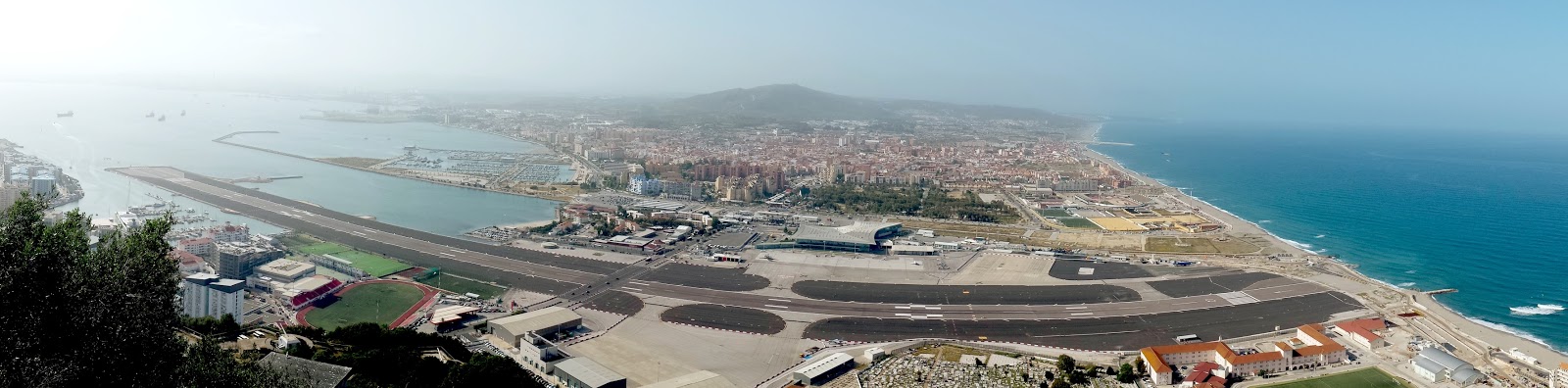
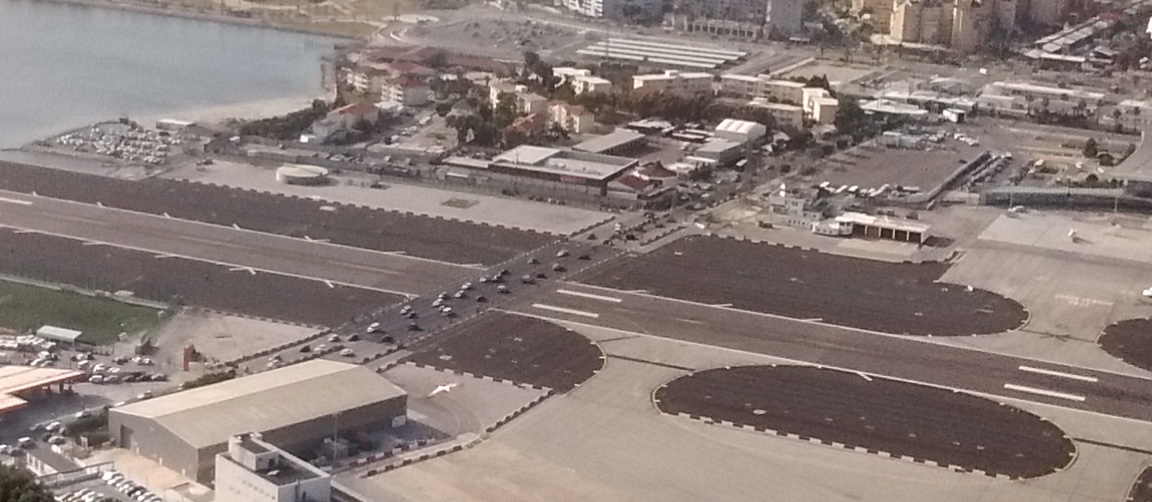
Aerial-style photo of the entire border between La Linea de la Concepcion, Spain, and the British territory of Gibraltar, as seen from atop the Rock of Gibraltar. At front and center is the Gibraltar Airport and runway.
The entire border of Spain (background) and Gibraltar (foreground), as seen from the Rock of Gibraltar. The border runs approximately along the far edge of the airport facilities. Click to see the picture at full size. (Photo by Meihsing Kuo)

Gibraltar is a special EU territory that’s outside the Customs Union and the Schengen Area, so there are still passport and customs checks at the border (though they seemed pretty lax to us). But in pre-EU days, Spain closed the border altogether as a way of protesting British control of the peninsula.

Photo of the border crossing facility between La Linea de la Concepcion, Spain, and the British territory of Gibraltar, including everyday vehicle and foot traffic.
Crossing the border from Spain into Gibraltar. In the background is the Rock of Gibraltar.

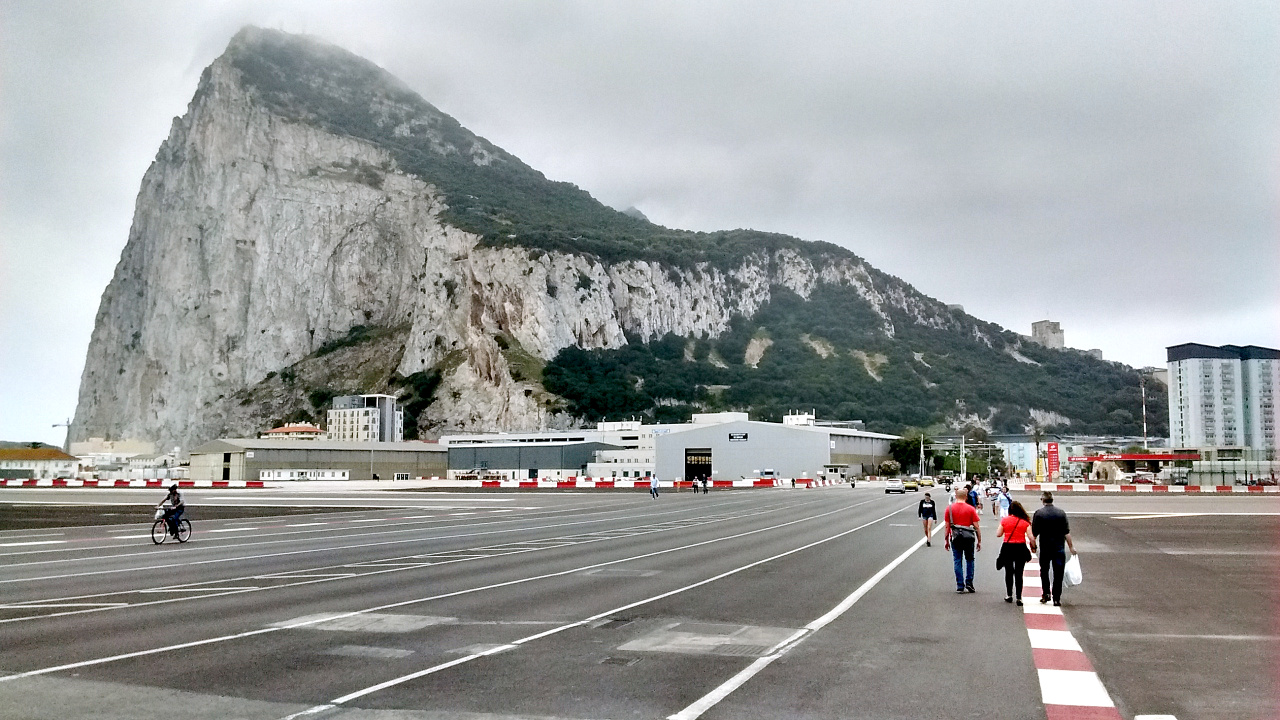
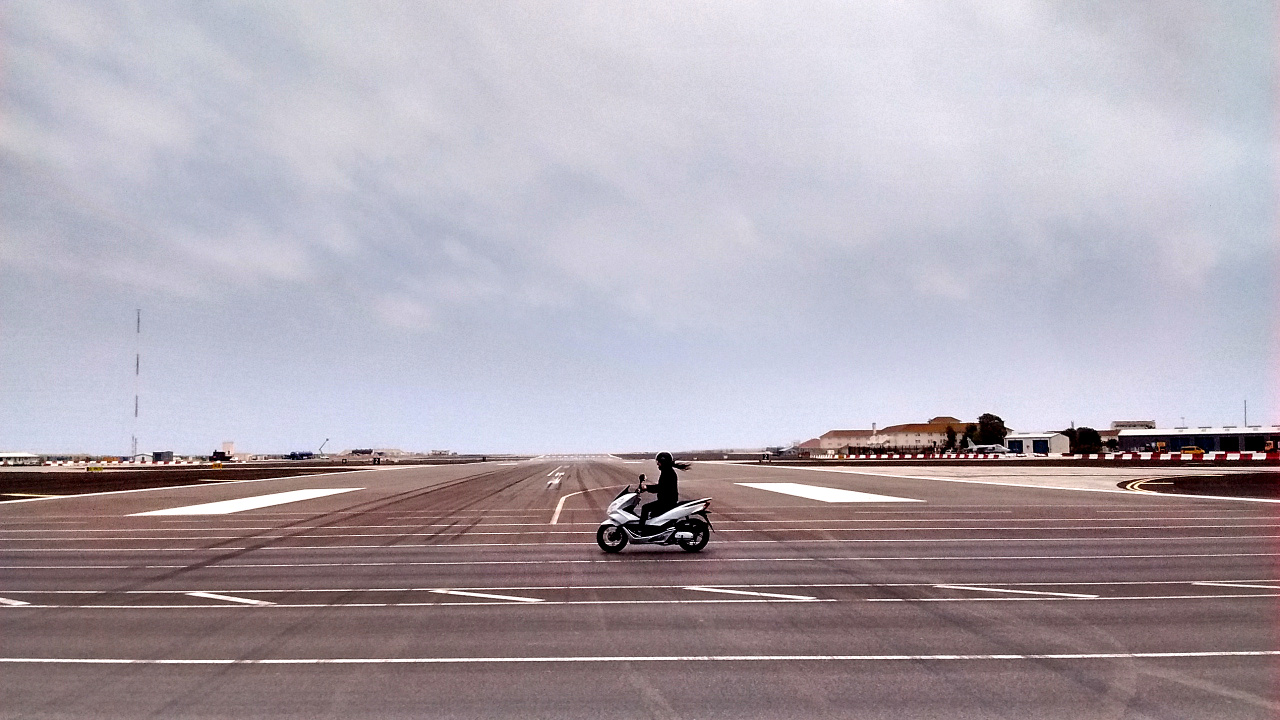
As a funny side-effect of Gibraltar’s position on a tiny peninsula, all traffic across the border has to cross the runway of the Gibraltar airport. There are only five or ten airplane takeoffs and landings each day, but each time there is one, cars and pedestrians have to wait for it to finish before they can go from Spain to Gibraltar or back. A planned traffic bypass is years overdue.

Photo of an airplane landing at the Gibraltar airport, crossing the only road that passes between Spain and the British colony, and temporarily stopping all cross-border traffic.

Photo of cars and other traffic crossing the runway of the Gibraltar airport after having waited for a plane to land. The road crossing the runway is the only land route in or out of the British territory which borders Spain.

Photo of pedestrians and a cyclist crossing the runway of the Gibraltar airport. The road crossing the runway is the only land route in or out of the British territory which borders Spain.

Photo of a motorcycle crossing the runway of the Gibraltar airport. The road crossing the runway is the only land route in or out of the British territory which borders Spain.

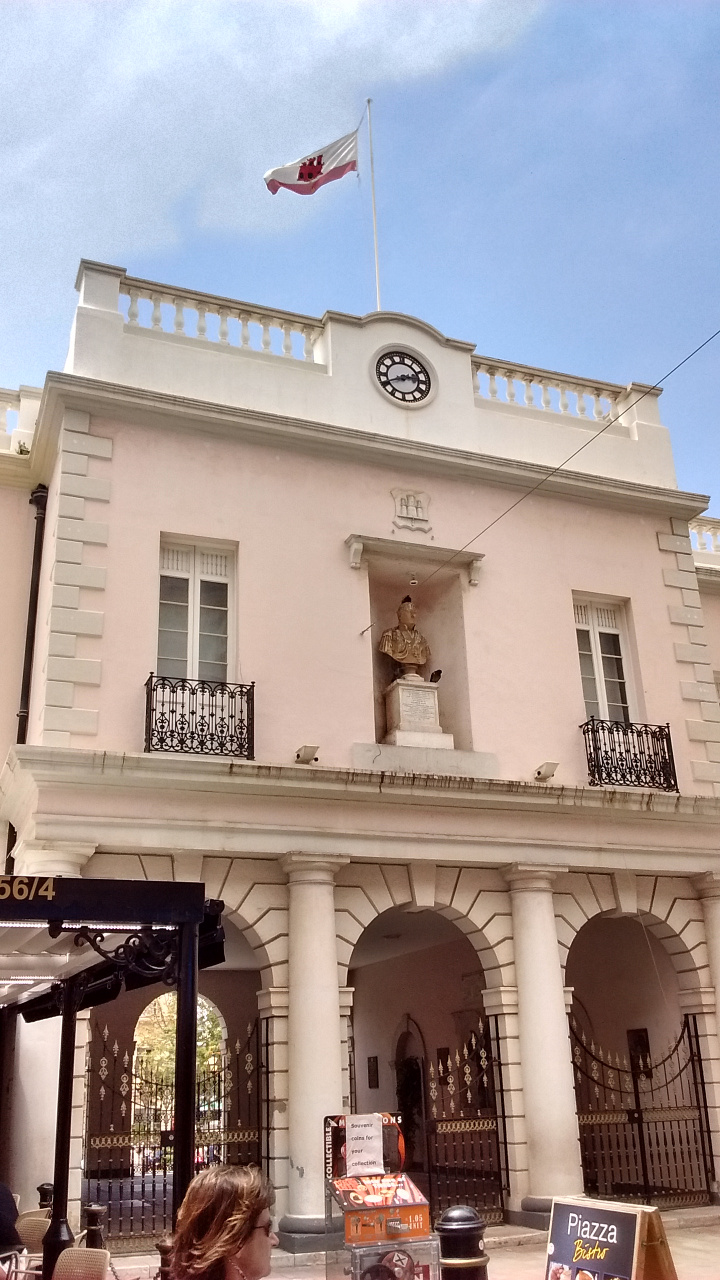
Photo of the Gibraltar Parliament building, headquarters of self-government in the highly-autonomous British territory.
The Gibraltar Parliament building

Unlike British colonies of the past, Gibraltar is almost completely self-governed by its own elected parliament. For internal matters, the Gibraltar parliament doesn’t even legally answer to the British parliament in Westminster. But although Gibraltar’s not considered part of the UK, its land officially belongs to the UK, and it can’t have its own military or international relations. That means if the UK cuts ties with the EU, Gibraltar is along for the ride.

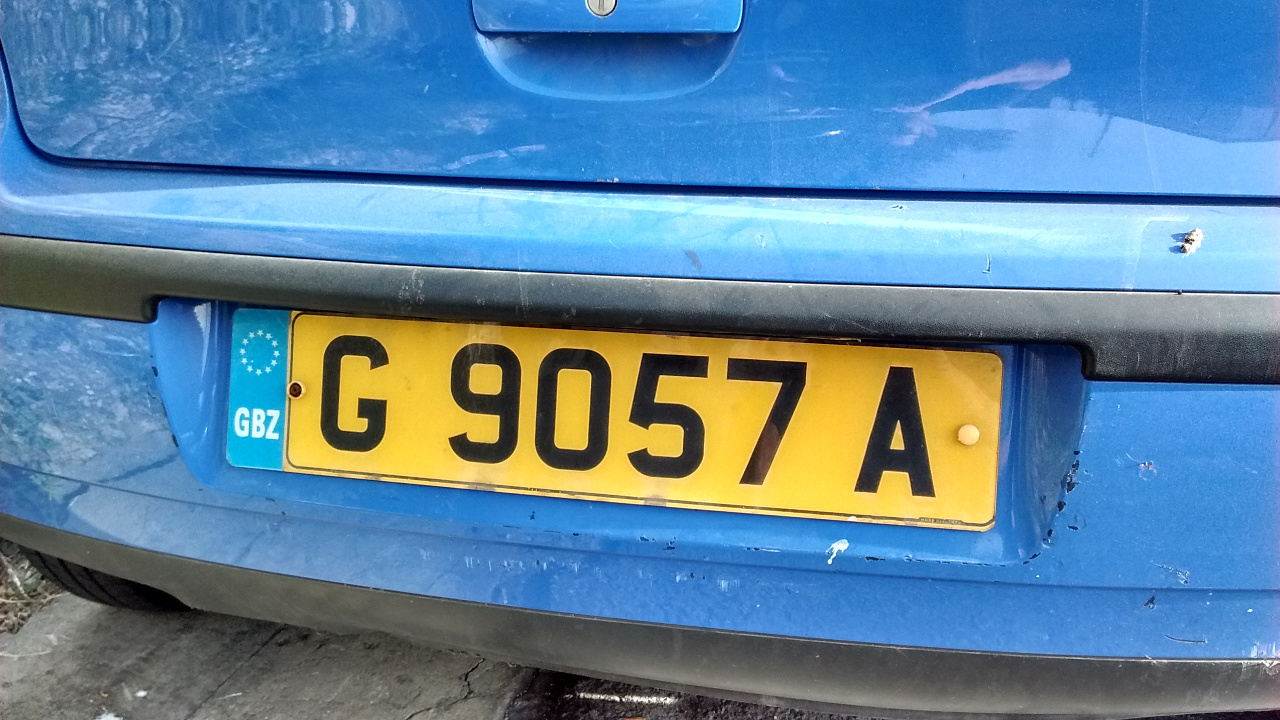
Photo of a yellow vehicle registration plate (license plate) in Gibraltar, showing the pan-European plate design and GBZ country code designation.
Gibraltar vehicle plates have their own country code – GBZ.

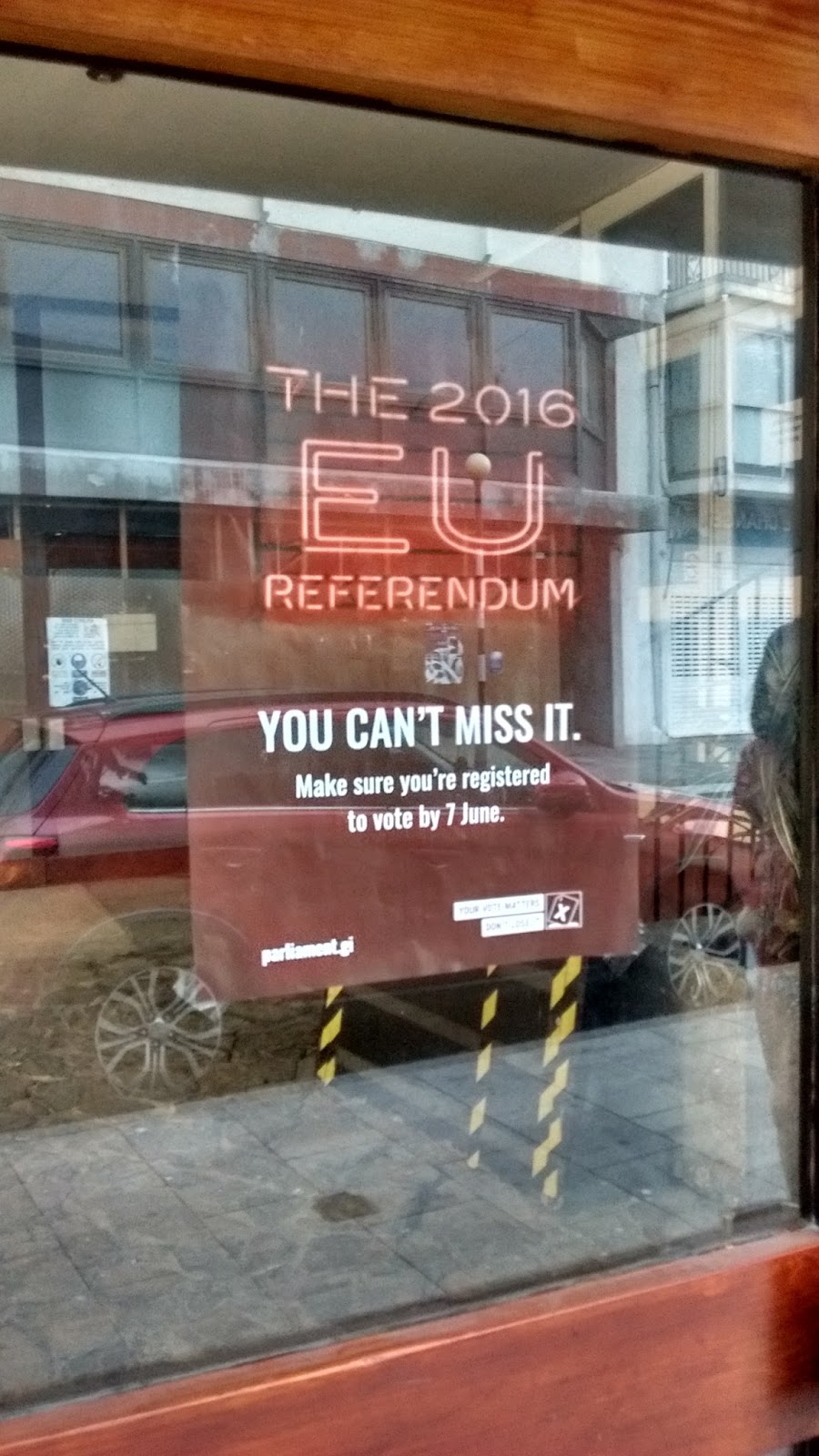
Photo of a bring-out-the-vote poster in a window in Gibraltar, posted by the territorial government to remind residents to vote in the upcoming Brexit referendum on whether Britain should leave the European Union (EU)
Gibraltar government promoting voter turnout in the “Brexit” referendum

Gibraltarians are able to vote in EU elections through a special arrangement that treats them as constituents of southwestern England, and the same arrangement will allow them to vote in the “Brexit” referendum. Though the territory’s 23,000 registered voters are just a drop in the bucket compared to the 45 million or so in the UK, this referendum might come right down to the wire, so it’s not out of the question that they could make a difference.

In any case, Gibraltarians want to be heard, even if only as justification to demand help from the UK if they do get pulled out of the EU. Because of the Gibraltar’s heavy dependence on the border, all three of the territory’s political parties are campaigning for the UK to remain in the union. And what about regular voters? A local newspaper poll found that 88% of people who planned to vote supported staying in the EU.

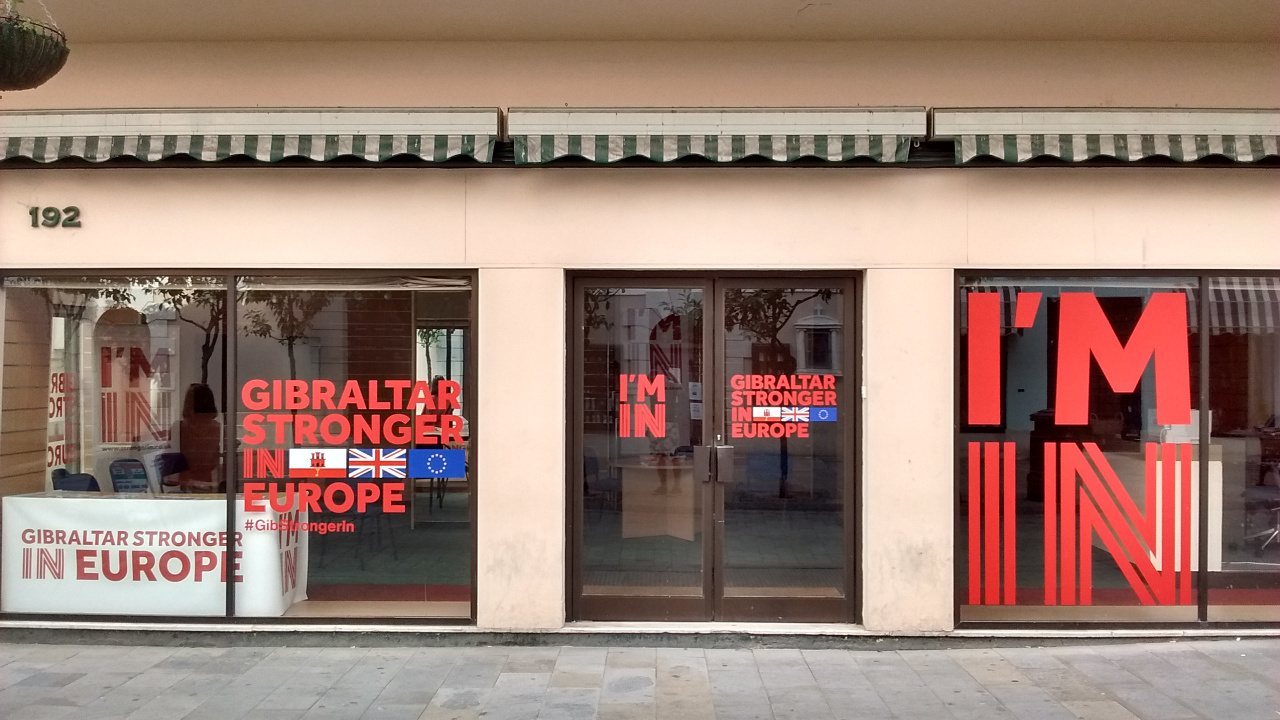
Photo of the Gibraltar Stronger in Europe campaign office on the British territory's main street. Gibraltar's population is overwhelmingly against a so-called Brexit, or departure of the UK from the European Union.
The Gibraltar chapter of Britain’s anti-Brexit “Stronger In” campaign has a prominent office on the town’s main street.

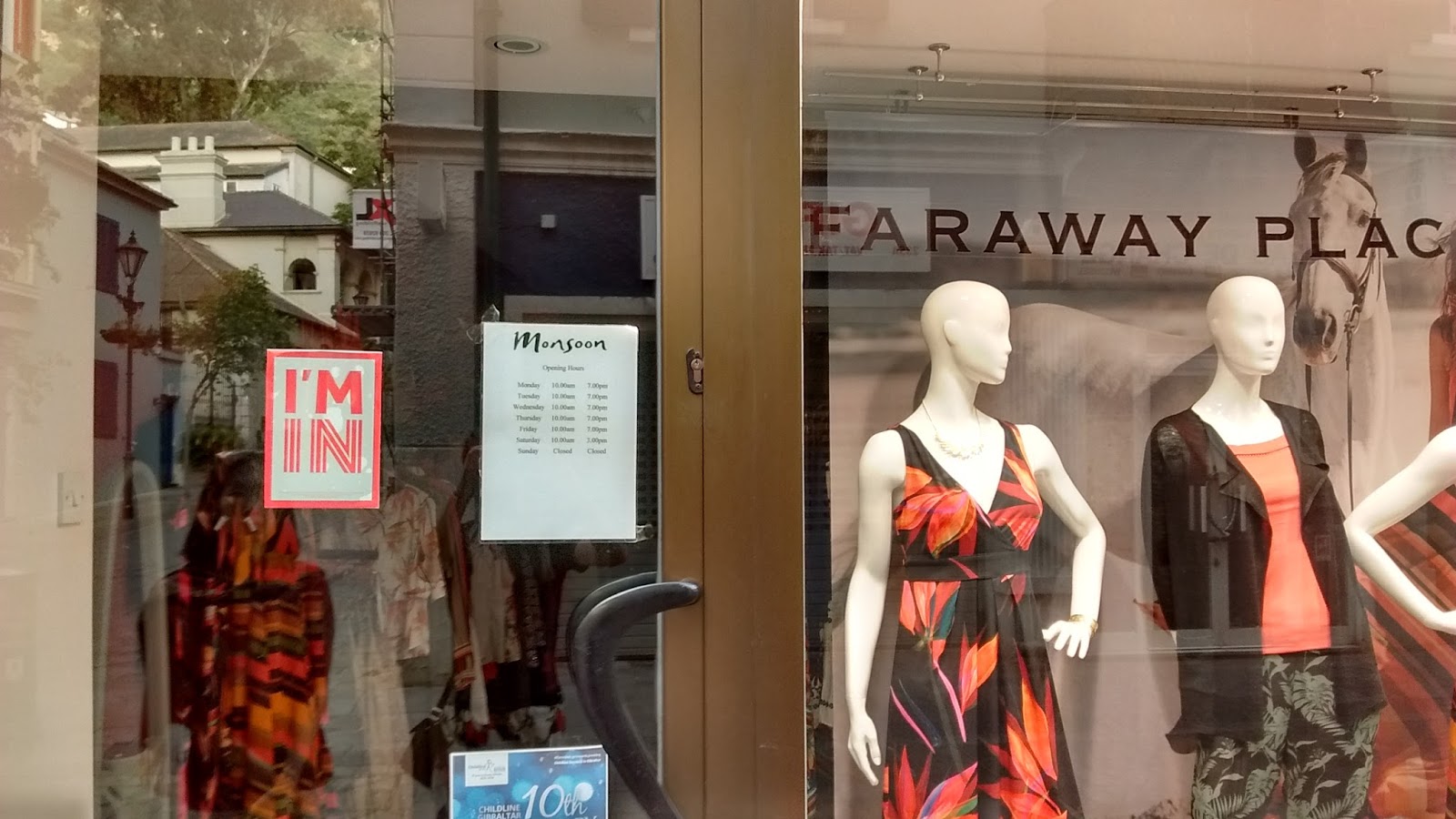
Photo of a shop window in Gibraltar, prominently displaying a sticker that reads I'm In, indicating that the business supports voting for the UK to remain in the European Union (EU) in the upcoming Brexit referendum.
Continued EU membership is uncontroversial in Gibraltar. “I’m In” stickers show many local businesses’ open support of the campaign to vote against leaving the EU.

It’s hard to say exactly what will happen to Gibraltar if the UK does choose to quit the European Union – and that uncertainty is part of what most Gibraltarians are trying to avoid. For now Gibraltar seems content to be a British territory: residents have already twice voted against joining Spain. But if they feel betrayed and abandoned by a UK that wants no part in the EU, could demands for greater autonomy or even independence be around the corner? Only time will tell.

Photos and text by Evan Centanni, except where specified otherwise. All rights reserved.

Ukraine War Control Map & Report: June 2016

Subscribers click here to view this article in the ad-free members area. Not a member yet? Learn about PolGeoNow subscriptions!

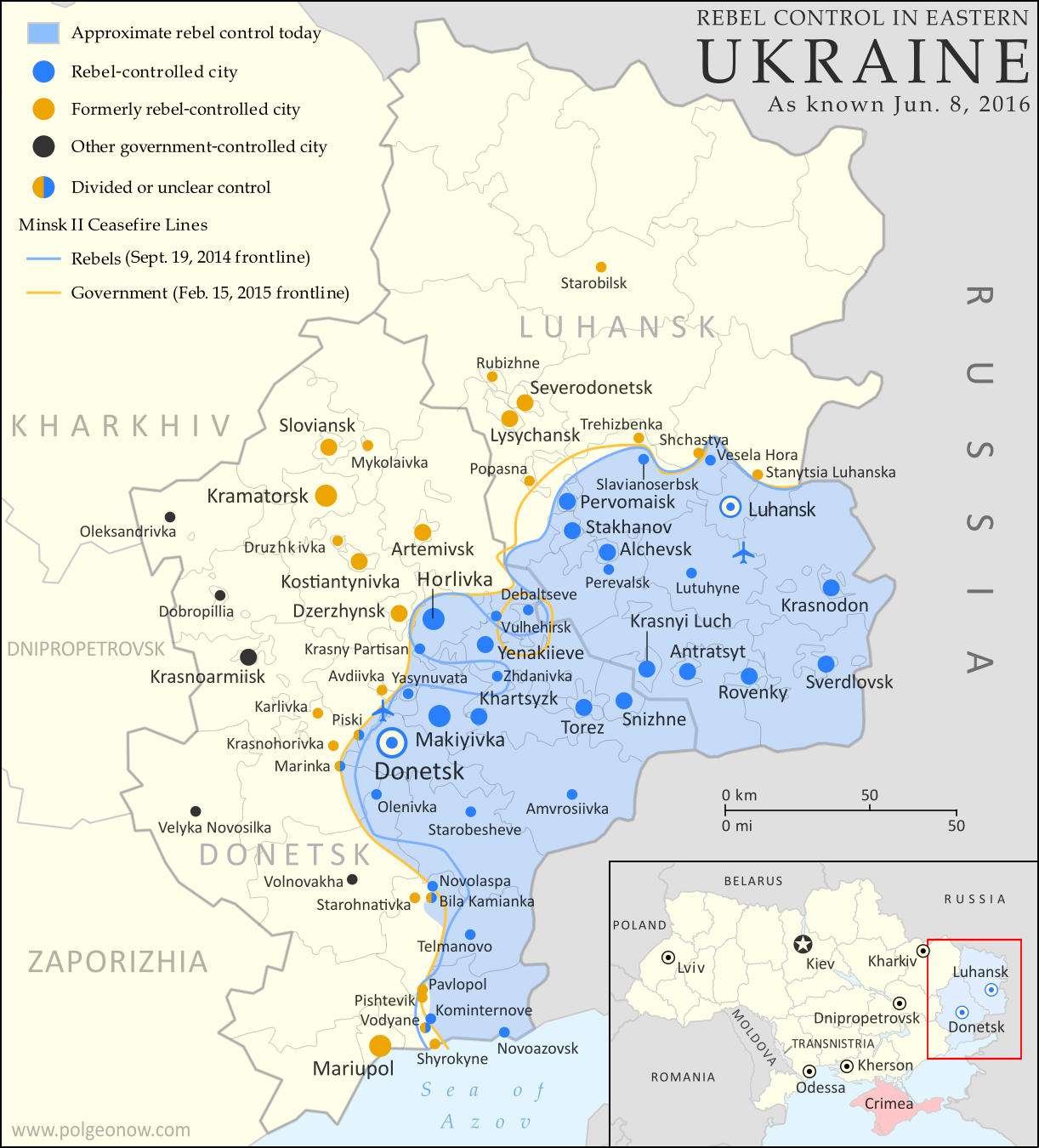
Map of rebel territorial control in Ukraine's eastern provinces of Donetsk and Luhansk, claimed by the breakaway Donetsk People's Republic and Lugansk People's Republic. Updated for June 2016, with Minsk ceasefire lines shown.
Map by Evan Centanni (all rights reserved)

Timeline by Djordje Djukic, with additional reporting by Evan Centanni

Summary of Developments
PolGeoNow’s previous Ukraine control map report was published in March of last year, just a month after a ceasefire was implemented under the Minsk II agreement, a hard-won deal between the Kiev government and representatives of the self-proclaimed Donetsk and Lugansk People’s Republics (established by rebels with extensive support from the other side of the Russian border). Since then, the ceasefire has broadly held, which explains why the war in eastern Ukraine has largely dropped out of world newspaper front pages. However, fighting has continued off and on at a reduced level, and the ceasefire agreement is still on shaky ground. This map and timeline report describe what has happened over the past year, including some small changes to territorial control.
Flag of Ukraine Full Country Name:  
• Ukraine (English)
• Ukrayina (Ukrainian)
Capital: Kiev

Timeline of Events
The following is a chronology of changes to territorial control and other major events since our previous update of March 2015.

March 12, 2015
Reuters reported the accounts of four villagers from a rebel-held village that pointed to rebel involvement in the downing of Malaysia Airlines Flight 17. However, the report noted that the accounts do not conclusively prove the specific missile was the one that brought down the plane, because none of them saw it being launched.

March 19, 2015
The Russian foreign minister, Sergey Lavrov, condemned the Reuters report on the downing of the Malaysia airliner, called it “stovepiping”, and pointed to contradictory statements being made by the witnesses. He additionally called for an “unbiased, professional” investigation.

March 20, 2015
Kiev submitted a formal request to the United Nations for peacekeepers to be deployed to the conflict zone in east Ukraine.

March 21, 2015
The rebels were reported to be in control of 30 percent of the village of Shyrokyne, near Mariupol.

March 22, 2015
It was revealed that rebel forces had established two bridgeheads across the river Seversky Donets, near the government-held town of Stanytsia Luhanska north of Luhansk, after capturing two bridges between March 16 and March 20.

March 27, 2015
The OSCE reported that 50-60 percent of the coastal village of Shyrokyne had been destroyed in the fighting, while a two-day ceasefire was still holding in the area.

March 31, 2015
The United Nations OCHA organisation reported that the death toll from the conflict had reached at least 6,083 by March 27. A large number of casualties were still being accounted for, especially in the area of the Donetsk airport and Debaltseve.

April 9, 2015
According to Ukrainian military officials, separatists tried to push the frontline closer to the Bakhmutka highway in the Luhansk region.

April 13, 2015
It was confirmed that the village of Vodyane, seven kilometers east of Mariupol, was captured by the separatists after it was reportedly in the middle of a no man’s land for almost a month following a government retreat.

April 14, 2015
Overnight fighting that started the previous day and continued into the early hours of the next led to the highest death toll since February. Six Ukrainian soldiers and four separatist fighters were killed, while 17 separatists and 12 soldiers were wounded. A Russian journalist was also injured.

April 16, 2015
Separatist forces were reported to be in control of much of Shyrokyne, but fighting in the village continued.

April 24, 2015
The United Nations OCHA organisation reported that the death toll from the conflict had reached 6,225.

April 28, 2015
Separatist forces reportedly crossed the plain between Donetsk and Avdiivka and set up a bridgehead on its northern side along the railway tracks which was later reinforced with bunkers and trenches.

April 30, 2015
The chairman of the Ukrainian parliament asserted that more than 100 Ukrainian soldiers had been killed and over 500 wounded since the ceasefire was declared on February 15.

May 5, 2015
A resolution by the Cabinet of Ministers was published that updated the list of towns lost to separatist forces. According to the new report, since February 18, government forces had lost control of 15 towns in the Artemivsk district and three in the “Yasuvatsky” (Yasynovastky?) district. In addition, 10 towns were listed as being on the frontline and only partially controlled. A Ukrainian military analyst also reported that a force of 3,000 separatist fighters and several dozen armored vehicles was positioned near Mariupol and that rebel formations in the Artemivsk area were reinforced by infantry, 18 armored personnel carriers, seven tanks, and several trucks. Over the following day, five Ukrainian soldiers were killed in clashes on the frontlines.

May 12, 2015
According to a Russian opposition report, at least 220 Russian soldiers had been killed in the conflict in eastern Ukraine (150 during the battle for Ilovaisk, south of Khartsyzk, and 70 at Debaltseve).

May 18, 2015
Two Russian soldiers were wounded and captured by Ukrainian forces near Luhansk, according to military officials. The separatists said the two were policemen from Luhansk, while Russia said they were no longer active-duty soldiers in the Russian Armed Forces.

May 22, 2015
Amnesty International accused both Ukrainian and separatist forces of war crimes such as summary executions, before and after the February truce, and torture.

May 24, 2015
The commander of a separatist police battalion from the self-proclaimed Lugansk People’s Republic, Alexei Mozgovoi, was killed along with six of his men after the vehicle they were traveling in was ambushed near Alchevsk, 40 kilometers west of Luhansk city.

June 1, 2015
According to the separatists, Ukrainian forces fired over 150 mortar shells at their positions in Shyrokyne since the previous day. Some government mortar fire also hit the Donetsk airport. Meanwhile, in its newest report, the UN stated that it had documented the deaths of 6,417 people since the war started, including 626 women and girls. One day later, 16 medics were confirmed to have been killed in the conflict, and another 60 wounded, since it started.

June 3, 2015
The military said the separatists launched an offensive against the government-held town of Marinka, west of Donetsk, using tanks and 1,000 fighters. The fighting reportedly started at 3 a.m. and lasted almost 12 hours before ending, but restarted once again later and left parts of the town on fire. The attack began with artillery fire, followed by an infantry and tank assault. The separatists denied they had launched an attack, and said government artillery fire hit their positions around Donetsk, killing 15 people. As the fighting at Maryinka continued, the separatists reportedly also attacked the neighboring town of Krasnohorivka. Both towns were left in flames as the rebels made attempts to break through government lines and soldiers were involved in bloody and chaotic street fighting. By evening, it was unclear who controlled Marinka, with the separatists saying soldiers withdrew from the town on their own and a member of the Ukrainian parliament also writing on Facebook that the rebels were in control of 70 percent of Marinka. However, the military later said that a ceasefire had taken hold and restored their control of the town.

June 4, 2015
The overall death toll from government artillery fire around Donetsk stood at 16 separatist fighters and 5 civilians, while 86 fighters and 38 civilians were wounded. In addition, five soldiers were killed and 39 wounded in the previous 24 hours, of which four died at Marinka. An AP reporter who briefly visited Marinka reported the town was under government control and the military was conducting mop-up operations.

June 5, 2015
The Ukrainian president claimed government troops had recaptured Marinka after expelling the separatists and capturing 12 “saboteurs”, including one Russian. His claim was not independently confirmed. For their part, the separatists claimed they killed 400 Ukrainian soldiers and wounded 1,000 at Marinka, while confirming 20 of their own fighters died and 99 were wounded. The rebels stated they did not attack Marinka, but that the fighting that took place was them counter-attacking against the Ukrainian military, and that if they were really attacking the town they would have captured it. Meanwhile, a UN official confirmed nine civilians were killed in the fighting around Marinka.

June 7, 2015
A Ukrainian Coast Guard cutter exploded off the coast of Mariupol after hitting a mine. Five crewmembers were injured, one was killed, and a search continued for the boat’s missing commander.

June 8, 2015
A Ukrainian military truck hit a mine near Krasnohorivka, killing seven soldiers and endangering the cease-fire.

June 11, 2015
The Ukrainian president visited government trench lines near Mariupol, as more fighting at Shyrokyne left one soldier dead and two wounded.

June 12, 2015
Ukrainian nationalists pelted the Russian consulate in Kharkiv (a major eastern Ukrainian city outside the conflict zone) with blue paint and eggs as a celebratory reception was being held on the occasion of the Russia Day holiday. In retaliation, the Ukrainian consulate in the Russian city of Rostov-on-Don was pelted with green paint and tomatoes, and empty cartons of eggs were left. The Russian foreign ministry accused the Ukrainian police of taking no action, in violation of the 1963 Vienna Convention on Consular Relations, in the Kharkiv incident. At the same time, Ukraine denounced what it called “barbarians” for the attack on their own consulate.

June 17, 2015
Ukrainian government prosecutors charged two soldiers with murder in a rare public case of the government prosecuting its own soldiers. The two soldiers were accused of killing a 77-year-old woman and her 45-year-old daughter two days earlier in a rebel-held village near Donetsk. The two women were killed when the soldiers broke into their home and killed them with machine gun fire after allegedly suspecting them of pro-Russian separatist sympathies. The soldiers were charged with premeditated murder, which carries a prison sentence of seven years to life, just under a month after both the government and the separatists were condemned by international rights groups for torture and intimidation tactics.

June 20, 2015
US opposition senator John McCain visited Kiev for talks with the Ukrainian president, during which he called for arms to be supplied to Ukraine. The same day, it was reported, per various government officials, that the separatists were still holding prisoner 127-200 soldiers and 70 civilians, while 289 soldiers were missing in action. It was also confirmed that the separatists had released 2,735 soldiers from captivity since the war began.

June 25, 2015
The Parliamentary Assembly of the Council of Europe issued a report stating that 1,300 people were missing in the conflict. Of these, 1,200 civilians and soldiers were missing on the Ukrainian side, while 100 people were missing from the separatist side.

July 1-3, 2015
The separatists declared Shyrokyne to be a demilitarized zone and withdrew from the village two days later.

July 7, 2015
Shyrokyne continued to be uncontrolled by either side as both Ukrainian and separatist forces held positions on two separate hills outside the village. Meanwhile, Kiev claimed that Russia cut power supplies to the rebel-held part of the Donbass (Donetsk-Luhanks region), which was according to them a sign that Moscow was losing interest in breaking up Ukraine.

July 13, 2015
An entire Ukrainian military battalion reportedly deserted after releasing a video in which the unit’s soldiers said they would no longer take orders from Kiev nor surrender their weapons, citing alleged neglect from their command. The commanding officer reportedly left his post, saying he was “unwilling to perform his functions” as the battalion commander.

July 15, 2015
The deadliest fighting in over a month was reported as both sides accused each other of intensified shelling along the frontline, with the heaviest attacks taking place in the area of Horlivka. The fighting left eight soldiers, two rebels, and one civilian dead. Another 16 soldiers were wounded.

July 24, 2015
Ukraine’s Justice Minister, Pavlo Petrenko, announced all communist parties in Ukraine would be barred from the local elections set to take place in October. Meanwhile, Russia’s Prime Minister, Dmitry Medvedev, warned that Ukraine could face a break-up similar to that of Yugoslavia unless the Kiev government showed “some flexibility”.

July 31, 2015
Ukraine’s supreme court ruled to allow a parliamentary vote on constitutional amendments giving rebel-held territories self-rule. Parliament had voted with an overwhelming majority on July 16 to ask the court whether such constitutional changes were legal.

August 9, 2015
Four armored cars belonging to international observers from the OSCE were destroyed in an arson attack in eastern Ukraine.

August 10, 2015
According to the Ukrainian government, 200 separatists, backed up by tanks, stormed the village of Novolaspa, between Donetsk and Mariupol. According to them, the attack was repelled, but was followed by a second attack with an unclear result. The separatists denied they attacked the village and instead said it was always under their control but had come under government artillery fire. Later, the government claimed 400 separatists, again supported by tanks, attacked the village of Starohnativka, north of Mariupol. They stated they had lost some ground, but had regained it with the help of artillery fire. The separatists also denied attacking Starohnativka. A third, and the most deadly, battle was reported near Bila Kamianka, leaving seven Ukrainian soldiers dead and 11 wounded. Again, both sides traded blame for initiating the fighting.

August 11, 2015
Ukraine returned heavy artillery to its frontline with the separatists following heavy fighting the previous day. The artillery had been withdrawn to 50km behind the frontlines as part of the February ceasefire.

August 12, 2015
Kiev confirmed that Novolaspa was rebel-held.

August 18, 2015
Russian president Vladimir Putin visited Russian-controlled Crimea after a night-long artillery exchange along the frontline in eastern Ukraine left nine people dead.

August 27, 2015
Ukrainian forces suffered their highest single-day loss of life since mid-July, after seven soldiers were killed and 13 wounded over the previous 24 hours of fighting.

August 31, 2015
265 out of 320 Ukrainian parliament members voted in favor of a bill granting larger autonomy to the rebel-held territories. Following the vote, street clashes erupted in Kiev between protesters opposing the bill and security forces, resulting in the death of a 24-year-old National Guard member.

September 1, 2015
Two more National Guard members died of wounds they received from a grenade explosion during clashes with protesters in Kiev the previous day. The grenade was allegedly thrown by a protester, wounding dozens of law-enforcement members. Meanwhile, a renewed effort to implement the February ceasefire was implemented in eastern Ukraine, and appeared to be holding.

September 8, 2015
The United Nations reported 7,962 people had been killed and 17,811 wounded since the start of the conflict. According to the report, more than 400 civilians had been killed or wounded in the period between May 15 and August 15, due to artillery exchanges.

September 12, 2015
International observer body the OSCE declared that the September 1 renewed ceasefire was still holding after more than 10 days, creating the possibility of political talks moving forward to end the conflict.

September 20, 2015
Hundreds of pro-Kiev Crimean Tatar protesters launched a blockade of all three roads from Ukraine to Crimea in an attempt to halt the delivery of goods to the peninsula.

September 22, 2015
Donestsk and Luhansk separatists stated that local elections in their territories were still to be held in October or November, as per the February Minsk peace agreement, despite Kiev arguing that they needed to be delayed due to continued security problems.

October 6, 2015
Separatist negotiators backed down on the issue of scheduling for local elections, announcing that they would be postponed until February 21.

October 10, 2015
The head of the separatist Donetsk People’s Republic (DPR), Alexander Zakharchenko, rescheduled local elections for April 20, 2016.

October 13, 2015
A Dutch probe concluded that Malaysian Airlines Flight 17, which crashed in eastern Ukraine on July 17, 2014, was downed by a Soviet-made surface-to-air Buk missile coming from rebel-held territory. It also pointed out that the incident would not have happened if the airspace over eastern Ukraine had been closed for passenger planes due to regional fighting. The inicident killed 298 people.

October 14, 2015
Ukraine reported the death of its first soldier in a month from direct separatist fire.

October 29, 2015

The first prisoner exchange since September 8 took place when eight soldiers and one civilian were swapped for 11 separatist fighters. According to the Ukrainian government, 89 soldiers and 59 civilians were still being held by the separatists, while the militants claimed 2,400 of their fighters and civilian supporters were being detained by the government.

November 4, 2015
The Ukrainian government threatened to stop its withdrawal of light weapons from the frontline due to the rebels allegedly continuing to violate the ceasefire.

November 5-7, 2015
The separatists reportedly completed their withdrawal of smaller weapons from the frontline, while the Ukrainian Army completed its own first phase of withdrawing light artillery two days later.

November 14, 2015
Five soldiers were killed in fighting over a period of 24 hours, which represented the highest death toll for the military in two months.

November 21-23, 2015
Unknown attackers blew up power lines in the Kherson area, leaving Crimea starved of electrical power. Two days later, the four pylons had still not been fixed as pro-Ukrainian activists, including ethnic Tartars and Ukrainian nationalists, blocked engineers from repairing them. Meanwhile, the Ukrainian government announced a temporary halt of all goods deliveries to Crimea.

November 24, 2015
Russia announced it would halt its gas supplies to Ukraine, due to Kiev not paying up front for the gas, and that it also might halt coal supplies over the power blackout affecting Crimea.

November 25, 2015
Ukraine banned Russian planes from using its airspace.

December 3, 2015
The Ukrainian military claimed to have taken control of the villages of Pishtevik and Pavlopol, which were previously inside a buffer zone near Mariupol and not controlled by ether side.

December 9, 2015

According to the U.N., the deaths of 9,115 people had been documented since the start of the conflict in eastern Ukraine.

December 21, 2015
Despite a growing split among EU member countries over how long to keep sanctions imposed on Russia over its annexation of Crimea and involvement in the Ukraine conflict, the punitive economic measures were extended. The previous week the vote on the extension was delayed by Italian Prime Minister Matteo Renzi, who wanted to confront German Chancellor Angela Merkel over a “double standard”. According to him, Merkel had been forcing EU countries to agree to the sanctions, while Germany itself was engaging in projects with Russia that were contrary to the measures. The same day the EU measures were extended, Russia hit Ukraine with its own trade sanctions in retaliation for Kiev’s sanctions and EU free trade deal.

December 22, 2015
The US imposed tighter sanctions on Russia over the Ukraine conflict.

January 5, 2016
It was confirmed that separatists had captured the village of Kominternove, which was previously in a buffer zone near Mariupol and not controlled by either side.

January 10, 2016
The first combat deaths of 2016 were confirmed as two Ukrainian soldiers and two rebels were killed in action.

January 14, 2016
The Ukrainian president stated that electrical power would not be restored to Crimea until “Ukrainian sovereignty over Crimea is restored”.

January 22-23, 2016
Russia’s finance minister announced that Russia was open to “talks in good faith” with Ukraine over the 3 billion dollar debt that Kiev had defaulted on in December. The next day, his Ukrainian counterpart said there was still a chance to avoid a court battle.

January 27, 2016
A statue of Vladimir Lenin in Donetsk was largely unharmed after a bomb exploded at its foundation. The explosive device was planted by an unknown group with the intent of demolishing the statue.

February 15, 2016
In an upsurge in fighting in the east, three soldiers were killed and seven wounded. This was the highest number of casualties suffered by the Ukrainian military since November 14, 2015, when five soldiers were killed.

February 16-17, 2016
Ukrainian prime minister Arseniy Yatseniuk barely survived a no-confidence vote in parliament among allegations of corruption, as well as criticism directed against the government’s record on reform. The following day, the fate of the pro-Western government was in doubt as the party of former prime minister Yulia Tymoshenko withdrew from the governing coalition.

February 20-22, 2016
Nationalist demonstrators demolished the offices of two Russian banks in Kiev, as well as that of a holding company belonging to Ukraine’s richest man, Rinat Akhmetov. Police did not intervene. Two days later, the offices of three Russian banks in the western Ukrainian city of Lviv were set on fire.

February 23-24, 2016
Ukrainian forces reported an upsurge in separatist shelling of their positions.

February 29, 2016
Separatist forces reportedly withdrew from the Shyrokyne area, with the military taking control of the town.

March 4, 2016
According to the Ukrainian military, a patrolling Special Forces squad on the front near Mariupol detected a separatist special operations group, and the subsequent engagement left two soldiers dead and five wounded. The military also claimed 30 separatists were killed. According to a separatist spokesman, government shelling of a nearby village lead to several civilian casualties.

March 6, 2016
Online Russian anti-Kremlin group “Cargo 200 from Ukraine to Russia” published a list of 2,081 Russians they said had been killed or gone missing in eastern Ukraine. The list included Russian servicemen, separatist DPR fighters, and several journalists.

March 22, 2016
According to the newest report by the UN, since the start of the conflict in eastern Ukraine, 9,208 combatants and civilians had been killed and 21,138 had been injured.

April 2, 2016
Nineteen Ukrainian soldiers were reported killed and 128 wounded in the month of March. One of these died in a traffic accident.

April 9, 2016
The government, the separatists, and OSCE observers all reported a sharp increase in ceasefire violations, on a scale not seen since September 2015. According to the government, one civilian was killed in a rebel mortar attack, while according to the separatists, one of their fighters was killed in shelling by government forces.

April 10, 2016
Ukraine’s prime minister, Arseniy Yatsenyuk, announced he would submit his resignation to a vote in parliament on April 12, clearing the way for the formation of a new government.

April 12, 2016
Ukraine’s parliament ended its session without a vote on the resignation of its prime minister. Observers described this as an indication of the inability of Ukraine’s political parties to form a new government, raising the possibility of a prolonged period of political uncertainty in Ukraine. Meanwhile, the separatist DPR reported that 90 of their fighters had been killed and more than 200 wounded during the past month in fighting along the frontline. The skirmishes mostly focused on three areas: the edge of the government-held industrial town of Avdiivka, the DPR-held railway junction of Yasynuvata, and near the DPR-held town of Horlivka.

April 18, 2016
Two captured Russian soldiers were convicted in a Ukrainian court to 14 years in prison, after being found guilty of waging an “aggressive war”. The Ukrainian president had earlier raised the possibility of a prisoner swap, with the two soldiers being exchanged for a Ukrainian military pilot, convicted in a Russian court the previous month under charges that she directed artillery fire that killed two Russian journalists.

April 20, 2016
The DPR once again pushed back its planned elections to July 24, with neighboring Lugansk also still waiting.
May 23, 2016
A separatist spokesman stated a Norwegian mercenary working for a private military company was killed in a clash with a pro-Kiev militia group. Norway said it had no information on the alleged death of its citizen.

May 24, 2016
Seven Ukrainian soldiers were killed and nine wounded in fighting in eastern Ukraine. Ukraine claimed seven Russian soldiers also died and 16 were wounded.

May 25, 2016
The two captured Russian soldiers, Yevgeny Yerofeyev and Alexander Alexandrov, were exchanged for the Ukrainian military pilot, Nadiya Savchenko.

May 28-June 1, 2016
Separatists reported that government forces attacked the out-of-service Donetsk airport, with the entire airport terminal being hit by fire from air defense guns, which should have been withdrawn under the terms of the ceasefire agreement. The government blamed the separatists for the escalation. Thirty-seven government soldiers were reported to have died during the month of May, while a separatist volunteer fighter said eight separatists had been killed in a town 10 kilometers north of Donetsk between May 30 and June 1.

June 3, 2016
A new UN report stated that 9,371 people had been killed and 21,532 wounded in eastern Ukraine between the start of the conflict and May 15, 2016. The report noted 14 civilian deaths in the period between mid-February and mid-May 2016. With the UN previously reporting 2,500 civilians being killed by the end of August 2015, and 68 between mid-August and mid-November 2015, the total documented number of civilian deaths could be estimated at around 2,580. In addition, at least 2,960 of those killed (up April 15) were confirmed to be pro-government soldiers and militiamen by the Ukrainian National Museum of Military History. Finally, taking into account several reports by an anti-Kremlin online group and the separatist DPR, around 2,180 pro-separatist fighters had also reportedly died.

Graphic of the Ukrainian flag is in the public domain (source).

Iraq Control Map & Report: May 2016 (Subscription)

MEMBERS CLICK HERE TO PROCEED TO ARTICLE AND MAP

There are newer versions of this map available. To see them, view all Iraq updates.

Research by Djordje Djukic. Map by onestopmap.com, Evan Centanni, and Djordje Djukic

Subscribe for full access to all conflict map reports!


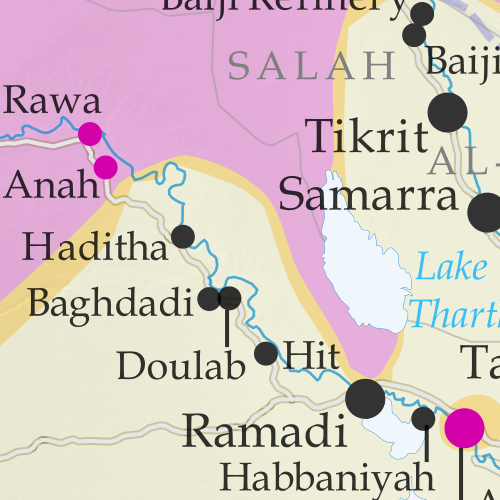
Detailed map of territorial control in Iraq as of May 17, 2016, including territory held by the so-called Islamic State (ISIS, ISIL), the Baghdad government, and the Kurdistan Peshmerga. Includes recent flashpoints such as Rutbah, Doulab, Tuz Khurmatu, and more. The past month has seen several small victories of Iraqi government forces against the so-called “Islamic State” (ISIS/ISIL), as well as a handful of other notable territorial events.
 
See all this and more on the latest update to PolGeoNow’s concise, professional map of control in Iraq’s civil war, including a timeline of changes since our previous Iraq map report of April 2016.

This map and report are premium professional content, available to paid subscribers of the PolGeoNow Conflict Mapping Service.

Want to see before you subscribe? Check out our most recent FREE SAMPLE Iraq map report!

Exclusive map report includes:

  • New since last year: Terrain shading and major highways included on map for geographic context
  • Up-to-date map of current territorial control in Iraq, color-coded for the Iraqi government, “Islamic State” (ISIS/ISIL) extremists, and Kurdistan’s Peshmerga forces
  • Detailed indication of town-by-town control, including provincial boundaries, all major cities, and many smaller ones
  • Markers for key areas of recent fighting such as Rutbah, Doulab, Tuz Khurmatu, and more
  • Timeline of changes to the situation since mid-April, compiled by our Iraq specialist, with links to sources

MEMBERS CLICK HERE TO PROCEED TO ARTICLE AND MAP

Not a member yet? Click here to learn more about our professional subscription service!

Can I purchase just this map?
This map and report are not available for automated purchase to non-subscribers. If you need access or republication rights for only this map report, contact service@polgeonow.com for options.

Syrian Civil War Control Map & Report: May 2016 (Subscription)

MEMBERS CLICK HERE TO PROCEED TO ARTICLE AND MAP

There are newer versions of this map available. To see them, view all Syria updates.

Research by Djordje Djukic. Map by onestopmap.com, Evan Centanni, and Djordje Djukic

Subscribe for full access to all conflict map reports!


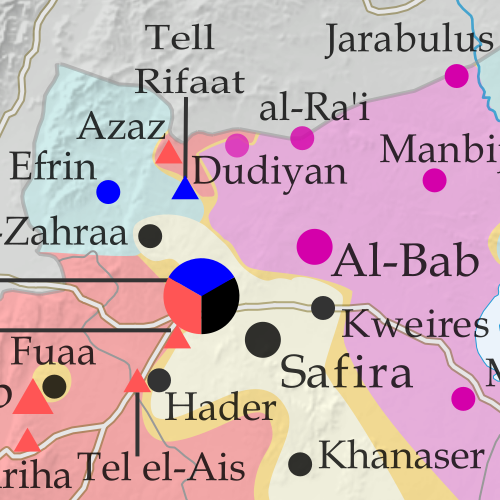
Map of fighting and territorial control in Syria's Civil War (Free Syrian Army rebels, Kurdish YPG, Syrian Democratic Forces (SDF), Al-Nusra Front, Islamic State (ISIS/ISIL), and others), updated for March 2016. Now includes terrain and major roads (highways). Highlights recent locations of conflict and territorial control changes, such as Daraa, Khanaser, Tell Rifaat, Shadadi, the Aleppo Power Plant, and more. The so-called “Islamic State” (ISIS/ISIL) has lost control of several towns in Syria over the past month and a half, but has also scored some victories. Meanwhile, a partial breakdown in the UN-brokered ceasefire has resulted in resumed fighting between government and rebel forces in the Aleppo area.
 
See all this and more on the latest update to PolGeoNow’s concise, professional Syrian Civil War control map, which includes a timeline of changes since our previous Syria map report at the end of March.

This map and report are premium professional content, available to paid subscribers of the PolGeoNow Conflict Mapping Service.

Want to see before you subscribe? Check out our most recent FREE SAMPLE Syria map!

Exclusive map report includes:

  • Up-to-date map of current territorial control in Syria, color-coded for the Assad government, rebel groups, “Islamic State” (ISIS/ISIL) extremists, and Kurdish/SDF forces. 
  • Special symbols indicating towns dominated by rebels of Al Qaeda affiliate Jabhat al-Nusra (the Nusra Front) and by multi-ethnic anti-ISIS Syrian Democratic Forces (SDF).
  • Detailed indication of city-by-city control, highlighting key towns and other locations important to current events.
  • Locations of recent fighting and military operations, including Qaryatain, Al-Rai, Shaer gas field, and more.
  • Detailed timeline of important events and changes to territorial control since March 31, 2016, compiled by our Syria-Iraq expert, with links to sources.

MEMBERS CLICK HERE TO PROCEED TO ARTICLE AND MAP

Not a member yet? Click here to learn more about our professional subscription service!

Can I purchase just this map?
This map and report are not available for automated purchase to non-subscribers. If you need access or republication rights for only this map report, contact service@polgeonow.com for options.

Yemen Control Map & Report: May 2016 (Subscription)

MEMBERS CLICK HERE TO PROCEED TO ARTICLE AND MAP

There are newer versions of this map available. To see them, view all Yemen updates.

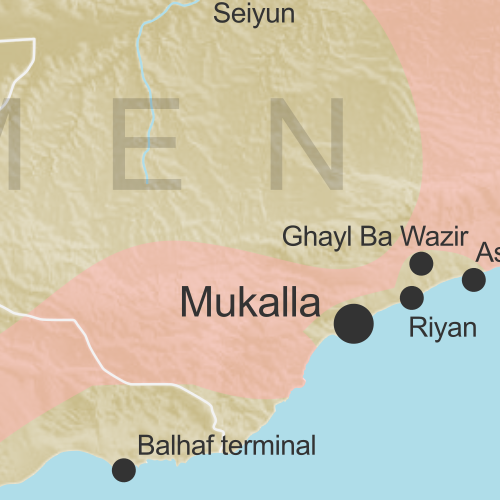
Map of territorial control in Yemen as of May 1, 2016, including territory held by the Houthi rebels and former president Saleh's forces, president-in-exile Hadi and his allies in the Saudi-led coalition and Southern Movement, Al Qaeda in the Arabian Peninsula (AQAP), and the so-called Islamic State (ISIS/ISIL). Includes recent locations of fighting, such as Taiz, Aden, Houta, Mukalla, and more.

Subscribe for full access to all conflict map reports!

Download PDF:
Buy now
New discounted price!

Timeline by Djordje Djukic. Map by Louis Martin-Vézian, Evan Centanni, and Djordje Djukic

In the months since our previous Yemen control map report, Al Qaeda has lost some of its most important territory in Yemen, including a major city it’s held for the past year. Fighting has also continued between the Hadi government and the Houthi alliance, despite attempts at a ceasefire. 


See all this and more on the newest update to PolGeoNow’s Yemen territorial control map, which includes a timeline of changes and important events since our previous Yemen map report in February.

This map and report are exclusive premium content, available to paid subscribers or for individual purchase. Download PDF (US$14.99) New discounted price!

Want to see before you buy? Check out our most recent FREE SAMPLE Yemen map report!

Exclusive report includes:

Map of territorial control in Yemen as of May 1, 2016, including territory held by the Houthi rebels and former president Saleh's forces, president-in-exile Hadi and his allies in the Saudi-led coalition and Southern Movement, Al Qaeda in the Arabian Peninsula (AQAP), and the so-called Islamic State (ISIS/ISIL). Includes recent locations of fighting, such as Taiz, Aden, Houta, Mukalla, and more.
  • Up-to-date map of current territorial control in Yemen, color-coded for the pro-Hadi coalition, Houthi/Saleh forces, Al Qaeda in the Arabian Peninsula (AQAP), and the so-called “Islamic State” (ISIS/ISIL).
  • Color scheme recently updated for consistency with Syria, Iraq, and Libya map series
  • Detailed indication of town-by-town control, including provincial boundaries, all major cities, and many smaller ones
  • Markers for recent areas of fighting, including Taiz, Mukalla, Harib, Ghayl Ba Wazir, and more
  • Timeline of changes to the situation since February 19, 2016, with links to sources

MEMBERS CLICK HERE TO PROCEED TO ARTICLE AND MAP

Not a member yet? Learn more about our professional subscription service!

What Ever Happened with New Zealand’s Flag Referendum?

Subscribers click here to view this article in the ad-free members area. Not a member yet? Learn about PolGeoNow subscriptions!

The proposed new flag: “Silver Fern (Black, White, and Blue)” by Kyle Lockwood (CC BY 3.0 nz)

Referendum Complete
PolGeoNow readers might remember that New Zealand’s vote on whether to change its national flag was scheduled to continue until late March 24. So how did it turn out?

Preliminary results were released on March 24, with detailed final results coming out six days later. The answer: New Zealanders voted “NO” on changing their country’s flag to the proposed “Silver Fern” design, by a margin of 57% to 43%.

Visual comparison of the very similar current flags of Australia and New Zealand
Current flags of New Zealand (top) and Australia (bottom)

The result is that New Zealand will keep the same flag it’s been using since 1902. Even though this design is confusingly similar to the Australian flag, and even though many New Zealanders liked the idea of a flag change, the government didn’t suggest any designs that were popular enough to get a majority of voters behind them.

If you’re curious how each part of New Zealand voted, you can see a color-coded summary and map of the results on Wikipedia. Be be aware that the blue just represents regions that voted just over 50% in favor of changing the flag: No area had more than 52% of voters supporting the Silver Fern, and some of the red-coded areas also had almost 50% support for the change.

Read more: Everything You Need to Know About New Zealand’s Flag Referendum

Current flags of New Zealand (source) and Australia (source) are in the public domain.

Iraq Control Map & Report: April 2016 (Subscription)

SUBSCRIBERS CLICK HERE TO PROCEED TO ARTICLE AND MAP

There are newer versions of this map available. To see them, view all Iraq updates.

Research by Djordje Djukic. Map by onestopmap.com, Evan Centanni, and Djordje Djukic

Subscribe for full access to all conflict map reports!

Download PDF:
Buy now
New discounted price!

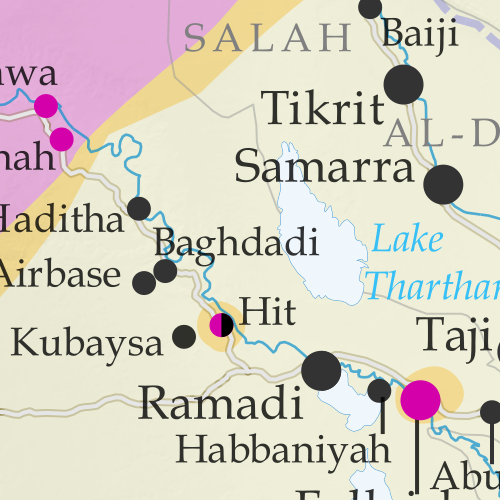
Detailed map of territorial control in Iraq's ongoing war as of April 14, 2016, including territory held by the so-called Islamic State (ISIS, ISIL), the Baghdad government, and the Kurdistan Peshmerga. Includes recent flashpoints including Ramadi, Hit, Bashir, and more.New: Improved map now includes terrain and major roads!

The past four months have seen two significant victories for Iraqi government forces over the so-called “Islamic State” (ISIS/ISIL), despite floundering attempts to retake the city of Mosul.
 
See all this and more on the latest update to PolGeoNow’s concise, professional map of control in Iraq’s civil war, including a timeline of changes since our previous Iraq map report in December 2015.

This map and report are professional subscriber content, available to paid members or for separate purchase. Download PDF (US$14.99) New discounted price!

Want to see before you buy? Check out our most recent FREE SAMPLE Iraq map report!

Exclusive map report includes:

Detailed map of territorial control in Iraq's ongoing war as of April 14, 2016, including territory held by the so-called Islamic State (ISIS, ISIL), the Baghdad government, and the Kurdistan Peshmerga. Includes recent flashpoints including Ramadi, Hit, Bashir, and more.
  • New since last time: Terrain shading and major highways included on map for geographic context
  • Up-to-date map of current territorial control in Iraq, color-coded for the Iraqi government, “Islamic State” (ISIS/ISIL) extremists, and Kurdistan’s Peshmerga forces
  • Detailed indication of town-by-town control, including provincial boundaries, all major cities, and many smaller ones
  • Markers for key areas of recent fighting such as Ramadi, Hit, Bashir, and more
  • Timeline of changes to the situation since December, compiled by our Iraq specialist, with links to sources 

Note: Republishing rights are not included with PDF purchases or basic subscriptions. If you need to use one of our maps in print or online, please contact service@polgeonow.com.

SUBSCRIBERS CLICK HERE TO PROCEED TO ARTICLE AND MAP

NON-MEMBERS: PURCHASE MAP REPORT

Not a member yet? Click here to learn about our professional subscription service!

Syrian Civil War Control Map: April 2016

There are newer versions of this map available. To see them, view all Syria updates.

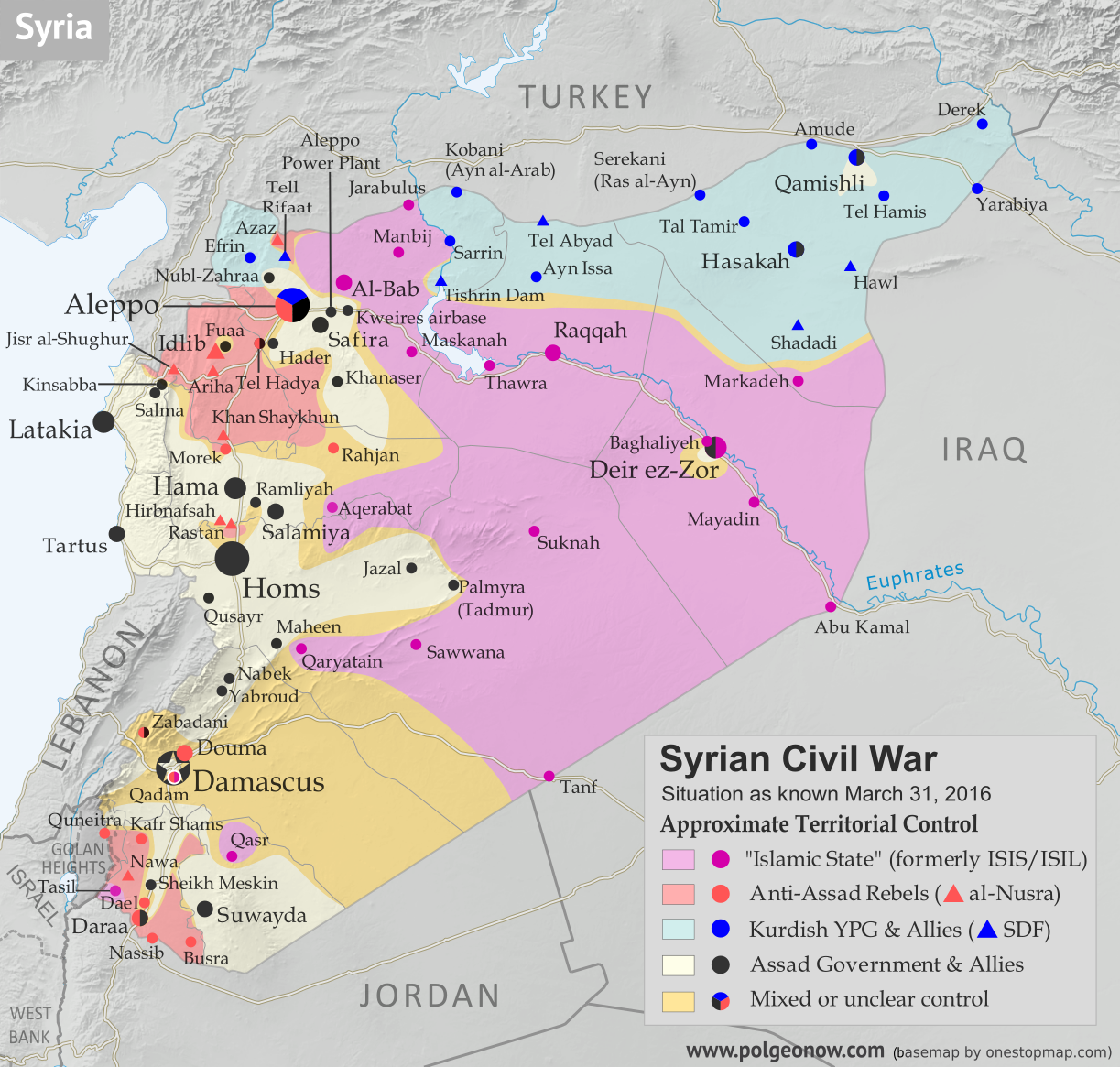
Map of fighting and territorial control in Syria's Civil War (Free Syrian Army rebels, Kurdish YPG, Syrian Democratic Forces (SDF), Al-Nusra Front, Islamic State (ISIS/ISIL), and others), updated for the beginning of April 2016. Now includes terrain and major roads (highways). Highlights recent locations of conflict and territorial control changes, including Palmyra, Qaryatayn, Deir Ez-Zor, and more. (Color blind accessible.)
Base map by Koen Adams of onestopmap.com, with territorial control by Evan Centanni and Djordje Djukic. All rights reserved.

Subscribers click here to view this article in the ad-free members area. Not a member yet? Learn about PolGeoNow subscriptions!

Timeline by Djordje Djukic

Recapture of Palmyra
Since our previous Syria control map report in early March, the Syrian government of Bashar al-Assad has recaptured the historic city of Palmyra (known in modern Arabic as Tadmur) from the so-called “Islamic State” (IS, formerly known as ISIS/ISIL). The military has also pushed back against IS in Qaryatain, one of the group’s westernmost outposts, even as IS is showing an increasingly prominent presence in the southwestern corner of Syria near the Golan Heights. Meanwhile, fighting between government and anti-Assad rebel forces has continued, though at a relatively low level, since the implementation of the UN-brokered ceasefire.

Flag of Syria under the current governmentCountry Name:  
• Syria (English)
• Sūriyya/Sūryā (Arabic)
Official Name:  
• Syrian Arab Republic (English)
• al-Jumhūriyyah al-‘Arabīyah  as-Sūriyyah (Arabic)
Capital: Damascus

Note: Red triangles on the map represent towns where Jabhat al-Nusra (a.k.a. the Nusra Front) is thought to be near the top of the power hierarchy, even if it doesn’t exercise exclusive control. It remains the case that there is some amount of Nusra presence in almost every rebel-held area in Syria, but it is not always the dominant group.

Timeline of Events
The following is a timeline of changes to territorial control and other key events in Syria since our previous map update of March 9, 2016.

March 9, 2016
The army captured five villages east of the Khanaser-Aleppo Road. Meanwhile, the military advanced towards a town on the border between Latakia and Idlib provinces, during which they captured a mountaintop overlooking the town. However, later in the day, the rebels recaptured the hill.

March 10, 2016
Dozens of Russian airstrikes on Palmyra killed 32 IS fighters. The strikes were seen as a prelude to a major army offensive to capture the city.

March 15-17, 2016
Government forces captured a mountain in Deir Ezzor, as well as large parts of the Deir Ezzor-Mayadeen highway near the city, advancing to a nearby oil field.

March 17, 2016
The military made advances in the eastern part of Homs province, capturing a mountaintop near Qaryatain.

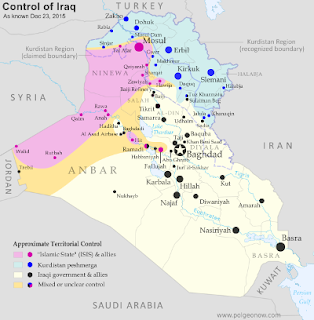
Map of Islamic State and Kurdish control in Iraq as of December 2015
“Islamic State” and Kurdish control in Iraq (click for full map)

March 19, 2016
The rebels captured two villages from IS north of Aleppo.

March 20, 2016
The army seized two or four positions in Latakia province.

March 21-24, 2016
On March 21, IS captured two towns, including Tasil, from rebels in Daraa province. Between March 23 and 24, IS captured another two towns and was contesting two more. Eventually, IS forces were repelled from the two contested towns, but surrounded one more on the border with Jordan.

March 26, 2016
The army advanced in an area of East Ghouta, in the eastern suburbs of Damascus.

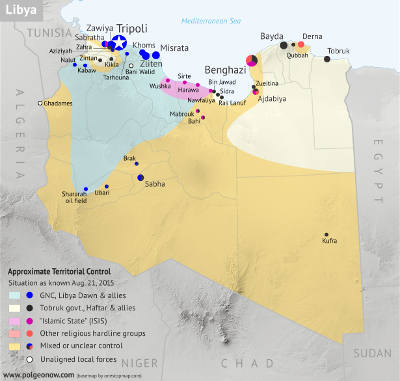
Map of control in Libya as of August 2015, including the so-called Islamic State (ISIS)
“Islamic State” (IS) control in Libya (click for full map)

March 27, 2016
The army captured the desert city of Palmyra, along with its famous 2,000-year-old ruins. Two large temples and a Roman triumphal archway that were part of the ruins had been destroyed by IS during its 10-month occupation of the city. However, it was confirmed that 80 percent of the Unesco World Heritage site was intact. Still, destruction and damage brought upon artifacts at the Palmyra museum were said to be shocking. During the battle for Palmyra, there were no civilian deaths, but 612 combatants were confirmed killed, including 417 IS fighters and 194 government soldiers and militiamen, as well as one Russian special forces soldier.

March 29, 2016
The army made advances around IS-held Qaryatayn, southeast of Homs, capturing several hills and effectively encircling the town.

March 29-30, 2016
Rebels captured two villages from IS north of Aleppo, while the SDF attempted to advance in the area of another village.

March 30-31, 2016
Rebels recaptured two hills and a checkpoint in Daraa province that they had lost recently to IS. However, the following day, IS reportedly captured a new village in Daraa province.

Graphic of the Syrian flag is in the public domain (source).
Libya Control Map & Report: March 2016 (Subscription)

MEMBERS CLICK HERE TO PROCEED TO ARTICLE AND MAP

There are newer versions of this map available. To see them, view all Libya updates.

Map by onestopmap.com and Evan Centanni

Subscribe for full access to all conflict map reports!

New: No Paypal account required! Just click “Pay using your credit or debit card.”

Download PDF:
Buy now

Libya control map: Shows detailed territorial control in Libya's civil war as of March 2016, including all major parties (Tobruk government, General Haftar's Operation Dignity forces, and Zintan militias; Tripoli GNC government, Libya Dawn, and Libya Shield Force; Shura Council of Benghazi Revolutionaries and other hardline Islamist groups; and the so-called Islamic State (ISIS/ISIL)). Also file under: Map of Islamic State (ISIS) control in Libya. Now includes terrain and major roads. Color blind accessible. Despite hopes that a UN-backed unity deal might bring Libya’s two rival governments back together, fighting in continues against the so-called “Islamic State” (ISIS/ISIL) and other religious hardline groups. Though most of the major cities have stayed in the same hands since last summer, there have still been several important changes to territorial control.
 
See all this and more on the latest update to PolGeoNow’s concise, professional Libyan Civil War control map, which comes with a timeline of changes since our previous Libya map report last August.

This map and report are professional subscriber content, available to paid members or for separate purchase. Download PDF (US$9.99)

Want to see before you buy? Check out our most recent FREE SAMPLE Libya map!

Exclusive Libya map report includes:

Libya control map: Shows detailed territorial control in Libya's civil war as of February 2016, including all major parties (Tobruk government, General Haftar's Operation Dignity forces, and Zintan militias; Tripoli GNC government, Libya Dawn, and Libya Shield Force; Shura Council of Benghazi Revolutionaries and other hardline Islamist groups; and the so-called Islamic State (ISIS/ISIL)). Also file under: Map of Islamic State (ISIS) control in Libya. Now includes terrain and major roads. Color blind accessible.
  • Up-to-date map of current territorial control in Libya, color-coded for the internationally-recognized Tobruk government (supported by General Haftar’s Operation Dignity), the rival Tripoli-based GNC government (supported by the Libya Dawn militias), “Islamic State” (ISIS/ISIL) extremists, and other religious hardline groups. 
  • Detailed indication of city-by-city control, highlighting key towns and other locations important to current events.
  • Locations of recent fighting and military operations, including Benghazi, Ajdabiya, Janzur, Bin Jawad, and more.
  • Detailed timeline of important events and changes to territorial control since August 21, 2015, with all sources cited.
  • New in this edition: Major roads are marked on the map for reference

MEMBERS CLICK HERE TO PROCEED TO ARTICLE AND MAP

Not a member yet? Click here to learn more about our professional subscription service!