Map of Rebel Control in Mali: June 2015

(To see other maps in this series, view all Mali articles.)

Map of territorial control in Mali as of June 2015. Includes separatist rebel control (CMA, MNLA, MAA, HCUA) and locations of UN peacekeeper (MINUSMA) deployments, as well as the location of a brief takeover by Al Qaeda in the Islamic Maghreb (AQIM).
Map by Evan Centanni, modified from this map by Orionist, Carport, and NordNordWest. License: CC BY-SA.

Subscribers click here to view this article in the ad-free members area. Not a member yet? Subscribe now!

Article by Evan Centanni

Separatist Return to Power
At the time of our last Mali rebel control map report, separatist rebels had just allowed the Malian government to resume control of the north as part of a ceasefire agreement ahead of elections. The rebels had for a time resumed control of the region after a French-led military intervention pushed out the religiously-oriented rebel groups who had usurped the initial separatist rebellion. In July 2013, Mali’s territory was again united for the first time in over a year.

But that was two years ago now. Skirmishes between government and separatist forces continued after the elections, and by summer of 2014, towns began to fall once again under separatist control. The National Movement for the Liberation of Azawad (MNLA) and allied groups once again ruled large parts of Mali’s sparsely-populated extreme north, where they had declared an independent country in April 2012.

Today, the allied separatist forces appear to control much of the region around Kidal, and have proven capable of attacking much farther south in recent months. However, they have gradually backed down from their insistence on full independence, and peace may finally be around the corner. A new agreement offering partially-devolved powers to the north has been signed by the Malian government and two small members of the separatist alliance, with the MNLA and two other major groups saying they too will sign on June 20.
Flag of MaliCountry Name:  
• Mali (English, French, Bambara)
Official Name:  
• Republic of Mali (English)
• République du Mali (French) 
• Mali ka Fasojamana (Bambara)
Capital: Bamako

Timeline of Events
The following is a timeline of major events and changes to territorial control since July 2013.

2013.07.01 A new UN peacekeeping mission, the United Nations Multidimensional Integrated Stabilization Mission in Mali (MINUSMA), officially begins. It replaces an early, more hastily-formed multinational force composed of troops from neighboring countries.

2013.07.28 Mali holds the first round of its presidential elections.

2013.08.02 The results of the first round of elections are announced: candidates Soumaila Cisse and Ibrahim Boubacar Keita will advance to the runoff election.

2013.08.11 The runoff presidential election is held, with Keita declared the new president-elect of Mali.

2013.08-2014.05 Regular clashes continue in northern Mali between separatists, pro-government forces, and others, but no reports emerge of rebels capturing territory.

2014.05.20 The town of N’Tilit is occupied by MNLA separatists (source: ACLED).

2014.05.21 A government attempt to assert greater control over the town of Kidal results in a resounding defeat, with separatists seizing the whole city.

2014.05.22 After the capture of Kidal, the MNLA rebels claim they have also taken over Anefis, Aguelhok, Tessalit, Ménaka, Ansongo, Anderamboukane and Léré, though government officials soon deny this. A BBC correspondent “confirms” that the Malian army has withdrawn from Anefis, Aguelhok, Tessalit, and Ménaka.

Later events will suggest that Ménaka and Anefis were indeed under rebel control, but that Léré was not. The status of the other towns remains unclear (Tessalit and Aguelhok, though inside the separatist-dominated Kidal region, are also home to contingents of foreign troops).

2014.10.16 N’Tilit is taken from the MNLA by fighters of the Self-Defense Group of Imghad Tuareg and Allies (GATIA), a pro-government, Tuareg-majority militia.

2014.10.18 GATIA and allied militias capture Tessit from the MNLA, which had retreated there after its defeat in N’Tilit.

2014.10.28 At a meeting in Anefis, the three largest separatist groups in Mali’s north form a unified military command, called the Coordination of Azawad Movements (CMA). The member groups are the MNLA, the Arab Movement of the Azawad (MAA), and the High Council for the Unity of Azawad (HCUA). The HCUA is a Tuareg-majority group formed largely from former members of Ansar Dine, the group which helped the MNLA take over in 2012, but sought to turn Mali into a religious state until it was defeated during the French intervention. Two smaller groups will later join the CMA as well.

2014.12.26 The MAA, an Arab-majority member group of the CMA, is reported to be in control of Taoudenni, the largest settlement in Mali’s vast northwestern desert.

2015.01.05 Fighters from Al Qaeda in the Islamic Maghreb (AQIM) briefly capture a major Malian military base in the central town of Nampala. AQIM has no direct connection to the separatist rebels, but has benefited from chaos in the north.

2015.02.04 GATIA fighters capture Tabrichat from CMA separatist forces.

2015.04.27 MNLA forces are pushed out of Ménaka by GATIA and a pro-government faction of the MAA.

2015.05.14 After internationally-brokered talks in Algeria, CMA separatists agree in principal to a peace deal with Mali’s government, which would allow more devolution of power to the northern regions. Two smaller members of the CMA sign the agreement, but the MNLA, MAA, and HCUA say they are not yet ready to sign.

More Control Maps:
Map of Territorial Control in Iraq (May 2015)
Map of Boko Haram Control in Nigeria (May 2015)
Syrian Civil War Territorial Control Map (May 2015)

Graphic of Malian flag is in the public domain (source).

Vatican City Administration Recognizes Palestine as a Country (map)

(Keep up with changes to Palestine’s situation: view all Palestine updates.)

Map of countries that recognize the State of Palestine as an independent country, updated for June 2015 with recent addition Vatican City (Holy See) highlighted
Click to enlarge: Countries recognizing the State of Palestine in green, with most recent addition highlighted. Palestine in magenta (circled). Map by Evan Centanni, modified from public domain graphic (source).

Subscribers click here to view this article in the ad-free members area. Not a member yet? Subscribe now!

Article by Evan Centanni

Vatican Recognizes Palestine
Last month the Holy See – the official administration of the Roman Catholic Church and government of Vatican City – became the latest national government to recognize Palestine as an independent country. The explicit acknowledgement of Palestine’s statehood came with a treaty signed May 13, 2015, regarding the activities of the Catholic Church within Palestine’s territory. 

In the face of criticism from Israel’s government and other groups, the Vatican played down the significance of the treaty, saying that the Holy See had really recognized Palestine ever since supporting the UN vote on Palestinian’s statehood in 2012. However, official diplomatic recognition usually requires an explicit statement by the country’s government, so the Holy See was presumed not to formally recognize Palestine until now.

Learn More: What’s the difference between Vatican City and the Holy See?

Vatican City is now one of about half the world’s countries whose government recognizes both Palestine and Israel as independent countries. But Palestine is recognized by only a few countries in Europe, and the Holy See is only the fifth European government to recognize since the end of the Cold War. The last was Sweden in October 2014, preceded by Iceland in 2011, Montenegro in 2006, and Bosnia in 1992.

Flag of Palestine Country Name:  
• Palestine (English)
Filasṭīn (Arabic)
Official Name:  
• State of Palestine (English)
• Dawlat Filasṭin (Arabic)
Capital: 
• Jerusalem (claimed)
Ramallah (administrative)

Palestine: Disputed Country
The Palestinian Liberation Organization (PLO) declared independence for Palestine in 1988, and has been seeking international acceptance for the proclaimed country ever since. Though its claimed territories are disputed and largely occupied by Israel, the “State of Palestine” is recognized by more than two-thirds of the world’s countries, and is also treated as a country by the UN General Assembly, where it is an “Observer State” but not a member.

The Holy See also has Observer State status in the UN, making Vatican City and Palestine the only two countries that are acknowledged as independent by the UN, but do not have votes in the General Assembly.

The number of individual countries recognizing Palestine as independent has grown gradually over the past decades. Last year we reported that 135 UN member states officially recognized Palestine (70% of all UN members), and this is still the case today, since Vatican City is not a full UN member. Palestine is also recognized by the proclaimed government of Western Sahara, a fellow disputed country whose independence is not formally recognized by the UN at all.

Related:
Is Palestine Really a Country?
Palestine Recognized as a Country by the U.N.
Map of Countries Recognizing Kosovo

Map of Boko Haram Control in Nigeria: May 2015 (Subscription)

The best online map of Boko Haram’s territorial control – guaranteed! 

There are newer versions of this map available. To see them, view all Boko Haram updates.

Detailed map of Boko Haram's territorial control in its war with Nigeria, marking each town reportedly under the group's control in Borno, Yobe, and Adamawa states. Includes key recent locations, such as Gwoza, Marte, and the Sambisa Forest.

Download PDF:
Buy now

(Subscribe via Paypal to view all premium content online)

Timeline by T.H., with additional reporting by Evan Centanni

Even as evidence mounts of Boko Haram’s ties to the Islamic State, the Nigerian rebel group has been driven from most of its recently-held territory. Yet as Nigeria’s new president prepares to take office, Boko Haram may already be making a comeback.

This map report illustrates areas of known and possible Boko Haram control in Nigeria, and for the first time shows the full area of the Sambisa Forest, the rebels’ last-resort hideout. The report includes a summary and timeline of events since our previous Boko Haram control map in March.

This map report is exclusive premium content, available to paid subscribers or for separate purchase. Buy now (US$14.99)

Exclusive map report includes:

  • Map of Boko Haram’s overall area of control in Nigeria, updated to May 28, 2015.
  • Detailed mapping of each town under Boko Haram’s influence, as well as most locations of recent attacks.
  • New: Full outline of the Sambisa Forest, Boko Haram’s vast safe haven.
  • Summary and detailed timeline of territorial changes and major events since late March, with links to sources.

MEMBERS CLICK HERE TO PROCEED TO ARTICLE AND MAP

NOT A MEMBER YET? SUBSCRIBE NOW!

Syria Civil War Control Map: May 2015 (Subscription)

There are newer versions of this map available. To see them, view all Syria updates.

Map of fighting and territorial control in Syria's Civil War (Free Syrian Army rebels, Kurdish groups, Al-Nusra Front, Islamic State (ISIS/ISIL) and others), updated for late May 2015. Highlights recent locations of conflict and territorial control changes, such as Palmyra, Jisr al-Shughur, al-Janf border crossing, and others.

Download PDF:
Buy now

(Subscribe via Paypal to view all premium content online)

Research by T.H., with additional reporting by Evan Centanni

Since just last month, the Syrian government of Bashar al-Assad has lost important ground to both the rebel coalition (including Al Qaeda affiliate Jabhat al-Nusra) and the Islamic State. The war has also spread into new parts of Syria previously untouched by fighting, while Kurdish groups in the north are continuing to consolidate their gains.

See all this and more on the newest update to PolGeoNow’s popular Syria control map, and read a timeline of changes since our previous Syria map report in mid-April.

This map and report are exclusive premium content, available to paid subscribers or for separate purchase.
Download PDF (US$19.99)

Exclusive map report includes:

  • Up-to-date map of current territorial control in Syria, color-coded for the Assad government, rebel groups, Islamic State (ISIS/ISIL) extremists, and Kurdish self-protection forces. Special symbol indicates rebel-held towns dominated by Al Qaeda affiliate Jabhat al-Nusra.
  • Detailed indication of city-by-city control, highlighting key towns and other locations relevant to current events.
  • Locations of recent fighting and military operations, including Palmyra, Jisr al-Shughur, Yarmouk, al-Tanf border crossing, and more.
  • Timeline of important events and changes to territorial control since April 10, 2015.

MEMBERS CLICK HERE TO PROCEED TO ARTICLE AND MAP

NOT A MEMBER YET? SUBSCRIBE NOW!

War in Iraq: Map of Islamic State Control in May 2015

There are newer versions of this map available. To see them, view all Iraq updates.

This is a free sample of our Iraq territorial control map. To access more Iraq control map updates like this one, sign up now for our conflict map subscription service!

Detailed map of territorial control in Iraq as of May 20, 2015, including territory held by the Islamic State (ISIS, ISIL), the Baghdad government, and the Kurdistan Peshmerga. Includes recent flashpoints including Ramadi, Tikrit, Habbaniyah, Khaldiya, Sinjar, and others, as well as the recently created province of Halabja in Iraqi Kurdistan.
Map by Evan Centanni, starting from blank map by NordNordWest. License: CC BY-SA

Subscribers click here to view this article in the ad-free members area. Not a member yet? Subscribe now!

Timeline by Djordje Djukic, with additional reporting by Evan Centanni

A City for a City
Since PolGeoNow published our February map of control in Iraq, two major cities have changed hands, in opposite directions. Tikrit, known as the home region of former leader Saddam Hussein, was the Islamic State’s farthest-forward prize in its spectacular takeover of northern Iraq last June. A priority for Iraq’s struggling Baghdad government, Tikrit was finally taken back this March and April in a major push by Shiite militias, led by Iran and ultimately supported by U.S.-Arab coalition airstrikes.

Soon afterwards, however, the Islamic State struck back with its own campaign to secure control of Ramadi, the capital of western Iraq’s sprawling Anbar province. Nearby Fallujah was the first Iraqi city taken over by Islamic State fighters almost a year and a half ago (free map), and parts of Ramadi have also been under the group’s control ever since.

However, focused efforts by the Iraqi security forces and allied fighters had kept much of the city under government control until just a few days ago, when Islamic State forces completely drove them out after a days-long battle. Though control in the Anbar countryside varies from town to town, there is now little doubt that the Islamic State controls a majority of the province’s populated territory.

See Also: Syrian Civil War Control Map: April 2015

Flag of IraqCountry Name:  
• Iraq (English, Kurdish)
• al-‘Irāq (Arabic)
Official Name:  
• Republic of Iraq (English)
• Jumhūriyyat al-‘Irāq (Arabic)
Komara Iraqê (Kurdish)
Capital: Baghdad

Timeline of Changes in Territorial Control
The following is an outline of major events since PolGeoNow’s previous Iraq control map update in February.

March 1, 2015
The Iraqi Defense Ministry claimed its forces had fully recaptured the town of Baghdadi, near Al Asad Airbase in Anbar province.

March 2, 2015
An Iraqi government offensive began with the purpose of recapturing Tikrit, the third-largest Iraqi city under Islamic State control, with support from Iran and Shiite militias.

March 4, 2015
Iraqi troops captured the police academy and hospital in Tikrit, as well as two oil fields in the surrounding Salah Al-Din province, according to a security official.

March 6, 2015
Government forces assaulted the town of Dawr (Dur), south of Tikrit, and reportedly captured the town’s main street. Meanwhile, the U.S. military reported that Iraqi troops and allied militias recaptured the town of Baghdadi, several days after the Iraqi government had made the same claim.

March 8, 2015
Government troops managed to capture the center of Dawr, but Islamic State fighters were still holding positions in the western part of town. The previous day, government forces had also captured a small town on the outskirts of Tikrit.

March 9, 2015
Kurdish forces secured several villages along a 30-kilometer front, and advanced at some points up to five kilometers, in an offensive against the Islamic State southwest of Kirkuk. Meanwhile, government troops captured the town of Al-Alam, just north of Tikrit, and parts of another town south of the city.

March 10, 2015
Al-Alam was officially declared under control of security forces by the local mayor.

March 12, 2015
Iraqi security forces managed to recapture 50-75 percent of Tikrit, one day after entering the city, but further progress was stalled due to heavy resistance and mounting casualties.

March 18, 2015
The Iraqi Ministry of Defense reported that government troops captured several villages in the Tuz Khurmatu area without any resistance from the Islamic State. (PolGeoNow research suggests that this area –  home to a major Iraqi Turkmen population – has already been outside of Islamic State control for some time. However, it is located within the region disputed between Kurdistan and the Iraqi government.)

March 25, 2015
For the first time, the United States began airstrikes on Islamic State positions in Tikrit in support of the battle to seize the city. The action reportedly came in response to a request from Iraqi Prime Minister Haider al-Abadi.

March 27, 2015
Several Shiite pro-government militias, part of the Iran-backed ground campaign to recapture Tikrit, reportedly pulled out of the battle in protest of U.S. involvement.

March 31, 2015
Iraqi security forces reached the center of Tikrit, and soon afterwards the Iraqi Prime Minister claimed that most of the city had been seized. However, U.S. officials expressed skepticism, and were of the opinion the battle was still not over. In addition, an Iraqi military official in Tikrit itself stated they had only taken about half of it and that fighting was still raging throughout the city.

Map of the territorial control (Assad government, Islamic State/ISIS/ISIL, rebel, and Kurdish) in the Syrian Civil War as of April 2015
Map of Islamic State Control in Syria, April 2015
(click for subscriber article and map).

April 4, 2015
The last pocket of Islamic State resistance in Tikrit was cleared, according to an Iraqi military officer. However, the next day a reporter from Rudaw, a Kurdish news service, said there were still around 500 IS fighters in the city’s Qadisiya district.

April 8, 2015
Fighting was still continuing in Tikrit’s Qadisiya district.

April 10, 2015
The Islamic State captured two areas on the northern outskirts of Ramadi, after punching through government lines with suicide bombers.

April 12, 2015
Tikrit was declared free of Islamic State forces by the Iraqi government.

April 13, 2015
Government forces launched a counter-attack in Ramadi’s northern outskirts and, according to a police officer, recaptured around 40 percent of it, but were facing stiff resistance.

April 15, 2015
The Islamic State captured several villages on the outskirts of Ramadi and seized parts of the Baiji oil refinery north of Tikrit. With the latest advance in the area of Ramadi, according to the deputy head of the Anbar Provincial Council, the Islamic State was possibly only hours away from taking control of the provincial capital, with security “collapsing rapidly in the city”.

April 16, 2015
Coalition airstrikes halted the Islamic State advance in the Ramadi area, cutting its logistical resupply routes.

April 17, 2015
Former Saddam Hussein aide Izzat Ibrahim al-Douri, who escaped the 2003 US invasion and had recently backed the Islamic State, was reportedly killed in a military operation east of Tikrit. The dissolved Baath party denied his death, while Al-Arabiya TV aired a picture allegedly showing his body, and a Shiite militia stated his remains were sent to Baghdad for DNA testing. Al-Douri was the last major figure from Saddam Hussein’s government still at large.

April 24, 2015
Brig. Gen. Hassan Abbas Toufan, commander of the Iraqi 1st Division, was killed in a suicide bombing, involving a bulldozer packed with explosives, against his convoy north of Fallujah. The attack also killed three other officers, a colonel and two lieutenant colonels. The overall toll was later put at 13 soldiers dead.

April 27, 2015
It was confirmed that 30 policemen had been killed and 100 wounded during the previous week in heavy fighting in the Ramadi area. More than 100,000 people were displaced by the clashes which left government forces in control of only 20 percent of the city.

May 2, 2015
Islamic State fighters captured half of the Baiji oil refinery and cut supply lines for around 150 government soldiers stationed at the facility, after four days of siege.

May 4, 2015
Islamic State forces controlled almost two thirds of the Baiji oil refinery and had advanced so far into the facility that the Iraqi Air Force was not in a position to strike them without damaging the complex.

May 5, 2015
Heavy fighting near Sinjar, in Iraq’s far northwest, left 45 Islamic State and 22 Kurdish Peshmerga fighters dead.

May 7, 2015
Islamic State forces expanded their control of the Baiji refinery to 80 percent of the facility, after Iraqi forces had suffered steady losses in the previous days.

May 12, 2015
A U.S. F-18 fighter jet supporting operations in Iraq and Syria crashed in the Persian Gulf, with both crewmembers rescued.

May 13, 2015
According to the Iraq Defence Ministry, the second-in-command of the Islamic State, Abu Alaa al-Afari, was killed in a coalition air strike in Tal Afar near Mosul. However, the U.S. denied parts of the story and did not claim to have killed al-Afari.

May 15, 2015
Islamic State fighters captured Ramadi’s government compound, which houses most of the municipal and provincial government offices. They then focused their attack on the Anbar Operation Command, the provincial military headquarters. Soon after, according to at least one report, the Islamic State had taken full control of Ramadi, with more than 60 police officers killed in the fighting. Islamic State fighters also captured the town of Jubba, near Al Asad Airbase northwest of Ramadi.

May 16, 2015
Islamic State fighters reportedly retreated from the main government building in Ramadi, after airstrikes from the U.S.-led coalition.

May 17, 2015
The Islamic State captured the last remaining military bases in Ramadi, including the Anbar Operation Command, after a desperate retreat by Iraqi government forces. This left Islamic State forces in control of the city, with Iraqi troops retreating to its outskirts. An estimated 500 civilians and security forces members had been killed since the start of the IS offensive three days earlier, according to one official.

The Iraqi Prime Minister ordered his troops not to abandon Anbar province in the face of the Islamic State advance. Among those killed in the final push was Col. Muthana al-Jabri, the chief of the Malaab police station, which was hit by four near-simultaneous suicide-bombings that left 10 policemen dead and 15 wounded. Additionally, five soldiers were killed and 12 wounded when three suicide-bombers struck the gate of the Anbar Operation Command. Two dozen police officers were also missing.

May 18, 2015
At the request of the Iraqi government, Shiite militias were assembling in Habbaniyah for an eventual counterattack on Islamic State positions in Ramadi.

May 19, 2015
Islamic State forces launched an offensive to capture the town of Khaldiya, near the Habbaniyah military base, but managed to capture only a village in its outskirts, while the attack on Khaldiya itself was repelled.

May 20, 2015
Iraqi troops and local militias reportedly recaptured Jubba, near Al Asad airbase in Anbar, from the Islamic State fighters that took it the previous week.

Don’t miss anything: check back for more Iraq map updates on PolGeoNow!

Graphic of the Iraqi flag is in the public domain (source).
Map: Another Country Joins the “Eurasian Union” (May 2015)

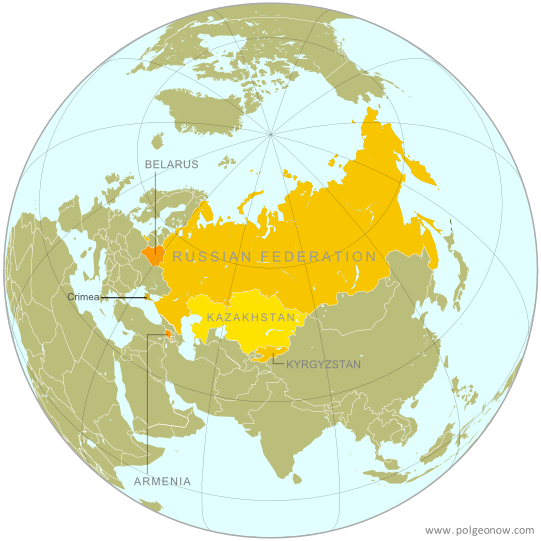
Map of the Eurasian Economic Union (EEU), also known as the Eurasian Union. Includes new member Kyrgyzstan, as well as prior members Russia, Belarus, Kazakhstan, and Armenia, and disputed territory Crimea
The Eurasian Economic Union’s five current member countries, plus disputed Crimea, claimed to be part of Russia. Map by Evan Centanni, starting from this map by Keverich2. License: CC BY-SA

Premium members click here to view this article in the ad-free members area. Not a member yet? Subscribe now!

Article by Evan Centanni

Kyrgyzstan Joins EEU
The Eurasian Economic Union (EEU, EAU, or EAEU), a new Russia-led free trade area, just welcomed Kyrgyzstan as a new member on May 8. The EEU, sometimes known as the “Eurasian Union” for short (or in reference to its possible future direction), officially launched at the beginning of this year, but has been in development since several years ago. The union has four other member countries: Russia, Belarus, Kazakhstan, and Armenia.

More: What is the “Eurasian Union”?

Flag of the Eurasian Economic Union (aka EEU, EAU, or Eurasian Union)
Country Name:
• Kyrgyzstan (English, Kyrgyz)
• Kirgiziya (Russian)
Official Name:
• Kyrgyz Republic (English)
• Kyrgyz Respublikasy (Kyrgyz)
• Kyrgyzskaya Respublika (Russian)
Capital: Bishkek

Kyrgyzstan started the process of joining the EEU last summer, and its entry in the organization has been delayed twice, allegedly due to last-minute hang-ups in the negotiations. The small central Asian country finally signed on as a full member last Friday, at a summit meeting of the leaders from all five member countries.

To ease economically-struggling Kyrgyzstan’s entry into the EEU, Russia has approved hundreds of millions of dollars in aid to the country. Kyrgyz President Almazbek Atambayev, for his part, has been enthusiastic about joining the union, and Russia-bound migrant workers are optimistic about the change. However, many Kyrgyz citizens are concerned that EEU rules favoring trade between the organization’s members could hamper trade and investment from neighboring China.

See Also: Armenia Joins EEU Ahead of Organization’s Official Launch

Graphic of the Kyrgyz flag is in the public domain (source).
Map: Seychelles Join WTO

Paid subscribers click here to view this article in the ad-free members area. Not a subscriber yet? Subscribe now!

Map of World Trade Organization (WTO) member and observer countries, updated for April 2015 to include new member Seychelles
Member and observer states of the World Trade Organization (WTO). Map by Evan Centanni, starting from public domain blank map (license: CC BY-NC-SA).

Additional reporting by Caleb Centanni

Seychelles Joins WTO

This Sunday, Seychelles joined the World Trade Organization (WTO), a global body founded in 1995 to promote the management and expansion of international trade.The last country to join the organization was Yemen last June, preceded by Laos and Tajikistan in 2013.

Logo of the World Trade Organization (WTO) Organization Name:  
• World Trade Organization (English)
• Organisation mondiale du commerce (French)
• Organización Mundial del Comercio (Spanish)
Founded: 1994 in Marrakech, Morocco (commenced in 1995)
Headquarters: Geneva, Switzerland
Website: www.wto.org

Seychelles is a country made up of a group of islands off the coast of East Africa. A member of the African Union, it is Africa’s smallest country by both area and population. This year marks the end of a 20-year negotiation process for Seychelles to enter the WTO. It is the organization’s 161st member.

Of the 195 UN-recognized countries in the world, 157 (about 81%) are members of the WTO. Another four members are not UN-recognized nations: the Chinese administered territories of Hong Kong and Macau, the European Union, and the disputed state of Taiwan, which participates under the name “Separate Customs Territory of Taiwan, Penghu, Kinmen and Matsu (Chinese Taipei)”.  

There are also 23 WTO “observers”, down from 24 now that Seychelles has become a full member. These observer countries are partially included in the organization and have applied for membership (excepting the Holy See, which does not plan to apply). There are only 15UN-recognized countries that are neither members nor observers of the WTO.

WTO logo is displayed without permission, based on fair use principles (source).

What is the “Eurasian Union”? (Map)

The Russia-led Eurasian Economic Union, sometimes simply called the “Eurasian Union”, was officially launched at the beginning of this year. Read on for a brief introduction to this major new regional organization, which you can expect to hear a lot more about in the coming months and years!

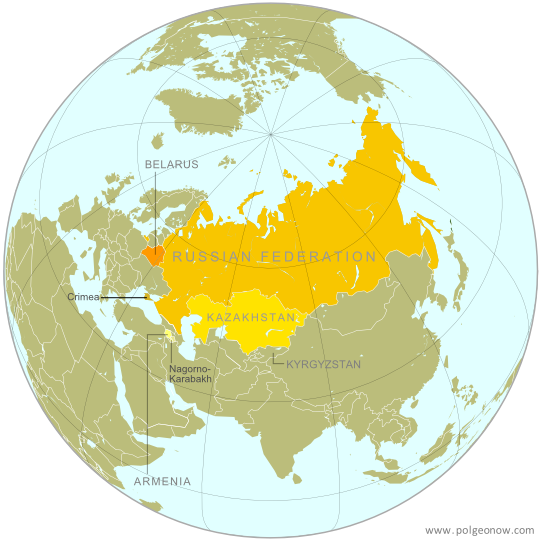
Map of the Eurasian Economic Union (EEU), also known as the Eurasian Union. Includes new member Armenia, as well as prior members Russia, Belarus, and Kazakhstan, and disputed territories Crimea and Nagorno-Karabakh, as well as acceding member Kyrgyzstan.
The Eurasian Economic Union’s four current member countries, plus disputed territories officially or unofficially included in the common market. Map by Evan Centanni, starting from this map by Keverich2. License: CC BY-SA

Premium members click here to view this article in the ad-free members area. Not a member yet? Subscribe now!

Article by Karina Barquet

Eurasian Economic Union
The Eurasian Economic Union (EEU, EAU, or EAEU) was officially launched on the 1st of January, 2015 by member countries Russia, Belarus, Armenia, and Kazakhstan, with Kyrgyzstan awaiting membership next month. The goal of the union is to allow for the free movement of goods, services, capital, and labor among the member countries.

The EEU operates through supranational and intergovernmental institutions including the Eurasian Commission, which serves as the executive body, the Court of the EEU, which acts as the judicial body, and the Eurasian Development Bank. All member states are said to retain full sovereignty and have the same veto power, despite the fact that Russia has financed up to 88% of the organization’s administration.

Flag of the Eurasian Economic Union (aka EEU, EAU, or Eurasian Union)
Organization Name:  
• Eurasian Economic Union (English)
Yevraziyskiy Ekonomicheskiy Soyuz (Russian)
Jeŭrazijski Ekanamičny Sajuz (Belorussian)
Ewrazïyalıq Ékonomïkalıq Odaq (Kazakh)
Yevrasiakan Tntesakan Miut’yun (Armenian)
Launched: Treaty signed My 2014 in Astana, Kazakhstan; effective January 1, 2015
Headquarters:  
Moscow, Russian (Commission)
Minsk, Belarus (Court)
Almaty, Kazakhstan (Development Bank)
Website: eaeunion.org

The EEU is built upon less-extensive cooperation previously established in 2007 through the Customs Union between Russia, Belarus and Kazakhstan, and in 2012 through the Common Economic Space.

Shared Economy
The union has a population of over 170 million people and a GDP of nearly $2.5 trillion, making it the largest common market in the ex-Soviet region. Energy sources constitute the strongest grounds for EEU cooperation. This is no surprise, given that Russia, Belarus, and Kazakhstan share over 20% of the world’s gas resources and 16% of its oil, in addition to being strong producers of electricity and holding large reserves of coal, steel, and iron ore. According to Russian Prime Minister Dmitry Medvedev, over 100 agreements to develop a common oil and gas market are expected to be signed in the EEU during 2015.

Iran, Argentina, Egypt, China and India have reportedly already expressed interest in establishing cooperation and creating a free trade zone with the EEU in the future. Recently, Russia’s ambassador to the European Union (EU) proposed that the EU renounce the Transatlantic Trade and Investment Partnership (TTIP) with the United States to instead enter a partnership and establish a free trade zone with the EEU.

Towards Greater Integration
Although the EEU is currently intended to be a purely economic cooperation block, the union is considered to be Russia’s most ambitious attempt at integrating the region that once formed part of the Soviet Union. Its creation has not been universally welcomed, with some outside obervers seeing the integration process as a symbol of aggressive Russian policy, particularly following Russia’s seizure of Crimea from Ukraine, whose new government chose not to seek EEU membership.

See Also: Armenia Joins EEU Ahead of Organization’s Official Launch

Graphic of the EEU flag is in the public domain (source).

Syria Civil War Control Map: April 2015 (Subscription)

There are newer versions of this map available. To see them, view all Syria updates.

Map of fighting and territorial control in Syria's Civil War (Free Syrian Army rebels, Kurdish groups, Al-Nusra Front, Islamic State (ISIS/ISIL) and others), updated for April 2015. Highlights recent locations of conflict and territorial control changes, such as Yarmouk, Idlib, Nassib border crossing, Busra, and Tel Hamis.

Download PDF:
Buy now

(Subscribe via Paypal to view all premium content online)

Research by T.H., with additional reporting by Evan Centanni

Since January, the Islamic State has captured part of Syria’s capital city, while rebels have gained important ground in both the north and the south. Meanwhile, Kurdish militias have scored victories against the Islamic State on the northeastern front. 

See all this and more on the newest update to PolGeoNow’s popular Syria control map, and read a timeline of changes since our previous Syria map report at the end of January.

This map and report are exclusive premium content, available to paid subscribers or for separate purchase.
Download PDF (US$19.99)

Exclusive map report includes:

  • Up-to-date map of current territorial control in Syria, color-coded for the Assad government, rebel groups, Islamic State (ISIS/ISIL) extremists, and Kurdish self-protection forces
  • Detailed indication of city-by-city control, highlighting key towns and other locations relevant to current events
  • Locations of recent fighting and military operations, including Yarmouk, Idlib, Nassib border crossing, Busra, and the Tomb of Suleyman Shah (site of Turkey’s brief military incursion in February).
  • Timeline of changes to important events since the end of January, plus summary of important territorial changes in recent months.

MEMBERS CLICK HERE TO PROCEED TO ARTICLE AND MAP

NOT A MEMBER YET? SUBSCRIBE NOW!

War in Yemen: Map of Territorial Control (April 2015)

Note: There are newer versions of this map available.

This is the second in a two-part report on the ongoing crisis in Yemen, a collaboration between PolGeoNow and CIGeography. Part 1 was the Map & Infographic of Foreign Military Deployments in Yemen.

The below article summarizes the political situation and presents a detailed chronicle of  events over the past several months. The map has been updated since Wednesday’s infographic.

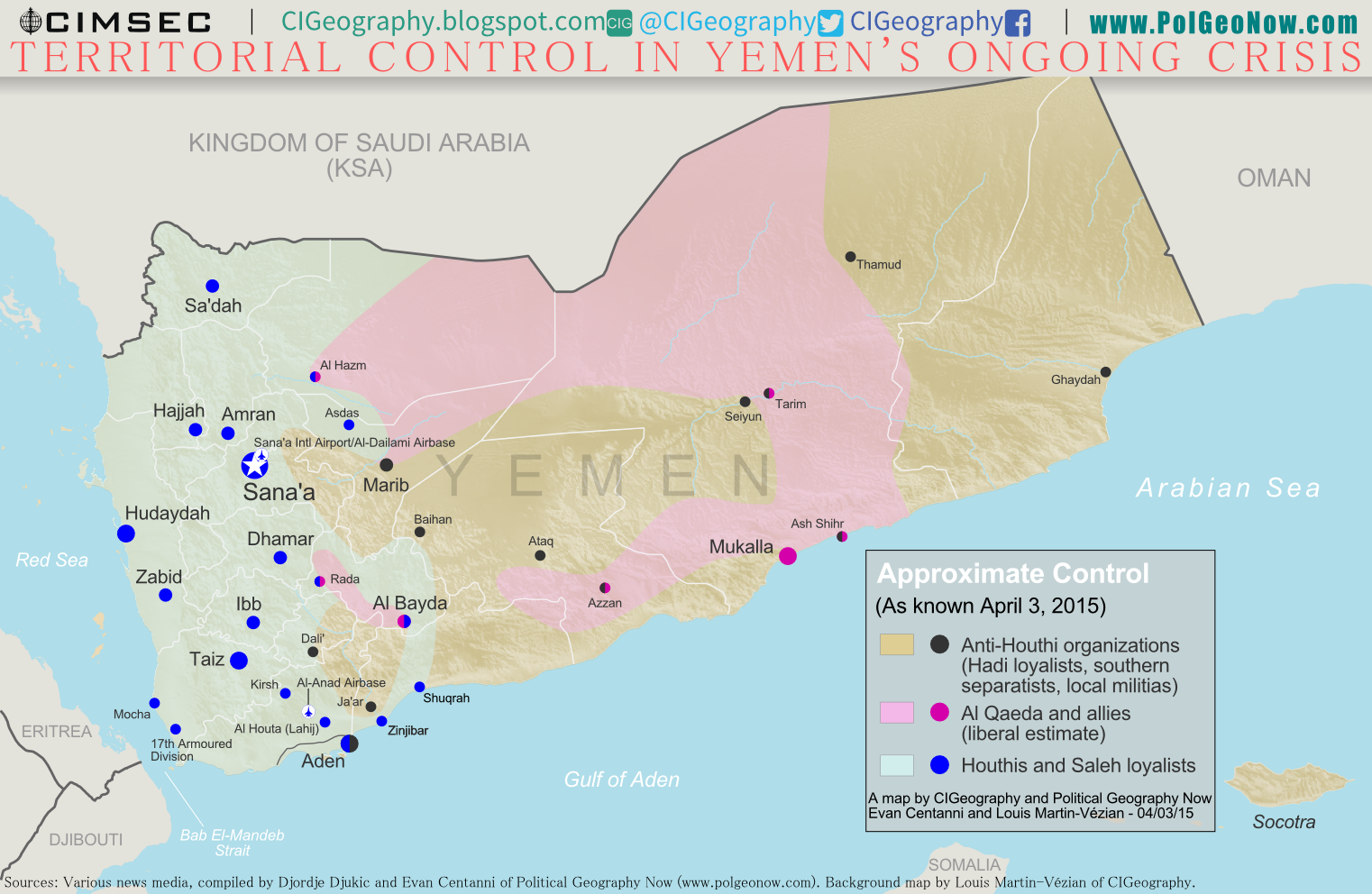
Map of territorial control in Yemen at the beginning of April 2015, at the time of Saudi Arabia's military intervention, including territory held by the Houthi rebels and former president Saleh's forces, president-in-exile Hadi and the Southern Movement, and Al Qaeda in the Arabian Peninsula (AQAP).
Map by Louis Martin-Vézian and Evan Centanni (click to enlarge). All rights reserved.

Subscribers click here to view this article in the ad-free members area. Not a member yet? Subscribe now!

Timeline by Djordje Djukic, with additional reporting by Evan Centanni

The Disintegration of Yemen
When PolGeoNow published our last Yemen control map two and a half years ago, the country appeared to be holding together, if only barely. Authoritarian president Ali Abdullah Saleh had stepped down in an internationally-backed political compromise to end the country’s Arab Spring uprising, and the northern Houthi rebels had halted their advances after promises of political involvement.

Al Qaeda was on the run from its claimed emirates in the south after a military campaign overseen by the new President Abdurabuh Mansur Hadi, Saleh’s former vice president. A movement for southern independence remained outspoken, but wasn’t taking up arms in large numbers against the government.

Now, everything has turned upside-down. The Houthis control most of the country’s populated area, and Al Qaeda is resurgent. Now bitter enemies, the former president and vice president have each joined with opposing rebel groups: Saleh with the Houthis, and Hadi with the southern separatists (though he is not himself a separatist).

Military Intervention
Bent on propping up Hadi and preventing Yemen from falling under the influence of the Houthis, Saudi Arabia and a coalition of Sunni Arab countries has seized Yemen’s waters and airspace and begun a military intervention. Saudi Arabia is joined by forces from its Gulf neighbors Bahrain, Kuwait, Qatar, and the UAE, as well as Egypt, Sudan, Jordan, and Morocco, with support from the U.S. and Somalia.

What brings all these countries together in war? It’s partly about supporting the transitional government they backed, but the real issue is a fear of growing Iranian influence, especially over the sea route connecting Europe and Asia.

However, Iran’s actual role in Yemen’s predicament is unclear: Saudi Arabia claims the Houthis receive military backing from Iran, but so far little evidence has emerged of that, other than the Iranian government’s public verbal support for the rebels’ government. Countering Al Qaeda is also a priority for many countries, but the Houthis are just as fiercely against Al Qaeda as Hadi is (perhaps even more; Al Qaeda is a hateful enemy of all Shiites).

Stay tuned to PolGeoNow and CIGeography for updates to the turbulent situation in Yemen!

See Also: Infographic on Foreign Military Activity in Yemen’s Crisis 

Flag of YemenCountry Name:  
• Yemen (English)
• Al-Yaman (Arabic)
Official Name:  
• Republic of Yemen (English)
al-Jumhūriyyah al-Yamaniyyah (Arabic) 
Capital: Sana’a

Chronology of Events
The following is a timeline of major political events and changes to territorial control in Yemen’s current crisis so far.

September 16, 2014
Houthi rebels attacked the Yemeni capital Sana’a and heavy fighting ensued.

September 21, 2014
After five days of fighting during which hundreds of people were killed, the Houthis took full control of the Yemeni capital of Sana’a.

January 18-22, 2015
Violent clashes erupt in Sana’a, and two days later the Houthis stormed the presidential palace. On January 22, Yemeni president Abdurabuh Mansur Hadi resigned.

February 6, 2015
The rebels dissolved the parliament and set up an interim Revolutionary Committee.

February 21, 2015
Hadi fled house arrest in Sana’a, arriving in the southern port city of Aden and declaring he was still the president.

February 25, 2015
A UN report found that former Yemeni president Ali Abdullah Saleh, who had been pushed out in 2012 after the Arab Spring protests, was actively aiding the Houthis in their advance. He allegedly funded them, ordered his supporters not to obstruct them, and directed an army unit previously commanded by his son to assist them.

March 19, 2015
Forces loyal to Saleh attacked the Aden international airport and carried out airstrikes on Hadi’s new presidential palace in the city. The attack on the airport was repelled and the airstrikes missed the palace. The clashes killed 13 people.

March 20, 2015
Five suicide bombers, allegedly representing a branch of the Islamic State (ISIS/ISIL), conducted coordinated attacks against mosques in Sana’a during Friday prayers, leaving 142 people dead and 345 wounded. Meanwhile, fighters of Al Qaeda – which rejected any blame for the mosque bombings – reportedly captured the Lahij provincial capital of Al Houta, but were pushed out by the army several hours later.

March 21, 2015
Some 100 U.S. special forces members were evacuated from al-Anad airbase and left the country, following the departure of 16 British military and security personnel earlier. The airbase is located close to al-Houta, the city briefly seized by Al Qaeda the previous day.

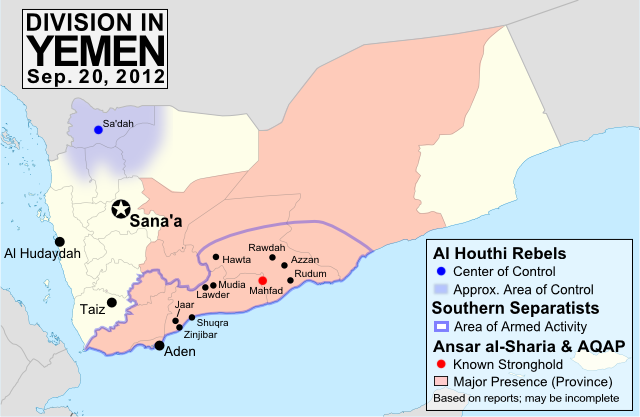
Map of territorial control in Yemen in September 2012, including Houthi rebels, government, and Al Qaeda (AQAP)
Sept. 2012 Yemen Control Map
(click for full-sized map).

March 22, 2015
Houthi fighters and military elements loyal to Saleh captured Taiz, Yemen’s third largest city.

March 24, 2015
The Houthis captured Dali’, Kirsh, and the port of Mocha.

March 25, 2015
Houthi forces and Army units loyal to Saleh seized Al Anad airbase and Aden’s airport. Hadi fled Aden, while his Defense Minister was captured. The Houthis had captured much of Lahij province by this time.

Overnight, a Saudi-led Arab Coalition began airstrikes against Houthi and Saleh forces, with Saudi Arabia claiming full control of Yemeni airspace. 

March 26, 2015
Hadi arrived in the Saudi capital of Riyadh, while his forces shelled the Al Anad airbase, forcing some Houthis to flee.

March 27, 2015
Houthi and Saleh army forces completed the land encirclement of Aden following the capture of the port town of Shuqrah. During the day, a Saudi F-15 fighter jet crashed in the Gulf of Aden and its two pilots were rescued by the U.S. Air Force and Navy. By the end of the day, the death toll from the airstrikes was reported to be 80 anti-Hadi fighters and at least 18 civilians.

March 28, 2015
The Houthis continued their advance in Aden as Houthi tanks near the airport shelled the city and the president’s residence was looted. A weapons storage facility also exploded. An NGO worker in the city reported “Aden is falling apart”.

March 29, 2015
The death toll from the weapons depot explosion in Aden reached 52, while a landmine explosion in Lahij province left 25 Houthi rebels dead. The same day, Houthis advanced west from Shuqrah port, capturing Zinjibar on their way to Aden. The center of a claimed Al Qaeda emirate three years ago, Zinjibar is now a center for pro-Hadi forces.

March 30, 2015
Artillery and rocket fire struck a roundabout in Aden after the Houthis advanced on the city from the east. Hadi troops claimed to have recaptured the Aden airport, while a source in Sana’a reported the Houthis were once again in control hours later. Meanwhile, Saleh Army forces were 30 kilometers from Aden and attempting to approach the city. The fighting for the city had left 100 people dead by this point. The city of Dali’ was also split by fighting between Houthi/Saleh forces and Hadi fighters.

March 31, 2015
Houthi rebels reportedly controlled parts of Aden, also capturing a coastal military base overlooking the strategic Bab El-Mandeb Strait after soldiers of the army’s 17th Armored Division opened the gates for them.

April 1, 2015
A Houthi/Saleh tank column pushed into central Aden, as the death toll from the battle for the city reached at least 103. Meanwhile, the U.N. had reported the previous day that 93 civilians had been killed and 364 injured in the Saudi-led bombing campaign since it started. Later, new reports said at least 23 more civilians were killed in an airstrike on a dairy factory in Hudaydah.

A local militia leader said the Houthis had been pushed out of Baihan, one of their easternmost footholds. 

April 2, 2015
Armed guards from a Chinese ship landed by sea in Aden to provide aid and evacuate civilians, while the Houthis captured another central district of the city.

At the same time, Al Qaeda militants captured the eastern port of Mukalla, Yemen’s fourth biggest city, and freed 300 prisoners from its central prison. Southern militias also reportedly captured Dali’ from the Houthis. During the day, the first Saudi soldier was killed in a firefight on the border.

April 3, 2015
Houthi forces abandoned Hadi’s temporary presidential palace in Aden, after holding it for one day.

Following this story? View all Yemen maps on PolGeoNow.

Graphic of Yemeni flag is in the public domain (source).