Taiwan Loses “Recognition” from El Salvador (Map)

You can always find the latest version of this map, and a list of all related articles, on our Which Countries Recognize Taiwan? page.

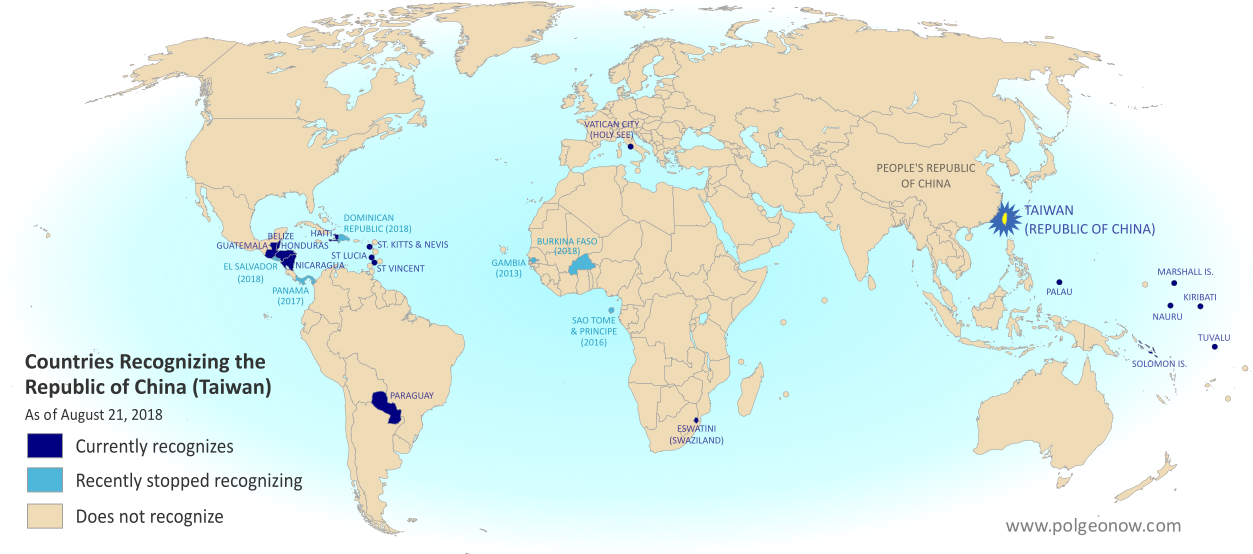
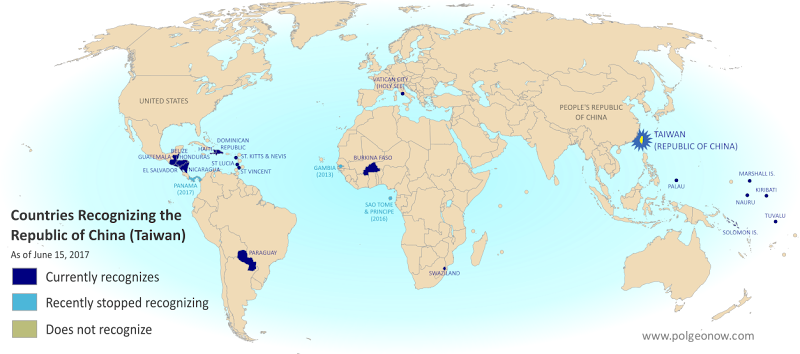
Map of who recognizes Taiwan (what countries recognize the Republic of China) in August 2018. Marks countries that have cut diplomatic ties with Taiwan (withdrawn recognition) in the last ten years: El Salvador, Burkina Faso, the Dominican Republic, Panama, Sao Tome and Principe, and the Gambia. Also answers question: Where is Republic of China located? (Colorblind accessible)
Click to enlarge. By Evan Centanni, modified from public domain blank world map.
Contact us for permission to use this map.

Article by Evan Centanni

El Salvador Drops Taiwan

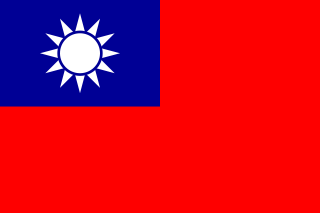
Flag of the Republic of China (Taiwan) Short Name (informal):  
• Taiwan (English)
• ROC (English)
• Táiwān (Chinese)
Official Name (in constitution):  
• Republic of China (English)
• Zhōnghuá Mínguó (Chinese)
Other names used officially:  
• “Republic of China (Taiwan)” (government offices)
• Chinese Taipei (international sports)
• Taiwan, Province of China (used by UN without Taiwan’s input)   
Capital: 
Taipei (de facto)
Claimed by: People’s Republic of China 

Disputed Taiwan lost its official endorsement from the Republic of El Salvador today. The small but densely-populated Central American country is cutting ties with Taiwan’s government in favor of setting up relations with Mainland China, becoming the latest to endorse the Mainland’s claim that Taiwan is part of China.

In a novel twist, reports said Taiwan’s government “pre-emptively” cut ties with El Salvador just hours before the Salvadoran government publicly announced the switch. But the move was still based on a decision by El Salvador, which Taiwan officials said had been holding talks on the possibility since June.

Is Taiwan a Country?

The islands of Taiwan operate like an independent country today, but are governed under the constitution of the “Republic of China” (ROC), the government that ruled Mainland China before the country’s communist revolution (the administration that now rules the Mainland is called the People’s Republic of China, or PRC).

Since 1991, Taiwan’s government has sought recognition separate from Mainland China in the UN, without challenging the PRC’s right to the Mainland. But because the Mainland government insists Taiwan can’t be separate, it cuts ties with any countries that set up relations with Taiwan, even if they want to stay friends with China too.

“Economic Reasons”

El Salvador’s government is calling its shift away from Taiwan the only reasonable choice in a world where China is one of the most powerful economies, saying that it will bring more opportunities in the future. El Salvador has never before had diplomatic relations with the PRC. Alluding to the fact that the ROC no longer governs most of China, a Salvadoran spokesman was quoted as saying, “El Salvador can’t turn its back on international reality.”

Taiwan’s government, on the other hand, described more specific motivations. The disputed country’s foreign minister accused El Salvador’s president of asking Taiwan to fund his re-election campaign, and said the Salvadoran government had also backing for an expensive port construction project that would have left both countries in debt. (Some speculate that if China steps in to fund the port, it could eventually host the first Chinese military base in the Americas.)

Though Taiwan’s dwindling list of diplomatic contacts may not be a critical threat to its self-governing status, these changes are not merely symbolic. Even aside form the economic ramifications for El Salvador, many average people on both sides may be affected. For example, Salvadoran students in Taiwan are about to see their studies cut short, being forced to either transfer to Mainland China or return home.

Learn More: What Exactly is Taiwan, and Do Countries Really “Recognize” It?

Republic of China: Shrinking Recognition

Today, only 17 countries in the world (about 9%) still have formal diplomatic relations with the Taiwan-based “Republic of China” government – the closest equivalent to officially “recognizing” Taiwan as a country. That includes 16 United Nations (UN) member countries plus UN observer state Vatican City.

El Salvador is the fifth country to drop Taiwan since the current ROC president, whose platform involves resisting Mainland Chinese influence, took office in 2016. Before El Salvador, the last four countries to switch to China were the Dominican Republic and Burkina Faso this May, Panama in June 2017, and São Tomé and Príncipe in December 2016.

Only one country, the Gambia, abandoned Taiwan between 2008 and 2016, during a “diplomatic truce” initiated by Taiwan’s most Mainland-friendly president (even then, the PRC waited until Taiwan elected its current president before restoring its own relations with the Gambia).

Graphic of the Republic of China (Taiwan) flag is in the public domain (source).

Taiwan Loses Recognition from Dominican Republic, Burkina Faso (Map)

You can always find the latest version of this map, and a list of all related articles, on our Which Countries Recognize Taiwan? page.

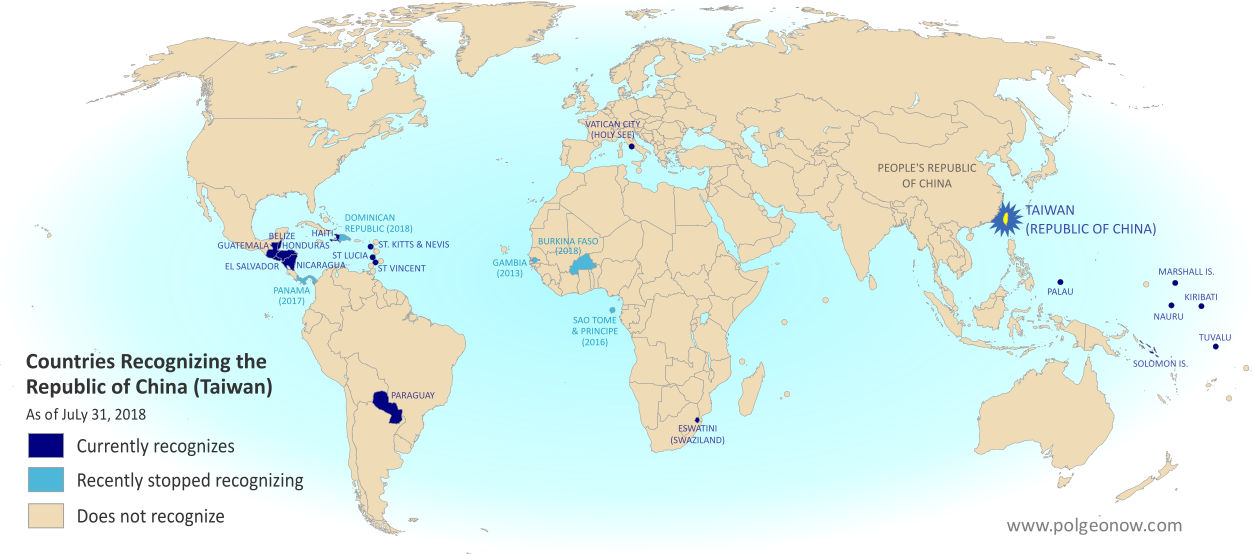
Map of who recognizes Taiwan (what countries recognize the Republic of China) in July 2018. Marks countries that have cut diplomatic ties with Taiwan (withdrawn recognition) in the last ten years: Burkina Faso, the Dominican Republic, Panama, Sao Tome and Principe, and the Gambia. Also answers question: Where is Republic of China located? (Colorblind accessible)
Click to enlarge. By Evan Centanni, modified from public domain blank world map.

Article by Evan Centanni

Dominican Republic, Burkina Faso Drop Taiwan

Flag of the Republic of China (Taiwan) Short Name (informal):  
• Taiwan (English)
• ROC (English)
• Táiwān (Chinese)
Official Name (in constitution):  
• Republic of China (English)
• Zhōnghuá Mínguó (Chinese)
Other names used officially:  
• “Republic of China (Taiwan)” (government offices)
• Chinese Taipei (international sports)
• Taiwan, Province of China (used by UN without Taiwan’s input)   
Capital: 
Taipei (de facto)
Claimed by: People’s Republic of China 

This past May, disputed Taiwan lost its official endorsements from both the Dominican Republic in the Caribbean, and Burkina Faso in West Africa. The two countries have cut ties with Taiwan in favor of setting up official relations with Mainland China, endorsing the Mainland’s claim that Taiwan is part of China.

The islands of Taiwan operate like an independent country today, but are governed under the constitution of the “Republic of China” (ROC), the government that ruled Mainland China before the country’s communist revolution (the administration that now rules the Mainland is called the People’s Republic of China, or PRC).

Since 1991, Taiwan’s government has sought recognition separate from Mainland China in the UN, without challenging the PRC’s right to the Mainland. But because the Mainland government insists Taiwan can’t be separate, it cuts ties with any countries that set up relations with Taiwan, even if they want to stay friends with China too.

The Dominican Republic announced it was cutting ties with Taiwan on May 1, 2018, saying the reason was “history and socioeconomic reality”. This reality allegedly includes the equivalent of $3.1 billion US dollars in investments and loans from China, though the Dominican government only mentioned future tourism opportunities as an example.

Burkina Faso followed on May 24, even though it had just co-sponsored Taiwan’s bid to become an observer at World Health Organization (WHO) meetings. The Burkinabe government also cited “socio-economic challenges” and the “evolution of the world” as the reasons for its switch.

Learn More: What Exactly is Taiwan, and Do Countries Really “Recognize” It?

Republic of China: Shrinking Recognition

Today, only 18 countries in the world (about 9%) still have formal diplomatic relations with the Taiwan-based “Republic of China” government – the closest equivalent to officially “recognizing” Taiwan as a country. Before the Dominican Republic and Burkina Faso cut ties in May, the last two countries to drop Taiwan in favor of the PRC were Panama in June 2017 and São Tomé and Príncipe in December 2016.

Only one country, the Gambia, abandoned Taiwan between 2008 and 2016, during a “diplomatic truce” initiated by Taiwan’s most Mainland-friendly president (even then, the PRC waited until Taiwan elected a more independence-leaning president before restoring its own relations with the Gambia).

Taiwan’s last remaining “diplomatic ally” in Africa is tiny Eswatini (Swaziland), whose king recently promised not to follow Burkina Faso in switching to the PRC. Supporters of a separate Taiwan worry their next loss might be the Holy See, government of the Catholic Church’s independent Vatican City in Rome. The Vatican has recently been working to patch up its bad relationship with the Mainland Chinese government.

Learn More: What’s the difference between Vatican City and the Holy See?

Graphic of the Republic of China (Taiwan) flag is in the public domain (source).

Map: Which Countries “Recognize” Taiwan?

This map and explainer will be updated whenever there’s a change to the list of Taiwan’s “diplomatic allies”. You can find articles on each change by scrolling to the bottom of this page, or by viewing all Taiwan articles on PolGeoNow.

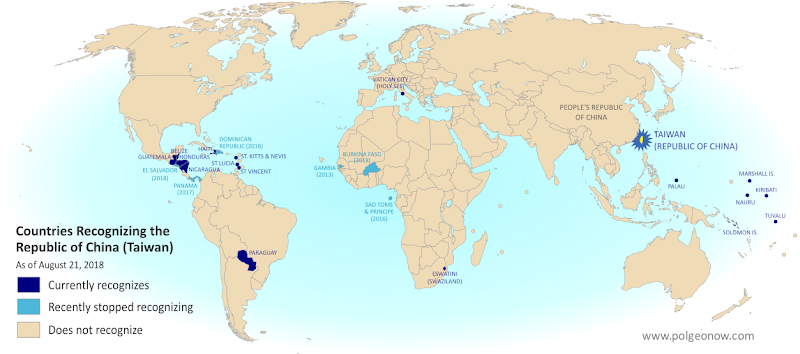
Map of who recognizes Taiwan (what countries recognize the Republic of China) in August 2018. Marks countries that have cut diplomatic ties with Taiwan (withdrawn recognition) in the last ten years: El Salvador, Burkina Faso, the Dominican Republic, Panama, Sao Tome and Principe, and the Gambia. Also answers question: Where is Republic of China located? (Colorblind accessible)
Click to enlarge. By Evan Centanni, modified from public domain blank world map.
Contact us for permission to use this map.

Is Taiwan a Country?

At PolGeoNow we frequently report on self-proclaimed, unrecognized or partially-recognized countries – but Taiwan is a special case. It operates like an independent country today, but has never formally declared independence. Instead, Taiwan and its surrounding islands govern themselves as the “Republic of China” (ROC), under a constitution brought there by a former government of the Chinese mainland.

Flag of the Republic of China (Taiwan) Short Name (informal):  
• Taiwan (English)
• ROC (English)
• Táiwān (Chinese)
Official Name (in constitution):  
• Republic of China (English)
• Zhōnghuá Mínguó (Chinese)
Other names used officially:  
• “Republic of China (Taiwan)” (government offices)
• Chinese Taipei (international sports)
• Taiwan, Province of China (used by UN without Taiwan’s input)   
Capital: 
Taipei (de facto)
Claimed by: People’s Republic of China

Taiwan (ROC) vs. Mainland China (PRC)

Taiwan’s ROC government stands in contrast to the People’s Republic of China (PRC), which took the Mainland from the ROC in the Chinese Communist Revolution of the 1940s. The PRC government in Bejing never managed to take over Taiwan, but still insists that it will someday, saying the island is an inseparable part of China. It maintains delicate, semi-official relations with the ROC government in Taipei, but fiercely opposes any move toward formal Taiwanese independence.

Taiwan’s ROC government also claimed ownership of all China at one time, when it was ruled under martial law by Chiang Kai-shek‘s Chinese Nationalist Party (Kuomintang, or KMT). But with democracy now in place, and fewer and fewer Taiwanese people thinking of themselves as Chinese, recent administrations have backed off from those claims.

In fact, many of Taiwan’s politicians support increased acknowledgement of independence, but so far no administration has been willing to risk war with Mainland China by issuing a full-on independence declaration.

Who “Recognizes” Taiwan?

Until the 1970s, the Taiwan’s ROC government held onto China’s seat in the United Nations (UN), and was considered China’s rightful government by the majority of the world’s countries. But after the UN General Assembly deposed it and replaced it with the PRC in 1971, the tables turned quickly.

Today, only 17 countries in the world (about 9%) still have formal diplomatic relations with the Taiwan-based ROC government, including 16 UN member countries plus UN observer state Vatican City. All of them are marked on the map above, along with all countries that have cut diplomatic ties with the ROC within the last ten years.
 
Now, recognizing a government doesn’t technically have the same legal meaning as recognizing a country. Officially, everyone recognizes China as a country, but they disagree over whether the ROC or PRC administration is China’s government. That means that when we talk about countries “recognizing” Taiwan, it’s not technically the same thing as when countries recognize Kosovo or Palestine.

To illustrate that point: A country that recognizes Kosovo as a country independent from Serbia normally continues to recognize Serbia as a country too. But in the case of China and Taiwan, countries are forced to pick one or the other. Because the Mainland government insists Taiwan can’t be separate, it cuts ties with any countries that set up relations with Taiwan, even if they want to stay friends with China too.

Still, saying that a country with diplomatic ties to the ROC “recognizes Taiwan” is a useful practical analogy, since Taiwan now strives to be something more like a self-declared country than a rival government of China. In fact, after 1991 Taiwan’s government requested a seat separate from Mainland China in the UN, accepting the PRC’s right to rule the Mainland even while making sure not to declare outright independence.

North and South Korea have an arrangement just like that, both technically claiming to be governments of Korea while still allowing each other to have separate recognition and UN seats. But because the PRC sees Taiwan its subordinate, not its equal, it has blocked any similar deal from happening.

Taiwan Recognition News on PolGeoNow

Since 2017, PolGeoNow has been bringing you ongoing coverage of all events effecting the recognition of Taiwan. News articles about these changes are listed here:

Map of who recognizes Taiwan (what countries recognize the Republic of China) in August 2018. Marks countries that have cut diplomatic ties with Taiwan (withdrawn recognition) in the last ten years: El Salvador, Burkina Faso, the Dominican Republic, Panama, Sao Tome and Principe, and the Gambia. Also answers question: Where is Republic of China located? (Colorblind accessible)El Salvador Switches Recognition from Taiwan to China
Taiwan and El Salvador cut ties in August 2018, amid accusations of unreasonable Salvadoran financial demands.

Full map and article

Map of who recognizes Taiwan (what countries recognize the Republic of China) in June 2018. Marks countries that have cut diplomatic ties with Taiwan (withdrawn recognition) in the last ten years: Burkina Faso, the Dominican Republic, Panama, Sao Tome and Principe, and the Gambia. Also answers question: Where is Republic of China located? (Colorblind accessible)Taiwan Loses Dominican Republic, Burkina Faso Recognition
In May 2018, two more countries cut ties with Taiwan in favor of relations with Mainland China, both under financial pressure.

Full map and article

Map of who recognizes Taiwan (what countries recognize the Republic of China) in June 2017. Marks countries that have cut diplomatic ties with Taiwan (withdrawn recognition) in the last ten years: Panama, Sao Tome and Principe, and the Gambia. Also answers question: Where is Republic of China located? (Colorblind accessible)Panama Recognizes China, Stops Recognizing Taiwan
In 2017, the Central American republic of Panama became the second country to cut ties with Taiwan since an eight-year “diplomatic truce” between the ROC and PRC ended in 2016.

Full map and article


Graphic of the Commonwealth flag is displayed under fair use principles (source).

Syrian Civil War Map & Timeline: Rebels Lose Daraa Province – July 2018 (Subscription)

SUBSCRIBERS CLICK HERE TO PROCEED TO ARTICLE AND MAP

(To see other maps in this series, view all Syria updates.)

Research by Djordje Djukic. Map by onestopmap.com, Evan Centanni, and Djordje Djukic

Subscribe for full access to all conflict map reports!


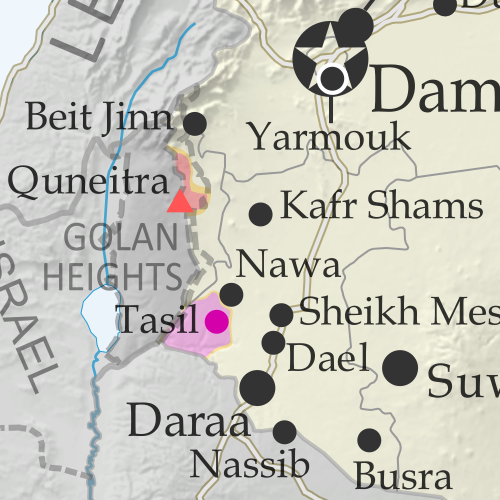
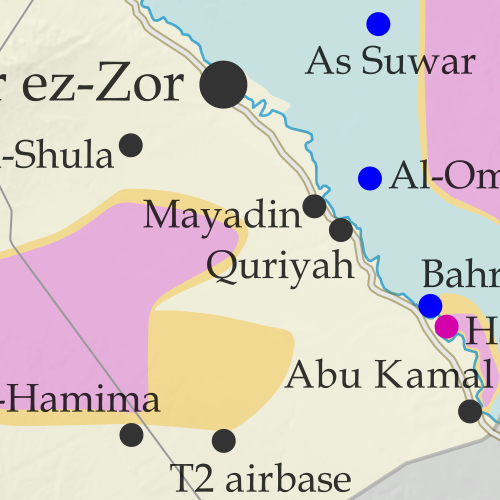
Map of Syrian Civil War (Syria control map): Fighting and territorial control in Syria in June 2018 (Free Syrian Army rebels, Kurdish YPG, Syrian Democratic Forces (SDF), Hayat Tahrir al-Sham (HTS / Al-Nusra Front), Islamic State (ISIS/ISIL), and others). Includes Russia-Turkey-Iran agreed de-escalation zones and US deconfliction zone, plus recent locations of conflict and territorial control changes, such as Daraa, the Golan Heights, Busra, Nawa, Fuaa, and more. Colorblind accessible.Since late June, a rapid government offensive has completely driven rebels out of southwestern Syria’s Daraa province, which they had controlled about half of. 

Meanwhile, the government has surrendered an enclave of control within rebel-held northwestern Syria, and the so-called “Islamic State” (ISIS/ISIL) is struggling to hold onto pockets of territory both east and west.

See all this and more on the latest update to PolGeoNow’s concise, professional Syrian Civil War control map, which includes a timeline of changes since our previous Syria map report in June, with sources cited.

This map and report are premium content, available to paid subscribers of the PolGeoNow Conflict Mapping Service.

Want to see before you subscribe? Check out our most recent FREE SAMPLE Syria map!

Exclusive map report includes:

  • Up-to-date illustration of current territorial control in Syria, color-coded for the Assad government, rebel groups, “Islamic State” (ISIS/ISIL) fighters, and the Kurdish-led Syrian Democratic Forces (SDF). Colorblind accessible.
  • Markers showing the approximate locations of Russian-Turkish-Iranian “de-escalation zones” and the one known US “deconfliction zone”.
  • Special symbols indicating towns dominated by rebels of the former Al Qaeda Nusra Front (now Hayat Tahrir al-Sham or HTS) and by the Kurdish YPG militia (part of the US-backed SDF).
  • Detailed indication of city-by-city control, including key towns and other locations important to current events.
  • Locations of recent control changes and other important events, including Daraa, the Golan Heights, Busra, Nawa, Fuaa, and more.
  • Detailed timeline of important events and changes to territorial control since June 21, 2018, compiled by our Syria-Iraq expert, with links to sources. 
  • Brief summary of the current situation and of major changes to the configuration of territorial boundaries and de facto enclaves and exclaves.

SUBSCRIBERS CLICK HERE TO PROCEED TO ARTICLE AND MAP

Not signed up yet? Click here to learn more about our professional subscription service!

Can I purchase just this map?
This map and report are not available for automated purchase to non-subscribers. If you need access or republication rights for only this map report, contact service@polgeonow.com for options.

Libyan Civil War Map & Timeline – July 2018

To see more maps in this series, view all Libya articles.
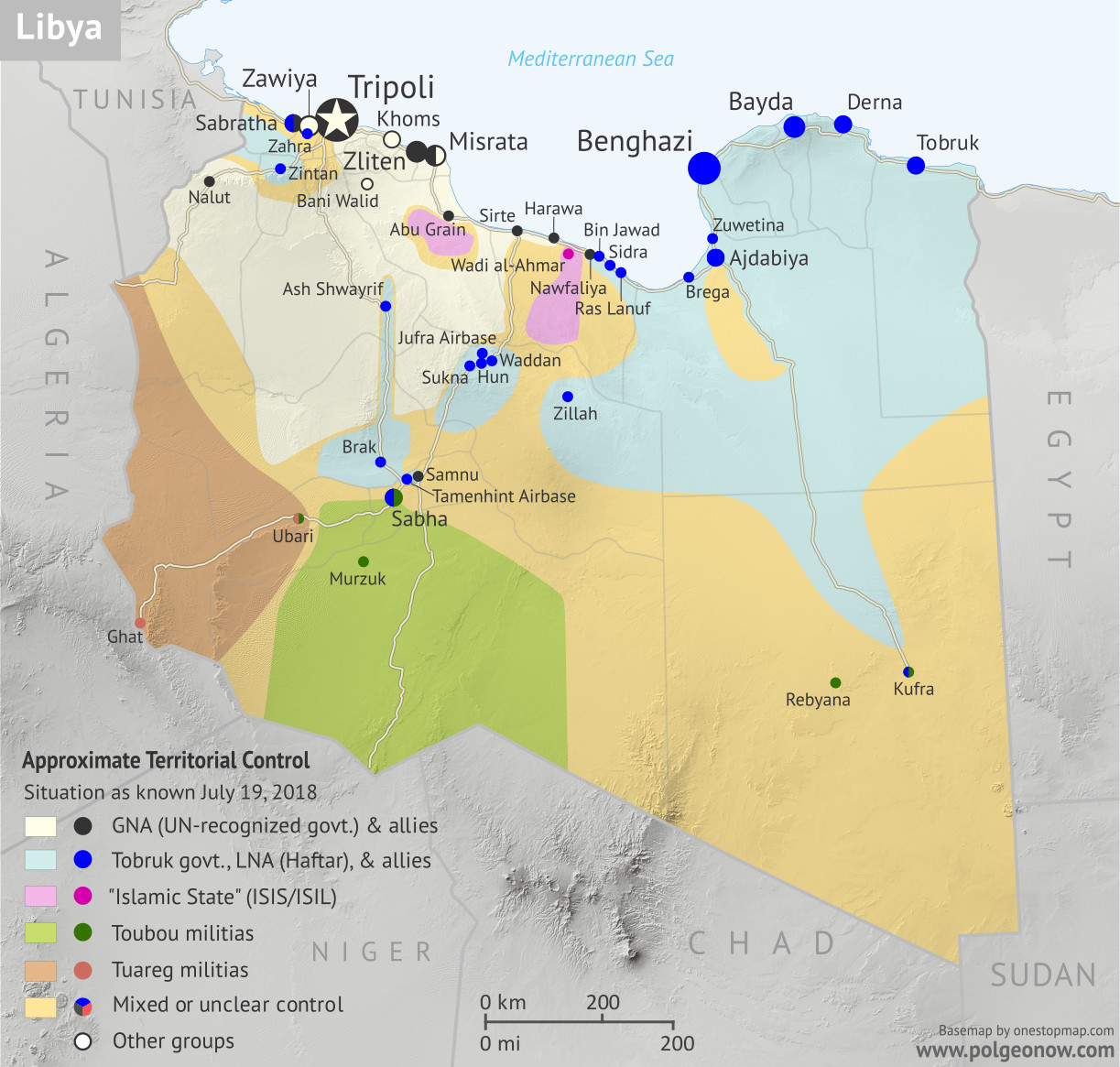
Libya: Who controls what? A concise, professional map of of who controls Libya now (July 2018). Shows detailed territorial control in the Libyan Civil War as of July 19, 2018, including all major parties (Government of National Accord (GNA); Tobruk House of Representatives, General Haftar's Libyan National Army (LNA), and allies; Tuareg and Toubou (Tebu) militias in the south; the so-called Islamic State (ISIS/ISIL); and other groups such as the National Salvation Government(NSG) and religious hardline groups). Includes terrain and major roads. Colorblind accessible.
Base map by Koen Adams of onestopmap.com, with territorial control by Evan Centanni. All rights reserved.

(Subscribers click here to view this article on the member site)

Timeline by Djordje Djukic

Libya: Who Controls What?

Ten months after our previous Libya control map and report, the country remains divided between two major rival governments and several smaller groups, but there have been a few changes to their areas of control. This is the first free edition of our map that also shows the territories of the Toubou and Tuareg militias in Libya’s south, which align on and off with the country’s two major governments.

(Toubou and Tuareg are two non-Arab ethnic groups residing in southern Libya and neighboring parts of the Sahara Desert – the armed coalitions shown on the maps are formed by and for members of those peoples, but not all Toubou and Tuareg people are affiliated with them.)

Maybe the biggest change to Libya’s political geography situation since last year has been the Toubou militias’ realignment. Until this May, they were loosely allied with the eastern government’s “Libyan National Army” (LNA), but after the LNA began supporting their opponents in the city of Sabha, they turned against the eastern government and have leaned more towards the western government in Tripoli.

Also, just last month, the LNA eliminated an enclave of rival control in eastern city of Derna, which had been controlled by an independent armed group often accused of having ties to Al Qaeda.

For a full explanation of Libya’s rival governments and major armed groups, including the history of the current civil war since the fall of Muammar Gaddafi in 2011, see our detailed Libya background article and timeline from August 2015. You can see subsequent updates from 2015 to present by viewing all Libya articles.
Flag of Libya (2011-present)Country Name:  
• Libya (English)
• Lībyā (Arabic)
Official Name:  
• State of Libya (English)
Dawlat Lībyā (Arabic) 
Capital: Tripoli

Timeline of Events

The following is a detailed timeline of major political events and changes to territorial control since our previous Libya map report of September 20, 2017.

September 21 – October 6, 2017
Clashes resumed between two opposing groups in Sabratha, west of Tripoli, after negotiations collapsed. The fighting pitted a group called the Anti-ISIS Operations Room (AIOR) and its allies on one side, against the Anas al-Dabbashi brigade, which had been called major facilitator of migrant smuggling, but recently said it had reached a deal with the UN-backed Government of National Accord (GNA) in Tripoli to stop boats from leaving to Europe across the Mediterranean sea.

The al-Dabbashi brigade said it was targeted by opponents who wanted to continue smuggling, while the AIOR claimed its rivals were “jihadists”. Some reports said the fighting came as a result of an Italian-backed deal to fund militias as police forces against migrants. On 23 September, the AOIR captured the downtown Qamar Hotel, while on 28 September, it seized the famous Sabratha Roman ruins, a UNESCO world heritage site. On October 6, the AOIR took full control of Sabratha.

Both the GNA and the Benghazi-based Libyan National Army (LNA) have claimed links to the AOIR and both welcomed the group’s capture of the city. The three weeks of fighting left at least 43 people dead and 340 wounded.

November 5, 2017
After holding out for four months in Benghazi, the last fighters of the religious hardline Benghazi Revolutionaries’ Shura Council (BRSC) in the city came under renewed attack from the LNA. Airstrikes were carried out against the fighters for the first time in weeks, along with a ground assault, after the LNA abandoned its attempts to starve them out. It was said only a few buildings remained under BRSC control. However, the LNA’s assault met with stiff resistance.

November 5-8, 2017
Brigades loyal to both the GNA and the LNA started a joint operation in a western district of Tripoli against alleged criminal elements, as well as a militia loyal to deceased Libyan leader Muammar Gaddafi. The district was seized three days later.

November 11, 2017
It was reported that the Sidi Akribesh neighborhood of Benghazi, the location of the BRSC holdouts, had come under control of the LNA. However, two days later, it was confirmed that fighting in the neighborhood was still continuing.

December 15, 2017
It was reported that 10 BRSC fighters and 7 LNA soldiers had been killed in fighting in Benghazi in November.

December 28-30, 2017
The LNA announced it had taken full control of Benghazi’s Sidi Akribesh neighborhood from the hardline fighters. However, the following day, it was said that clearing operations were still continuing in the area. The area was secured and the operations concluded on December 30, after five hardline fighters were killed. Overall, 17 LNA soldiers had been killed throughout December in the clashes, while another 76 had been wounded. Some reported that remaining BRSC fighters managed to retreat to Derna, the LNA denied this.

January 15, 2018
The Mitiga airport in Tripoli was shut down after a GNA-allied group repelled an attack by a rival militia. Several planes at the airport were damaged in the fighting, which left at least 20 people dead.

January 23, 2018
Twin car bombings targeting the Bayaat al-Radwan mosque in Benghazi left 35 people dead. Senior security officers were among the casualties, including Ahmed al-Feitouri, head of the LNA’s investigations and arrests unit.

February 4-March 2, 2018
Fighting erupted in the southern city of Sabha between the Sixth Brigade, composed of members of the Awlad Suleiman tribe, and Toubou militias. The Sixth Brigade had up to then supported the GNA, while the Toubous were nominally linked to the LNA. However, the GNA-loyal commander of the Sixth Brigade was eventually replaced by an LNA commander, after which eastern tribal elders tasked with mediating a truce in Sabha declared the Sixth to be a LNA unit.

The LNA then began providing support to the Sixth Brigade, which the GNA had not previously delivered, and the brigade used this to press its advantage against the Toubou militias. The walls of the historic Sabha castle were severely damaged by missile fire during the fighting.

February 24, 2018
A reconciliation agreement was reached between the Toubou and the Zawia tribe in Kufra. The two groups had previously clashed in late 2015. The agreement called for the establishment of a neutral security force in the town.

March 6, 2018
Fighting was temporarily renewed in Sabha, before the situation calmed down again.

March 15, 2018
The first LNA units from Benghazi arrived in Kufra to secure the town. The local LNA unit was mostly made up of members of the Zawia tribe, which had previously been involved in fighting against the Toubou.

April 2, 2018
Sabha’s castle was once again hit by rocket fire.

May 2, 2018
Suicide bombers loyal to the so-called “Islamic State” (IS; formerly ISIS/ISIL) attacked the High National Elections Commission in Tripoli, killing 16 people. Meanwhile, Kufra’s tribes vowed support for the LNA.

May 5, 2018
Fighting was renewed in Sabha. Overall, 18 people had been killed and 86 injured, mostly civilians, since the clashes in the city began in February.

May 7-8, 2018
The LNA launched an assault on the city of Derna, held by the allegedly religious-hardline Derna Mujahideen Shura Council (DMSC), with clashes erupting in the eastern Fatayeh district. The next day, the LNA captured a point of high ground outside Derna.

May 11, 2018
The DMSC dissolved itself and announced the creation of the Derna Protection Force (DPF), which it said would a moderate group under the command of anti-LNA Libyan army officers. The DMSC was widely considered a religious hardline group with links to Al Qaeda, but its leaders claimed this was a lie spread by the LNA’s General Haftar.

May 12-13, 2018
After a new LNA governor arrived in Sabha, he declared a ceasefire between the Sixth Brigade and the Toubou. At this point the Toubou coalition, which had been drifting away from the LNA, demanded that the new governor say whether the Sixth was an LNA unit. After he confirmed that it was, the Toubou declared war on the LNA and launched a large attack, capturing the Sabha castle.

The castle was temporarily recaptured by the Sixth Brigade before the Toubou fighters once again seized it, along with the Sixth’s headquarters, the next day. The Toubou coalition also reopened the road to northern Libya and called on the GNA to secure the city. Since the beginning of May, 31 people had been killed in the fighting in Sabha.

May 15, 2018
The DPF withdrew from the Heela district of Derna.

May 28, 2018
The LNA captured two southwestern suburbs of Derna.

May 31, 2018
It was reported that since the start of the battle for Derna, 20 LNA soldiers had been killed and 35 wounded. The LNA also estimated that more than 100 DMSC/DPF fighters had died and another 100 had surrendered.

Meanwhile, an armed group attacked and briefly captured Tamenhint Airbase, northeast of Sabha. The attack was reportedly conducted by either the Benghazi Defence Brigades (BDB), a religious hardline militia, or the Toubou militias.

June 5, 2018
The LNA reached 75 percent control of Derna.

June 9-10, 2018
The LNA advanced in Derna’s Sheiha district up to the edge of the central Al-Maghar area after multiple airstrikes. This left less than 10 square kilometers remaining under DPF control.

June 14, 2018
A UK-based Arab human rights organization reported that since the start of the battle for Derna, 17 civilians had been killed and about 30 wounded.

June 14-16, 2018
The hardline Beghazi Defense Brigades (BDB) attacked and captured the Sidra and Ras Lanuf oil ports from the LNA. The LNA conducted a counterattack two days later, reporting that at least 20 BDB fighters and 14 LNA soldiers had been killed in the two-day clashes.

June 21-25, 2018
The LNA recaptured Sidra and Ras Lanuf. However, the BDB soon launched a counterattack. The BDB, which is said to have links with Al Qaeda, was also supported by mercenaries from the neighboring country of Chad. Four days later, the LNA fully secured the two oil terminals.

June 28, 2018
The LNA assumed full control of Derna after capturing the Al-Maghar district from the DPF. LNA sources said their next target would be gangs and foreign mercenaries in the southern city of Sabha.

Following this story? View all Libya maps on PolGeoNow.

Graphic of the Libyan flag is in the public domain (source).

All About Swaziland’s Name Change (With Maps)

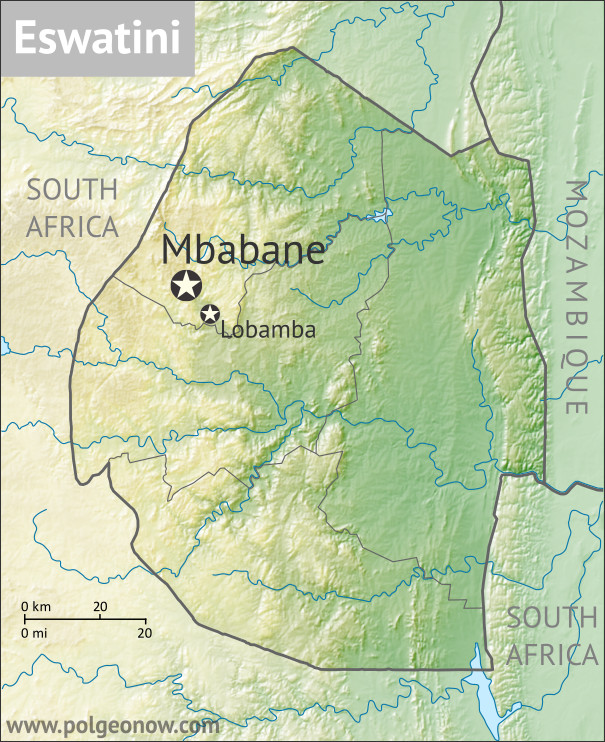
Topographic map of Eswatini (Swaziland), showing terrain, rivers, bordering countries, and capital cities.
Eswatini, formerly known as Swaziland. Based on this map by Htonl and NordNordWest.

Swaziland’s New Name

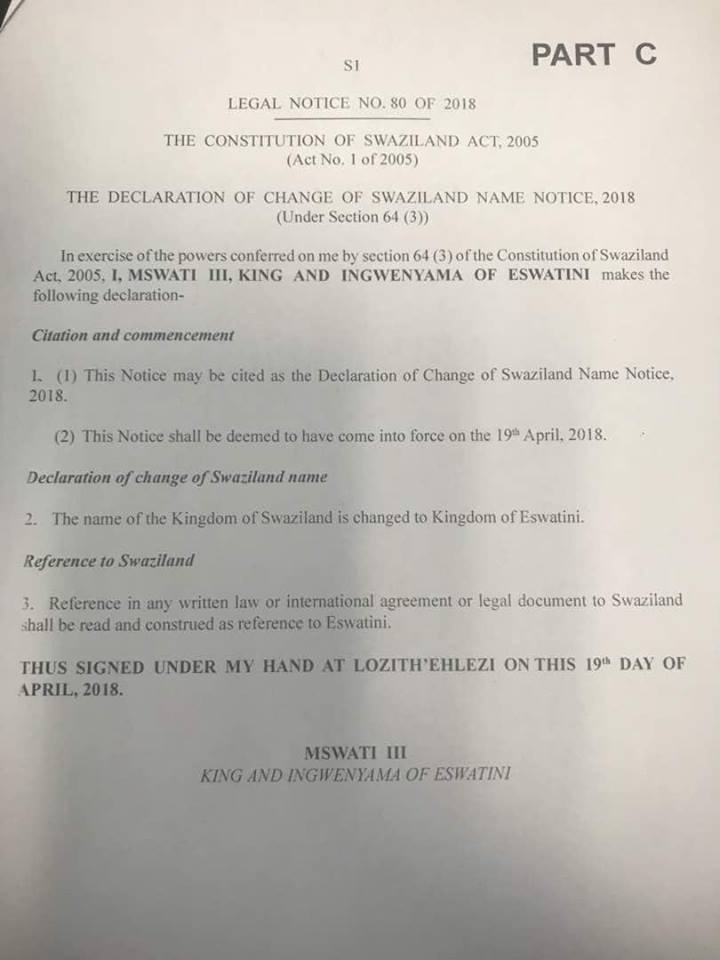
If you follow PolGeoNow on Twitter, you already know that the small, southern African country of Swaziland was renamed “Eswatini” this April. The full English name of the country, previously “Kingdom of Swaziland”, has also been changed to “Kingdom of Eswatini”.

The rename was first announced by the country’s king on April 19 – his 50th birthday. (Some media incorrectly reported that April 19 was also Swaziland’s 50th anniversary of independence. The country is indeed celebrating its 50th this year, but the actual day of the anniversary is September 6.)

The change was apparently effective immediately: A purported copy of the legal order making the new name official, also dated April 19, was posted on a Swaziland news blog in May, with some validation from other sources.

The announcement was unexpected, but King Mswati III has been using the new name in speeches for years, so it wasn’t a complete surprise. Still, citizens of the country of course had varying opinions on the change. Some called it long overdue, while others denounced it as a distraction from more important national issues. Some of those critics noted that renaming a country isn’t purely a symbolic act – you also have to spend time and money changing all the things the name is written on.

Why “Eswatini”?

Actually, “eSwatini” was already the country’s name – in the local Swazi language. Like Cape Verde’s switch to “Cabo Verde” in 2013, this is just a case of adjusting the official English name to match the native name. And just like “Swaziland” in English, eSwatini means “place of the Swazi people” in Swazi (or as the language calls itself, “Swati”).

But why change the English name to match the Swazi one? King Mswati argued that it only makes sense to do the same as other African countries, many of which “reverted to their ancient, native names” when they became independent. For Swaziland, he said, that ancient name was eSwatini.

On top of that, some people considered the name “Swaziland” an awkward mix of the Swazi and English languages, and the king has complained that the name “Swaziland” often gets mistaken for “Switzerland”.

Capitalization: Eswatini or eSwatini?

Journalists reporting on the name change when it first happened in April spelled the new country name “eSwatini”, with a lowercase “e” and capital “S”. That’s the way the country’s name is properly written in the Swazi language, and it was also spelled that way in the government’s official transcript of King Mswati’s September 2017 speech to the United Nations (which was delivered in English). Capitalizing only the second letter of a name is unusual in English, but then, that doesn’t stop you from shopping on eBay with your iPhone.

Where is Eswatini? Map of Eswatini's location in Africa. Formerly known as the Kingdom of Swaziland, the country was renamed Kingdom of Eswatini in 2018.
Location of Eswatini (Swaziland) in Africa. Derived from this blank map by Eric Gaba. License: CC BY-SA

Still, the point seems to be moot: The purported legal order for Swaziland’s name change spells it “Eswatini” with a capital “E” and lower case “s”, and official sources from other countries have done the same – probably following the official notice they’ve received from the Swazi government.

The government’s own websites, where the name has been updated, also use the capital “E” spelling for the name. So that seems to be the officially proper way to write it.

[Edit: The official ISO standard list of countries, now updated, also uses the capital “E” spelling.]

Eswatini: How to Pronounce It?

So what’s the correct pronunciation of Eswatini? Well, international news outlets we checked have been pronouncing it “ess-wah-TEE-nee”. But King Mswati himself seems to pronounce it differently – to our ears, it sounds more like “eh-SWAH-tee-nee”, with emphasis on the “swa”.

You can listen for yourself in his announcement speech, or in his September 2017 speech to the United Nations (country name at 1:59, 3:08, and 6:08).

Eswatini vs. Swaziland: Which Name Wins?

Ultimately, no country’s government can completely control what people call it in another language, and it’s always been common for places to have completely different names in foreign tongues. Think of how Deutschland and Nippon are known as “Germany” and “Japan” in English – it would be pretty hard to convince all English speakers to switch to the native names.

And every language does this. In some, like Chinese or Arabic, almost every single country’s name is at least a little different from the native version, since they have to spell it using a whole different writing system that doesn’t have the same letters.

Flag of Eswatini (Swaziland)Country Name:  
• Eswatini (official English)
• eSwatini (Swazi)
• Swaziland (unofficial English)
Full Name:  
• Kingdom of Eswatini (English)
• Umbuso weSwatini (Swazi)
Capital:  
• Mbabane (executive and UN-registered official)
• Lobamba (legislative and ceremonial) 
Adjective: Swazi

In English, some news outlets and organizations have already switched from Swaziland to Eswatini (or more often, eSwatini with the lowercase “e”), but many more haven’t. Only time will tell, but country name changes are usually slow to catch on, especially if they involve substituting a non-English word for the traditional English name.

Wikipedia, whose editors prioritize commonly-used names over official ones, still calls Côte d’Ivoire “Ivory Coast” 30 years after the country ordered the switch. Traditional, more English-sounding names still prevail for Cabo Verde and Timor-Leste too, and the Czech Republic’s invented short name hasn’t made the grade yet either. (On the other hand, changes for Zaire and Western Samoa in the 1990s have caught on just fine.)

So What Really Changes?

Besides English-language signs and documents within the country, Swaziland’s name change will also affect official usage in the United Nations (UN), and foreign governments and diplomats have been asked to use the new name for official English communications. Meanwhile, the ISO 3166-1 international standard list of country codes is based on UN usage, so pretty soon “Eswatini” should start showing up as an option on drop-down lists of the world’s countries. Other websites and apps, like Google Maps, may also make the switch.

At the moment, the UN’s official country names website and the ISO 3166-1 country name database are still showing “Swaziland”, but it looks like they just haven’t been updated yet. A different UN web page lists the country as “Eswatini (Kingdom of)”, and foreign governments haven’t waited to jump on board. It’s almost certainly just a matter of time until ISO and the UN country name site also show “Eswatini”.

Once the UN page updates, we can answer our last question: The UN also records official country names in Arabic, Chinese, French, Russian and Spanish – so is Swaziland only changing its name in English, or in other UN languages too? We’ll let you know when we find out!

Update 2018-07-16: ISO has now updated its list with the new name, Eswatini, spelled with a capital “E”. The name has also been changed in French, which is the only other language that ISO offers its standard in (there are Russian and Spanish versions of the ISO website, but the standard country names aren’t translated into those languages.)

PolGeoNow always reports on changes to countries’ names – learn about others by viewing all country name change articles.

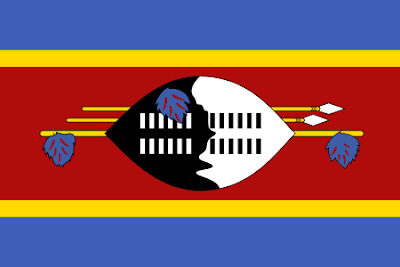
Graphic of the Swazi flag is in the public domain (source).

Syrian Civil War Map & Timeline: June 2018 (Subscription)

SUBSCRIBERS CLICK HERE TO PROCEED TO ARTICLE AND MAP

There are newer versions of this map available. To see them, view all Syria updates.

Research by Djordje Djukic. Map by onestopmap.com, Evan Centanni, and Djordje Djukic

Subscribe for full access to all conflict map reports!


Map of Syrian Civil War (Syria control map): Fighting and territorial control in Syria in June 2018 (Free Syrian Army rebels, Kurdish YPG, Syrian Democratic Forces (SDF), Hayat Tahrir al-Sham (HTS / Al-Nusra Front), Islamic State (ISIS/ISIL), and others). Includes Russia-Turkey-Iran agreed de-escalation zones and US deconfliction zone, plus recent locations of conflict and territorial control changes, such as Dashishah, Al Kara'a, and more. Colorblind accessible.Since late May, fighting between government and rebel forces in Syria has subsided, but battles against the so-called Islamic State (ISIS/ISIL) have continued in both eastern and western parts of the country.

See all this and more on the latest update to PolGeoNow’s concise, professional Syrian Civil War control map, which includes a timeline of changes since our previous Syria map report in May, with sources cited.

This map and report are premium content, available to paid subscribers of the PolGeoNow Conflict Mapping Service.

Want to see before you subscribe? Check out our most recent FREE SAMPLE Syria map!

Exclusive map report includes:

  • Up-to-date illustration of current territorial control in Syria, color-coded for the Assad government, rebel groups, “Islamic State” (ISIS/ISIL) fighters, and the Kurdish-led Syrian Democratic Forces (SDF). Colorblind accessible.
  • Markers showing the approximate locations of Russian-Turkish-Iranian “de-escalation zones” and the one known US “deconfliction zone”.
  • Special symbols indicating towns dominated by rebels of the former Al Qaeda Nusra Front (now Hayat Tahrir al-Sham or HTS) and by the Kurdish YPG militia (part of the US-backed SDF).
  • Detailed indication of city-by-city control, including key towns and other locations important to current events.
  • Locations of recent control changes and other important events, including Dashishah, Al Kara’a, Manbij, and more.
  • Detailed timeline of important events and changes to territorial control since May 23, 2018, compiled by our Syria-Iraq expert, with links to sources. 
  • Brief summary of the current situation and of major changes to the configuration of territorial boundaries and de facto enclaves and exclaves.

SUBSCRIBERS CLICK HERE TO PROCEED TO ARTICLE AND MAP

Not signed up yet? Click here to learn more about our professional subscription service!

Can I purchase just this map?
This map and report are not available for automated purchase to non-subscribers. If you need access or republication rights for only this map report, contact service@polgeonow.com for options.

Yemen Control Map & Report – June 2018 (Subscription)

SUBSCRIBERS CLICK HERE TO PROCEED TO ARTICLE AND MAP

(To see other maps in this series, view all Yemen articles on PolGeoNow.)

Map of what is happening in Yemen as of June 16, 2018, including territorial control for the unrecognized Houthi government and former president Saleh's forces, president-in-exile Hadi and his allies in the Saudi-led coalition and Southern Movement, Al Qaeda in the Arabian Peninsula (AQAP), and the so-called Islamic State (ISIS/ISIL). Includes recent locations of fighting, including Hodeida, Al Faza, Al Tuhayata, and more. Colorblind accessible.

Subscribe for full access to all conflict map reports!

Timeline by Djordje Djukic. Map by Evan Centanni, Djordje Djukic, and onestopmap.com

Since April, Yemen’s Saudi-led coalition has resisted increasing internal divisions to gain some ground against the rival Houthi government, as well as Al Qaeda forces in the east. Now, the coalition is making a concerted push to capture the Houthi-held city of Hodeida, Yemen’s main port on the Red Sea.

See all this and more on the newest update to PolGeoNow’s Yemen territorial control map, which includes a timeline of changes and important events since our previous Yemen map report in April.

This map and report are premium content available to paid subscribers of the PolGeoNow Conflict Mapping Service.

Want to see before you buy? Check out our most recent FREE SAMPLE Yemen map report!

Exclusive report includes:

  • Up-to-date map of current territorial control in Yemen, color-coded for the pro-Hadi coalition, Houthi/Saleh forces, Al Qaeda in the Arabian Peninsula (AQAP), and the so-called “Islamic State” (ISIS/ISIL).
  • Detailed indication of town-by-town control, including provincial boundaries, all major cities, and many smaller ones
  • Markers for recent areas of fighting, including Hodeida, Al Faza, Al Tuhayata, and more
  • Timeline of changes to the situation since April 14, 2018, with links to sources

SUBSCRIBERS CLICK HERE TO PROCEED TO ARTICLE AND MAP

Not a member yet? Click here to learn more about our professional subscription service!

Can I purchase just this map?
This map and report are not available for automated purchase to non-subscribers. If you need access or republication rights for only this map report, contact service@polgeonow.com for options.

World Cup 2018: Which Countries Are (and Aren’t) Members of FIFA?

This is an updated edition of our FIFA member countries article. The original version, from 2014, is here.

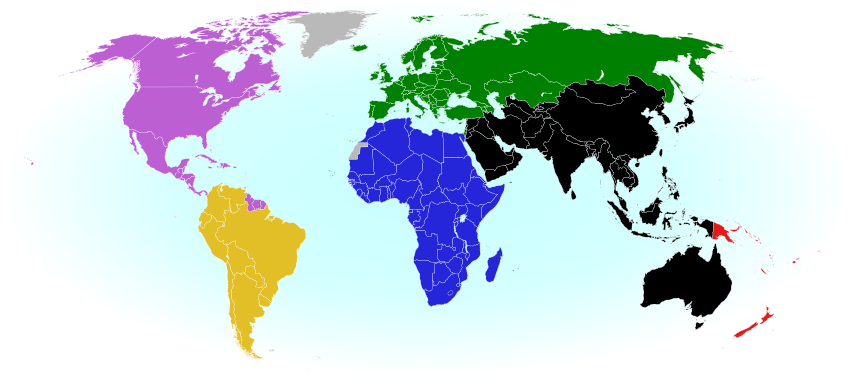
2018 world map showing the six continental confederations of men's national association football (soccer) teams, including all FIFA national teams and World Cup countries. Colorblind accessible.
The six continental confederations of national football teams associated with FIFA. Most, but not all, confederation members are individually members of FIFA as well. Map by Evan Centanni, based on work by EOZyo (source).

Around the world, fans of association football – also known in many countries as “soccer” – are tuning in today for the beginning of the month-long FIFA World Cup in Russia. Not all the world’s countries can advance to the cup, but did they all get a shot at it? Which countries were eligible to enter the tournament, and which are excluded? Read on for our exclusive guide to the roster of FIFA national football teams…

How many FIFA national teams are there?

There are currently 211 national football teams with official FIFA membership, which is required to compete for qualification in the World Cup. FIFA members are divided into six continental confederations that preside over competitions within each region (see map above), though it’s possible to be a member of one of these confederations but not of FIFA.

The confederations are loosely based on the geographical boundaries of the world’s continents, but there are some exceptions: The Asian Football Confederation also includes Australia, Guam, and the Northern Mariana Islands (usually considered part of Oceania), while culturally Caribbean countries, including South America’s Guyana, Suriname, and French Guiana, are grouped with North and Central America. As in the Olympics, Israel is a member of the European confederation despite its location on the Asian continent. Turkey, Kazakhstan, Armenia, Azerbaijan, and Georgia are also grouped with Europe even though each one is technically located mostly in Asia.

FIFA members that aren’t independent countries

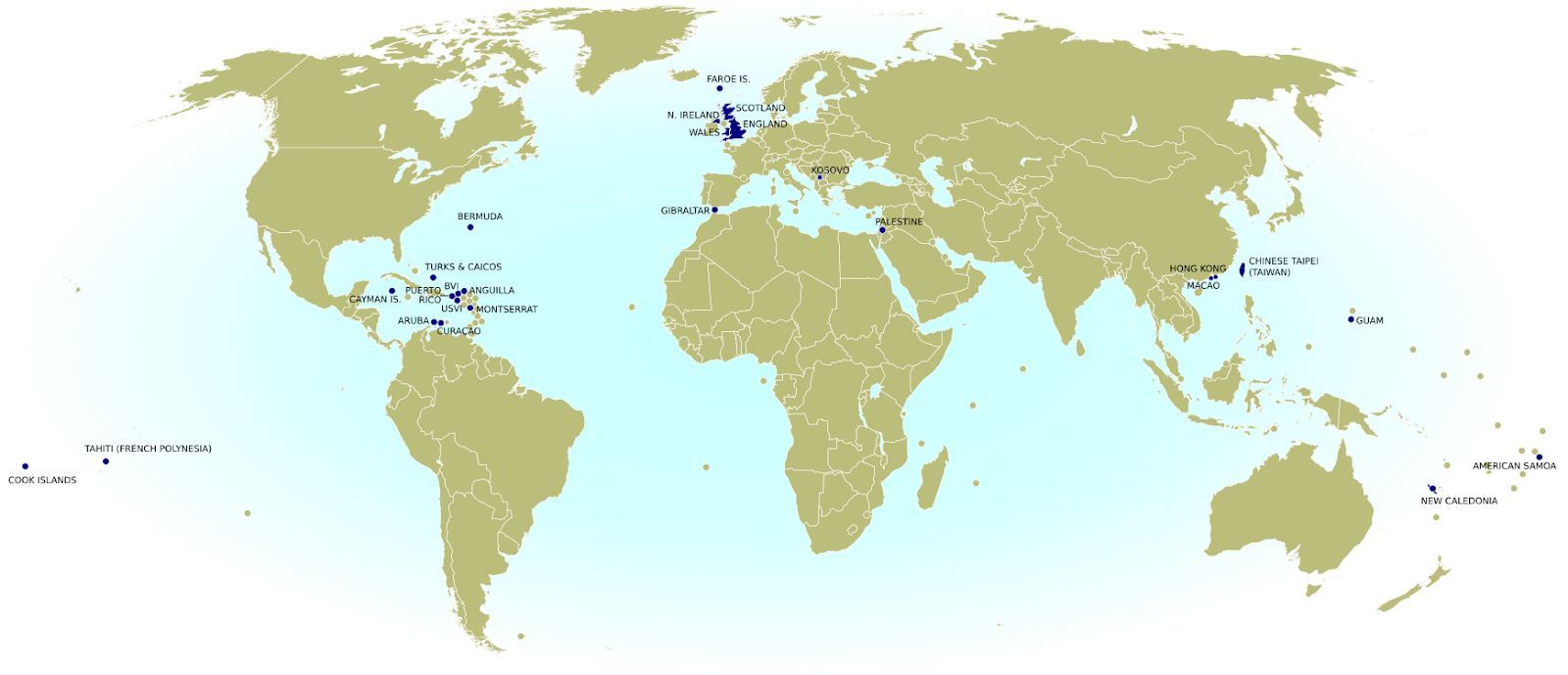
You might have noticed that 211 is more than the number of actual independent countries in the world. After all, the United Nations only recognizes 195. That’s because, much like the Olympics, FIFA used to allow dependent territories to apply for membership. Now it mostly only admits recognized independent countries, but teams that became members in the past are allowed to stay on regardless of their sovereignty status, and exemptions to the rule are possible. Today there are 19 dependent territories with FIFA-eligible national football teams:

World map showing recognized FIFA national teams that represent dependent territories, partially-recognized or unrecognized countries, and subnational entities. None are independent countries, but all are eligible to qualify for the FIFA World Cup of men's association football/soccer. Map updated to 2018. Colorblind accessible.
Click to enlarge: FIFA members that aren’t UN member countries, including dependent territories, partially recognized states, and national subdivisions. By Evan Centanni, from public domain base map (source).

North America & the Caribbean
 Anguilla (UK)
 Aruba (Netherlands)
 Bermuda (UK)
 British Virgin Islands (UK)
 Cayman Islands (UK)
 Curaçao (Netherlands)
 Montserrat (UK)
 Puerto Rico (US)
 Turks & Caicos Islands (UK)
U.S. Virgin Islands (US)

Asia
 Hong Kong (China)
 Guam (US)
 Macau (China)

Europe
 Faroe Islands (Denmark)
 Gibraltar (UK)

Oceania
 American Samoa (US)
 Cook Islands (New Zealand)
 New Caledonia (France)
 Tahiti (France)

By tradition, each of the four “countries” making up the UK also has a separate team, despite not being independent:

 England
 Northern Ireland
 Scotland
 Wales

Also as in the Olympics, disputed countries Palestine, Kosovo, and Taiwan (known in international sports as “Chinese Taipei“) are included as special cases without the requirement for fully-recognized independence. In fact, Palestine is now treated as an independent country by the UN, but that wasn’t yet the case when it was first admitted to FIFA in 1998.

New FIFA national teams since 2014

No national teams have left FIFA in the four years since the 2014 World Cup in Brazil, but there are two new ones that have been added.

Europe’s disputed, self-declared Republic of Kosovo was accepted in June 2016, after the FIFA congress decided it had gathered enough recognition from the world’s countries to be considered independent – despite opposition from Serbia, which claims Kosovo as a part of it. Kosovo was also accepted into the Olympics in 2014, but still isn’t treated as an independent country by the United Nations (UN).

At the same time, FIFA also accepted Gibraltar, a British territory in southwestern Europe, as a national team. Since Gibraltar isn’t independent, and its status as a British territory is disputed by Spain, it was rejected from FIFA at first. But in early 2016, a world sports court ruled that its application had to be reconsidered, and within a few months, it was approved.

Which countries aren’t members of FIFA?

As we’ve seen, even some dependent territories are FIFA members – but there are actually a few independent countries that still aren’t:

Map of countries and territories with FIFA-unrecognized national football teams, plus those with no national team. Includes recognized countries, breakaway states, and dependent territories. Colorblind accessible.
Click to enlarge: FIFA non-members – countries, claimed countries, dependent territories, and any national subdivisions that participate in continental confederations but are not recognized by FIFA. Map by Evan Centanni, from public domain base map (source).

Europe
  Monaco
 United Kingdom (UK)
   Vatican City

Oceania
 Kiribati
 Marshall Islands
 Micronesia
 Nauru
 Palau
 Tuvalu

The Marshall Islands is the only UN-recognized independent country without a national team at all. All the others do have teams (yes, even Vatican City!), but aren’t members of FIFA. That means they’re not eligible even to enter into qualifying matches for the World Cup – though Kiribati and Tuvalu do participate as associate members in the Oceania Football Confederation (OFC), which is associated with FIFA.

And even though Palestine, Taiwan, and Kosovo have managed to secure membership in FIFA, other partially-unrecognized countries haven’t. There are ten non-FIFA teams belonging to unrecognized but independently-governed countries:

 Abkhazia
 Artsakh (Nagorno-Karabakh)
 Donetsk People’s Republic
 Kosovo
 Luhansk People’s Republic
 Northern Cyprus
 Somaliland
 South Ossetia
 Transnistria
 Western Sahara

Transnistria, a self-declared republic in Eastern Europe that’s not recognized by any UN member country, first formed its own national football team in 2015, so it’s been added to the this list since the last World Cup. The less well-established Donetsk and Luhansk People’s Republics, which declared independence from Ukraine in 2014, apparently have their own national teams now as well.

CONIFA, an organization for non-FIFA football, counts almost another 30 “national” teams among its members, many of them representing separatist states or marginalized ethnic groups within FIFA member countries. You can see the full list of those here.

Several other dependent territories and remote islands have their own national teams as well, even if they’re not members of any major confederation. And ten dependent territories and country subdivisions have full or associate membership in the FIFA-connected continental confederations, even though they haven’t been accepted into FIFA itself:

Africa
 Réunion (France)
 Zanzibar (Tanzania)

North America and the Caribbean
 Bonaire (Netherlands)
 French Guiana (France)
 Guadeloupe (France)
 Martinique (France)
 Saint-Martin (France)
 Sint Maarten (Netherlands)

Asia
 Northern Mariana Islands (US)

Oceania
 Niue (New Zealand)

Which countries qualified for the 2018 FIFA World Cup in Russia?

Even if a country is an eligible FIFA member, it still has to compete in the pre-tournament qualification process before moving on to the actual World Cup. In the 2018 World Cup, for the first time ever, every single national team in FIFA registered to compete in the qualifiers (209 teams that registered on time, plus new members Kosovo and Gibraltar who were allowed to join later). Besides Kosovo and Gibraltar, Bhutan and South Sudan also tried out for the first time.

Out of the 211 eligible countries, only 32 are allowed to continue into the final World Cup tournament in Russia. Iceland and Panama have both qualified for the first time ever, while four-time champion Italy has gotten locked out for the first time since 1958. Other major players that won’t make it this year include the US, the Netherlands, Cameroon, and Chile. England is the only qualifying team not representing an independent, UN-recognized country (remember, England is just one part of the UK).

Here’s a full map of eligible and qualifying national teams in this year’s World Cup – you can find all the details on Wikipedia.

World Cup Countries 2018: Map of FIFA qualifying teams for the 2018 World Cup in Russia. Color-coded for qualified World Cup national teams, countries that were eliminated in the qualifiers, and countries that were expelled from the tournament before playing any matches.
Blue = countries qualifying for the 2018 FIFA World Cup; Orange = countries eliminated in the qualifying rounds; Black = countries expelled before playing any matches; Gray = countries and dependent territories that aren’t FIFA members. Map by 2Nyte and other Wikimedia Commons users (source; CC BY-SA).

Have something to ask or say about FIFA or non-FIFA countries while you’re watching the World Cup? Tweet to us @PolGeoNow!

Somalia Control Map & Timeline – June 2018 (Subscription)

SUBSCRIBERS CLICK HERE TO PROCEED TO ARTICLE AND MAP

(To see other maps in this series, view all Somalia updates.)

Map by onestopmap.com, Evan Centanni, and Djordje Djukic

Subscribe for full access to all conflict map reports!


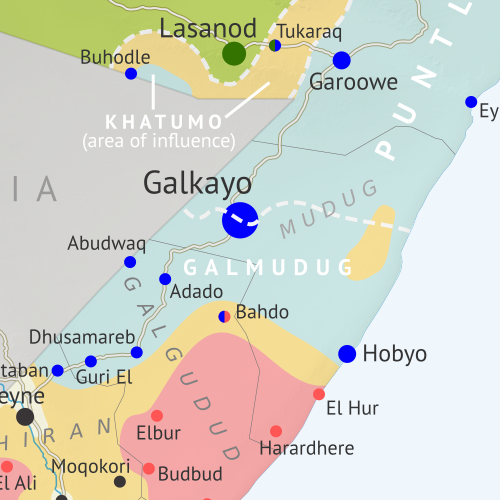
Who controls Somalia? Map (2018). With states, regions, and territorial control. Best Somalia control map online, thoroughly researched and detailed but concise. Shows territorial control by Federal Government of Somalia (FGS), Al Shabaab, so-called Islamic State (ISIS/ISIL), separatist Somaliland, and autonomous states Puntland, Galmudug, and Khatumo (the ASWJ Sufi militia has merged with Galmudug state). Updated to June 2, 2018. Colorblind accessible.
In the last two months, several towns in southern Somalia have changed hands between Al Shabaab and government-allied forces, while political realignments have continued to change the country’s map of autonomous states.

See all this and more on the latest update to PolGeoNow’s concise, professional Somalia control map, which includes a timeline of changes since our previous Somalia map report of March 2018, with sources cited.

This map and report are premium content, available to paid subscribers of the PolGeoNow Conflict Mapping Service.

Want to see before you subscribe? Check out our most recent FREE SAMPLE Somalia map!

Exclusive map report includes:

  • Up-to-date illustration of current territorial control in Somalia, color-coded for the federal government coalition (including AMISOM peacekeepers), autonomous unionist forces, separatist Somaliland, Al Qaeda affiliate Al Shabaab, and fighters aligned to the so-called “Islamic State” (ISIS/ISIL). Areas of lawlessness or unclear control indicated separately. Colorblind accessible.
  • Boundaries and labels for Somalia’s official regions, plus control lines for the autonomous administrations of Somaliland, Puntland, Galmudug, and Khatumo.
  • Detailed indication of city-by-city control, including many relevant smaller towns and villages.
  • Locations of recent fighting and other important events, including Tukaraq, Moqokori, Bulo Haji, Bali Khadar, and more.
  • Detailed timeline of territorial control changes and key political developments since March 28, 2018, with sources indicated. 
  • Brief summary of the conflict situation, as well as major changes to the alignment of autonomous administrations, over the past seven months.

SUBSCRIBERS CLICK HERE TO PROCEED TO ARTICLE AND MAP

Not signed up yet? Click here to learn more about our professional subscription service!