Map: Which Countries Recognize Palestine as Independent in 2016?

(Keep up with changes to Palestine’s situation: view all Palestine updates.)

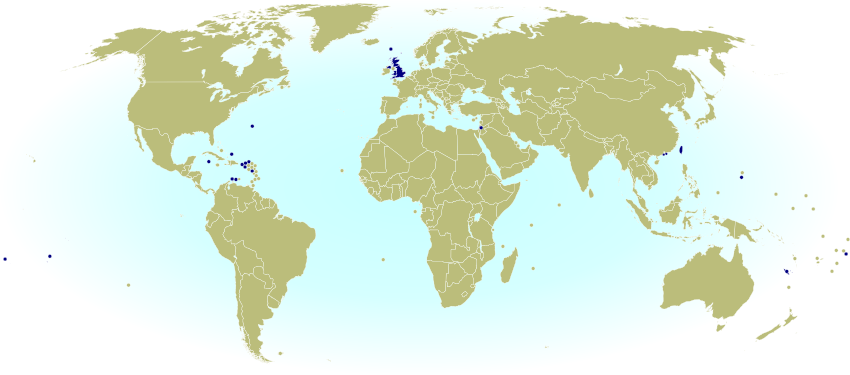
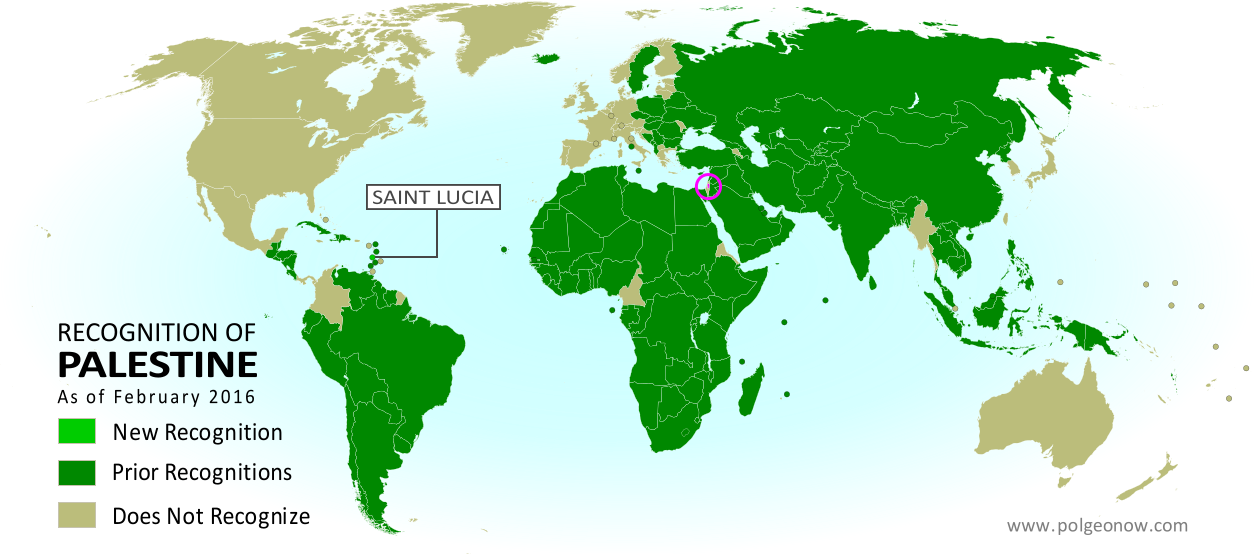
Map of countries that recognize the State of Palestine as an independent country, updated for February 2016 with recent addition Saint Lucia highlighted
Click to enlarge. Palestine in magenta (circled). Map by Evan Centanni, modified from public domain graphic (source).

Subscribers click here to view this article in the ad-free members area. Not a member yet? Learn about PolGeoNow subscriptions!

Article by Evan Centanni

Disputed Country

The Palestinian Liberation Organization (PLO) declared an independent State of Palestine in 1988, and continues to pursue its recognition as a country today. Though Palestine’s claimed territories are disputed and largely occupied by Israel, it has gathered recognition from more than two-thirds of the world’s countries, and is also treated as a country by the UN General Assembly, where it’s an “Observer State” but not a member.

Flag of Palestine Country Name:  
• Palestine (English)
Filasṭīn (Arabic)
Official Name:  
• State of Palestine (English)
• Dawlat Filasṭin (Arabic)
Capital: 
• Jerusalem (claimed)
Ramallah (administrative)

The number of individual countries recognizing Palestine has grown gradually over the past decades. Last June we reported that 135 U.N. member states (and one observer state) officially recognized Palestine, and since September the number is now 136 (about 70% of all UN members). Palestine is also recognized by the proclaimed government of Western Sahara, another disputed country that’s not formally recognized by the UN.

Saint Lucia Recognizes Palestine

Last September, the small Caribbean island country of Saint Lucia became the latest national government to recognize Palestine as independent. The formal acknowledgement came on September 14, 2015, when the two countries’ UN representatives signed an agreement in New York to establish diplomatic relations.

Saint Lucia is now one of about half the world’s countries whose government recognizes both Palestine and Israel as independent countries. All of the independent Caribbean countries except Cuba recognize Israel, and most also recognize Palestine, with the exception of Jamaica, the Bahamas, Saint Kitts and Nevis, Barbados, and Trinidad and Tobago.

Read More:
Is Palestine Really a Country?
Palestine Recognized as a Country by the UN
Map of Countries Recognizing Kosovo

How Many Countries Are There in the World in January 2016?

There are newer editions of this article available. To find the most recent, view all “How Many Countries in the World” updates!

This article was first published in 2011, and the version below was last updated in January 2016 for South Sudan’s admission as an Olympic Nation

How many countries in the world?
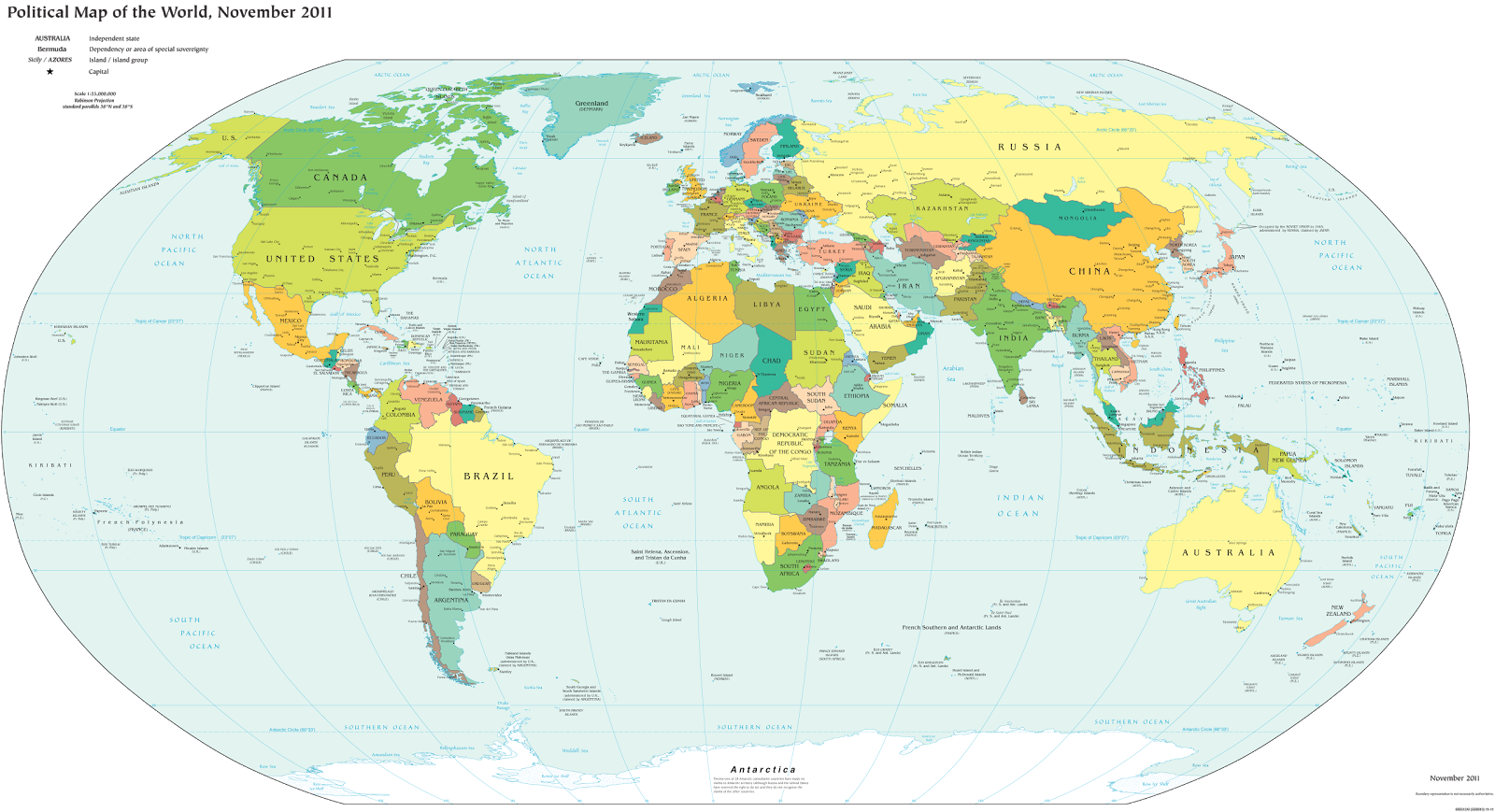
A world political map published by the U.S. government (public domain)

One of the most basic questions for map-lovers is, “How many countries are there in the world?” But anyone who replies with a simple number is leaving out part of the story. The fact is, the answer depends heavily on how you define “country”.

Here are six of the most common answers, each correct in its own way:

195 Sovereign States According to the UN
“Country” and “nation” are casual words for what political scientists call a “sovereign state”, meaning a place with its own borders and completely independent government. The question of which places count as sovereign states can be controversial, but for starters we can count all the member and observer countries of the United Nations (UN):

UN Members: 193
UN Observer States: 2
Total: 195

These countries mostly all accept each other as sovereign states, and they’re the ones you’ll see on most world maps and many lists of the world’s countries. Most of the countries you’ve ever heard of are probably members of the UN, and the two UN Observer States are Vatican City (represented by the Holy See) and Palestine. If you want to know the names of all 195, Wikipedia has a complete list.

The last addition to the list was in 2012, when Palestine became a UN Observer State, and the last country to join the UN as a full member was South Sudan in 2011.

Note: Palestine’s status as a UN Observer State is controversial, so some lists may still only include 194 countries.

201 States With At Least Partial Recognition
Several more country candidates are left out of the UN itself, but are still officially acknowledged by at least one UN member (this kind of official acceptance is called “diplomatic recognition“). These controversial countries are usually labeled on world maps as disputed territories or special situations, if they’re on the map at all.

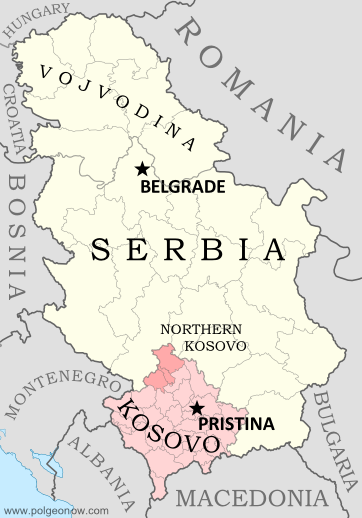
Map of Serbia, Kosovo, and North Kosovo
Kosovo is claimed by Serbia, but recognized as independent by over 100 countries.

UN Members: 193
UN Observer States: 2
States With Partial Recognition:
Total: 201

The six non-UN states with partial recognition are Taiwan, Western Sahara, Kosovo, South Ossetia, Abkhazia, and Northern Cyprus. All of these are claimed as parts of other countries, but aren’t actually controlled by them (at least not completely). The number of UN members recognizing them varies, from just one for Northern Cyprus to over 100 for Kosovo.

A few lists also include the Cook Islands and Niue as partially-recognized states. These two places sometimes act like independent countries, but they’ve never actually declared independence or tried to join the UN, and are usually considered overseas territories of New Zealand.

204-207 De Facto Sovereign States
But wait, there’s more! Those six partially recognized countries aren’t the only breakaway states with full self-governance. There are at least three more declared countries that aren’t recognized by any UN members at all, but still operate independently from the countries that claim them. These are often called “de facto” sovereign states, a fancy Latin way of saying that they’re independent countries in actual fact, even if not on paper.

UN Members: 193
UN Observer States: 2
States With Partial Recognition:
Unrecognized de facto Sovereign States: 3 to 6 (see below)
Total: 204 to 207

The three places most often considered de facto independent countries are Nagorno-Karabakh, Transnistria, and Somaliland. And since 2014 there are three more contenders for the list: the Islamic State, the Donetsk People’s Republic, and the Lugansk People’s Republic. But because these last three are located in active war zones and have only limited government structures, there’s some debate over whether they count even as de facto countries.

Tiny “micronations” declared by individual people are usually not taken seriously enough to count on the list. The closest contender would be Sealand, but it’s debatable whether this tiny “nation” really counts as having a territory, population, or government, all key ingredients for a sovereign state.

There are also many rebel-held territories (and fully self-governing areas like Puntland) that aren’t controlled by any country, but are left off the list because they aren’t trying to become independent countries. They agree in principle to be part of the country they’re in, even though they might disagree about who should be in charge or how the country should be governed.

206 Olympic Nations
Lots of people learn about the world’s list of countries by watching the Olympic Games every two years. If you’re one of them, you might be confused at why the Olympic Parade of Nations claims over 200 members, even though your atlas only has 195.

This is because the Olympics didn’t always require applicants to be independent countries. Dependent territories with partial self-government have sometimes been approved by the International Olympic Committee (IOC), and a couple of the partially-recognized states mentioned above have also managed this.

Olympic Nations that are UN Member States: 193
Olympic Nations that are UN Observer States: 1
Olympic Nations that are Partially-recognized States: 2
Olympic Nations that are Dependent Territories: 10
Total IOC-Recognized Olympic Nations: 206

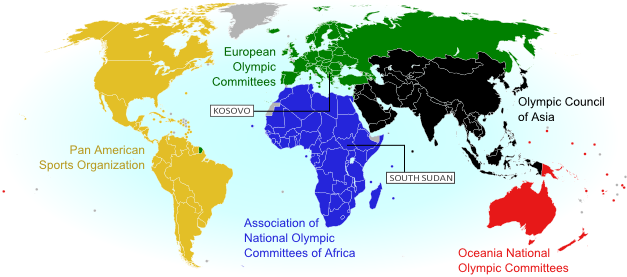
World map showing the five continental associations of National Olympic Committees, including all nations eligible for the Olympic games
The Olympics include most of the world’s independent countries, and some dependent territories too.

About half of the dependent territories in the Olympics are overseas possessions of the US (such as Puerto Rico) and of the UK (such as Bermuda), and some nearly-independent “countries” such as the Cook Islands (New Zealand) and Aruba (the Netherlands) are included as well.

Every UN member country is also in the Olympics, with the latest addition, South Sudan, joining in August 2015.  The one UN Observer State in the Olympics is Palestine; Vatican City isn’t interested. As for the two partially-recognized IOC members, Kosovo just became an Olympic Nation in 2014, and Taiwan has been a member for some time, but has to call itself  “Chinese Taipei” after a deal struck with China in the 1980s.

See Also: Parade of Nations: Which Countries Are (and Aren’t) in the Olympics

209 FIFA Countries Eligible for the World Cup
Soccer, or football as it’s known outside North America, is the world’s most popular sport, and most international matches all the way up to the World Cup are regulated by an organization called FIFA. If you’re a soccer superfan, you might know there are 209 member countries that compete in FIFA matches (though most don’t make it to the World Cup). This is even more than the number of Olympic Nations, and certainly more than the number of independent countries on most world maps.

Like the Olympics, FIFA didn’t always require independence or international recognition of its member states. Now it’s a bit stricter, but any team that’s already a member is allowed to stay. And based on European tradition, FIFA allows England, Scotland, Wales, and Northern Ireland to compete as separate teams, even though they’re all part of the UK.

World map marking dependent territories, partially recognized sovereign states, and subnational entities that have national football (soccer) teams recognized by FIFA, making them eligible for the World Cup.
Map of FIFA members that aren’t recognized as independent countries by the U.N.

Teams of UN Member States: 186
Teams of UN Observer States: 1
Teams of Partially Recognized States: 1
Teams of UK Constituent Countries: 4
Teams of Dependent Territories: 17
Total FIFA Member Associations: 209

You may notice that not all of the 193 UN member states are included. That’s because several very small countries aren’t members, plus the UK is replaced by its four “constituent countries”, which aren’t UN members on their own.

See Also: Which Countries Are (and Aren’t) Part of FIFA?

249 Country Codes in the ISO Standard List
Have you ever been filling out an internet form, and had to choose from a surprisingly long list of countries? You were probably looking at the international standard “country code” list, officially known as ISO 3166-1. Many companies and other organizations adopt this standard list rather than spending their own time compiling one. The standard also includes convenient two-letter codes for each country, like us for the United States, de for Germany, and jp for Japan, which you might recognize from web addresses specific to those countries.

This ISO standard is based on an official list kept by the UN….but then why on Earth are there 249 country codes? That’s way more than the total number of UN member and observer countries! Well, the standard list does leave out some breakaway states not recognized by the UN, but makes up for it by listing dependent territories separately from their mother countries. So there are country codes not only for actual countries, but also for nearly-independent states, overseas territories, uninhabited islands, and even Antarctica! This is important because organizations might need an option for every place that any person is located, and dependent territories often aren’t technically part of the countries they belong to.

UN Members: 193
UN Observer States: 2
States With Partial Recognition:
Inhabited Dependent Territories: 45
Uninhabited Territories: 6
Antarctica: 1
Total: 249

So there you have it! Next time someone tells you “There are X countries in the world,” remember that the real answer isn’t so simple!

Map Update: Kosovo Recognized by 3 More Countries in 2015 (108/193 UN members)

Premium members click here to view this article in the ad-free members area. Not a member yet? Subscribe now!

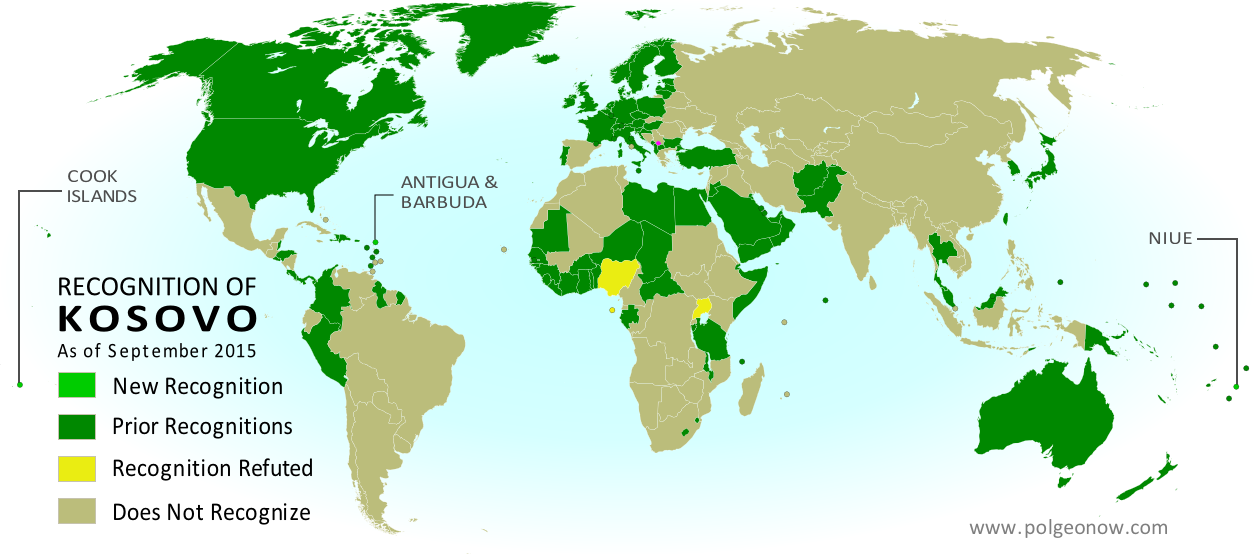
Map of countries that recognize the Republic of Kosovo as an independent state, updated to September 2015, with the most recent additions (Antigua and Barbuda, Cook Islands, and Niue) highlighted. Also shows countries that have refuted claims that they recognized Kosovo: Sao Tome and Principe, Nigeria, and Uganda.
Map by Evan Centanni, modified from public domain graphic (source).

Flag of the Republic of KosovoCountry Name:  
• Kosovo (English, Serbian)
• Kosova (Albanian)
Official Name:  
Republic of Kosovo (English)
Republika e Kosovës (Albanian)
Republika Kosovo (Serbian)
Capital: Pristina/Prishtina

Article by Evan Centanni, with additional reporting by Caleb Centanni

New Recognitions for Kosovo
Since our last Kosovo recognition map report nearly a year ago, the breakaway republic’s independence has been endorsed by three more countries. However, only one of these three new recognizers, Antigua and Barbuda, is a fully independent country and UN member. The other two, the Cook Islands and Niue, are semi-independent states often considered to be overseas territories of New Zealand.

Antigua and Barbuda, a small two-island country in the Caribbean, reportedly recognized Kosovo as independent on May 20, 2015, after several years of talks between the two states’ foreign ministers. Kosovo is now recognized by about half of the island countries in the Caribbean.

Also in May, the Cook Islands recognized Kosovo, with nearby Niue joining a month later. The Cook Islands and Niue are two nearly independent Pacific island countries in “free association” with New Zealand. They are often considered dependent territories rather than independent countries; their people retain New Zealand citizenship, and they have never declared independence or tried to join the UN. However, they are self-governed, with the choice to become independent at any time, and there’s no rule against them diplomatically recognizing other countries or being recognized in return.

Before this year, the last country to recognize Kosovo was Solomon Islands in August 2014. With the addition of Antigua and Barbuda, Kosovo is now considered independent by 108 of the 193 UN member countries (about 56 percent).

What is Kosovo?
The Republic of Kosovo, located in southeastern Europe, controversially declared independence from Serbia in 2008. It has been blocked from UN membership by objections from Serbia, Russia, and other countries who see its secession as invalid. In addition to the 108 UN members recognizing Kosovo, its independence is also acknowledged by non-UN member Taiwan. For more on Kosovo’s special situation, see our first Kosovo recognition report, which also includes a map of Kosovo’s location relative to Serbia.

Refuted Recognitions
In the past, the government of the Republic of Kosovo has been accused of exaggerating its numbers by claiming recognition from countries that didn’t really intend to recognize it. Three African countries – São Tomé and Príncipe, Uganda, and Nigeria – have denied recognizing Kosovo, and are not included in our numbers. However, they are often included in lists compiled by pro-Kosovo sources, so we have illustrated them in yellow on the above map.

And what about the most recent additions to the list? Antigua and Barbuda’s recognition of Kosovo has not been confirmed by sources outside Kosovo’s government, but because it has not been denied either, we are presuming its truth for now. The Cook Islands and Niue, on the other hand, both have online documents confirming that they’ve established diplomatic relations with Kosovo. Diplomatic relations aren’t always the same thing as recognition, but the documents make it fairly clear that the two states indeed consider Kosovo to be an independent country.

Stay Up to Date: Check for further news and map updates related to Kosovo’s recognition by viewing all Kosovo articles on Political Geography Now.
 
Flag graphic by Cradel (source). License: CC BY-SA

Vatican City Administration Recognizes Palestine as a Country (map)

(Keep up with changes to Palestine’s situation: view all Palestine updates.)

Map of countries that recognize the State of Palestine as an independent country, updated for June 2015 with recent addition Vatican City (Holy See) highlighted
Click to enlarge: Countries recognizing the State of Palestine in green, with most recent addition highlighted. Palestine in magenta (circled). Map by Evan Centanni, modified from public domain graphic (source).

Subscribers click here to view this article in the ad-free members area. Not a member yet? Subscribe now!

Article by Evan Centanni

Vatican Recognizes Palestine
Last month the Holy See – the official administration of the Roman Catholic Church and government of Vatican City – became the latest national government to recognize Palestine as an independent country. The explicit acknowledgement of Palestine’s statehood came with a treaty signed May 13, 2015, regarding the activities of the Catholic Church within Palestine’s territory. 

In the face of criticism from Israel’s government and other groups, the Vatican played down the significance of the treaty, saying that the Holy See had really recognized Palestine ever since supporting the UN vote on Palestinian’s statehood in 2012. However, official diplomatic recognition usually requires an explicit statement by the country’s government, so the Holy See was presumed not to formally recognize Palestine until now.

Learn More: What’s the difference between Vatican City and the Holy See?

Vatican City is now one of about half the world’s countries whose government recognizes both Palestine and Israel as independent countries. But Palestine is recognized by only a few countries in Europe, and the Holy See is only the fifth European government to recognize since the end of the Cold War. The last was Sweden in October 2014, preceded by Iceland in 2011, Montenegro in 2006, and Bosnia in 1992.

Flag of Palestine Country Name:  
• Palestine (English)
Filasṭīn (Arabic)
Official Name:  
• State of Palestine (English)
• Dawlat Filasṭin (Arabic)
Capital: 
• Jerusalem (claimed)
Ramallah (administrative)

Palestine: Disputed Country
The Palestinian Liberation Organization (PLO) declared independence for Palestine in 1988, and has been seeking international acceptance for the proclaimed country ever since. Though its claimed territories are disputed and largely occupied by Israel, the “State of Palestine” is recognized by more than two-thirds of the world’s countries, and is also treated as a country by the UN General Assembly, where it is an “Observer State” but not a member.

The Holy See also has Observer State status in the UN, making Vatican City and Palestine the only two countries that are acknowledged as independent by the UN, but do not have votes in the General Assembly.

The number of individual countries recognizing Palestine as independent has grown gradually over the past decades. Last year we reported that 135 UN member states officially recognized Palestine (70% of all UN members), and this is still the case today, since Vatican City is not a full UN member. Palestine is also recognized by the proclaimed government of Western Sahara, a fellow disputed country whose independence is not formally recognized by the UN at all.

Related:
Is Palestine Really a Country?
Palestine Recognized as a Country by the U.N.
Map of Countries Recognizing Kosovo

Kosovo Becomes an Olympic Nation

Premium members click here to view this article in the ad-free members area. Not a member yet? Subscribe now!

Map of Serbia, Kosovo, and North Kosovo
Kosovo controversially claims independence from Serbia (Northern Kosovo is under partial pro-Serbian control). Map by Evan Centanni, based on these two blank maps by Nord-NordWest. License: CC BY-SA

By Evan Centanni

Next Stop: Rio 2016
Disputed country Kosovo has become the 205th member of the International Olympic Committee (IOC), making it an official Olympic Nation and allowing it to field a team at the 2016 Olympics in Brazil. Its full acceptance came at an IOC meeting in Monaco on December 9, after being granted “provisional recognition” in October.

Kosovo’s admission process has been ongoing for five years, and the self-proclaimed country was denied the chance to participate in the London Olympics of 2012. However, one Kosovan athlete attended the games with the team from Albania, a neighboring country with close cultural ties to Kosovo.

Disputed Status
Located in southeastern Europe, Kosovo controversially declared independence from Serbia in 2008, while under the control of UN peacekeepers. Since then, it has been recognized as independent by over half of the world’s countries, including the US and most of the European Union. However, Russia, China and many other countries still consider it to be rightfully part of Serbia.

Flag of the Republic of KosovoCountry Name:  
• Kosovo (English, Serbian)
• Kosova (Albanian)
Official Name:  
• Republic of Kosovo (English)
Republika e Kosovës (Albanian)
Republika Kosovo (Serbian)
Capital: Pristina/Prishtina

Serbia strongly opposed Kosovo’s admission into the Olympics, arguing that Kosovan athletes had been invited to join the Serbian team. However, in the name of good sportsmanship, Serbia’s Olympic committee has declined to file a formal protest.

Rules and Precedents
Kosovo will become one of only three disputed countries allowed to send teams to the Olympics, after Taiwan (participating as “Chinese Taipei“) and Palestine. Other breakaway states, like Western Sahara, Abkhazia, and Northern Cyprus, are still shut out.

Most Olympic Nations are fully-recognized UN member countries, but the rules don’t explicitly require that. Official IOC regulations say only that every new member must be an “independent State recognised by the international community“. This has often been assumed to mean UN membership, but the IOC apparently decided it’s good enough to be recognized individually by 107 out of 193 UN member countries.

The last time the IOC admitted new members was in 2007, when Montenegro and Tuvalu both joined. Both of those countries were members of the UN prior to becoming Olympic Nations.

See Also: 
Which Countries Are (and Aren’t) in the Olympics?
Which Countries Recognized Kosovo as Independent?
 

Flag graphic by Cradel (source). License: CC BY-SA

Map: Which Countries Recognize Palestine in 2014?

(Keep up with changes to Palestine’s situation: view all Palestine updates.)

Map of countries that recognize the State of Palestine as an independent country, updated for December 2014 with recent addition Sweden highlighted
Countries recognizing the State of Palestine in green, with most recent addition highlighted. Palestine in magenta (circled). Click to enlarge. Map by Evan Centanni, modified from public domain graphic (source).

Premium members click here to view this article in the ad-free members area. Not a member yet? Subscribe now!

Article by Evan Centanni

Disputed Country
Palestine declared independence in 1988, and its government continues to pursue recognition as a country today. Though its claimed territories are disputed and largely occupied by Israel, the “State of Palestine” has gathered recognition from more than two-thirds of the world’s countries, and is also treated as a country by the U.N. General Assembly, where it is an “Observer State” but not a member.

The number of individual countries recognizing Palestine as independent has grown gradually over the past decades. A year ago we reported that 134 U.N. member states officially recognized Palestine, and as of December 2014 the number is now 135 (70% of all U.N. members). Palestine is also recognized by the proclaimed government of Western Sahara, another disputed country that’s not formally recognized by the U.N.

Flag of Palestine Country Name:  
• Palestine (English)
Filasṭīn (Arabic)
Official Name:  
• State of Palestine (English)
• Dawlat Filasṭin (Arabic)
Capital: 
• Jerusalem (claimed)
Ramallah (administrative)

Sweden’s Recognition of Palestine
Only one new country has endorsed Palestine’s independence in 2014, but it’s a big one. On October 30, Palestine was officially recognized by Sweden, a major European country and and member of the European Union (EU). This is a big deal because most of Western Europe does not recognize Palestine, and of the 50-60 total countries worldwide that don’t recognize, about half are in Europe.

Palestinian Recognition in Europe
Sweden is the first country to begin recognizing Palestine after becoming a member of of the EU, an organization that tends to take a centrist stance on the Israeli-Palestinian conflict. In recent months, legislatures in France, Spain, Ireland, and the UK have also voted in support of recognizing Palestine, but so far none of their governments has followed through with official recognition.

However, Sweden isn’t the only EU country that endorses Palestine’s claimed independence: Malta, Czechoslovakia, Cyprus, Hungary, Romania, Bulgaria, and Poland all recognized it in 1988, before they became EU members.* Russia, Belarus, Ukraine, Serbia, and Albania also retain recognition from 1988, but are not members of the EU. And yet, neither is Sweden the only European country to recognize Palestine since the end of the Cold War. Bosnia recognized in 1992, Montenegro in 2006, and Iceland in 2011. 

*After the breakup of Czechoslovakia, the Czech Republic and Slovakia inherited their recognition of Palestine, though the current Czech government does its best to ignore that fact, having become a very close ally of Israel. Cyprus, on the other hand, has recently reaffirmed its original position on Palestinian independence. 

Related Articles:
Is Palestine Really a Country?
Palestine Recognized as a Country by the U.N.
Map of Countries Recognizing Kosovo

Map Update: Kosovo Now Recognized by Every Country in Oceania (107/193 UN members)

Premium members click here to view this article in the ad-free members area. Not a member yet? Subscribe now!

Map of countries that recognize the Republic of Kosovo as an independent state, updated for October 2014, with the most recent addition (Solomon Islands) and disputed recognitions highlighted
Countries recognizing the Republic of Kosovo in green, highlighting recent additions. Disputed recognitions in yellow. Kosovo in magenta. Map by Evan Centanni, modified from public domain graphic (source).

Flag of the Republic of KosovoCountry Name:  
• Kosovo (English, Serbian)
• Kosova (Albanian)
Official Name:  
Republic of Kosovo (English)
Republika e Kosovës (Albanian)
Republika Kosovo (Serbian)
Capital: Pristina/Prishtina

By Caleb Centanni

Solomon Islands Recognizes Kosovo
Kosovo, a small breakaway state in the Balkan Region of Southeastern Europe, was recently recognized as an independent country by Solomon Islands (the country’s name is officially singular, with no “the”). This completes Kosovo’s recognition by every UN member country in the Oceania region, which includes Australia, New Zealand, and the islands of the South Pacific.

Solomon Islands, a former British protectorate in Melanesian cultural region of the South Pacific, recognized Kosovo on August 13, 2014. The foreign minister of the island country indicated that a decision was made based on “the improvement of relations between Serbia and Kosovo.” Kosovo’s foreign ministry announced the recognition on the same day.

In the past, many recognitions have been announced only by the Kosovan government, sometimes calling their validity into question (See also “Disputed Recognitions” below). In this case, however, the comments of the Solomon Islands foreign minister leave little doubt.

Solomon Islands’ recognition is Kosovo’s fourth this year, and the twelfth since the beginning of 2013. Prior to this, the most recent recognition was by Togo this past July. Kosovo is now considered a sovereign state by 107 of the 193 UN member countries (just over 55 percent).

Disputed Country
The Republic of Kosovo declared independence from Serbia in 2008, but has been blocked from UN membership by objections from Serbia, Russia, and other countries who see its secession as invalid. In addition to the 107 UN members recognizing Kosovo, its independence is also acknowledged by non-UN member Taiwan. For more on Kosovo’s special situation, see our first Kosovo recognition report, which also includes a map of Kosovo’s location relative to Serbia.

Disputed Recognitions
There are a few countries that appear on lists of UN members recognizing Kosovo, but whose actual recognitions have been called into question. The most contentious case is the African island nation of São Tomé and Príncipe, which announced its recognition of Kosovo on March 13, 2012. However, on January 7, 2013, the country’s president declared the recognition invalid on the grounds that he had not been informed of the decision. Despite this, Kosovo’s government still claims recognition from São Tomé and Príncipe. Political Geography Now has chosen not to include São Tomé and Príncipe in its tallies of recognition until the dispute has been resolved.

The Kosovan foreign ministry also still includes Uganda and Nigeria in its list of “Countries that have recognized the Republic of Kosova”, despite these two recognitions having been strongly refuted. However, as discussed in our previous Kosovo article, even the Kosovan government seems not to actively claim recognition from Uganda and Nigeria anymore.

After Solomon Islands’ recognition took effect in August, the South Pacific country’s foreign minister stated that 109 nations had recognized Kosovo (two more than our tally of 107). This likely indicates that the Solomon Islands was including São Tomé and Principe, bringing the total up from 107 to 108. The figure of 109 could be a reference to the recognition of Kosovo by Taiwan, another disputed non-UN member state that Solomon Islands considers to be an independent country.

Stay Up to Date: Check for further news and map updates related to Kosovo’s recognition by viewing all Kosovo articles on Political Geography Now.

Related Articles:
Kosovo Recognition Map Update: July 2014
North Kosovo Status Changing After Serbia Deal
Which Countries Recognize Palestine as Independent?
 
Flag graphic by Cradel (source). License: CC BY-SA

Map: “Eurasian Union” Gets New Member

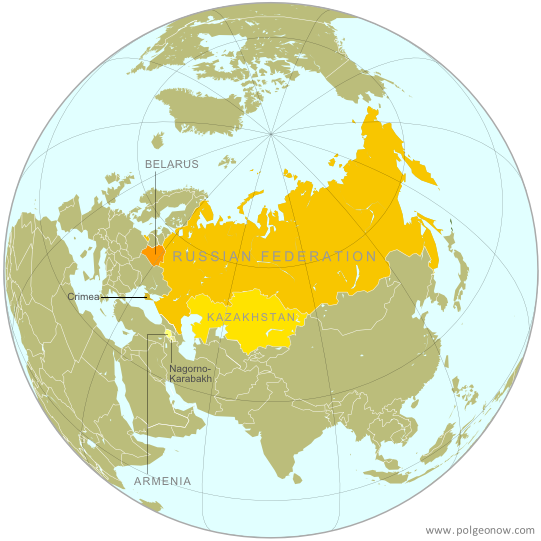
Map of the Eurasian Economic Union (EEU), also known as the Eurasian Union. Includes new member Armenia, as well as prior members Russia, Belarus, and Kazakhstan, and disputed territories Crimea and Nagorno-Karabakh.
The Eurasian Economic Union’s four member countries, plus disputed territories that might be officially or unofficially included. Map by Evan Centanni, starting from this map by Keverich2. License: CC BY-SA

Premium members click here to view this article in the ad-free members area. Not a member yet? Subscribe now!

Article by Evan Centanni

Armenia Joins Eurasian Economic Union
The Eurasian Economic Union (EEU), widely seen as a Russian-led answer to the European Union (EU), just welcomed its fourth member country. Armenia, a small former Soviet republic in the Caucasus region of Western Asia, joined Russia, Belarus, and Kazakhstan in the trade bloc after signing the organization’s founding treaty last Friday, October 10. However, the EEU, which will unite the four member countries’ economies into a single cooperatively-managed entity, doesn’t officially go into effect until New Year’s Day (January 1, 2015).

Flag of ArmeniaCountry Name:  
• Armenia (English)
• Hayastan (Armenian) 
Official Name:  
• Republic of Armenia (English) 
• Hayastani Hanrapetutyun (Armenian)
Capital: Yerevan

What is the “Eurasian Union”?
Though sometimes called just the “Eurasian Union”, the EEU is for now strictly economic in nature. Russia has shown interest in eventually expanding it into a political union to match the EU – however, that path is unpopular with fellow founding member Kazakhstan, which sees political union as a threat to the independence it gained after the breakup of the Soviet Union in 1991.

The economic union hopes to increase trade and lower prices by establishing a “Single Economic Space,” where goods, services, money, and people can all move freely from country to country without the obstruction of borders or import taxes. Industrial development, agriculture, and transportation will also be managed cooperatively, and people from one country will be able to live and work in any of the other countries without a visa.

What’s the difference: Eurasian Economic Union, EURASEC, and the Customs Union
Though the EEU has not yet gone into effect, Russia, Belarus, and Kazakhstan are already united in an organization called “the Customs Union“. This union partially combines the countries’ economies by replacing customs checks along their mutual borders with a unified customs policy for all imports coming into the three-country bloc. Armenia is apparently still not a member of the Customs Union, though the issue will presumably become moot on January 1, when the Customs Union is replaced with the new EEU.

The EEU is not the same thing as the Eurasian Economic Community (EURASEC), an earlier attempt at economic integration among former Soviet countries. EURASEC includes more countries than the EEU, but its members’ economies are not closely unified. The EEU in many ways grew out of the broader organization, and the member countries have agreed to dissolve EURASEC once the EEU comes into force on January 1, 2015.

Armenia’s Path to Membership
Armenia had originally sought to join the Customs Union this past spring, in advance of the EEU treaty coming into effect. However, its membership has been repeatedly delayed. Many suspect this was because of disagreements with the current Customs Union member countries over the Nagorno-Karabakh Republic, an Armenian-backed breakaway state that the rest of the world considers to be part of the neighboring ex-Soviet country of Azerbaijan. Even Armenia doesn’t officially recognize Nagorno-Karabakh, which declared independence in 1991, but makes no secret of being the breakaway state’s main supporter.

Map of the breakaway Nagorno-Karabakh Republic relative to Armenia and Azerbaijan
The breakaway Nagorno-Karabakh Republic (NKR)
Orange: Former NK Autonomous region in USSR
White: Current NKR territorial control
(public domain map by VartanM and Kmusser; source)

Because Armenia doesn’t maintain any border checks along its boundary with Nagorno-Karabakh, questions have been raised about whether the disputed territory will become an unofficial part of the EEU along with Armenia. With the other EEU members insisting Nagorno-Karabakh can’t be part of the union, and Armenia insisting it won’t set up border checks, it’s unclear how this issue will be resolved.

Meanwhile, another disputed territory will almost certainly be treated as part of the EEU, and officially at that. Crimea, recognized by the rest of the world as part of Ukraine, came under Russian control after a hostile takeover earlier this year. Since Russia, the most powerful member of the new EEU, considers Crimea a legitimate part of its territory, it seems unlikely the region will be excluded in any way from the new economic union.

Graphic of the Armenian flag is in the public domain (source).

Map Update: Kosovo Recognized by 3 More Countries in 2014 (106/193)

Premium members click here to view this article in the ad-free members area. Not a member yet? Subscribe now!

Map of countries that recognize the Republic of Kosovo as an independent state, updated for July 2014, with most recent additions (Togo, Tonga, Lesotho) and disputed recognitions highlighted
Countries recognizing the Republic of Kosovo in green, highlighting recent additions. Disputed recognitions in yellow. Kosovo in magenta. Map by Evan Centanni, modified from public domain graphic (source).

Flag of the Republic of KosovoCountry Name:  
• Kosovo (English, Serbian)
• Kosova (Albanian)
Official Name:  
Republic of Kosovo (English)
Republika e Kosovës (Albanian)
Republika Kosovo (Serbian)
Capital: Pristina/Prishtina

By Caleb Centanni

Kosovo Recognition Continues Growing
Over the last six months, three new countries have extended diplomatic recognition to the self-proclaimed Republic of Kosovo. The breakaway state, located in the Balkan Region of Southeastern Europe, is now recognized by at least 106 U.N. member nations (about 55%). Kosovo’s government claims recognition from 107 U.N. members, but one of these has been called into question (see “Disputed Recognitions” below).

The three new states which have recognized Kosovo are Tonga, in January; Lesotho, in February; and Togo, on July 2nd. Tonga is a Pacific Island state, Togo is a small country located in West Africa, and Lesotho is an enclave surrounded by South Africa. None of these countries’ governments appear to have confirmed their recognitions, with the information coming only from Kosovo’s foreign ministry. However, so far none of them has disputed Kosovo’s claims.

The Republic of Kosovo declared independence from Serbia in 2008, but has been blocked from U.N. membership by objections from Serbia, Russia, and other countries who see its secession as invalid. In addition to the 106 U.N. members recognizing Kosovo, its independence is also acknowledged by non-U.N. member Taiwan. For more on Kosovo’s special situation, see our first Kosovo recognition report, which also includes a map of Kosovo’s location relative to Serbia.

Disputed Recognitions
The African Island nation of São Tomé and Príncipe announced its recognition of Kosovo on March 13, 2012. However, on January 7, 2013, the President of the small country declared the recognition invalid on the grounds that he had not been informed of the decision. Despite this, Kosovo still maintains that the recognition is valid. Political Geography Now has chosen not to include São Tomé and Príncipe in its tallies of recognition until the dispute has been resolved.

In addition to this, Kosovo has previously claimed that two other African countries, Nigeria and Uganda, recognized its independence. However, Nigeria clearly stated in March that it did not recognize the breakaway state, and Kosovo’s foreign ministry recently included Uganda in a discussion of nations that “have not yet recognized Kosovo”, also indicating that there are only 107 U.N. members currently recognizing the country. Despite this, the ministry’s website has still not dropped Nigeria and Uganda from its list of “Countries that have recognized the Republic of Kosova”.

Stay Up to Date: Check for further news and map updates related to Kosovo’s recognition by viewing all Kosovo articles on Political Geography Now.

Related Articles:
Kosovo Recognition Map Update: October 2013
North Kosovo Status Changing After Serbia Deal
Who Recognizes Palestine in 2013?
 
Flag graphic by Cradel (source). License: CC BY-SA

Palestine: West Bank and Gaza Reunited Under Transitional Government

(Keep up with changes to Palestine’s situation: view all Palestine updates.)

Map of the State of Palestine in the West Bank and Gaza Strip, including both its claimed borders (the Green Line) and zones of actual control (Areas A, B, and C from the Oslo Accords)
Control zones based on the Oslo Accords. Area A: Palestinian control; Area B: mixed Israeli-Palestinian control; Area C: full Israeli control. Map by Evan Centanni (sources: Natural Earth, B’Tselem, U.N. OCHA oPt).

Premium members click here to view this article in the ad-free members area. Not a member yet? Subscribe now!

By Evan Centanni

Unity Government
The partially-unrecognized State of Palestine is not only divided between Palestinian and Israel control – even the Palestinian-administered areas have been governed separately for several years now. However, this month rival parties Hamas and Fatah have finally come together to reunite the West Bank and Gaza Strip under a single Palestinian government.

Divided Country
The rift in control opened up in 2007, after religious militant group Hamas won a majority of seats in the 2006 Palestinian legislative elections. Hamas and Fatah, the current ruling party at the time, failed to form a stable unity government then, and the conflict between them escalated into a short civil war in the Gaza Strip. 

See Also: Is Palestine Really a Country?

The fighting ended with Hamas expelling Fatah’s administration from Gaza, while Fatah in turn refused to seat Hamas members to the government in Ramallah. This standoff has persisted for nearly seven years, with the West Bank and Gaza controlled separately by the two rival parties. Though both parties supported Palestine’s successful bid for recognition in the UN, the two regions have been administered completely separately since 2007.

Flag of the State of Palestine Country Name:  
• Palestine (English)
Filasṭīn (Arabic)
Official Name:  
• State of Palestine (English)
• Dawlat Filasṭin (Arabic)
Capital: 
• Jerusalem (claimed)
Ramallah (administrative)

Reunification
One week ago, Hamas and Fatah finally came together to form a Palestinian Authority (PA) government that includes both parties. This new administration will have jurisdiction over both the Gaza Strip and Palestinian-controlled areas of the West Bank, making it responsible for domestic affairs all across the claimed State of Palestine. Foreign relations (and relations with Israel) are handled instead by the Palestinian Liberation Organization (PLO), which has been around since before the PA was created in the 1990s by the Oslo Accords.

The current agreement also does not cover whether PA security forces will be allowed into Gaza, whose security has been handled directly by Hamas since 2007. So for the time being, the two areas may remain separate in at least that regard.

Palestine’s new unity administration is facing strong opposition from the Israeli government (which refuses to negotiate with Hamas), but has gained acceptance by much of the world. The UN, the European Union (EU), and China have all signaled their willingness to work with the new PA administration. Even the US has come on board, despite having rejected Hamas’s 2006 election victory. Because of its hardline ideology and ongoing violence against Israel, Hamas is classified as a terrorist organization by the US government, as well as by the EU.

Joining Treaties
These events come on the tail of another development in Palestine’s political status: its entry into 15 international treaties this April. The action was taken by Mahmoud Abbas, who serves as both the President of Palestine and chairman of the PLO. Palestine’s applications to these treaties have already been accepted by the UN (which considers Palestine to be a non-member “Observer State” like Vatican City), and most of them were set to go into effect in May.

Related:
Is Palestine Really a Country?
Which Countries Recognize Palestine as Independent?
Palestine Recognized as a Country by the UN

Flag of the State of Palestine is in the public domain (source).