Kosovo Diplomatic Recognition Continues

Country Name: Kosovo (English, Serbian), Kosova (Albanian)
Official Name: Republic of Kosovo (English), Republika e Kosovës (Albanian),
Republika Kosovo (Serbian)
News Categories: Recognition, Partially Recognized States, Breakaway States
Summary: The Republic of Kosovo has continued to receive diplomatic recognition from other countries, despite widespread opposition to its 2008 declaration of independence from Serbia. Thirteen more U.N. members have declared their recognition of independent Kosovo just within the last year.

Flag of the Republic of Kosovo
Flag of the Republic of Kosovo.
Image by Cradel (source). License: CC BY-SA

Full Story
The majority of recently independent countries, such as South Sudan and Montenegro, enjoy unopposed recognition from the U.N. and its members. However, acceptance into the international community doesn’t always come so easily. Kosovo is one example: because it declared its independence without first coming to an agreement with its former host country (unlike South Sudan and Montenegro), it has struggled to gain acceptance as a sovereign state. The last of the Balkan countries to declare independence after the breakup of Yugoslavia in the 1990s, Kosovo was first separated unofficially from the country in 1999, when NATO intervened militarily in the province to stop Serbian government violence against ethnic Albanians. The Albanians are a cultural group from southeastern Europe who speak a unique language only distantly related to other European tongues, and like the Bosniaks in nearby Bosnia & Herzegovia, are one of the few majority-Muslim European peoples. They also form a majority of the population in the neighboring country of Albania.
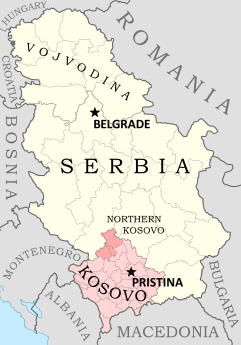
Map of Kosovo within Serbia
Kosovo, claimed as a province of Serbia, is
policed by U.N. and E.U. peacekeepers. The
Republic of Kosovo also governs the region,
except for the Serbian-loyalist north. Map is
my own work, based on these two blank
maps by Nord-NordWest. License: CC BY-SA

Policed by a U.N. peacekeeping mission since 1999, most of Kosovo has never since been controlled by the Yugoslav (now Serbian) government, though the U.N. still officially considers it to be a province of Serbia. Despite fierce political opposition from Serbia, Russia, and other countries, as well as from the ethnic Serb minority within Kosovo, the local government declared independence in 2008. The self-proclaimed Republic of Kosovo government has since administered the territory alongside the U.N. and another police force sent by the European Union, though the Northern Kosovo area, a Serb-majority region, has resisted independence and continues to support the Serbian government in Belgrade, even setting up roadblocks to keep out the Kosovan police – a sort of breakaway state within a breakaway state.

The Republic of Kosovo has not been admitted into the U.N., and it is recognized by only 88 U.N. member countries (many of them NATO members or countries with Muslim populations) and one other state (Taiwan). Serbia and Russia still strongly oppose independence for Kosovo, but the list of states recognizing its sovereignty has nevertheless continued to grow. Within the last year, 13 more U.N. members have offered diplomatic recognition of Kosovan independence: Andorra, the Central African Republic, Guinea, Niger, Benin, Saint Lucia, Nigeria, Gabon, Ivory Coast, Kuwait, Uganda, Ghana, and Haiti.

Map of countries recognizing the Republic of Kosovo
Diplomatic recognition of the Republic of Kosovo. Countries that recognized Kosovan independence recently (in the last twelve months) in light green, others in dark green; Kosovo in magenta. Public domain (source).

Sources: See citations on Wikipedia’s list of Entities that recognize Kosovo as an independent state.

States Recognize Palestine Ahead of U.N. Bid

Country Name: Palestine (English), Filastin (Arabic)
Official Name: State of Palestine (English), Dawlat Filastin (Arabic)
News Category: Partially Recognized States, Diplomatic Recognition
Summary: The Palestinian Liberation Organization, which claims sovereignty over the disputed territories of the West Bank and Gaza Strip as the State of Palestine, will apply for U.N. membership this week. Meanwhile, the total number of countries recognizing Palestinian independence has grown sharply in the lead-up to the U.N. bid.

The Palestinian Territories. Area A: Full Palestinian Control
(on the ground); Area B: Joint Palestinian-Israeli Control;
Area C: Full Israeli Control. Israeli government considers
the green areas “disputed territory”. Map is my own work.
Sources: Natural Earth, B’Tselem, U.N. OCHA oPt, others.

Full Story
Palestine is a unique case within the nation-state system. It is recognized as an independent state by more than half of the world’s countries, but not by the U.N. itself or by any major Western powers. It indirectly administers much of its claimed territories, yet exercises full sovereign control over none of them. At the heart of one of the world’s most intractable conflicts, it is perhaps the most controversial topic in international politics. The coming weeks could see significant changes to the political status of the Palestinian Territories on the world stage.


The Palestinian Territories are made up of the West Bank and the Gaza Strip, two regions previously controlled by Jordan and Egypt respectively, which were captured by Israel in the Six Day War of 1967. Israel has never fully relinquished control, and Egypt and Jordan eventually gave up their claims to the regions, leaving them in an unusual political situation. Despite widespread calls for independence based on a 1947 U.N. partition plan, Israel refuses to refer to them as anything other than “disputed territories” until negotiations determine their final status. Some of the land within the territories is now administered by the Palestinians, though much of it is still ruled by the Israeli military, which also controls all associated airspace and territorial waters.

Wikipedia: History of the Israeli-Palestinian Conflict 

This week, Mahmoud Abbas, chairman of the Palestinian Liberation Organization (PLO), will formally request full membership for the State of Palestine in the United Nations. The PLO declared independence in 1988, and has enjoyed a degree of support from the U.N. General Assembly, but currently only holds observer status in the organization, which pointedly labels it as a “non-state entity”. Palestinian membership in the U.N. is likely to be vetoed by the U.S., which holds a permanent seat in the U.N. Security Council. However, Palestine may still achieve “state observer” status by a majority vote in the General Assembly, which would elevate it to the same level as the Holy See (Vatican City): a U.N.-recognized state with legal rights.

Countries recognizing the State of Palestine. Recent additions (in the last year) indicated in lighter color.
Modified from this map by Alinor at en.wikipedia (license: CC BY-SA).

Though 90 U.N. members recognized Palestine during the first year after its declaration, the number grew little over the next 15 years. However, since the campaign for U.N. membership began a few years ago, recognition has risen sharply. The State of Palestine is now recognized by 126 U.N. members – nearly two-thirds of the world body – 17 of which have announced their recognition just in the last year. This summer alone has seen six new additions: Syria, Liberia, El Salvador, Honduras, St. Vincent and the Grenadines, and Belize. Palestine’s independence is also endorsed by Western Sahara, a partially-recognized state without U.N. membership.

Chart over time of total U.N. members recognizing the State of Palestine. My own work (source).


Wikipedia:
State of Palestine, Palestinian Territories, International Recognition of the State of Palestine

Abkhazia Recognized by Vanuatu

Country Name: Abkhazia (English), Apsny (Abkhaz), Abkhaziya (Russian)
Official Name: Republic of Abkhazia
News Category: Partially Recognized States, Diplomatic Recognition
Summary: The disputed breakaway state of Abkhazia has gained diplomatic recognition from Vanuatu, the fifth U.N. member to acknowledge its independence from Georgia.

Abkhazia (purple stripes) and South Ossetia (gold stripes), and their
claimed location within Georgia. Wikimedia map by Ssolbergj (CC BY-SA).

Full Story
The Republic of Abkhazia is one of seven states in the world which are recognized by some U.N. members, but not by the U.N. as a whole. Located in the Caucasus region on the border between Europe and Asia, Abkhazia is considered part of Georgia by most U.N. members; however, it has enjoyed de facto independence since winning a war of secession against the larger country in 1993. It has shared much of its fate with South Ossetia, another breakaway state which also seceded from Georgia around the same time. Abkhazia and South Ossetia passed their first decade and a half of independence without the recognition of any U.N. members. That changed after a 2008 war in which Georgia attempted to take back the two breakaway states by force, and was repelled by Russian forces. In the aftermath of the war, both Abkhazia and South Ossetia received diplomatic recognition from Russia, as well as from the Central American Republic of Nicaragua. The next year, South America’s Venezuela and the Pacific island country of Nauru followed suit. The two breakaway republics are also recognized by each other and at least two other non-U.N. member states.

U.N. members recognizing Abkhazia shown in green. Vanuatu circled in green, Abkhazia circled in pink.
Modified from this map by Wikimedia user NuclearVacuum (license: CC BY-SA).

This summer, Abkhazia received recognition from a fifth U.N. member, the Republic of Vanuatu. For the first time, South Ossetia was not recognized along with Abkhazia. Vanuatu is a Pacific island country of a quarter-million people, formerly known as the New Hebrides, which won independence from Britain and France in 1980. Vanuatu’s recognition of Abkhazia this year was accompanied by a great deal of confusion. Negotiated in secret between the two states, the recognition agreement was first announced to the public at the end of May. However, government officials in Vanuatu gave differing reports on whether or not the agreement existed, with confirmation finally coming on June 7. Making things even more complicated, Vanuatu’s temporary prime minister withdrew recognition of Abkhazia on June 19, but it was reinstated on July 12 after the return of the permanent head of government.

Wikipedia: Abkhazia, Vanuatu, International Recognition of Abkhazia & South Ossetia