Syrian Civil War Map & Timeline: Kurds Enter “Islamic State” Capital – June 2017

There are newer versions of this map available. To see them, view all Syria updates.
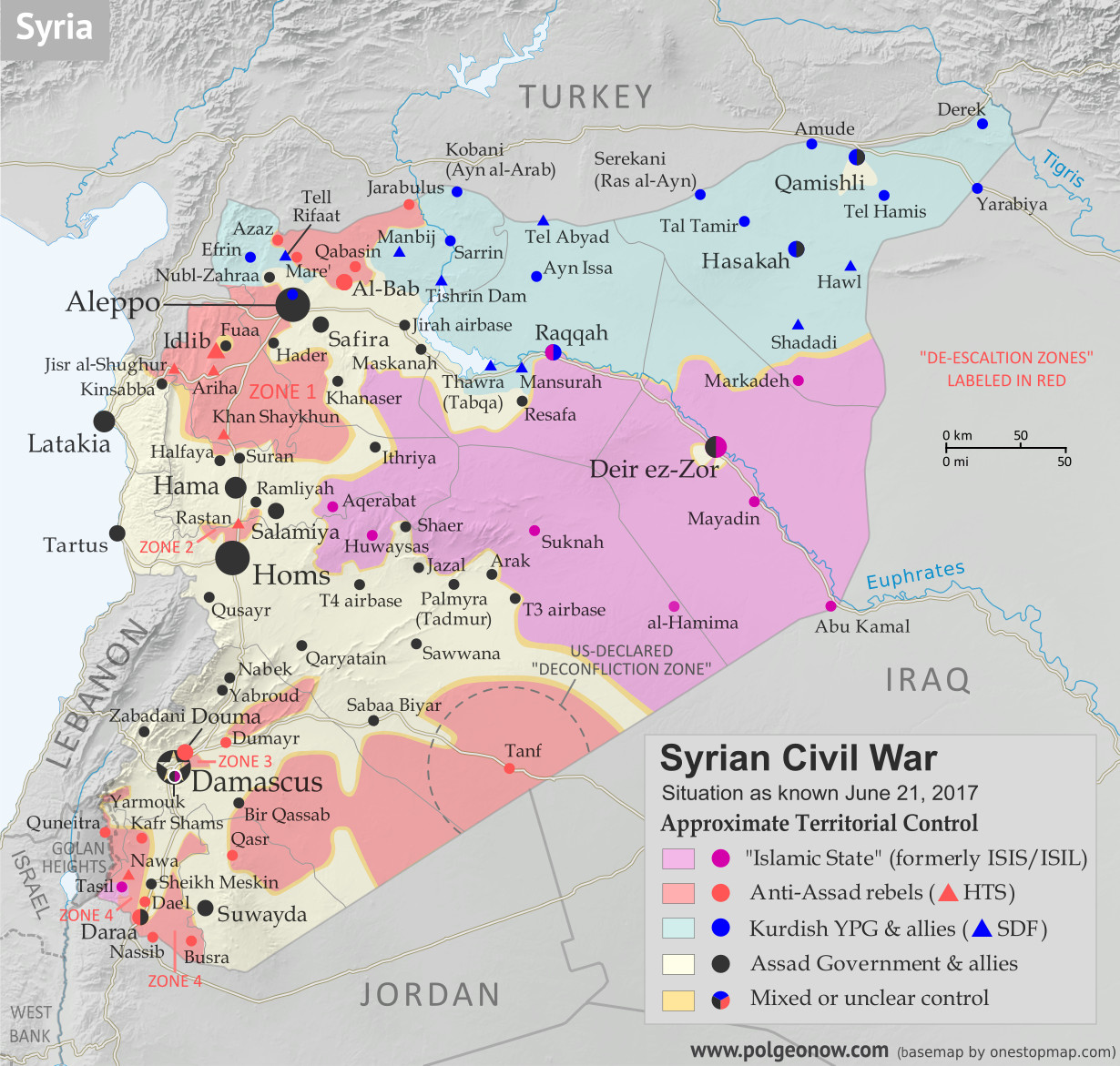
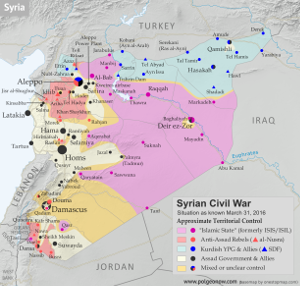
Map of Syrian Civil War (Syria control map): Fighting and territorial control in Syria in June 2017 (Free Syrian Army rebels, Kurdish YPG, Syrian Democratic Forces (SDF), Jabhat Fateh al-Sham / Hayat Tahrir al-Sham (Al-Nusra Front), Islamic State (ISIS/ISIL), and others). Includes Russia-Turkey-Iran agreed de-escalation zones and US deconfliction zone. Includes recent locations of conflict and territorial control changes, such as Raqqah, Maskanah, Arak, Tanf, Sabaa Biyar, Bir Qassab, and more. Colorblind accessible.
Base map by Koen Adams of onestopmap.com, with territorial control by Evan Centanni and Djordje Djukic.
All rights reserved.

(Subscribers click here to view this article in the member area.)

Timeline by Djordje Djukic

Syria: Where Things Stand Now

In the four weeks since our previous Syrian Civil War map report, the US-backed, Kurdish-led Syrian Democratic Forces (SDF) have advanced all the way into Raqqah, capital city of the so-called “Islamic State” (IS; formerly ISIS/ISIL). Meanwhile, Syrian government forces have also been pushing hard against IS, nearing Raqqah themselves, while making even more major advances in the southern desert. Clashes between rebels and government forces have also continued across Syria’s south, even as the US enforces a rebel safe zone around its base in Tanf.

Political geography milestones in the last month include the Syrian government’s reestablishment of a border with Iraq (entirely controled IS, Kurdish forces, and rebels since 2015); Syrian rebels’ loss of their last border with IS, near Tanf; and the first time in a year that the government has controlled any of Raqqah province.
Flag of Syria under the current governmentCountry Name:  
• Syria (English)
• Sūriyya/Sūryā (Arabic)
Official Name:  
• Syrian Arab Republic (English)
• al-Jumhūriyyah al-‘Arabīyah  as-Sūriyyah (Arabic)
Capital: Damascus

Note: Red triangles on the map represent towns where rebel group Hayat Tahrir al-Sham (HTS) – formerly known as Al Qaeda affiliate Jabhat al-Nusra (a.k.a. the Nusra Front), and later Jabhat Fateh al-Sham (JFS) – is thought to be in a dominant position among rebel forces, even if it doesn’t exercise exclusive control. This organization has some presence in almost every rebel-held area in Syria.

Timeline of Events
The following is a timeline of changes to territorial control and other key events in Syria since our previous map update of May 25, 2017. Sources are provided as in-line links.

May 26, 2017
The Syrian Army seized a village three kilometers west of IS-held Maskanah, between Aleppo and Raqqah.

May 27, 2017
Government forces captured 13 villages along the eastern bank of a lake in Aleppo province, coming within 1.5 kilometers of the western entrance to Maskanah. Meanwhile, the army captured a town south of Sawwana, in the southern desert.

May 28, 2017
The army captured a village on Maskanah’s northern flank.

May 29, 2017
The last batch of rebels and family members left the Barzeh neighborhood of Damascus, leaving it entirely under government control.

May 30, 2017
The army advanced against US-backed rebels southeast of Sawwana.

May 30-31, 2017
The Kurdish-led, US-backed Syrian Democratic Forces (SDF) advanced to within three kilometers of IS capital Raqqah, reaching the city’s northern entrance. The next day, the SDF besieged the town of Mansurah and one more village between Thawra and Raqqah, after capturing several nearby villages.

May 31, 2017
Rebels broke through pro-government militias’ first line of defense near a government-held junction in the Sabaa Biyar area (west of Tanf in the southern desert). However, the rebel advance on the junction was subsequently halted by Russian airstrikes. Meanwhile, the army launched an offensive towards IS-held Aqerabat east of Hama, reportedly capturing several villages.

June 2, 2017
The SDF launched an assault on the besieged IS-held town of Mansurah, just west of Raqqah, capturing it later in the day.

June 2-4, 2017
The Syrian Army seized over a dozen villages south and southwest of Maskanah, cutting off IS’s main supply route between Maskanah and Raqqah. The next day, Maskanah was surrounded, and on June 4 it was captured by government troops. The army also secured its own main supply route to and from Khanaser. These advances brought the army to Raqqah’s provincial border.

June 3, 2017

The army made advances against rebels north of Hama. This was followed by a rebel counterattack attempting to regain control of the lost positions. The army also made a push towards IS-held Arak and Suknah, in the southern desert near Palmyra, capturing several hilltops along the highway.

June 3-4, 2017
Government forces hit rebel-held parts of Daraa city with air and artillery strikes following a rebel attack on government positions in the city’s Manshiyah district. At least 31 fighters on both sides were killed in the fighting, with the fatalities divided nearly evenly between the two sides. Meanwhile, IS made advances against government forces near the eastern city of Deir ez-Zor, capturing a roundabout south of the city. Fighting continued for control of two hilltops near the southern city’s entrance.

June 4-5, 2017
The SDF seized a dam near Raqqah. The next day, it proceeded to capture six villages north and northwest of the city, tightening the siege of the IS capital. In all, over the previous week, the SDF had taken control of about 350 square kilometers from IS.

June 5-6, 2017
Government forces reportedly seized several positions east of Salamiya.

June 6, 2017
The US-led coalition conducted airstrikes against a force of 60 pro-government fighters who entered the US-declared “deconfliction zone” centered on the rebel-held town of Tanf, near the Iraqi and Jordanian borders. Two self-propelled howitzers and a self-propelled anti-aircraft gun were destroyed, while a tank was damaged. Pro-government sources reported two soldiers were killed, while other reports said between 10 and 32 government troops died in the attack. Despite the strikes, the pro-government forces remained in place within the zone.

Meanwhile, government forces took control of a hill in the eastern countryside of Damascus, near Dumayr. Elsewhere, government troops captured six villages on the provincial border of Aleppo and Raqqah while attempting to link up with the SDF near Thawra. Two of the villages were on Raqqah’s side of the boundary, marking the first time in a year that the Syrian Army had entered the province.

June 6-17, 2017
The SDF started its assault on the IS capital city of Raqqah. The US-backed forces attacked the al-Mashlab district on the city’s eastern edge, as well as a military base around one kilometer north of the city center. The next day, the SDF captured a village and the ruins of a more than 1,000-year-old fortress west of Raqqah, reaching the city’s western outskirts.

By June 13, the military base and four neighborhoods were captured by the SDF, including al-Mashlab, Romaniah, al-Sinaa and Hattin. Additionally, the SDF seized parts of the western Jazrah suburb and all or at least half of the western al-Sabahia district. In the first eleven days of the battle, 117 civilians were killed in US-led coalition airstrikes and SDF artillery shelling, while between 142 and 312 IS fighters, as well as at least 15 SDF fighters, also died.

June 7, 2017
In the southern desert, the army seized several hills around Arak, as well as reportedly an area 25 kilometers east of Sawwana. Meanwhile, the SDF captured a village west of Thawra.

June 8, 2017
The Syrian Army captured a hilltop from rebels southeast of Damascus, while the US-led coalition bombed government forces once again near the Iraqi border, destroying two technical fighting vehicles. The US also shot down a pro-government drone that was bombing rebel forces near Tanf. Meanwhile, the army advanced further southeast of Palmyra against IS, while IS withdrew from 20 villages west of Raqqah ahead of a government advance into the area. Elsewhere, government troops reportedly captured a town in the besieged rebel-held East Ghouta pocket, in the eastern suburbs of Damascus.
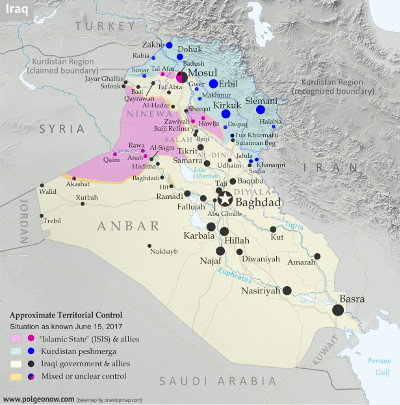
Iraq: Map of IS and Kurdish Control in June 2017

June 9, 2017
Pro-government forces reached the Iraqi border for the first time since 2015, after going around Tanf and positioning themselves around 70 kilometers northeast of the border crossing. The Syrian Army reportedly met the Iraqi Army on the border. Meanwhile, rebels counter-attacked in the area they had lost the previous day southeast of Damascus, and managed to advance. Elsewhere, pro-government forces captured an area southeast of Palmyra, reaching a strategic crossroad.

June 11, 2017
The army reached the outskirts of Arak and advanced towards Suknah, a remote desert town on the way from Palmyra to Deir ez-Zor. Meanwhile, Jordanian border guards shot and killed five people who were approaching the border from the Tanf area in Syria. The targeted people’s vehicles were also destroyed. The pro-Syrian government Al-Masdar News reported that the five dead were “Free Syrian Army” (FSA) rebels who were trying to avoid government forces. Elsewhere, rebel infighting erupted in the northern town of Al-Bab, leaving between 27 and 31 rebels dead or wounded.

June 12, 2017
The army advanced in Daraa city, capturing 25 to 50 percent of the rebel-held Daraa Refugee Camp neighborhood amid vicious fighting. Meanwhile, pro-government forces advanced to a second location along the border with Iraq.

June 13, 2017

The Syrian Army advanced against IS in the desert west of Raqqah, capturing nine villages and reaching the Ithriya-Thawra highway. This left government forces about 40 kilometers from besieging the remaining IS-held villages in the southeast of Aleppo province, as well as some in Raqqah province. The advance would relieve IS pressure on the government’s main supply route for Aleppo, which runs through Ithriya and Khanaser. Meanwhile, an army attack on the IS-held T3 airbase was repelled, but government forces still reportedly managed to advance in a nearby area.

Elsewhere, the SDF attacked and captured several mountain positions overlooking a rebel-held town on the provincial border of Idlib and Aleppo. A subsequent rebel counterattack regained all lost positions, but as the rebels advanced they were ambushed by the SDF, suffering heavy casualties. Some 36 rebels were killed in the fighting; it was initially reported that 19 SDF fighters had also died, but later reports confirmed that only one YPG fighter from the SDF was killed (the YPG is a Kurdish “self-defense” militia that makes up the biggest member force of the SDF).

June 14, 2017
The US deployed its HIMARS missile system near the southern town of Tanf.

June 14-15, 2017
East of Palmyra, the army captured Arak, including its oil fields, as well as the T3 airbase, advancing towards Suknah. The next day, its forces were within 25 kilometers of the town.

June 14-19, 2017
Southwest of Thawra, the Syrian Army seized an oil field, while the SDF captured several villages. Two days later, the army once again advanced, taking control of more villages and oil fields. On June 17, the army captured 14 villages and hills in the area, closing in on the IS stronghold of Resafa and its nearby road junction. Concurrently, the SDF seized two villages south of Raqqah.

The next day, the Syrian Army and the SDF were in a race to reach Resafa, with the SDF capturing a district north of the town, while the army managed to reach Resafa’s outskirts. The army alleged that the US-led coalition downed a Syrian fighter plane bombing IS positions near Resafa. According to the coalition, Syrian government forces attacked an SDF-held town south of Thawra, driving the SDF from the town, after which a coalition show of force stopped the initial government advance towards it. But later, the coalition said, a Syrian Air Force fighter jet dropped bombs near SDF fighters, after which it was shot down by the coalition.

In response to the downing of the Syrian jet, Russia announced that all aircraft from the US-led coalition would be “tracked…and treated as targets” any time they crossed west of the Euphrates River. The US military said it was repositioning its planes for safety, and Australia suspended air missions in Syria.

On June 19, Resafa was captured by the Syrian Army, while the SDF seized the closest village north of the town, about four kilometers away.

June 16-18, 2017
Government forces captured a hill east of Salamiya. Two days later, the army captured four villages north of Aqerabat.

June 17, 2017
A 48-hour ceasefire was declared by the army in southwestern Syria’s Daraa city.

June 18, 2017
Reportedly for the first time since 2015, the Syrian Army and Iraqi government forces met on the border of the two countries, following advances by Iraqi forces against IS. Meanwhile, the rebels captured about half of a town in the southern countryside of Hama province, but subsequently withdrew due to heavy airstrikes and artillery shelling.

June 19, 2017

The SDF captured the al-Baitara district of Raqqah city.

June 20, 2017
Following the conclusion of the ceasefire in Daraa, government forces resumed their attacks on rebel-held areas of the city, managing to push into some, as well as to advance in Daraa’s western outskirts. Their capture of a former air defence base there apparently split rebel territory in the region in two, but later in the day the rebels recaptured the base.

Elsewhere, the army attacked the rebel-held Bir Qassab area, about 75 kilometers southeast of Damascus, and captured it. The same day, the US-led coalition shot down a second Syrian government-affiliated drone that was just outside the Tanf “deconfliction zone”, but within firing range of the coalition base. Meanwhile, the SDF captured an area on the southern outskirts of Raqqah, coming close to fully surrounding the city.

June 21, 2017
Recently-elected French president Emmanuel Macron stated that he saw no legitimate successor to Syrian President Bashar al-Assad and that France no longer considered his removal a pre-condition to resolving the conflict in Syria. According to him, the priority was “a complete fight against all the terrorist groups” and to ensure that Syria does not become a “failed state”. Meanwhile, the Syrian Army reportedly advanced against the rebels in two areas of Damascus’s eastern outskirts.

The same day, Turkey reportedly sent a large number of troops into Syria near Azaz to reinforce rebels in the area. Observers speculated that their purpose was to assist rebels in capturing the SDF-held town of Tell Rifaat. (Turkey considers the SDF’s leading YPG militia to be a branch of the Kurdish PKK rebel group that operates in Turkish territory.)

Graphic of the Syrian flag is in the public domain (source).
“Islamic State” in the Philippines? Detailed Control Map & Timeline of the Marawi Conflict

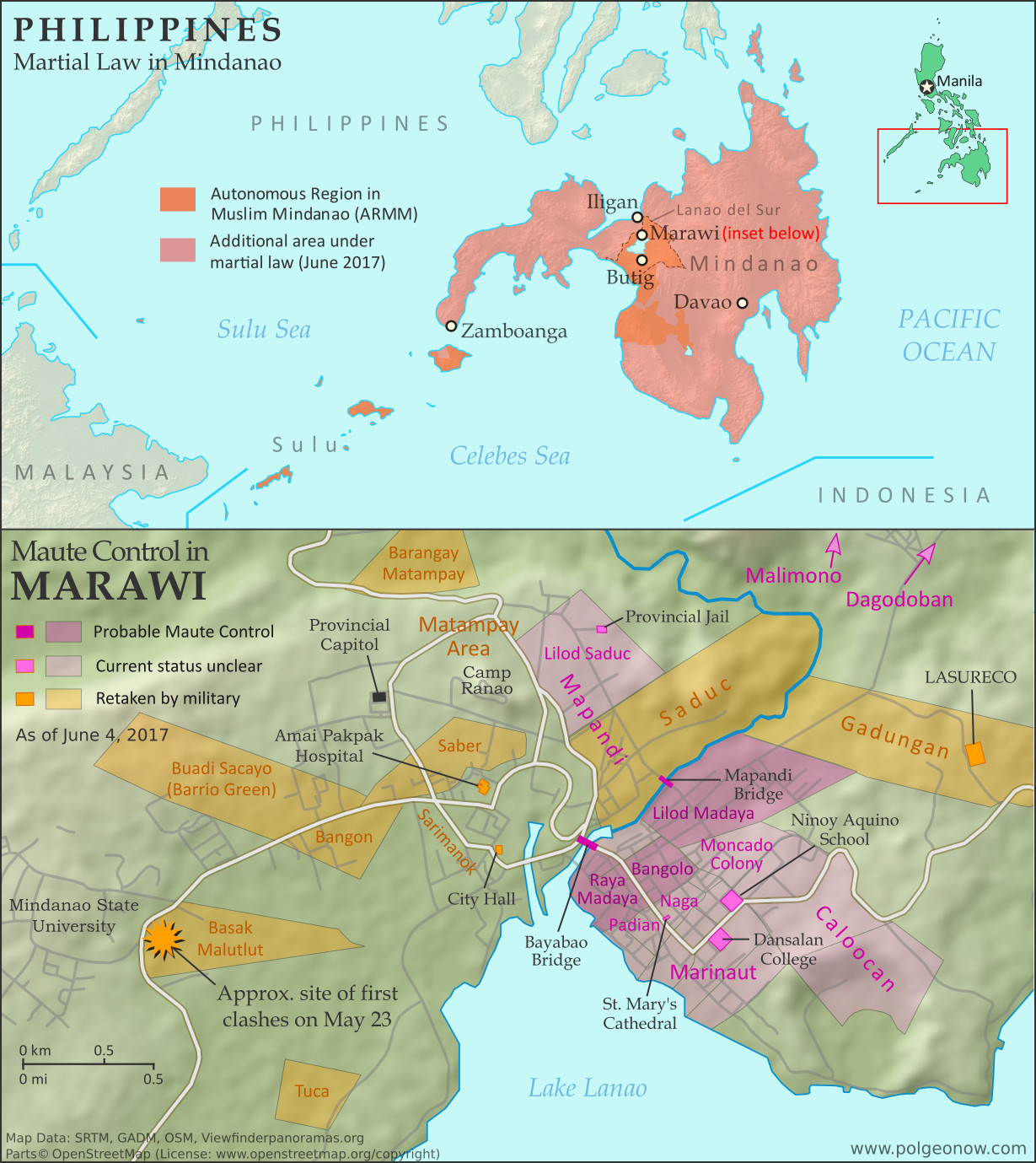
Map of so-called Islamic State (ISIS/ISIL) control in the Philippines, during the May-June 2017 crisis involving the Maute group and Abu Sayyaf takeover of Marawi Ciy, Lanao del Sur province, Mindanao. Updated to June 4, 2017, shows detailed control of Marawi by barangay. Includes map of area affected by martial law declared by President Rodrigo Duterte. Colorblind accessible.
Map by Evan Centanni. All rights reserved.

Article by Evan Centanni

(Subscribers click here to view this article in the members area.)

Rebellion in the Southern Philippines

For the past week and a half, headlines have chronicled an alleged new front in the war against the so-called “Islamic State” (IS; formerly ISIS/ISIL). A recently-formed armed organization known as the Maute group (after the family name of the two brothers who lead it) has launched a rebellion in Marawi, capital of Lanao del Sur province of the southern Philippines, apparently allying with elements of the older Abu Sayyaf organization to spread the vision of IS into southeast Asia. Marawi is a historic center for Muslim culture in the Philippines, and the largest city in the country’s partially self-governed Autonomous Region in Muslim Mindanao (ARMM).

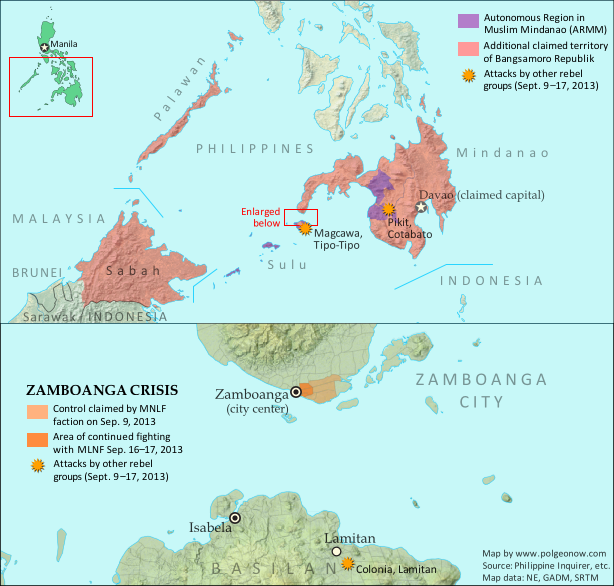
Map of territory in the Philippines and Malaysia claimed by the separatist Bangsamoro Republik, plus territorial control by the Moro National Liberation Front (MNFL) as part of the 2013 Zamboanga crisis.

The southern Philippines has a long tradition of rebellions led by members of the minority Moro ethnic group, whose main difference from the rest of Filipinos is that they’re Muslims rather than Christians. But different armed groups vary widely in their goals. Some, like the MNLF group that declared an independent “Bangsamoro Republik” in 2013, just want increased self-governance for the Moro people, without necessarily involving religion in government.

Others, like the Moro Islamic Liberation Front (MILF) – currently waiting for the Philippine government to approve a 2014 peace deal that would convert the ARMM into a more self-governed “Bangsamoro” region – are more religiously-oriented, but still support democracy.

Abu Sayyaf and the Maute group, on the other hand, are religious hardliners, who believe in the far-right ideologies of violent Salafi Muslim groups like Al Qaeda and IS. According to media in the Philippines, the Maute brothers call their organization “Dawlah Islamiyah” (Arabic for “Islamic State”), and have pledged allegiance to the leadership of the Islamic State organization in Iraq and Syria. Meanwhile, they appear to have been working closely with Isnilon Hapilon, a leader of Abu Sayyaf who IS claims as its top representative in the Philippines.

Martial Law in Mindanao

On the first day of the violence in Marawi, citing the attacks and alleged attempts at rebellion against the government of the Philippines, President Rodrigo Duterte declared martial law across the entire Mindanao island group (roughly the southern third of the country). The declaration allows for indefinite detention of suspects without trial, and will last for 60 days unless revoked or extended by the national legislature.

Flag of the PhilippinesCountry Name:  
• Philippines (English)
• Pilipinas (Filipino)
Official Name:  
• Republic of the Philippines (English)
• Republika ng Pilipinas (Filipino)
Capital: Manila

Former president Ferdinand Marcos controversially used martial law to maintain dictatorial powers across the Philippines for 8 years starting in 1972. However, the country’s current constitution, in addition to the time limits, also doesn’t allow for the courts or legislature to be overridden under martial law. This limited type of martial law declaration was also used by President Gloria Macapagal Arroyo for one week in 2009.

President Duterte himself grew up in the Mindanao region from a young age, and before his election as president served as longtime mayor of Davao, the largest city in Mindanao and second largest in the country after greater Manila. Some of Duterte’s ancestors were reportedly Muslims from the Marawi area.

Timeline of Maute Control

The following is a timeline of territorial control and other events related to the Marawi conflict. Sources are provided as in-line links. The accuracy and truthfulness of officially-available information has been called into question regarding these events, but PolGeoNow has done our best to consult a wide range of sources and provide as accurate a story as possible.

Note: The entire Philippines is divided into neighborhood/village-level administrative units known as “barangays”. Referencing these units is a useful way of tracking events on a very local scale, but because they’re very small, can change frequently, and aren’t well documented online, there’s often confusion over the exact locations and correct names of specific barangays. Because of this, references to barangays in the media and our timeline – as well as their status and locations on the above map – won’t always be 100% accurate.

November 24 – December 1, 2016
The Maute group seized control of the town of Butig, 50 km (30 mi) south of Marawi, until being driven out by the Philippine military after six days of fighting. The military estimated there were 61 Maute fighters killed in the episode and 12 injured, while 35 Philippine soldiers also sustained injuries.

May 23, 2017
Marawi City: Around 2pm at “the lower portion of the Mindanao State University Compound” in Barangay Basak Malutlut, clashes broke out between the Philippine military and fighters of the Maute group. The military had been attempting to arrest Isnilon Hapilon, a leader of the Abu Sayyaf armed group and reputed top representative of the so-called “Islamic State” (IS) in the Philippines.

By about 3pm, fighting broke out in the Caloocan neighborhood, near the Lanao del Sur provincial police command. According to early reports, during the afternoon Maute-affiliated fighters took over “Barangays Saber, Sarimanok, Mapandi, Amai Pakpak, the area near the provincial jail, [Basak] Malutlut, and Calookan [Caloocan]”. Later reports said the fighters had seized 11 barangays: Basak Malutlut, Bangon, Saber, Tuca, Bangolo, Naga, Moncado Colony, Caloocan, Marinaut, Mapandi, and Matampay.

A humanitarian organization reported that fighters raised a black flag, of the design used by the so-called “Islamic State” (IS; formerly ISIS/ISIL) and some Al Qaeda affiliates, at the Amai Pakpak Hospital. The hospital administration later denied that the facility had been taken over, while confirming it had been the site of a scuffle between Maute fighters and police.

Marawi City Jail, City Hall, the city’s main street, and two bridges were also reportedly occupied by the attackers, while St. Mary’s Cathedral was seized and its priest and 14 church workers taken hostage. Meanwhile, the city jail, a church, Ninoy Aquino School, and Dansalan College were set on fire. The fighters reportedly released 107 inmates from the city jail and neighboring Malabang District Jail. [Editor’s note: PolGeoNow was unable to confirm a map location for the Marawi City and Malabang District Jails, which appear to be different from the provincial jail.]

Residents said many of the fighters could not speak the local Maranao language, instead conversing in tongues native to the Sulu Islands, where Abu Sayyaf is known to operate. In addition, intelligence sources later estimated that up to 10 percent of pro-Maute combatants in Marawi were foreign fighters, mostly from Malaysia, Indonesia, and Singapore, but also including “at least one Pakistani, a Saudi, a Chechen, a Yemeni, an Indian, a Moroccan and one man with a Turkish passport.”

Thousands of Marawi residents fled the city to escape the violence, as ground troops in armored personnel carriers attempted to contain the Maute fighters, and airstrikes were conducted at the shore of Lake Lanao. Police reportedly closed down all entry and exit points to Iligan City, 40 km (25 mi)  to the north.

At 10pm, Philippine Presdient Rodrigo Duterte declared martial law in the Mindano island group, cutting short a visit to Russia so he could return to the Philippines.

May 24, 2017
Fighting reportedly reached a pause, as the military held its ground while awaiting reinforcements. A humanitarian spokesperson from the regional government said the conflict-affected neighborhoods were “Barangays Basak Malutlut, Caloocan, Abubakar, and Bangolo”. [Editor’s note: There does not appear to be any barangay called “Abubakar” in Marawi.]

Marawi’s police chief and another police official were killed in confrontations, while government agencies bused fleeing civilians to three new evacuation centers in Iligan City, and the Maute group threatened to behead the priest of St. Mary’s Cathedral if the military didn’t pull out of the city. The military reported that 13 Maute fighters and 5 Philippine soldiers had been killed since the beginning of the incident. The city of 200,000 was reportedly “like a ghost town” after tens of thousands of residents fled for safety, though 800 were sheltering within Marawi at the Lanao del Sur provincial capitol building.

May 25, 2017
Army tanks and assault helicopters entered Marawi, while residents said the Maute fighters looted and burned civilian homes. A military spokesperson said that Amai Pakpak Hospital, Marawi City Hall, and Mindanao State University had been cleared of Maute fighters.

The same day, fighting was reported from Barangays Malimono, Gadungan, Bangolo, and Marinaut. The military said the heaviest fighting occurred around two bridges in Barangay Bangolo, while elsewhere in the city Maute fighters attacked the Camp Ranao army base and occupied the LASURECO electric company headquarters. Airstrikes were conducted in Barangays Gadungan, Basak Malutlut, and Bangon. 

May 26, 2017
The military announced that the death toll in the Marawi conflict had increased to 31 Maute fighters and 11 Philippine soldiers, in addition to the two police officers killed on the 24th.

May 29, 2017
The government said it was “in full control of Barangays Matampay, Basak Malulut, Barrio Green, Bangon and Saduc, the peripheries of the Mindanao State University campus and the Amai Pakpak Hospital and the Matampay area.” Major fighting occurred in Marinaut and around the LASURECO compound. The military apparently prevailed at the latter location, rescuing several hostages, and also evacuated a number of civilians from Barangay Saber.

May 30, 2017
A week after the conflict began, the military said Maute group fighters were “still present” in nine barangays. Progress in retaking the rest of the city had been slowed by Maute snipers targeting soldiers from buildings under their control. Media quoted the death toll of the Marawi conflict at 20 “members of the security forces”, 61-64 Maute fighters, and 19-24 civilians, while the Red Cross estimated that 3,000 residents were still trapped in their homes. Meanwhile, the military admitted that Maute fighters had captured an armored personnel carrier – a type of tank.

A regional news report – dated June 2 but apparently referring to the situation as of May 30-31 – listed Mindanao State University, Matampay, Saber, and Basak Malutlut as “areas declared clear” by the military. Areas not yet “cleared” included “Banggolo, Raya Madaya I and II; Lilod Madaya, Dagodoban, Padian, Barrio Naga, Marinaut West and East; Caloocan, Pangarungan, and Moncado Colony”. [Editor’s note: “Pangarungan” seems to refer to the same area also known as Barangay Moncado Colony.] Barangays Banggolo, Raya Madaya I and II, and Marinaut were also reportedly inaccessible due to airstrike damage. Over 3,000 residents were estimated to still be trapped in their homes, even after the rescue of more than 2,300, who were brought to the provincial capitol.

May 31, 2017
According to eyewitness media accounts, the Mapandi and Bayabao bridges were still under Maute control after one week, with the group inferred to control much of the town center as well. Military accounts said Maute fighters controlled only 10% of the city, with 89 members of the group killed since the start of the conflict. One military source said the fighers were confined to just four barangays: Bangolo, Lilod Madaya, Raya Madaya I, and Raya Madaya II.

Hapilon and the two Maute brothers were believed to still be in Marawi. The Marawi City Jail and Malabang District jail were reported to still be under Maute control as well, with their staff trapped inside. The military’s fatality count for the conflict rose to 120 Maute fighters and 36 soldiers, including 10 killed accidentally by a government airstrike. The official count of civilian deaths remained at 19.

June 2, 2017
Ongoing military efforts were reportedly focused on Bangolo in Marawi’s downtown. Meanwhile, military forces reportedly eliminated a Maute sniper position in Mapandi, while airstrikes continued in the area. Delays in securing control of the city were attributed to Maute snipers and use of civilians as a human shields. A military spokesperson admitted that the government would not achieve its goal of gaining complete control over Marawi by June 2.

Meanwhile, IS claimed credit for an alleged attack on a casino in the Philippine capital city of Manila, which the Philippine government insisted was actually a robbery attempt by a lone gambler – an interpretation apparently supported by video of the events. The attacker fired a weapon multiple times, but reportedly didn’t shoot anyone (except eventually himself); however, 37 people died as an apparent result of fires he started.

June 3, 2017
Though military efforts were reportedly still focused on Barangay Bangolo, civilians were also said to still be trapped in the nearby Raya Madaya neighborhood. The Philippine government said it believed the fighters had prepared in advance for their takeover attempt, and may have received assistance from IS in the Middle East. Meanwhile, the military raised the official death toll to 120 Maute members, 38 government personnel, and 20 civilians, after a resident was allegedly shot by a Maute sniper while being evacuated. The government also raised its estimate of the total remaining Maute fighters to “200 to 250” in addition to the 120 already killed, after having estimated a total of just 100 the previous week.

June 4, 2017
A four-hour humanitarian ceasefire, arranged directly with one of the Maute brothers by the Moro Islamic Liberation Front (MILF) rebel group, allowed 134 non-combatants to be evacuated from the heart of the fighting in Barangay Bangolo. The MILF, Mindanao’s most powerful rebel group, which is awaiting the completion of a peace deal with the government, has opposed the Maute takeover but not directed its forces to get involved militarily.

Meanwhile, President Duterte announced he had accepted an offer by Nur Misuari, leader of the MNLF rebel faction that took over another city in Mindanao in 2013, to send 2,000 fighters to help the government against the Maute group. The president publicly invited the communist New People’s Army (NPA), the country’s oldest active rebel group, to do the same.

Related: Map of 2013 MNLF Rebel Control in the Philippines’ Zamboanga City

Also on June 4, a humanitarian agency said over 220,000 people had fled the violence, of whom about 58,000 were staying in evacuation centers and 163,000 were living at the homes of family members. Meanwhile, a news agency released photos of the destruction caused by government airstrikes in downtown Marawi.

Following this story? To check for updates, view all Philippines articles on PolGeoNow!

Graphic of the flag of the Philippines is in the public domain (source).

Schengen Border Controls in February 2017: Map of Free Travel Restrictions

There are newer versions of this map available. To see them, view all Schengen Area articles. 

Last year, we explained Europe’s Schengen free travel area in plain English, then published maps of which European countries had temporarily reintroduced border controls as of March 2016 and August 2016. We now present an updated map and summary of the situation.

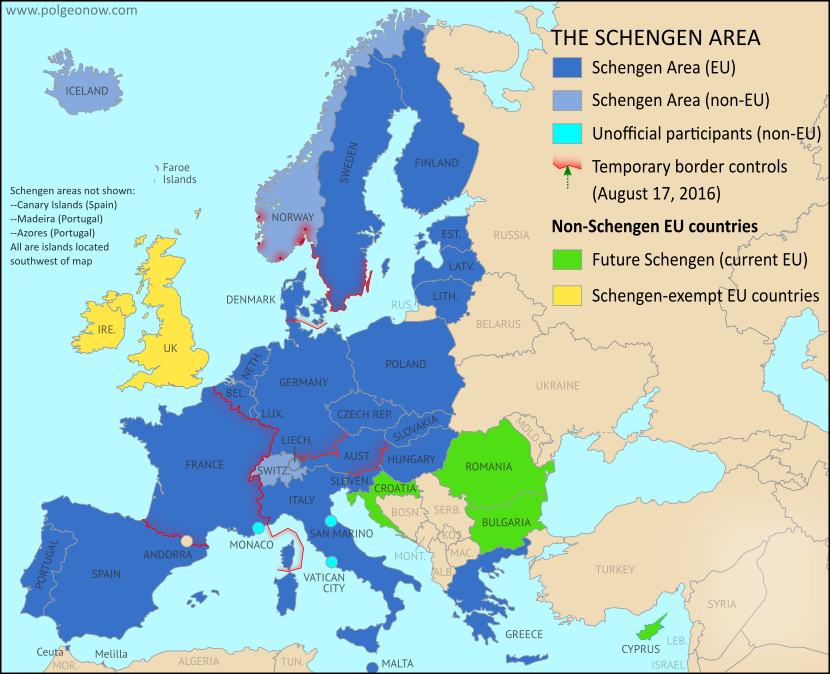
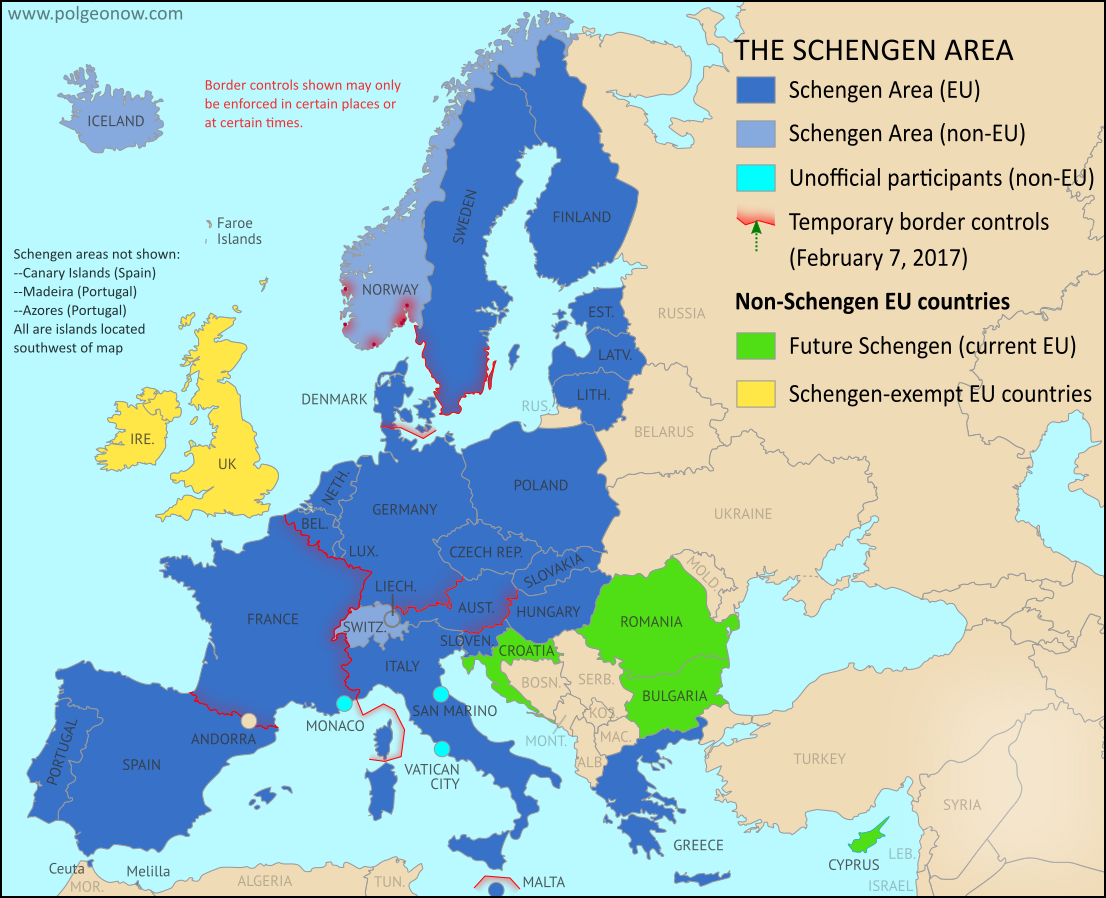
Schengen border checks map: map of Temporarily Reintroduced Border Control in the Schengen Area (the European Union's border-free travel zone) as of February 2017, color-coded for EU Schengen countries, non-EU Schengen countries, future Schengen countries, and Schengen-exempt EU countries, as well as microstates unofficially participating in the Schengen agreements (colorblind accessible).
Map by Evan Centanni, from blank map by Ssolbergj. License: CC BY-SA

(Subscribers click here to view this article in the members area.)

Article by Evan Centanni

Changes to Schengen Border Controls Since 2016

As anyone who’s visited Europe in recent decades knows, much of the continent is linked together as part of the “Schengen Area“, a collection of countries that don’t make travelers show any ID to cross back and forth across their borders (though this system is overseen by the European Union, the Schengen Area and the EU are not the same thing). But the system does allow countries to temporarily reintroduce border controls under certain circumstances.

With the spike in numbers of refugees and other immigrants arriving in Europe in the past two years, many Schengen countries have rushed to control the flow of people by using these special temporary border controls. When we published our previous map of temporary Schengen border controls in August of last year, there were six countries policing their borders with fellow Schengen members. At the moment there are seven, but the situation has largely remained the same since last summer.

It’s important to note that the border controls shown on the map above are the maximum possible under each country’s declaration – in some cases actual controls may be limited to only certain parts of these borders, or to certain times.

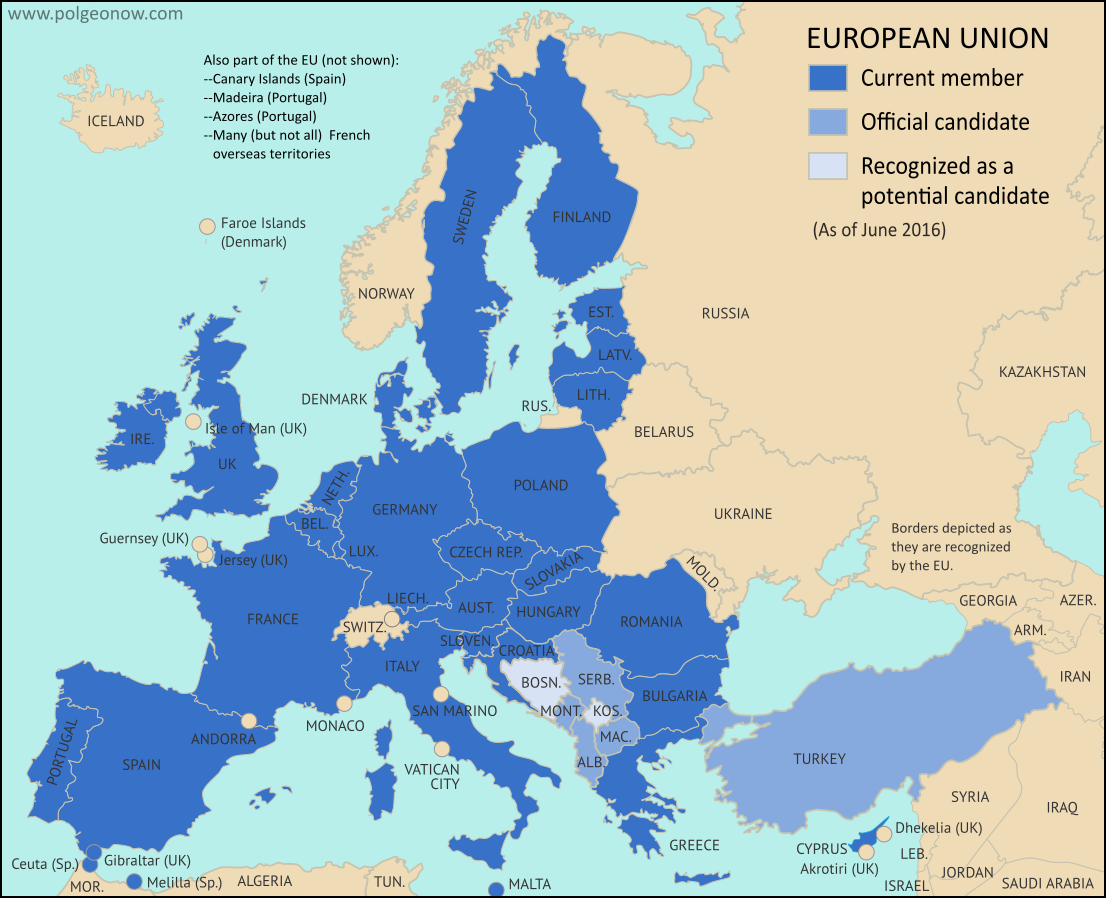
Map of the European Union (EU) and prospective member countries
The full EU and prospective members

France’s Border Controls Extended

Unlike most of the countries with temporary border checks, which have focused their controls on specific stretches of borders popular with refugees and other migrants, France has reserved the right to maintain controls on all its borders – except, presumably, the boundary with tiny Monaco, which for immigration-control purposes is already treated as if it were within France.

Unlike other countries with border checks, France’s controls are justified mostly as an anti-terrorism measure, not as a way of keeping out migrants. The French border controls were declared over a year ago and have been in place ever since then due to several extensions:

Start Date Duration Stated Reason
Nov. 13, 2015* 1 month Paris Climate Change Conference 
Dec. 14, 2015 6 months, 12 days “emergency state as introduced further to Paris attacks
May 27, 2016 2 months Euro 2016 and Tour de France
July 26, 2016 6 months “emergency state as introduced further to Nice attack
January 27, 2017 5 months, 18 days “persistent terrorist threat”

*France’s November-December 2015 border controls were only for air and land borders (sea ports were excluded)

The most recent extension, declared on the 27th of last month, had the most generic justification yet, and came as France’s front-running presidential candidate promised to “ignore” the Schengen agreement and re-institute permanent border checks if he’s elected this May.

The 5 Schengen Countries with Negotiated Border Controls

Amid fears that the Schengen Area’s dream of free travel was going down the drain, the foreign ministers of the EU’s member countries met up and hashed out a compromise solution last year, with five countries reducing the scope of their border controls by refocusing them on high-priority areas:

  • Germany agreed to control only its border with Austria, ruling out border controls with Switzerland, the Czech Republic, Luxembourg, Belgium, the Netherlands, and Denmark.
  • Austria agreed to control only its borders with Slovenia and Hungary, ruling out border controls with Italy, Switzerland, Liechtenstein, the Czech Republic, and Slovakia.
  • Denmark agreed to control only its border with Germany (including land crossings and ferry connections), ruling out border control for arrivals from Sweden or Norway.
  • Sweden agreed to control only crossings over the bridge from Denmark and sea arrivals along its western and southern coastline, ruling out controls for land borders with Norway and Finland or arrivals by sea along its east-central and northern coasts.
  • Norway agreed to control only arrivals in ports with ferry connections to Sweden, Denmark, and Germany, ruling out controls along its land borders with Sweden and Finland.

These border controls, originally set to expire in November, were extended another three months, and now expire on February 11-12. However, EU leaders appear to have approved yet another three month extension, to May 2017, and Germany’s government is talking about switching to France-style anti-terrorism controls.

Temporary Border Controls in Malta

Besides those same six countries, border controls are also in place right now for the tiny island country of Malta. However, Malta’s border checks are truly temporary, and are only scheduled for January 21 to February 9, as a security precaution while the country is hosting two important political summits related to migration into Europe.

Learn More:
Which Countries Are in the Schengen Area, and Which EU Countries Aren’t? 
Map of Temporary Schengen Border Controls in March 2016 
Map of Temporary Schengen Border Controls in August 2016 

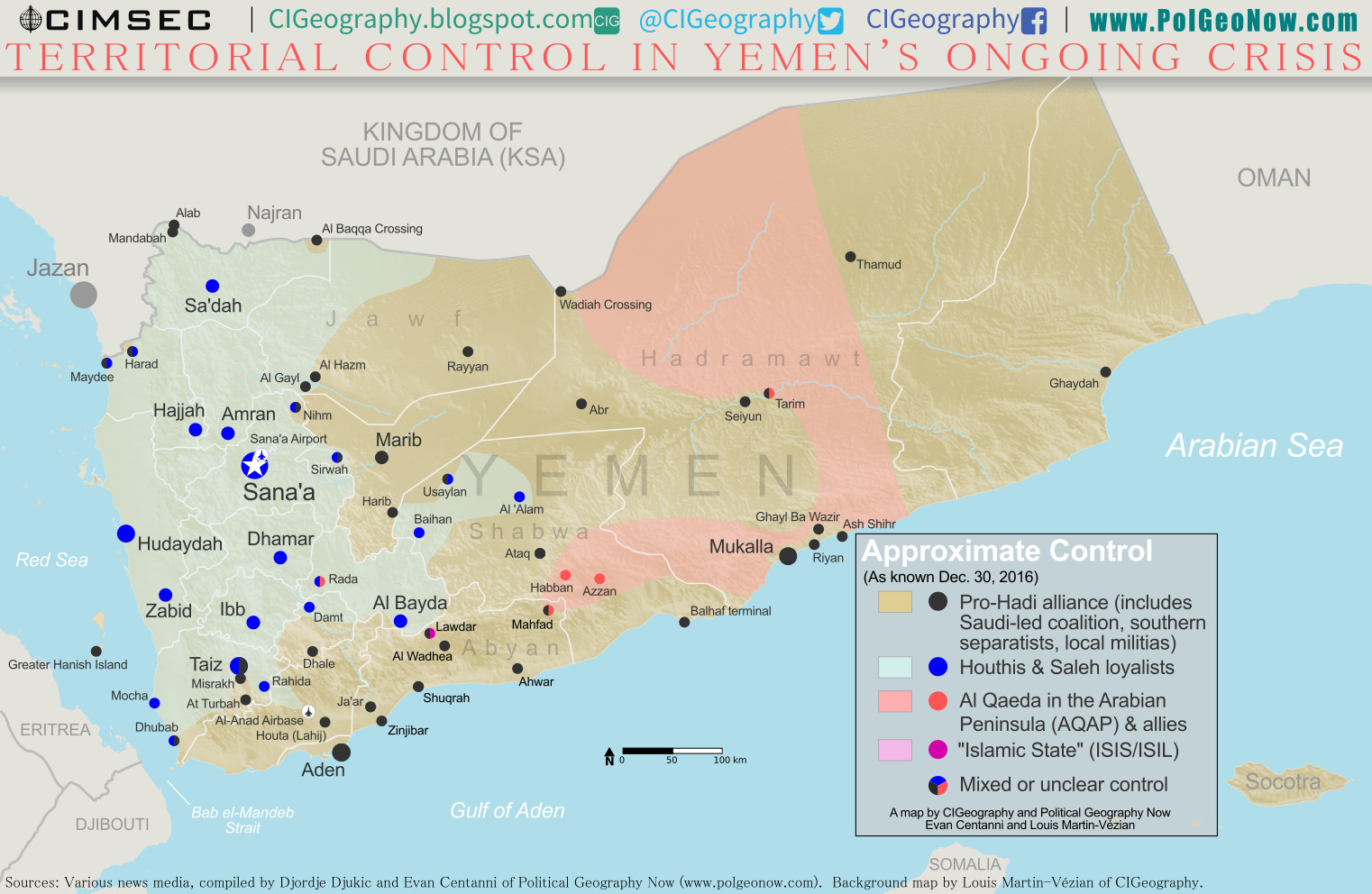
Yemen Control Map & Report: December 2016

There are newer versions of this map available. To see them, view all Yemen updates.

This is part of a series of Yemen maps and infographics created in collaboration between PolGeoNow and CIGeography.

Map of what is happening in Yemen as of December 30, 2016, including territorial control for the Houthi rebels and former president Saleh's forces, president-in-exile Hadi and his allies in the Saudi-led coalition and Southern Movement, Al Qaeda in the Arabian Peninsula (AQAP), and the so-called Islamic State (ISIS/ISIL). Includes recent locations of fighting, including Al Gail, Sirwah, Usaylan, and areas long the Yemen border with Saudi Arabia.
Click to enlarge. Map by Louis Martin-Vézian, Evan Centanni, and Djordje Djukic. All rights reserved.

(Subscribers click here to view this article in the members area.)

Timeline by Djordje Djukic

Situation Summary
In the past three months since our previous Yemen control map report, fighting has continued between Houthi rebels and forces loyal to the Saudi-backed government of President Hadi, with small changes to territorial control on the eastern and northern fringes of Houthi territory, including along Yemen’s border with Saudi Arabia. Meanwhile, Al Qaeda in the Arabian Peninsula (AQAP) has remained entrenched in parts of the east, while allegedly capturing an area near its one-time stronghold of Rada in the country’s west.

Flag of YemenCountry Name:  
• Yemen (English)
• Al-Yaman (Arabic)
Official Name:  
• Republic of Yemen (English)
al-Jumhūriyyah al-Yamaniyyah (Arabic) 
Capital: Sana’a (official); Aden (seat of internationally-recognized government)

Chronology of Events
The following is a timeline of major events and changes to territorial control since PolGeoNow’s previous Yemen control map report of September 23, 2016.

October 1, 2016
Pro-Hadi forces captured the the village of Al Gayl, which they claimed to be the last Houthi stronghold in Jawf province. Meanwhile, the Houthis claimed they hit a UAE military ship in the Bab al-Mandeb Strait, while according to the UAE the vessel that was hit was an aid ship en route to Aden.

October 8, 2016
At least 140 people were killed and more than 500 wounded in several airstrikes on a funeral reception in Sana’a which was attended by military and intelligence officials of the Houthi-led government.

October 9, 2016
The US Navy guided missile destroyer Mason was targeted in a failed missile attack from Houthi-held territory in Yemen.

October 12, 2016
The USS Mason was targeted in a second failed missile attack off the coast of Yemen.

October 13, 2016
In retaliation for the two missile attacks, the USS Mason targeted and destroyed three coastal radar sites in Houthi-held areas, using cruise missiles.

November 2, 2016
Twenty-eight Houthi and six pro-Hadi fighters were reportedly killed in fighting in Taiz.

November 7, 2016
The WHO announced that at least 7,070 people had been killed and 36,818 injured in the conflict in Yemen since the start of the Saudi-led intervention in March 2015.

November 15-16, 2016
Fighting in Maydee and Harad on the border between Yemen and Saudi Arabia, as well as in Taiz, left 46 pro-Houthi and 39 pro-Hadi fighters dead, in addition to five civilians. During the clashes in Taiz, pro-Hadi forces managed to advance towards the Houthi-held presidential residence and police headquarters.

November 17-18, 2016
Twenty-four Houthi and 14 pro-Hadi fighters were reportedly killed in Taiz, as well as two civilians, dashing any hopes of a ceasefire that had been announced by US Secretary of State John Kerry, which was supposed to start on November 17. Instead, a 48-hour ceasefire began on November 19.

November 21-22, 2016
Following the fragile two-day ceasefire, heavy fighting in Taiz and Maydee left a reported 29 Houthi and 12 pro-Hadi fighters dead.

November 24, 2016
More fighting in Taiz killed 10 Houthi fighters.

November 28, 2016
The Houthis and their political allies formed a new government. A Hadi spokesman deemed the move “a disregard not just for the Yemeni people, but also for the international community”.

December 2, 2016
The Saudi-led coalition claimed that 172 people were killed and 686 wounded due to indiscriminate shelling in Taiz by pro-Houthi forces during the month of November.

December 4-5, 2016
Pro-Hadi troops captured the Alab border crossing, which is one of two border crossings between Saudi Arabia and Yemen’s Sa’dah province. The second crossing, Al Baqqa, had already been taken by pro-Hadi troops previously. The fighting spread the following day to the nearby Mandabah mountain. Pro-Hadi forces also claimed that the Houthis had withdrawn from the port town of Maydee. However, fighting was still being reported around the town 15 days later.

December 10, 2016
An IS suicide bomber killed between 48 and 50 soldiers and wounded around 70 at a base in Aden.

December 12-15, 2016
Al-Qaeda captured a mountain in Bayda province and claimed to have also seized an area of the Rada district from pro-Houthi forces.

December 13, 2016
Eighteen Houthi fighters were reportedly killed in fighting in Taiz, while Houthi forces attempted to recapture a hill overlooking the Sirwah airport in Marib province, which they had recently lost.

December 18, 2016
An IS suicide bomber killed between 49 and 52 soldiers and wounded between 34 and 60 in Aden while they were collecting their salaries.

December 18-19, 2016
Houthi fighters managed to temporarily capture a hilly air-defense base on the western edge of Taiz, before they were forced to retreat the following morning. Pro-Hadi forces claimed 41 Houthi fighters were killed, while they lost nine. Meanwhile, pro-Hadi forces reportedly captured Mandabah mountain on the Yemeni-Saudi border.

December 22, 2016
Seven Pakistani crew members of an Iranian cargo ship were killed when their ship was sunk in a rocket attack off the coast of Yemen.

December 23, 2016
Saudi artillery and helicopter strikes on the Saudi-Yemeni border reportedly killed at least 30 pro-Houthi fighters, while the US military reported 28 Al Qaeda militants were killed in nine strikes between September 23 and December 13 in Yemen.

December 24, 2016
Pro-Hadi forces captured several areas in the Nihm district northeast of Sana’a.

December 27, 2016
Twenty-eight Houthi and 12 pro-Hadi fighters were reportedly killed in fighting in the southern province of Shabwa when pro-Hadi forces launched an offensive against Baihan. Fighting also took place at nearby Usaylan. Pro-Hadi forces claimed to have made advances during the offensive.

December 29, 2016
Pro-Hadi troops reportedly captured three regions of the Usaylan district in Shabwa province and were trying to push towards Baihan. At least 10 Houthi fighters were killed in the fighting.

CHECK FOR UPDATES: View all Yemen maps on PolGeoNow

Graphic of Yemeni flag is in the public domain (source).
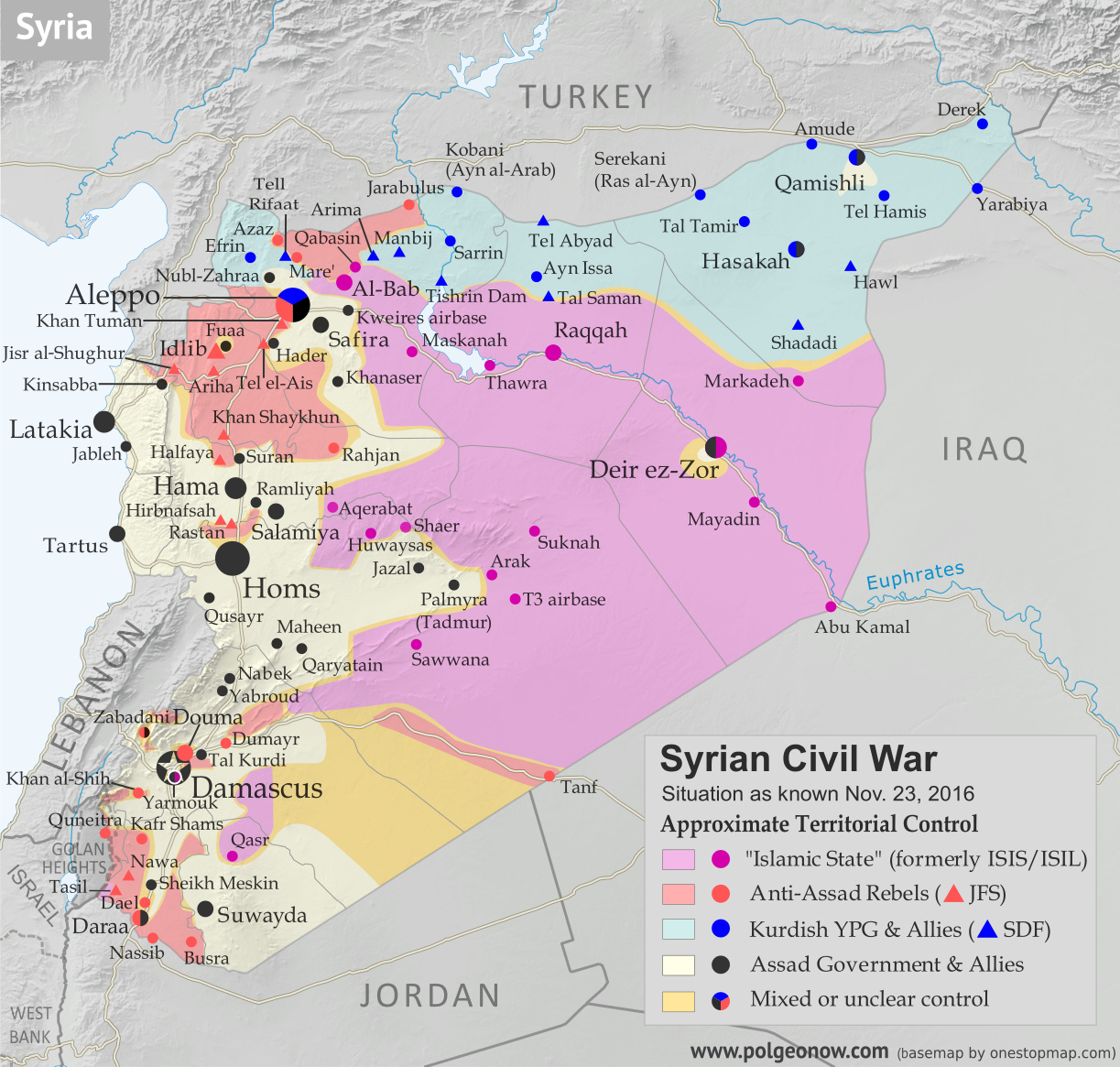
Syrian Civil War Control Map & Report: November 2016

There are newer versions of this map available. To see them, view all Syria updates.

Map of fighting and territorial control in Syria's Civil War (Free Syrian Army rebels, Kurdish YPG, Syrian Democratic Forces (SDF), Jabhat Fateh al-Sham (Al-Nusra Front), Islamic State (ISIS/ISIL), and others), updated to November 23, 2016. Now includes terrain and major roads (highways). Includes recent locations of conflict and territorial control changes, such as Al-Bab, Khan al-Shih, Tal Saman, Qabasin, and more. Colorblind accessible.
Base map by Koen Adams of onestopmap.com, with territorial control by Evan Centanni and Djordje Djukic.
All rights reserved.

(Subscribers click here to view this article in the member area.)

Timeline by Djordje Djukic, with additional reporting by Evan Centanni

Situation Summary
In the past month since our previous Syrian Civil War map update, fighting has focused largely on the ongoing battle for the city of Aleppo, where rebels control a large enclave in the east, as well as a three-way fight for control of Al-Bab, the largest town in the countryside east of Aleppo (at least, according to pre-war census figures). Held for nearly three years by the so-called “Islamic State” (IS; formerly ISIS/ISIL), Al-Bab is now the target of both the Turkish-backed Free Syrian Army (FSA) rebels and the US-backed Syrian Democratic Forces (SDF) coalition led by Kurdish militias. The SDF has also made progress toward the IS capital of Raqqah in the east, while the Syrian Army of President Bashar al-Assad is making slow progress against rebels in the west of the country.

Flag of Syria under the current governmentCountry Name:  
• Syria (English)
• Sūriyya/Sūryā (Arabic)
Official Name:  
• Syrian Arab Republic (English)
• al-Jumhūriyyah al-‘Arabīyah  as-Sūriyyah (Arabic)
Capital: Damascus

Note: Red triangles on the map represent towns where rebel group Jabhat Fateh al-Sham (JFS), formerly known as Al Qaeda affiliate Jabhat al-Nusra (a.k.a. the Nusra Front), is thought to be in a dominant position among rebel forces, even if it doesn’t exercise exclusive control. This organization has some presence in almost every rebel-held area in Syria.

Timeline of Events
The following is a timeline of changes to territorial control and other key events in Syria since our previous map update of October 23, 2016. Sources are provided in the form of links.

October 26-27, 2016
The race for control of IS-held Al-Bab continued as Turkish-backed Free Syrian Army (FSA) rebels seized three villages from the group north of the town, while the Kurdish-led SDF captured four villages from the rebels (two west and two east of Al-Bab). With the advances, the rebels were 13 kilometers from Al-Bab, while the SDF was positioned at a distance of18 kilometers..

October 27, 2016
The Syrian Army recaptured the town of Suran, north of Hama, which it had lost to rebels at the end of August. Meanwhile, northeast of Aleppo, the race to the IS-held town of Al-Bab continued. The Kurdish-led SDF captured several villages from the Turkish-backed rebels, while the rebels themselves took control of several villages from IS.

October 28, 2016
The SDF and the Syrian Army jointly seized half a dozen villages from IS, northeast of Aleppo, and a former Infantry College came under the control of the army. Elsewhere, the army surrounded the rebel-held town of Khan al-Shih, southwest of Damascus.

October 28-November 12, 2016
Rebels launched an offensive on the government-held western part of Aleppo city in an attempt to break the siege of the rebel-held eastern section. In the first two days of the operation, they managed to capture the Minyan Sawmills, most of the Dahiyat al-Assad district and half of the Minyan district. During this period, 12 suicide bombers were used against government positions.

On November 3, the rebels launched the second phase of their offensive, attacking the New Aleppo district, but the assault was ultimately repelled. At this point, the rebel offensive slowed and on November 6, government forces launched a counter-attack in the southwest of the city. By November 12, pro-government troops had managed to reverse all rebel gains and additionally retake territory they had lost in the rebels’ summer offensive.

Between October 28 and November 11, 291 rebels and 146 pro-government fighters were killed in the offensive, along with 96127 civilians who died due to rebel shelling. An additional 350-400 rebels and 200-300 pro-government fighters were wounded. Pro-rebel media also reported nearly 500 civilian deaths from government shelling in eastern Aleppo.

October 30, 2016
The army captured Tal Kurdi, as well as one other nearby town, east of Damascus, further shrinking the rebel pocket known as Eastern Ghouta and coming closer to the rebel stronghold of Douma.

November 1-2, 2016
IS managed to recapture 17 villages from the Turkish-backed rebels northeast of Aleppo.

November 4, 2016
The army captured a village near the town of Khan al-Shih. Thirty-three rebels were reported killed in the area the previous day.

November 5, 2016
A rebel assault north of Hama resulted in the capture of several positions. However, an army counter-attack subsequently regained all lost territory.

November 6-15, 2016
The Turkish-backed rebels captured 36 villages from IS north of Al-Bab, advancing to within two kilometers of the town. On November 14, the rebels managed to enter the northern outskirts of Al-Bab, but were forced to withdraw one kilometer to the north of the town the next day. Concurrently, between November 11 and 15, the SDF captured 15 villages east of Al-Bab from IS, besieging the town of Arima.

November 6-22, 2016
On November 6, the SDF announced the start of the offensive to reach the IS capital of Raqqah. Within 15 days, they managed to seize 48 villages and farms from IS, including the strategic hilltop village of Tal Saman, 26 kilometers north of Raqqah. Following these advances, the SDF said Phase One of their offensive (cutting of Raqqah from its northern countryside) had been completed. The aim of Phase Two was to enforce a full blockade of the city. By November 22, the SDF was 20 kilometers north of Raqqah. At this point, the SDF threatened to halt the offensive if the US-led coalition did not force Turkey to halt attacks on SDF forces in the Manbij area.

The previous day, Turkish-backed rebels attacked and temporarily captured a village northeast of Al-Bab from the SDF, before the Kurdish-led forces managed to retake it.

November 8-13, 2016
The Syrian Army took control of a strategic road southwest of Damascus, tightening the siege of Khan al-Shih. Over the next five days, the town was hit with more than 140 barrel bombs and ground-to-ground missiles.

November 12, 2016
Government forces captured two villages south of Aleppo.

November 15-23, 2016
A new Syrian-Russian offensive on the rebel-held eastern part of Aleppo city was announced with heavy Russian airstrikes. By November 22, the military managed to seize a strategic hill overlooking the rebel-held Hanano district, half of Hanano itself, and 75 percent of the central Bustan al-Basha district. Reports said 159 civilians had been killed in the first seven days of the offensive. Of these, 143 died due to pro-government shelling and airstrikes, while 16 were killed by rebel shelling.

November 15-23, 2016
On November 15, rebels attacked the IS-held town of Qabasin, northeast of Al-Bab, and over the next eight days the town changed hands six times, ending up under IS control at press time.

November 17-19, 2016
The army managed to seize two areas west and east of Khan al-Shih before a surrender agreement was reached for the town’s rebel administration. Under the agreement, after a two-day ceasefire, 1,000 rebels would be evacuated to Idlib province and the town would be surrendered to the military.

November 20, 2016
The Assad government rejected a UN proposal to halt the fighting in Aleppo by granting the eastern half of the city autonomous status, which would have allowed the Syrian opposition to continue administering the area after a drawdown of rebel armed forces.

November 22, 2016
The head of Iran’s veterans’ affairs office confirmed more than 1,000 fighters sent from Iran to Syria have been killed since the start of the war. The number includes Iranian soldiers, as well as Afghan and Pakistani militiamen.

November 23, 2016
The Turkish-backed rebels captured three villages from the SDF and two from IS west and east of Al-Bab, while the SDF managed to seize the town of Arima from IS. In addition, the SDF took control of a village from IS west of Al-Bab.

Elsewhere, the Syrian Army launched an assault on a rebel-held mountainous area in Latakia province and managed to capture several positions before ultimately being repelled, with the rebels recapturing most of their lost territory. Meanwhile, it was reported that rebels in eastern Aleppo were preventing about 100 families, totaling 250 civilians, from crossing from the rebel-held part of the city into the Kurdish-held northern district to escape the government offensive.

Graphic of the Syrian flag is in the public domain (source).
Libya’s Political Realignment: May 2016 Control Map & Timeline

This is the first of a pair of Libya map reports, with the second spotlighting the retreat of “Islamic State” forces from May to September. The second report, with a more up-to-date map, is available to members of our conflict map subscription service. 

There are newer versions of this map available. To see them, view all Libya updates.

Libya control map: Shows detailed territorial control in Libya's civil war as of May 2016, reflecting the political realignment after UN peace deal, including all major parties (Government of National Accord (GNA), Tobruk House of Representatives, General Haftar's Libyan National Army, Zintan militias, Petroleum Facilities Guard (PFG); Tripoli GNC government, Libya Dawn, and Libya Shield Force; Shura Council of Benghazi Revolutionaries and other hardline Islamist groups; and the so-called Islamic State (ISIS/ISIL)). Also file under: Map of Islamic State (ISIS or ISIL) control in Libya. Now includes terrain and major roads. Color blind accessible.
Base map by Koen Adams of onestopmap.com, with territorial control by Evan Centanni. All rights reserved.

(Subscribers click here to view this article in the member area)

Timeline by Djordje Djukic, with additional reporting by Evan Centanni

Drastic Political Shift
Starting soon after our last Libya control map report in March, the structure of Libya’s divided control and rival governments underwent a massive realignment, with international recognition essentially switching from one side of the country to the other, and some key fighting forces switching sides as well.

Last year, the country was already divided between two rival governments, the controversial General National Congress (GNC) in the capital city of Tripoli and the more internationally-recognized House of Representatives in the eastern city of Tobruk (with forces of the so-called “Islamic State”, formerly ISIS/ISIL, holding territory in between).

In an effort to unite the two governments, a UN-backed peace deal created a new “Government of National Accord” (GNA), which last March dramatically sailed into Tripoli from Tunisia to take over the reigns. Within a few weeks, the old GNC government had yielded to GNA authority, and most of the GNC-associated Libya Dawn militias agreed to support the new government too (at least for the time being). However, the GNA failed to secure an endorsement from the legislature in Tobruk, limiting the new government’s power in the east to support from the maverick Petroleum Facilities Guard (PFG) along the central coast.

The result is that most international recognition has shifted to the new Tripoli government, whose military is largely made up of the same forces that were loyal to the controversial GNC, while Tobruk’s formerly recognized government and army are now the defiant rivals.

For the full history of the current civil war since the fall of dictator Muammar Gaddafi in 2011, including the origins of the country’s competing governments, see our detailed Libya background article and timeline from August 2015.

Flag of Libya (2011-present)Country Name:  
• Libya (English)
• Lībyā (Arabic)
Official Name:  
• State of Libya (English)
Dawlat Lībyā (Arabic) 
Capital: Tripoli

Timeline of Events
The following is a detailed timeline of major political events and changes to territorial control since our previous Libya control map of March 2016.

March 16-17, 2016
The European Union agreed on sanctions against three Libyan officials – including the president of the Tripoli-based General National Congress (GNC) – who were opposed to the new UN-backed unity government, the Government of National Accord (GNA). The designated prime minister of the GNA said he expected to move to Tripoli from the neighboring country of Tunisia within days.

March 31, 2016
The dissolution of the GNC government started, with its officials, under pressure from former allies, leaving Tripoli and going back to their home cities. Members of the Presidential Council of the GNA sailed into Tripoli the same day. Subsequently, 10 cities formerly under the control of the GNC pledged their support for the GNA. Following this, GNA support continued to spread further in the west and south of the country, while in the east support for the GNA remained uncertain.

However, the Petroleum Facilities Guard (PFG) under Ibrahim Jathran, in control of eastern oil ports including Sidra, Ras Lanuf, and Brega, did pledge its allegiance to the GNA.

April 5-6, 2016
The GNC-affiliated “National Salvation Government” in Tripoli disbanded and ceded authority to the Presidential Council. The next day, the State Supreme Council elected its president and first deputy. By this time, GNA Prime Minister Fayez al-Serraj was in control of Libya’s central bank and national oil company as well.

Read More: Foreign Policy magazine tells the story of the GNA’s whirlwind rise to power

April 17-19, 2016
The Tobruk-loyal “Libyan National Army” (LNA) organization captured the University of Benghazi, the Al-Hawari cement factory and two nearby cemeteries from religious hardline militias in Benghazi, as well as the Al-Quwarsha area of Benghazi’s district.

April 20, 2016
Forces of the so-called “Islamic State” (IS, formerly ISIS/ISIL) withdrew from positions on the outskirts of Derna, cementing the control of the Mujahideen Shura Council (MSC), a rival religious hardline group, over the town. The LNA also claimed to have taken control of IS’s abandoned positions.

Map of the territorial control (Assad government, Islamic State/ISIS/ISIL, rebel, SDF, and Kurdish) in the Syrian Civil War as of April 2016
Map of IS Control in Syria, April 2016
(click for free article and map)

April 27, 2016
IS ambushed a convoy reportedly consisting of GNA fighters and British and Italian soldiers. The attack reportedly left some Italian marines dead or wounded.

April 29, 2016
As of the end of April, the Tobruk-based House of Representatives, the previous internationally-recognised Libyan parliament, had not yet given its support to the new GNA government in Tripoli. Major sticking points were Tripoli’s disdain for LNA star general Khalifa Haftar, as well as a procedural requirement for the GNA government to present itself in person before the House (meanwhile, GNA leaders were still holed up in an old navy base in Tripoli despite the proclaimed support of many militias in the city).

Also by late April, the GNA had gained the loyalty of several important government ministries.

May 5, 2016
As GNA forces were preparing an offensive to recapture Sirte from IS forces, IS launched a pre-emptive attack. In the offensive, IS claimed to have captured several villages, including Abu Grain, Baghla, and Abu Najaym.

May 10, 2016
A military faction in the eastern city of Ajdabiya declared that it did not support the Tobruk-based LNA.

Timeline continued in subscriber article:
The Fall of Libya’s “Islamic State”: Sept. 2016 Control Map & Timeline

Graphic of the Libyan flag is in the public domain (source).
Iraq Control Map & Report: September 2016

There are newer versions of this map available. To see them, view all Iraq updates.

Detailed map of territorial control in Iraq as of September 5, 2016, including territory held by the so-called Islamic State (ISIS, ISIL), the Baghdad government, and the Kurdistan Peshmerga. Includes results of recent fighting around Qaiyarah (Qayyarah) south of Mosul. Color blind accessible.
Basemap by Koen Adams of onestopmap.com, with territorial control by Evan Centanni and Djordje Djukic. All rights reserved.

(Subscribers click here to view this article in the member area.)

Research and timeline by Djordje Djukic

Summary of Recent Events
After recapturing Ramadi from the so-called “Islamic State” (IS; formerly ISIS/ISIL), the Iraqi government and allies have set their sights on Mosul, the largest IS-controlled city, and until a few years ago the second largest city in Iraq (some sources say half or more of its population fled after the IS takeover in 2014). Since our last Iraq control map report at the end of June, the main change to territorial control has been the government capture of Qaiyarah, a town south of Mosul that’s still more or less surrounded by IS and Kurdish controlled ground.

See Also: Syrian Civil War Control Map: August 2016

Flag of IraqCountry Name:  
• Iraq (English, Kurdish)
• al-‘Irāq (Arabic)
Official Name:  
• Republic of Iraq (English)
• Jumhūriyyat al-‘Irāq (Arabic)
Komara Iraqê (Kurdish)
Capital: Baghdad

Timeline of Changes in Territorial Control
The following is an outline of major events since PolGeoNow’s previous Iraq map update of June 30, 2016. The abbreviation “IS” refers to the organization calling itself “the Islamic State”, also known as ISIS or ISIL. The Peshmerga is the military of Iraqi Kurdistan.

June 29-July 12, 2016
Two weeks after the military started an advance towards the Qaiyarah airbase, they took control of a village 45 kilometers from the airfield on June 29. Subsequently, on July 9, the Iraqi army captured the Qaiyarah airbase, 60 kilometers south of Mosul. Three days later, the same forces linked up with government troops which had been advancing from Makhmour since March, after they captured a village on the Tigris riverbank north of Qaiyarah.

July 3, 2016
Reports said 292 people were killed by a suicide bomber detonating an explosive-filled minibus in the Karrada district of Baghdad.

July 7, 2016
IS suicide bombers attacked a Shiite shrine in a town between Samarra and Baquba, leaving 56 people dead and more than 70 wounded. The attackers fought their way through a market before reaching the gates of the Sayyid Muhammad bin Ali al-Hadi mausoleum, where they blew themselves up.

July 9, 2016
Iraqi security forces captured two villages north of Ramadi from IS.

July 18, 2016
The Iraqi Army launched an assault on the town of Qaiyarah. Meanwhile, Iraqi security forces captured a town in the western part of Anbar province.

August 2, 2016
Iraqi security forces seized two areas south of Mosul, in the area of Qaiyarah.

August 7, 2016
IS suicide bombers attacked a village 60 kilometers south of Mosul, killing 11 people, including six soldiers.

August 14-16, 2016
Kurdish forces took control of 12 villages near Mosul. During the advances, Kurdish Peshmerga forces reached a bridge connecting Erbil, Mosul, and Kirkuk. The Kurds managed to reach the western side of the bridge, thus securing a crossing over the Grand Zab river. The crossing over the river would make it possible for Kurdish forces to eventually advance on Mosul from a new front. Meanwhile, Iraqi security forces captured four villages in the Qaiyarah area.

August 23-25, 2016
Iraqi government forces attacked the center of Qaiyarah, fully capturing the town two days later. They claimed about 250 IS fighters were killed in the battle.

August 29, 2016
Five IS attackers, including a suicide bomber, killed 15 people at a wedding in a town west of Karbala (south of Baghdad, far outside of the IS control zone).

August 30, 2016
It was revealed that before retreating from the Qaiyarah airbase, IS had almost completely destroyed the facility. This was seen as possibly hindering any future attempt by Iraqi forces to retake Mosul, since the air base was intended to be used as a staging area for any future operations against the city.

August 31, 2016
Human Rights Watch accused Sunni pro-government militias of recruiting children into their ranks.

Graphic of the Iraqi flag is in the public domain (source).
Map of Border Controls Inside Europe’s Schengen Area: August 2016

There are newer versions of this map available. To see them, view all Schengen Area articles.

Last March, we explained Europe’s Schengen free travel area in plain English, then published a map of which European countries had temporarily reintroduced border controls. We now present an updated and improved version of the border control map, reflecting several changes from the past five months.

Map of Temporarily Reintroduced Border Control in the Schengen Area (the European Union's border-free travel zone) in August 2016, color-coded for EU Schengen countries, non-EU Schengen countries, future Schengen countries, and Schengen-exempt EU countries, as well as microstates unofficially participating in the Schengen agreements (colorblind accessible).
Map by Evan Centanni, from blank map by Ssolbergj. License: CC BY-SA

(Subscribers click here to view this article in the members area.)

Article by Evan Centanni

Changes to Schengen Border Controls Since March

As anyone who’s visited Europe in recent decades knows, much of the continent is linked together as part of the “Schengen Area“, a collection of countries that don’t make travelers show any ID to cross back and forth across their borders (though this system is overseen by the European Union, the Schengen Area and the EU are not the same thing). But the system does allow countries to temporarily reintroduce border controls under certain circumstances.

With last year’s spike in numbers of refugees and other immigrants arriving in Europe, many Schengen countries have rushed to control the flow of people by using these special temporary border controls. When we published our previous map of temporary Schengen border controls back in March, there were seven countries policing their borders with fellow Schengen members. Today there are only six, and there have been major changes to which borders are controlled:

Belgium’s French Border Controls Expire

In February, Belgium controversially declared an emergency reintroduction of controls along part of its border with France, which it claimed was necessary to limit flows of displaced people caused by the forced closure of a major refugee camp in France. Normally, emergency border controls have to be renewed every ten days, though Belgium announced from the outset that it planned to keep them for a whole month. However, in the end the country did respect the two-month renewal limit on emergency controls, letting them expire in late April.

Denmark Border Controls Expire, then are Reintroduced

Map of the European Union (EU) and prospective member countries
The full EU and prospective members

Denmark declared emergency controls at all its borders in January, citing “unexpected migratory flow” as the reason. Like Belgium, it kept them in place for the full two months allowable, ending on March 4.

However, Denmark followed that expiration immediately with a normal, non-emergency reintroduction of border controls, which it said were to deal with a “big influx of persons seeking international protection”.

EU-brokered Compromise Aims to Stabilize Schengen

Amid fears that the Schengen Area’s dream of free travel was going down the drain, the foreign ministers of the EU’s member countries met up and hashed out a compromise solution, which they published as an EU “recommendation” document on May 12. Though a lot of their recommendations involved telling Greece to try harder not to let refugees into Europe, they also came up with a plan to reduce the scope of the border controls by refocusing them on high-priority areas.

In exchange for keeping their controls for another six months (more than the normal maximum), five of the six remaining countries agreed to limit which parts of their borders they would police:

  • Germany agreed to control only its border with Austria, ruling out border controls with Switzerland, the Czech Republic, Luxembourg, Belgium, the Netherlands, and Denmark.
  • Austria agreed to control only its borders with Slovenia and Hungary, ruling out border controls with Italy, Switzerland, Liechtenstein, the Czech Republic, and Slovakia.
  • Denmark agreed to control only its border with Germany (including land crossings and ferry connections), ruling out border control for arrivals from Sweden or Norway.
  • Sweden agreed to control only crossings over the bridge from Denmark and sea arrivals along its western and southern coastline, ruling out controls for land borders with Norway and Finland or arrivals by sea along its east-central and northern coasts.
  • Norway agreed to control only arrivals in ports with ferry connections to Sweden, Denmark, and Germany, ruling out controls along its land borders with Sweden and Finland.

All of these border controls will be up for renegotiation after November 11-12, 2016.

France’s Border Controls Continue

The sixth country, France, has continued to control all its borders – except, presumably, the boundary with tiny Monaco, which for immigration-control purposes is already treated as if it were within French borders. France has been policing all its borders since December 14, 2015, when it introduced border controls for security in the aftermath of the massive terror attacks in Paris.

In May 2016, when its border controls were nearing their six-month expiration date (the maximum allowed for any one purpose), France notified the EU that it was extending controls for two more months while it hosted the European soccer championship and the Tour de France cycling race (major sporting events are a normal reason for Schengen countries to temporarily reintroduce border controls).

Before the two months was up, France had experienced another episode of bloody terrorist violence, the July 14 attack in the city of Nice, and it used the resulting state of emergency as reasoning to declare another six months of border controls, to last until January 2017.

And One More: Temporary Border Controls in Poland

Although the number of Schengen countries with reintroduced border controls fell to six after Belgium’s expired, for one month since our last update there were again seven of them. Poland implemented a routine reintroduction of controls on all its borders from July 4 to August 2, for security during a NATO summit and a Catholic Church “World Youth Day” event that featured a visit from Pope Francis.

The EU’s official Temporary Introduction of Border Control page actually lists Poland’s controls as continuing until September 2, but this appears to be an error. Other sources, including the same site’s comprehensive PDF record of border control notifications, all say the controls ended on August 2.

Learn More:
Map of Temporary Schengen Border Controls in March 2016
Which Countries Are in the Schengen Area, and Which EU Countries Aren’t? 

Map: Which Countries are in the European Union, Which Aren’t, and Which Want to Join?

The UK is preparing to quit the European Union (EU) after the 2016 “Brexit” vote. But how much do you know about the EU’s membership roster? Here’s a map and list of which countries are in the EU, which ones are trying to join, and which European countries are in neither group.

Map of the European Union, including all member countries, official candidate countries, and potential candidate countries, as of June 2016 (colorblind accessible).
The UK is still part of the EU for now, since the vote to leave hasn’t been implemented yet.
Map by Evan Centanni, from blank map by Ssolbergj. License: CC BY-SA

(Subscribers click here to view this article in the members area.)

What is the European Union?

Europe’s continental union is probably most famous to outsiders for its euro currency and Schengen free travel area. But it’s actually much more than that. After all, the UK is preparing to leave the EU, but it’s not even in the Schengen Area or euro currency zone anyway!

What unites the countries of the European Union is a set of laws that all members are required to share. Mostly these are laws about things like the economy, trade, natural resources, and immigration (a major sticking point in Britain). Some countries or territories have exemptions from certain laws, but overall, being an EU member means agreeing to follow a set of rules set out by the collaborative union government in Brussels.

The idea is that Europe can do better economically, and better guarantee basic rights and standards of living, if all the countries work together as one. Needless to say, not everyone in Europe agrees this is a good thing (or that it works), and that’s how Britain has ended up headed for the exit. But at the same time, many other countries are still scrambling to join.

Which Countries are in the European Union? (Full List of EU Members)

The European Union currently has 28 member countries. The UK is still a member for now, but is expected to leave in about two years. 

List of  EU Member Countries
 Austria
 Belgium
 Bulgaria
 Croatia
 Cyprus*
 Czech Republic
 Denmark (except the Faroe Islands and Greenland)
 Estonia
 Finland
 France (except some overseas regions and territories)
 Germany
 Greece
 Hungary
 Ireland
 Italy
 Latvia
 Lithuania
 Luxembourg
 Malta
 Netherlands (except Caribbean islands)
 Poland
 Portugal
 Romania
 Slovakia
 Slovenia
 Spain
 Sweden
 United Kingdom (UK)** (not including Jersey, Guernsey, the Isle of Man, or overseas territories except Gibraltar)

*The Republic of Cyprus holds EU membership on behalf of both southern and northern Cyprus, though the north is controlled by the unrecognized breakaway Turkish Republic of Northern Cyprus, where EU law is considered to be “suspended” until the dispute can be resolved. Two British military bases on Cyprus’s southern coast, Akrotiri and Dhekelia, are considered territories of the UK and are not part of the EU. Incidentally, it is arguable whether the whole island of Cyprus is even located in Europe, but it was allowed in on the basis of its shared cultural history (78% of the population is ethnically Greek).

**In June 2016, the UK voted to exit the EU. Though the country has already been excluded from some high-level EU meetings, it has not yet begun the legal process of leaving. Once it does, there will likely be around two years of exit negotiations before it fully separates itself from the union.

Which Countries are in Line to Join the EU?

European Union membership is open any “European” country (a fuzzily-defined concept) that can convince existing members it will meet the standards of EU membership. These include being free and democratic, respecting human rights, and having a “functioning market economy” (basically anything except total economic chaos or communism). New members also have to adopt all the EU’s laws before joining, prepare to efficiently implement new EU laws made after joining, and have the “capacity to cope” with having their economies basically merged with all the other member countries. Normally, they’re also required to plan on adopting the euro as their currency, but not right away after joining. 

List of Official EU Candidate Countries
Joining the EU requires years of negotiation with the existing member countries, and the EU has a list of official candidate countries that are working on it now.

 Albania
 Macedonia
 Montenegro
 Serbia
 Turkey

Turkey applied all the way back in 1987, but is still struggling to get approval from the existing EU members. The other candidate countries are mostly at early stages of membership negotiations, or haven’t even formally started yet. 

List of Potential EU Candidate Countries
The EU also has an official designation for “potential candidates” that haven’t been fully invited to apply yet:

 Bosnia and Herzegovina
 Kosovo

What Other European Countries Aren’t in the EU?

So which countries are left, that aren’t in the European Union and aren’t even applying for membership? There are actually quite a few. Some may hope to apply further in the future, while others have decided not to apply at all. 

List of European Countries That Aren’t EU Members, Candidates, or Potential Candidates
 Andorra
 Belarus
 Moldova
 Iceland*
 Liechtenstein
 Monaco 
 Norway*
 Russia**
 San Marino
 Switzerland*
 Ukraine
 Vatican City 

*Switzerland, Norway, and Iceland have all applied for EU membership in the past, but later suspended or withdrawn their applications

**Russia is located partially in Europe and partially in Asia, but its historical center and the majority of its population are on the European side

List of Arguably European Countries That Aren’t EU Members, Candidates, or Potential Candidates
There are some cases where it’s not clear if a country is in Europe or not. The countries of the Transcaucasia region are sometimes considered culturally European, and sit right along the most commonly-used line between the European and Asian continents (following the divide of the Caucasus Mountains). Meanwhile, Kazakhstan is rarely treated as European, but part of it also lies on the European side of the line (here following the Ural River).

 Armenia (physically on Asian side, but within Transcaucasia)
 Azerbaijan (in Transcaucasia, mostly in Asia with small parts in Europe)
 Georgia (in Transcaucasia, mostly in Asia with small parts in Europe)
 Kazakhstan (mostly in Asia, with a small part in Europe)

These lists exclude several unrecognized or partially recognized breakaway states that the European Union doesn’t even consider to be countries: Northern Cyprus, Transnistria, Abkhazia, South Ossetia, Nagorno-Karabakh, the Donetsk People’s Republic, and the Lugansk People’s Republic

The disputed Republic of Kosovo, claimed by Serbia and only recognized by 56% of the world’s countries, is generally acknowledge as a country by the EU, which is why it was allowed to become a “potential candidate” country.

Who Will Join or Leave Next?

The future is impossible to predict, but you can stay up to date on European Union membership by checking back frequently with Political Geography Now, or by signing up for email updates from the box on the right-hand side of this page! You can also view all European Union articles, or follow PolGeoNow on Twitter for even more news and facts!

Related:
Map of How Britain Voted in the Brexit Referendum
9 Geography Facts You Should Know About the Brexit and Britain’s EU Membership 
Photo Essay: British Territory Gibraltar and the Brexit Referendum

Article by Evan Centanni. Country flags and associated HTML code from Wikipedia (licensed under CC BY-SA).

Which Countries Use the Euro? (Map of the Eurozone)

This Eurozone map and explainer article have been updated to June 2016. You can also view the original version from 2014.

Map of the Eurozone (euro area), showing which countries use the euro as their currency. Includes members, pre-members (ERM II), EU non-members using the euro, and other EU countries (color blind accessible).
The Eurozone, European Union, and other countries using the euro.
Map by Evan Centanni, from blank map by Ssolbergj. License: CC BY-SA

(Subscribers click here to view this article in the members area.)

Article by Caleb Centanni, with additional content by Evan Centanni 

What is the Eurozone?
Officially called the “euro area”, the Eurozone is a nickname for the group of countries in Europe that share a single currency, called the euro. The euro currency is administered by the European Union (EU), but many countries in the EU don’t use the euro, and some countries outside the EU do use it. The European Central Bank, the governing financial body of the Eurozone, is headquartered in Frankfurt, Germany. Germany, along with eleven other EU countries, became a founding member of the Eurozone in 1999.

Since then, eight more members have joined after meeting the five necessary economic criteria. This has brought the total to nineteen members, including all but nine of the 28 European Union member countries.

Which EU Countries Don’t Use the Euro?

Map of the European Union (EU) and prospective member countries in 2016 (color blind accessible)
The EU and prospective members

One country, Denmark, is part of the European Exchange Rate Mechanism (ERM II), which ties members’ currency to the euro and is a necessary step for joining the Eurozone. However, Denmark is allowed to opt out of adopting the euro, despite its ERM II membership. All members of the European Union were required by the Maastricht Treaty of 1992 to change to the euro after meeting the criteria. However, both Denmark and the UK negotiated exceptions to the requirement later in that year. Seven other EU members are still required to adopt the euro in the future.

Which Non-EU Countries Do Use the Euro?

There are four tiny countries outside the EU – Andorra, Monaco, San Marino, and Vatican City – that have monetary agreements allowing them to use the euro as their official currency. Meanwhile, two other EU non-members, Montenegro and the disputed Republic of Kosovo, have unilaterally adopted the euro without coming to any agreement with the Central Bank. The EU has expressed its dissatisfaction with these unilateral adoptions, but the currency’s use in the two countries has gone forward anyway.

What Next for the Eurozone?
Many countries sought Eurozone membership at the beginning of the financial crisis in 2008, but most became less interested after the euro was hit by its own crisis in 2009. Meanwhile, Danish polls suggest the country is unlikely to support moving to the new currency any time soon. However, all EU members except Denmark and the UK are legally required to eventually adopt the currency.

You can stay up to date on Eurozone membership by bookmarking this article (which will be updated if anything changes), or by checking Political Geography Now for new articles about countries joining or leaving the Eurozone. You can also sign up for email updates from the box on the right-hand side of this page, or follow PolGeoNow on Twitter for even more news and facts!

Articles using versions of this map:
Lithuania Joins the Eurozone (2015)
Latvia Joins the Eurozone (2014)