Syrian Uprising: Map Update 2

There are newer versions of this map available. To see them, view all Syria updates.

Country Name: Syria (English), Sūriyya/Sūryā (Arabic)
Official Name: Syrian Arab Republic (English),
al-Jumhūriyyah al-‘Arabīyah as-Sūriyyah (Arabic)
News Category: Divided Countries
Full Story: See Syria Divided by Armed Conflict

Map of Syria, showing control by the rebel Free Syrian Army as of March 20, 2012
Known areas of armed activity for the rebel “Free Syrian Army” – many rural areas may be under full rebel
control. Unarmed protests not shown. Revised for control of Qalaat al-Madiq and Azaz (see article). Map
is my own work, starting from this blank map by German Wikipedia user NordNordWest. License: CC BY-SA

(Note: For further updates to this map, follow the Syria label on Political Geography Now.)

Syria Conflict Update
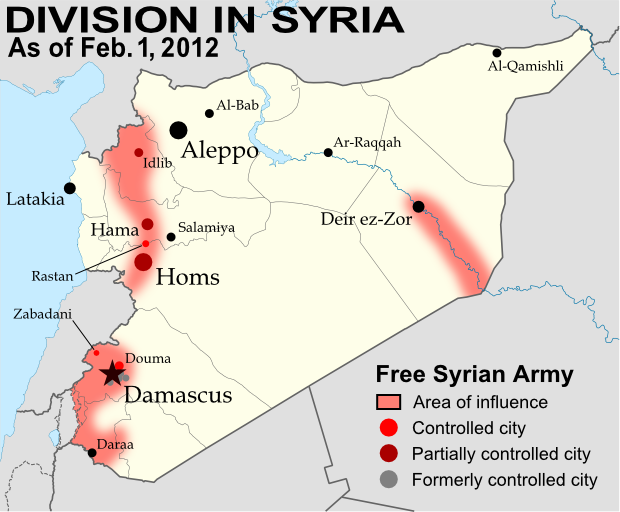
The last few weeks have seen territorial losses for the Free Syrian Army (FSA), as government forces have executed a series major offensives on rebel-held areas. By the end of February, Qusayr near Homs was already reportedly only under partial control of the FSA, and on March 1 the Syrian army overran the rebel stronghold district of Baba Amr in the city of Homs itself. While fighting continues in a few other districts, the capture of Baba Amr was widely seen as crucial defeat for the FSA in Homs.

Less than two weeks later, government forces successfully took the northern city of Idlib from the rebels after a three-day battle. Daraa in the south and Deir ez-Zor in the east have also seen government offensives, while shelling continues in Rastan and rebel-held areas of Hama, though territorial control of these areas has mostly not changed. Meanwhile, since our last update, significant FSA activity has been reported for apparently the first time in the areas around Aleppo and Al-Qamishli, both cities that have been relatively quiet up until now.

This map also contains a correction from the last report – the town of Zabadani near Damascus was held by the rebels through late January and early February, but was taken back by the Syrian army prior to the last map update on February 26. That map has now been updated as well. Finally, the meaning of red coloration for cities on the map has been adjusted to include cities mostly under rebel control, since it is often difficult to determine whether control is 100% complete. You can see Political Geography Now’s original report and background information on the Syrian uprising in the article entitled Syria Divided by Armed Conflict.

Revision (April 10, 2012)
Since this map was first posted, it has since been reported that Azaz and Qalaat al-Madiq were already under rebel control on March 20. The map has been revised to show this.

Useful Link: Wikipedia – Timeline of the 2011-2012 Syrian Uprising
Map Update: Yemen Conflict

Country Name: Yemen (English), Al Yaman (Arabic)
Official Name: Republic of Yemen (English), Al Jumhūriyyah al Yamaniyyah (Arabic)
News Category: Divided Countries
Summary: Despite a negotiated end to its political crisis, Yemen is still deeply divided between the official government and at least three separate armed groups which existed even before the recent turmoil. For a description of the beginnings of Yemen’s popular uprising and the first version of this conflict map from last July, see Yemen Fragments Under Uprising. A previous updated version of that map can be seen in the News Bits: October 2011 article.

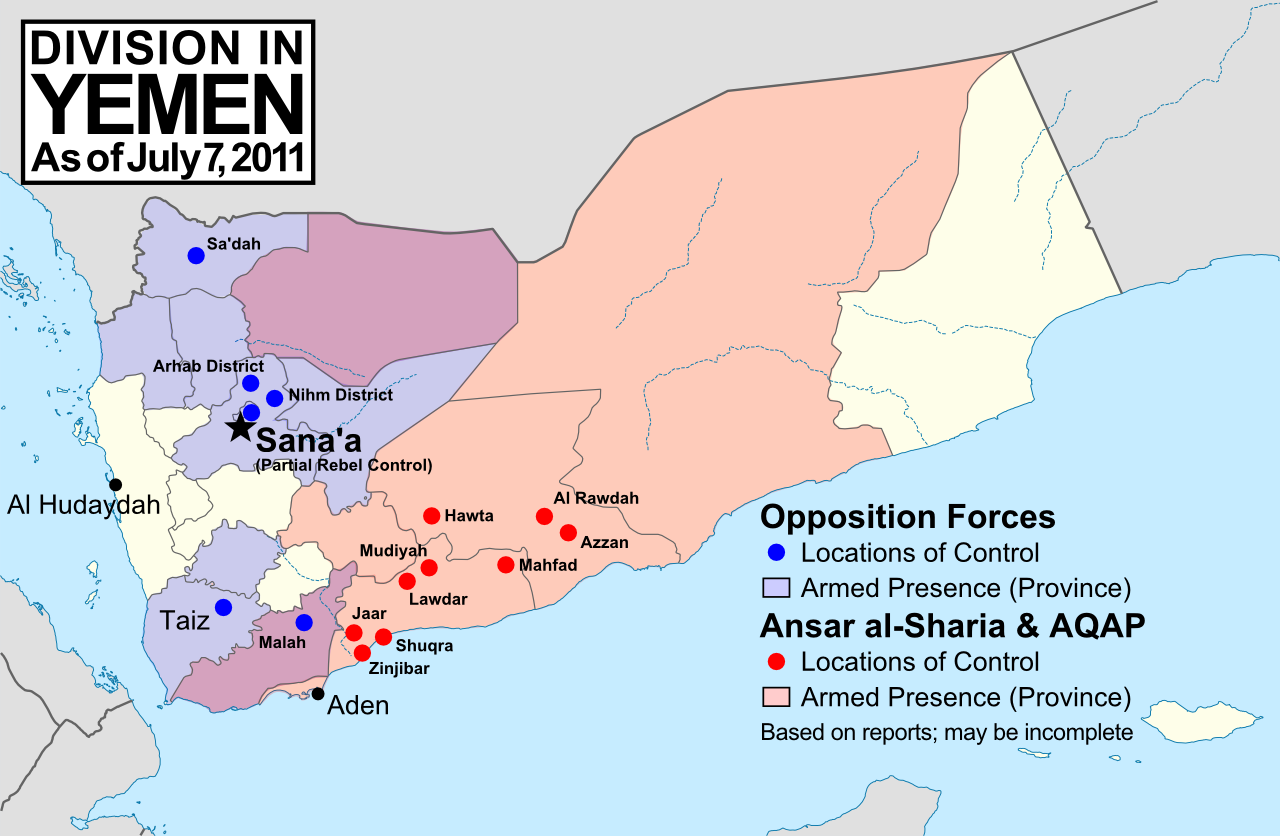
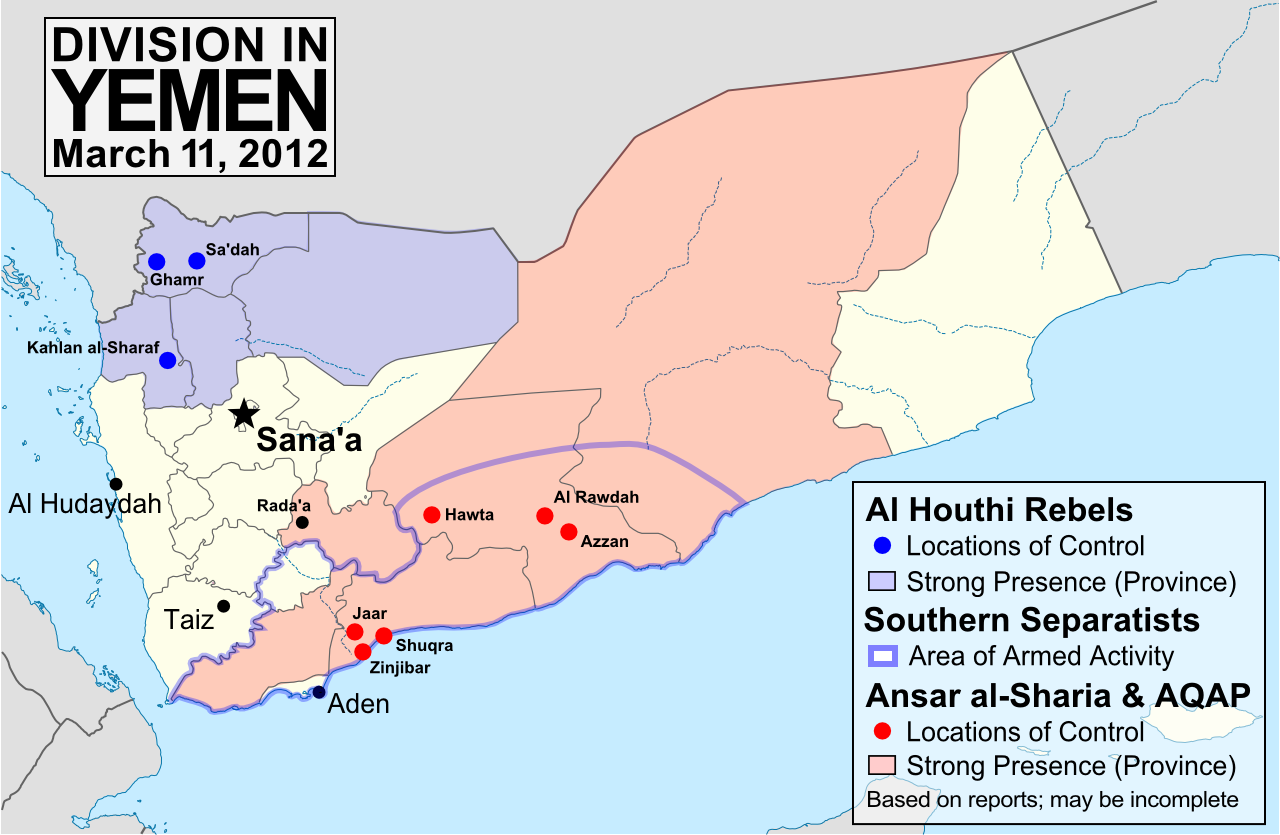
Major areas of non-government control in Yemen, held by armed groups resistant to the country’s recent power-sharing deal. Ansar al-Sharia and Al-Qaeda in the Arabian Peninsula (AQAP) are two related Islamic extremist groups. Map is my own work, from this blank map by Wikipedia user NordNordWest (license: CC BY-SA)

(Note: For updates to this map, follow the Yemen label on Political Geography Now.)

Conflict Update
Since last fall, the conflict in Yemen has undergone something of a change in direction. In November President Ali Abdullah Saleh finally signed an agreement with the Joint Meeting Parties, a coalition of opposition politicians that includes Nobel Peace Prize winner Tawakkul Karman. Under the deal, brokered by the Gulf Cooperation Council, Saleh would yield the presidency in February to vice president Abd Rabbuh Mansur Al-Hadi via a symbolic election. After the power transfer went forward as planned last month, opposition militias have mostly ended their conflicts with the government, and unarmed protests have decreased (but not ended altogether). The city of Taiz, referred to as the heart of Yemen’s revolution, has been largely demilitarized, and the streets of Sana’a no longer see frequent violence.

Useful Link: Timeline of the 2011–2012 Yemeni uprising (Wikipedia)

However, not all groups have fully agreed to the terms of the new arrangement. Most notably, there are three major armed groups who have been resisting the Yemeni government since long before last year’s popular uprising began:

Ansar al-Sharia & Al Qaeda in the Arabian Peninsula (AQAP): These two apparently connected groups of Islamic extremists took advantage of the chaos of the revolution to carve out their own territories in southern Yemen. Ansar al-Sharia now controls much of Abyan and Shabwah provinces, including hotly contested Zinjibar, as well as its recently declared “Islamic emirates” in both Jaar (which they renamed Waqar) and the eastern Shabwah region. Al Qaeda affiliate AQAP operates widely in the country, and in January briefly captured the town of Rada’a before withdrawing after negotiations with local leaders. Ansar al-Sharia and AQAP have played no part in the peace process, and are sworn enemies of nearly all other major political groups in the country.

The Al Houthi Rebels: The Houthis are a Shiite insurgent group that has fought several wars for autonomy from predominantly Sunni Yemen since 2004. During the beginnings of last year’s uprising, the Houthis solidified control over their home region of Sa’dah in the far northwest of the country, and have recently extended their power to the three surrounding provinces as well. The group’s leadership has called for participation in the national reconciliation process, but boycotted voting in last month’s single-party election. Only time can tell whether the Houthis’ territories will be integrated into Yemen or again erupt into full-blown rebellion.

The Southern Separatists: Ever since North and South Yemen united in 1990, southerners wishing to re-secede have become a major political force in the country. Many of the separatists use peaceful political methods, but there are also insurgents who occasionally make attacks on the government in the name of southern independence. These separatist militants played only a small part in the uprising last year, but have recently become more active, denouncing last month’s election and even going so far as to attack polling stations. Though they do not solidly control any territory, they still form a major threat to unity in Yemen.

Further Reading: Land of the Black Flag – Journalist Casey Coombs visits and photographs the Ansar al-Sharia stronghold of Jaar, the so-called “Islamic Emirate of Waqar”.

Major Sources:
Yemen Post News
AEI Critical Threats 

Syrian Uprising Rebel Control Map: February 2012

There are newer versions of this map available. To see them, view all Syria updates.

Country Name: Syria (English), Sūriyya/Sūryā (Arabic)
Official Name: Syrian Arab Republic (English), al-Jumhūriyyah al-‘Arabīyah as-Sūriyyah (Arabic)
News Category: Divided Countries
Full Story: See Syria Divided by Armed Conflict

Known areas of armed activity for the rebel “Free Syrian Army” – many rural areas may be under full rebel
control. Unarmed protests, which are much more widespread than armed rebel activity, are not shown here. Map
is my own work, starting from this blank map by German Wikipedia user NordNordWest. License: CC BY-SA

[Corrections: This map has been corrected to show FSA control of Rastan, a city which they have held since the beginning of February, and to show the return of Zabadani to government control, a turn of events which occurred in mid-February.]

(Note: For further updates to this map, follow the Syria label on Political Geography Now.)

Syria Conflict Update
Since this site first reported on the situation in Syria, the rebel Free Syrian Army (FSA) has continued to gain ground against the government of President Bashar Al-Assad. As February began, Assad’s forces were wrapping up their campaign to reclaim the Damascus suburbs with a final victory in Douma; however, since then the uprising has continued to spread. In the north, FSA fighters solidified their control of Idlib city, and later took the nearby town of Saraqib. Meanwhile, as the government shelled disobedient neighborhoods in the central city of Homs, the rebels achieved a major victory in neighboring Qusayr, yesterday securing full control of the town. In the south, parts of the city of Daraa have also reportedly fallen to the FSA.

Two other changes to this map are corrections reflecting what was already the situation at the beginning of the month: (1) parts of the central city of Hama have reportedly been under FSA control since January, while (2) the rebels have reportedly been active in the eastern region of Deir ez-Zor since at least the end of last year. You can see the corrected version of the first map, along with the original report and background information, at the Syria Divided by Armed Conflict article.

Useful Link: Wikipedia – Timeline of the 2011-2012 Syrian Uprising

Syria Divided by Armed Conflict (Feb. 2012)

There are newer versions of this map available. To see them, view all Syria updates.

Country Name: Syria (English), Sūriyya/Sūryā (Arabic)
Official Name: Syrian Arab Republic (English), al-Jumhūriyyah al-‘Arabīyah as-Sūriyyah (Arabic)
News Category: Divided Countries, Intergovernmental Organizations
Summary: Ten months in Syria’s popular uprising, parts of the country have fallen out of government hands and into the control of the “Free Syrian Army,” a group made up mostly of defectors from the national military. Meanwhile, Syria has been been suspended from the Arab League due its government’s failure to stop using violence against unarmed protesters.

Known areas of armed activity for the rebel “Free Syrian Army” – many rural areas may be under full rebel
control. Unarmed protests, much more widespread than armed rebel activity, are not shown here. Map is my
own work, starting from this blank map by German Wikipedia user NordNordWest. License: CC BY-SA (Corrected
Feb. 26, 2012 for partial Hama control and eastern region activity; again on Mar. 9, 2012 for Rastan control.)

Full Story
The “Arab Spring” has brought incredible upheaval to the the Middle East and North Africa – first the Tunisian and Egyptian dictatorships fell to peaceful protesters; then Libya became embroiled in a civil war, while Yemen too began to fragment under opposing forces. Now, Syria has become the third country in the region to be divided between warring armies, as the 10-month-old uprising has given way to formidable armed resistance from a growing network of military defectors calling themselves the “Free Syrian Army” (FSA).

Wikipedia: Arab Spring

Even before the armed resistance began in earnest last September, the Syrian government and its president, Bashar al-Assad, were making headlines with their brutal crackdowns on peaceful protesters, along with tank-led sieges of disobedient cities. After six months of government violence, the FSA rebels burst onto the stage with a successful, if temporary, takeover of the anti-government city of Rastan (See News Bits: October 2011). They were eventually driven out of Rastan, and moved their headquarters across the border into Turkey, using the next three months to slowly consolidate control over the northwestern province of Idlib, while also gaining ground in the city of Homs and the provinces of Hama and Daraa. [Update: The FSA took control a of Rastan a second time just as this post was being written.]

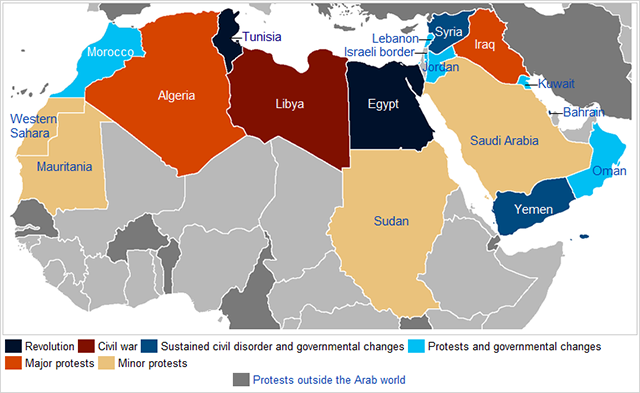
Map of the Arab Spring. Protests, and in some cases full scale revolutions, have reached across the entire Arab
World. Map is from this Wikipedia page (public domain; original graphic).

All the while, the rebels were hitting targets closer and closer to the capital city of Damascus, until finally in January they successfully seized the nearby city of Zabadani. Fighting around the capital escalated quickly, with the FSA spreading its control across most of the suburbs of Damascus by January 27. Over the next few days, Assad’s government launched a largely successful offensive to take back the areas surrounding the capital, though the rebels still claim control of Douma, Damascus’s most populous suburb. The cities of Homs and Idlib are also reported to be largely under FSA control, along with much of rural Idlib province. And the territorial division in Syria may be even more extensive than we know – journalists have been forbidden to enter the country, making it difficult to follow developments on the ground.

Wikipedia: 2011–2012 Syrian uprising

The Arab League, with Syria in lighter green at top right.
Map by Danalm000, from Wikimedia (license: CC BY-SA)

Arab League Involvement
The League of Arab States (better known as the Arab League), an international organization of which Syria is a founding member, has taken a close interest in the events unfolding within the country. In November, the body voted to suspend Syria’s membership unless President Assad brought an end to the violence against civilian protesters. Assad failed to follow through with any concrete action, and the country was suspended from the League. In January, the organization sent a delegation of observers into Syria to examine the situation; they were allowed inside the country, but eventually were forced to leave due to escalating violence between government forces and the FSA. As the region’s main representative body, the Arab League will likely be a major player in any future decisions by the international community to intervene in Syria’s civil war.

Wikipedia: League of Arab States

News Bits: October 2011

“News Bits” posts cover minor political geography events from the last few months. Although the news may be of great political relevance, these events haven’t (yet) affected major changes to the shapes, sovereignty, or political status of the world’s countries.

Yemen: Militias Take Territory From Islamists

Territory and areas of influence for rebels (blue) and Islamic
extremists (red) in Yemen. Map is my own work, starting
from this map by German Wikipedia user NordNordWest
(license: CC BY-SA). (Corrected November 20, 2011)

In Yemen’s ongoing political crisis (See: Yemen Fragments Under Uprising), some territory previously held by Islamist militants has fallen under the control of unsympathetic non-government forces, whose presence around the country seems to be expanding. The Islamists, who call themselves Ansar al-Sharia (“Partisans of Islamic Law”), have occupied the cities of Jaar, Zinjibar, and Shuqra in Abyan province for several months now, along with various smaller towns both in Abyan and in heighboring Shabwah. However, since July, many of the smaller towns have fallen into the hands of local militias, and the Yemeni government has gained ground in the Zinjibar area. Though the local militias are currently working alongside the government, it is unclear whether it may be only a temporary truce. Yemen’s opposition forces are composed of a mixture of local and kinship-based militias, army defectors, and pre-existing rebel groups, which sometimes work together but are increasingly clashing among themselves. The country’s third largest city, Taiz, is largely under the control of opposition forces, as are some parts of the capital, Sana’a. (More Yemen news on Political Geography Now)

Sudan No Longer Africa’s Largest Country
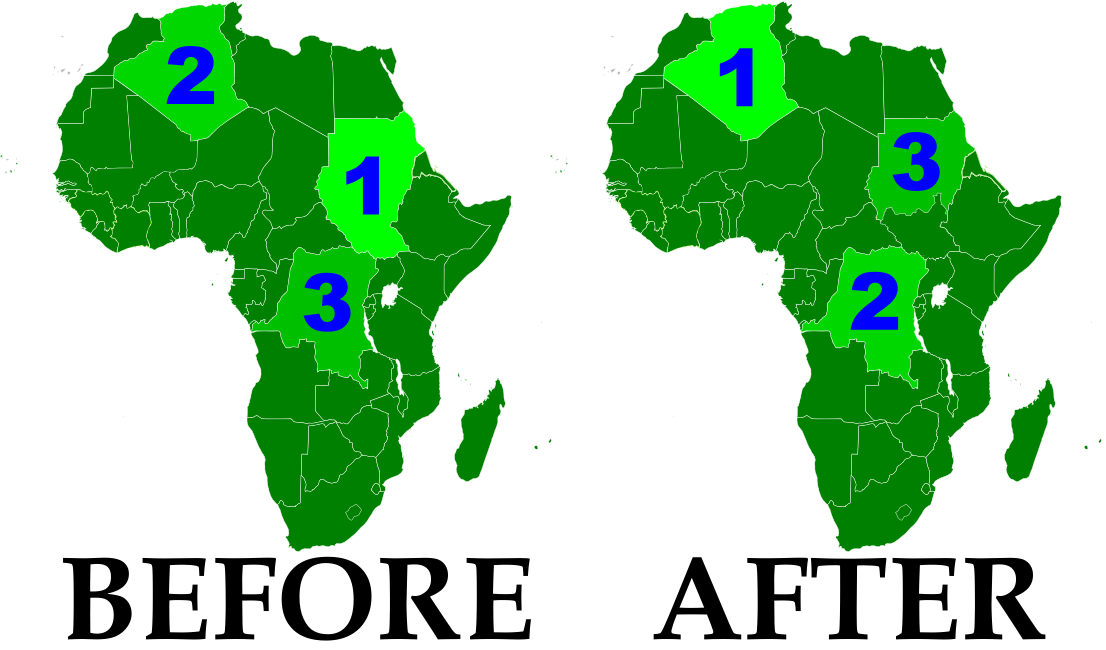
Now that the South Sudan has gained independence (See: New Country – South Sudan), the remainder of Sudan is no longer Africa’s largest country by area. Sudan’s one-time top spot was  followed by Algeria in second place and the Democratic Republic of the Congo in third. However, the secession of South Sudan  removed a substantial portion of Sudan’s territory, and the northern remainder of the country now ranks third in Africa – after Algeria and the DRC. South Sudan ranks 19th, out of a total of 54 U.N.-recognized countries in Africa. (Graphic my own work, based on this map by Wikipedia user Mangwanani. License: CC BY-SA)

Map showing most of the Cooch Behar
enclaves. By Dutch Wikipedia user
Jeroen (source). License: CC BY-SA

Wikipedia: List of African Countries and Territories

Indo-Bangladesh Treaty Defines Border, Trades Enclaves
A treaty signed last month between the governments of India and Bangladesh fully defines the border between the two countries, and provides for the trade of dozens of enclaves. The Indo-Bangladesh enclaves, also known as “chitmahals” or the “Cooch Behar enclaves” (after the district of India which most of them either belong to or are located inside), number well over 100, including patches of Indian territory within Bangladesh and patches of Bengladeshi territory within India. Their inhabitants have long suffered under abominable living conditions due to the fact that they have access neither to services from their own country (because of their isolation) nor to services from the country surrounding them (because they are not considered part of its territory). Under the new agreement, based on a 1974 deal that was never adopted, nearly all of the enclaves will be ceded to whichever country surrounds them, and inhabitants will have a choice of citizenship. The two parties also defined the border in several previously disputed or undemarcated areas. The treaty will not go into effect until it is ratified by both countries’ legislatures.

Location of Rastan within Syria. Based on this
map
by German Wikipedia user NordNordWest.
License: CC BY-SA

Syrian City Falls Briefly to Rebels
In Syria’s ongoing uprising, the city of Rastan fell under control of protester-friendly rebel forces for a few weeks last month, before ultimately being retaken by government troops. The crisis in Syria, seen as part of the so-called “Arab Spring” movement for democratic change in the Middle East, began with protests last January. By march it had escalated to widespread displays of defiance in the streets, to which the government responded by sending in tanks and soldiers. However, the resistance was mostly unarmed until army defectors began organizing against the military in September. The city of Rastan, one of several major protest centers, was taken over by anti-government forces, which were not driven out until October 1. So far there have been no more reports of Syrian cities falling under armed anti-government control, but protests and violent government crackdowns continue in full gear.

States Recognize Palestine Ahead of U.N. Bid

Country Name: Palestine (English), Filastin (Arabic)
Official Name: State of Palestine (English), Dawlat Filastin (Arabic)
News Category: Partially Recognized States, Diplomatic Recognition
Summary: The Palestinian Liberation Organization, which claims sovereignty over the disputed territories of the West Bank and Gaza Strip as the State of Palestine, will apply for U.N. membership this week. Meanwhile, the total number of countries recognizing Palestinian independence has grown sharply in the lead-up to the U.N. bid.

The Palestinian Territories. Area A: Full Palestinian Control
(on the ground); Area B: Joint Palestinian-Israeli Control;
Area C: Full Israeli Control. Israeli government considers
the green areas “disputed territory”. Map is my own work.
Sources: Natural Earth, B’Tselem, U.N. OCHA oPt, others.

Full Story
Palestine is a unique case within the nation-state system. It is recognized as an independent state by more than half of the world’s countries, but not by the U.N. itself or by any major Western powers. It indirectly administers much of its claimed territories, yet exercises full sovereign control over none of them. At the heart of one of the world’s most intractable conflicts, it is perhaps the most controversial topic in international politics. The coming weeks could see significant changes to the political status of the Palestinian Territories on the world stage.


The Palestinian Territories are made up of the West Bank and the Gaza Strip, two regions previously controlled by Jordan and Egypt respectively, which were captured by Israel in the Six Day War of 1967. Israel has never fully relinquished control, and Egypt and Jordan eventually gave up their claims to the regions, leaving them in an unusual political situation. Despite widespread calls for independence based on a 1947 U.N. partition plan, Israel refuses to refer to them as anything other than “disputed territories” until negotiations determine their final status. Some of the land within the territories is now administered by the Palestinians, though much of it is still ruled by the Israeli military, which also controls all associated airspace and territorial waters.

Wikipedia: History of the Israeli-Palestinian Conflict 

This week, Mahmoud Abbas, chairman of the Palestinian Liberation Organization (PLO), will formally request full membership for the State of Palestine in the United Nations. The PLO declared independence in 1988, and has enjoyed a degree of support from the U.N. General Assembly, but currently only holds observer status in the organization, which pointedly labels it as a “non-state entity”. Palestinian membership in the U.N. is likely to be vetoed by the U.S., which holds a permanent seat in the U.N. Security Council. However, Palestine may still achieve “state observer” status by a majority vote in the General Assembly, which would elevate it to the same level as the Holy See (Vatican City): a U.N.-recognized state with legal rights.

Countries recognizing the State of Palestine. Recent additions (in the last year) indicated in lighter color.
Modified from this map by Alinor at en.wikipedia (license: CC BY-SA).

Though 90 U.N. members recognized Palestine during the first year after its declaration, the number grew little over the next 15 years. However, since the campaign for U.N. membership began a few years ago, recognition has risen sharply. The State of Palestine is now recognized by 126 U.N. members – nearly two-thirds of the world body – 17 of which have announced their recognition just in the last year. This summer alone has seen six new additions: Syria, Liberia, El Salvador, Honduras, St. Vincent and the Grenadines, and Belize. Palestine’s independence is also endorsed by Western Sahara, a partially-recognized state without U.N. membership.

Chart over time of total U.N. members recognizing the State of Palestine. My own work (source).


Wikipedia:
State of Palestine, Palestinian Territories, International Recognition of the State of Palestine

Yemen Fragments Under Uprising

Country Name: Yemen (English), Al Yaman (Arabic)
Official Name: Republic of Yemen (English), Al Jumhūriyyah al Yamaniyyah (Arabic)
News Category: Divided Countries
Summary: After months of unrest and popular opposition to the government, much of Yemen’s territory has fallen out of government control. Several areas are occupied by Islamist militants seeking to implement Sharia Law, while others have fallen under the control of various local groups and military defectors united in their demand for the removal of president and dictator Ali Abdullah Saleh.

Rebel and Islamic extremist control in Yemen, according to news reports. Ansar al-Sharia and Al-Qaeda in the
Arabian Peninsula (AQAP) are two related Islamic extremist groups. Unarmed protests not shown. Map is my
own work, based on this map by Wikipedia user NordNordWest (license: CC BY-SA). (Corrected: Nov. 20, 2011)

(Note: For updates to this map, follow the Yemen label on Political Geography Now.)

Full Story
When a country faces revolutionary change, the power of the people to oppose their government can result in a loss of control by the state, as opposition groups seize territory bit by bit. Despite the country maintaining international recognition as a single “nation-state”, the territory claimed by the state may become divided. While in many cases this means one large rebel group taking control of a large section of the country, in other cases the territory may fragment into various scattered regions under the control of multiple groups. This is the process that has been occurring in Yemen during recent months.

Yemen is located at the tip of the Arabian Peninsula, south of Saudi Arabia. A republic made up of 20 provinces or “governorates”, it is the only country on the Arabian Peninsula with a democratic constitution; yet it also holds the unfortunate distinction of having the lowest standard of living of any country in the Arab world. Like many other allegedly democratic countries, Yemen has remained under the tight control of a single “president”, Ali Abdullah Saleh, for more than 30 years. The current unrest began in January of this year, as part of the “Arab Spring” movement that has seen protests across the Arab world and beyond, and which early on resulted in the overthrow of governments in Tunisia and Egypt. After months of protests, crackdowns, and stalled negotiations in Yemen, an armed uprising erupted in late May.

Armed opposition to President Saleh’s government has been undertaken by two largely separate groups. The first group is a loose coalition of “tribes” (social groups held together by family relations) and military defectors who support the peaceful protesters’ goal of ousting the president. The second group is a coalition of Islamist militants calling themselves Ansar al-Sharia (“Supporters of Islamic Law”), whose objective is to create an Islamic state in Yemen. The secular opposition groups are most active in Yemen’s populated western region, while Islamist activity is centered along the southern coast and in the sparsely populated regions of the east.

The series of 2011 protests and revolutions in the Arab world is sometimes called the “Arab Spring”. Yemen is
located at the lower right. Map is from this Wikipedia page (public domain; original graphic).

(More Yemen news from Political Geography Now)

News Bits: June 2011

“News Bits” posts cover minor political geography events from the previous month. Although the news may be of great political relevance, these events haven’t (yet) affected major changes to the shapes, sovereignty, or international positions of the world’s countries.

Abyei’s location within Sudan
(yellow). The south (blue) gains
independence this July. Based
on this map (license: CC BY-SA).

Sudan Government Forces Overrun Disputed Abyei
The Abyei Area, subject of a territorial dispute between the central Government of Sudan and the autonomous Southern Sudan region, has been invaded by Sudanese government forces. Southern troops, who had shared joint control of the area with the central government, have been driven out, along with many of the area’s inhabitants. Southern Sudan is set to become an independent country this July, based on the 2005 peace agreement that ended Sudan’s second civil war. A referendum was planned for Abyei residents to choose whether they would stay in Sudan or join the new Republic of South Sudan, but it was never held due to disagreements about who was eligible to vote. The Sudan government in Khartoum has asserted that it will not give up Abyei, and southern president Salva Kiir has promised not to go to war again over the territory.

Israel with occupied territories (green).
The PLO claims both the West Bank
and Gaza Strip, but they are currently
ruled by rival factions (map source).

West Bank & Gaza Strip to be Reunited
Rival Palestinian political parties Fatah and Hamas have agreed to form a new unity government in the coming months, which will effectively reunite their respective territories in the West Bank and Gaza Strip. Both groups claimed control of the Palestinian Authority (PA) government after a brief civil war following the 2006 elections, in which Hamas won a majority of seats in the previously Fatah-dominated Palestinian Legislative Council. The armed clash left Hamas in control of the Gaza Strip, while Fatah retained its authority in the Palestinian-controlled areas of the West Bank. Known to the U.N. as the Occupied Palestinian Territories, the West Bank and Gaza Strip are claimed as the State of Palestine by the Palestinian Liberation Organization (PLO), parent organization of the PA. Over half of the U.N.’s member countries have recognized the state’s independence, but the U.N. itself has not. Furthermore, the territories remain under military occupation by Israel, which controls much of the West Bank as well as all air space and territorial waters in the region.

Peruvian and Ecuadorian waters, with the newly agreed
upon boundary marked in yellow. My own work, based
on data sources listed on map (terms of use).

Ecuador & Peru Define Sea Border
The neighboring South American countries of Ecuador and Peru have formally agreed on a boundary between their respective territorial waters in the Pacific Ocean. Although the location of the border was never actively in dispute, its acceptance had been called into question by Peru’s ongoing territorial dispute with Chile, in which Peru claims a 1952 agreement between the three countries did not technically establish the location of their maritime borders. The new agreement is widely seen as a move by Peru to gain Ecuador’s support as the case of the Peru-Chile conflict heads to the International Court of Justice. The agreed upon boundary is located along the parallel of 3° 23′ 33.96″ S, originating at the point where the countries’ land border reaches the ocean.

Libya as of June 1, 2011. Cities controlled by Gaddafi
government in green, rebel-held cities in black, and
areas of ongoing fighting in blue. Public domain map
from Wikipedia (source).

Libyan Rebels Gain Further Recognition
Libya’s rebel National Transitional Council (NTC) over the last month gained diplomatic recognition from five more national governments, bringing to 11 the list of countries recognizing its legitimacy. The NTC forms the political leadership of the rebel forces fighting for control of the North African country against dictator Muammar Gaddafi, in a civil war provoked by Gaddafi’s violent crackdown on popular protests last February. Although Libya’s independence is already recognized by the U.N. and all of it’s members, countries have begun to make the special diplomatic gesture of switching their recognition from Gaddafi’s government to the NTC. Recent additions to the list are Jordan, Russia, and Malta; two other countries, Senegal and Turkey, have acknowledged the NTC’s status as a legitimate opposition group, while still maintaining ties with Gaddafi. Six other countries, starting with France in early March, had all previously recognized the NTC as Libya’s sole representative, some of them expelling Gaddafi’s diplomats and sending ambassadors to the rebel command center in Benghazi. As Gaddafi’s forces continue to face NATO bombing attacks, the war has ground to a near-stalemate, with Gaddafi controlling the capital city of Tripoli and several smaller western cities, while the rebels control the eastern half of the country and some areas of the west.

Venezuela Leaves Andean Community

Country Name: Venezuela (English, Spanish)
Official Name: Bolivarian Republic of Venezuela (English), República Bolivariana de Venezuela (Spanish)
News Category: Intergovernmental Organization Membership
Summary: Venezuela has withdrawn from the Andean Community (CAN) customs union, in favor of joining Mercosur, another union in South America. The switch has been represented as a protest against free trade agreements made with the United States on the part of CAN members Peru and Colombia. Admission into Mercosur is still pending, though Venezuela remains a member of the Union of South American Nations (UNASUR).

Venezuela (red) has left CAN (orange) in anticipation of joining
Mercosur (green). Other UNASUR members are in blue. Map
includes all claimed territories of the member states. My own
work, based on this map by Wikimedia user Luan (terms of use).

Full Story
Although nation-states are usually considered the basic units of the modern political globe, it has become common in recent decades for countries to work together towards integration at a higher level. The most well known case, and probably the furthest advanced, is the European Union. However, there are a number of other intergovernmental organizations working for integration in other parts of the world. In South America, supranational integration has progressed largely through two major trade blocs: the Southern Common Market (known by its Spanish or Portuguese abbreviations, “Mercosur” or “Mercosul”) and the Andean Community (known by the Spanish abbreviation, CAN).

The Andean Community represents a group of countries in the northwestern part South America, while Mercosur is centered around the southeastern region of the continent. The country of Venezuela, located in the north of the continent at the meeting place of the two blocs, has long been a member of the Andean Community. However, in 2006 the Venezuelan government announced the intention to switch its membership to Mercosur. Citing free trade agreements made between the United States and CAN members Peru and Colombia, Venezuelan president Hugo Chávez announced that he believed CAN was no longer relevant. After five years, Venezuela fully withdrew this month from the Andean Community. Admission to Mercosur is still pending, though it seems likely in the near future.

CAN and Mercosur have both implemented trade agreements forming customs unions between their members – that is, they have mostly eliminated tariffs between member countries, and have also unified their external customs regulations to be consistent among the whole bloc. They have also proceeded with other cooperative programs, such as coordinating economic policies and setting up courts with international jurisdiction. Over the last decade, they have been working towards integrating with each other to form the Union of South American Nations (USAN or UNASUR/UNASUL), an organization modeled after the European Union. In fact, UNASUR includes all of South America’s sovereign states, independently of their membership in CAN or Mercosur, which means that Venezuela will remain a member of UNASUR during its transition period. Venezuela’s bid to join Mercosur had originally been seen as a gesture towards integration between Mercosur and CAN, though that is clearly not the case now that the country has withdrawn from CAN.

Wikipedia:
Venezuela
Andean Community (CAN)
Southern Common Market (Mercosur)
Union of South American Nations (UNASUR)