
Last month, rebels in the Central African Republic launched a sudden military campaign against the government, rapidly taking over city after city in their advance towards the capital. Fighting has now come to a temporary halt, with much of the country under rebel control. Read on for a summary of the conflict so far.
 |
Updated Map: Central African Republic – Map of Rebel Control (March 2013)
Rebellion in the Central African Republic
In 2007, a three-year civil war came to an end in the Central African Republic (CAR) when the government reached a peace agreement with several rebel groups. Yet six years later, some of the rebels feel that the government has still not honored its side of that agreement, and last month violence broke out once again.
The new fighting was initiated by a coalition of rebel groups calling itself “Séléka”, which means “alliance” in Sango, the national language of the CAR. The rebels have threatened to depose President François Bozizé, who took power in a 2003 coup but has since won two controversial elections.
More Background: BBC News Q&A – Central African Republic’s rebellion
Rebel Advance from the North
The rebel campaign began on December 10, when they took over N’Délé, a regional capital in the country’s north, which had been under the control of a government-allied former rebel group. At the same time, the new rebel coalition captured two other northern towns, Ouadda and Sam Ouandja. A week later, they stormed into Bria, a diamond-mining town and regional capital in the country’s east. By this time, their forces in N’Délé had also advanced south to capture the town of Bamingui.
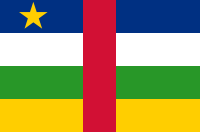 Country Name: Country Name: • Central African Republic (English) • Centrafrique (French) • Bêafrîka (Sango) Official Name: • Central African Republic (English) • République centrafricaine (French) •Ködörösêse tî Bêafrîka (Sango) Capital: Bangui |
Despite the Central African government receiving reinforcements from its ally and neighbor Chad, the Séléka rebels continued on the road to Bangui, taking the towns of Kabo and Batangafo in the next two days after the Bria attack (despite some sources indicating towns being retaken, government forces no longer seem to be in control of these places; however, rebel forces may not maintain a strong presence either).
In the following days, Séléka’s forces moved west from Bria, seizing the town of Ippy on the way to Bambari. The latter city, among the country’s largest, fell to the rebels on December 23. Central African government forces subsequently attempted to retake Bambari, but were held them back. Two days later, Séléka forces in the north captured another regional capital, Kaga-Bandoro, after only brief resistance.
The seizure of Bambari and Kaga-Bandoro paved the way for Séléka to advance on Sibut, the last regional capital on the road to Bangui. It was soon reported that the rebels had bypassed Sibut to avoid Chadian forces stationed there, and had instead proceeded to the next major town, Damara. However, a few days later rebel forces seized Sibut, and it became apparent that Damara was in fact still government-held, with Central African and Chadian troops having pulled back to there from Sibut.
Standoff and Ceasefire in the South
The rebels are now using Sibut as their forward base, while forces from neighboring countries are amassing in Damara as a firewall against any invasion of the national capital, Bangui. A contingent has also arrived from more distant South Africa. Aside from the rebel capture of Alindao (and possibly one other small town) near Bambari, fighting has come to a standstill since the end of December.
A temporary ceasefire was finally reached on Thursday between the Central African Republic government and Séléka, with word of a possible unity government in the near future if talks proceed smoothly. Political Geography Now will be watching the situation closely, and reporting promptly on any new territorial developments.
Graphic of the flag of the Central African Republic is in the public domain (source).
Are there any information which foreign country supports the rebels?
Regards
I haven't heard any accusations of state actors supporting the rebels so far, though the CAR government has attempted to link them to other rebel groups in Chad and Sudan (http://n24.cm/SoIANd).
Love the site — can you do any maps on Mali??? it seems like the whole place is blowing up with a little al qaeda empire. love to see some maps of N mali!
Thanks! In fact, we do have a series of maps of the conflict in Northern Mali:
http://www.polgeonow.com/search/label/mali
And there will be a new updated map coming this week!
-Evan
I suggest you review the locations of Carnot and Berberati, where I worked for two years, a while back. You will find that they are not where your maps show them to be.
Sincerely, James
Wow, you're right – they seem to have switched places! I'll fix it. Thanks!
Done!
I've also corrected it in the two follow-ups to this map:
Central African Republic Rebels Join Government
Central African Republic: Map of Rebel Advance to Capital